Skip Content
You are currently on the new version of our website. Access the old version .

Metrology

Metrology is an international, peer-reviewed, open access journal on the science and technology of measurement and metrology, published quarterly online by MDPI.

All Articles (196)

Ethanol Concentration Sensing Using a 3D-Printed Microwave Cavity Resonator

  • Thet Pai Oo,
  • Thipamas Phakaew and
  • Suramate Chalermwisutkul
  • + 4 authors

This work presents microwave sensing of ethanol concentration in ethanol–water mixtures using a low-cost 3D-printed cavity resonator. The objective is to realize a customizable liquid sensor that combines high measurement accuracy with inexpensive, in-house fabrication. The cylindrical cavity is fabricated from polylactic acid using fused deposition modeling and metallized on its inner surface with copper tape. The resonator operates in the TM010 mode with a resonant frequency of 3 GHz. A standard 1.5 mL centrifuge tube is used as a modular sample holder and inserted through a circular opening in the top endcap of the cavity. The quality factor of the air-filled cavity is 200, which decreases to 37.3 when the cavity is loaded with deionized water. As an application example, ethanol concentrations in ethanol–water mixtures are determined using both the resonant frequency and the peak magnitude of the transmission coefficient (|S21|). For ethanol concentrations between 20% and 100%, the concentration can be accurately extracted from the resonant frequency alone: a quartic calibration curve yields a coefficient of determination R2=0.9992, an average sensitivity of approximately 8.4 MHz/% ethanol, and a mean absolute error of about 0.58% on the calibration set. In addition, a cubic calibration based on the peak S21 over the 0–90% concentration range achieves a mean absolute error of approximately 0.52% on the calibration set and about 0.55% on an independent validation set covering 5–85% ethanol. Comparison with conventionally machined metal cavities shows that the proposed 3D-printed cavity achieves a high Q-factor at significantly lower cost and can be fabricated in-house using a standard 3D printer. These results demonstrate metrologically relevant performance in terms of low error and high sensitivity using a low-cost and easily replicable platform for microwave liquid sensing in biomedical and chemical engineering applications.

6 February 2026
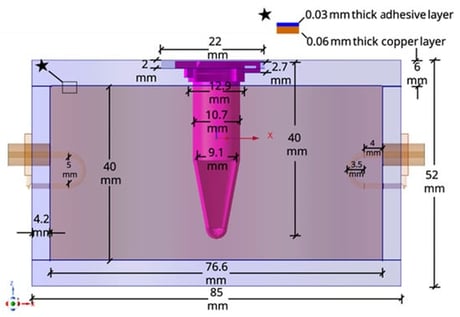
Cross-sectional view of the proposed cylindrical cavity resonator with dimensions. The star indicates the close-up detail of the copper tape used to metallize the interior surface of the cavity.

Accurate and efficient frequency estimation is essential in many scientific fields and has led to the development of various algorithms. Commonly used methods involve applying the Discrete Fourier Transform followed by spectral interpolation. This approach faces challenges especially under low signal-to-noise ratio conditions. To mitigate this limitation, the Generalized Fractional Interpolated Discrete Fourier Transform for frequency estimation of rectangular-windowed sinewaves is proposed. This non-iterative algorithm enhances frequency estimation by employing spectral components at fractional steps of the Discrete Fourier Transform frequency resolution. A non-iterative, closed-form equation for frequency estimation is derived, enabling efficient computation. The proposed algorithm is evaluated through numerical simulations and compared with existing interpolation methods for different frequencies, signal-to-noise ratios, and number of acquired samples. The method is validated using experimentally acquired sinewave signals.

2 February 2026

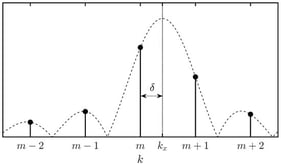
Generic theoretical spectrum of a sinewave with spectral leakage (dashed black line). The dotted vertical line marks the waveform normalized frequency index 
  
    k
    x
  
. The vertical solid lines are DFT components 
  
    (
    m
    ∈
    N
    )
  
 near 
  
    k
    x
  
. 
  δ
 is the sinewave normalized frequency offset which interpolation algorithms aim to estimate.

Limitations associated with traditional automation approaches within manufacturing have driven the pursuit of more flexible and intelligent robot guidance methods. One promising development in this area is the integration of external multitarget six degrees of freedom (6 DoF) distributed large-volume metrology (DLVM) into the control loop. Although multiple standards exist across dimensional metrology, motion tracking, indoor positioning, robot guidance, and machine tool accuracy, there is no harmonised, technology-agnostic standard that fully encompasses the unique challenges of 6 DoF DLVM systems for dynamic applications. This work identifies key gaps in the current standards’ landscape and presents a technology-agnostic candidate test methodology intended to support future standardisation of dynamic DLVM performance evaluation. The method provides a metrologically grounded spatial reference path and a temporal alignment strategy so that position and orientation errors can be reported in the intrinsic coordinates of the path. The paper covers the basic principle of the test, artefact construction, synchronisation strategies, preliminary error modelling, and a baseline uncertainty approach, and reports representative results from initial prototype trials on a multi-nodal distance-camera DLVM system. The prototype results demonstrate feasibility and highlight temporal sampling and traceable timing as current limiting factors for fully deconvolving latency and pose error; these aspects are therefore positioned as instrumentation requirements and the focus of ongoing work.

30 January 2026

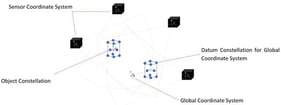
Diagrammatic representation of a distributed, multitarget, six degrees of freedom (6 DOF) large-volume metrology (DLVM) system. Black boxes represent imaging nodes with respective field-of-view represented by dotted lines. Two constellations are shown with the global coordinate system defined offset to the datum constellation.

Anthropogenic CO2 emissions drive ocean acidification through changes in the carbonate system, lowering seawater pH. In contrast, salinity variations arise from physical processes such as freshwater fluxes and circulation. This study reports the preparation and Harned cell characterization of three equimolal TRIS buffer solutions (0.01 mol·kg−1, 0.025 mol·kg−1, and 0.04 mol·kg−1) in artificial seawater (ASW) matrices with practical salinities of 35 and 50 and temperatures of 20 °C, 25 °C, and 30 °C. Determined pHT values achieved expanded uncertainties (UpHT ≤ 0.006), meeting Global Ocean Acidification Observing Network (GOA-ON) “climate” quality standards. Absolute salinity (SA) was concurrently measured via density (TEOS-10), revealing systematic deviations from practical salinity due to TRIS content. A nonlinear regression model was developed to predict pHT as a function of salinity, temperature, and TRIS molality, with r2 = 0.99998. These results provide a robust dataset for developing Certified Reference Materials (CRMs) for pHT calibration under climate-relevant high-salinity environments at different temperature conditions, offering a practical tool for high-accuracy calibration in variable marine conditions.

29 January 2026

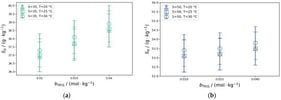
Panels (a,b) show the SA values obtained from density measurements for equimolal TRIS buffers at molalities of 0.01 mol·kg−1, 0.025 mol·kg−1, and 0.04 mol·kg−1 at temperatures of 20 °C, 25 °C, and 30 °C. Panel (a) corresponds to S = 35, while panel (b) presents the results for S = 50. The vertical bars represent the expanded uncertainties U (k = 2) for the SA investigated at each molality and temperature.

News & Conferences

Issues

Open for Submission

Editor's Choice

Get Alerted

Add your email address to receive forthcoming issues of this journal.

XFacebookLinkedIn
Metrology - ISSN 2673-8244