
Article

Metrological Assessment of pHT in TRIS Buffers Within Artificial Seawater: Implications for High-Salinity Reference Materials

1
Departamento de Metrologia, Instituto Português da Qualidade, R. António Gião, 2, 2829-513 Caparica, Portugal
2
Chemistry Department, NOVA School of Science and Technology|NOVA FCT, NOVA University of Lisbon, Campus Caparica, 2829-516 Caparica, Portugal
3
LAQV REQUIMTE, Associated Laboratory for Green Chemistry, Chemistry Department, NOVA School of Science and Technology|NOVA FCT, NOVA University of Lisbon, Lisbon Campus, 2819-516 Caparica, Portugal
4
MEtRICs/CubicB, Chemistry Department, NOVA School of Science and Technology|NOVA FCT, NOVA University of Lisbon, Campus Caparica, 2829-516 Caparica, Portugal
5
Instituto Hidrográfico, Rua das Trinas, 49, 1249-093 Lisboa, Portugal
*
Author to whom correspondence should be addressed.
Metrology 2026, 6(1), 6; https://doi.org/10.3390/metrology6010006
Submission received: 31 July 2025 / Revised: 4 December 2025 / Accepted: 12 January 2026 / Published: 29 January 2026

Abstract

Anthropogenic CO2 emissions drive ocean acidification through changes in the carbonate system, lowering seawater pH. In contrast, salinity variations arise from physical processes such as freshwater fluxes and circulation. This study reports the preparation and Harned cell characterization of three equimolal TRIS buffer solutions (0.01 mol·kg−1, 0.025 mol·kg−1, and 0.04 mol·kg−1) in artificial seawater (ASW) matrices with practical salinities of 35 and 50 and temperatures of 20 °C, 25 °C, and 30 °C. Determined pHT values achieved expanded uncertainties ( U p H T ≤ 0.006), meeting Global Ocean Acidification Observing Network (GOA-ON) “climate” quality standards. Absolute salinity (SA) was concurrently measured via density (TEOS-10), revealing systematic deviations from practical salinity due to TRIS content. A nonlinear regression model was developed to predict pHT as a function of salinity, temperature, and TRIS molality, with r2 = 0.99998. These results provide a robust dataset for developing Certified Reference Materials (CRMs) for pHT calibration under climate-relevant high-salinity environments at different temperature conditions, offering a practical tool for high-accuracy calibration in variable marine conditions.

1. Introduction

Since the industrial revolution, anthropogenic CO2 emissions have significantly altered ocean carbonate chemistry, leading to increased acidification and measurable changes in seawater pH. In parallel, temperature and salinity variability are primarily governed by physical processes such as freshwater fluxes, evaporation, and ocean circulation. Monitoring these changes requires highly accurate and traceable measurements, especially for seawater pH, which is a critical indicator in global ocean acidification networks and climate models. However, accurate pH measurement in saline matrices presents substantial metrological challenges, primarily due to the influence of high ionic strength (I), liquid junction potentials, and the inadequacy of conventional buffer-based calibrations. These issues are particularly pronounced in environments subject to high evaporation rates and minimal freshwater input from fluvial or atmospheric sources [1,2,3,4,5,6,7].
pH is the key quantity to measure the acidity of any medium. According to the IUPAC 2002 definition [8], pH is linked with the molal activity of the hydrogen ion, aH, in the following way:
p H = lg a H = l g b H γ H / b 0 ,
In Equation (1), bH and γH are respectively the molality in mol·kg−1 and the molal activity coefficient of the hydrogen ion (H+), and b0 is the standard molality equal to 1 mol·kg−1.
pH is experimentally determined with the primary potentiometric method, namely the Harned cell. This pH scale is known as the IUPAC pH scale or activity pH scale, tra ceable to the International System of Units (SI) with validity until ionic strength (I) up to 0.1 mol·kg−1. Seawater with a practical salinity (S) around 35 is a complex aqueous medium where the presence of salts as NaCl, Na2SO4, KCl, CaCl2, MgCl2, among others, makes its I higher than 0.7 mol·kg−1 [9].
In oceanographic studies, several pH concentration scales are used in place of the activity-based pH scale, with the total pH scale (pHT) being the most widely adopted due to its accuracy and ease of use. This scale considers the concentration of the free hydrogen ion [H+] and the [H+] linked to the sulphate ion [HSO42] in the following way:
p H T = l g H + + H S O 4 b 0 .
According to Nemzer and Dickson (2005), this scale was first proposed in the works of Ramette et al. (1970) and Hansson (1973) [10,11,12]. The works of Dickson (1990) and DelValls and Dickson (1998) strongly contributed to the standardization of this scale by developing primary reference buffers (the so-called TRIS buffers) for the accurate measurement and calibration of pH equipment, ensuring that pH measurements made in different laboratories were consistent, accurate, and metrologically comparable [13,14].
Indeed, TRIS buffers are considered the highest-level standards for use in oceanic pH measurements and are based on the strong base Tris(hydroxymethyl)aminomethane and the conjugate acid (TRIS.HCl) in an artificial seawater matrix (ASW) adjusted to achieve the desired pH of seawater (between 7.9 and 8.1). The ASW medium is a solution that mimics the composition of standard seawater, containing all the major salts except bromides, which can make the response of the Ag/AgCl electrodes used in the Harned cell unstable, and fluoride, which is present in vestigial concentration and is not incorporated [13,15,16]. Other cations, such as strontium (Sr2+), are replaced by calcium (Ca2+) for convenience and simplicity of the formulation [11].
The preparation of these solutions is extensively described elsewhere [10,11,12,13,14,17,18,19,20], along with the 2008 recommendations of the International Association for the Physical Sciences of the Oceans (IAPSO).
The pH of reference buffer solutions is assigned by the Harned cell in the following configuration [13,14,18,19,20,21,22,23]:
P t H 2 g , 1   a t m A S W   w i t h   H A   a n d   H B A g C l A g ,
where HA and HB are respectively the acidic and basic forms of the added buffer solution. In cell A, the measured potential, E, in volts (V), is related to the operational/molal pH, pHb, through the Nernst equation according to:
p H b = E E 0   F R T   l n ( 10 ) + l g b C l b 0 ,
where E is the difference in the potential measured between the Pt/H2 and Ag/AgCl electrodes immersed in the TRIS buffer solution; E0* (in V) is the standard potential of Ag/AgCl electrodes in the unbuffered ASW with HCl; bCl (in mol·kg−1) is the total molality of the chloride ions present in the buffer solution; T, R, and F are respectively the absolute temperature (in K), the gas molar constant exactly equal to 8.314462618 J K−1 mol−1, and the Faraday constant exactly equal to 96,485.33212 C mol−1.
The pHb in Equation (3) is obtained by measuring the electromotive force (e.m.f.) of solutions prepared in the molality base, mol·kg−1 of H2O, and is converted to pHT of seawater, as defined by DelValls and Dickson (1998), based on the amount content (mol·kg−1 of solution). While Pratt (2014) [20] and Capitaine et al. (2023) [21] used the water mass fraction (ωH2O) to convert pHb to pHT in their work, the present study uses the salinity dependent correction to ensure direct comparability with the historical reference data [14,17,24], all of which employed the same conversion methodology. This is performed by relating S in the following way:
p H T = p H b l g 1 0.00106   S .
The standard potential of Ag/AgCl electrodes in ASW solutions, as a function of increasing HCl molality, assuming S and I are equivalent to those in TRIS buffer solutions, is determined as follows:
E 0 = lim b HCl 0 E .
In Equation (5), E0* (in V) is the E′ value at zero HCl molality, bHCl, of a second-order polynomial of E′ in terms of bHCl. This polynomial expression of E′ is determined using the statistical least squares method [20,23]:
E = E A S W , H C l + R T l n 10 F l g b H C l   b C l ,
where EASW,HCl, corrected for the hydrogen partial pressure of 101.325 kPa, is the potential difference between the electrodes immersed in ASW with HCl added at increasing molalities, bHCl is the molality of the HCl added in mol·kg−1, and bCl− is the molality of the chloride ions in mol·kg−1. E is determined with the Harned cell in the following configuration:
P t H 2 g , 1   a t m A S W   w i t h   H C l   a d d e d A g C l A g
This work presents an advancement in the metrological characterization of TRIS buffer solutions in ASW at S = 50 and temperatures extending up to 30 °C. Existing datasets [14,17,21] have predominantly focused on lower salinities (S ≤ 40) and on temperatures ranging from the freezing point of water to 25 °C [24], highlighting the need for expanded characterization under more extreme conditions. In this context, two target salinities were chosen: S = 35 and S = 50. The choice of S = 35 (the reference salinity established by IAPSO [25], representing typical open-ocean conditions, ensures direct comparability with extensive existing pHT literature [13,14,17,20,21,24,26,27], validation of our methodology, and continuity with GOA-ON measurement protocols, which predominantly use S = 35 reference materials. The selection of S = 50 addresses a critical gap in available data. While S up to 40 has been comprehensively characterized by DelValls and Dickson (1998) [14], Khoo et al. (1977) [22], and more recently Capitaine et al. (2025) [27], we chose to extend our measurements to S = 50 rather than replicating this well-established work. This decision maximizes the scientific contribution of our study by addressing the most significant data gap in the literature. Our regression model (Equation (11)), which incorporates and validates against existing S = 40 data, enables reliable interpolation to intermediate salinity conditions. In contrast, data at higher salinities remain scarce, with the notable exception of Papadimitriou et al. (2016) [24], who focused on hypersaline conditions at sub-zero temperatures and T = 25 °C.
Our work extends measurements to S = 50 at temperatures ranging from 20 °C to 30 °C, conditions relevant for tropical, subtropical, and hypersaline marine environments such as the Red Sea, Persian Gulf, and evaporative coastal systems. The S = 35/50 choice prioritizes filling the most critical data gap (high-salinity, elevated temperature), enabling accurate interpolation through robust regression, providing reference data for emerging oceanographic priorities (climate-impacted marginal seas), and efficient use of metrolo gical resources. This strategy enables the development of oceanographically relevant pHT reference materials supporting improved traceability in regions subject to intense evaporation and reduced freshwater input.
Additionally, the study quantifies and analyzes the deviation between SA and S due to TRIS base additions—an aspect rarely addressed in prior literature. Our findings confirm that while SA varies due to TRIS contributions, pHT remains consistent due to constant ionic strength and molal substitution protocols.
The development of a nonlinear model, based on the established models of DelValls and Dickson [14] and Papadimitriou et al. [24], incorporating salinity, temperature, and the approach of Müller et al., including buffer molality [17], further contributes to a practical tool for CRM design and pH calibration in diverse marine conditions such as high-salinity and warm-water environments.
Future studies should explore TRIS buffer behavior in natural seawater matrices and expand SA determination across broader salinity regimes.

2. Materials and Methods

2.1. Artificial Seawater Composition

In this work, the composition and preparation of ASW was performed according to the “recipe” of Pratt, 2014, with the recommendations of the IAPSO reference compositions [20,25]. The concentration of ASW solutions is usually reported in molality rather than molarity due to its invariance with respect to temperature and pressure. This choice supports the preparation of buffer solutions with stable composition and traceable concentration values under varying experimental conditions. Furthermore, all reference data used for comparison in this study are expressed in molality, including key works on TRIS buffer characterization in synthetic seawater, thereby ensuring methodological consistency and compatibility [11,13,14,17,20,21,24,26,27].
In Table 1, the molalities of each salt (for S = 35 and S = 50) were first calculated from Equation (7) with the coefficients derived from the IUPAC 2013 atomic weights [17], which relates S and I according to the following equation:
I = 19.919   S 1000 1.00192   S .
It is essential to distinguish between practical salinity S (dimensionless, PSS-78) and absolute salinity SA (in g·kg−1, TEOS-10). The S is based on electrical conductivity and defines the target ionic strength during solution preparation. In this work, solutions were formulated to achieve S = 35 and S = 50 by adjusting ionic strength according to Equation (7). The SA represents the total mass of dissolved solids per kg of solution, determined independently via density measurements (Section 2.3, Table 2) using TEOS-10 algorithms [28].
For the preparation of solutions with S > 35, each salt’s molality was determined according to the following equation:
b S = b 35 · I S I 35 ,
where bS is the molality at S > 35, b35 is the molality at S = 35, IS and I35 are the ionic strengths at S > 35 and S = 35, respectively.
The concentration of each salt, in mol·kg−1, in both solutions of S = 35 and S = 50 was determined by the following expression [23]:
b i = ν i 1 ν i · M i 1000 l ν j · M j 1000 ,
where bi is the molality of NaCl, in mol·kg−1, νi is the amount content of NaCl in mol·kg−1, Mi is the NaCl molar mass in g·mol−1, and νj and Mj are respectively the amount content and the molar masses of the remaining salts in the ASW solution.
The molalities of HCl (b1) and TRIS (b2) were independent of the chosen salinities [14,26,29]. The concentration of the solutions of HCl in ASW matrix at increasing molalities was calculated by subtracting the intended molality of HCl (b1) from the molality of NaCl (0.42753 − b1), and for the TRIS buffered solutions, b2 = 2 b1.

2.2. Preparation of ASW/HCl and TRIS Buffer Solutions

Before conducting the measurements in a saline matrix, the standard potential, E0Ag/AgCl, in V, of Ag/AgCl electrodes was determined using a 0.01 mol·kg−1 HCl solution. This solution was accurately characterized by potentiometric titration against TRIS SRM 723e primary standard, from the National Institute of Standards and Technology (NIST), with an expanded uncertainty UHCl = 1.72 × 10⁻⁵ mol·kg−1 (k = 2).
E0Ag/ACl was measured at three temperatures, 20 °C, 25 °C, and 30 °C in a climatic chamber. These values were systematically compared with previously established reference standards, allowing for the traceability of E0* values [20].
The solutions for E0* determination were prepared with increasing molalities of HCl ranging from 0.005 mol·kg−1 to 0.05 mol·kg−1 for both S = 35 and S = 50. All preparations were conducted under environmentally controlled conditions of temperature, pressure, and relative humidity to enable buoyancy correction.
In this context, four stock solutions of the major salts constant in Table 1 were gravimetrically prepared in a Sartorius CCE2004 comparator with a resolution of 0.1 mg and diluted with Ultra-pure water (18.2 MΩ cm) provided by a MilliQ system. All the weights were corrected for air buoyancy.
The salts used in the preparation of stock solutions for measurements in the Harned cell must be of high purity or very well characterized. For this purpose, NaCl was purchased from Sigma-Aldrich (purity ≥ 99.999%), Na2SO4 and KCl, with purities of 99.999% and 99.880%, respectively, were both sent by the Physikalisch-Technische Bundesanstalt (PTB). The mass fraction of both salts was coulometrically characterized by the Slovak Metrology Institute (SMU) within the scope of the EMPIR project SapHTies. The MgCl2 and CaCl2 salts were both purchased from Merck. All the salts except MgCl2 and CaCl2, which are highly hygroscopic, were dried for 3 h at 110 °C before weighing. The MgCl2 and CaCl2 stock solutions with molalities around 1.3 mol·kg−1 and 0.4 mol·kg−1 were assayed by argentometric titration with AgNO3 itself standardized against KCl from NIST (SRM 999b) with an expanded uncertainty U = 0.5% (k = 2). The TRIS ultrapure base was from Panreac Applichem with a purity of 99.9%, and HCl with the amount content of (0.106000 ± 0.000038) mol·kg−1 was from the Danish Institute of Metrology (DFM).
The electrodes used in the Harned cell measurements were Ag/AgCl electrodes (thermal electrolytic type) and platinum hydrogen electrodes. Both types of electrodes were prepared according to the published literature [8,13,14,20,21,24].
Prior to the measurements, the climatic chamber is set to the target temperature, and the solutions are equilibrated for 30 min. Simultaneously, the water bath is adjusted to the measurement temperature. Before measurements, the cells are filled with buffer solution and equilibrated for an additional 30 min at the intended temperature in a Lauda ther mostated water bath with the temperature controlled within ±0.005 K with a platinum resistance thermometer. This 1 h equilibration protocol ensures thermal stability and minimizes temperature-dependent drift in TRIS dissociation, which is critical given the strong temperature dependence (∂pHT/∂T ≈ −0.03 K−1). Temperature was measured using a calibrated Pt100 platinum resistance thermometer with traceability to national standards (IPQ, Portugal) and ITS-90. The thermometer was calibrated within 12 months prior to measurements. The combined standard uncertainty in temperature measurement was determined according to [30] as u(T) = 0.021 K (k = 1), incorporating the following Type A and Type B uncertainty contributions: calibration uncertainty, ucal = 0.0045 K (stated in the calibration certificate), repeatability, urep = 0.00025 K (standard deviation of repeated temperature readings under stable conditions, n ≥ 150), resolution, ures = 0.0058 K (uncertainty contribution from the digital resolution of the temperature readout, estimated as Δ/(2√3) where Δ is the least significant digit), and residual systematic effects, uresid = 0.0195 K (uncertainty from the residuals of the calibration curve fit, reflecting unmodeled deviations between the thermometer response and the calibration function).
The potential measurements were obtained with a digital multimeter, Keithley 2700, and were corrected for the partial pressure of hydrogen, and the atmospheric pressure was measured using a digital barometer from Vaisala [17,20].

2.3. Absolute Salinity Determination SA

The absolute salinities, SA, in g·kg−1, of all TRIS buffer solutions, with molalities b (TRIS) = b (TRIS.HCl) = 0.01 mol·kg−1, 0.025 mol·kg−1, and 0.04 mol·kg−1, were determined from density measurements at temperatures 20 °C, 25 °C, and 30 °C using the approach described in [31,32,33].
The equipment used for the density measurements was a density meter from Anton Paar (DMA 5000) with a measuring range of 0–3000 kg·m−3, and an expanded uncertainty of 0.033 kg·m−3. SA was calculated from the measured density ρ, in kg·m−3, using the relationship SA = f(ρ, T, P) where the density–salinity conversion follows the algorithms established in the Thermodynamic Equation of Seawater 2010 (TEOS-10) [28], accounting for temperature (T) and pressure (P) effects on seawater density.
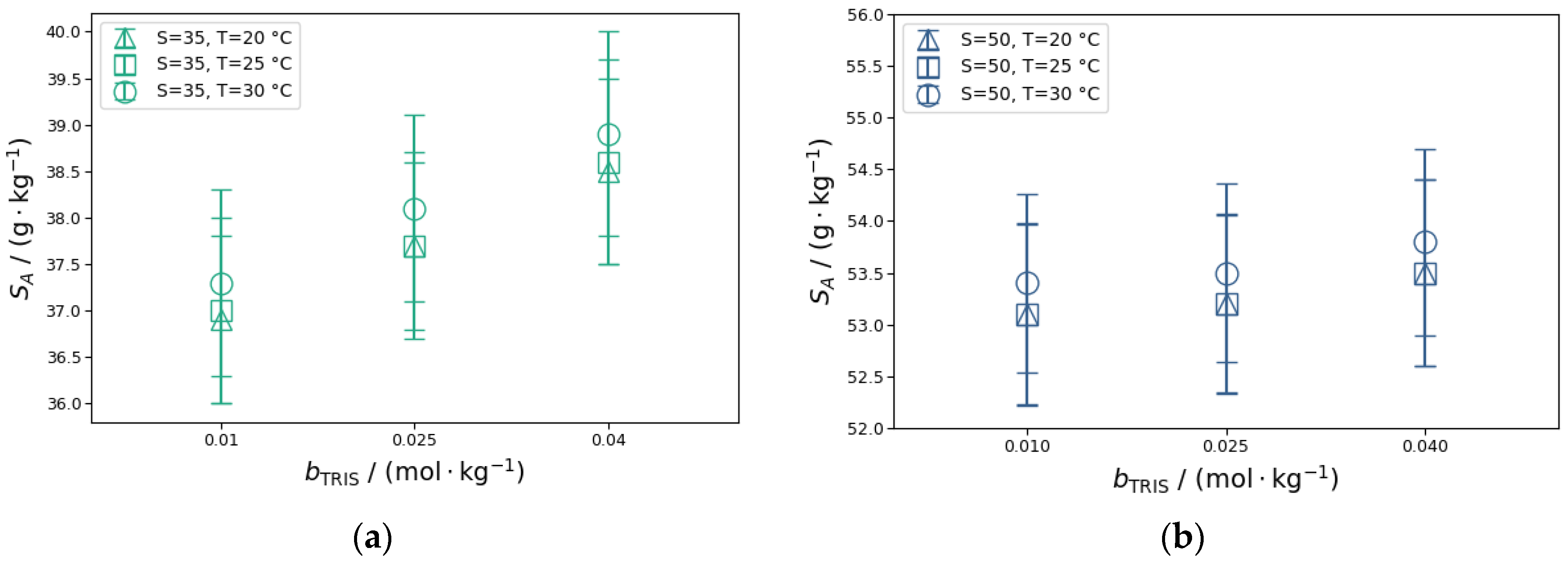
The uncertainties reported in Table 2 were obtained by standard propagation methods following [30]. The standard uncertainty in density measurements uρ = 0.017 kg·m−3 was propagated through the TEOS-10 algorithms to yield standard uncertainties uSA ranging from 0.45 to 0.55 g·kg−1, with expanded uncertainties USA = 0.9 to 1.1 g·kg−1 (k = 2), accounting for temperature and pressure covariances as per the TEOS-10 GSW toolbox documentation [28]. The variation in the USA across different TRIS molalities and temperatures reflects the non-linear sensitivity of the density–salinity relationship under these conditions. The values obtained for each combination of S, SA, b, and T are summarized in Table 2 and plotted in Figure 1.
As mentioned before, when preparing TRIS buffer solutions with increasing molalities of TRIS, HCl systematic substitutions had to be made. This was performed by replacing the amount of HCl added to the molality of NaCl, ensuring that both I and S remain constant across different TRIS molalities, allowing for direct comparison of pH measurements while maintaining identical ionic background conditions.
The results in Table 2 reveal several important trends that warrant detailed analysis: a systematic deviation from practical salinity confirmed by all measured SA values, consistently exceeding their corresponding practical salinities (S = 35 and S = 50), with deviations ranging from 1.9 g·kg−1 to 3.9 g·kg−1 for S = 35 solutions and 3.1 g·kg−1 to 3.8 g·kg−1 for S = 50 solutions. This systematic increase reflects the fundamental difference between S (deduced from conductivity measurements) and SA (total dissolved mass), particularly when components like TRIS are present. Another observation that can be made is the TRIS concentration dependence confirmed by SA increasing progressively with TRIS buffer concentration, with the magnitude of increase being salinity-dependent, at S = 35, ΔSA = 1.6 g·kg−1 (from 0.01 mol·kg−1 to 0.04 mol·kg−1 TRIS), and S = 50, ΔSA = 0.4 g·kg−1 (from 0.01 mol·kg−1 to 0.04 mol·kg−1 TRIS). A trend is observed with SA increasing with TRIS buffer concentration for both salinity levels, the effect being more pronounced at S = 35 (ΔSA ≈ 1.6 g·kg−1) compared to S = 50 (ΔSA ≈ 0.4 g·kg−1). This differential response can be attributed to the combined effects of proportional dilution, where the same absolute amount of added TRIS represents a smaller relative fraction of total dissolved solids in the higher salinity solution’s ionic activity, where at higher I (for S = 50, I ≈ 1.04 mol·kg−1 and I ≈ 0.72 mol·kg−1 for S = 35), the activity coefficients of all ionic species are reduced due to enhanced ion-ion interactions and competition for hydration sites. This results in a diminished effective contribution of the added TRIS components to solution density, and consequently to the calculated SA and non-ideal solution behavior, where the more complex ionic environment at higher salinities leads to increased ion pairing and association phenomena, which partially offset the mass contribution of additional solutes to the overall solution density [23,25,34,35].

2.4. Harned Cell Measurements for the Standard Potential (E0*) Determination

For both salinity levels (S = 35 and S = 50), six solutions of ASW containing HCl at increasing molality were prepared following protocols outlined in Section 2.1 and Section 2.2. The HCl molalities investigated were 0.005 mol·kg−1, 0.01 mol·kg−1, 0.02 mol·kg−1, 0.03 mol·kg−1, 0.04 mol·kg−1, and 0.05 mol·kg−1. Electrochemical measurements were conducted using the Harned cell configuration B at three controlled temperatures: 293.15 K, 298.15 K, and 303.15 K. All potentials were corrected to the standard atmospheric pressure (101.325 kPa).
Table 3 and Table 4 present the comprehensive electrochemical data, including HCl molality (bHCl), total chloride molality ( b C l ) , measured cell potentials (E), and associated standard uncertainties (uE, k = 1) for both salinity matrices across all the experimental temperatures. The standard uncertainties uE = 3–6 μV (k = 1) arise from three principal sources: calibration, resolution, and repeatability of the Keithley 2700 multimeter (contributing 2 μV), pressure correction uncertainty from the Vaisala barometer (contributing 2 μV), and short-term electrode stability and reproducibility within a measurement series (contributing 3 μV). These components were combined according to the law of propagation of uncertainties. The variation in uE across measurements reflects differences in electrode conditioning and solution stability.
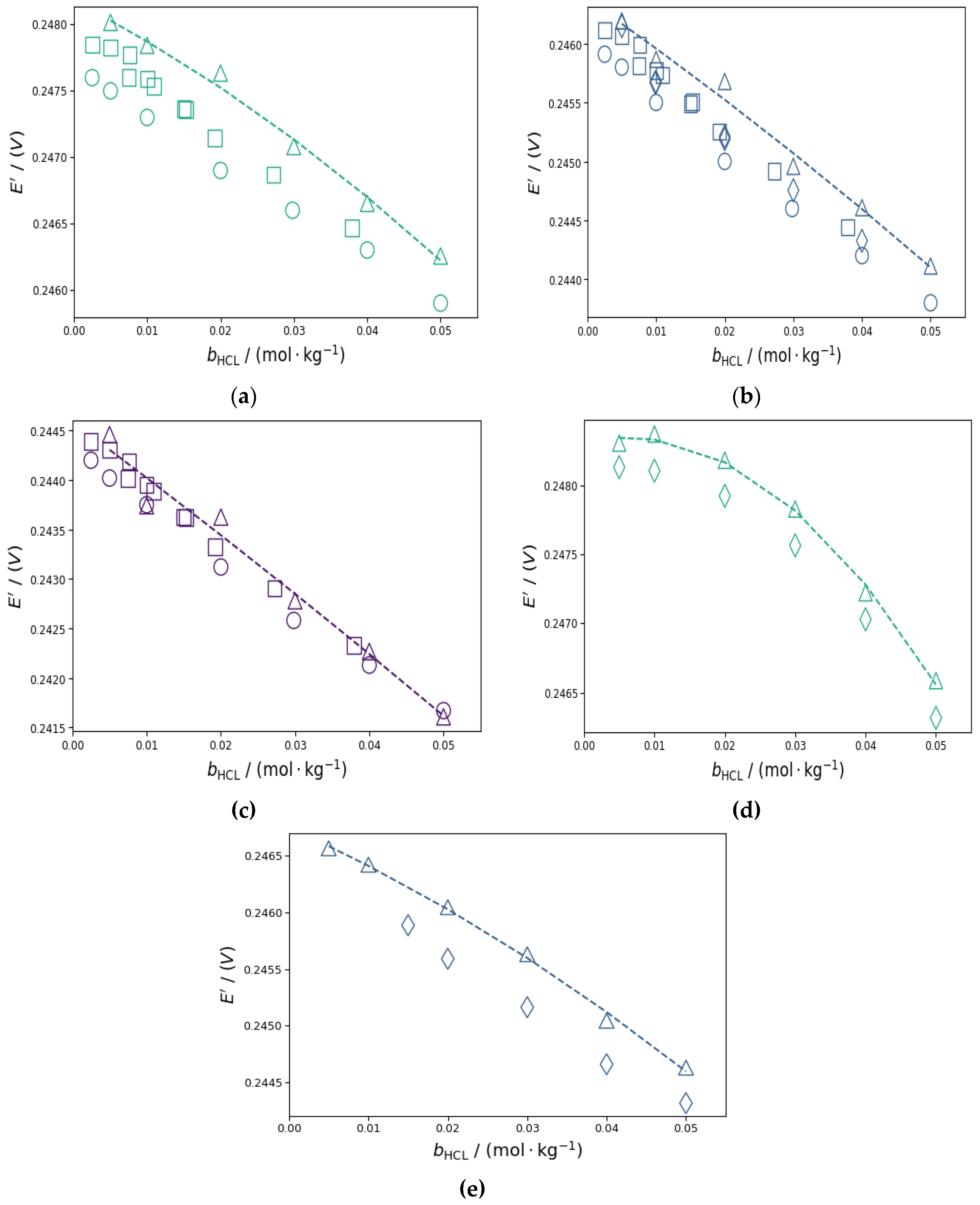
Table 5 summarizes the determined standard potentials E0* for each salinity and temperature investigated, calculated using Equations (6) and (7), alongside comprehensive comparisons with established literature values and associated deviations plotted in Figure 2. The expanded uncertainties U E 0 * = 2.1–2.2 × 10⁻⁴ V (k = 2) were determined by propagating uncertainties from two sources: regression intercept uncertainty from the second-order polynomial fit (Equations (5) and (6)), contributing 23% to the uncertainty budget, and propagated uncertainties from E measurements, temperature, and from molalities bHCl and bCl− through the logarithmic term in Equation (6). The gravimetric preparation of solutions dominates the uncertainty budget, contributing around 58% via b C l . The slight variation in U E 0 * across conditions reflects differences in regression quality and temperature-dependent sensitivities. The uncertainty propagation pathway from raw measurements (E, T, p, weighing) to E0* with the corresponding data is discussed in Section 3.
Beyond ‘closeness,’ our results meet the metrological criterion of compatibility: the observed deviations in E0* (≤330 μV, maximum 440 μV at S = 35 and 293.15 K) are covered by the combined expanded uncertainties U E 0 * ≈ 2.1–2.2 × 10⁻⁴ V (k = 2). When translated to pHT via Equation (3), the maximum deviation corresponds to ≈ 0.002 pH units for bTRIS = 0.01 mol·kg−1, and the electrode-specific offset cancels in the difference ETRISE0*, preserving pHb and hence pHT [20]. This is consistent with the En analysis reported in Section 3, where all comparisons to the literature remain below En < 1.
Figure 2 graphically represents the E′ values as a function of HCl molality obtained from Equation (6).
Figure 2 compares experimental data from this study with values reported by Dickson (1990) [13], Papadimitriou et al. [24], and Müller et al. [17] across different salinities (S = 35 and S = 50) and temperatures of 20 °C, 25 °C, and 30 °C. At S = 35, E′ increases slightly with HCl molality, with higher values observed at elevated temperatures. The dashed lines represent quadratic fits based on a second-order polynomial function, highlighting the non-linear behavior. For S = 50, the corrected data (panel d) shows strong agreement with Papadimitriou et al. [24], confirming the reliability of the applied correction. Overall, these trends indicate that both temperature and salinity exert a measurable influence on E′, which is consistent with previous findings.
All experimental datasets demonstrate good adherence to second-order polynomial functions with squared correlation coefficients ranging from 0.9744 to 0.9922 for S = 35 and from 0.9843 to 0.9970 for S = 50, validating both the theoretical framework and experimental methodology.
Standard uncertainties u (k = 1) and expanded uncertainties U (k = 2) reported in the tables are derived from instrument specifications, repeatability, weighing, temperature control/measurement, pressure corrections, density to SA conversion (TEOS-10), and regression intercepts (E0*). The detailed propagation pathway from these inputs to the tabulated values is documented in the uncertainty notes accompanying Table 2, Table 3 and Table 4 and in Section 3.

3. Results

3.1. Harned Cell Measurements and pHT Determination

In Table 6, the results for pHT determination of the three equimolal TRIS buffers at S = 35 and S = 50, and for the thermodynamic temperatures 293.15 K, 298.15 K, and 303.15 K, are summarized. It also presents the ETRIS values obtained from measurements in the Harned cell, corrected for the standard pressure of 101.325 kPa. The pHT values are given as amount of substance content on a molality basis, and Equation (4) was used to convert pHb to pHT. Along with the pHT values of this study, the values for the expanded uncertainty U p H T (k = 2), calculated according to [30], are also presented.

3.2. Metrological Compatibility Analysis with Literature Data

According to the ISO/IEC 17025 standard [36], the recommendations of the Consultative Committee for Metrology in Chemistry and Biology (CCQM) [37], and the guidance of International Organization for Standardization (2022) [38], the normalized error (En) provides a standardized criterion for evaluating the metrological compatibility between measurement results and reference values, and is defined as follows:
E n = x i x R e f U x i 2 + U x R e f 2 ,
where xi and Uxi2 are the pHT values of this study and the expanded uncertainty (k = 2), and xRef and URef.2 are the reference values from the relevant literature and the expanded uncertainty U (k = 2), respectively.
The results in Table 7 present a quantitative comparison between pHT values of this work and those reported in relevant literature sources [14,17,24] for identical experimental conditions. The agreement is within U ≤ 0.006 for pHT values across all conditions:
-
DelValls and Dickson [14]: for S = 35, bTRIS = 0.01 mol·kg−1 at 20 °C; our value (8.248) differs by 0.001 pH units from Dickson’s reference value (8.249).
-
Müller et al. [17]: for S = 35, bTRIS = 0.04 mol·kg−1 at 25 °C; our value (8.091) differs by 0.004 units from Müller’s (8.095).
-
Papadimitriou et al. [24] for S = 50, bTRIS = 0.04 mol·kg−1 at 25 °C; our value (8.123) differs by 0.002 units from Papadimitriou’s (8.125).

Table 7. Mean pHT values of this work, together with the available pHT values of the reference literature and respective U (k = 2) at S = 35 and S = 50, with temperature ranging from 20 °C to 30 °C.
ST/KbTRIS/mol·kg−1pHT
This Study
UpHT
DelValls [14]
UpHT
Müller [17]
UpHT
Papadimitriou [24]
U
35293.150.018.2480.0058.2490.0018.2460.002-
0.048.2550.0058.2510.0018.2530.002
298.150.018.0860.0068.0910.0018.0890.002--
0.048.0910.0068.0940.0018.0950.0028.0930.001
303.150.017.9330.0067.9370.0017.9350.002-
0.047.9420.0067.9390.0017.9410.002
50298.150.048.1230.005 8.1250.001
In summary, all differences are well within the combined measurement uncertainties, validating our experimental methodology and demonstrating excellent inter-laboratory reproducibility.
Beyond the comparisons presented in Table 7, we conducted additional validation against Pratt (2014) [20] and Capitaine et al. (2023) [21], who employed the water mass fraction (ωH2O) to convert pHb to pHT. For S = 35, T = 25 °C, and bTRIS = 0.04 mol·kg−1, Pratt reported pHT = 8.0951 (mean of duplicate measurements: 8.0948 and 8.0954). Our corresponding value of pHT = 8.0905 (mean of duplicates: 8.090 and 8.091) obtained using the salinity-dependent correction (Equation (4)) yields ΔpHT = −0.005 with En = 0.73 < 1.0, confirming metrological compatibility. Capitaine reported for S = 35, T = 25 °C, and bTRIS = 0.04 mol·kg−1, with pHT = 8.0915; and for S = 35, T = 30 °C, and bTRIS = 0.04 mol·kg−1, with pHT = 7.9375. This yields ΔpHT = −0.001 with En = 0.13 < 1.0 and ΔpHT = −0.005 with En = 0.69 < 1.0, respectively. This agreement demonstrates the agreement of our pHT values with the relevant published literature.
The expanded uncertainties for the pHT values reported in [14,24] are not explicitly stated, despite these values being considered the most reliable reference data currently available.
For the purposes of this study, to assess the accuracy and reliability of pHT measurements throughout En deduction, these uncertainties were conservatively estimated (values in italic in Table 7). The estimation was based on the nominal resolution expected for pHT measurements obtained using the primary potentiometric method, following standard metrological guidance [30,36]. Typically, pHT values determined via the Harned cell are reported with a resolution of 0.001, corresponding to a high level of accuracy [30,36,37,38,39]. Although estimating uncertainty from the corresponding instrumental resolution may appear approximate, it remains a justifiable and traceable approach when no explicit uncertainty is provided. This approach provides a realistic assessment of measurement compatibility while acknowledging inherent methodological limitations.
Given the use of Harned cells with comparable gravimetric procedures, our analysis highlights weighing steps as the primary contributor to uncertainty, accounting for approximately 50% of the total. We estimated uncertainties in the literature data to fall within 0.001, although procedural differences may account for some variability.
Indeed, the major source of uncertainty in pHT determination is the calculation of E0*, the standard potential of the Ag/AgCl electrode in ASW medium, for different salinities and temperatures as the intercept of a second-order polynomial, in terms of HCl molalities, bHCl, derived from Equations (6) and (7) [17]. This calculation relies on E measurements in a Harned cell, of solutions of unbuffered ASW with increasing molalities of HCl. These solutions are gravimetrically prepared by adding ultrapure water to a mixture of major seawater salts (NaCl, KCl, Na2SO4, CaCl2, MgCl2) and HCl in concentrations ran ging from 0.005 mol·kg−1 to 0.05 mol·kg−1 for the studied salinities.
The major salts are typically prepared from stock solutions, which are gravimetrically prepared from high-purity salts and ultrapure water, and characterized by coulometric or argentometric titration, which are primary methods to assess their content. In summary, the primary source of uncertainty arises from successive weighing during solution pre paration, making this process the dominant contributor to the total uncertainty associated with E0* estimation, accounting for approximately 50% of the total uncertainty budget and around 63% in pHT determination [17]. Table 8 and Table 9 summarize the influencing quantities for the deduction of E0* and pHT.
As summarized in Table 9, the u E 0 *   propagates into pHT through Equation (3) with the sensitivity coefficient −F/(RT ln 10), contributing around 34% of U p H T at S = 35 and 298.15 K, while b C l contributes around 63%, and T contributes 3–4%.
The En values calculated for the pHT results of this work using Equation (10) and the assumptions outlined above were all below 1, indicating acceptable agreement.
The highest values, En = 0.82 and En = 0.79 (but still within En < 1), were observed for the TRIS buffer with b = 0.01 mol·kg−1, S = 35, and T = 25 °C (compared with DelValls and Dickson values) and for TRIS buffer with b = 0.04 mol·kg−1, S = 35, and T = 25 °C (compared with Müller values), respectively.

3.3. Fitting Function for pHT Results (20 ≤ S ≤ 50) from Combined Results

To extend the predictive capability and thermodynamic representativeness of the model, the pHT data obtained in this work were combined with experimental results from DelValls and Dickson [14], Müller et al. [17], and Papadimitriou et al. [24]. This composite dataset spans a range of salinities S = 20 to S = 50 and temperatures from –2.795 °C to 45 °C, enabling the construction of a generalized nonlinear regression model as a function of S, T (in K), and bTRIS (in mol·kg−1). The model was fitted using multivariate regression tools in Excel, yielding an excellent fit (r2 = 0.99998) with residuals within the uncertainty bounds of ±0.006 pH units, even under extreme conditions. The fit equation is based on Equation (18) of Del Valls and Dickson, derived from it by including bTRIS, as in [17].
The output coefficients for Equation (11) are summarized in Table 10:
p H T = a 0 + a 1 ·   S + a 2 · S 2 + a 3 · T + a 4 · S · T + a 5 · T 1 + a 6 · ln T +   a 7 · S 2 T + a 8 · T · S 2 + a 9 · S T + a 10 · S · ln T + a 11 ·   S 2 · ln T + a 12 · b T R I S
To assess the statistical significance of the regression model, an Analysis of Variance (ANOVA) was performed. Table 11 presents the ANOVA analysis parameters for the multivariate regression model described in Equation (11). The F-test assesses whether the explained variance (due to regression) is significantly greater than the unexplained variance (residual), thereby validating the inclusion of the predictor variables in the model [38,40].
The high F-statistic (441,123) with 12 and 100 degrees of freedom, far exceeding the critical F-value of 1.91 at α = 0.05, confirms the regression model’s statistical significance (p < 2.26 × 10−230). This indicates that the predictor variables (S, T, and bTRIS) collectively explain 99.998% of the total variance in pHT values, thereby validating the functional form of all 12 terms in Equation (11).
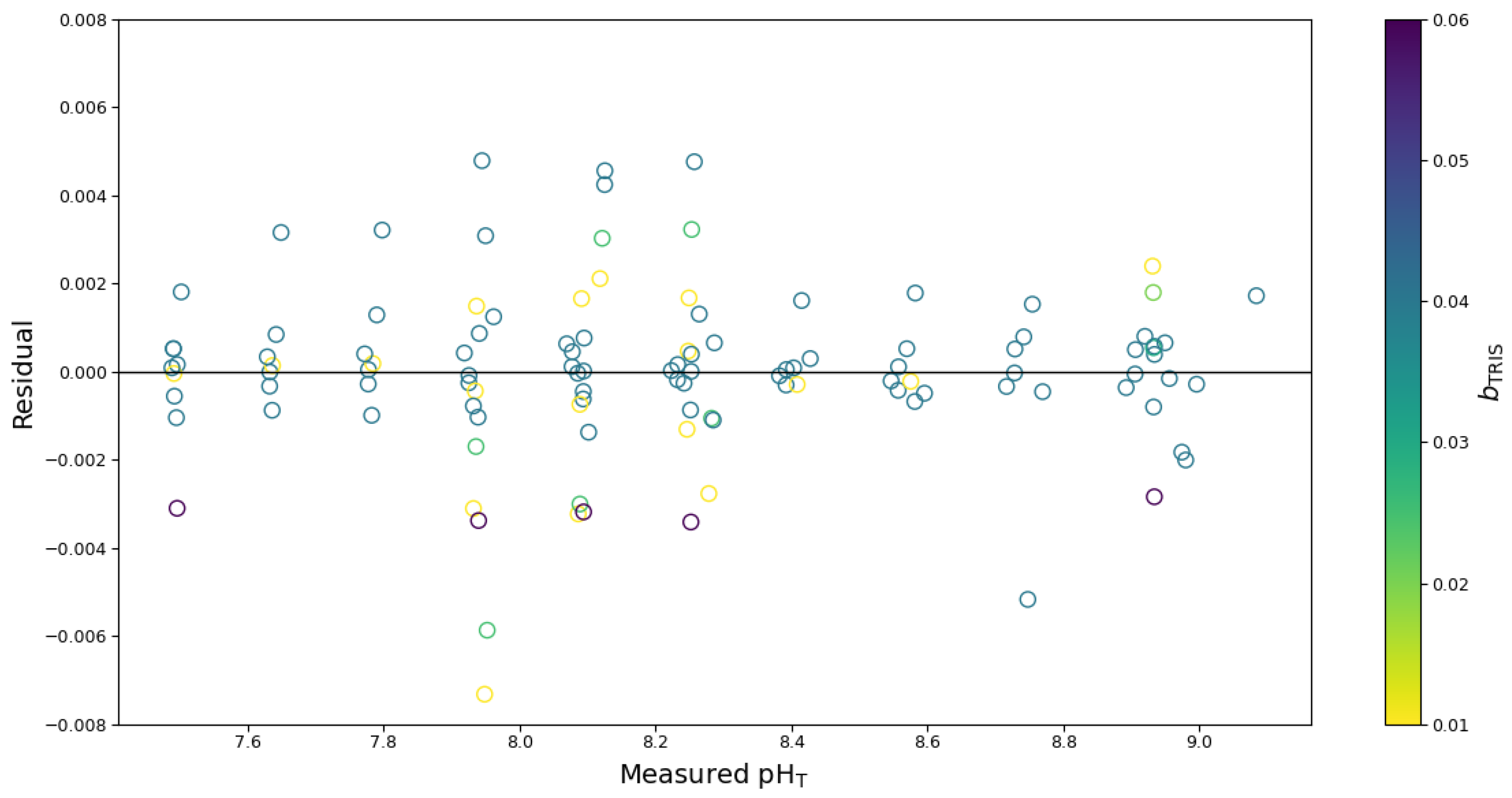
The fit equation has validity for temperatures from 270.36 K to 303.15 K and 20 ≤ S ≤ 50 with the quality of the fit given by r2 = 0.99998, p ≤ 1.1 × 10−143 (very close to zero), and sFit = 0.001 (standard error). The fit equation, tested for the bTRIS = 0.04 mol·kg−1, at S = 50, T = 270.36 K, yields a pHT = 9.082; at S = 40, T = 318.15 K, yields a pHT = 7.500; at S = 35, T = 298.15 K, the pHT = 8.094; and at S = 20, T = 273.15 K, the pHT = 8.893. The fitted residuals are represented in Figure 3.
All the ΔpHT values are below 0.006 pH units from the pH measured values in Table 6, which is the expanded uncertainty for pHT values [17,21], except for TRIS buffer with b = 0.01 mol·kg−1), S = 50, and T = 303.15 K. A possible explanation would be that at higher salinities, the buffering capacity of TRIS is less pronounced for lower molalities of the base (0.02 mol·kg−1) because it depends on the protonation equilibrium of TRIS, which is influenced by ionic strength and the presence of salts in the solution [10]. This model stands out in the current literature by combining moderate complexity, wide applicability, and the ability to resolve TRIS buffer molality effects. Unlike Papadimitriou et al. [24], whose model for equimolal TRIS assumes a fixed concentration (b = 0.04 mol·kg−1) and does not distinguish pHT variations across equimolal formulations, our equation incorporates molality as an explicit variable, allowing it to predict pHT differences between 0.01 mol·kg−1, 0.025 mol·kg−1, and 0.04 mol·kg−1 buffers. Müller et al. [17] include a molality term, and their model can capture molality effects; however, it is more complex—comprising numerous interaction terms—and its validation range is limited to S ≤ 40. The present model, therefore, offers a more practical and extensible solution for marine chemistry applications, particularly in high-salinity environments. This fitting equation prioritizes the primary thermodynamic and empirical effects relevant to the dataset used, capturing the major influences of salinity, temperature, and buffer concentration on pHT without losing accuracy. This indicates that the model captures the aggregate effects of complex interactions effectively within the range of the experimental data provided, leading to a robust, accurate, and interpretable model without overfitting.

4. Discussion

This study aimed to characterize TRIS buffers in artificial seawater (ASW) across salinities (S = 35 and 50), temperatures (20 °C, 25 °C, and 30 °C), and molalities (0.01 mol·kg−1 to 0.04 mol·kg−1) by focusing on the dependence of these variables and their effects on pHT. By analyzing these relationships, the research provides valuable insights into the thermodynamic behavior of TRIS buffers in marine environments.
The characterization was performed using the primary potentiometric method (Harned cell), the only method that allows accurate pHT measurements. These findings are critical for understanding seawater’s acid-base chemistry and buffering capacity.
A critical evaluation against the complete published literature reveals excellent agreement across multiple independent high-quality studies spanning 27 years [14,17,20,21,24,27] and this work. All normalized errors En < 1.0 confirm metrological compatibility according to international standards. Importantly, our results agree with studies employing two different pHb to pHT conversion methods: (a) the salinity-dependent correction (Equation (4)) used by DelValls & Dickson, Papadimitriou, Müller, and this work; and (b) the water mass fraction (ωH2O) method employed by Pratt and Capitaine. The negligible differences between results obtained with these approaches (ΔpHT ≤ 0.005) confirm that both are metrologically sound when properly applied. We chose the salinity-based method specifically to maintain direct comparability with the historical reference database [14,17,24] that forms the foundation of oceanographic pH measurements. The systematic multi-laboratory agreement at S = 35, where validation data from five independent sources now exist, provides strong confidence in our novel measurements at S = 50 and T = 30 °C, where prior high-quality data remain scarce.
The results align closely with existing literature, with an experimental expanded uncertainty up to 0.006 corresponding to a maximum standard uncertainty of 0.003 and consequently meeting the GOA-ON “climate” quality objective [27].
One of the key contributions of this work is a detailed examination of the relationship between pHT, salinity, temperature, and molality. The findings reveal complex, nonlinear interactions. For instance, as salinity increases, pHT deviates from linear behavior, an effect magnified by temperature changes. Higher temperatures generally shift pHT values more significantly, particularly at higher buffer molalities [17,24]. Buffer molality itself plays a significant role in stabilizing pHT. While higher molalities enhance buffering capacity, the relationship is not strictly linear. At elevated concentrations, the ionic strength of the solution may influence TRIS dissociation, introducing further complexity.
By addressing these variables together, the study offers a comprehensive framework for understanding TRIS buffer behavior in ASW. The fitting function, Equation (11), with a correlation coefficient (r2) of 0.99998, demonstrates the strong dependency of salinity, temperature, and molality in determining pHT. This model has important implications for accurate pH measurements in marine systems, particularly in a scenario of climate change and ocean acidification.
Despite the robust metrological characterization presented here, the broader implications of the findings—particularly the deviations observed between absolute salinity (SA) and practical salinity (S) in TRIS-buffered solutions—warrant further research. While these differences are systematically quantified, their practical significance for Certified Reference Material (CRM) production or for the interpretation of pHT in real seawater samples remains to be fully established. Specifically, it is not yet clear whether the SA deviations introduced by TRIS components meaningfully affect the traceability or comparability of pHT measurements between laboratories or under field conditions.
The insights gained from this research pave the way for further studies in TRIS buffer behavior under more extreme salinity conditions, such as those found in equatorial waters and closed seas. Investigating the impact of natural seawater constituents, such as organic matter and trace metals, could provide a clearer picture of TRIS buffers’ performance in complex marine settings. Testing in real-world samples would further validate the buffer’s reliability.
Additionally, the empirical regression model developed in this study based on the functional form originally proposed by DelValls and Dickson [14] and incorporating the molality term as proposed by Müller et al. [17] demonstrated high quality of fit (r2 = 0.99998) within the studied matrix (20 ≤ S ≤ 50 and 270.36 K ≤ T ≤ 303.15 K), suggesting that the main thermodynamic effects could be captured.
This assumption may not hold outside the calibration range, particularly at salinity or temperature extremes where ionic activity coefficients, speciation equilibria, and buffer dissociation constants can exhibit non-linear behaviors. For example, at S > 50, the thermodynamic interactions governing TRIS protonation may no longer be well-approximated by this model [20,24]. Consequently, while the model performs well within the experimental conditions, its predictive reliability under extrapolated conditions—such as sea ice brines or hypersaline lagoons—has not been independently validated. In this context, it is important to recognize that the practical application of TRIS buffers, particularly in the form of CRMs, depends on their physical stability, temperature dependence, and compatibility with in situ sensors. These factors critically influence the traceability and comparability of pHT measurements in field work and interlaboratory comparability [9,14,24].
Future work should assess the robustness of the current regression model by systematically evaluating residuals across extended S and T ranges. Validation against independent experimental datasets, particularly those employing natural seawater matrices or extreme boundary conditions, will be essential for confirming the model’s generalizability.
Finally, integrating machine learning into pHT and E0* predictions could improve accuracy and applicability by using larger datasets to train algorithms that would allow for reliable forecasts under conditions that have not yet been tested.

5. Conclusions

This study provides a comprehensive metrological characterization of TRIS buffers in artificial seawater (ASW), emphasizing the combined effects of salinity, temperature, and buffer molality on accurate pHT determination by Harned cell. The results demonstrate high accuracy and metrological traceability to the primary potentiometric method, which is aligned with the GOA-ON climate quality standards.
The incorporation of molality as a variable in the model equation provides a good fit (r2 = 0.99998) for pHT calculations, extending reliable predictions to more extreme conditions (T ≤ 30 °C, S ≤ 50) previously outside the validated range of existing pHT models. However, extending this model to more extreme conditions requires additional experimental data at higher salinities (S > 50) and temperatures (T > 30 °C), particularly considering discrepancies between practical salinity (S) and absolute salinity (SA), which could affect interlaboratory comparability and traceability of pHT measurements. In this context, the practical application of TRIS buffers as Certified Reference Materials relies on their chemical stability and on compatibility with field sensors, thereby becoming indispensable to extend testing in marine environments and under diverse ecological conditions.
For future work, the adoption of machine learning approaches is proposed to enhance the predictive power of pHT and E0* models, expanding their usability under conditions that extend beyond current experimental boundaries. In addition, extending the dataset towards higher temperatures and performing source-robustness checks will be pursued to reinforce the validity domain and robustness of the fitted function.
Finally, this work presents a metrological characterization for pHT measurements in chemical oceanography, with direct implications for monitoring ocean acidification and ensuring global comparability of environmental data.

Author Contributions

Conceptualization, R.Q. and M.J.N.; methodology, R.Q., M.J.N., S.M. and O.P.; investigation, R.Q., M.J.N., S.M. and O.P.; resources, R.Q., O.P. and J.A.e.S.; writing—original draft preparation, R.Q. and M.J.N.; writing—review and editing, R.Q., M.J.N., A.L.F., C.P., S.M., O.P. and J.A.e.S.; visualization, M.J.N.; supervision, M.J.N., C.P. and A.L.F.; funding acquisition, J.A.e.S. All authors have read and agreed to the published version of the manuscript.

Funding

This work was supported by FCT—Fundação para a Ciência e Tecnologia/MECI through the MEtRICs research unit (UID/04077/2025, https://doi.org/10.54499/UID/04077/2025, Mechanical Engineering and Re-source Sustainability Center) and by national funds from FCT—Fundação para a Ciência e a Tecnologia, I.P., under the scope of the projects UID/50006/2025, UID/PRR/50006/2025 and LA/P/0008/2020 of the Associated Laboratory for Green Chemistry—LAQV REQUIMTE (https://doi.org/10.54499/UID/50006/2025, https://doi.org/10.54499/UID/PRR/50006/2025 and https://doi.org/10.54499/LA/P/0008/2020).

Data Availability Statement

The original contributions presented in this study are included in the article. Further inquiries can be directed to the corresponding author.

Acknowledgments

Raquel Quendera would like to thank Instituto Português da Qualidade, I. P., for technical assistance, support, and facility access. The authors have reviewed and edited the output and take full responsibility for the content of this publication.

Conflicts of Interest

The authors declare no conflicts of interest.

Abbreviations

The following abbreviations are used in this manuscript:
ASWArtificial Seawater
TRISTris(hydroxymethyl)aminomethane
CRMCertified Reference Material
GOA-ONGlobal Ocean Acidification Observing Network
TEOS-10 Thermodynamic Equation of Seawater 2010
IUPACInternational Union of Pure and Applied Chemistry
IAPSOInternational Association for the Physical Sciences of the Oceans
SIInternational System of Units
EMPIREuropean Metrology Programme for Innovation and Research
NISTNational Institute of Standards and Technology
Symbols
TTemperature (K or °C)
SNominal Practical Salinity
SAAbsolute Salinity (g·kg−1)
IIonic strength (mol·kg−1)
p0Standard Atmospheric Pressure (101.325 kPa)
pPartial pressure in Pa
pHIUPACIUPAC pH scale (equal to the negative decimal logarithm of the molal activity of the H+ ion).
pHbmolal pH scale
pHTOperational definition of the total hydrogen pH scale
ρDensity in kilogram per cubic decimeter (kg·dm−3)
bMolality, expressed in moles per kilogram of solvent (mol·kg−1)
νAmount content, expressed in moles per kilogram of solution (mol.kg−1)
EMeasured potential between the Standard Hydrogen electrode and silver/silver chloride electrode corrected to a pressure of H2 equal to 1 atm (V)
E0Standard potential of silver-silver chloride electrode in HCl 0.01 mol kg−1 (V)
E0* Standard potential of silver-silver chloride electrode in ASW medium (V)
EPotential of silver-silver chloride electrode in saline medium at a given chloride molality (>0 mol·kg−1) (V)
FFaraday constant (C·mol−1)
RMolar gas constant (J·mol−1·K−1)
ωH2OWater mass fraction
aMolal ionic activity, in moles per kilogram of solvent (mol·kg−1)
γMolal activity coefficient, in moles per kilogram of solvent (mol·kg−1)
uxstandard uncertainty
Uxexpanded uncertainty
kcoverage factor
r2coefficient of determination
Ennormalized error

References

  1. Raven, J.; Caldeira, K.; Elderfield, H.; Hoegh-Guldberg, O.; Liss, P.; Riebesell, U.; Shepherd, J.; Turley, C.; Watson, A.; Heap, R.; et al. Ocean Acidification due to Increasing Atmospheric Carbon Dioxide; The Royal Society: London, UK, 2005. [Google Scholar]
  2. Frank, M.; Benjamin, D. Use of thermodynamics in examining the effects of ocean acidification. Elements 2010, 6, 299–303. [Google Scholar] [CrossRef]
  3. O’Dowd, C.; Cave, R.; McGovern, E.; Ward, B.; Kivimae, C.; McGrath, T.; Stengel, D.; Westbrook, G. Impacts of Increased Atmospheric CO2 on Ocean Chemistry and Ecosystems; Marine Institute: Galway, Ireland, 2011. [Google Scholar]
  4. Ran, J.; Chao, N.; Yue, L.; Chen, G.; Wang, Z.; Wu, T.; Li, C. Quantifying the contribution of temperature, salinity and climate change to sea level rise in the Pacific Ocean: 2005–2019. Front. Mar. Sci. 2023, 10, 1200883. [Google Scholar] [CrossRef]
  5. Cheng, L.; Trenberth, K.E.; Gruber, N.; Abraham, J.P.; Fasullo, J.T.; Li, G.; Zhu, J. Improved estimates of changes in upper ocean salinity and the hydrological cycle. J. Clim. 2020, 33, 10357–10381. [Google Scholar] [CrossRef]
  6. Parras-Berrocal, I.M.; Vázquez, R.; Cabos, W.; Sein, D.V.; Álvarez, O.; Bruno, M.; Izquierdo, A. Dense water formation in the eastern Mediterranean under a global warming scenario. Ocean Sci. 2023, 19, 941–952. [Google Scholar] [CrossRef]
  7. General Assembly. Resolution Adopted by the General Assembly on 11 September 2015; United Nations: New York, NY, USA, 2015. [Google Scholar]
  8. Buck, R.P.; Rondinini, S.; Covington, A.K.; Baucke, F.G.K.; Brett, C.M.A.; Camoes, M.F.; Milton, M.J.T.; Mussini, T.; Naumann, R.; Pratt, K.W.; et al. Measurement of pH. Definition, standards, and procedures (IUPAC Recommendations 2002). Pure Appl. Chem. 2002, 74, 2169–2200. [Google Scholar] [CrossRef]
  9. Dickson, A.G.; Sabine, C.L.; Christian, J.R. Guide to Best Practices for Ocean CO2 Measurements; North Pacific Marine Science Organization: Sidney, BC, Canada, 2007. [Google Scholar]
  10. Nemzer, B.V.; Dickson, A.G. The stability and reproducibility of Tris buffers in synthetic seawater. Mar. Chem. 2005, 96, 237–242. [Google Scholar] [CrossRef]
  11. Ramette, R.W.; Culberson, C.H.; Bates, R.G. Acid-base properties of tris(hydroxymethyl)aminomethane (Tris) buffers in sea water from 5 to 40 °C. Anal. Chem. 1977, 49, 867–870. [Google Scholar] [CrossRef]
  12. Hansson, I. A new set of pH-scales and standard buffers for sea water. Deep Sea Res. 1973, 20, 479–491. [Google Scholar] [CrossRef]
  13. Dickson, A.G. Standard potential of the reaction: AgCl (s) + 12H2 (g) = Ag (s)+ HCl (aq), and the standard acidity constant of the ion HSO4− in synthetic sea water from 273.15 to 318.15 K. J. Chem. Thermodyn. 1990, 22, 113–127. [Google Scholar] [CrossRef]
  14. DelValls, T.A.; Dickson, A.G. The pH of buffers based on 2-amino-2-hydroxymethyl-1,3-propanediol (‘tris’) in synthetic sea water. Deep Sea Res. Part I Oceanogr. Res. Pap. 1998, 45, 1541–1554. [Google Scholar] [CrossRef]
  15. Millero, F.J.; Zhang, J.Z.; Fiol, S.; Sotolongo, S.; Roy, R.N.; Lee, K.; Mane, S. The use of buffers to measure the pH of seawater. Mar. Chem. 1993, 44, 143–152. [Google Scholar] [CrossRef]
  16. Marion, G.M.; Millero, F.J.; Camões, M.F.; Spitzer, P.; Feistel, R.; Chen, C.T. pH of seawater. Mar. Chem. 2011, 126, 89–96. [Google Scholar] [CrossRef]
  17. Müller, J.D.; Bastkowski, F.; Sander, B.; Seitz, S.; Turner, D.R.; Dickson, A.G.; Rehder, G. Metrology for pH Measurements in Brackish Waters—Part 1: Extending Electrochemical pH T Measurements of TRIS Buffers to Salinities 5–20. Front. Mar. Sci. 2018, 5, 176. [Google Scholar] [CrossRef]
  18. Paulsen, M.L.; Dickson, A.G. Preparation of 2-amino-2-hydroxymethyl-1,3-propanediol (TRIS) pHT buffers in synthetic seawater. Limnol. Oceanogr. Methods 2020, 18, 504–515. [Google Scholar] [CrossRef]
  19. Campbell, D.M.; Millero, F.J.; Roy, R.; Roy, L.; Lawson, M.; Vogel, K.M.; Moore, C.P. The standard potential for the hydrogen-silver. silver chloride electrode in synthetic seawater. Mar. Chem. 1993, 44, 221–233. [Google Scholar] [CrossRef]
  20. Pratt, K.W. Measurement of pHT values of Tris buffers in artificial seawater at varying mole ratios of Tris: Tris HCl. Mar. Chem. 2014, 162, 89–95. [Google Scholar] [CrossRef]
  21. Capitaine, G.; Stoica, D.; Wagener, T.; Fisicaro, P. Production of a reference material for seawater pHT measurements by a National Metrology Institute. Mar. Chem. 2023, 252, 104244. [Google Scholar] [CrossRef]
  22. Khoo, K.H.; Culberson, C.H.; Bates, R.G. Thermodynamics of the dissociation of ammonium ion in seawater from 5 to 40 C. J. Solut. Chem. 1977, 6, 281–290. [Google Scholar] [CrossRef]
  23. Clegg, S.L.; Humphreys, M.P.; Waters, J.F.; Turner, D.R.; Dickson, A.G. Chemical speciation models based upon the Pitzer activity coefficient equations. including the propagation of uncertainties. II. Tris buffers in artificial seawater at 25 °C, and an assessment of the seawater ‘Total’ pH scale. Mar. Chem. 2022, 244, 104096. [Google Scholar] [CrossRef]
  24. Papadimitriou, S.; Loucaides, S.; Rérolle, V.; Achterberg, E.P.; Dickson, A.G.; Mowlem, M.; Kennedy, H. The measurement of pH in saline and hypersaline media at sub-zero temperatures: Characterization of Tris buffers. Mar. Chem. 2016, 184, 11–20. [Google Scholar] [CrossRef]
  25. Millero, F.J.; Feistel, R.; Wright, D.G.; McDougall, T.J. The composition of Standard Seawater and the definition of the Reference-Composition Salinity Scale. Deep Sea Res. Part I Oceanogr. Res. Pap. 2008, 55, 50–72. [Google Scholar] [CrossRef]
  26. Dickson, A.G. The measurement of sea water pH. Mar. Chem. 1993, 44, 131–142. [Google Scholar] [CrossRef]
  27. Capitaine, C.; Schäfer, R.; Bastkowski, F.; Stoica, D.; Pellegrino, O.; Quendera, R.; Achterberg, E.P.; Wagener, T.; Clegg, S.L.; Seitz, S.; et al. pHT measurements of TRIS buffer solutions in an artificial seawater matrix in the salinity range 5–40 and temperature range 5–40° C. Part 1: Measurements and data fitting. Mar. Chem. 2025, 273, 104551. [Google Scholar] [CrossRef]
  28. Intergovernmental Oceanographic Commission. The International Thermodynamic Equation Of Seawater—2010: Calculation and Use of Thermodynamic Properties; UNESCO Manuals and Guides; Intergovernmental Oceanographic Commission: Paris, France, 2010; Volume 56, p. 196. [Google Scholar]
  29. Prenesti, E.; Ferrara, E.; Berto, S.; Fisicaro, P.; Daniele, P.G. Development of a reference solution for the pH of seawater. Anal. Bioanal. Chem. 2007, 388, 1877–1883. [Google Scholar] [CrossRef] [PubMed]
  30. JCGM. 100: 2008 (GUM 1995 with Minor Corrections) Evaluation of Measurement Data-Guide to the Expression of Uncertainty in Measurement; Joint Committee for Guides in Metrology: Sèvres, France, 2008; Volume 19. [Google Scholar]
  31. Napoleão, A.; Furtado, A.; Pereira, J.; Quendera, R.; Pellegrino, O.; Cidade, M.T.; Oliveira, C.R. Salinity determinations by refractometry and oscillation-type densimetry as compatible methods: From salinity to pH. J. Phys. Conf. 2018, 1065, 072037. [Google Scholar] [CrossRef]
  32. Quendera, R.; Pellegrino, O.; Moura, S.; Abrantes, J.; Cabral, V.; Furtado, A.; Sousa, J.A. Unified pH applied to standard seawater and NaCl solutions: Preliminary studies. In Proceedings of the 2021 International Workshop on Metrology for the Sea; Learning to Measure Sea Health Parameters (MetroSea), Reggio Calabria, Italy, 4–6 October 2021; IEEE: Piscataway, NJ, USA, 2021. [Google Scholar]
  33. Furtado, A.; Napoleão, A.; Pereira, J.; Moura, S.; Quendera, R.; Pellegrino, O. Absolute salinity determination by oscillation-type densimetry and refractometry. Int. J. Metrol. Qual. Eng. 2022, 13, 10. [Google Scholar] [CrossRef]
  34. Dickson, A.G.; Camões, M.F.; Spitzer, P.; Fisicaro, P.; Stoica, D.; Pawlowicz, R.; Feistel, R. Metrological challenges for measurements of key climatological observables. Part 3: Seawater pH. Metrologia 2015, 53, R26. [Google Scholar] [CrossRef]
  35. Feistel, R.; Wielgosz, R.; Bell, S.A.; Camões, M.F.; Cooper, J.R.; Dexter, P.; Dickson, A.G.; Fisicaro, P.; Harvey, A.H.; Heinonen, M.; et al. Metrological challenges for measurements of key climatological observables: Oceanic salinity and pH, and atmospheric humidity. Part 1: Overview. Metrologia 2015, 53, R1–R11. [Google Scholar] [CrossRef]
  36. ISO/IEC 17025:2017; General Requirements for the Competence of Testing and Calibration Laboratories, 2nd ed. International Organization for Standardization: Geneva, Switzerland, 2017.
  37. Kaarls, R. The Consultative Committee for Metrology in Chemistry and Biology-CCQM. J. Chem. Metrol. 2018, 12, 1–16. [Google Scholar] [CrossRef]
  38. ISO 13528:2022; Statistical Methods for Use in Proficiency Testing by Interlaboratory Comparison. International Organization for Standardization: Geneva, Switzerland, 2022.
  39. ISO 80000-1:2009; Quantities and Units—Part 1: General. International Organization for Standardization: Geneva, Switzerland, 2009.
  40. Oliveira, E.C. Critical metrological evaluation of fuel analyses by measurement uncertainty. Metrol. Meas. Syst. 2011, 18, 235–247. [Google Scholar] [CrossRef]
Figure 1. Panels (a,b) show the SA values obtained from density measurements for equimolal TRIS buffers at molalities of 0.01 mol·kg−1, 0.025 mol·kg−1, and 0.04 mol·kg−1 at temperatures of 20 °C, 25 °C, and 30 °C. Panel (a) corresponds to S = 35, while panel (b) presents the results for S = 50. The vertical bars represent the expanded uncertainties U (k = 2) for the SA investigated at each molality and temperature.
Metrology 06 00006 g001
Figure 2. Panels (ac) represent the E′ as a function of HCl molality at S = 35 and temperatures of 20 °C, 25 °C, and 30 °C, respectively. The triangles (Δ) are the experimental values of this study, the squares (□) are from Dickson (1990) [13], diamonds (◊) are experimental results from Papadimitriou et al. [24], and circles (○) represent experimental values from Müller et al. [17]. The dashed lines represent the quadratic fit for the second order polynomial function. Panels (d,e) represent the E′ values for S = 50 at temperatures of 20 °C and 25 °C, respectively. In panel (d), the diamonds (◊) represent the experimental results of this work corrected using Equation (3) of Papadimitriou et al. [24]. In panel (e), the diamonds (◊) are the experimental values from Papadimitriou et al. [24].
Metrology 06 00006 g002
Figure 3. The residuals in pHT values (ΔpHT = pHTExperimental − pHTPredicted) from Equation (11) plotted against measured pHT values. Colors represent bTRIS molality ranging from 0.01 (yellow) to 0.06 (dark purple).
Metrology 06 00006 g003
Table 1. Composition of reference ASW with I = 0.72250 mol·kg−1 and S = 35 (adapted from [20]).
Major SaltMolality b/mol·kg−1Amount Content ν/mol·kg−1
NaCl—b10.427530.41254
Na2SO40.029260.02824
KCl0.010580.01021
MgCl20.054740.05282
CaCl20.010750.01037
HClb10
TRISb20
Table 2. SA values (in g·kg−1) deduced for the equimolal TRIS buffers, b (TRIS) = b (TRIS.HCl) = 0.01 mol·kg−1, 0.025 mol·kg−1, and 0.04 mol·kg−1 at S = 35 and S = 50 and the expanded uncertainties U (k = 2) at the investigated temperatures.
S TRIS 0.01/
mol·kg1
TRIS 0.025/
mol·kg1
TRIS 0.04/
mol·kg1
T/KSA/
g·kg−1
U/
g·kg−1
SA/
g·kg−1
U/
g·kg−1
SA/
g·kg−1
U/
g·kg−1
35293.1536.90.937.70.938.51.0
298.1537.01.037.71.038.61.1
303.1537.31.038.11.038.91.1
50293.1553.10.953.20.953.50.9
298.1553.10.953.20.953.50.9
303.1553.40.953.50.953.80.9
Table 3. The molalities of HCl and Cl, the measured values of E (corrected to 101.325 kPa) at S = 35 for the temperatures investigated, and the corresponding standard uncertainty uE (k = 1) in the synthetic matrices.
T/KbHCl/mol·kg−1bCl−/mol·kg−1E/VuE/V
293.150.0050000.5688430.3961123.80 × 10−6
0.0099980.5687980.3784353.53 × 10−6
0.0200000.5687340.3607143.50 × 10−6
0.0299930.5686680.3499273.53 × 10−6
0.0399980.5687520.3422233.54 × 10−6
0.0499970.5688240.3361863.53 × 10−6
298.150.0050000.5688430.3968174.37 × 10−6
0.0099980.5687980.3786873.53 × 10−6
0.0200000.5687340.3606894.08 × 10−6
0.0299930.5686680.3495603.51 × 10−6
0.0399980.5687520.3418093.48 × 10−6
0.0499970.5688240.3355783.47 × 10−6
303.150.0050000.5688430.3976103.69 × 10−6
0.0099980.5687980.3787883.52 × 10−6
0.0200000.5687340.3605643.50 × 10−6
0.0299930.5686680.3491353.52 × 10−6
0.0399980.5687520.3410996.50 × 10−6
0.0499970.5688240.3346076.49 × 10−6
Table 4. The molalities of HCl and Cl, the measured values of E (corrected to 101.325 kPa) at S = 50 for the temperatures investigated, and the corresponding standard uncertainty uE (k = 1) in the synthetic matrices.
T/KbHCl/mol·kg−1bCl−/mol·kg−1E/Vu/V
293.150.0050000.8258120.3869803.56 × 10−6
0.0100040.8254880.3695373.53 × 10−6
0.0200040.8253670.3518463.49 × 10−6
0.0300080.8253010.3412514.14 × 10−6
0.0400050.8254510.3333753.49 × 10−6
0.0500100.8252750.3271063.48 × 10−6
298.150.0050000.8258120.3876023.80 × 10−6
0.0100040.8254880.3696503.50 × 10−6
0.0200040.8253670.3514773.48 × 10−6
0.0300080.8253010.3406463.47 × 10−6
0.0400050.8254510.3326703.54 × 10−6
0.0500100.8252750.3265283.46 × 10−6
303.150.0050000.8258120.3886633.54 × 10−6
0.0100040.8254880.3703383.78 × 10−6
0.0200040.8253670.3517943.50 × 10−6
0.0300080.8253010.3409033.58 × 10−6
0.0400050.8254510.3322553.51 × 10−6
0.0500100.8252750.3258013.50 × 10−6
Table 5. The standard potential E0* for the ASW unbuffered solutions of S = 35 and S = 50 with the U (k = 2), the three thermodynamic T investigated, and published references for the values of E0* and the differences obtained (ΔE0* = E0*meas. − E0*Ref.) between this study and the reference values.
ST/KE0*/V
This Study
U/VE0*/V
Papadimitriou [24]
E0*/V
Dickson [13]
E0*/V
Müller
[17]
ΔE0*/µV
Papadimitriou [24]
ΔE0*/µV
Dickson [13]
ΔE0*/µV
Müller
[17]
35293.150.248182.14 × 10−40.24796 (a)0.248000.24774220180440
298.150.246372.18 × 10−40.246420.246280.24604−50.090.0330
303.150.244592.20 × 10−4 0.244590.24437 0.168220
50293.150.248312.11 × 10−40.24811 (a) 200
298.150.246742.14 × 10−40.246640.24641 (b) 100330
303.150.2453432.17 × 10−4
In Table 5, the values with the superscript (a) are derived from the model Equation (3) of Papadimitriou et al. [24] to determine E0* of ASW solutions within its interval of validity S ≥ 35 and for T from the freezing point of water up to 25 °C. Superscript (b) is the value from [24]. Good agreement was found between the values of this study and the reference literature for S = 35 and S = 50 (deviations ≤ 330 μV). This agreement is consistent with the deviations reported in the reference literature, indicating that the observed values fall within the expected range of experimental variability.
Table 6. Measured potential (ETRIS, in V) and pHT values determined in duplicate for TRIS in ASW-buffered solutions at S = 35 and 50, with the respective expanded uncertainties ( U p H T ), for the three thermodynamic temperatures and the studied molalities.
ST/KbTRIS/mol·kg−1ETRIS/VpHT U p H T
35293.150.010.741190.741328.2478.2490.005
0.0250.741370.741508.2518.2530.005
0.040.741590.741628.2548.2550.005
298.150.010.738220.738338.0858.0870.006
0.0250.738270.738438.0868.0890.006
0.040.738520.738578.0908.0910.006
303.150.010.735450.735567.9327.9340.006
0.0250.735780.735887.9377.9390.006
0.040.736120.735997.9437.9410.006
50293.150.010.733310.733388.2788.2790.005
0.0250.733490.733508.2818.2820.005
0.040.733640.733678.2848.2840.005
298.150.010.730530.730618.1188.1190.005
0.0250.730690.730678.1218.1200.005
0.040.730770.730898.1228.1240.005
303.150.010.727040.726917.9487.9460.005
0.0250.727190.727257.9517.9520.005
0.040.727700.727717.9597.9590.005
Table 8. Most relevant parameters for the determination of E0* u (k = 1) of a solution of unbuffered ASW in HCl (b = 0.005 mol·kg−1), S = 35, and T = 25 °C.
Parameter/qiUnitsxiuici(ui × ci)2U/%
EV0.3968174.37 × 10−611.91 × 10−110.086
TK298.152.08 × 10−2−5.05 × 10−41.10 × 10−100.499
bH+mol·kg−10.0049991.90 × 10−55.149.53 × 10−943.1
bCl−mol·kg−10.5688435.61 × 10−44.52 × 10−26.41 × 10−102.90
pH2Pa97,3831.01 × 101−1.32 × 10−71.77 × 10−120.008
EV0.2461931.02 × 10−411.03 × 10−846.6
ΔEAg/AgClV03.39 × 10−511.15 × 10−95.20
IV0.246371.90 × 10−513.61 × 10−101.63
u(E0*) = 1.09 × 10⁻⁴ V. U = [(ui × ci)2/u2(E0)]/%.
Table 9. Most relevant parameters for the determination of U p H T (k = 2) of a solution of TRIS buffer (b = 0.04 mol·kg−1), S = 35, and T = 25 °C.
Parameter/qiUnitsxiuici(ui × ci)2U/%
E0*V0.246371.09 × 10−4−16.93.80 × 10−633.8
EV0.7385184.71 × 10−616.906.34 × 10−90.06
SDAg/AgClV06.40 × 10−514.10 × 10−90.04
TK298.152.08 × 10−2−2.79 × 10−23.37 × 10−73.38
RJ·mol−1·K−18.3144626180−1.0000
FC·mol−196,485.3321208.62 × 10−500
pH2Pa98,1610.814 × 101−1.31 × 10−71.13 × 10−121.14 × 10⁻⁵
bCl−mol·kg−10.5687253.48 × 10−4−7.186.26 × 10−662.7
U (pHT) = 0.006. U = [(ui × ci)2/u2(E0)]/%.
Table 10. Coefficients and respective values for the calculation of the pHT model Equation (11).
CoefficientValue
a01841.815785
a1−158.7621782
a22.781023769
a30.551733008
a4−0.047854353
a5−44929.99834
a6−324.2751098
a7−71.62354127
a80.000835236
a94082.029463
a1027.96623154
a11−0.489648562
a120.156471814
Table 11. Analysis of Variance (ANOVA) for the pHT fitting equation (Equation (11)).
Source of
Variation
Sum of Squares Degrees of
Freedom
Mean Squares F-Statisticp-Value
Regression21.714121.809441,123<2.259 × 10−230
Residual4.10 × 10−41004.10 × 10−6
Total21.714112
F-critical (α = 0.05, df1 = 12, df2 = 100) = 1.91.
Disclaimer/Publisher’s Note: The statements, opinions and data contained in all publications are solely those of the individual author(s) and contributor(s) and not of MDPI and/or the editor(s). MDPI and/or the editor(s) disclaim responsibility for any injury to people or property resulting from any ideas, methods, instructions or products referred to in the content.