
Quantifying the Performance of Distributed Large-Volume Metrology Systems for Dynamic Measurements: Methodology Development


Abstract
1. Introduction
1.1. Addressing the Gap
1.2. Aim
2. Materials and Methods
2.1. Summary of Test Method
- Intra-system comparison: a path is determined statically using the stop-measure-move protocol. Dynamic performance is then expressed relative to static performance. This relative measurement is not influenced by uncertainty introduced by the calibration procedure but still requires temporal synchronisation. The test would have to be combined with other tests to characterise static performance.
- Inter-system comparison: transformations between the global and local coordinate frames are determined using calibration procedures combining in situ and ex situ methods. With sufficient characterisation of the artefact and a robust uncertainty model the path can be known absolutely. Static and dynamic performance is then compared against the ground truth path.
- Concurrent inter-system comparison: test will be designed such that systems able to operate concurrently can be directly compared in situ.
2.2. Path Selection
2.3. Artefact and Actuator Assembly Design
2.4. Coordinate System Construction and Calibration Strategy
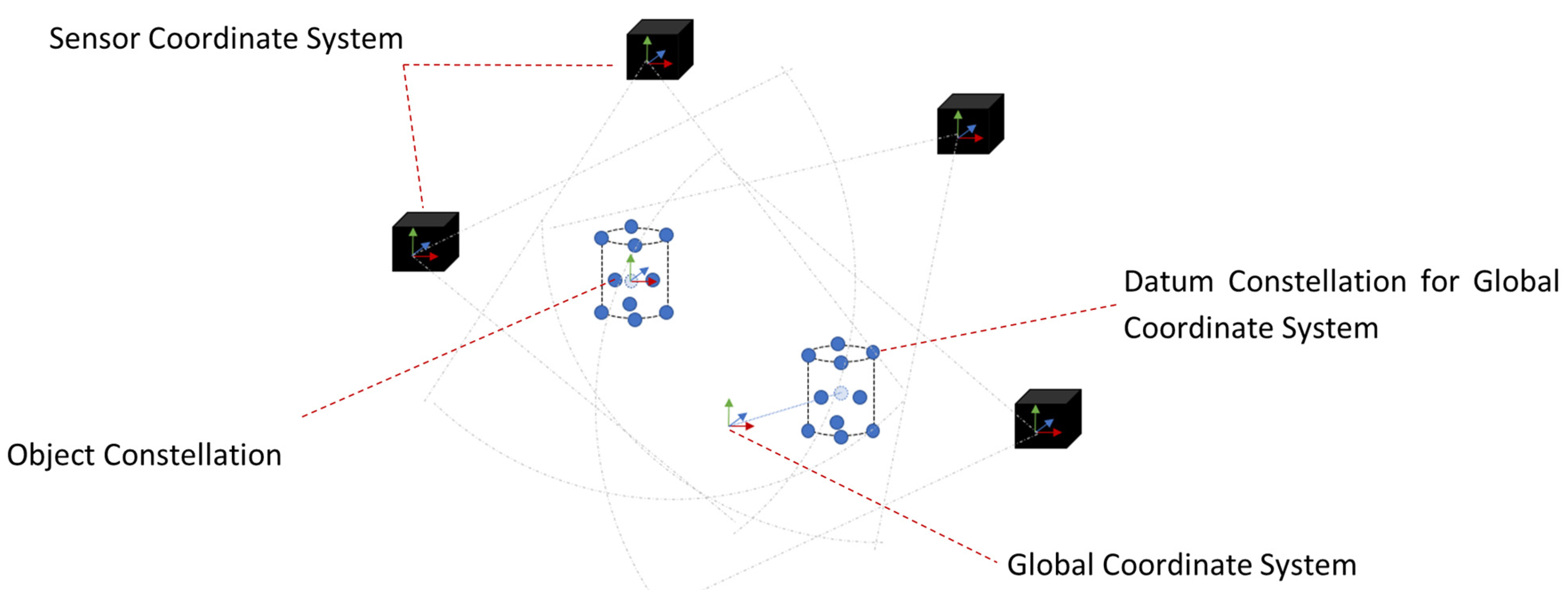
- Global coordinate frame refers to the reference frame of the system under test; the frame within which the reports pose and in which inter-system transformations are established for comparisons and benchmarking.
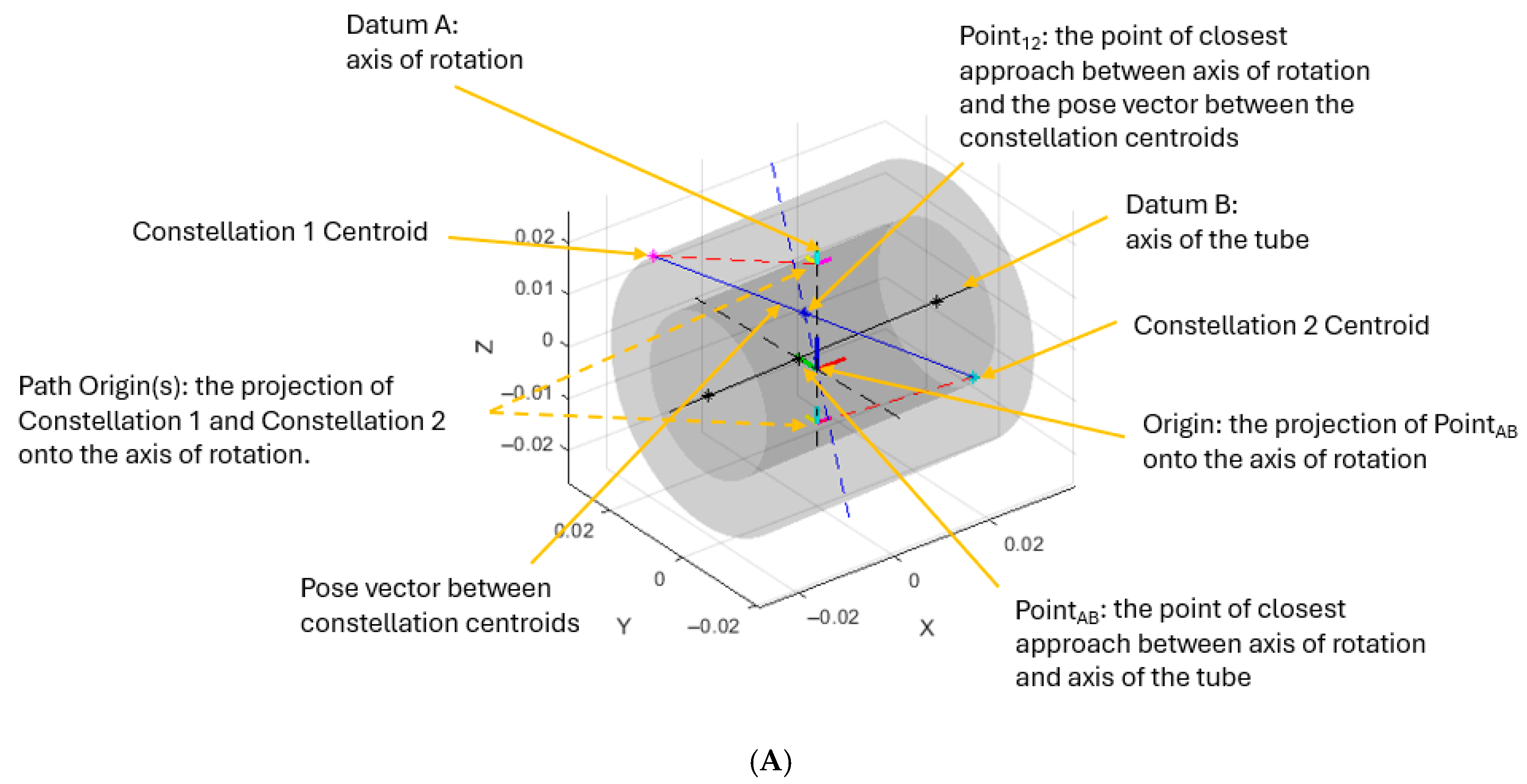
- Local coordinate frame refers to the artefact’s calibration frame constructed from its physical datums (e.g., Datum A: axis of rotation; Datum B: tubular body axis) and origin definition and is the frame in which the circular path and its intrinsic coordinates are parameterised.
- Object coordinate frame refers to a frame attached to an individual target constellation or feature mounted on the artefact (e.g., tiles, SMRs, locator devices), used when reporting pose relative to the local frame or when defining constellation-specific orientations.
- (1)
- Datum A is the axis of rotation which defines the z direction.
- Datum A is determined by measurement of a locator pin feature nominally coincident with the axis of rotation. Error associated with the rotation or misalignment of the locator pin can be accounted for by measuring the locator pin multiple times whilst rotating the artefact using the actuator as an additional step in the calibration procedure.
- (2)
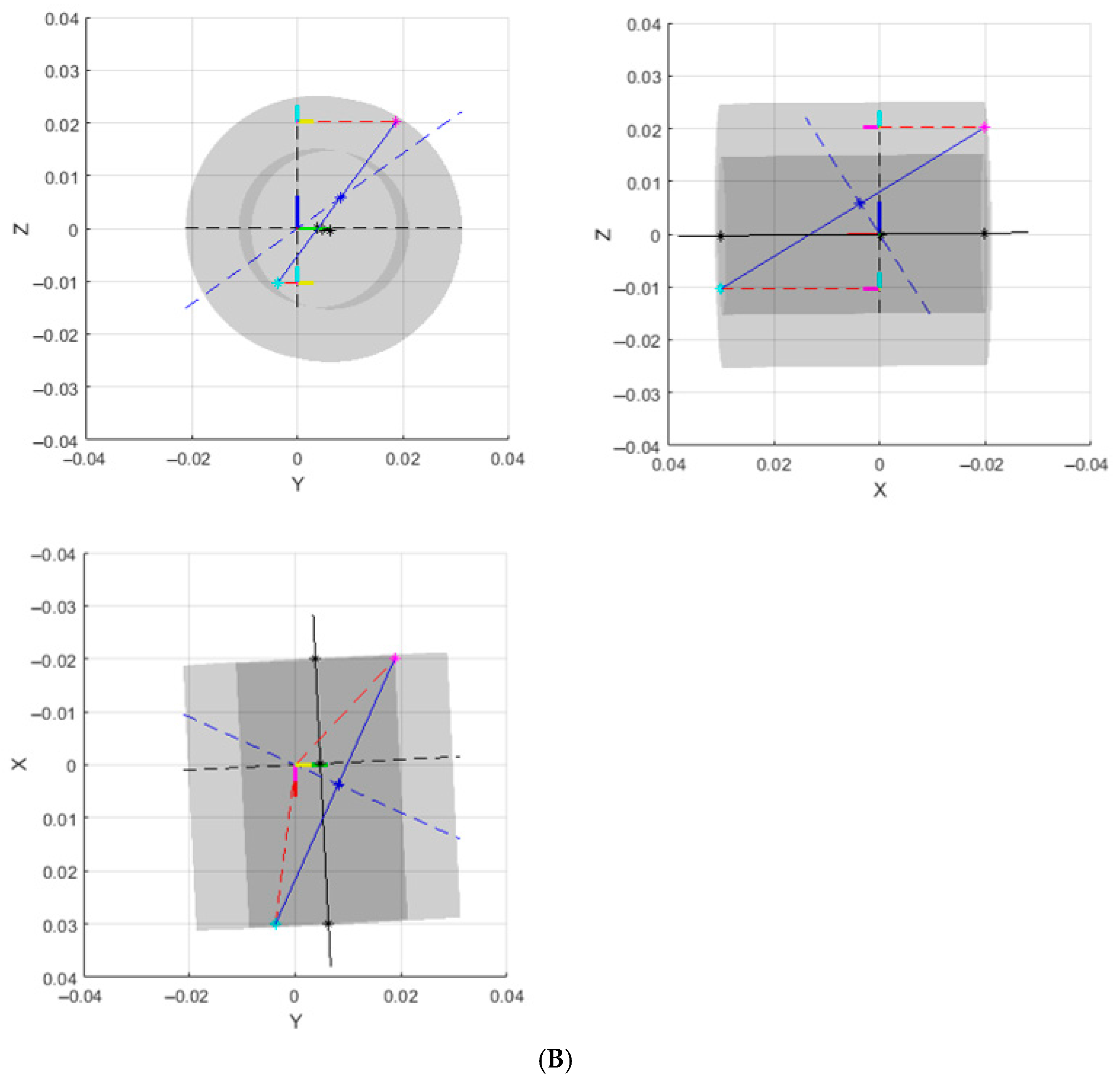
- Datum B is the axis of the tubular body. The orientation of the projection of Datum B onto the plane perpendicular to Datum A defines the x orientation.
- The axis of the tubular body is measured by sampling the outer surface of the tube at both sides of the split clamp.
- (3)
- The origin is determined by the point of closest approach between the axis of rotation (Datum A) and the axis of the tubular body (Datum B) projected onto Datum A within the plane perpendicular to Datum A.
- (4)
- The y orientation is defined as orthogonal to the x and z directions.
- (5)
- The target constellation centroids are determined by measuring the relative positions of the target(s) that constitute the constellation.
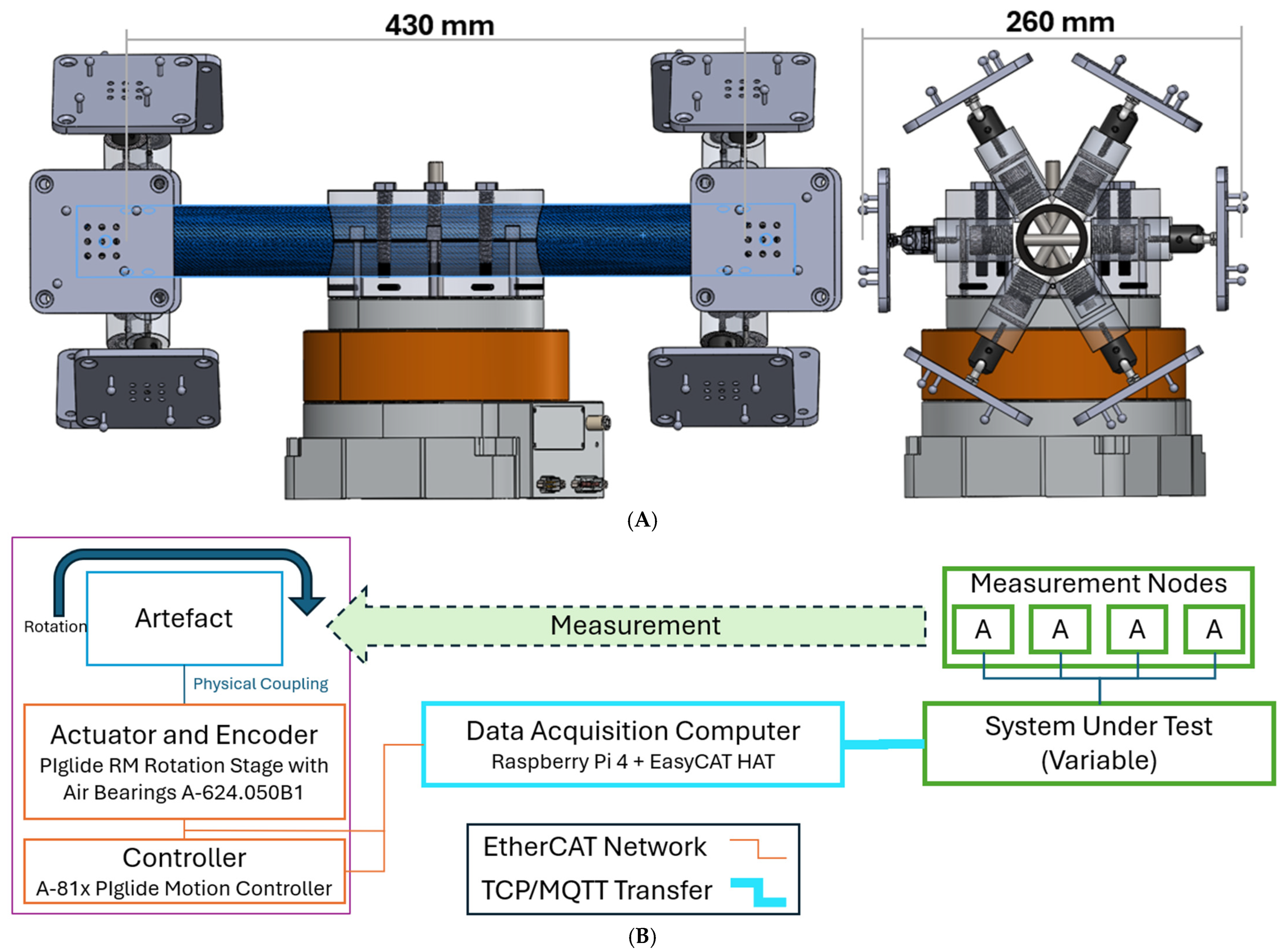
- For the example given in Figure 2 this involves measuring the centroids of multiple spherical retroreflector targets and taking the average. Although technically challenging it is, conceptually, a simple measurement of physical spheres. For other technologies the traceable measurement of the target constellation centroids may be non-trivial
- (6)
- The origin of the respective paths of the two target constellation centroids is defined as the projection of the centroids onto the axis of rotation (Datum A) within the plane perpendicular to Datum A.
- (7)
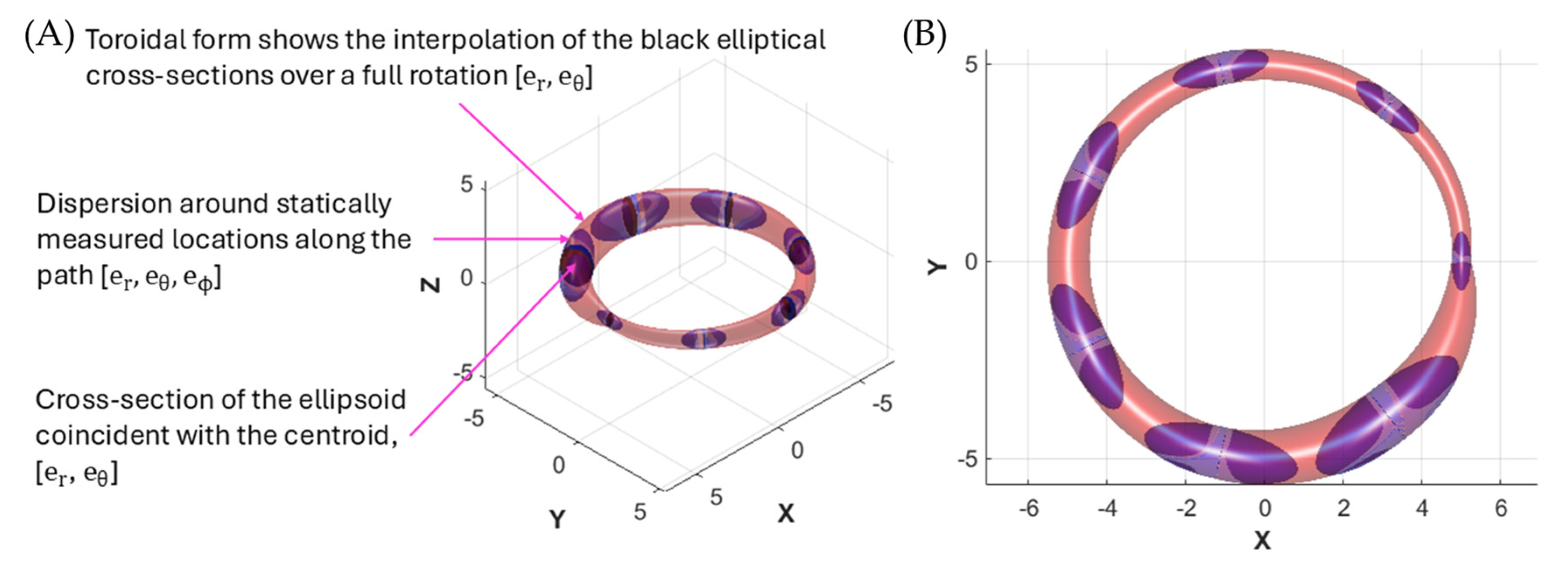
- A coordinate frame is established for each target constellation with the origin at the centroid of the spheres orientated with the ex_constellation = er_path, ey_constellation = eθ_path, and ez_constellation = eφ_path, where er_path, eφ_path, eθ_path describe the intrinsic coordinates of the circular path of the constellation centroid as it rotates around Datum A.
- (8)
- Additional features, e.g., SMRs or physical locator devices, can be incorporated into the artefact assembly and their position and orientation within the object coordinate system measured during calibration procedures.
2.5. Data Acquisition
2.6. Data Analysis
2.6.1. Overview
2.6.2. Analysis 1: End-to-End Latency Measurement—Temporal Synchronisation
2.6.3. Analysis 2: Comparison to Expected Path
2.6.4. Analysis 3: Intra-System Comparison—Dynamic Measurement Against Statistically Determined Path
2.6.5. Analysis 4 Relative Pose of the Two Target Constellations
2.6.6. Analysis 5 Correlation of Paired Target Constellation Pose Deviations from Mean
2.6.7. Analysis 6: Inter-System Comparison
2.7. Error Modelling
3. Results and Discussion
3.1. Analysis #1
3.2. Analysis #2
3.3. Analysis #3
4. Conclusions
- Gap 1—Technology agnosticism. By designing a generalisable geometric test defining performance in the intrinsic coordinates of the path and enabling both intra-system and inter-system comparison (including concurrent operation when feasible), the method decouples evaluation from specific instrument architectures and supports cross-technology benchmarking. It is however noted that calibration of specific targets/beacons depending on technology may be a complicating factor.
- Gap 2—Coherent static and dynamic characterisation. The methodology integrates three protocols: oscillation for latency/synchronisation, stop-measure-move for static path determination, and continuous motion for speed-dependent dynamic performance within a single framework, so dynamic outcomes are referenced to an internally consistent static baseline. Although not covered in detail the presence of two constellations allows the artefact to be used for relative pose measurements in line with ASTM E3064-16.
- Gap 3—Complex system/process variables. The artefact design accommodates reconfigurable target constellations and minimises self-occlusion, providing a practical baseline. We acknowledge that comprehensive coverage of occlusion patterns, sensor/target configurations, multi-target motion, and large workspaces is impractical solely via physical testing; thus, we propose virtualisation and modular extensions to broaden applicability.
- Gap 4—Industrial relevance and environmental realism. The method is conceived for in situ (re)verification and acceptance and explicitly considers environmental influence factors in the test design and uncertainty model. However, rigorous environmental robustness (temperature, ambient lighting, humidity, vibration) and high-rate temporal metrics (clock-skew, packet loss) remain open areas; we therefore commit to integrating formal environmental monitoring and a traceable ground-truth time source in future iterations to demonstrate industrial relevance at scale.
Author Contributions
Funding
Data Availability Statement
Acknowledgments
Conflicts of Interest
References
- Sitjongsataporn, S.; Paenoi, N. Development of Single-Arm Robots for Automotive Body Assembly Automation. In Proceedings of the 2023 International Conference on Power, Energy and Innovations (ICPEI 2023), Hua Hin, Thailand, 18–20 October 2023; pp. 61–64. [Google Scholar] [CrossRef]
- Das, P. Implementing Advanced Robotics to Optimize Manufacturing Cycle Times in Automotive Production Lines. Int. J. Multidiscip. Res. 2023, 5, 1–5. [Google Scholar]
- Tripathi, S. Engineering the Future: Robotics in the Automotive Industry Explained. Int. J. Sci. Res. Eng. Manag. 2024, 8, 1–7. [Google Scholar] [CrossRef]
- Löfving, M.; Almström, P.; Jarebrant, C.; Wadman, B.; Widfeldt, M. Evaluation of flexible automation for small batch production. Procedia Manuf. 2018, 25, 177–184. [Google Scholar] [CrossRef]
- Bilancia, P.; Schmidt, J.; Raffaeli, R.; Peruzzini, M.; Pellicciari, M. An Overview of Industrial Robots Control and Programming Approaches. Appl. Sci. 2023, 13, 2582. [Google Scholar] [CrossRef]
- Messina, E.R.; Saidi, K.S. Research Opportunities for Advancing Measurement Science for Manufacturing Robotics Research Opportunities for Advancing Measurement Science for Manufacturing Robotics; National Institute of Standards and Technology: Gaithersburg, MD, USA, 2024. [Google Scholar]
- Adebayo, R.A.; Obiuto, N.C.; Olajiga, O.K.; Festus-Ikhuoria, I.C. AI-enhanced manufacturing robotics: A review of applications and trends. World J. Adv. Res. Rev. 2023, 21, 2060–2072. [Google Scholar] [CrossRef]
- Simonič, M.; Hrovat, M.M.; Džeroski, S.; Ude, A.; Nemec, B. Determining Exception Context in Assembly Operations from Multimodal Data. Sensors 2022, 22, 7962. [Google Scholar] [CrossRef] [PubMed]
- Javaid, M.; Haleem, A.; Singh, R.P.; Rab, S.; Suman, R. Significant applications of Cobots in the field of manufacturing. Cogn. Robot. 2022, 2, 222–233. [Google Scholar] [CrossRef]
- Maitry, C.; Raj, H.; Wangchuk, S.; Madan, A.K. Extensive Review of Advancements in Telecommunications/Iot With Mems and Rf Passives. Int. Res. J. Mod. Eng. Technol. Sci. 2023, 5, 2582–5208. [Google Scholar] [CrossRef]
- Gielis, J.; Shankar, A.; Prorok, A. A Critical Review of Communications in Multi-robot Systems. Curr. Robot. Rep. 2022, 3, 213–225. [Google Scholar] [CrossRef] [PubMed]
- Coyle, D.; Hampton, L. 21St Century Progress in Computing. Telecomm. Policy 2023, 48, 102649. [Google Scholar] [CrossRef]
- Jayaweera, N.; Webb, P. Metrology-assisted robotic processing of aerospace applications. Int. J. Comput. Integr. Manuf. 2010, 23, 283–296. [Google Scholar] [CrossRef]
- Lindqvist, R.P.; Strand, D.; Nilsson, M.; Collins, V.; Torstensson, J.; Kressin, J.; Spensieri, D.; Archenti, A. 3D Model-Based Large-Volume Metrology Supporting Smart Manufacturing and Digital Twin Concepts. Metrology 2023, 3, 29–64. [Google Scholar] [CrossRef]
- Muralikrishnan, B.; Phillips, S.; Sawyer, D. Laser trackers for large-scale dimensional metrology: A review. Precis. Eng. 2016, 44, 13–28. [Google Scholar] [CrossRef]
- Trends in Aerospace Assembly: Measurement Assisted Assembly. Available online: https://www.faro.com/en/Resource-Library/Article/trends-in-aerospace-assembly-introduction#:~:text=As%20we%20shall%20see%20in,less%20complexity%20and%20less%20cost (accessed on 28 February 2025).
- Grant Agreement Number 17IND03 Project Short Name LaVA Project Full Title Large Volume Metrology Applications. Available online: http://empir.npl.co.uk/lava/ (accessed on 10 November 2025).
- Franceschini, F.; Galetto, M.; Maisano, D.; Mastrogiacomo, L. Combining multiple Large Volume Metrology systems: Competitive versus cooperative data fusion. Precis. Eng. 2016, 43, 514–524. [Google Scholar] [CrossRef]
- ISO 10360-2:2009; Geometrical Product Specifications (GPS)—Acceptance and Reverification Tests for Coordinate Measuring Machines (CMM)—Part 2: CMMs Used for Measuring Linear Dimensions. British Standards Institution: London, UK, 2010.
- ISO 10360-10:2021; Geometrical Product Specifications (GPS)—Acceptance and Reverification Tests for Coordinate Measuring Systems (CMS)—Part 10: Laser Trackers. British Standards Institution: London, UK, 2021.
- ISO 10360-12:2016; Geometrical Products Specifications (GPS)—Acceptance and Reverification Tests for Coordinate Measuring Systems (CMS)—Part 12: Articulated Arm Coordinate Measurement Machines (CMM). British Standards Institution: London, UK, 2016.
- ISO 10360-13:2021; Geometrical Product Specifications (GPS)—Acceptance and Reverification Tests for Coordinate Measuring Systems (CMS)—Part 13: Optical 3D CMS. British Standards Institution: London, UK, 2021.
- VDI/VDE 2634; Optical 3D Measuring Systems—Part 1 Imaging Systems with Point-by-Point Probing. Verein Deutscher Ingenieure: Berlin, Germany, 2002.
- VDI/VDE 2634; Optical 3D Measuring Systems—Part 3 Multiple View Systems Based on Area Scanning. Verein Deutscher Ingenieure: Berlin, Germany, 2008.
- ASME B89.4.19-2006; Performance Evaluation of Laser Based Spherical Coordinate Measurement Systems. ASME: New York, NY, USA, 2006.
- ASTM E2919-22; Standard Test Method for Evaluating the Performance of Systems That Measure Static, Six Degrees of Freedom (6DOF), Pose. ASME: New York, NY, USA, 2023; pp. 1–18. [CrossRef]
- ASTM E3064-16; Standard Test Method for Evaluating the Performance of Optical Tracking Systems that Measure Static, Six Degrees of Freedom (6DOF) Pose. ASME: New York, NY, USA, 2013; pp. 1–16. [CrossRef]
- ISO/IEC 18305:2016; Information Technology—Real Time Locating Systems—Test and Evaluation of Localization and Tracking systems. British Standards Institution: London, UK, 2016.
- BS EN ISO 9283:1998; Manipulating Industrial Robots. Performance Criteria and Related Test Methods. British Standards Institution: London, UK, 1998.
- ISO 17123; Optics and Optical Instruments—Field Procedures for Testing Geodetic and Surveying Instruments. British Standards Institution: London, UK, 2022.
- ISO 80000-2:2019; Quantities and Units—Part 2: Mathematics. BSI Standards Publication: London, UK, 2019.
- Cieslik, K.; Łopatska, M.J. Research on Speed and Acceleration of Hand Movements as Command Signals for Anthropomorphic Manipulators as a Master-Slave System. Appl. Sci. 2022, 12, 3863. [Google Scholar] [CrossRef]
- Martin, O.; Southon, N.; Meekums, P.; Davey, C.; Yu, N. Comparing performance evaluation methods for assessing an industrial robot tracking system. In Proceedings of the Lamda Map 2023, Laser Metrology and Machine Performance XV—15th International Conference and Exhibition on Laser Metrology, Coordinate Measuring Machine and Machine Tool Performance, Edinburgh, UK, 14–15 March 2023; pp. 205–215. [Google Scholar]
- ISO 230-7:2015; Test Code for Machine Tools—Part 7: Geometric Accuracy of Axes of Rotation. British Standards Institution: London, UK, 2015. Available online: https://www.iso.org/standard/56624.html (accessed on 13 June 2025).
- Torr, P.H.S.; Zisserman, A. MLESAC: A new robust estimator with application to estimating image geometry. Comput. Vis. Image Underst. 2000, 78, 138–156. [Google Scholar] [CrossRef]





| Standard/Guideline | Scope and Coverage | DLVM Applicability/Gaps |
|---|---|---|
| ISO 10360 series (GPS—Acceptance and reverification tests for CMMs) * [19,20,21,22] | Defines procedures to verify static dimensional accuracy (typically by measuring calibrated artefacts like gauge blocks or lengths) for specific classes of measuring systems. Each part targets one instrument type (CMM, laser tracker, etc.), focusing on point accuracy and length measurement errors under controlled conditions. | Provides traceable accuracy benchmarks for static measurements in large volumes (e.g., laser tracker length accuracy) but are not designed for moving targets or real-time tracking. Orientation (rotational) error is only indirectly tested (e.g., via multiple lengths). Dynamic performance (latency, tracking fidelity) is outside the scope. Each part is instrument-specific, so cross-technology comparison is difficult. |
| VDI/VDE 2634 Parts 1–3 (Guidelines, 2008) [23,24] | German consortium standards for optical 3D measuring systems. Part 1 covers point-to-point length measurement tests (e.g., using calibrated length artefacts). Parts 2 and 3 cover surface and multi-view scanning systems (e.g., fringe projection, photogrammetry) with defined test artefacts and geometry checks. | Used for verifying static accuracy of optical measurement systems (e.g., camera-based systems). Applicable to large-volume photogrammetry (Part 3) for static points. However, assumes measurements on a stationary artefact; no provisions for target motion or real-time tracking. Thus, not fully representative for DLVM dynamic use-cases (e.g., tracking moving assemblies). |
| ASME B89.4.19 (2021 revision) [25] | American standard for laser tracker performance evaluation. Specifies tests for 3D distance accuracy (similar to ISO 10360-10 [20]) and includes an interim field check (e.g., two-face measuring tests). Focused on single-point accuracy and drift over time. | Ensures a laser tracker meets accuracy specs in static measurements (e.g., measuring fixed scale bars at various angles). Orientation (6DOF probe) accuracy and dynamic tracking are not explicitly characterised. Geared toward static calibration/verification; thus limited insight into performance during continuous motion or for non-tracker systems. |
| ASTM E2919–22 [26] | ASTM test method for evaluating static 6DOF pose measurement systems. Involves measuring a test object’s position and orientation against known references to quantify pose errors in six degrees of freedom, under static conditions. | Provides a 6DOF performance assessment (position/orientation accuracy) for systems like optical trackers or indoor GPS, but only in static scenarios (e.g., fixed poses). Requires a reference system with greater accuracy to compare against; this may not always be available. Does not evaluate tracking continuity, update latency, or performance while the object is moving. Serves as a precursor to dynamic tests (it is cited as “the static case” for 6DOF systems), but insufficient alone for DLVM dynamics. |
| ASTM E3064–16 [27] | ASTM test method for dynamic 6DOF optical tracking systems. Defines a moving test trajectory for a tracked “metrology bar” artefact within a volume, and metrics (RMS, max, percentile errors in position and orientation) to evaluate dynamic accuracy. Focused on camera-based optical systems (e.g., infrared marker tracking). | It is one of the first standards targeting dynamic metrology, providing statistical error metrics for moving target tracking. Highly relevant to DLVM in that it addresses time-dependent accuracy. Limitations: Technology-specific (built around optical marker tracking; assumes line-of-sight camera systems and a defined artefact). Other DLVM technologies (e.g., laser trackers or multi-sensor networks) might need different artefacts or adaptations. Also, latency is acknowledged as important but not explicitly measured in this standard. |
| ISO/IEC 18305:2016 [28] (International standard for indoor Localisation and Tracking Systems) | Provides general test and evaluation (T&E) procedures for localisation/tracking systems in various scenarios. It introduces standardised performance metrics (accuracy, latency, coverage) and test layouts for systems like indoor GPS, UWB, optical or hybrid tracking—often aimed at emergency responders, robotics, or asset tracking. | Relevant as a framework for holistic tracking performance. It stresses using common metrics and scenarios so different systems can be compared. However, it is not specific to high-precision manufacturing metrology: the accuracy levels and traceability focus may not meet micron-level needs of DLVM. It also deals with whole-system performance in a broad sense, rather than calibrating metrology instruments. Still, it highlights how standardised tests can remove ambiguity (a model for DLVM standardisation to emulate). |
| Others/Emerging: ISO 9283:1998 [29] (robot performance); ISO 17123 [30] series (field surveying instruments); Empirical frameworks (e.g., Global Reference Systems) | ISO 9283 defines how to measure robot accuracy and repeatability in an automation context (often using external metrology to gauge robot end-point error). ISO 17123 covers field test procedures for devices like theodolites, total stations (large-scale but static measurements, often outdoors). Recent research proposes frameworks like a “Global Reference System” for factory-wide metrology integration to support flexible automation. | Robot and surveying standards provide context e.g., the need to verify dynamic machine accuracy (robots) or perform large-scale measurements (geodetic instruments) but do not provide methods to characterise the metrology systems themselves under dynamic conditions. The proposed factory reference frameworks aim to combine multiple metrology sources for unified coordinates, which underscores the need for interoperability and consistent characterisation, but these are conceptual and not yet formal standards. |
| Test Parameter/Variable | Considerations | Treatment |
|---|---|---|
| Sensor and target Configuration | Easy to control for but difficult to dynamically alter. Different technologies may impose different requirements. | Test will be designed to accommodate sensor reconfiguration but to remain technology agnostic and allow task-specific refinement the configuration will not be dictated. A potential target of modelling approaches. |
| Sensor/Target Occlusion | For generalised dynamic application individual targets are expected to move in and out of measurement node detection range and/or to be occluded. | Test will be designed to minimise self-occlusion with the provision to add occlusion as a task-specific test variable in the future. Quantifying occlusion and sensor coverage is non-trivial and will likely involve modelling; this is currently out of scope. Coverage of the entire working volume is difficult given the large volumes over which these systems can operate. |
| Position | Principle measurand expressed as a function of location on a path. Could be held constant as a snapshot along a path assuming accurate temporal synchronisation. | The test will establish a ground truth position at a given time to compare against. |
| Orientation | Principle measurand expressed as a function of location on a path. Could be held constant as a snapshot along a path assuming accurate temporal synchronisation. | The test will establish a ground truth orientation at a given time to compare against. |
| Velocity | Principle variable. Parameterised as rate of change in location on a path with time. Upper limit assigned to be 3 m·s−1 as defined an upper limit on the speed of a human hand [32] | At 3 m·s−1 a temporal accuracy of 1 µs would result in a positional accuracy of 3 µm is the current upper bound targeted by the test. |
| Time synchronisation and Latency (accuracy, jitter, latency, drift, resolution, discretisation) | Temporal uncertainty manifests as an uncertainty on the path location and therefore position and orientation in real and measurement space. System clock latency, jitter, and drift should be handled by the synchronisation protocol. It is feasible that a DLVM system manufacturer may integrate a grandmaster quality time source to enhance the accuracy of their system. There may be latency between the trigger, data capture, time stamp, telegraph, and data receive events. Measurement latency may be variable, especially if processing is performed prior to the timestamp event, e.g., at the node level. Every data capture or telegraph event requires a discrete amount of time to complete which imposes a physical limitation on the spatial specificity of a measurement system. This value is also limited by the synchronicity of nodes. | High-accuracy temporal synchronisation must be established between any actuator and the data acquisition method. Ideally temporal synchronisation should also be achieved with the system under test. If the DLVM system has an integrated grandmaster time source its performance should be handled by other standards. The test should be able to accommodate different methods of synchronisation. Even with high-accuracy temporal synchronisation between the actuator and system under test there may still be variable latency associated with any pre-processing steps performed at the node level by the system under test prior to time stamping of a data capture event. This should be measured as part of the test. Network architecture should be simple and optimised to reduce additional latency due to the experimental setup. The test should aim to achieve a temporal accuracy of ≤1 µs. Furthermore, to accommodate different technologies, the test method must be adaptable to different levels of integration between the system under test and the path actuator. With an expected upper bound on temporal accuracy of 1 µs path location accuracy can be expected to be 3 µm. This can potentially be corrected for in the reference values with an appropriate error model. |
| Path Geometry, Kinematics, and Uncertainty | The position and orientation must be parameterised as a location on a known path at a given time. Example paths may include linear (discrete or oscillatory), Circular (continuous or oscillatory), or free form. | Location on a path must be controlled and known to a high degree of accuracy. Rotational paths allow for steady state motion and simplify control. Synchronisation with other systems will be achieved temporally. Contributions to uncertainty on the path include structural integrity of the artefact, characteristics of the path actuator, temporal factors, and reference measurement uncertainty. Deflection from the path can be estimated in the steady state through artefact characterisation and kinematic modelling. Temporal factors require a ground truth source of time. |
| Spatial Ground Truth (calibration activities) | Traceability back to the primary standard may be difficult depending on the complexity of the calibration procedure applied to the physical reference artefact. | Efforts should be taken to propagate uncertainty on the reference values through appropriate metrology. |
| Temporal Ground Truth | To test synchronisation and temporal error a high accuracy and traceable source of time should be provided. | Ideally, a grand master clock capable of outputting time using Precision Timing Protocol and EtherCAT should be present. |
| Dynamic Motion and Forces: acceleration, jerk, vibration | Dynamic motion (acceleration, jerk) and dynamic forces such as air resistance or variable gravitational force vector have the potential to distort a physical artefact or introduce vibration. | To simplify the problem during the development stage a path will be chosen perpendicular to the gravitational force vector. This allows the establishment of steady state motion. The test will be performed at continuous motion and allowed sufficient time to reach dynamic equilibrium. Acceleration and jerk will be adjusted to minimise the introduction of vibration. Vibrational modes should be characterised and resonant excitation avoided. |
| Packet Loss/Data Drops | Loss of data packets impacts dynamic measurement uncertainty. | Loss of data is a source of uncertainty in the temporal domain and has implications on the use of DLVM for control. The implications are task specific; however, a generic metric for packet loss should be quoted as part of the test. |
| Environmental Factors (temperature, pressure, humidity, air flow) | The test apparatus and the system under test will be sensitive to environmental conditions to a greater or lesser extent. | Ideally, the environmental conditions should be controlled and held constant to within an acceptable window. To allow in situ testing the apparatus could incorporate sensors to monitor environmental conditions. The test apparatus will be designed to minimise the influence of environmental factors on the ground truth values. An error model must be constructed to account or compensate for measurable variation in the test environmental conditions. |
| Parameter mapping/spatial coverage (isotropy, homogeneity) | The test should cover the entire working volume at all orientations. | Due to the nature of DLVM systems, their large working volumes, constraints on physical targets, and degrees of freedom of their measurement, it may be impractical to comprehensively test measurement performance throughout the working volume. Any test developed may need to be repeated over multiple regions and at different orientations to characterise a system. Measurement strategies may have to be developed with consideration of generalisation across technologies and/or in relation to a specific task. |
| Analysis Designation | Analysis Title | Measurement |
|---|---|---|
| 1 | End-to-end latency measurement. | Temporal offset between path location as measured by the actuator encode and measurement event. |
| 2 | Comparison to expected path. The path is expected to be circular. | Short-range scale error and spatial distortion as a function of location on the path. |
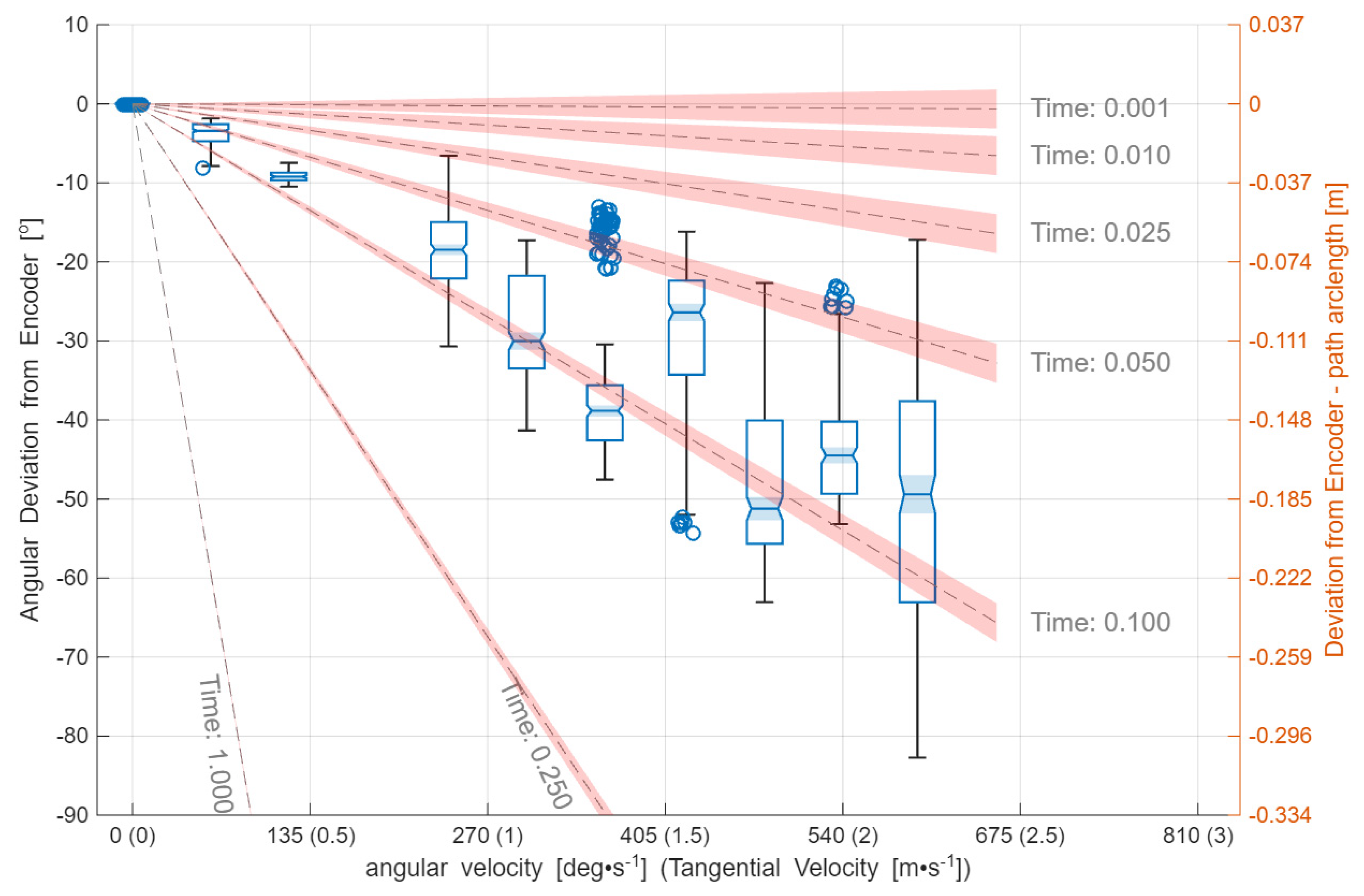
| 3 | Intra-system comparison—compare the system under test’s dynamic measurement against its statically measured path. | 6 DoF measurement performance as a function of angular velocity relative to static performance. |
| 4 | Relative pose of the two target constellations. | Short-range scale error and 6 DoF measurement performance independent of temporal error, error on the path, and error on the global coordinate frame (akin to ASTM E3064–16). Results convolve error on position and orientation. |
| 5 | Correlation of paired deviations from mean position of concurrently measured target constellations. | Indication of influence factors that operate on both target constellations in the same way (e.g., drift or variable error on the global coordinate frame). |
| 6 | Inter-system comparison against a reference system with data collected concurrently or sequentially. | Benchmarking, absolute error. |
| Parameter | Source | ||
|---|---|---|---|
| Rotary-stage kinematics | |||
| 1 | Radial error motion (run-out) | Normal | PI datasheet |
| 2 | Axial error motion | Normal | PI datasheet |
| 3 | Dynamic tilt (wobble) | Normal | PI datasheet |
| 4 | Static rotary-axis offset | Normal | CMM calibration |
| 5 | Static rotary-axis tilt | Normal | CMM calibration |
| Stage control/dynamics | |||
| 6 | Angular velocity | Normal | PI servo spec |
| 7 | Encoder quantisation and cyclic error | Rect. → Normal | PI encoder spec |
| 8 | Timing and synchronisation jitter | Normal | Controller datasheet/EtherCAT network diagnostics |
| 9 | Constant latency | 1–5e_r | Estimated via Protocol 1, oscillation. |
| 10 | Sampling rate | Rect. → Normal | Controller datasheet/EtherCAT network diagnostics or experimental measurement |
| Stage stiffness and inertia | |||
| 11 | Stage translational stiffness (X,Y,Z) | Normal | PI datasheet |
| 12 | Stage polar inertia (θZ) | Normal | PI datasheet |
| Tube and beam | |||
| 13 | Tube Young’s modulus | Normal | Manufacturer cert. |
| 14 | CF coefficient of thermal expansion | Normal | Literature/Experimentally derived |
| 15 | Tube mounting eccentricity | Normal | CMM calibration |
| 16 | Tube non-parallelism angle | Normal | CMM calibration |
| 17 | First bending natural frequency | Normal | Euler-Bernoulli clac./Experimental modal analysis |
| 18 | Model damping ratio | Normal | Impact-hammer test |
| Spoke | |||
| 19 | Tube Young’s modulus | Normal | Literature/Experimentally derived |
| 20 | CF coefficient of thermal expansion | Normal | Literature/Experimentally derived |
| Target constellations/optical targets | |||
| 21 | Target constellation alignment to tube axis | Normal | CMM calibration |
| 22 | Calibration centroid noise (one-shot) | Normal | CMM calibration |
| Environment | |||
| 23 | Ambient temperature change | Normal | Lab log |
Disclaimer/Publisher’s Note: The statements, opinions and data contained in all publications are solely those of the individual author(s) and contributor(s) and not of MDPI and/or the editor(s). MDPI and/or the editor(s) disclaim responsibility for any injury to people or property resulting from any ideas, methods, instructions or products referred to in the content. |
© 2026 by the authors. Licensee MDPI, Basel, Switzerland. This article is an open access article distributed under the terms and conditions of the Creative Commons Attribution (CC BY) license.
Share and Cite
Gorman, D.; Pottier, C.; Cibrian, M.; Johnston, S. Quantifying the Performance of Distributed Large-Volume Metrology Systems for Dynamic Measurements: Methodology Development. Metrology 2026, 6, 7. https://doi.org/10.3390/metrology6010007
Gorman D, Pottier C, Cibrian M, Johnston S. Quantifying the Performance of Distributed Large-Volume Metrology Systems for Dynamic Measurements: Methodology Development. Metrology. 2026; 6(1):7. https://doi.org/10.3390/metrology6010007
Chicago/Turabian StyleGorman, David, Claire Pottier, Marta Cibrian, and Samual Johnston. 2026. "Quantifying the Performance of Distributed Large-Volume Metrology Systems for Dynamic Measurements: Methodology Development" Metrology 6, no. 1: 7. https://doi.org/10.3390/metrology6010007
APA StyleGorman, D., Pottier, C., Cibrian, M., & Johnston, S. (2026). Quantifying the Performance of Distributed Large-Volume Metrology Systems for Dynamic Measurements: Methodology Development. Metrology, 6(1), 7. https://doi.org/10.3390/metrology6010007