


Beyond Play—Serious Games, Gamification in Education, and Game-Based Learning
This special issue belongs to the section "Human–Computer Interactions".
Special Issue Information
Dear Colleagues,
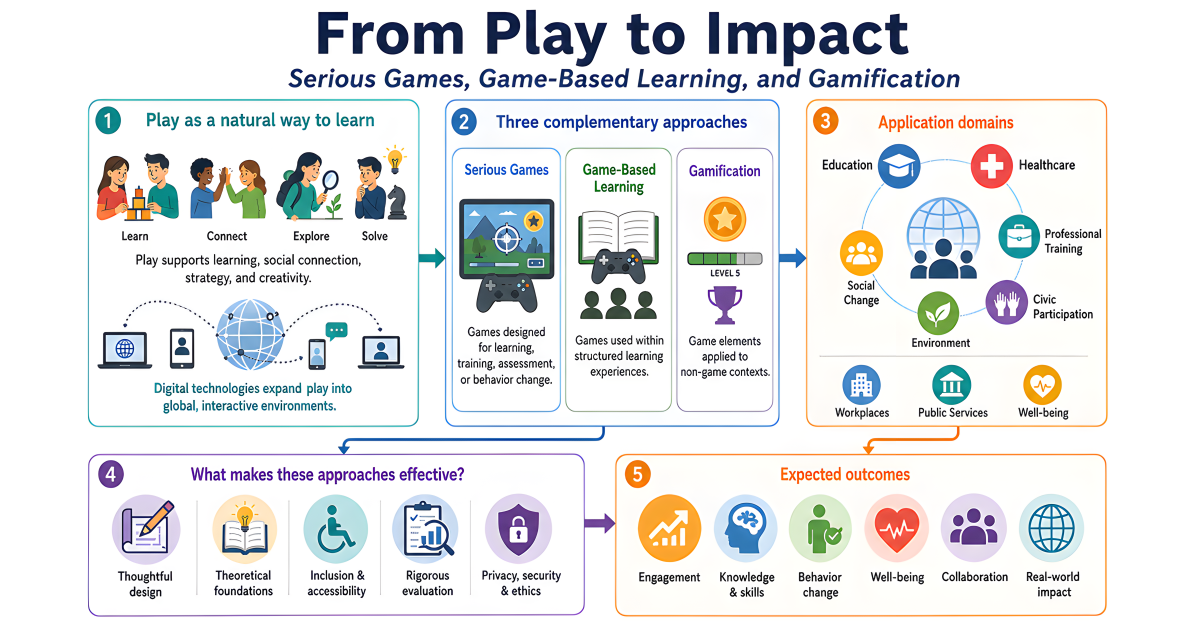
Play is one of the most natural ways in which people learn, connect, and make sense of the world. Long before the digital age, games already provided spaces for developing skills, strengthening social bonds, testing strategies, and exploring new ideas. Digital technologies have greatly expanded these possibilities, transforming games into global environments for interaction, creativity, experimentation, and change.
Serious games, game-based learning, and gamification raise a simple but powerful question: What if the same design principles that sustain engagement in games could be applied to education, healthcare, professional training, civic participation, environmental action, and social change?
However, serious games, game-based learning, and gamification represent distinct approaches. Serious games are designed primarily to achieve purposes beyond entertainment, such as learning, training, assessment, or behavioral change. Game-based learning involves the use of games as part of a structured learning experience. Gamification applies game-design elements and principles—such as challenges, feedback, progression, narratives, and rewards—to activities that are not themselves games.
Research and practice in these domains are producing increasingly diverse answers, from educational games that promote curiosity and active learning to immersive simulations that help professionals develop complex skills, from exergames that encourage physical activity and active life practices to community-based games that support collaboration, and playful campaigns that raise awareness of urgent social and environmental challenges. These approaches are creating new opportunities to improve learner engagement, strengthen knowledge and skill development, support healthier behaviors, enhance professional preparation, and encourage public participation. However, achieving meaningful outcomes requires thoughtful design, sound theoretical foundations, inclusive and accessible experiences, rigorous evaluation, and careful consideration of privacy, security, and ethics.
This Special Issue brings together cutting-edge research, critical perspectives, innovative methods, and real-world applications related to serious games, gamification, and game-based learning. We welcome theoretical, empirical, methodological, and practice-oriented contributions that demonstrate innovation, provide evidence of impact, examine limitations, and advance understanding of how games can contribute to education, industry, health, and society.
Topics of interest include, but are not limited to, the following:
- Serious games for education, healthcare, professional development, and workforce training;
- Game-based learning practices, pedagogical models, and design frameworks;
- Gamification strategies in education, workplaces, public services, and other non-game contexts;
- Advergames, branded games, and persuasive play experiences;
- Exergames for physical activity, rehabilitation, mental health, and well-being;
- Pervasive, mobile, and location-based games;
- Games for civic participation and social, cultural, or environmental awareness;
- Emerging technologies for serious games, including virtual, augmented, mixed, and extended reality;
- Artificial intelligence for serious games, adaptive systems, digital twins, wearables, haptics, and intelligent feedback;
- Personalization, learning analytics, player modeling, and data-informed game design;
- Evaluation methods and the assessment of engagement, learning, skill transfer, behavior change, and real-world impact;
- Psychological dimensions of play, including motivation, immersion, presence, agency, emotion, and flow;
- Collaborative, multiplayer, and community-driven serious games;
- Accessibility, inclusion, cultural adaptation, and equitable participation;
- Security, privacy, data governance, responsible design, and ethics;
- Participatory, user-centered, and co-design approaches;
- Case studies, implementation challenges, unsuccessful interventions, and lessons learned.
We invite researchers, educators, designers, developers, practitioners, and policymakers to explore how thoughtfully designed play can move beyond entertainment to support meaningful learning, influence behavior, improve well-being, foster social innovation, and generate measurable impact.
Prof. Dr. Carlos Vaz de Carvalho
Dr. Hariklia Tsalapatas
Dr. Ricardo Baptista
Guest Editors
Manuscript Submission Information
Manuscripts should be submitted online at www.mdpi.com by registering and logging in to this website. Once you are registered, click here to go to the submission form. Manuscripts can be submitted until the deadline. All submissions that pass pre-check are peer-reviewed. Accepted papers will be published continuously in the journal (as soon as accepted) and will be listed together on the Special Issue website. Research articles, review articles as well as short communications are invited. For planned papers, a title and short abstract (about 250 words) can be sent to the Editorial Office for assessment.
Submitted manuscripts should not have been published previously, nor be under consideration for publication elsewhere (except conference proceedings papers). All manuscripts are thoroughly refereed through a single-anonymized peer-review process. A guide for authors and other relevant information for submission of manuscripts is available on the Instructions for Authors page. Computers is an international peer-reviewed open access monthly journal published by MDPI.
Please visit the Instructions for Authors page before submitting a manuscript. The Article Processing Charge (APC) for publication in this open access journal is 1800 CHF (Swiss Francs). Submitted papers should be well formatted and use good English. Authors may use MDPI's English editing service prior to publication or during author revisions.
Keywords
- game-based learning
- gamification
- serious games
- educational games
Benefits of Publishing in a Special Issue
- Ease of navigation: Grouping papers by topic helps scholars navigate broad scope journals more efficiently.
- Greater discoverability: Special Issues support the reach and impact of scientific research. Articles in Special Issues are more discoverable and cited more frequently.
- Expansion of research network: Special Issues facilitate connections among authors, fostering scientific collaborations.
- External promotion: Articles in Special Issues are often promoted through the journal's social media, increasing their visibility.
- Reprint: MDPI Books provides the opportunity to republish successful Special Issues in book format, both online and in print.
Published Papers


Computers - ISSN 2073-431X