


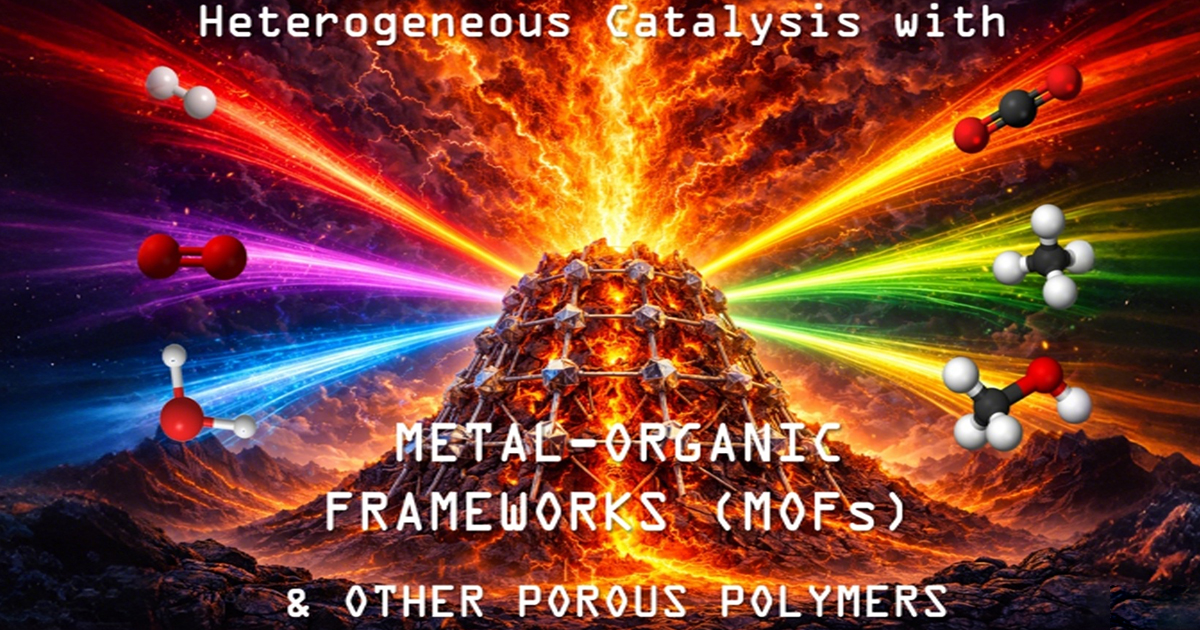
Heterogeneous Catalysis with Metal-Organic Frameworks (MOFs) and Other Porous Polymers
This special issue belongs to the section "Catalytic Materials".
Special Issue Information
Dear Colleagues,
Porous framework materials have rapidly emerged as one of the most dynamic areas in modern catalysis. Metal–organic frameworks (MOFs), coordination polymers, and related porous polymers offer exceptional opportunities for the rational design of catalytic systems thanks to their high surface areas, tunable porosity, and the possibility of precisely engineering active sites and defects. These unique characteristics enable the development of advanced catalysts for a broad range of chemical transformations relevant to energy, environmental remediation, and sustainable chemical production.
The importance of these materials has been further highlighted by the 2025 Nobel Prize in Chemistry awarded for pioneering contributions to reticular chemistry and framework materials, underscoring their growing impact across chemistry and materials science.
This Special Issue aims to collect cutting-edge contributions on heterogeneous catalysis involving MOFs and other porous materials, including catalyst design, synthesis, structural engineering, defect chemistry, advanced characterization, and catalytic applications. Topics such as CO2 valorization, water splitting, solar fuels, and environmental catalysis are particularly encouraged, although other catalytic processes are also welcome.
We invite both research articles and reviews. Review papers should preferably focus on developments from the last five years and highlight emerging trends in the field.
Dr. Sergio Carrasco
Dr. Arianna Melillo
Guest Editors
Manuscript Submission Information
Manuscripts should be submitted online at www.mdpi.com by registering and logging in to this website. Once you are registered, click here to go to the submission form. Manuscripts can be submitted until the deadline. All submissions that pass pre-check are peer-reviewed. Accepted papers will be published continuously in the journal (as soon as accepted) and will be listed together on the Special Issue website. Research articles, review articles as well as short communications are invited. For planned papers, a title and short abstract (about 250 words) can be sent to the Editorial Office for assessment.
Submitted manuscripts should not have been published previously, nor be under consideration for publication elsewhere (except conference proceedings papers). All manuscripts are thoroughly refereed through a single-anonymized peer-review process. A guide for authors and other relevant information for submission of manuscripts is available on the Instructions for Authors page. Catalysts is an international peer-reviewed open access monthly journal published by MDPI.
Please visit the Instructions for Authors page before submitting a manuscript. The Article Processing Charge (APC) for publication in this open access journal is 2200 CHF (Swiss Francs). Submitted papers should be well formatted and use good English. Authors may use MDPI's English editing service prior to publication or during author revisions.
Keywords
- MOFs
- porosity
- defects
- coordination polymers
- CO2 valorization
- water splitting
- green solar fuels
- environmental remediation
Benefits of Publishing in a Special Issue
- Ease of navigation: Grouping papers by topic helps scholars navigate broad scope journals more efficiently.
- Greater discoverability: Special Issues support the reach and impact of scientific research. Articles in Special Issues are more discoverable and cited more frequently.
- Expansion of research network: Special Issues facilitate connections among authors, fostering scientific collaborations.
- External promotion: Articles in Special Issues are often promoted through the journal's social media, increasing their visibility.
- Reprint: MDPI Books provides the opportunity to republish successful Special Issues in book format, both online and in print.
Published Papers


Catalysts - ISSN 2073-4344