



Next Issue
Volume 10, May
Previous Issue
Volume 10, March


Soil Syst., Volume 10, Issue 4 (April 2026) – 5 articles
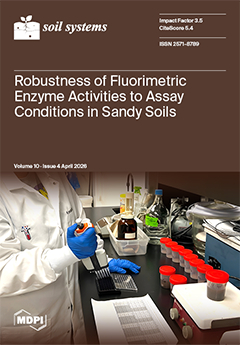
Cover Story (view full-size image): Biochemical soil health indicators are useful for quantifying soil health outcomes due to their sensitivity to management, but protocol optimization is often necessary to apply these indicators across different soil types. The microplate fluorometric soil enzyme assay is a reliable, rapid, and cost-effective assay for an indicator that responds quicker to management than other metrics. However, it currently lacks a standardized protocol, affecting the ability to both adapt the protocol and make appropriate result comparisons across regions. In this paper, the impact of different protocol conditions (temperature, pH, termination reagent) on fluorometric enzymatic activities was assessed for carbon-, nitrogen-, and phosphorus-associated enzymes, using seven coarse-textured soils of Florida (all >89% sand) as a basis for optimization. View this paper
  • Issues are regarded as officially published after their release is announced to the table of contents alert mailing list.
  • You may sign up for e-mail alerts to receive table of contents of newly released issues.
  • PDF is the official format for papers published in both, html and pdf forms. To view the papers in pdf format, click on the "PDF Full-text" link, and use the free Adobe Reader to open them.
Order results
Result details
Select all
Export citation of selected articles as:
24 pages, 1025 KB  
Review
Remediation of Contaminated Soils Using Organic Waste and Waste Products in Sub-Saharan Africa: A Review of Technologies, Adoption and Challenges
by Hamisi J. Tindwa and Bal Ram Singh
Soil Syst. 2026, 10(4), 49; https://doi.org/10.3390/soilsystems10040049 - 18 Apr 2026
Cited by 1 | Viewed by 1980
Abstract
Soil contamination in Sub-Saharan Africa (SSA) is increasingly driven by rapid industrialization, intensive agriculture, mining activities, and urban expansion, posing significant risks to food safety, ecosystem services, and human livelihoods. Despite the growing scale of the problem, low-cost, locally adaptable remediation technologies are [...] Read more.
Soil contamination in Sub-Saharan Africa (SSA) is increasingly driven by rapid industrialization, intensive agriculture, mining activities, and urban expansion, posing significant risks to food safety, ecosystem services, and human livelihoods. Despite the growing scale of the problem, low-cost, locally adaptable remediation technologies are widely available and technically feasible within the region. Organic waste and waste-derived products—such as compost, manure, biochar, vermicompost, digestate, and agro-industrial residues—have emerged as sustainable and cost-effective amendments for the remediation of contaminated soils. These materials can immobilize heavy metals, enhance the microbial degradation of organic pollutants, and improve soil health, making them especially suitable for resource-constrained settings. This review synthesizes the current knowledge on the use of organic waste-based remediation approaches in SSA, highlighting technologies already applied at the laboratory, pilot, and field scales, as well as their effectiveness across different contaminant types. However, despite their demonstrated potential, their widespread adoption remains limited. The primary challenge is not the absence of affordable solutions, but rather the systemic constraints characteristic of many SSA countries, including limited technical capacity, weak policy and regulatory frameworks, low stakeholder awareness, and insufficient financial and institutional support for large-scale implementation. To enable broader uptake, there is a need to strengthen waste segregation and treatment systems, standardize composting and pyrolysis processes, and develop robust regulatory guidelines and certification schemes. Investments in monitoring infrastructure, practitioner training, and knowledge transfer mechanisms will also be critical to translating scientific advances into scalable, field-ready solutions for sustainable soil remediation in SSA. Full article
Show Figures

Figure 1

20 pages, 5183 KB  
Article
Land Use and Soil Properties Drive Earthworm Community Assembly in Recently Irrigated Semi-Arid Soils of Northern Patagonia, Argentina
by Marina Quiroga, Julia L. Bazzani, Roberto S. Martínez, Anahí Domínguez and José C. Bedano
Soil Syst. 2026, 10(4), 48; https://doi.org/10.3390/soilsystems10040048 - 10 Apr 2026
Viewed by 1420
Abstract
Earthworms are ecosystem engineers that are sensitive to land-use intensification and edaphic conditions, yet their ecology remains poorly understood in transformed semi-arid landscapes. We hypothesized that, in recently colonized agroecosystems, land-use intensity and physicochemical soil conditions jointly filter the earthworm assembly. In the [...] Read more.
Earthworms are ecosystem engineers that are sensitive to land-use intensification and edaphic conditions, yet their ecology remains poorly understood in transformed semi-arid landscapes. We hypothesized that, in recently colonized agroecosystems, land-use intensity and physicochemical soil conditions jointly filter the earthworm assembly. In the recently irrigated Lower Valley of the Negro River, Patagonia, Argentina, we sampled earthworms and soils across five land uses—riparian reference sites, fruit orchards, pastures, cereal crops, and horticulture plots—in landscapes dominated by Natrargid Ustolls and Fluventic Haplocambids. We found five species, all of which were exotic Lumbricidae, including the first Argentine record for Murchieona minuscula, indicating a recent colonization following human-mediated niche construction that created an ecological island. The earthworm abundance and biomass were highest in permanent and semi-permanent uses and were driven primarily by soil moisture, pH, and particulate organic matter. Crucially, our results reveal that land-use intensity filters communities by restricting the initial colonization rather than through local extinctions. These findings confirm that soil properties mediate the impact of land use on earthworm assemblages. The inclusion of pastures and fruit orchards in the rotations favors the earthworm populations that, despite low diversity, enhance soil functioning and contribute to agricultural sustainability in semi-arid irrigated agroecosystems. Full article
(This article belongs to the Special Issue Effects of Earthworms on Soil Systems)
Show Figures

Graphical abstract

28 pages, 3241 KB  
Article
Evaluation of Global Data for National-Scale Soil Depth Mapping in Data-Scarce Regions: A Case Study from Sri Lanka
by Ebrahim Jahanshiri, Eranga M. Wimalasiri, Yinan Yu and Ranjith B. Mapa
Soil Syst. 2026, 10(4), 47; https://doi.org/10.3390/soilsystems10040047 - 9 Apr 2026
Viewed by 1209
Abstract
High-resolution soil depth maps are valuable for environmental modelling, yet reliable data remains scarce in the tropics. This study evaluates the feasibility of mapping depth to bedrock (DTB) in Sri Lanka using a legacy dataset (n = 88) and global environmental covariates (n [...] Read more.
High-resolution soil depth maps are valuable for environmental modelling, yet reliable data remains scarce in the tropics. This study evaluates the feasibility of mapping depth to bedrock (DTB) in Sri Lanka using a legacy dataset (n = 88) and global environmental covariates (n = 247). A robust machine learning workflow was employed—including feature selection, hyperparameter tuning, and a stacked ensemble of four algorithms (Random Forest, XGBoost, Cubist, SVM)—to test the limits of global data for local mapping. Despite rigorous optimization, the final ensemble model achieved a performance of R2 = 0.197 (RMSE = 35.4 cm) under spatial cross-validation. While still modest, this result significantly outperforms existing global products and quantifies the “prediction gap” inherent in using ~1 km resolution global covariates to model micro-scale soil variability. An initial exploration involved log-transforming the target variable; however, following rigorous testing, the untransformed depth was modelled directly to avoid bias in back-transformation. A robustness experiment was further conducted, reducing predictors from 24 to 12, which degraded performance, confirming that the model captures complex, physically meaningful climatic interactions rather than fitting noise. The study concludes that while global covariates can capture regional meso-scale trends (explaining ~20% of variance), they are insufficient for resolving local micro-relief (<50 m). The resulting map and uncertainty products provide a critical “baseline” for national planning, but effectively demonstrate that future improvements will require investment in higher-resolution local covariates (e.g., LiDAR) rather than more complex algorithms. Full article
(This article belongs to the Special Issue Use of Modern Statistical Methods in Soil Science)
Show Figures

Figure 1

14 pages, 1638 KB  
Article
Effects of Compost Use on Soil Physical Quality of Vertosols
by Ana Carolina De Mattos E. Avila, Jackson Adriano Albuquerque, Johannes Biala, Yash Dang and Gunnar Kirchhof
Soil Syst. 2026, 10(4), 46; https://doi.org/10.3390/soilsystems10040046 - 7 Apr 2026
Viewed by 1254
Abstract
Compost is widely used to improve soil fertility and structure, yet its effects on soil physical properties in Vertosols remain insufficiently documented. This study evaluated the effects of repeat compost application on soil carbon and nitrogen contents and selected soil physical properties in [...] Read more.
Compost is widely used to improve soil fertility and structure, yet its effects on soil physical properties in Vertosols remain insufficiently documented. This study evaluated the effects of repeat compost application on soil carbon and nitrogen contents and selected soil physical properties in Vertosols from three farms in Queensland, Australia (Roma, Dalby, and Goovigen). Compost had been applied at rates between 5 and 22 Mg ha−1 yr−1 for periods ranging from 3 to 11 years, depending on the site. Intact and disturbed soil samples from the top 0–8 cm were analyzed for bulk density, water retention, hydraulic properties, aggregate stability, and water repellence. Aggregate stability was assessed using laser diffraction before and after ultrasonic dispersion. Compost application significantly increased total carbon and nitrogen contents at all sites (p ≤ 0.01), although effects on soil physical properties varied by site. In Dalby, compost improved water retention and aggregate stability; in Goovigen, it resulted in lower Disaggregation Ratios. Compost did not induce soil water repellence at any site. The results indicate that compost amendments improve soil carbon and nitrogen concentrations and can modify soil physical properties in Vertosols, although responses depend on site conditions and management history. Full article
(This article belongs to the Special Issue Land Use and Management on Soil Properties and Processes: 2nd Edition)
Show Figures

Figure 1

22 pages, 2736 KB  
Article
Robustness of Sample Rankings by Fluorimetric Enzyme Activities Against Varied Protocol Conditions in Coarse-Textured Soils
by Kendall Mackin, Sarah L. Strauss, Yang Lin, Diego Arruda Huggins de Sá Leitão, Marcio R. Nunes and Gabriel Maltais-Landry
Soil Syst. 2026, 10(4), 45; https://doi.org/10.3390/soilsystems10040045 - 26 Mar 2026
Cited by 1 | Viewed by 1295
Abstract
Soil enzyme activities are sensitive biochemical indicators that could benefit soil health assessments, especially in coarse-textured soils. Current protocols are inconsistent for fluorimetric assays and an optimized assay would facilitate comparisons of activities across climates and soils. A factorial experiment was conducted to [...] Read more.
Soil enzyme activities are sensitive biochemical indicators that could benefit soil health assessments, especially in coarse-textured soils. Current protocols are inconsistent for fluorimetric assays and an optimized assay would facilitate comparisons of activities across climates and soils. A factorial experiment was conducted to evaluate how assay conditions affect the activity of three enzymes (acid phosphatase, β-glucosidase, and N-acetyl-β-glucosaminidase) across seven Florida mineral soils (>89% sand) by crossing two temperatures, four pH values, and two reaction termination reagents. Results between microplate fluorimetry and benchtop colorimetry and between air-dried and frozen (−80 °C) soils were also compared. For these soils, a pH of 4.5 with sodium hydroxide termination and a temperature of 25 °C were deemed “optimal” for maximizing activities and maintaining consistent trends. Activities measured with benchtop colorimetry and microplate fluorimetry were related for each enzyme (R2 range: 0.58–0.83) and activities from air-dried soils were 50–90% of those from frozen soils (R2 range: 0.75–0.91). Enzyme activities were positively correlated with other indicators (total C, nutrients), supporting their use in soil health assessments. As the rankings of soil samples by highest enzyme activities were similar regardless of protocol variations, this suggests that inherent soil properties were the dominant drivers of enzymatic activity. Full article
(This article belongs to the Special Issue Research on Soil Management and Conservation: 2nd Edition)
Show Figures

Figure 1

Previous Issue
Next Issue
Back to TopTop
