

Remediation of Contaminated Soils Using Organic Waste and Waste Products in Sub-Saharan Africa: A Review of Technologies, Adoption and Challenges


Abstract
1. Introduction
2. Soil Contaminants Most Commonly Found in the SSA Region
3. Available Technologies and Extent of Their Adoption for Remediation of Contaminated Soils in SSA
4. Organic Waste and Waste Products: Availability and Use in Remediation of Contaminated Soils of SSA
- (a)
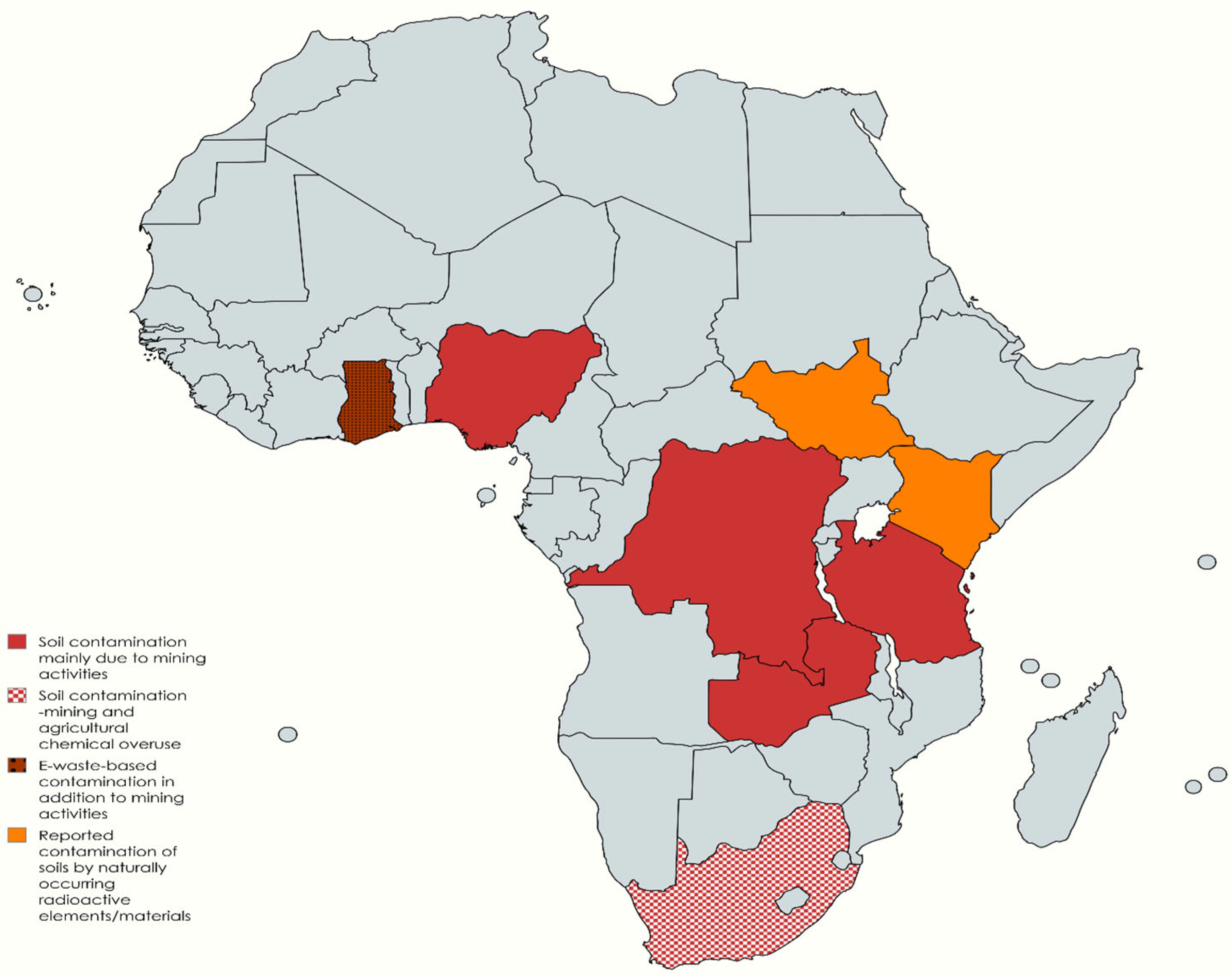
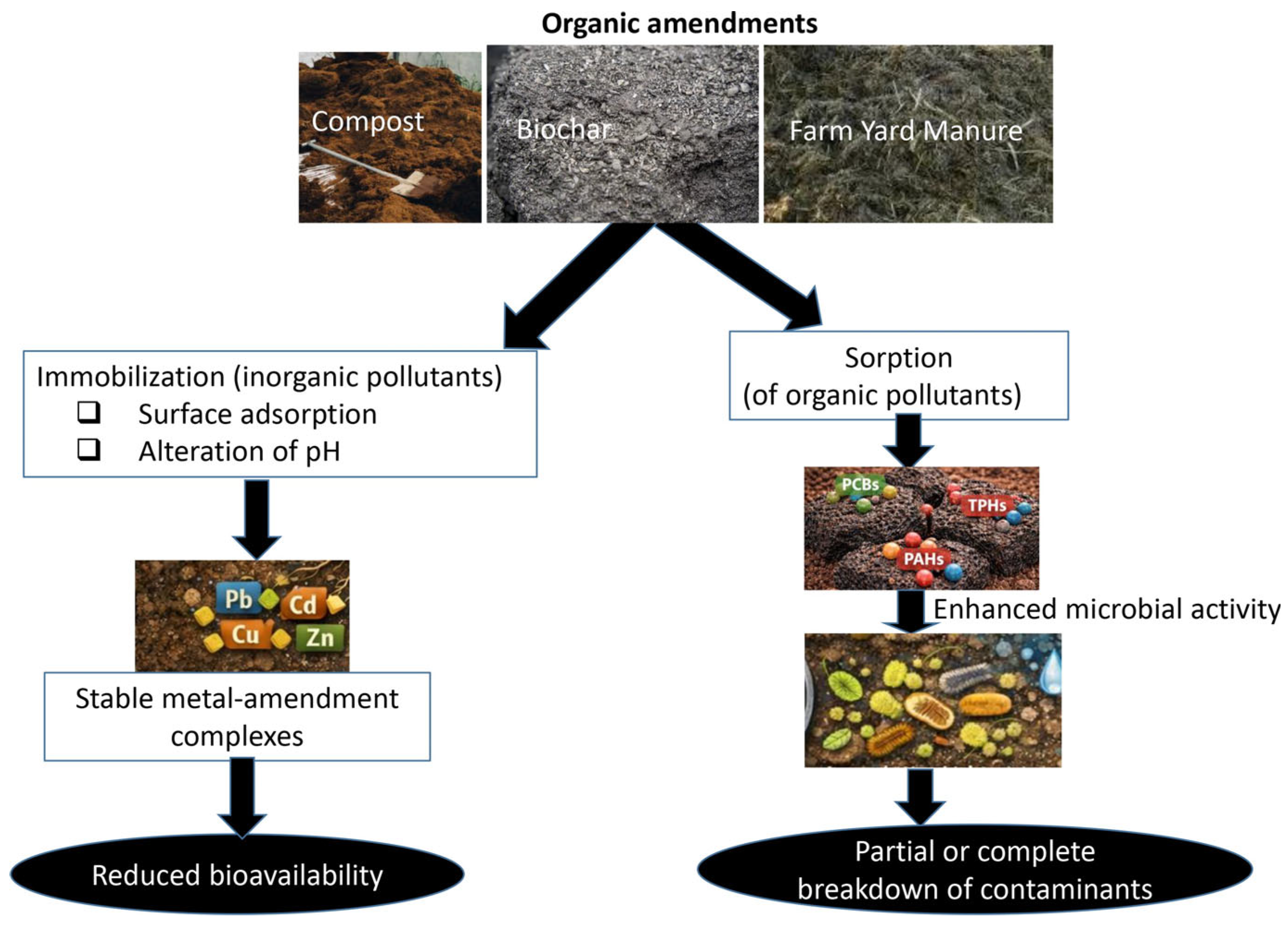
- The Lead (pb) Legacy of Kabwe, Zambia: Kabwe carries a canonical example of intensive Pb contamination from historic lead–zinc mining in Zambia, which led to over 3000 mg·kg−1 of lead at some of its contamination hotspots. However, remediation research has shown that biochar and phosphate amendments have helped to reduce bioavailable Pb and lower the plant uptake of the contaminant [95]. Biochar immobilizes Pb in contaminated soils through multiple mechanisms that reduce its solubility, mobility, and plant uptake. This is because Pb2+ ions bind to oxygen-containing functional groups (–COOH, –OH, carbonyl) on biochar surfaces via adsorption and complexation [96]. Its alkaline nature raises soil pH, promoting the precipitation of Pb(OH)2 and PbCO3, while mineral constituents like carbonates and phosphates facilitate the formation of stable, insoluble Pb minerals such as pyromorphite [96]. Biochar also enhances the soil cation exchange capacity, shifting Pb from bioavailable to stable fractions, thereby lowering plant uptake and reducing ecological and human health risks [97]. Phosphate, on the other hand, immobilizes Pb by forming stable Pb–phosphate minerals, enhancing adsorption by soil particles, and reducing soluble Pb in soil solutions, which together decrease Pb bioavailability and plant uptake [97]. It is clear, therefore, that biochar helps to immobilize the contaminant Pb, averting its uptake and translocation to edible parts of crop plants, which in turn prevents its entry into the food chain.
- (b)
- Niger Delta Oil Contamination Problem in Nigeria: The oil contamination crisis in the Niger Delta, Nigeria, is among the most severe environmental challenges in Sub-Saharan Africa. Decades of oil exploration have led to thousands of spills, contaminating soils, mangroves, and water bodies, particularly in Ogoniland. A landmark assessment by the United Nations Environment Programme [98] found widespread hydrocarbon pollution and warned that full restoration could take 25–30 years [98,99]. Studies show, however, that compost, poultry manure, chicken manure digestate (CMD) and pig dung were successfully deployed in the Niger Delta to provide essential nutrients (N, P, K) to indigenous microbes, which in turn, helped in the degradation of hydrocarbons in contaminated soils. These organic amendments were shown to stimulate bacterial, especially Pseudomonas aeruginosa and fungal growth, and thus the biodegradation of petroleum hydrocarbons, achieving, in some cases, between 70 and 95% petroleum hydrocarbon reduction in contaminated soils [100,101,102].
- (c)
- Smallholder/Municipal Composting Pilot Projects for Remediation of Low-Level Heavy Metal-Contaminated Urban Areas in Ghana and Tanzania: Smallholder and municipal composting pilot projects in Ghana are emerging as a sustainable, low-cost strategy to remediate urban soils lightly contaminated with heavy metals including Pb, Cd, Zn, and Cu. These initiatives focus on using organic waste to rehabilitate soil, enhancing nutrient levels while reducing the mobility and bioavailability of contaminants in urban agriculture [103,104,105]. Similarly, in Tanzania, pilot projects and initiatives for composting to address heavy metal-contaminated soils are primarily concentrated in Dar es Salaam, where key strategies include converting municipal organic waste into soil conditioners, implementing small-scale community composting, and employing phytoremediation to stabilize heavy metals in urban areas [106]. Further studies have shown that the community composting of market/yard waste to produce compost for urban vacant lots and peri-urban farms with low-level mixed contamination of heavy metals and hydrocarbons were proven to successfully reduce PCB/TPH fractions in the soils to which they were applied [107,108].
- (d)
- Use of Organic Waste to Promote Remediation of Contaminated Soils in Witwatersrand, South Africa: Soil contamination in this area is a severe, long-standing environmental problem primarily driven by gold mining activities, leading to high levels of heavy metals like arsenic (As), lead (Pb), copper (Cu), zinc (Zn), cadmium (Cd), and chromium (Cr) from mine tailings and acid mine drainage (AMD). Organic amendments like compost derived from organic waste enhance soil fertility, increase organic matter and nutrient availability, and create favorable conditions for plant establishment and phytoremediation on degraded mine tailings, which are otherwise hostile to vegetation due to heavy metal contamination and poor structure [109]. Studies have reported the efficacy of compost and Moringa leaf extract (MLE) in enhancing the phytoremediation potential of vetiver grass on the gold mine tailings dam in the Witwatersrand goldfields [109]. A similar report in South Africa showed that organic waste-based compost enhances the capacity of vetiver grass to accumulate and stabilize multiple heavy metals in metal-contaminated soils and waters, which indicates the synergistic benefits of combining organic waste-derived amendments with plant-based remediation [110]. Generally, however, most studies in the region have focused on the immobilization of potentially toxic elements such as lead, cadmium, zinc, copper, arsenic and mercury rather than complete contaminant removal. Among organic waste types, compost—derived from OFMSW and animal manure—and biochar—derived from agricultural residues such as rice husks, maize cobs or coffee husks—are the most frequently investigated [111,112,113]. Compost and manure amendments are primarily used to enhance soil organic matter, buffer pH, and reduce metal bioavailability, while biochar is increasingly favored for its strong sorption capacity, persistence, and multifunctional benefits. Integrated approaches—combining compost, biochar, and phytoremediation—represent an emerging research frontier and are widely regarded as the best practice for SSA conditions.
5. Effects of Organic Amendments on Accessibility and Bioavailability of Soil Contaminants
6. Challenges Impeding the Wide-Spread Use of Organic Wastes and Waste Products in the Remediation of Contaminated Soils in SSA
7. Increasing Meaningful Adoption of Organic Waste-Based Remediation Technologies in SSA
8. Conclusions and Future Directions
Author Contributions
Funding
Data Availability Statement
Conflicts of Interest
References
- Owusu-Sekyere, K.; Aladago, D.A.; Leverenz, D.; Oteng-Ababio, M.; Kranert, M. Environmental Impacts on Soil and Groundwater of Informal E-Waste Recycling Processes in Ghana. Sustainability 2024, 16, 4347. [Google Scholar] [CrossRef]
- UNEP. Environmental Assessment of Ogoniland Report. Available online: https://www.unep.org/topics/disasters-and-conflicts/country-presence/nigeria/environmental-assessment-ogoniland-report?utm_source=chatgpt.com (accessed on 1 December 2025).
- UNCCD. Global Land Outlook—Africa Regional Report; UNCCD: Bonn, Germany, 2022; Available online: https://www.unccd.int/resources/global-land-outlook/global-land-outlook-2nd-edition (accessed on 2 December 2025).
- FAO. Status of the World’s Soil Resources (SWSR)—Regional Assessment for Africa; FAO: Rome, Italy, 2021; Available online: http://www.fao.org/3/a-i5199e.pdf (accessed on 28 October 2025).
- Ssebugere, P.; Miiro, A.; Matovu, H.; Odongo, S.; Kato, C.D.; Babirye, P.M.; Nabuuma, J.; Sillanpaa, M.; Sifuna, D.; George William Nyakairu, G.W. Electronic wastes in sub-Saharan Africa: A critical review of environmental and health impacts, regulatory responses, and future perspectives. J. Hazard. Mater. Adv. 2025, 20, 100873. [Google Scholar] [CrossRef]
- Turyahabwa, E.R.S.; Kyeyune, F.; Mucunguzi, E.; Kisolo, A.; Mathuthu, M. Radioactivity and toxic element concentrations in soil and food crops from a copper mining area in Uganda: Environmental and public health implications. Radiati. Phys. Chem. 2025, 239, 113276. [Google Scholar] [CrossRef]
- Maphosa, V.; Maphosa, M. E-waste management in Sub-Saharan Africa: A systematic literature review. Cogent Bus. Manag. 2020, 7, 1814503. [Google Scholar] [CrossRef]
- The African Center for Economic Transformation (ACET). Towards a Circular Economy: E-Waste Management in Africa. 2025. Available online: https://acetforafrica.org (accessed on 3 December 2025).
- Mkhonza, N.P.; Zondo, S.; Vilakazi, S. Toxic heavy metals distribution in urban soils of Africa: A systematic review. Environ. Monit. Assess. 2026, 198, 205. [Google Scholar] [CrossRef]
- Tindwa, H.J.; Singh, B.R. Soil pollution and agriculture in sub-Saharan Africa: State of the knowledge and remediation technologies. Front. Soil Sci. 2023, 2, 1101944. [Google Scholar] [CrossRef]
- Abd-Elhalim, B.T.; Gideon, M.; Anton, K.; Boyi, M.O. Impact of dumpsite compost on heavy metal accumulation in some cultivated plants. BMC Res. Notes 2025, 18, 20. [Google Scholar] [CrossRef]
- Gong, Y.; Zhao, D.; Wang, Q. An overview of field-scale studies on remediation of soil contaminated with heavy metals and metalloids: Technical progress over the last decade. Water Res. 2018, 147, 440–460. [Google Scholar] [CrossRef] [PubMed]
- Roy, J.; Dutta, S.; Pal, T.; Sarowar, S.G.; Saha, C.; Rupesh, T. Modified biochar for remediation of potentially toxic elements in soils: A systematic review of modification approaches, novel mechanisms and field-scale applications. Discov. Soil 2026, 3, 14. [Google Scholar] [CrossRef]
- Ouédraogo, H.A.; Ouoba, Y. Adoption intensity of soil and water conservation techniques in Burkina Faso is influenced by farmers’ preferences for their attributes. Sci. Rep. 2025, 15, 2884. [Google Scholar] [CrossRef] [PubMed]
- Yamada, D.; Hiwatari, M.; Hangoma, P.; Narita, D.; Mphuka, C.; Chitah, B.; Yabe, J.; Nakayama, S.M.M.; Nakata, H.; Choongo, K.; et al. Assessing the population-wide exposure to lead pollution in Kabwe, Zambia: An econometric estimation based on survey data. Sci. Rep. 2020, 10, 15092. [Google Scholar] [CrossRef]
- Lugendo, I.J.; Mwesiga, V. Heavy metal contamination and health risks in Katoro’s artisanal gold mining soils, Tanzania. Tanzan. J. Sci. 2025, 51, 18. [Google Scholar] [CrossRef]
- Nunes, N.; Ragonezi, C.; Gouveia, C.S.S.; Pinheiro de Carvalho, M.Â. Review of Sewage Sludge as a Soil Amendment in Relation to Current International Guidelines: A Heavy Metal Perspective. Sustainability 2021, 13, 2317. [Google Scholar] [CrossRef]
- Tóth, G.; Hermann, T.; Da Silva, M.R.; Montanarella, L. Heavy metals in agricultural soils of the European Union with implications for food safety. Environ. Int. 2016, 88, 299–309. [Google Scholar] [CrossRef] [PubMed]
- Okoye, A.U.; Selvarajan, R.; Chikere, C.B.; Okpokwasili, G.C.; Mearns, K. Characterization and identification of long-chain hydrocarbon-degrading bacterial communities in long-term chronically polluted soil in Ogoniland: An integrated approach using culture-dependent and independent methods. Environ. Sci. Pollut. Res. 2024, 31, 30867–30885. [Google Scholar] [CrossRef]
- Belle, G.N.; Schoeman, Y.; Oberholster, P.J. Source to Receptor: Assessing Health Risks from Heavy Metal Exposure in Mining Soils. Minerals 2024, 14, 858. [Google Scholar] [CrossRef]
- Okonkwo, S.O.; Jacob, J.O.; Iyaka, Y.A.; Inobeme, A. Assessment of selected heavy metal concentrations in soils from a mining area in Minna, Niger state. Environ. Monit. Assess. 2021, 193, 140. [Google Scholar] [CrossRef]
- Naylo, A.; Almeida Pereira, S.I.; Benidire, L.; El Khalil, H.; Castro, P.M.; Ouvrard, S.; Schwartz, C.; Boularbah, A. Trace and major element contents, microbial communities, and enzymatic activities of urban soils of Marrakech city along an anthropization gradient. J. Soils Sediments 2019, 19, 2153–2165. [Google Scholar] [CrossRef]
- Konadu, F.N.; Gyamfi, O.; Ansah, E.; Borquaye, L.S.; Agyei, V.; Dartey, E.; Dodd, M.; Obiri-Yeboah, S.; Darko, G. Human health risk assessment of potentially toxic elements in soil and air particulate matter of automobile hub environments in Kumasi, Ghana. Toxicol. Rep. 2023, 11, 261–269. [Google Scholar] [CrossRef]
- Lilella, M.; Belzile, N.; Chen, Y. Antimony in the environment: A review focused on natural waters I. Occurrence. Earth Sci. Rev. 2002, 57, 125–176. [Google Scholar] [CrossRef]
- Dinake, P.; Mokgosi, S.M.; Kelebemang, R.; Kereeditse, T.T.; Motswetla, O. Pollution assessment of antimony in shooting range soils. S. Afr. J. Chem. 2021, 76, 72–78. [Google Scholar]
- Silva, V.; Mol, H.G.J.; Zomer, P.; Tienstra, M.; Ritsema, C.J.; Geissen, V. Pesticide residues in European agricultural soils—A hidden reality unfolded. Sci. Total Environ. 2019, 653, 1532–1545. [Google Scholar] [CrossRef]
- Nyihirani, F.; Qu, C.; Yuan, Z.; Mbululo, Y.; Janneh, M.; Qi, S. Level, source, and distribution of organochlorine pesticides (OCPs) in agricultural soils of Tanzania. Environ. Monit. Assess. 2022, 194, 19. [Google Scholar] [CrossRef] [PubMed]
- Mlay, G.W.; Kaniu, M.I.; Njenga, L.W.; Njoroge, K.D.; Gatari, M.J.; Kilel, K.K.; Lugendo, I.J. Assessment of natural radioactivity and radiation risks in soil near the Manyoni uranium deposit, Tanzania. Radiat. Prot. Dosim. 2025, 201, 351–360. [Google Scholar] [CrossRef] [PubMed]
- Ilori, A.O.; Ojo, F.M.; Karigidi, K.O. Radiometric investigation of naturally occurring radionuclides in soils from Igbokoda, a coastal area in Ondo State Nigeria. J. Niger. Soc. Phys. Sci. 2024, 7, 2034. [Google Scholar] [CrossRef]
- Debela, T.H.; Beyene, A.; Tesfahun, E.; Getaneh, A.; Gize, A.; Mekonnen, Z. Fecal contamination of soil and water in sub-Saharan Africa cities: The case of Addis Ababa, Ethiopia. Ecohydrol. Hydrobiol. 2018, 18, 225–230. [Google Scholar] [CrossRef]
- Acosta Soto, L.; Santísima-Trinidad, A.B.; Bornay-Llinares, F.J.; Martín González, M.; Pascual Valero, J.A.; Ros Muñoz, M. Quantitative PCR and Digital PCR for Detection of Ascaris lumbricoides Eggs in Reclaimed Water. BioMed Res. Int. 2017, 2017, 7515409. [Google Scholar] [CrossRef] [PubMed]
- Ali, A.S.; Gari, S.R.; Goodson, M.L.; Walsh, C.L.; Dessie, B.K.; Ambelu, A. Fecal Contamination in the Wastewater Irrigation System and its Health Threat to Wastewater-Based Farming Households in Addis Ababa, Ethiopia. Environ. Health Insights 2023, 17, 11786302231181307. [Google Scholar] [CrossRef]
- Asirifi, I.; Kaetzl, K.; Werner, S.; Saba, C.K.S.; Abagale, F.K.; Amoah, P.; Marschner, B. Pathogen and heavy metal contamination in urban agroecosystems of northern Ghana: Influence of biochar application and wastewater irrigation. J. Environ. Qual. 2021, 50, 1097–1109. [Google Scholar] [CrossRef]
- Kgoale, D.M.; Gokul, K.J.K.; Duvenage, S.; Du Plessis, E.M.; Korsten, L. Profiling bacterial communities of irrigation water and leafy green vegetables produced by small-scale farms and sold in informal settlements in South Africa. CABI Agric. Biosci. 2023, 4, 36. [Google Scholar] [CrossRef]
- Selwe, K.P.; Thorn, J.P.R.; Desrousseaux, A.O.S.; Dessent, C.E.H.; Sallach, J.B. Emerging contaminant exposure to aquatic systems in the Southern African Development Community. Environ. Toxicol. Chem. 2022, 41, 382–395. [Google Scholar] [CrossRef] [PubMed]
- Traverso, M.; Mankaa, R.; Pedalá, M.C.; Covais, A. Social Hotspot analysis of the e-waste sector in Ghana and Nigeria. Waste Manag. 2024, 183, 271–277. [Google Scholar] [CrossRef] [PubMed]
- Mvovo, I. A comprehensive review on micro-plastic pollution in African aquatic systems. Environ. Adv. 2021, 5, 100107. [Google Scholar] [CrossRef]
- Mileusnić, M.; Mapani, B.S.; Kamona, A.F.; Ružičić, S.; Mapaure, I.; Chimwamurombe, P.M. Assessment of agricultural soil contamination by potentially toxic metals dispersed from improperly disposed tailings, Kombat mine, Namibia. J. Geochem. Explor. 2014, 144, 409–420. [Google Scholar] [CrossRef]
- Oruko, R.O.; Edokpayi, J.N.; Msagati, T.A.M.; Tavengwa, N.T.; Ogola, H.J.O.; Ijoma, G.; Odiyo, J.O. Investigating the chromium status, heavy metal contamination, and ecological risk assessment via tannery waste disposal in sub-Saharan Africa (Kenya and South Africa). Environ. Sci. Pollut. Res. 2021, 28, 42135–42149. [Google Scholar] [CrossRef]
- Kolawole, T.O.; Oyelami, C.A.; Olajide-Kayode, J.O.; Jimoh, M.T.; Fomba, K.W.; Anifowose, A.J.; Akinde, S.B. Contamination and risk surveillance of potentially toxic elements in different land-use urban soils of Osogbo, Southwestern Nigeria. Environ. Geochem. Health 2023, 45, 4603–4629. [Google Scholar] [CrossRef]
- Ameh, E.G. Phytoremediation of Iron and Antimony Polluted Waste Dump Sites in Anyigba Kogi State, Nigeria: A Multivariate Statistical Technique. Glob. J. Earth Sci. Eng. 2023, 10, 14–26. [Google Scholar] [CrossRef]
- Mununga Katebe, F.; Raulier, P.; Colinet, G.; Ngoy Shutcha, M.; Mpundu Mubemba, M.; Jijakli, M.H. Assessment of Heavy Metal Pollution of Agricultural Soil, Irrigation Water, and Vegetables in and Nearby the Cupriferous City of Lubumbashi, (Democratic Republic of the Congo). Agronomy 2023, 13, 357. [Google Scholar] [CrossRef]
- Ahogle, A.M.A.; Letema, S.; Schaab, G.; Ngure, V.; Mwesigye, A.R.; Korir, N.K. Heavy metals and trace elements contamination risks in peri-urban agricultural soils in Nairobi city catchment, Kenya. Front. Soil Sci. 2022, 2, 1048057. [Google Scholar] [CrossRef]
- Pereira, M.J.S.L.; Leitão, J.M.M.; Silva, J.E.d. Classification of Agricultural Soils in Manica and Sussundenga (Mozambique). Environments 2025, 12, 265. [Google Scholar] [CrossRef]
- Oginga, B.; Gudda, F.O.; Ibrahim, A.; Li, Z.; Minkina, T.; Qin, C.; Gao, Y. Perflourooctane sulfonate in soil–plant systems in Africa: Occurrence and ecological risks. New Contam. 2025, 1, e015. [Google Scholar] [CrossRef]
- Adebusuyi, A.T.; Sojinu, S.O.; Aleshinloye, A.O. The prevalence of persistent organic pollutants (POPs) in West Africa—A review. Environ. Chall. 2022, 7, 100486. [Google Scholar] [CrossRef]
- Ngweme, G.N.; Al Salah, D.M.M.; Laffite, A.; Sivalingam, P.; Grandjean, D.; Konde, J.N.; Mulaji, C.K.; Breider, F.; Poté, J. Occurrence of organic micropollutants and human health risk assessment based on consumption of Amaranthus viridis, Kinshasa in the Democratic Republic of the Congo. Sci. Total Environ. 2021, 754, 142175. [Google Scholar] [CrossRef] [PubMed]
- Ofori, S.A.; Cobbina, S.J.; Doke, D.A. The occurrence and levels of polycyclic aromatic hydrocarbons (PAHs) in African environments-a systematic review. Environ. Sci. Pollut. Res. 2020, 27, 32389–32431. [Google Scholar] [CrossRef]
- Janneh, M.; Qu, C.; Zhang, Y.; Xing, X.; Nkwazema, O.; Nyihirani, F.; Qi, S. Distribution, sources, and ecological risk assessment of polycyclic aromatic hydrocarbons in agricultural and dumpsite soils in Sierra Leone. RSC Adv. 2023, 13, 7102. [Google Scholar] [CrossRef]
- Shan, X.; Yuan, W.; Song, S.; Wu, Q.; Li, F.; Chen, G.; Yang, S.; Su, C.; Hirwa, H. Polycyclic aromatic hydrocarbons in Ethiopian soils: Distribution, sources, and implication from energy consumption structures. Emerg. Contam. 2025, 11, 100461. [Google Scholar] [CrossRef]
- Ephraim-Emmanuel, B.C.; Ordinioha, B. Exposure and Public Health Effects of Polycyclic Aromatic Hydrocarbon Compounds in Sub-Saharan Africa: A Systematic Review. Int. J. Toxicol. 2021, 40, 250–269. [Google Scholar] [CrossRef]
- Jegede, D.O.; Afolabi, T.A.; Agunbiade, F.O.; Ogundiran, O.O.; Gbadamosi, M.R.; Sojinu, S.O.; Ojekunle, O.Z.; Varanusupakul, P. Spatial distribution and radiological hazards assessment of naturally occurring radionuclide materials in soil from quarry sites in Ogun State, Nigeria. Environ. Monit. Assess. 2025, 197, 575. [Google Scholar] [CrossRef] [PubMed]
- Demewoz, N.M.; Kassie, L.N.; Zeleke, H.G. Assessment of radioactivity in soil samples from Wolaita Sodo town, Ethiopia: Implications for environmental and public health. Radiat. Protect Dosim. 2023, 201, 160–177. [Google Scholar] [CrossRef]
- Ilori, A.O.; Chetty, N. A review of the occurrence of naturally occurring radioactive materials and radiological risk assessment in South African soils. Int. J. Environ. Health Res. 2024, 34, 2969–2982. [Google Scholar] [CrossRef]
- K’oreje, K.O.; Okoth, M.; Van Langenhove, H.; Demeestere, K. Occurrence and treatment of contaminants of emerging concern in the African aquatic environment: Literature review and a look ahead. J. Environ. Manag. 2020, 254, 109752. [Google Scholar] [CrossRef] [PubMed]
- Bayabil, H.K.; Teshome, F.T.; Li, Y.C. Emerging Contaminants in Soil and Water. Front. Environ. Sci. 2022, 10, 873499. [Google Scholar] [CrossRef]
- Chokwe, T.B.; Themba, N.; Mahlambi, P.N.; Mngadi, S.V.; Sibali, L.L. Poly- and per-fluoroalkyl substances (PFAS) in the African environments: Progress, challenges, and future perspectives. Environ. Sci. Pollut. Res. Int. 2024, 31, 65993–66008. [Google Scholar] [CrossRef] [PubMed]
- Cangola, J.; Abagale, F.K.; Cobbina, S.J. A systematic review of pharmaceutical and personal care products as emerging contaminants in waters: The panorama of West Africa. Sci. Total Environ. 2024, 911, 168633. [Google Scholar] [CrossRef] [PubMed]
- Vidali, M. Bioremediation: An overview. Pure Appl. Chem. 2001, 73, 1163–1172. [Google Scholar] [CrossRef]
- Dermont, G.; Bergeron, M.; Mercier, G.; Richer-Laflèche, M. Soil washing for metal removal: A review of physical/chemical technologies and field applications. J. Hazard. Mater. 2008, 152, 1–31. [Google Scholar] [CrossRef] [PubMed]
- Bolan, N.; Kunhikrishnan, A.; Thangarajan, R.; Kumpiene, J.; Park, J.; Makino, T.; Kirkham, M.B.; Scheckel, K. Remediation of heavy metal(loid)s contaminated soils—To mobilize or to immobilize? J. Hazard. Mater. 2014, 266, 141–166. [Google Scholar] [CrossRef] [PubMed]
- Adams, G.O.; Fufeyin, P.T.; Okoro, S.E.; Ehinomen, I. Bioremediation, biostimulation and bioaugmentation: A review. Int. J. Environ. Bioremediation Biodegrad. 2015, 3, 28–39. [Google Scholar] [CrossRef]
- Tirima, S.; Bartrem, C.; von Lindern, I.; von Braun, M.; Lind, D.; Anka, S.M.; Abdullahi, A. Environmental Remediation to Address Childhood Lead Poisoning Epidemic due to Artisanal Gold Mining in Zamfara, Nigeria. Environ. Health Perspect. 2016, 124, 1471–1478. [Google Scholar] [CrossRef]
- Li, Q.; Wen, D.; Qin, C.; Qian, Y.; Fu, R.; Lin, S. Physical, Chemical, Biological, and Synergistic Technologies for Remediation of Pesticide-Contaminated Soil. Rev. Environ. Contam. Toxicol. 2024, 262, 7. [Google Scholar] [CrossRef]
- Moller, N.; Baldock, J.; McKeown, S.; Nel, M. In situ thermal remediation application in South Africa: A case study incorporating sustainable remediation principles. Q. J. Eng. Geol. Hydrogeol. 2022, 55, qjegh2021-118. [Google Scholar] [CrossRef]
- RLC Technologies. RLC Technologies Delivered an 84” ATDU for Titan Projects Ltd. Operations at the Bonny Facility in Port Harcourt, Nigeria for the Processing of Oily Sludges and Exploration Waste. Available online: https://www.rlctechnologies.com (accessed on 13 February 2026).
- Koskei, S.; Cheng, Y.; Shi, W. Feasibility Studies of Soil Remediation for Kenya. Am. J. Life Sci. 2017, 5, 36–42. [Google Scholar] [CrossRef]
- Mgbeahuruike, L.; Potgieter-Vermaak, S.S.; van Dyk, L.; Potgieter, J.H.; Dike, M.U.; Emereibeole, E.I.; Njoku-Tony, R.F.; Ihejirika, C.E.; Uyo, C.N.; Edo, F.A.; et al. Washing and Extraction of Metals from Two Industrially Contaminated Soils: A Prognostication for Techno-economic Clean up. Eur. J. Adv. Chem. Res. 2021, 2, 10–14. [Google Scholar] [CrossRef]
- Audu, P.; Wuana, R.A.; Eneji, I.S.; Itodo, A.U. Single and Mixed Surfactants-aided Removal of Mixed Toxic Metals and Petroleum Hydrocarbons in Contaminated Soil: Batch and Column Studies. J. Environ. Anal. Chem. 2019, 6, 253. [Google Scholar]
- Alazaiza, M.Y.D.; Albahnasawi, A.; Ali, G.A.M.; Bashir, M.J.K.; Copty, N.K.; Amr, S.S.A.; Abushammala, M.F.M.; Al Maskari, T. Recent Advances of Nanoremediation Technologies for Soil and Groundwater Remediation: A Review. Water 2021, 13, 2186. [Google Scholar] [CrossRef]
- Malunguja, G.K.; Paschal, M. Evaluating potential phytoremediators to combat detrimental impacts of mining on biodiversity: A review focused in Africa. Discov. Environ. 2024, 2, 94. [Google Scholar] [CrossRef]
- Uwimbabazi, A.; Ramasamy, S.; Mwamba, T.M.; Syampungani, S. Microbial communities in mine waste- contaminated soil of Sub-Saharan Africa: Potential application for ecoremediation. Environ. Geochem. Health 2025, 48, 22. [Google Scholar] [CrossRef] [PubMed]
- Kilonzi, J.M.; Otieno, S. Degradation kinetics and physiological studies of organophosphates degrading microorganisms for soil bioremediation. Stress Biol. 2024, 4, 11. [Google Scholar] [CrossRef] [PubMed]
- Katayama, A.; Matsumura, F. Degradation of organochlorine pesticides by Trichoderma harzianum. Environ. Toxicol. Chem. 1993, 12, 1059–1065. [Google Scholar] [CrossRef]
- Kaur, R.; Singh, D.; Kumari, A.; Sharma, G.; Rajput, S.; Arora, S. Pesticide residues degradation strategies in soil and water: A review. Int. J. Environ. Sci. Technol. 2023, 20, 3537–3560. [Google Scholar] [CrossRef]
- Chikere, C.B.; Okpokwasili, G.C.; Chikere, B.O. Monitoring of microbial hydrocarbon remediation in the soil. 3 Biotech 2011, 1, 117–138. [Google Scholar] [CrossRef] [PubMed]
- Mekonnen, B.A.; Aragaw, T.A.; Genet, M.B. Bioremediation of petroleum hydrocarbon contaminated soil: Mechanisms and advancements. Front. Environ. Sci. 2024, 12, 1354422. [Google Scholar] [CrossRef]
- Ducey, T.F.; Sigua, G.C.; Novak, J.M.; Ippolito, J.A.; Spokas, K.A.; Johnson, M.G. Microbial Response to Phytostabilization in Mining Impacted Soils Using Maize in Conjunction with Biochar and Compost. Microorganisms 2021, 9, 2545. [Google Scholar] [CrossRef]
- Ogundiran, M.B.; Mekwunyei, N.S.; Adejumo, S.A. Compost and biochar assisted phytoremediation potentials of Moringa oleifera for remediation of lead contaminated soil. J. Environ. Chem. Eng. 2018, 6, 2206–2213. [Google Scholar] [CrossRef]
- Ogunremi, O.O.; Amubieya, O.F.; Ogunkunle, C.O.; Fatoba, P.O. Efficacy of biochar on the phytoremediation potential of Tithonia diversifolia on spent oil-contaminated soil. BMC Environ. Sci. 2025, 2, 12. [Google Scholar] [CrossRef]
- Maphuhla, N.G.; Oyedeji, O.O. Evaluation of Acacia karroo’s Potential Aspect in the Phytoremediation of Soil Pollution. Sustainability 2024, 16, 3315. [Google Scholar] [CrossRef]
- Shikanga, E.A. Phytoremediation Potential of Cyperus rotundus L. in Soils Contaminated with Potentially Toxic Elements, the Case of Abandoned Artisanal Small-Scale Gold Mines in Kenya. Int. J. Res. Innov. Soc. Sci. 2024, 8, 3507–3520. [Google Scholar] [CrossRef]
- Mahar, A.; Wang, P.; Ali, A.; Awasthi, M.K.; Lahori, A.H.; Wang, Q.; Li, R.; Jiang, X. Challenges and opportunities in the phytoremediation of heavy metals contaminated soils: A review. Ecotoxicol. Environ. Saf. 2016, 126, 111–121. [Google Scholar] [CrossRef]
- Baiyeri, P.K.; Felix, D.U.; Sunday, O.E.; Nwobodo, C.E. Agricultural waste management for horticulture revolution in sub-Saharan Africa. CABI Rev. 2020, 15, 1–28. [Google Scholar] [CrossRef]
- Ndambi, O.A.; Pelster, D.E.; Owino, J.O.; de Buisonjé, F.; Vellinga, T. Manure Management Practices and Policies in Sub-Saharan Africa: Implications on Manure Quality as a Fertilizer. Front. Sustain. Food Syst. 2019, 3, 29. [Google Scholar] [CrossRef]
- International Solid Waste Association (ISWA). Global Assessment of Municipal Organic Waste Production and Recycling. Available online: https://www.r-e-a.net/wp-content/uploads/2020/03/Global-Assessment-of-Organic-Waste-Production-and-Recycling.pdf?utm_source=chatgpt.com (accessed on 12 December 2025).
- Adedara, M.L.; Taiwo, R.; Bork, H.-R. Municipal Solid Waste Collection and Coverage Rates in Sub-Saharan African Countries: A Comprehensive Systematic Review and Meta-Analysis. Waste 2023, 1, 389–413. [Google Scholar] [CrossRef]
- Ogunjuyigbe, A.S.O.; Ayodele, T.R.; Alao, M.A. Electricity generation from municipal solid waste in some selected cities of Nigeria: An assessment of feasibility, potential and technologies. Renew. Sustain. Energy Rev. 2017, 80, 149–162. [Google Scholar] [CrossRef]
- Center for Tropical Agriculture (CIAT). Organic Waste Recycling for a Sustainable Future in Kenya. 2024. Available online: https://www.cgiar.org/news-events/news/organic-waste-recycling-for-a-sustainable-future-in-kenya (accessed on 12 December 2025).
- Kusi-Appiah, M.; Murphy, R.J.; Liu, L. An Analysis of Municipal Solid Waste Management in Ghana: A Scoping Review of Challenges, Opportunities, and Technology Options. Sustainability 2025, 17, 8266. [Google Scholar] [CrossRef]
- World Bank (WB). What a Waste 2.0: A Global Snapshot of Solid Waste Management to 2050. Available online: https://datatopics.worldbank.org/what-a-waste/?utm_source=chatgpt.com (accessed on 12 December 2025).
- Soud, B.; Bouabid, R.; Badraoui, M. The Storage of Organic Carbon in Dryland Soils of Africa. Constraints and opportunities. In Soil Degradation and Restoration in Africa; Lal, R., Stewart, B.A., Eds.; CRC Press: Boca Raton, FL, USA; Taylor & Francis Group: London, UK; New York, NY, USA, 2020; pp. 227–253. [Google Scholar]
- Mengistu, D.; Sori, G.; Mohammed, A. Assessment of Nutrient Contents of Compost Prepared by Farmers in BunoBedele Zone, South Western Oromia, Ethiopia. Am. J. Agric. For. 2023, 11, 37–44. [Google Scholar] [CrossRef]
- Kizza-Nkambwea, S.; Mpewoa, M.; Kasima, J.S.; Mfuranzima, K. Compost quality of a peri-urban waste composting facility: A case of Mukono municipality, Uganda. Sustain. Environ. 2023, 9, 2251794. [Google Scholar] [CrossRef]
- Katebe, F.M.; Colinet, G.; Kyalamakasa, J.M.K.; Mubemba, M.M.; Jijakli, M.H. Application of soil amendments to reduce the transfer of trace metal elements from contaminated soils of Lubumbashi (Democratic Republic of the Congo) to vegetables. Environ. Monit. Assess. 2024, 196, 902. [Google Scholar] [CrossRef]
- Beasley, L.; Moreno-Jiménez, E.; Gomez-Eyles, J.L. Effects of biochar and greenwaste compost amendments on mobility, bioavailability and toxicity of inorganic and organic contaminants in soil. Environ. Pollut. 2011, 159, 2282–2287. [Google Scholar]
- Park, J.H.; Lamb, D.; Paneerselvam, P.; Choppala, G.; Bolan, N.; Chung, J.W. Role of organic amendments on enhanced bioremediation of heavy metal(loid) contaminated soils. J. Hazard. Mater. 2011, 185, 549–574. [Google Scholar] [CrossRef]
- United Nations Environmental Program (UNEP). Environmental Assessment of Ogoniland. United Nations Environment Programme, 2011. Available online: https://wedocs.unep.org/handle/20.500.11822/7947 (accessed on 22 February 2026).
- Amnesty International. No Clean Up, No Justice: Shell’s Oil Pollution in the Niger Delta. Amnesty International 2020. Available online: https://www.amnesty.org/en/latest/news/2020/06/no-clean-up-no-justice-shell-oil-pollution-in-the-niger-delta/ (accessed on 22 February 2026).
- Oghoje, S.U.; Ukpebor, J.E. The Effects and Efficacy of Chicken Manure Digestates on Bioremediation of Petroleum Hydrocarbons Polluted Soils. Niger. Res. J. Chem. Sci. 2020, 8, 2682–6054. [Google Scholar]
- Coo, A.E.; Oviasogie, F.E.; Ikhajiagbe, B. Microbial effects of manure from poultry droppings and pig dung in diesel-contaminated soil. BioTechnologia 2022, 103, 385–396. [Google Scholar] [CrossRef] [PubMed]
- Norozpour, M.; Sarikhani, M.R.; Aliasgharzad, N. Monitoring of Soil Respiration Changes in a Heavy Naphtha-Contaminated Sandy Loam Soil Under Different Bioremediation Treatments. Water Soil Sci. 2023, 33, 53–72. [Google Scholar] [CrossRef]
- Cofie, O.; Nikiema, J.; Impraim, R.; Adamtey, N.; Paul, J.; Koné, D. Co-Composting of Solid Waste and Fecal Sludge for Nutrient and Organic Matter Recovery; CGIAR Research Program on Water, Land and Ecosystems (WLE) (Resource Recovery and Reuse Series 3); International Water Management Institute (IWMI): Colombo, Sri Lanka, 2016; 47p. [Google Scholar] [CrossRef]
- Cao, X.; Williams, P.N.; Zhan, Y.; Coughlin, S.A.; McGrath, J.W.; Chin, J.P.; Xu, Y. Municipal solid waste compost: Global trends and biogeochemical cycling. Soil Environ. Health 2023, 1, 100038. [Google Scholar] [CrossRef]
- Boakye, K.O.; Dodd, M.; Asante, M.D.; Logah, V.; Darko, G. Biochar Amendment in Remediation of Heavy Metals in Paddy Soil: A Case Study in Nobewam, Ghana. Soil Syst. 2025, 9, 38. [Google Scholar] [CrossRef]
- Unitar and UNIDO. Solving Solid Waste Management Through Composting in Tanzania. Available online: https://stopopenburning.unitar.org/guidance-and-examples/tanzania/solving-solid-waste-management-through-composting-in-tanzania/# (accessed on 24 February 2026).
- Marwa, E. Influence of Organic Waste on Bioremediation of Oil-Contaminated Soil. Ecol. Eng. Environ. Technol. 2024, 5, 32–41. [Google Scholar] [CrossRef]
- Palansooriya, K.N.; Shaheen, S.M.; Chen, S.S.; Tsang, D.C.W.; Hashimoto, Y.; Hou, D.; Bolan, N.S.; Rinklebe, J.; Ok, Y.S. Soil amendments for immobilization of potentially toxic elements in contaminated soils: A critical review. Environ. Int. 2020, 134, 105046. [Google Scholar] [CrossRef] [PubMed]
- Mlalazi, N.; Chimuka, L.; Simatele, M.D.; Chimwani, N. The effect of compost and Moringa leaf extract biostimulant on the phytoremediation of gold mine tailing storage facilities in South Africa using Chrysopogon zizanioides (L.) Roberty. Available online: http://dx.doi.org/10.2139/ssrn.5215144 (accessed on 27 December 2025).
- Otunola, B.O.; Aghoghovwia, M.P.; Thwala, M.; Ololade, O.O. A mesocosm study on the use of clay minerals to improve heavy metal phytoremediation capacity of vetiver grass (Chrysopogon zizanioides L. Roberty). S. Afr. J. Sci. 2023, 119, 1–7. [Google Scholar] [CrossRef] [PubMed]
- Aziandeke, D.K.; Vianna, M.S.; Bouka, E.C.; Mawussi, G.; Coulibaly, A.; Gaiser, T. The influence of rice husk biochar, compost, and their mixture on maize yields and soil organic carbon content in southern Togo. Geoderma Reg. 2025, 42, e00996. [Google Scholar] [CrossRef]
- Motsi, H.; Phiri, E.E.; Mothapo, P.N. Manure utilisation under smallholder farmers in Sub–Saharan Africa. A systematic review and meta-analysis. Nutr. Cycl. Agroecosystems 2025, 131, 613–634. [Google Scholar] [CrossRef]
- Abban-Baidoo, E.; Manka’abusi, D.; Apuri, L.; Marschner, B.; Frimpong, K.A. Biochar addition influences C and N dynamics during biochar co-composting and the nutrient content of the biochar co-compost. Sci. Rep. 2024, 14, 23781. [Google Scholar] [CrossRef]
- Mirsal, I.A. Pollution Mechanisms and Soil-Pollutants Interaction. In Soil Pollution; Springer: Berlin/Heidelberg, Germany, 2008. [Google Scholar] [CrossRef]
- Manzoor, M.Z.; Sarwar, G.; Alamery, S.; Ibrahim, M.; Sami, A.; Ahmed, B.; Ahsan, F.; Gul, S.; Attia, K.A.; Faiz, S.; et al. Efficacy of various amendments for immobilization of potentially toxic elements in wastewater contaminated soils. Sci. Rep. 2014, 14, 17350. [Google Scholar] [CrossRef]
- Sierra Aragón, M.; Nakamaru, Y.M.; García-Carmona, M.; Martínez Garzón, F.J.; Martín Peinado, F.J. The role of organic amendment in soils affected by residual pollution of potentially harmful elements. Chemosphere 2019, 237, 124549. [Google Scholar] [CrossRef] [PubMed]
- Chafik, Y.; Sena-Velez, M.; Henaut, H.; Missbah El Idrissi, M.; Carpin, S.; Bourgerie, S.; Morabito, D. Synergistic Effects of Compost and Biochar on Soil Health and Heavy Metal Stabilization in Contaminated Mine Soils. Agronomy 2025, 15, 1295. [Google Scholar] [CrossRef]
- Li, Q.; Imran. Using biochar, compost, and dry-based organic amendments in combination with mycorrhizae for mitigating heavy metal contamination in soil. Int. J. Phytoremediation 2025, 27, 1502–1513. [Google Scholar] [CrossRef]
- Hong, Y.; Li, D.; Xie, C.; Zheng, X.; Yin, J.; Li, Z.; Zhang, K.; Jiao, Y.; Wang, B.; Hu, Y.; et al. Combined apatite, biochar, and organic fertilizer application for heavy metal co-contaminated soil remediation reduces heavy metal transport and alters soil microbial community structure. Sci. Total Environ. 2022, 851, 158033. [Google Scholar] [CrossRef]
- Meng, F.; Wang, Y.; Wei, Y. Advancements in Biochar for Soil Remediation of Heavy Metals and/or Organic Pollutants. Materials 2025, 18, 1524. [Google Scholar] [CrossRef]
- Dong, X.; Chu, Y.; Tong, Z.; Sun, M.; Meng, D.; Yi, X.; Gao, T.; Wang, M.; Duan, J. Mechanisms of adsorption and functionalization of biochar for pesticides: A review. Ecotoxicol. Environ. Saf. 2024, 272, 116019. [Google Scholar] [CrossRef]
- Mashamaite, C.V.; Motsi, H.; Manyevere, A.; Poswa, S.B. Assessing the Potential of Biochar as a Viable Alternative to Synthetic Fertilizers in Sub-Saharan Africa Smallholder Farming: A Review. Agronomy 2024, 14, 1215. [Google Scholar] [CrossRef]
- Kahle, M.; Stamm, C. Sorption of the Veterinary Antimicrobial Sulfathiazole to Organic Materials of Different Origin. Environ. Sci. Technol. 2007, 41, 132–138. [Google Scholar] [CrossRef]
- Kabasiita, J.K.; Opolot, E.; Malinga, G.M. Quality and Fertility Assessments of Municipal Solid Waste Compost Produced from Cleaner Development Mechanism Compost Projects: A Case Study from Uganda. Agriculture 2022, 12, 582. [Google Scholar] [CrossRef]
- Debrah, J.K.; Teye, G.K.; Dinis, M.A.P. Barriers and Challenges to Waste Management Hindering the Circular Economy in Sub-Saharan Africa. Urban Sci. 2022, 6, 57. [Google Scholar] [CrossRef]
- Primus, A.; Marculescu, A.; Cao, L.T.T.; Nadifah, G.; Twum-Ampofo, D.; Jannat, A.H.; Tongco, J.V. Challenges and future prospects of using biochar for soil remediation. Trop. Aquat. Soil Pollut. 2025, 5, 18–33. [Google Scholar] [CrossRef]
- García-Delgado, C.; Yunta, F.; Eymar, E. Bioremediation of multi-polluted soil by spent mushroom (Agaricus bisporus) substrate: Polycyclic aromatic hydrocarbons degradation and Pb availability. J. Hazard. Mat. 2015, 300, 281–288. [Google Scholar] [CrossRef] [PubMed]
- COPIP-Pilot Report and Lessons, Mombasa, Kenya. 2024. Available online: https://copip.eu/news/key-lessons-copip-pilot-project-on-source-separation-of-dry-and-wet-waste-in-likoni-and-mvita-sub-county-mombasa/?utm_source=chatgpt.com (accessed on 20 November 2025).
- Kihila, J.M.; Wernsted, K.; Kaseva, M. Waste segregation and potential for recycling—Case study Kimara ward, Dar es Salaam. Sustain. Environ. 2021, 7, 1935532. [Google Scholar] [CrossRef]
- CSIR. Municipal Waste Separation at Source—Implementation Guideline Derived from Pilot Study Learning. South Africa. 2021. Available online: https://www.csir.co.za/sites/default/files/Documents/Municipal%20Waste%20Separation%20at%20Source%20Implementation%20-%20Guideline%20Derived%20from%20the%20Pilot%20Study%20Learning%201.pdf?utm_source=chatgpt.com (accessed on 20 November 2025).
- Dongo, K.; Yeo, D.; Gnagne, T.; Mertenat, A.; Lüssenhop, P.; Zurbrügg, C.; Körner, I. Implementing biowaste source segregation for sustainable decentralized composting schemes in Tiassalé, southern Côte d’Ivoire. Waste Manag. Res. 2025, 43, 1434–1442. [Google Scholar] [CrossRef]
- World Bank. Improving Solid Waste and Plastics Management in Lagos State: A way forward. 2024. Available online: https://documents1.worldbank.org/curated/en//099101824172020522/pdf/P1761781eb744507f184b01f525451f4014.pdf?utm_source=chatgpt.com (accessed on 22 November 2025).
- Mugambe, R.K.; Nuwematsiko, R.; Ssekamatte, T.; Nkurunziza, A.G.; Wagaba, B.; Isunju, J.B.; Wafula, S.T.; Nabaasa, H.; Katongole, C.B.; Atuyambe, L.M. Drivers of Solid Waste Segregation and Recycling in Kampala Slums, Uganda: A Qualitative Exploration Using the Behavior Centered Design Model. Int. J. Environ. Res. Public Health 2022, 19, 10947. [Google Scholar] [CrossRef]
- Mersha, B.A.; Manczarski, P. Enhancing Municipal Solid Waste Management in Addis Ababa, Ethiopia: Lessons from Warsaw’s Municipal Waste Management Practices. GAZ, Woda I Technika Sanitarna. 2025. Available online: https://gazwoda.pl/wp-content/uploads/Openaccess/2025/101519917202554.pdf?utm_source=chatgpt.com (accessed on 20 January 2026).
- Japan International Cooperation Agency (JICA). Solid Waste Management Advisor for Addis Ababa City. Project Completion Report. 2024. Available online: https://openjicareport.jica.go.jp/pdf/12384889.pdf?utm_source=chatgpt.com (accessed on 25 November 2025).
- Rural21. 2024. Available online: https://www.rural21.com/english/scientific-world/detail/article/alternative-organic-resources-for-soil-health-in-africa.html?utm_source=chatgpt.com (accessed on 22 November 2025).
- Mng’ong’o, M.; Munishi, L.K.; Ndakidemi, P.A.; Blake, W.; Comber, S.; Hutchinson, T.H. Accumulation and bioconcentration of heavy metals in two phases from agricultural soil to plants in Usangu agroecosystem-Tanzania. Heliyon 2021, 7, e07514. [Google Scholar] [CrossRef]
- Kamunda, C.; Mathuthu, M.; Madhuku, M. Health Risk Assessment of Heavy Metals in Soils from Witwatersrand Gold Mining Basin, South Africa. Int. J. Environ. Res. Public Health 2016, 13, 663. [Google Scholar] [CrossRef]
- Anyanwu, B.O.; Ezejiofor, A.N.; Igweze, Z.N.; Orisakwe, O.E. Heavy Metal Mixture Exposure and Effects in Developing Nations: An Update. Toxics 2018, 6, 65. [Google Scholar] [CrossRef]
- Aljabri, M. Recent advances in pesticide bioremediation: Integrating microbial, phytoremediation, and biotechnological strategies—A comprehensive review. Environ. Pollut. Bioavailab. 2025, 37, 2554173. [Google Scholar] [CrossRef]
- Sanchez-Castro, I.; Molina, L.; Prieto-Fernandez, M.A.; Segula, A. Past, present and future trends in the remediation of heavy-metal contaminated soil—Remediation techniques applied in real soil-contamination events. Heliyon 2023, 9, e16692. [Google Scholar] [CrossRef]
- Liu, L.; Wang, J.; Zhai, J.; Yan, D.; Lin, Z. Regional disparities and technological approaches in heavy metal remediation: A comprehensive analysis of soil contamination in Asia. Chemosphere 2024, 366, 143485. [Google Scholar] [CrossRef]
- Mishra, P.; Ali, S.; Kumar, R.; Shekhar, S. Global lead contamination in soils, sediments, and aqueous environments: Exposure, toxicity, and remediation. J. Trace Elem. Miner. 2025, 14, 100259. [Google Scholar] [CrossRef]
- Zhang, H.; Xu, Y.; Kanyerere, T.; Wang, Y.; Sun, M. Washing Reagents for Remediating Heavy-Metal-Contaminated Soil: A Review. Front. Earth Sci. 2022, 10, 901570. [Google Scholar] [CrossRef]
- Kihara, J.; Bolo, P.; Kinyua, M.; Nyawira, S.; Sommer, R. Soil health and ecosystem services: Lessons from sub-Saharan Africa. Geoderma 2020, 370, 114342. [Google Scholar] [CrossRef]
- Zhang, X.; Yu, Q.; Gao, B.; Hu, M.; Chen, H.; Liang, Y.; Yi, H. Organic Amendments Enhance the Remediation Potential of Economically Important Crops in Weakly Alkaline Heavy Metal-Contaminated Bauxite Residues. Agriculture 2025, 15, 15. [Google Scholar] [CrossRef]
- Wang, A.; Dang, Z.; Wang, Y.; Fan, H.; Miao, S. Efficient Inorganic Stabilization Materials for Chromium and Arsenic Pollution in Water and Soil. Appl. Sci. 2025, 15, 7069. [Google Scholar] [CrossRef]
- Sharma, S.; Bolan, S.; Mukherjee, S.; Petruzzelli, G.; Pedron, F.; Franchi, E.; Fonseka, W.; Wijesekara, H.; Wang, L.; Hou, D.; et al. Role of Organic and Biochar Amendments on Enhanced Bioremediation of Soils Contaminated with Persistent Organic Pollutants (POPs). Curr. Pollut. Rep. 2025, 11, 33. [Google Scholar] [CrossRef]



| Contaminant Category | Contaminant Subcategory/Group | Contaminant Type | Location/Context | Notes | Permissible Limits (Means) * | References |
|---|---|---|---|---|---|---|
| Inorganic Contaminants | Heavy metals | Pb, | * Kabwe (town/mining areas), Zambia | Extremely elevated soil Pb and blood lead levels in children of up to 11.9 μg/dL. | <5 μg/dL for Pb, | [15] |
| Pb, Ni, Cu, Cr | Katoro, artisanal gold-mining areas in Geita, Tanzania | Pb, Cr, Cu, and Ni had soil concentrations (mg/Kg) of 11.1–14.4, 117–1255, 81–104, and 89–271, respectively, from sampled areas. | 50 mg Pb/kg 50 mg Ni/kg 100 mg Cu/kg 100 mg Cr/kg | [16,17,18] | ||
| Mn, Zn Pb, Cd | * Minna, Niger State, Nigeria | Soils were found to have up to (mg/kg) 2.87, 286.21, 15,375.46, 2233.60 and 131.71 for Cd, Zn, Fe, Mn, and Pb, well above FAO/WHO permissible limits. | 80 mg Pb/kg 500 mg Mn/kg 1 mg Cd/Kg 200 mg Zn/kg | [17,18,19,20] | ||
| Metaloids | As | Marrakech, Morocco | Urban soils were found to have up to 8.64 mg/kg, mainly attributed vehicle emissions and corrosion of source materials. | 20 mg/kg | [17,18,19,20,21] | |
| Kumasi, Ghana | Soil concentration of As was measured at 54.3 mg/kg, attributed to automotive repairs associated with auto-mechanics workshops. | [22] | ||||
| Sb | Thebephatshwa (TAB) shooting range, Botswana | Soil concentrations of Sb were found to be 38.8–283.5 mg/kg, attributed to shooting range activities. | 20 mg/Kg | [17,23,24] | ||
| Organic Contaminants | Petroleum hydrocarbons | TPH, PAHs | * Niger Delta/Ogoniland (coastal wetlands) | Concentrations above permissible limits, reaching 14,087 to 36,775 ppm of TPH and 3248.75 ppm of PAH. | TPH < 100 μg/kg PAH < 200 μg/kg | [25] |
| Persistent organic pesticides (POPs) | DDT, Diedrin, | * Tanzania (agricultural soils) | Soils had concentrations of 2.29 ng/g DDT, 1.57 ng/g Diedrin. | 0.1 mg/kg for DDT, 0.05 mg/kg for Diedrin. | [26,27] | |
| Radioactive contaminants | Naturally occurring radioactive materials (NORMs) in soils | 238U, 232Th, | Manyoni, Tanzania (uranium deposit) | Levels of each NORM were above global average (in Bq/kg). 238U = 302 232Th = 78. Some areas of Manyoni were classified as high-background-radiation areas (HBRAs). | International limits (Bq/kg) are 238U = 33 232Th = 45 | [28] |
| A mixture of NORMs in Industrial zone | 238U, 232Th, 40K | Johannesburg, South Africa | Levels of soil0related materials around industrial zones were (Bq/kg) 238U = 37.6 40K= 657. | International limits (Bq/kg) are 238U = 33 40K = 400–420 | [29] | |
| Microbiological contaminants | Solid Fecal contaminant materials | Ascaris lumbricoides | Addis Ababa, Ethiopia | Near-universal presence of helminth ova in soils. | ≤1 viable parasitic helminth egg per liter | [30,31] |
| Contaminated wastewater for irrigation | Fecal coliforms, enteric pathogens | Addis Ababa, Ethiopia | Extensive contamination across soil–water–crop continuum. | <10 CFU fecal coliforms/g of soil | [32] | |
| Contaminated irrigation water | E. coli, Salmonella, helminths | Northern Ghana | Measurable pathogen loads of up to 4.58 log10CFU gDW−1 in soils were detected. | <10 CFU fecal coliforms/g of soil | [33] | |
| Fecal contaminated wastewater used for irrigation | Escherichia-Shigella, Clostridiaceae, Enterococcaceae | South Africa | Diverse pathogenic microbial communities linked to fecal contamination. | 0 CFU of –Escherichia-Shigella | [34] | |
| Emerging Contaminants | Pharmaceuticals and personal care products (PPCPs) and per- and polyfluoroalkyl substances (PFAs) and microplastics | South Africa, Nigeria, Kenya, Ghana, and Tanzania | Wastewater irrigation, sludge use and unregulated waste dumping. | NA * | [35] | |
| South Africa, Nigeria, and Ghana | Unregulated E-waste-disposal hotspots. These countries showed the largest amounts. | NA * | [7,36,37] |
| Country/Area in SSA | Evidence/Status of Waste Separation at Source (2020–2025) | Notable Pilot/Success Story | Key References |
|---|---|---|---|
| Kenya | Separation of wet and dry waste at source in the Mvita and Likoni areas in Mombasa. | Pilot led to the growth and expansion of household collection and private BSF (black soldier fly) organic processing. | [128] |
| Tiassalé, Côte d’Ivoire | Pilot/source-segregation of wastes. | Pilot projects proved the effectiveness of the biowaste source-segregation system in the production of high-quality compost. Up to 75% of the participants accepted the source-segregation system and were ready to pay for the service. | [131] |
| Ghana (Accra/Kumasi) | MRFs and composting facilities with some elements of source separation. | Large composting/processing plants experienced operational problems, largely due to insufficiently source-separated feedstock. | [132] |
| Tanzania (Dar es Salaam) | Evidence from household studies and pilots showing low routine city-wide separation—but city systems still mix streams. | Community pilots show feasibility and potential for separation; however, citywide collection still mixes fractions. | [129] |
| Uganda (Kampala/GKMA) | Evidence of waste segregation at source exists; implementation has remained at the research stage. | Community pilot models and studies show physical space and social networks driving segregation; GIZ and municipal pilots test community collection linked to informal collectors. | [133] |
| Ethiopia (Addis Ababa) | Sub-city composting (Nifasilk). Some pilot market composting and municipal organizations continue to support the collection of organic wastes from source points in the city. | Composting programs collected organic waste from markets and cooperatives (2020–2021), producing compost for local use and showing that the market–operator separation approach works well in Ethiopia. | [134,135] |
| Nigeria, Lagos | Lagos policy calls for sustainable waste separation. | Market pilots/scoping studies recommend piloting source separation at large markets (food/vegetable) and show potential for composting if separation is implemented in Lagos’ policy. | [136] |
Disclaimer/Publisher’s Note: The statements, opinions and data contained in all publications are solely those of the individual author(s) and contributor(s) and not of MDPI and/or the editor(s). MDPI and/or the editor(s) disclaim responsibility for any injury to people or property resulting from any ideas, methods, instructions or products referred to in the content. |
© 2026 by the authors. Licensee MDPI, Basel, Switzerland. This article is an open access article distributed under the terms and conditions of the Creative Commons Attribution (CC BY) license.
Share and Cite
Tindwa, H.J.; Singh, B.R. Remediation of Contaminated Soils Using Organic Waste and Waste Products in Sub-Saharan Africa: A Review of Technologies, Adoption and Challenges. Soil Syst. 2026, 10, 49. https://doi.org/10.3390/soilsystems10040049
Tindwa HJ, Singh BR. Remediation of Contaminated Soils Using Organic Waste and Waste Products in Sub-Saharan Africa: A Review of Technologies, Adoption and Challenges. Soil Systems. 2026; 10(4):49. https://doi.org/10.3390/soilsystems10040049
Chicago/Turabian StyleTindwa, Hamisi J., and Bal Ram Singh. 2026. "Remediation of Contaminated Soils Using Organic Waste and Waste Products in Sub-Saharan Africa: A Review of Technologies, Adoption and Challenges" Soil Systems 10, no. 4: 49. https://doi.org/10.3390/soilsystems10040049
APA StyleTindwa, H. J., & Singh, B. R. (2026). Remediation of Contaminated Soils Using Organic Waste and Waste Products in Sub-Saharan Africa: A Review of Technologies, Adoption and Challenges. Soil Systems, 10(4), 49. https://doi.org/10.3390/soilsystems10040049