1. Introduction
The USDA Natural Resources Conservation Service (NRCS) defines soil health as “the capacity of the soil to function as a vital living ecosystem that supports plants, animals, and humans” [
1]. A healthy soil performs key ecological functions, including the ability to cycle nutrients, filter water and air, and sequester carbon (C), which are directly shaped by both inherent soil properties and management factors [
2,
3]. Among inherent factors, soil texture is an important variable that affects overall soil health due to its strong influence on soil water infiltration, nutrient holding capacity, and, most crucially, soil organic matter (SOM) [
4]. Therefore, reliable measurements of soil health across different soil textural classes and SOM concentrations are required to determine what land management strategies are effective in improving soil health across different contexts [
5,
6].
Soil health indicators are a set of biological, chemical, and physical measurements that can be used to index soil health by approximating the complex interactions within a soil [
5,
7]. Useful indicators of soil health must meet several eligibility criteria: relation to soil functioning, sufficient sensitivity to changes in management, practicality of measurement, and interpretability of results that can be applied to land management decisions [
7,
8]. These indicators can then be used in soil health assessment frameworks, such as the Soil Management Assessment Framework (SMAF), which includes indicators such as potentially mineralizable nitrogen (PMN) and microbial biomass C (MBC), and the Comprehensive Assessment of Soil Health (CASH), which includes indicators such as autoclave-extractable (ACE) protein and permanganate-oxidizable carbon (POXC) [
1,
4]. Mineralizable carbon (CMIN) is another indicator that can be used as a proxy for the activity of soil microorganisms and has been implemented in the Soil Health Institute’s North American Project to Evaluate Soil Health Measurements (NAPESHM) [
4]. Ultimately, selected indicators vary greatly depending on study objectives, but true biological indicators make up less than 20% of the indicators included in the most popular soil health frameworks, despite a recent push for a broader inclusion of these informative indicators [
5,
9].
Soil enzymes catalyze the conversion of complex organic macromolecules into simpler compounds that are more easily used by organisms, directly contributing to effective soil functioning [
6,
10]. Thus, soil enzyme activity values can be used as a highly sensitive biochemical indicator to approximate the maximum potential C and nutrient cycling capacity of a soil sample, using a particular substrate [
11,
12]. Soil enzymes are also advantageous as they can respond more quickly to management changes (~1–2 years) than other indicators [
3,
7], and the assays are practical to measure: they are inexpensive, high-throughput, repeatable, and easy to conduct [
7,
13,
14].
Although soil enzymes are extremely diverse, a few specific enzymes are often used in soil health determination, including β-glucosidase (BG), which hydrolyzes larger C-based molecules into simpler sugars [
2], N-acetyl-β-glucosaminidase (NAG), an enzyme associated with C and nitrogen (N) that hydrolyzes chitin [
15,
16], and phosphatases, which are responsible for the hydrolysis of phosphate esters [
17]. Although a multitude of different enzymes are involved in depolymerization reactions, quantifying the activity of these “keystone” soil enzymes involved in rate-limiting steps allows for the approximation of the rate of C and nutrient turnover in the soil [
18,
19].
Interpreting soil enzyme activities remains a major limitation, as activity values do not represent in situ activities and can only be interpreted as an index [
20]. Additionally, enzyme activities often correlate positively with other metrics of soil health, including total C [
21], leading many soil health frameworks (e.g., SMAF, CASH) to use a “more-is-better” interpretation scale [
7], although alternatives such as optimum functions exist [
8]. Certain enzymes exhibit negative feedback mechanisms [
22], however, resulting in lower activity in the presence of mineralized nutrients, such as with chemical fertilizer applications [
17,
23]. Thus, one common approach to interpreting soil enzyme activities is that higher rates are representative of a greater capacity of the soil to release essential nutrients, regardless of the actual availability of nutrients in the soil at the time of sampling.
The most commonly utilized soil enzyme assays are colorimetric, using modified versions (e.g., Acosta-Martínez [
13]) of the Tabatabai & Bremner [
24] protocol, or are fluorimetric, using fluorescence-marked substrates (such as 4-Methylumbelliferyl or “MUF”) [
10,
12]. The colorimetric method has a more widely accepted “standard” protocol but has substantial benchtop and incubator space requirements [
25] and requires corrections for both dissolved organic matter (DOM) interference, which inflates values for soils high in SOM, and the incomplete recovery of p-Nitrophenol (pNP), which reduces activities in soils with high silt and clay [
26]. The fluorimetric approach is more sensitive but lacks a standard protocol and requires additional standard curves made within each soil sample to correct for a “quenching” effect that reduces measured activities [
10]. Regardless of assay type, a key consensus is that the enzyme assay protocol must be optimized to be effective across different climates and soil types [
27].
Methodological recommendations for fluorimetric enzyme assays have been detailed before but focused on peat soils [
28] or clay loam soils [
29]; lacked a specification of the properties of the tested soils [
10]; or followed an in situ type of assay with recommendations for matching environmental conditions [
20]. Optimizing a soil enzyme assay for coarse-textured soils requires determining kinetic parameters, specifically maximum reaction rate (Vmax) and the Michaelis–Menten constant (Km), to ensure the substrate is not limiting by using a concentration of 5× Km [
20,
26]. Assay conditions such as temperature and pH can also be adjusted, with 25 °C [
17,
30] or 37 °C [
11,
27] being most common, while optimal assay pH varies significantly, with a different optimum pH reported for fluorimetry relative to colorimetry [
25]. The choice of a termination reagent to stop the enzymatic reaction typically varies between sodium hydroxide (NaOH) and tris(hydroxymethyl)aminomethane (Tris) [
10,
26], but the termination reagent should not alter enzymatic activity values, although MUF can be unstable in the presence of NaOH [
31]. The time between adding a termination reagent and reading a plate should also be standardized, ideally at 1 min [
20,
32]. Finally, soils should be assayed as soon as possible for enzyme activity (within ~24 h), but as this is often not feasible, different storage options are available [
32,
33]. Soils can be frozen at different temperatures (e.g., −20 °C or −80 °C), and thawed prior to use [
32,
34], or soils can be air-dried, which can help standardize protocols, as air-dried soils are more stable over time [
15].
An optimized fluorimetric soil enzyme assay could provide an effective, biologically based indicator for coarse-textured soils, where high sensitivity may allow for the detection of relatively small changes in soil health. Florida’s mineral soils represent a good model system for optimization, as Florida soils are highly sandy, due to historic marine deposits, and have a low capacity to store soil C due to a subtropical climate that expedites the decomposition of SOM [
35]. This can lead to high inputs of synthetic fertilizers and organic amendments to improve soil fertility, which can lead to off-target environmental effects when nutrients are lost [
35]. A highly sensitive indicator like soil enzyme activity could provide rapid information relevant to nutrient cycling in these soils, and it could be used for more efficient nutrient management as well.
Therefore, a factorial experiment was designed to evaluate the impact of fluorimetric enzyme assay conditions (pH, temperature, termination reagent) on the activity of three enzymes (AP, BG, NAG) across seven representative Florida mineral soils. Fluorimetric enzyme activities measured with air-dried and frozen (−80 °C) soils and activities measured with the fluorimetric microplate method and the benchtop colorimetric method were also compared. Lastly, the relationships between soil enzyme activities and other soil health and fertility indicators were assessed. The hypotheses for this study were that (1) enzyme activity will be greater at 37 °C than 25 °C, but trends among soils will remain the same; (2) enzymatic activity will be greatest at the optimal pH value for each soil sample and enzyme combination, which may differ from the optimal pH in the colorimetry method [
20]; (3) enzymatic activity will not change significantly regardless of whether NaOH or Tris buffer is used as a termination reagent [
10]; (4) enzymatic activity generated by MUF microplate fluorescence should be related to that from pNP colorimetry, but it is unclear which will be greater [
12,
31]; and (5) enzymatic activity will be greater in frozen fresh soils than in air-dried soil, but with similar trends among soils [
15,
21].
2. Materials and Methods
2.1. Soil Selection
Seven mineral soils were collected at six locations across Florida, spanning from the North Florida Research and Education Center (NFREC) in Quincy (30.312905, −82.901796) to the Southwest Florida Research and Education Center (SWFREC) in Immokalee (26.461028, −81.435260) (
Supplementary Figure S1). Sampling locations in central Florida were located within Alachua and Marion Counties and included the Plant Science Research and Education Unit (PSREU) in Citra (29.408815, −82.171063), the Field and Fork Farm (29.644514, −82.362760) and two commercial farms (Farm A and Farm B). These seven soils were chosen because they are within a sand and SOM gradient that encompasses most mineral soils across Florida. The Quincy sample was collected in April, and all others were collected in May of 2024, from agricultural fields that had not recently been fertilized or amended (for at least several weeks).
The Quincy soil (Fuquay-Lucy-Orangeburg complex; fine-loamy/loamy, kaolinitic, thermic Arenic/typic Plinthic Kandiudults) was collected from a weedy field that had been fallow for a year after being cropped with peanut and cotton. At Citra, two samples, the Citra and Citra [low SOM] soils (both Candler sands; hyperthermic, uncoated Lamellic Quartzipsamments), were taken from locations less than 1 km apart due to visible differences in soil appearance that allowed for the comparison of enzyme activities in similar soils but with contrasting SOM concentrations, located at the same site. The Field and Fork sample (Arredondo fine sand; loamy, siliceous, semiactive, hyperthermic Grossarenic Paleudults) was collected from a small field that had recently been tilled after beet production. The “Farm A” soil (Bonneau fine sand; loamy, siliceous, subactive, thermic Arenic Paleudults) was collected from a recently tilled vegetable field amongst fruit trees. The “Farm B” sample (Tavares sand; hyperthermic, uncoated Typic Quartzipsamments) was collected from a tilled field that was previously cropped with potato. The Immokalee sample (Immokalee fine sand; sandy, siliceous, hyperthermic Arenic Alaquods) was collected from a weedy fallow area adjacent to a production field.
2.2. Soil Sampling and Characterization
At each sampling location, a hand-held probe was used to collect 20 random subsamples of the top 0–15 cm of soil, in a zig-zag pattern throughout the plot of interest. The subsamples were pooled into a composite sample that was placed in a cooler on ice for travel back to the Sustainable Nutrient Management Systems lab; all samples were taken to the lab within 4 h, except for the Immokalee soil, which was shipped overnight on ice. Fresh soils were sieved through a 2 mm sieve within 48 h of sampling. A subsample was used to determine field moisture content, and the rest of the subsample was divided for different storage conditions. Roughly 500 g of fresh soil from each sampling location was stored in a −80 °C freezer. The remainder of the soil was set out to air-dry for at least 5 days.
The air-dried soil samples were used for other analyses including SOM, particle size distribution, total C and N, autoclaved citrate-extractable (ACE) protein, permanganate-oxidizable carbon (POXC), and mineralizable carbon (CMIN). A subsample of air-dried soils was also sent to Waters Agricultural Laboratories (Camilla, GA) for a comprehensive soil analysis, including pH (determined 1:1 with water), cation exchange capacity, and nutrients extractable with Mehlich 3 via Inductively Coupled Plasma Optical Emission Spectrometry (ICP-OES). Selected soil properties are shown in
Table 1.
Organic matter was determined by the loss on ignition (LOI) procedure, using the difference between the mass of a moisture-free sample dried at 105 °C and the mass of the same sample after being ignited at 550 °C for 4 h [
1]. Particle size distribution was determined by laser diffractometry, in which the volumetric percentage of each particle size class was calculated following the method of Pachon [
37]. Total C and total N percentages were determined by combustion [
1]. ACE protein was determined by the method of Hurisso [
38] using a bicinchoninic acid (BCA) kit, and POXC was measured following Weil [
39]; both ACE protein and POXC were measured by colorimetry using an Agilent BioTek Epoch 2 microplate reader (Santa Clara, CA, USA). CMIN was calculated by adding 3 mL of water (reaching roughly field capacity) to each sample in a sealed glass jar and determining the change in CO
2 produced over 24 h in jar headspace using a LI-COR LI-830 CO
2 gas analyzer (Lincoln, NE, USA).
2.3. Kinetic Parameter Testing
The Km value was determined for every sample, following a protocol modified from German [
20]. Briefly, 5 g of air-dried soil was extracted with 45 mL of 50 mM sodium acetate buffer (pH = 5) at 700 rpm for 5 min in a sealed specimen cup, then 200 µL of the soil slurry was transferred into a black-bottomed 96-well microplate with a multichannel pipette. The plate set-up involved a concentration gradient (from 0 to 2000 µM) of each of the three enzyme substrates (4-Methylumbelliferyl phosphate for AP, 4-Methylumbelliferyl β-D-glucopyranoside for BG, and 4-Methylumbelliferyl N-acetyl-β-D-glucosaminide for NAG) as well as a standard curve made with 4-Methylumbelliferone (MUF). After the addition of soil slurry, the microplate was incubated for 1 h in an oscillator at 120 oscillations per minute in a dark cabinet, then 10 µL of 1 M NaOH was added to each well. After exactly 10 min, the plate was read with an Agilent Biotek Synergy HI Multimode reader (Santa Clara, CA, USA) at 365 nm excitation and 450 nm emission. A preliminary test using the plate reader’s auto gain feature was used to determine the optimal gain setting, following the procedure of Bell [
10], which was set to 55.
Fluorescence values were then plotted against the concentration of MUF-marked substrate for each of the three enzymes (AP, BG, and NAG). The nonlinear least squares (
nls) function from the stats package in R, version 4.3.1 [
40], was used to fit the model using the equation
where v is representative of enzyme fluorescence (unitless), and s is substrate concentration (µM). Vmax is typically determined with calculated enzyme activity (i.e., maximum velocity of the chemical reaction), but here raw fluorescence values were used as a proxy for activity since the behavior of the Michaelis–Menten curve is the same regardless of the units on the y axis. Km values were not affected by this decision, although the Vmax computed here is not a true Vmax; thus, these values are referred to as “pseudo-Vmax”.
Once values for Km and the pseudo-Vmax were determined, soils were assigned a “high” or “low” concentration (see
Section 3.1 for details) with the understanding that concentrations much higher than 5 times the Km for a sample could potentially lead to enzyme activity inhibition by end-product build-up [
22]. Therefore, using a lower Km value for “low”-concentration soils was thought to reduce the risk of generating inaccurate results. Additionally, given the high costs of MUF substrates, using a low substrate concentration that is still considered to exceed saturation allows for the conservation of substrate resources.
2.4. Fluorimetric Enzyme Assay
The factorial design crossed two assay temperatures (25 °C and 37 °C) with four pH values (4.5, 5.0, 5.5, and 6.0) and two termination reagents (1 M NaOH at pH = 14 and 1 M Tris at pH = 12), for a total of 16 testing conditions. All three enzymes (AP, BG, and NAG) were included, with three replicate extractions for each of the seven soils. To increase throughput, all three enzymes were assayed within the same microplate for a given set of samples, thus necessitating that the temperature, pH, termination reagent, and several other assay conditions were identical across all three tested enzymes.
The fluorimetric enzyme assay protocol used was adapted from Bell [
10] and involved the same soil slurry preparation steps as described in
Section 2.3. This assay was formatted for sets of two 96-well microplates, one called the “quenching” plate for standard curves, and one called the “substrate” plate for the enzyme assays. For the quenching plate, several standard curves were made with buffer to obtain final concentrations of 5, 2.5, 1.25, 0.62, 0.31 and 0 µM of MUF, and each standard curve received a different soil sample slurry, except for one true MUF stock standard curve made with buffer and no soil. For the enzyme plates, 50 µL of the MUF-marked substrate for each of the three enzymes was pipetted in four replicate wells per sample. The addition of soil samples, plate incubation, reaction termination and plate reading steps followed what is detailed in
Section 2.3, with variations for different testing conditions.
For the calculation of all enzyme activities, raw fluorescence values were converted into MUF concentrations using the equation (including slope and intercept) of standard curves made with soil slurry, referred to as “quenching” curves. Enzyme activity rates were corrected by a dilution factor and standardized as nmol of MUF produced per gram of dried soil per hour, following the calculations of Bell [
10]:
For testing conditions, all pH adjustments to buffer were made using either 1 M NaOH at a pH of 14 to raise the pH, or glacial acetic acid to lower the pH. The pH of the sodium acetate buffer always fell within 0.05 units of the desired pH prior to the addition of the soil and substrates, according to a Mettler Toledo FiveEasy Plus (Columbus, OH, USA) pH probe. For termination reagents, 10 µL of either 1 M NaOH or 1 M Tris (adjusted to pH 12 with 1 M NaOH) was used. For all 37 °C testing conditions, plates were set on the oscillator while it was located inside a large incubator set to 37 °C, using reagents that had been previously warmed to 37 °C for approximately 2 h.
2.5. Sample Storage Comparison
Following the tests conducted in
Section 2.4, assay conditions were set at pH = 4.5, 25 °C, and with NaOH termination to compare fluorimetric enzyme activities by storage conditions. Soils that were frozen at −80 °C were thawed overnight at 4 °C prior to analysis and thawed samples were used within 5 days. When calculating enzyme activity, sample moisture content was used to transform soil fresh weight into dry weight to keep units standardized with air-dried soils.
2.6. Benchtop Colorimetric Assay
For the benchtop colorimetric assay, a modified version [
13] of the assay by Tabatabai and Bremner [
24] was used with modifications for the incorporation of AP, BG, and NAG enzymes. This analysis involved no modifications for the purpose of optimization as detailed in the previous factorial design, and instead served as a basis of comparison for the fluorimetric assay results. For each sample and enzyme, three 25 mL Erlenmeyer flasks received 0.5 g of soil, 2 mL of a buffering reagent, and 0.5 mL of an enzyme substrate. Two flasks, A and B, were analytical replicates of the same soil, and the third flask, C, was the control flask, where enzyme substrates were added after the incubation period. For the AP enzyme, the buffering reagent was modified universal buffer (MUB) at a pH of 6.5 and the substrate was 0.05 M p-Nitrophenyl phosphate. For the BG enzyme, the buffering reagent was MUB at pH 6.0 and the substrate was 0.05 M p-Nitrophenyl-β-D-glucopyranoside. For NAG, the buffering agent was 0.1 M acetate buffer at pH 5.5 and the substrate was 0.01 M p-Nitrophenyl-N-acetyl-β-D glucosaminide.
After substrates were added, each flask was swirled, stoppered, and incubated at 37 °C. After 1 h, a flocculation agent (0.05 M CaCl
2) and termination reagent (0.5 M NaOH for AP and NAG, and 0.1 M Tris at pH 12 for BG) were added to flasks A and B, with additions to the control flask (C) last. The control flask also received substrate after the termination reagent, before all flasks were filtered. Standards made from pNP (0 to 50 µg pNP mL
−1) were used to create a standard curve on each plate and 100 µL of sample was pipetted in triplicate into wells. Microplates were then read on an Agilent BioTek Epoch 2 microplate reader (Santa Clara, CA, USA) at 400–420 nm. Dilutions of samples were used when the sample absorbance was above the highest point of the standard curve (i.e., 50 µg pNP mL
−1), and enzyme activity (mg pNP kg
−1 h
−1) was calculated as in Equation (3), where “values” refer to pNp concentrations obtained from raw absorbances after converting them to concentrations with a standard curve:
2.7. Data Analysis
All statistical analyses and data visualization were done with R Statistical Software [
40]. A linear mixed model was used to test the effects of temperature, pH, termination reagent, and sampling location on enzyme activity for each enzyme using the
lme function from the
nmle package [
41]. Assay conditions were treated as fixed effects and sampling location was included as a random intercept. Activity values were log-transformed to meet the assumptions of homogeneity of variance and normality of residuals, and a multifactor ANOVA was used to determine statistical significance, followed by Tukey’s HSD tests (α = 0.05).
Enzyme activities measured with different quantification methods (benchtop colorimetry vs. microplate fluorimetry) and soil storage conditions (air-dried vs. frozen at −80 °C) were compared using linear regression, with a separate model used for each enzyme. Averages of three analytical replicates (fluorimetry) and two analytical replicates (colorimetry) per sample were used in the regression, where the mean from one assay served as a predictor variable for the mean from the second assay; statistical significance was determined using the
p-value from the regression slope (α = 0.05). Assumptions of linear models were assessed prior to analysis, and found to be met using statistical tests, such as the Kolmogorov–Smirnov test for residual uniformity, the Shapiro–Wilk test for normality, and the Breusch–Pagan test for heteroscedasticity. Visual inspection of residuals was less informative due to the small sample size (n = 7). Due to violations of the assumption of homoscedasticity for one enzyme, a heteroscedastic-consistent (HC) standard error estimator was used for all enzymes to ensure proper hypothesis testing and interpretations of significance using the
coeftest function with the type set as “HC3”, in the
sandwich and
lmtest packages in R [
42,
43]. All other assumptions for linear models were met.
The function
prcomp was used to generate a centered and scaled PCA including the activities of all three enzymes measured using the “optimal” conditions (i.e., 25 °C, pH 4.5, and termination with NaOH) for air-dried and frozen soils, as well as the activities from the benchtop colorimetry method by Tabatabai and Bremner [
24]. Several additional soil properties detailed in
Section 2.2, including SOM, total C, POXC, CMIN, total N, ACE protein, pH, clay, silt, sand, CEC, and several nutrients (Mg, Ca, P, B, S, and Zn), were also included. The
get_eigenvalue function from the
factoextra package was used to extract eigenvalues and the
fviz_pca_biplot function was used for visualization [
44]. The
get_pca_var function was then used to look at each component with an eigenvalue greater than 1.
Spearman’s coefficients were used to visualize monotonic relationships between soil properties and the activities of the three enzymes measured by fluorimetry on air-dried soils, using the
cor function in the
stats package, indicating the method as “spearman”, and “use” as “pairwise.complete.obs”. Relationships were visualized using the
corrplot function from the
corrplot package [
45].
Finally, clustering was conducted using the
hclustvar function in the
ClustOfVar package, which groups variables based on decreasing homogeneity [
46]. Homogeneity was calculated as the sum of the squared correlations between a variable and the first principal component of the cluster obtained with the PCAMIX method [
46]. Clustering was visualized using the
rect.hclust function to generate a dendrogram with visible cluster groupings.
3. Results
3.1. Kinetic Parameters
For each enzyme (AP, BG, and NAG) in each soil, Km values were calculated based on German [
20]. Values for Km (
Table 2) and pseudo-Vmax (
Supplementary Table S1) differed between soils, e.g., between the Citra and Citra [low SOM] soils (
Supplementary Figure S2), and soils were separated into two groups, “high” or “low”, due to these differences. The largest Km value in each group was multiplied by five and rounded for use in subsequent assays, resulting in AP concentrations of 1750 µM (high) and 1000 µM (low), BG concentrations of 1000 µM (high) and 500 µM (low), and NAG concentrations of 1250 µM (high) and 625 µM (low). The high and low designations were intended to avoid end-product build-up that can inhibit enzyme activity, although no decrease in activity was observed in any sample at the highest concentration tested (2000 µM of each substrate).
Overall, Km values (CV of 29–58%) were less variable among the seven soils than pseudo-Vmax values (CV of 79–101%). For example, for the two soils from the Citra location, Km for BG varied less (2-fold difference) than pseudo-Vmax (4-fold difference); similar trends were observed for NAG and AP.
3.2. Factorial Fluorimetric Experiment
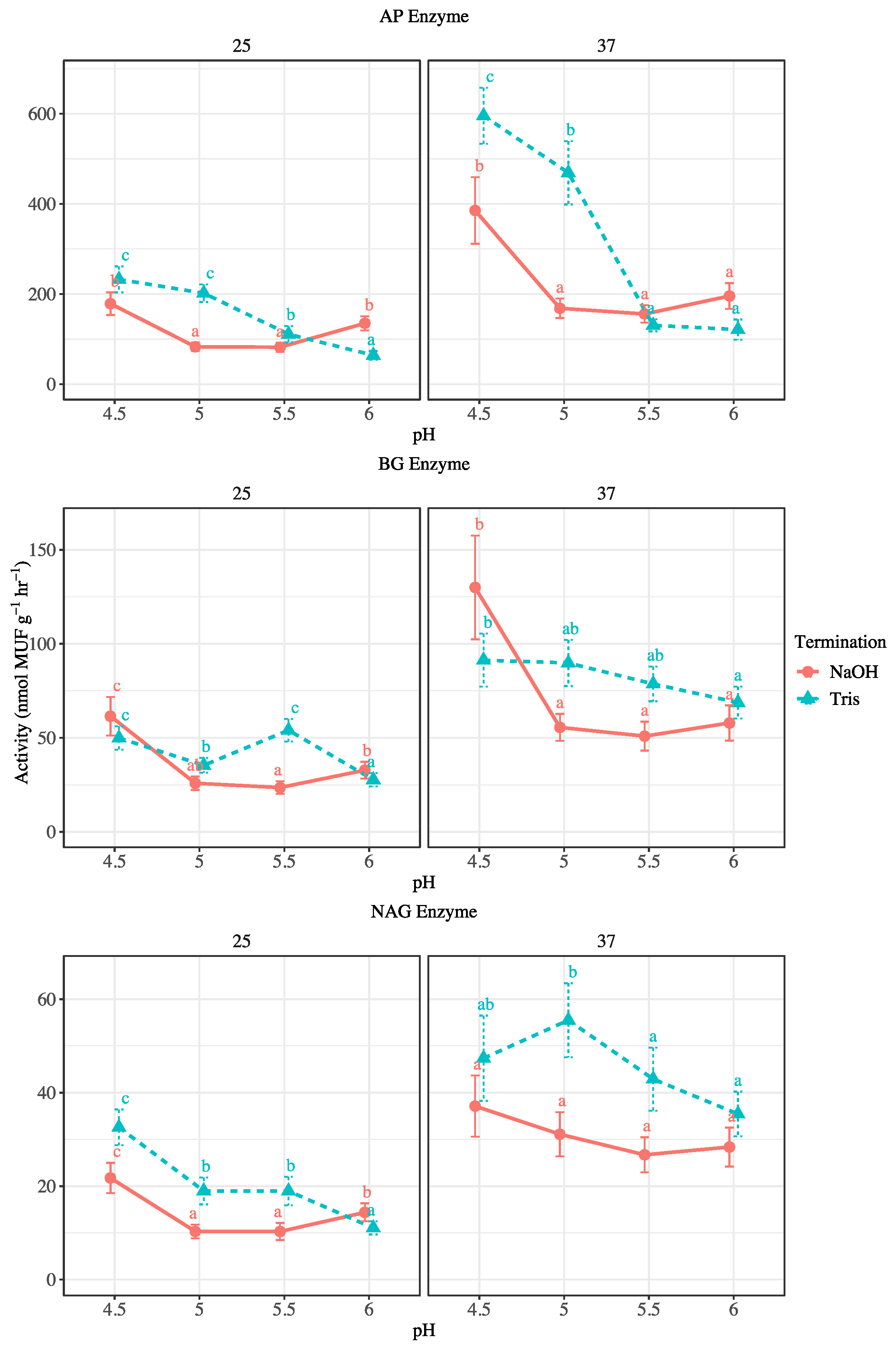
For all three enzymes, main effects and interaction terms were significant, except for the interaction between temperature and the termination reagent (
Table 3). The impact of temperature on enzyme activities was uniform for all three enzymes, with greater activities at 37 °C than at 25 °C for every combination of pH and termination reagent, except for the Tris termination at pH 4.5 for the NAG enzyme (
Figure 1).
For NaOH termination, the impact of pH was generally similar at both temperatures for all enzymes (
Figure 1). For the AP enzyme, activities at 25 °C were significantly highest at pH 4.5 and pH 6 and lowest at pH 5 and 5.5, while at 37 °C, activities were higher at pH 4.5 than at other pH values. For the BG enzyme at both temperatures, activities were significantly highest at pH 4.5 with no difference between pH 5 and 5.5, and activities increased (25 °C) or did not vary (37 °C) between pH 5.5 and 6. For the NAG enzyme at 25 °C, activities were significantly highest at pH 4.5, there was no difference between pH 5 and 5.5, and activities rose from pH 5.5 to 6. In contrast, NAG activities were not significantly affected by pH at 37 °C.
Trends among pH values at each temperature were less consistent for Tris than for NaOH termination (
Figure 1). For the AP enzyme at 25 °C, activities were significantly highest at pH 4.5 and 5, lowest at pH 6, and intermediate at pH 5.5. At 37 °C, activities were highest at pH 4.5, lowest at pH 5.5 and 6, and intermediate at pH 5. For the BG enzyme at 25 °C, activities were significantly highest at pH 4.5 and 5.5, lowest at pH 6, and intermediate at pH 5; at 37 °C, activities were greater at pH 4.5 than at pH 6, with no differences among other pH values. For the NAG enzyme at 25 °C, activities were significantly highest at pH 4.5, lowest at pH 6, and intermediate at pH 5 and 5.5, while at 37 °C, activities at pH 5 were higher than activities at pH 5.5 and 6, with no other differences among pH values.
Overall, Tris termination resulted in significantly higher activities than NaOH termination in 63% of the testing conditions for the BG and AP enzymes, and in 88% of the testing conditions for the NAG enzyme. For the AP enzyme, activities were significantly higher with Tris termination at pH 4.5 and 5 (for both temperatures) and at pH 5.5 (only at 25 °C), while activities were higher with NaOH at pH 6 for both temperatures. For the BG enzyme, Tris termination resulted in higher activities than NaOH termination at pH 5 and 5.5 (for both temperatures) and at pH 6 (only at 37 °C), with no difference between termination reagents at pH 4.5. For the NAG enzyme, activities were higher with Tris termination at all pH values for both temperatures, except for pH 6 at 25 °C, for which there was no difference between the two termination reagents.
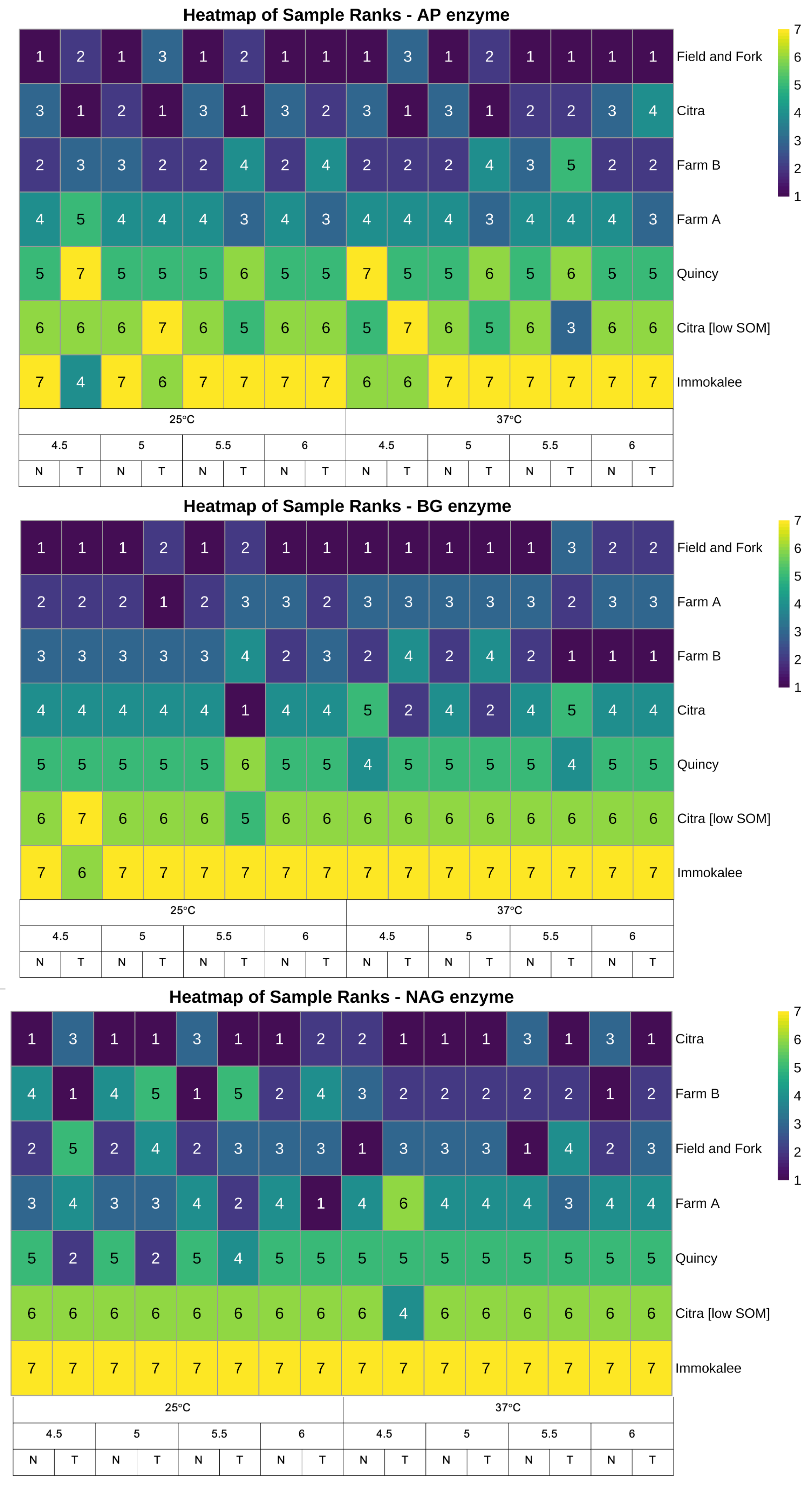
3.3. Sampling Location Rankings
A separate analysis was used to evaluate the impact of the 16 fluorimetric assay condition combinations on the rankings of sampling locations, to verify if the assay was sufficiently robust to maintain the relative rankings of different samples, even if changing an assay parameter caused the absolute values of enzyme activities to systematically increase or decrease. For each enzyme, raw data points were separated by unique testing conditions of temperature, pH, and termination reagent, then the three replicates per location were averaged, and the
pheatmap function in the package
pheatmap [
47] was used to create a heatmap to indicate the rankings of locations by activity within each condition (
Figure 2).
While the exact rank of a given location often changed between conditions, samples typically fell within the same range of ranks. The degree to which the rankings changed was sample-specific, with some samples varying to a greater extent (e.g., Farm A and Farm B) and other samples remaining at the same rank consistently (e.g., Immokalee and Citra [low SOM]). For example, the Immokalee sample had the lowest BG activity in 15 of the 16 conditions, and the second lowest activity in one condition. Similarly, the Quincy sample was consistently in the intermediate rankings, being ranked 5th highest in BG activity in 13 of 16 conditions, 4th highest in two of 16 conditions and 6th highest in activity in one condition. The Field and Fork sample had the highest BG activity in 11 of 16 conditions, 2nd highest activity in 4 of 16 conditions and 3rd highest in the other condition. Similar patterns, albeit with greater variability, were present for the AP and NAG enzymes, suggesting that results were generally consistent across assay conditions when comparing soils with contrasting properties.
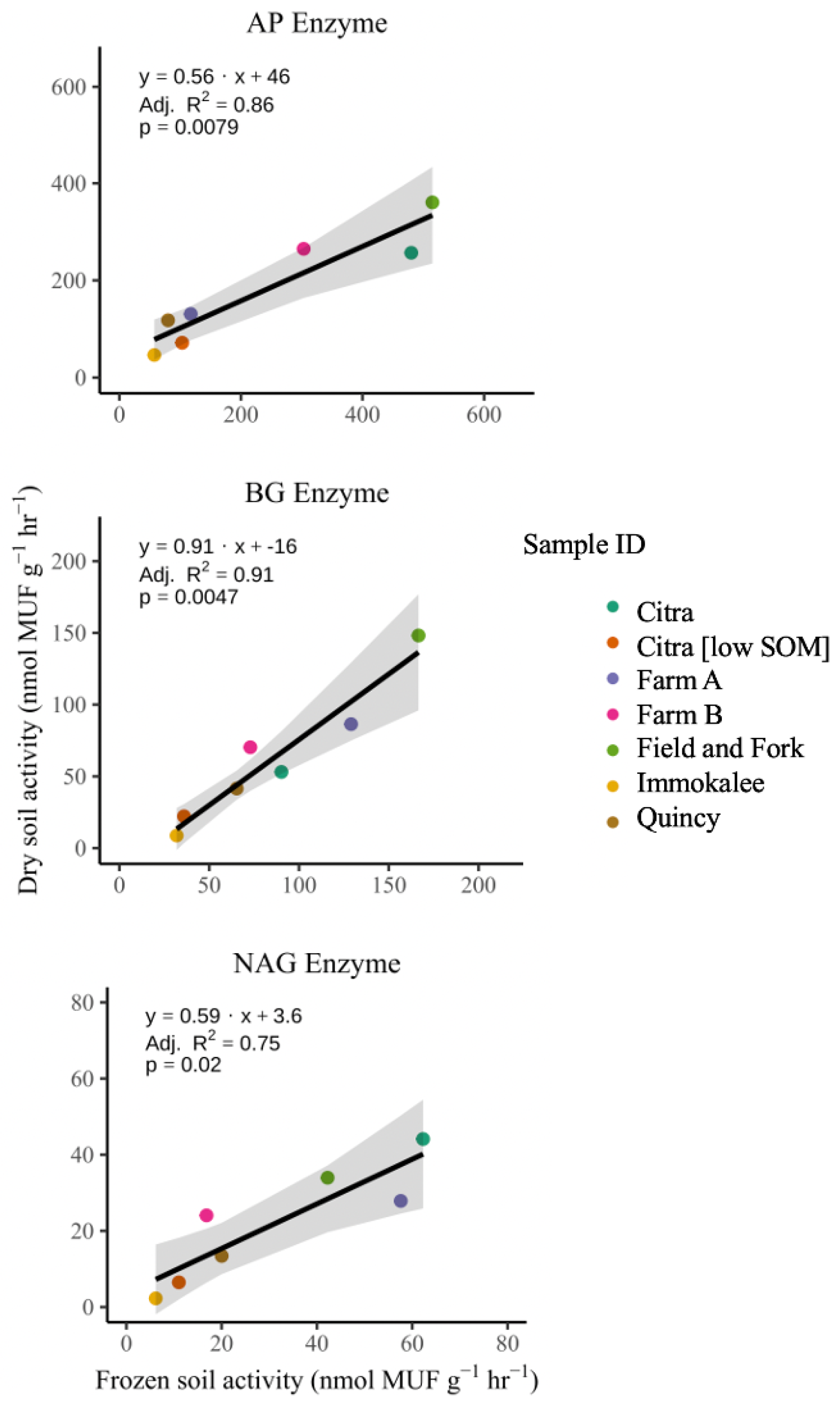
3.4. Sample Storage Analysis
The linear model comparing activities obtained with air-dried and frozen soils was significant for the AP, BG, and NAG enzymes (
Figure 3). The fraction of variation explained by the model was highest for BG (R
2adj = 0.91), intermediate for AP (R
2adj = 0.86), and lowest for NAG (R
2adj = 0.75). The intercept was not different from zero for any enzyme, and the slope estimates were lower for AP (0.56) and NAG (0.59) compared to BG (0.91).
Samples were ranked to see if storage conditions affected the relative rankings of different soils. For the AP enzyme, the rankings from the air-dried soils were the same as for frozen soils, except that Citra and Farm B, as well as Quincy and Citra [low SOM], were inverted. For the BG enzyme, the rankings were the same for air-dried and frozen soils, except that Citra and Farm B were inverted. For the NAG enzyme, the rankings were the same for air-dried and frozen soils except that Field and Fork and Farm A, as well as Quincy and Farm B, were inverted.
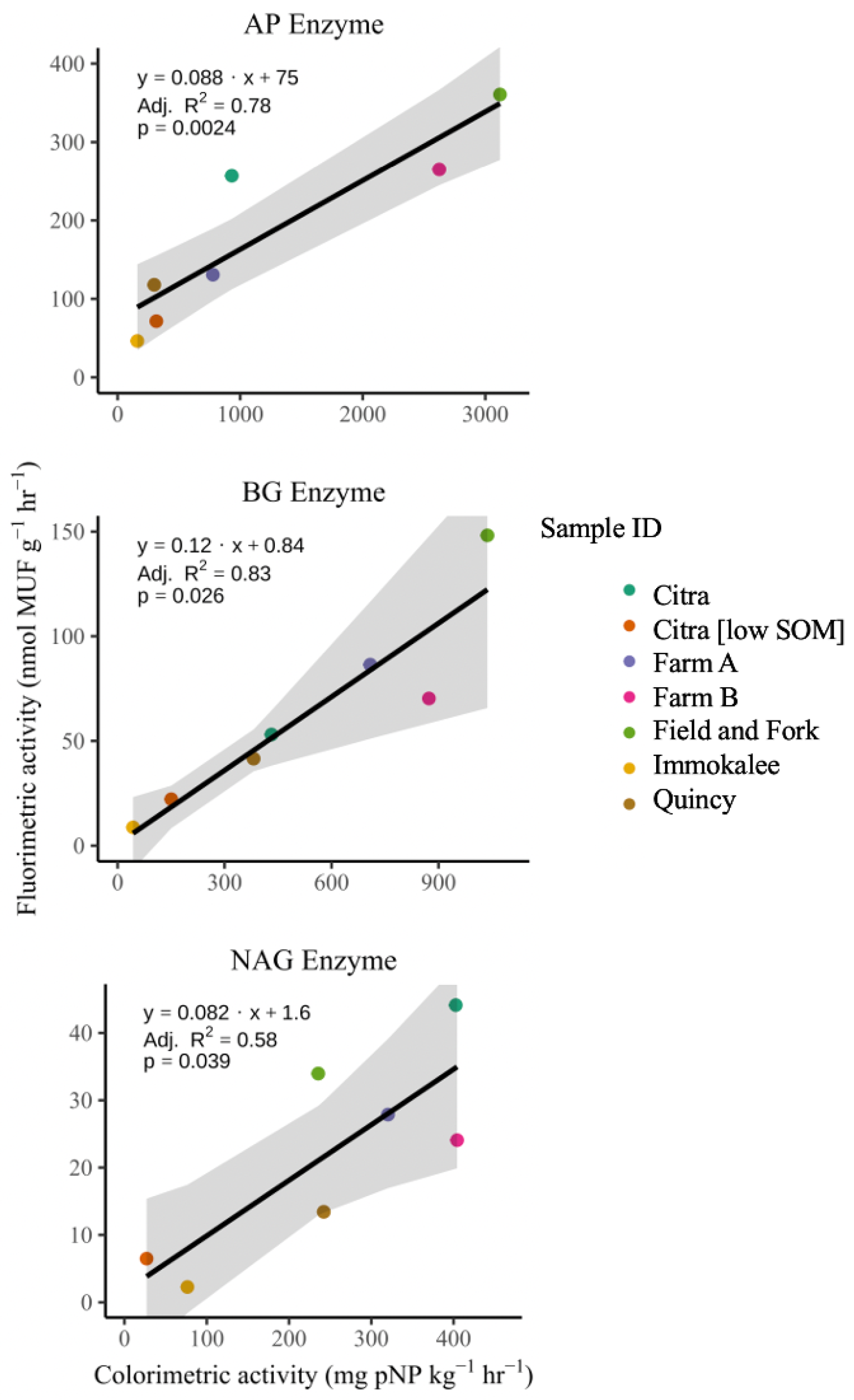
3.5. Comparison Between Microplate Fluorimetry and Benchtop Colorimetry
The linear models comparing enzyme activities obtained with the benchtop colorimetric assay to those obtained with the fluorimetric microplate assay (at 25 °C, pH 4.5, and NaOH termination) were significant for the AP, BG, and NAG enzymes (
Figure 4). The proportion of variation explained by the model was highest for BG (R
2adj = 0.83), intermediate for AP (R
2adj = 0.78), and lowest for NAG (R
2adj = 0.58). The intercept was not significantly different from zero for any enzyme, but the slope values were similar for all three enzymes (i.e., 0.08–0.12).
Samples were ranked by activity measured from both methodologies to determine if rankings were affected by method. For the AP and BG enzymes, the rankings for fluorimetry and colorimetry were the same, except for two soils that were inverted: Quincy and Citra [low SOM] for AP, and Farm A and Farm B for BG. In contrast, the rankings for the NAG enzymes differed between fluorimetry (from highest to lowest: Citra, Field and Fork, Farm A, Farm B, Quincy, Citra [low SOM], and Immokalee) and colorimetry (Farm B, Citra, Farm A, Quincy, Field and Fork, Immokalee, and Citra [low SOM]).
3.6. Comparison of Soil Enzyme Activities with Other Soil Properties
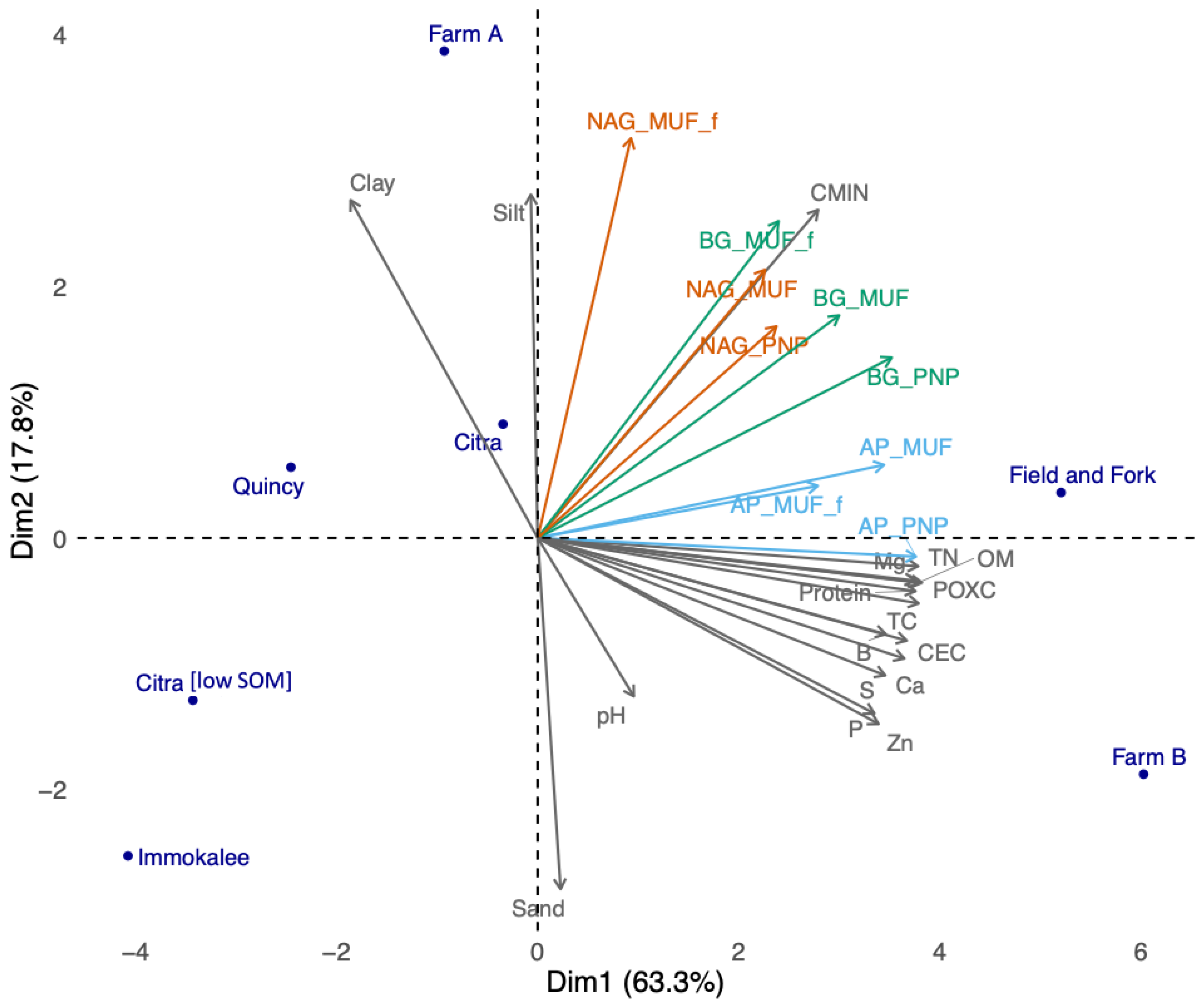
Most of the variance in the data was represented by the first two principal components (PCs), which together explained 81.1% of the variance (PC1 = 63.3%, PC2 = 17.8%). The activities of all three enzymes and several carbon-associated indicators (SOM, total C, POXC, CMIN) had positive loadings on PC1, while % clay had a negative loading (
Figure 5). Activities from the fluorimetric assay at optimal conditions on air-dried and frozen soils and activities from the colorimetric assay were clustered in the same quadrant for the BG and NAG enzymes, together with CMIN. All three AP activities were correlated with each other, although the fluorimetric activities were located closer to the cluster of CMIN, BG and NAG activities, and the colorimetric AP activity was located closer to the cluster of other C-based indicators (SOM, TC, POXC), which was supported by the clustering analysis (
Supplementary Figure S3).
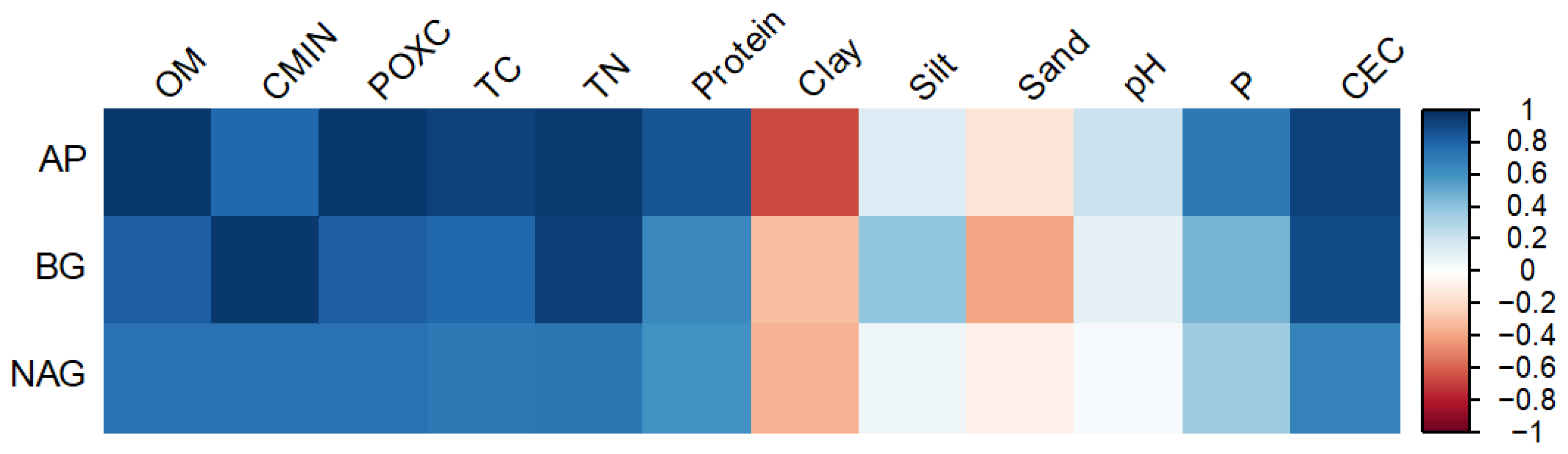
There were moderate to strong positive Spearman correlations (defined as correlations with a coefficient > 0.6) between the activities of all three enzymes and SOM, CMIN, POXC, total C, total N, ACE protein, CEC, and several nutrients (
Figure 6). There was also a moderately strong positive relationship between AP activities and Melich-3 P, with a much weaker (coefficient < 0.5) correlation for the BG and NAG enzymes. There were negligible to slightly negative correlations between soil texture variables and enzyme activities, except for the strong negative correlation between AP activities and clay, and a slight positive correlation between BG and silt content.
Overall, several observations were consistent between Spearman correlations and the PCA; e.g., clay content was negatively correlated with enzyme activities, and the AP enzyme activities were more strongly correlated with SOM, POXC, and total C than the other two enzymes (
Figure 6). Linear regressions confirmed the stronger relationship of AP with SOM than Mehlich-3 P (
Supplementary Figure S4), and the strong positive correlation between BG activity and CMIN (
Supplementary Figure S5). Overall, NAG was less strongly associated with several soil health and fertility indicators than either AP or BG.
5. Conclusions
The results of this study confirm the value of testing kinetic parameters to ensure that substrate-saturating conditions (i.e., at least five times Km) are achieved, although the relatively low variability in Km values among the seven samples tested suggests that kinetic parameters do not need to be tested for soils under different treatments originating from a single location. In the Florida coarse-textured soils used for this study, the assay conditions of 25 °C, pH = 4.5, and NaOH termination were selected as the best compromise in terms of maximizing activity values while maintaining the greatest consistency across assay conditions, although different variations may be optimal in other regions and under different land uses. Most importantly, this study found that fluorimetric enzyme assays were sufficiently robust to identify differences in the seven soil samples from different locations even when storage and assay conditions varied, likely because the driving impact of soil properties, such as sand and SOM content, outweighed the effects of variations in the assay protocol. Thus, running preliminary tests to determine optimal assay conditions is likely not essential for every study, but it can be useful to optimize the protocol for a range of different soil types and climates. Finally, the activities of the AP, BG, and NAG enzymes were positively correlated with other measures of soil health (e.g., SOM, CMIN), highlighting their connection with other soil health indicators, but also raising potential concerns in terms of whether the information enzyme activities provide is redundant with other indicators.
Future studies with larger sample sizes are needed to validate that the optimal protocol conditions identified in this study (25 °C, pH 4.5, NaOH termination) are appropriate across varied coarse-textured soils throughout Florida and within similar soils globally. The results of this study also support further fluorimetric assay optimization (specifically regarding temperature and pH manipulation) for enzyme protocols in other “uncommon soils”, such as in wetlands, arid conditions, and soils very high in clay content, as the de facto fluorimetric enzyme protocols optimized under different conditions may be ineffective at accurately assessing soil fluorimetric enzymatic activities in these soils.




 ,
,