You are currently viewing a new version of our website. To view the old version click .

Journal of Manufacturing and Materials Processing, Volume 4, Issue 2

June 2020 - 34 articles

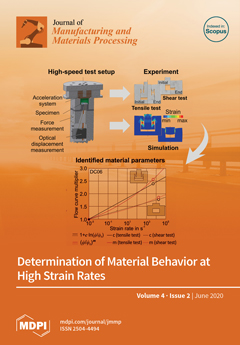
Cover Story: In conventional forming processes, quasistatic conditions are a good approximation, and numerical process optimization is the state-of-the-art in industrial practice. In production technologies with high forming velocities, however, the dependency of material behavior on the strain rate must be considered. Therefore, a method for determining material characteristics in processes with high forming speeds was developed by designing and implementing a test setup and an inverse parameter identification. The identified material parameters allow numerical modeling of high-speed processes with good accuracy. Material parameters determined for steel show significant differences for different stress states, an effect which does not occur under quasistatic loading. This trend suggests a triaxiality-dependent rate dependence, which might be attributed to shear-band -nduced strain localization and adiabatic heating. View this paper.
  • Issues are regarded as officially published after their release is announced to the table of contents alert mailing list .
  • You may sign up for email alerts to receive table of contents of newly released issues.
  • PDF is the official format for papers published in both, html and pdf forms. To view the papers in pdf format, click on the "PDF Full-text" link, and use the free Adobe Reader to open them.

Articles (34)

  • Article
  • Open Access
8 Citations
4,085 Views
18 Pages

Assessment of Mechanisms for Particle Migration in Semi-Solid High Pressure Die Cast Aluminium-Silicon Alloys

  • Madeleine Law,
  • Christopher Neil Hulme-Smith,
  • Taishi Matsushita and
  • Pär G. Jönsson

In semi-solid metal high pressure die casting and in conventional high pressure die casting, it is common to find a defect band just below the surface of the component. The formation of these bands is not fully understood. However, there are several...

  • Article
  • Open Access
14 Citations
4,721 Views
10 Pages

Green Ceramic Machining: Influence of the Cutting Speed and the Binder Percentage on the Y-TZP Behavior

  • Anthonin Demarbaix,
  • François Ducobu,
  • Nicolas Preux,
  • Fabrice Petit and
  • Edouard Rivière-Lorphèvre

The demand for inert bioceramics is always increasing in the dental field. Yttrium oxide tetragonal zirconia polycrystals (Y-TZP) are oxide ceramics which are currently used because of their interesting mechanical properties due to a toughening trans...

  • Review
  • Open Access
40 Citations
11,895 Views
26 Pages

Distributed digital manufacturing offers a solution to medical supply and technology shortages during pandemics. To prepare for the next pandemic, this study reviews the state-of-the-art of open hardware designs needed in a COVID-19-like pandemic. It...

  • Article
  • Open Access
84 Citations
8,671 Views
17 Pages

Quality Performance Evaluation of Thin Walled PLA 3D Printed Parts Using the Taguchi Method and Grey Relational Analysis

  • Kyriaki-Evangelia Aslani,
  • Dimitrios Chaidas,
  • John Kechagias,
  • Panagiotis Kyratsis and
  • Konstantinos Salonitis

This paper investigates the quality performance of FDM 3D printed models with thin walls. The design of experiments method (DOE) was used and nine models of the same size were fabricated in a low-cost 3D printer using polylactic acid (PLA) material....

  • Article
  • Open Access
10 Citations
3,892 Views
18 Pages

Characterisation of Laser System Power Draws in Materials Processing

  • Nicholas Goffin,
  • Lewis C. R. Jones,
  • John Tyrer,
  • Jinglei Ouyang,
  • Paul Mativenga and
  • Elliot Woolley

Due to their high speed and versatility, laser processing systems are now commonplace in many industrial production lines. However, as the need to reduce the environmental impact from the manufacturing industry becomes more urgent, there is the oppor...

  • Article
  • Open Access
39 Citations
6,220 Views
15 Pages

A numerical model that incorporates temperature-dependent non-Newtonian viscosity was developed to simulate the extrusion process in extrusion-based additive manufacturing. Agreement with the experimental data was achieved by simulating a polylactic...

  • Article
  • Open Access
17 Citations
4,900 Views
18 Pages

The tribological effect of cutting fluids in the machining processes to reduce the friction in the cutting zone is still widely unknown. Most test benches and procedures do not represent the contact conditions of machining processes adequately, espec...

  • Article
  • Open Access
61 Citations
5,242 Views
21 Pages

This paper deals with the development and comparison of prediction models established using response surface methodology (RSM) and artificial neural network (ANN) for a wire electrical discharge machining (WEDM) process. The WEDM experiments were des...

  • Article
  • Open Access
8 Citations
3,441 Views
20 Pages

Evaluation of Prediction Accuracy for Anisotropic Yield Functions Using Cruciform Hole Expansion Test

  • Hideo Tsutamori,
  • Toshiro Amaishi,
  • Ray Rizaldi Chorman,
  • Matthias Eder,
  • Simon Vitzthum and
  • Wolfram Volk

To evaluate the prediction accuracy of the anisotropic yield function, we propose an original cruciform hole expansion test. Displacements on two axes were applied to the cruciform specimens with a hole in the center. The thickness strain in the regi...

  • Article
  • Open Access
20 Citations
5,313 Views
15 Pages

This work presents a comprehensive structure for evaluating the sustainability of machining processes. Industries can contribute towards developing a sustainable future by using algorithms that evaluate the sustainability of their processes. Inspired...

of 4

Get Alerted

Add your email address to receive forthcoming issues of this journal.

XFacebookLinkedIn
J. Manuf. Mater. Process. - ISSN 2504-4494