


Skip to Content
You are currently on the new version of our website. Access the old version .

Philosophies, Volume 6, Issue 2

2021 June - 28 articles

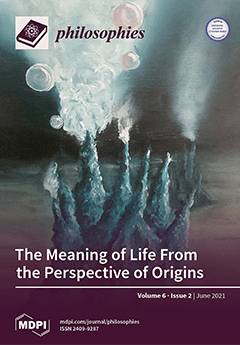
Cover Story: Biological meaning is traditionally approached from the perspective of evolution rather than from the perspective of definitions. Studies of life’s origin entail a time when there were no organisms on Earth, followed by a time when there were. The question of where, in that transition, chemicals on Earth became alive is defined by premises for how life arose. Cultural narratives and scientific narratives for our origins have in common that they always start with a setting, a place on Earth or elsewhere where we can imagine what happened. This structures both the problem and the narrative for its solution. Hydrothermal vents are now widely discussed as the site of life’s chemical genesis, as depicted in the painting by Lilli M. Martin on the cover. Origin narratives convey meaning to humans by unveiling both the place where we arose and the inanimate things from which we are descended. View this paper
  • Issues are regarded as officially published after their release is announced to the table of contents alert mailing list .
  • You may sign up for email alerts to receive table of contents of newly released issues.
  • PDF is the official format for papers published in both, html and pdf forms. To view the papers in pdf format, click on the "PDF Full-text" link, and use the free Adobe Reader to open them.

Articles (28)

  • Article
  • Open Access
6 Citations
4,439 Views
13 Pages

This paper naturalizes inductive inference by showing how scientific knowledge of real mechanisms provides large benefits to it. I show how knowledge about mechanisms contributes to generalization, inference to the best explanation, causal inference,...

  • Article
  • Open Access
2 Citations
4,514 Views
13 Pages

In this contribution, I discuss some less well-known premodern and early modern antecedents of Spinoza’s concepts and claims in the Tractatus Theologico-Politicus. On the one hand, I will argue, Spinoza’s notion of prophecy owes more to Moses Maimoni...

  • Article
  • Open Access
25 Citations
10,663 Views
22 Pages

A philosopher and a cognitive neuroscientist conversed with Buddhist lama Tilmann Lhündrup Borghardt (TLB) about the unresolved phenomenological concerns and logical questions surrounding “pure” consciousness or minimal phenomenal experience (MPE), a...

  • Article
  • Open Access
3 Citations
5,628 Views
7 Pages

This article is intended to provide a review of some modifications to the Drake equation, a 1961 concept presented by Frank Drake to determine the number of extra-terrestrial civilizations able to communicate. A reduced version of the Drake equation...

  • Article
  • Open Access
11 Citations
5,678 Views
10 Pages

Despite a decade of diversity policy plans, a wave of student rallies has ignited debates across western European university campuses. We observe these debates from a situated call for anti-racism in Belgian higher education institutions, and critica...

  • Feature Paper
  • Article
  • Open Access
1 Citations
4,447 Views
19 Pages

Educational assessments, specifically standardized and normalized exams, owe most of their foundations to psychological test theory in psychometrics. While the theoretical assumptions of these practices are widespread and relatively uncontroversial i...

  • Article
  • Open Access
5 Citations
4,233 Views
20 Pages

This article offers an overview of Marilena Chaui’s reading of the Tractatus Theologico-Politicus (TTP). Chaui has published numerous books and essays on Baruch Spinoza. Her two-volume study The Nerve of Reality is the culmination of a decades-long e...

  • Article
  • Open Access
1 Citations
2,537 Views
10 Pages

The Blochian concept of cipher is discussed in some detail with a view to possible developments in the modern philosophy of nature. Parallels and differences are listed as to the Idealistic tradition in Germany preceding Bloch’s approach. It is found...

  • Article
  • Open Access
1 Citations
3,676 Views
14 Pages

The details of abiogenesis, to date, remain a matter of debate and constitute a key mystery in science and philosophy. The prevailing scientific hypothesis implies an evolutionary process of increasing complexity on Earth starting from (self-) replic...

  • Article
  • Open Access
2 Citations
5,892 Views
18 Pages

In the form of a case study and based upon novel material about the reception of Spinoza’s Theological–Political Treatise (TTP) in Iran, this paper studies issues with the interactions among political, theological and philosophical ideas in the recep...

  • Article
  • Open Access
6 Citations
5,630 Views
20 Pages

The nineteenth century was a time of great economic, social, and political change. The population of a modernizing Europe began demanding more freedom, which in turn propelled the ongoing discussion on the philosophy of nature. This spurred on Centra...

  • Article
  • Open Access
3,783 Views
12 Pages

The contention in this paper is that the theological-political disputes Spinoza was concerned with 350 years ago are similar to the conspiratorial disputes we experience today. The world in Spinoza’s Tractatus theologico-politicus, a political interv...

  • Article
  • Open Access
4,454 Views
11 Pages

In the field of responsibility and climate change, much attention has been paid to actions and what we need to do in order to take responsibility. This paper shifts the perspective from what we should do to how we should be in order to be responsible...

  • Article
  • Open Access
4 Citations
6,006 Views
20 Pages

This paper demonstrates the method and meaning behind the argument that contemporary philosophers have found the key to “de-creation” in potentiality by implementing it in artwork. While creation in the usual sense seems to imply an active attitude,...

  • Feature Paper
  • Article
  • Open Access
3,762 Views
12 Pages

What is a philosophical religion? Carlos Fraenkel proposes that we use this term to describe “the interpretation of the historical forms of a religion in philosophical terms”. Such a philosophical interpretation allows religious traditions to be util...

  • Article
  • Open Access
2 Citations
4,736 Views
20 Pages

This paper resolves some puzzles regarding Spinoza’s appropriations and rejections of various aspects of Bacon’s methodology, and uses these solutions to resolve some long-standing puzzles concerning Spinoza’s modus operandi in the TTP. We argue firs...

  • Article
  • Open Access
2 Citations
5,930 Views
19 Pages

To What Inanimate Matter Are We Most Closely Related and Does the Origin of Life Harbor Meaning?

  • William F. Martin,
  • Falk S. P. Nagies and
  • Andrey do Nascimento Vieira

The question concerning the meaning of life is important, but it immediately confronts the present authors with insurmountable obstacles from a philosophical standpoint, as it would require us to define not only what we hold to be life, but what we h...

  • Article
  • Open Access
18 Citations
8,119 Views
12 Pages

This article is about a specific, but so far neglected peril of AI, which is that AI systems may become existential as well as causing suffering risks for nonhuman animals. The AI value alignment problem has now been acknowledged as critical for AI s...

  • Article
  • Open Access
5 Citations
6,270 Views
21 Pages

Design for Values (DfV) philosophies are a series of design approaches that aim to incorporate human values into the early phases of technological design to direct innovation into beneficial outcomes. The difficulty and necessity of directing advanta...

  • Article
  • Open Access
3 Citations
4,957 Views
12 Pages

In one of the last paragraphs of his Tractatus theologico-politicus (1670), Spinoza extolls the harmony between people of a diversity of faiths, maintained by the magistracy of Amsterdam. However, he also seems apprehensive about the possibility of t...

  • Article
  • Open Access
6 Citations
4,369 Views
22 Pages

Among the biggest challenges facing the contemporary human condition, and therefore also education, is responding to the climate crisis. One of the sources of the crisis is assumed to be absent-mindedness, presented by Leslie Dewart as a distortion o...

  • Article
  • Open Access
1 Citations
2,904 Views
16 Pages

The article is based on the dual concepts of theoretical incompleteness in systems science and theoretical incomprehensibility in philosophy previously introduced in the literature. Issues of incompleteness relate to the logical openness of complexit...

Get Alerted

Add your email address to receive forthcoming issues of this journal.

XFacebookLinkedIn
Philosophies - ISSN 2409-9287