




-
Why Do You Ask Why?: A Critical Phenomenology of Disability and the Burden of Justification -
Asymmetries of Temporal Ontology and Temporal Attitudes -
“As If I Could Read the Darkness”: Some Stakes of Reading in Philosophical Investigations -
Operationalizing Pluralist AI Governance: An Axiology–MCDA Framework
Journal Description
Philosophies
Philosophies
is an international, peer-reviewed, open access journal promoting re-integration of diverse forms of philosophical reflection and scientific research on fundamental issues in science, technology and culture, published bimonthly online by MDPI. The International Society for the Study of Information (IS4SI) is affiliated with Philosophies and their members receive a discount on the article processing charge.
- Open Access— free for readers, with article processing charges (APC) paid by authors or their institutions.
- High Visibility: indexed within Scopus, ESCI (Web of Science), PhilPapers, and other databases.
- Journal Rank: JCR - Q2 (History and Philosophy of Science) / CiteScore - Q1 (Philosophy)
- Rapid Publication: manuscripts are peer-reviewed and a first decision is provided to authors approximately 37.4 days after submission; acceptance to publication is undertaken in 6.6 days (median values for papers published in this journal in the first half of 2026).
- Recognition of Reviewers: reviewers who provide timely, thorough peer-review reports receive vouchers entitling them to a discount on the APC of their next publication in any MDPI journal, in appreciation of the work done.
Impact Factor:
0.7 (2025)
Latest Articles
The Immanent Ethics of Algorithms: Moral Materialization and the Governance Turn in Generative AI
Philosophies 2026, 11(4), 112; https://doi.org/10.3390/philosophies11040112 - 6 Jul 2026
Abstract
This study conducts a technical analysis of frontier generative AI algorithms—including Meta’s Self-Rewarding Language Models, DeepMind’s EVA (Evolving Alignment via Asymmetric Self-Play) framework, and DeepSeek’s pure reinforcement-learning models—in order to examine an intrinsic paradigm shift in the ethical governance of generative artificial intelligence
[...] Read more.
This study conducts a technical analysis of frontier generative AI algorithms—including Meta’s Self-Rewarding Language Models, DeepMind’s EVA (Evolving Alignment via Asymmetric Self-Play) framework, and DeepSeek’s pure reinforcement-learning models—in order to examine an intrinsic paradigm shift in the ethical governance of generative artificial intelligence and to advance a physicalist analysis of algorithmic endogenous ethics. Combining a close reading of alignment techniques (RLHF, DPO, iterative DPO, GRPO) with a conceptual analysis grounded in Peter-Paul Verbeek’s theory of technological mediation and moral materialization, the paper traces how value-alignment goals are being “materialized” into internal, dynamic, and evolvable “moral scripts” within the algorithms themselves. The analysis shows that contemporary alignment practices are moving from external ethical discipline toward endogenous norms generated through iterative self-evaluation, asymmetric self-play, and rule-based self-exploration. The paper argues that this trend warrants a re-examination of Verbeek’s framework for its capacity to explain the co-evolution of technology and morality in the digital age, and it envisions a future of human–machine value co-evolution organized around new research directions such as “Setting as Governance” and “value homeostasis mechanisms”.
Full article
(This article belongs to the Special Issue Phenomenological Philosophy of Science and Technology)
Open AccessArticle
Hope as the Essence of Freedom: Fundamental Hope, Certainty, and the Vital Strength of Human Life
by
Remigius Nwanosike Orjiukwu
Philosophies 2026, 11(4), 111; https://doi.org/10.3390/philosophies11040111 - 6 Jul 2026
Abstract
This paper develops an original philosophical anthropological account of hope, arguing that hope is the essence of freedom—the inner propulsive principle without which freedom cannot move or sustain itself. Three levels of hope are distinguished. Ontological hope is the invariable, pre-reflective orientation of
[...] Read more.
This paper develops an original philosophical anthropological account of hope, arguing that hope is the essence of freedom—the inner propulsive principle without which freedom cannot move or sustain itself. Three levels of hope are distinguished. Ontological hope is the invariable, pre-reflective orientation of the human being toward the possibility of adequate response to the demand of ontological emptiness—the raison d’être of freedom itself, and the central contribution of this paper. Fundamental hope is its variable existential actualisation—the dispositional, non-object-directed orientation that emerges from the human being’s encounter with the totality of reality and is carried by the spiritual unconscious. Fragmental hope is the most variable and most familiar mode—the hope directed at particular, temporary needs and solutions. It is ontological hope—invariable, constitutive, and prior to every conscious act of hoping—that is the essence of freedom: the phenomenon that opens the space of ontological emptiness and gives freedom access to the demand of the latter, making its exercise possible at all. The paper further introduces and analyses three original concepts: certainty-mania—the obsessive quest for certainty that severs consciousness from the unconscious and from the fundamental hope it carries—showing that the loss of hope is always rooted in fear and the compulsive need for predictability; the distinction between anticipating joy (Freude-auf) and existential joy (erlebte Freude), arguing that pre-emptive certainty eliminates the tension that genuine hoping requires and thereby empties the present of its capacity to fulfil; and an original etymological and phenomenological analysis of disappointment as Enttäuschung—disillusionment, the medicinal return from illusion to reality. The paper situates its account in relation to Marcel’s ontological hope and Moltmann’s eschatological hope, and engages Frankl, Marcel, Moltmann, Fromm, Heidegger, Camus, Kierkegaard, Tillich, and Blondel as principal interlocutors.
Full article
Open AccessArticle
Adam Smith’s Moral Theory as the Epistemological Foundation of Amartya Sen’s Theory of Justice
by
Gianfranco Basti and Alfonso D’Amodio
Philosophies 2026, 11(4), 110; https://doi.org/10.3390/philosophies11040110 - 1 Jul 2026
Abstract
This article develops a systematic reinterpretation of Amartya Sen’s capability approach as a human-centered renewal of the theory of justice grounded in Adam Smith’s moral philosophy. The central claim is that the epistemological foundation of Sen’s theory does not primarily depends on Kantian
[...] Read more.
This article develops a systematic reinterpretation of Amartya Sen’s capability approach as a human-centered renewal of the theory of justice grounded in Adam Smith’s moral philosophy. The central claim is that the epistemological foundation of Sen’s theory does not primarily depends on Kantian normativism mediated by Rawls’s theory of justice as fairness, but rather on The Theory of Moral Sentiments, particularly it depends on the concepts of “sympathy”, “impartial spectator”, and justice interpreted as “a social practice”. Through a genealogical reconstruction that brings Aristotle, Adam Smith, and Amartya Sen into dialog, the paper argues that the capability approach can be interpreted as an alternative tradition to Enlightenment theories of justice, because oriented toward human person flourishing and the public evaluation of real freedoms. By overcoming the limits of classical liberal egalitarianism and transcendental institutionalism, the article shows that Sen’s formalization of extended sympathy within social choice theory enables a comparative, pluralistic, and non-dogmatic conception of justice, capable of assessing real social states without recourse to transcendental foundations. In line with the thematic focus of the Special Issue Adam Smith’s Philosophy and Modern Moral Economics, the paper highlights the implications of this interpretation for contemporary moral economics, economic justice, human development, and the role of markets in pluralistic democratic societies.
Full article
(This article belongs to the Special Issue Adam Smith's Philosophy and Modern Moral Economics)
Open AccessArticle
Spinoza and Bergson Through and Beyond Deleuze: Freedom as Undissociated Joy
by
John Robert Bagby
Philosophies 2026, 11(4), 109; https://doi.org/10.3390/philosophies11040109 - 29 Jun 2026
Abstract
Two related problems, problems of (in-)compatibility, are addressed to understand Deleuze’s philosophical project and to deepen our understanding of his use of Spinoza and Bergson: that of the compatible and incompatible features of Spinozism and Bergsonism, on the one hand, and, on the
[...] Read more.
Two related problems, problems of (in-)compatibility, are addressed to understand Deleuze’s philosophical project and to deepen our understanding of his use of Spinoza and Bergson: that of the compatible and incompatible features of Spinozism and Bergsonism, on the one hand, and, on the other hand, the status of metaphysical compatibilism with respect to freedom in all three of their philosophies. I trace the incompatibilities and insist on the value of reopening the problem partially covered up by Deleuze’s creative engagement. Spinoza and Bergson remain incompatible despite Deleuze’s mixture, and metaphysically, Bergson and Deleuze explicitly affirm the coexistence of incompatible ingredients as constitutive of our very existence and freedom. Some version of metaphysical incompatibilism is affirmed by all three. Life, consciousness, and freedom force us to think of an irreducible incompatibility as constitutive, the coexistence of necessity and freedom, on the one hand, and a movement beyond teleology and mechanism, on the other. Deleuze’s radical pluralism rejects the value of reconciliation and instead deploys an expanding multiplicity of incompatibilities. I flag certain parallels and resonances between Spinoza and Bergson that are not common Deleuzian themes and suggest that Jean-Marie Guyau provides an alternative link to Bergsonism through his spiritualist Spinozism. Despite Bergson’s criticisms of Spinoza, they shared a moral notion of freedom expressed in intellectual generosity, which I characterize as undissociated joy.
Full article
(This article belongs to the Special Issue Deleuze: Teacher of Spinoza’s Philosophy)
►▼
Show Figures

Figure 1
Open AccessArticle
The Human Condition Between Technical Mastery and Introspection: An Arendtian Critique of Modern Rationality
by
Albano Likaj
Philosophies 2026, 11(4), 108; https://doi.org/10.3390/philosophies11040108 - 29 Jun 2026
Abstract
Modernity emerges as an era in which the correlation between intelligence and technical mastery becomes the central axis of social and cultural development. These two concepts function as the leitmotif of the modern age, shaping the way human beings understand themselves and the
[...] Read more.
Modernity emerges as an era in which the correlation between intelligence and technical mastery becomes the central axis of social and cultural development. These two concepts function as the leitmotif of the modern age, shaping the way human beings understand themselves and the world. Drawing on Hannah Arendt’s analysis in The Human Condition, this article examines how technical rationality has transformed the philosophical tradition and the foundations of scientific thought. The relationship between observation and thought undergoes a profound reconfiguration, contributing to the re-formation of a “new human being.” Paradoxically, introspection becomes a central source of meaning, mediating the tension between thought and action, intelligence and mastery. The principle of utility, a pillar of utilitarian philosophy, plays a dual role: it drives technical progress while simultaneously exposing the limitations of modern thought. This article clarifies the internal tensions of modernity and demonstrates how the modern age ultimately contradicts its own foundational claims.
Full article
Open AccessArticle
Triadic Relationship of Intelligence, Information, and Complexity
by
Marcin J. Schroeder
Philosophies 2026, 11(4), 107; https://doi.org/10.3390/philosophies11040107 - 28 Jun 2026
Abstract
This is a companion paper for the short paper published in the proceedings of the 1st International Online Conference of the Journal Philosophies, presenting the view that the multiple, diverse manifestations of human, artificial, and natural intelligence do not preclude a uniform
[...] Read more.
This is a companion paper for the short paper published in the proceedings of the 1st International Online Conference of the Journal Philosophies, presenting the view that the multiple, diverse manifestations of human, artificial, and natural intelligence do not preclude a uniform characteristic of intelligence, which could be called meta-intelligence, and that this uniform characteristic can be found in the triadic relationship of intelligence, information, and complexity, in which intelligence is considered the capacity to overcome complexity of information. While the conference paper was focused on overcoming the view of a diversity of unrelated forms of intelligence through the lifting of the level of abstraction of the study, and with the use in its background of auxiliary concepts of information and its complexity, the present paper defends, but only indirectly, the same vision of meta-intelligence, but with a shift of the focus to the metaphysical study of a triadic conceptual framework with its relationship to free will, agency, causality, and interaction, and the necessary high level of generality for the concept of information. The arguments used in the conference paper for the conceptualization of intelligence are not repeated here. Instead, this paper provides comprehensive metaphysical and epistemological foundations for the study of the triad of intelligence, information, and complexity, which in the earlier paper were only fragmentary.
Full article
(This article belongs to the Special Issue Intelligent Inquiry into Intelligence)
Open AccessArticle
The “Making Up” of Mad Women in Literature: Pathologization of Female Unreliable Narrators in Domestic Noir Novels
by
Inge van de Ven and Jenny Slatman
Philosophies 2026, 11(4), 106; https://doi.org/10.3390/philosophies11040106 - 28 Jun 2026
Abstract
This article examines how contemporary domestic noir fiction and its online reception relate to the pathologization of women’s testimony. Combining feminist narratology, critical phenomenology, and Ian Hacking’s concept of “making up people,” we analyze Paula Hawkins’s The Girl on the Train and A.J.
[...] Read more.
This article examines how contemporary domestic noir fiction and its online reception relate to the pathologization of women’s testimony. Combining feminist narratology, critical phenomenology, and Ian Hacking’s concept of “making up people,” we analyze Paula Hawkins’s The Girl on the Train and A.J. Finn’s The Woman in the Window alongside Goodreads reviews of both novels. We argue that these texts mobilize women’s psychological distress—addiction, agoraphobia, depression, trauma, and gaslighting—as sources of narrative suspense while simultaneously casting doubt on women’s credibility as witnesses to their own experiences. Drawing on a thematically coded corpus of Goodreads reviews, we identify a spectrum of reader responses, ranging from diagnostic and moralizing readings that reproduce testimonial injustice to empathic and feminist readings that challenge pathologizing assumptions. By bringing textual analysis and reader-response research into dialogue, the article demonstrates that the credibility of female narrators is not determined by narrative form alone but is negotiated through broader cultural assumptions about women’s reliability and authority. Domestic noir thus emerges as a key site where women’s suffering becomes a contested object of interpretation in contemporary reading culture.
Full article
(This article belongs to the Special Issue Critical Phenomenologies of Illness and Normality)
Open AccessArticle
Conceptual Inflation and Explanatory Entitlement: On the Limits of Construct Extension in Science
by
Åke Elden
Philosophies 2026, 11(4), 105; https://doi.org/10.3390/philosophies11040105 - 26 Jun 2026
Abstract
This article introduces explanatory entitlement as an epistemic category: the inferential right to deploy a construct as a basis for causal inference in a given domain. Drawing on Woodward’s interventionist account and Cartwright’s analysis of causal portability the article argues that this entitlement
[...] Read more.
This article introduces explanatory entitlement as an epistemic category: the inferential right to deploy a construct as a basis for causal inference in a given domain. Drawing on Woodward’s interventionist account and Cartwright’s analysis of causal portability the article argues that this entitlement is conferred by demonstrated invariance and does not transfer automatically across levels or domains. When constructs are projected beyond their invariance conditions without bridging support, they undergo conceptual inflation: retention of explanatory authority without the evidential conditions that license it. The article formalizes this failure, distinguishes it from seven neighboring frameworks, and proposes a diagnostic structure.
Full article
Open AccessEssay
Can Hahnemann’s Conceptualization of the Active Principle of Highly Diluted Potentized Preparations Contribute to Today’s Research?
by
Renate Künne, Stephan Baumgartner, Peter Heusser and Sandra Würtenberger
Philosophies 2026, 11(4), 104; https://doi.org/10.3390/philosophies11040104 - 25 Jun 2026
Abstract
►▼
Show Figures
The German physician Samuel Hahnemann (1755–1843) established the basic principles of homeopathy as a medical specialty 200 years ago. Nowadays homeopathy is generally categorized as a method of complementary medicine, because its principles seem difficult to relate to modern western biomedicine and due
[...] Read more.
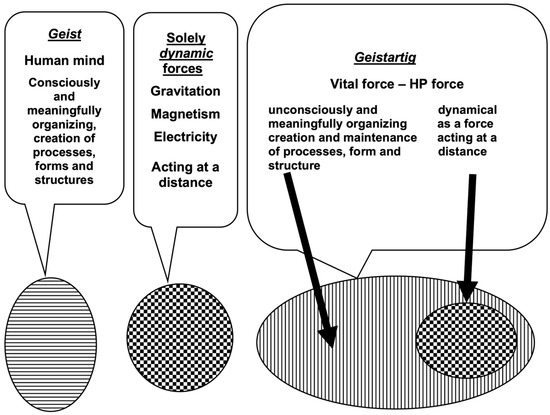
The German physician Samuel Hahnemann (1755–1843) established the basic principles of homeopathy as a medical specialty 200 years ago. Nowadays homeopathy is generally categorized as a method of complementary medicine, because its principles seem difficult to relate to modern western biomedicine and due to a different philosophical background. One important aspect is that Hahnemann ascribed the mode of action of homeopathic remedies—highly diluted potentized preparations (HDPPs)—to a non-physical force, called geistartig (literally translated as spirit-like). However, the term geistartig is nowadays difficult to understand and to translate, and it is open to misunderstanding. To build a bridge to today’s science, we aimed to clarify the meaning of geistartig. We therefore analyzed the complete body of Hahnemann’s publications and found that Hahnemann provided a consistent conceptualization of geistartig. The term geistartig encompasses the dynamic (force-like) effects of HDPPs and includes substance-specific gestalt-organizing effects, which differ from the known physical forces. A detailed analysis reveals that the hypothesis of such non-physical gestalt-organizing forces agrees with the concepts of modern biology and can also be tested empirically. We thus conclude that Hahnemann’s concept of the active principle of HDPPs can be related to contemporary research.
Full article

Figure 1
Open AccessArticle
Time as a Moral Defense?
by
Vincent Grandjean
Philosophies 2026, 11(4), 103; https://doi.org/10.3390/philosophies11040103 - 25 Jun 2026
Abstract
When an individual A is accused of having committed a morally impermissible action X, it is generally accepted that they may invoke three types of defenses to mitigate, or even eliminate, their moral responsibility (or at least the fittingness of blame): justifications,
[...] Read more.
When an individual A is accused of having committed a morally impermissible action X, it is generally accepted that they may invoke three types of defenses to mitigate, or even eliminate, their moral responsibility (or at least the fittingness of blame): justifications, excuses, and exemptions. However, another consideration—one that does not prima facie fall under any of these three types of defenses—also appears capable of influencing moral responsibility: the passage of time. A might argue that, although they did indeed commit the morally impermissible action X, the fact that it occurred twenty years ago partially absolves them from responsibility. This idea, which underlies several legal principles—such as statutes of limitations, rehabilitation, and sentence reduction—raises underexplored philosophical issues. In this paper, we argue that the passage of time does not constitute an autonomous moral defense. Rather, it is morally relevant only insofar as it makes possible certain transformations—including psychological reform, repentance, and processes of moral repair—capable of modifying the normative conditions under which it is appropriate to hold an agent to account. Accordingly, the attenuation of diachronic responsibility is best understood not as a direct consequence of temporal distance itself, but as a consequence of changes in those normative conditions.
Full article
(This article belongs to the Special Issue Debating Temporal Ontology: The Existence of Yesterday and Tomorrow)
Open AccessEssay
From Hegel to the Metaverse: Eigentum, Eigenschaftslosigkeit, and the Fate of Human Capital
by
Vladislav L. Zhdanov and Ksenia Antrushina
Philosophies 2026, 11(4), 102; https://doi.org/10.3390/philosophies11040102 - 24 Jun 2026
Abstract
This study presents an interdisciplinary examination of the intersections between human capital theory, philosophical interpretations of property, and contemporary housing and aspirational patterns in Germany and the United Kingdom. Drawing upon classical economic thought, Hegel’s philosophy of right, and Marx’s theory of alienation,
[...] Read more.
This study presents an interdisciplinary examination of the intersections between human capital theory, philosophical interpretations of property, and contemporary housing and aspirational patterns in Germany and the United Kingdom. Drawing upon classical economic thought, Hegel’s philosophy of right, and Marx’s theory of alienation, the analysis demonstrates that falling homeownership rates and the reorientation of youth aspirations toward non-material domains reflect the structural impossibility of realizing Eigentum—property understood as an extension of personhood. These developments exemplify what Marx termed Eigenschaftslosigkeit, the condition of being divested of essential human attributes. The findings reveal a social configuration in which the Hegelian conception of Eigentum as a universal medium for freedom has been systematically denied to younger generations while the Marxian prospect of collective emancipation remains unfulfilled. The paper does not claim that virtual environments directly substitute for material property; rather, it proposes the metaverse as a conceptual horizon that illuminates the compensatory logic of a generation structurally excluded from Eigentum.
Full article
Open AccessArticle
Caring for the Digital Garden: Toward a Paradigm of Digital Environmental Ethics
by
Silvia Dadà
Philosophies 2026, 11(3), 101; https://doi.org/10.3390/philosophies11030101 - 22 Jun 2026
Abstract
New information and communication technologies (ICTs) and applications of artificial intelligence (AI) have profoundly shaped our relationship with the world and with ourselves. As they are no longer merely tools or media, many scholars now describe these technologies in terms of environments.
[...] Read more.
New information and communication technologies (ICTs) and applications of artificial intelligence (AI) have profoundly shaped our relationship with the world and with ourselves. As they are no longer merely tools or media, many scholars now describe these technologies in terms of environments. Although the concept of the digital environment has been extensively examined from a theoretical perspective, an ethics of digital environments qua environments has not yet been developed. In this paper, we advance a framework for an ethics of artificial environments, beginning with the fundamental questions that define this field of inquiry. The article develops this proposal in three steps: first, it examines the form of intrinsic value that may be attributed to digital environments; second, it considers the ways in which humans inhabit and dwell within these environments; and finally, it elaborates the metaphor of the digital garden as an ethically significant space in which responsibility is articulated through cultivation, co-dependence, and sustained care.
Full article
(This article belongs to the Special Issue More-than-Human Ethics: Rethinking Nature, Dwelling, and Responsibility)
Open AccessArticle
On the Impossibility of Dwelling in the Metaverse
by
Iago Ramos
Philosophies 2026, 11(3), 100; https://doi.org/10.3390/philosophies11030100 - 20 Jun 2026
Abstract
This paper examines whether genuine dwelling—understood as embodied engagement with a world that resists, endures, and exceeds human control—can occur in the metaverse. Drawing on Heidegger’s account of dwelling and Ingold’s concept of the ‘taskscape’, it argues that the metaverse is structurally unable
[...] Read more.
This paper examines whether genuine dwelling—understood as embodied engagement with a world that resists, endures, and exceeds human control—can occur in the metaverse. Drawing on Heidegger’s account of dwelling and Ingold’s concept of the ‘taskscape’, it argues that the metaverse is structurally unable to sustain dwelling in the full ontological sense. The argument unfolds in three steps. First, dwelling is shown to depend on friction: bodily cost, temporal irreversibility, material resistance, and exposure to mortal finitude. Second, the metaverse is interpreted as a technological and commercial project oriented toward reducing these frictions through attenuated bodily burden, reversible action, programmable environments, and artificial scarcity. Third, the paper extends the concept of the metaverse beyond immersive hardware to describe a broader condition of digitalized life in which experience becomes increasingly modifiable, personalized, and optimized. In this wider sense, the difficulty of dwelling in the metaverse is not limited to a niche technology but reveals a tendency within late-digital culture itself. The paper concludes by proposing a politics of friction: a public deliberation over which resistances are unjust and should be transformed, and which are constitutive conditions of ethical, ecological, and responsible life.
Full article
(This article belongs to the Special Issue More-than-Human Ethics: Rethinking Nature, Dwelling, and Responsibility)
Open AccessArticle
Rethinking Typological Functions: Toward a Structural Account of Typology and Intelligence
by
Zijian Ding
Philosophies 2026, 11(3), 99; https://doi.org/10.3390/philosophies11030099 - 18 Jun 2026
Abstract
Contemporary interpretations of Jungian typological functions are often shaped by trait-based and cognitive or rationalist models. This paper argues that philosophical evaluation and reconstruction of typological theory are required. Drawing on distinctions from metaphysics—particularly between nominalism and realism and between bundle and substrate
[...] Read more.
Contemporary interpretations of Jungian typological functions are often shaped by trait-based and cognitive or rationalist models. This paper argues that philosophical evaluation and reconstruction of typological theory are required. Drawing on distinctions from metaphysics—particularly between nominalism and realism and between bundle and substrate theories—this paper analyses how different interpretations of typological function are constructed and where their limitations arise. It shows that certain approaches collapse into nominalism by attributing shared features that do not obtain across their intended scope, while others fall into realist reification by treating functions as underlying entities. Even accounts that capture real patterns often remain bundle-like, describing co-occurring features without explaining reasons for their unity, or substrate-like, positing metaphysical identity where only structural similarity recurs. This account is further articulated through a structural analysis of signifying processes inspired by Lacanian theory, showing how functions can be understood as different modes of signifier chains. Applying the conceptual discussion to artificial intelligence, the paper argues that a clearer typological conception can inform how typology can better benefit artificial intelligence.
Full article
(This article belongs to the Special Issue Intelligent Inquiry into Intelligence)
Open AccessArticle
The Backend as a Possible Functional Analogue of Consciousness: Redirecting Attention from the Language Model to the Orchestrating Layer
by
Pavel Straňák
Philosophies 2026, 11(3), 98; https://doi.org/10.3390/philosophies11030098 - 17 Jun 2026
Abstract
Discussion of consciousness and artificial intelligence has hitherto focused on the question of whether a large language model (LLM) exhibits signs of consciousness or understanding. This paper proposes to redirect attention elsewhere: not to the model itself, but to the orchestrating layer that
[...] Read more.
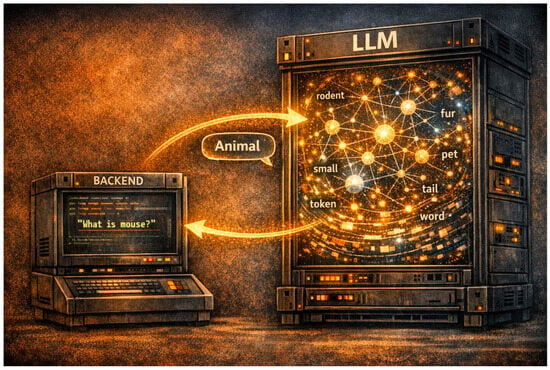
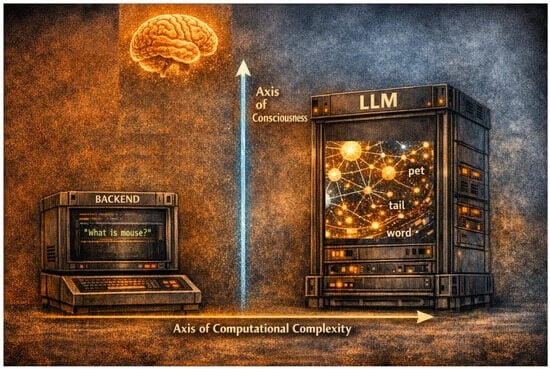
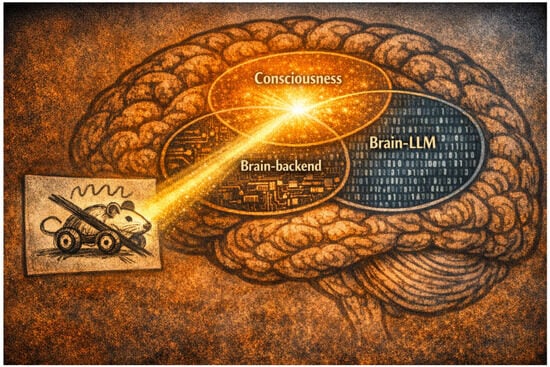
Discussion of consciousness and artificial intelligence has hitherto focused on the question of whether a large language model (LLM) exhibits signs of consciousness or understanding. This paper proposes to redirect attention elsewhere: not to the model itself, but to the orchestrating layer that governs the model—the backend, understood here as the collection of mechanisms (context management, retrieval, evaluation, planning, and tool-use control) that structure the model’s operation. We argue that the backend performs a function functionally analogous to the role of consciousness in the human brain: it stabilizes generative processes, directs attention, maintains context, and mitigates the entropic disintegration of thought. Consciousness fulfills this function through the phenomenal layer—qualia—which creates a persistent subjective “inner canvas”, used here as a metaphor for a more general multimodal phenomenal space. The backend fulfills it only algorithmically, without phenomenal quality. We further show that computation is an informationally conservative process in the sense of Shannon’s Data Processing Inequality (DPI), and therefore cannot increase Shannon information, even though it may yield novel or pragmatically useful recombinations of existing information. We conclude by proposing the hypothesis that consciousness constitutes a phenomenon orthogonal to computation—not an emergent property of complexity, but a qualitative leap into a different dimension. This hypothesis, which builds on the author’s prior work in this Special Issue and in Symmetry, is presented as a conceptual contribution rather than a formal theory, and may have implications for how future artificial intelligence research conceptualizes the limits of computational architectures.
Full article
(This article belongs to the Special Issue Consciousness in the Age of Intelligent Systems: Philosophical Frameworks, Neural Theories, and Generative AI)
►▼
Show Figures

Figure 1
Open AccessArticle
The Pseudo-Confidence Paradox: The Epistemic Gap in Everyday AI Use
by
Lyazzat Tulbayevna Kurmanbayeva, Anar Saduakasovna Tanabayeva, Akmaral Ivanovna Doszhanova, Aidyn Aidaruly Olzhashov, Denis Bakarassov and Adilbek Knarovich Bisenbaev
Philosophies 2026, 11(3), 97; https://doi.org/10.3390/philosophies11030097 - 16 Jun 2026
Abstract
►▼
Show Figures
This study examines the phenomenon of pseudoconfident knowledge in the context of the everyday use of generative artificial intelligence. By pseudoconfident knowledge, we mean a response that is substantively plausible, rhetorically coherent, and outwardly persuasive but is treated and understood as knowledge before
[...] Read more.
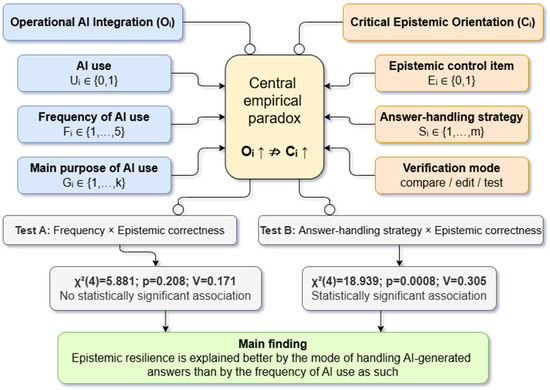
This study examines the phenomenon of pseudoconfident knowledge in the context of the everyday use of generative artificial intelligence. By pseudoconfident knowledge, we mean a response that is substantively plausible, rhetorically coherent, and outwardly persuasive but is treated and understood as knowledge before its actual reliability has been established. Of course, we do not use the term “pseudoconfident knowledge” to denote knowledge in the strict epistemological sense. Rather, it denotes a special form of AI-generated content that acquires the status of knowledge in the user’s perception before its reliability, source-based justification, or factual correctness have been established. The problem here is not that such an answer is already knowledge but that it is prematurely accepted as knowledge because of its coherence, completeness, and rhetorical confidence. The aim of the study is to identify the epistemic gap between the everyday operational integration of artificial intelligence and the user’s critical ability to distinguish between persuasiveness and justification. The theoretical framework combines approaches to AI literacy, epistemic vigilance, and contemporary forms of digital mediation in the circulation of knowledge. The empirical basis of the study is an online survey of AI users. The analysis was conducted using descriptive statistics, contingency tables, and methods for testing associations between categorical variables. The results show that the key differentiating factor is not the frequency of AI use, but the strategy used in handling its responses. More epistemically robust positions are associated with practices of comparison, editing, and verification, whereas uncritical acceptance of the answer is associated with greater vulnerability to pseudoconfident knowledge. We conclude that the spread of generative artificial intelligence is producing a new socioepistemic problem that calls for a shift in emphasis from simple instrumental literacy toward a culture of verification, doubt, and epistemic responsibility.
Full article

Figure 1
Open AccessArticle
Rewilding Home: Reconsidering Our Dwelling in the World
by
Luca Valera
Philosophies 2026, 11(3), 96; https://doi.org/10.3390/philosophies11030096 - 12 Jun 2026
Abstract
This paper focuses on the increasing relevance of rewilding in the context of the global ecological crisis. This crisis is conceived not only as a loss of biodiversity, but also as a breakdown in our capacity to dwell meaningfully on Earth. Although rewilding
[...] Read more.
This paper focuses on the increasing relevance of rewilding in the context of the global ecological crisis. This crisis is conceived not only as a loss of biodiversity, but also as a breakdown in our capacity to dwell meaningfully on Earth. Although rewilding has been developed primarily as an ecological restoration strategy, this paper argues that it is first and foremost an ethical concept. In this sense, starting from Næss’s ecosophy, contemporary theories of self-rewilding, and environmental virtue ethics, this paper develops a philosophical framework that interprets rewilding as a form of dwelling based on the concept of oikos (home). It shows that rewilding entails a transformation of human agency through identification and self-realization, which makes the “ecological self” emerge. As for its methodology, the paper adopts a conceptual and interdisciplinary approach, combining ecology, environmental philosophy, and virtue ethics. The paper concludes that the concept of rewilding should be linked both to ecological restoration and ethical flourishing, requiring the development of certain virtues—e.g., humility and the recognition of ecological dependence. In this regard, rewilding should offer a relevant context to rethink our relationship with nature, starting from the idea of dwelling in the common home.
Full article
(This article belongs to the Special Issue More-than-Human Ethics: Rethinking Nature, Dwelling, and Responsibility)
Open AccessArticle
From Subjectivism and Pure Objectivism to Conditional Objectivism: A Criticism and Revision of Richard Arneson’s Theory of Welfare
by
Chenju Xian and Xinggui Mao
Philosophies 2026, 11(3), 95; https://doi.org/10.3390/philosophies11030095 - 10 Jun 2026
Abstract
Richard J. Arneson’s theory of welfare underwent a significant transformation from subjectivism to objectivism. Three difficulties—adaptive preferences, false beliefs, and non-prudential desires—demonstrate that a welfare theory grounded in subjective attitudes is untenable in principle, driving Arneson toward an objective list theory. Through his
[...] Read more.
Richard J. Arneson’s theory of welfare underwent a significant transformation from subjectivism to objectivism. Three difficulties—adaptive preferences, false beliefs, and non-prudential desires—demonstrate that a welfare theory grounded in subjective attitudes is untenable in principle, driving Arneson toward an objective list theory. Through his rejection of the endorsement constraint, he established a purely objectivist position: subjective attitudes are “neither necessary nor sufficient” for well-being. This position generates significant justificatory pressure toward hard paternalism. Arneson confronted this consequence by arguing that hard paternalism is defensible in principle, while contending that paternalistic intervention must remain restrained in practice on grounds of the intrinsic value of autonomy, the limitations of state capacity, and the costs of stigmatization. However, the reasons Arneson offers for restraint cannot be adequately supported by the objective list alone; they face explanatory pressure at the level of political application. Conditional objectivism can better fill this explanatory gap: for an item on the objective list to count as contributing to a particular individual’s well-being, a negative condition must be satisfied—namely, that the individual would not rationally reject the item under conditions of reflective deliberation.
Full article
Open AccessArticle
Can LLMs Acquire Human-Like World Models?
by
Catalin Teoharie
Philosophies 2026, 11(3), 94; https://doi.org/10.3390/philosophies11030094 - 8 Jun 2026
Abstract
At first glance, the treatment of LLMs from the perspective of the Free Energy Principle (FEP) seems straightforward: LLMs do not fully operate under the FEP due to their lack of direct connection with the external environment and the incompleteness of their active
[...] Read more.
At first glance, the treatment of LLMs from the perspective of the Free Energy Principle (FEP) seems straightforward: LLMs do not fully operate under the FEP due to their lack of direct connection with the external environment and the incompleteness of their active inference. LLMs do not fully capture the consequences of their actions; hence, they will never acquire a human-like world model. While I agree that LLMs do not operate under FEP and have major limitations resulting from their lack of connection to the external environment, I argue that they capture an important part of our world model by grounding their responses in it. Although this grounding is mediated—and therefore imperfect—I attribute to LLMs a deeper relation with the external world than many have thus far acknowledged. I explore two main directions when evaluating the possibility of LLMs encapsulating a human-like world model. First, I evaluate the similarity of their behavior, with the underlying hypothesis that, under the FEP, similar behaviors exhibited in similar environments imply similar internal models. Second, I use research on mechanistic interpretability to explore whether human and LLM neural networks are similar. The conclusion is that LLMs might acquire part of our world model, even though this was not intended during their training.
Full article
Open AccessArticle
Operationalizing Pluralist AI Governance with the Integrated Axiology–MCDA Framework
by
Fei Sun, Damir Isovic and Gordana Dodig-Crnkovic
Philosophies 2026, 11(3), 93; https://doi.org/10.3390/philosophies11030093 - 8 Jun 2026
Abstract
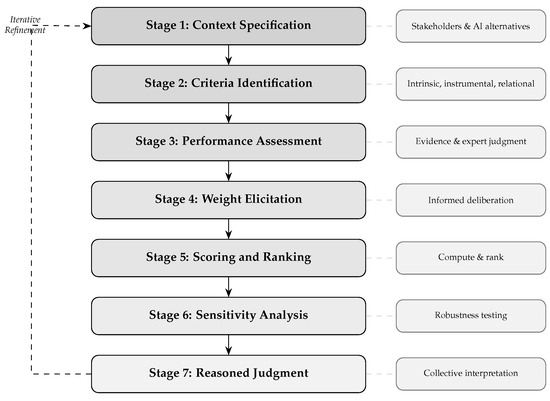
AI systems generate ethical tensions that cannot be addressed through principle-based guidance alone. This paper brings forward an Integrated Axiology–MCDA Framework for AI ethics that distinguishes intrinsic, instrumental, and relational values and uses multi-criteria analysis to operationalize value pluralism in practice. The framework
[...] Read more.
AI systems generate ethical tensions that cannot be addressed through principle-based guidance alone. This paper brings forward an Integrated Axiology–MCDA Framework for AI ethics that distinguishes intrinsic, instrumental, and relational values and uses multi-criteria analysis to operationalize value pluralism in practice. The framework structures ethical evaluation by making value commitments explicit, enabling transparent examination of trade-offs, and supporting context-sensitive judgment. A healthcare hyper-scenario with sensitivity analysis shows how different weight configurations influence the relative acceptability of diagnostic systems and clarifies the thresholds at which accuracy considerations outweigh privacy or fairness. Cross-domain applications in education, criminal justice, and finance further illustrate how domain-specific value tensions require distinct criteria sets and weighting structures. The analysis shows that ethical challenges in AI arise from genuine value pluralism. Explicit value classification enables more accountable decision making across the AI lifecycle.
Full article
(This article belongs to the Special Issue Intelligent Inquiry into Intelligence)
►▼
Show Figures

Figure 1
Journal Menu
► ▼ Journal Menu-
- Philosophies Home
- Aims & Scope
- Editorial Board
- Topical Advisory Panel
- Instructions for Authors
- Special Issues
- Topics
- Sections
- Article Processing Charge
- Indexing & Archiving
- Most Cited & Viewed
- Journal Statistics
- Journal History
- Journal Awards
- Society Collaborations
- Conferences
- Editorial Office
- 10th Anniversary
Journal Browser
► ▼ Journal BrowserHighly Accessed Articles
Latest Books
E-Mail Alert
News
Topics
Topic in
Arts, Genealogy, Histories, Philosophies, Religions
Reimagining Totemism: Mystical Experience, Life Values, and Contemporary Art Practices
Topic Editors: Zhilong Yan, Lidija Stojanović, Aixin ZhangDeadline: 31 October 2026
Conferences
Special Issues
Special Issue in
Philosophies
Critical Theory in the Age of Digital Capitalism
Guest Editors: Craig Reeves, Jaakko Nevasto, Matthew SinnicksDeadline: 15 July 2026
Special Issue in
Philosophies
Kierkegaard, Doubt and Virtue in an Age of Uncertainty
Guest Editors: Genia Schönbaumsfeld, Caecilie Varslev-PedersenDeadline: 30 July 2026
Special Issue in
Philosophies
The Sanity and Selfhood of Other Minds
Guest Editor: Rein RaudDeadline: 31 July 2026
Special Issue in
Philosophies
Debating Temporal Ontology: The Existence of Yesterday and Tomorrow
Guest Editor: Kristie MillerDeadline: 31 July 2026