You are currently viewing a new version of our website. To view the old version click .

Fermentation, Volume 7, Issue 2

June 2021 - 55 articles

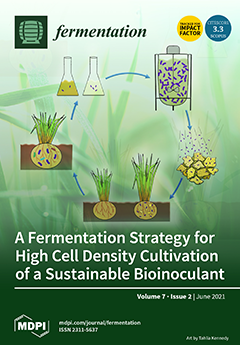
Cover Story: Paraburkholderia sp. SOS3 is a plant-growth-promoting bacterium isolated from sugarcane soils in Queensland, Australia. In this study, we developed an efficient strategy to produce a commercial-scale sustainable bioinoculant. The beneficial effects of SOS3 were validated in seeds. Proteome analysis of SOS3 cultures provided new insights into the metabolic pathways linked to plant-growth promotion. Still, further research is needed to explore the mechanisms that are responsible for the observed results. View this paper.
  • Issues are regarded as officially published after their release is announced to the table of contents alert mailing list .
  • You may sign up for email alerts to receive table of contents of newly released issues.
  • PDF is the official format for papers published in both, html and pdf forms. To view the papers in pdf format, click on the "PDF Full-text" link, and use the free Adobe Reader to open them.

Articles (55)

  • Article
  • Open Access
4 Citations
4,488 Views
14 Pages

Growth Enhancement Facilitated by Gaseous CO2 through Heterologous Expression of Reductive Tricarboxylic Acid Cycle Genes in Escherichia coli

  • Shou-Chen Lo,
  • En-Pei Isabel Chiang,
  • Ya-Tang Yang,
  • Si-Yu Li,
  • Jian-Hau Peng,
  • Shang-Yieng Tsai,
  • Dong-Yan Wu,
  • Chia-Hua Yu,
  • Chu-Han Huang and
  • Tien-Tsai Su
  • + 2 authors

The enzymatic mechanisms of carbon fixation by autotrophs, such as the reductive tricarboxylic acid cycle (rTCA), have inspired biotechnological approaches to producing bio-based chemicals directly through CO2. To explore the possibility of construct...

  • Article
  • Open Access
10 Citations
6,661 Views
17 Pages

Effect of Aeration on Yeast Community Structure and Volatile Composition in Uninoculated Chardonnay Wines

  • Cristian Varela,
  • Kathleen Cuijvers,
  • Steven Van Den Heuvel,
  • Mark Rullo,
  • Mark Solomon,
  • Anthony Borneman and
  • Simon Schmidt

Uninoculated wines are regarded as having improved mouthfeel and texture and more complex flavor profiles when compared to wines inoculated with commercial S. cerevisiae strains. Uninoculated fermentation involves a complex microbial succession of ye...

  • Feature Paper
  • Article
  • Open Access
7 Citations
5,121 Views
12 Pages

The microbiota involved in Korean soy paste (doenjang) fermentation are the key factors determining its quality aspects. In this study, doenjang was prepared by adding three different herbs (Peppermint, Korean mint, and Coriander), and their effect o...

  • Article
  • Open Access
2 Citations
4,282 Views
14 Pages

Optimal Control Applied to Oenological Management of Red Wine Fermentative Macerations

  • Ricardo Luna,
  • Bruno M. Lima,
  • José Cuevas-Valenzuela,
  • Julio E. Normey-Rico and
  • José R. Pérez-Correa

The management of wineries for industrial red winemaking is limited by the capacity and availability of fermentation tanks over the harvest season. The winemakers aim to optimize the wine quality, the fermentative maceration length, and the fermentat...

  • Article
  • Open Access
11 Citations
3,938 Views
17 Pages

Improvement of Enantiomeric l-Lactic Acid Production from Mixed Hexose-Pentose Sugars by Coculture of Enterococcus mundtii WX1 and Lactobacillus rhamnosus SCJ9

  • Augchararat Klongklaew,
  • Kridsada Unban,
  • Apinun Kanpiengjai,
  • Pairote Wongputtisin,
  • Punnita Pamueangmun,
  • Kalidas Shetty and
  • Chartchai Khanongnuch

Among 39 pentose-utilizing lactic acid bacteria (LAB) selected from acid-forming bacteria from the midgut of Eri silkworm, the isolate WX1 was selected with the highest capability to produce optically pure l-lactic acid (l-LA) from glucose, xylose an...

  • Article
  • Open Access
20 Citations
5,468 Views
13 Pages

Incorporation of Fermented Brewers Spent Grain in the Production of Sourdough Bread

  • Frank Vriesekoop,
  • Annie Haynes,
  • Niels van der Heijden,
  • Hao Liang,
  • Paraskevi Paximada and
  • Antien Zuidberg

The utilisation of food production by-products back into food production within a circular food economy is one of the driving examples to improve sustainability within the food industry. Brewers spent grain is the most abundant by-product from the br...

  • Article
  • Open Access
12 Citations
4,426 Views
12 Pages

Impact of Commercial Yeasts on Phenolic Profile of Plavac Mali Wines from Croatia

  • Ana-Marija Jagatić Korenika,
  • Ivana Tomaz,
  • Darko Preiner,
  • Vedran Plichta and
  • Ana Jeromel

Wine quality is influenced by the presence of over 500 different chemical compounds, with polyphenols having a crucial role in color intensity and tonality, astringency, mouthfeel, and overall impression formation, especially in red wine production....

  • Article
  • Open Access
22 Citations
5,921 Views
10 Pages

Plant-based beverages are growing in popularity due to the rise of vegetarianism and other health trends. A probiotic almond beverage that combines the properties of almonds, inulin, and Lacticaseibacillusrhamnosus GR-1 may meet the demand for a non-...

  • Article
  • Open Access
38 Citations
7,628 Views
14 Pages

Valorization of Bread Waste to a Fiber- and Protein-Rich Fungal Biomass

  • Sofie E. Svensson,
  • Ludmila Bucuricova,
  • Jorge A. Ferreira,
  • Pedro F. Souza Filho,
  • Mohammad J. Taherzadeh and
  • Akram Zamani

Filamentous fungi can be used for the valorization of food waste as a value-added product. The goal of this study was the valorization of bread waste through fungal cultivation and the production of value-added products. The fungal cultivation was ve...

  • Communication
  • Open Access
1 Citations
5,194 Views
10 Pages

Biological Stoichiometric Analysis during Substrate Utilization and Secondary Metabolite Production by Non-Saccharomyces Yeasts Using Grape Pomace Extract as Fermentation Medium

  • Maxwell Mewa-Ngongang,
  • Heinrich W. du Plessis,
  • Seteno K. O. Ntwampe,
  • Enoch A. Akinpelu,
  • Ucrecia F. Hutchinson,
  • Boredi S. Chidi,
  • Vincent I. Okudoh and
  • Neil P. Jolly

The emerging interest in the search for alternatives to synthetic preservatives has led to various successful research studies exploring the use of yeasts as potential biological control agents and producers of biopreservatives. The findings that yea...

of 6

Get Alerted

Add your email address to receive forthcoming issues of this journal.

XFacebookLinkedIn
Fermentation - ISSN 2311-5637