

Skip to Content

Fermentation, Volume 4, Issue 1

2018 March - 20 articles

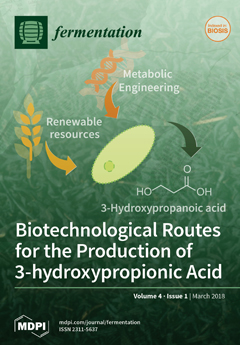
Cover Story: 3-hydroxypropionic acid is a building block chemical with a wide range of application and currently is considered among the most important chemicals to be produced from renewable resources. In the current work we summarize the research efforts towards the direction of establishing a microbial platform from the production of 3-hydroxypropionic acid from renewable resources. Various attempts have be made by employing molecular and process engineering tools resulting in very promising results which pave the way towards industrial biotechnological production of 3-hydroxypropionic acid. View this paper
  • Issues are regarded as officially published after their release is announced to the table of contents alert mailing list .
  • You may sign up for email alerts to receive table of contents of newly released issues.
  • PDF is the official format for papers published in both, html and pdf forms. To view the papers in pdf format, click on the "PDF Full-text" link, and use the free Adobe Reader to open them.

Articles (20)

  • Review
  • Open Access
30 Citations
9,414 Views
11 Pages

The Microbial Diversity of Sherry Wines

  • Gustavo Cordero-Bueso,
  • Marina Ruiz-Muñoz,
  • Mónica González-Moreno,
  • Salvador Chirino,
  • María Del Carmen Bernal-Grande and
  • Jesús Manuel Cantoral

The principal role of wine yeast is to transform efficiently the grape-berries’ sugars to ethanol, carbon dioxide, and other metabolites, without the production of off-flavors. Wine yeast strains are able to ferment musts, while other commercial or l...

  • Feature Paper
  • Review
  • Open Access
77 Citations
19,924 Views
13 Pages

Beer is a complex beverage containing a myriad of flavor- and aroma-active compounds. Brewers strive to achieve an appropriate balance of desired characters, while avoiding off-aromas and flavors. Phenolic compounds are always present in finished bee...

  • Review
  • Open Access
38 Citations
22,472 Views
8 Pages

The Use of UV-Vis Spectroscopy in Bioprocess and Fermentation Monitoring

  • Jessica Roberts,
  • Aoife Power,
  • James Chapman,
  • Shaneel Chandra and
  • Daniel Cozzolino

Real-time analytical tools to monitor bioprocess and fermentation in biological and food applications are becoming increasingly important. Traditional laboratory-based analyses need to be adapted to comply with new safety and environmental guidelines...

  • Feature Paper
  • Article
  • Open Access
25 Citations
7,185 Views
12 Pages

The Effect of pH and Temperature on Arachidonic Acid Production by Glycerol-Grown Mortierella alpina NRRL-A-10995

  • Aleksei A. Mironov,
  • Vitaly A. Nemashkalov,
  • Nadezda N. Stepanova,
  • Svetlana V. Kamzolova,
  • Waldemar Rymowicz and
  • Igor G. Morgunov

Arachidonic acid (AA) has a wide range of applications in medicine, pharmacology, diet, infant nutrition, and agriculture, due to its unique biological properties. The microbiological processes involved in AA production usually require carbohydrate s...

  • Feature Paper
  • Review
  • Open Access
55 Citations
19,628 Views
27 Pages

Bioethanol a Microbial Biofuel Metabolite; New Insights of Yeasts Metabolic Engineering

  • Khaled A. Selim,
  • Dina E. El-Ghwas,
  • Saadia M. Easa and
  • Mohamed I. Abdelwahab Hassan

Scarcity of the non-renewable energy sources, global warming, environmental pollution, and raising the cost of petroleum are the motive for the development of renewable, eco-friendly fuels production with low costs. Bioethanol production is one of th...

  • Article
  • Open Access
50 Citations
10,920 Views
16 Pages

Adding Flavor to Beverages with Non-Conventional Yeasts

  • Davide Ravasio,
  • Silvia Carlin,
  • Teun Boekhout,
  • Marizeth Groenewald,
  • Urska Vrhovsek,
  • Andrea Walther and
  • Jürgen Wendland

Fungi produce a variety of volatile organic compounds (VOCs) during their primary and secondary metabolism. In the beverage industry, these volatiles contribute to the the flavor and aroma profile of the final products. We evaluated the fermentation...

  • Feature Paper
  • Article
  • Open Access
18 Citations
7,243 Views
10 Pages

Schizosaccharomyces japonicus: A Polysaccharide-Overproducing Yeast to Be Used in Winemaking

  • Cristina Romani,
  • Livio Lencioni,
  • Mirko Gobbi,
  • Ilaria Mannazzu,
  • Maurizio Ciani and
  • Paola Domizio

Mixed starter cultures made of Saccharomyces cerevisiae EC1118 and Schizosaccharomyces japonicus #13 were inoculated in commercial grape must, and the impact of different inoculum ratios (1:1; 1:100; 1:10,000) on growth and fermentation kinetics and...

  • Feature Paper
  • Article
  • Open Access
41 Citations
12,412 Views
15 Pages

Pigment Production by the Edible Filamentous Fungus Neurospora Intermedia

  • Rebecca Gmoser,
  • Jorge A. Ferreira,
  • Magnus Lundin,
  • Mohammad J. Taherzadeh and
  • Patrik R. Lennartsson

The production of pigments by edible filamentous fungi is gaining attention as a result of the increased interest in natural sources with added functionality in the food, feed, cosmetic, pharmaceutical and textile industries. The filamentous fungus N...

  • Feature Paper
  • Article
  • Open Access
13 Citations
10,799 Views
12 Pages

Grain sorghum is a potential feedstock for fuel ethanol production due to its high starch content, which is equivalent to that of corn, and has been successfully used in several commercial corn ethanol plants in the United States. Some sorghum grain...

  • Feature Paper
  • Review
  • Open Access
66 Citations
18,093 Views
21 Pages

Biological Production of 3-Hydroxypropionic Acid: An Update on the Current Status

  • Leonidas Matsakas,
  • Kateřina Hrůzová,
  • Ulrika Rova and
  • Paul Christakopoulos

The production of high added-value chemicals from renewable resources is a necessity in our attempts to switch to a more sustainable society. 3-Hydroxypropionic acid (3HP) is a promising molecule that can be used for the production of an important ar...

  • Article
  • Open Access
23 Citations
8,283 Views
16 Pages

Novel Wine Yeast for Improved Utilisation of Proline during Fermentation

  • Danfeng Long,
  • Kerry L. Wilkinson,
  • Dennis K. Taylor and
  • Vladimir Jiranek

Proline is the predominant amino acid in grape juice, but it is poorly assimilated by wine yeast under the anaerobic conditions typical of most fermentations. Exploiting the abundance of this naturally occurring nitrogen source to overcome the need f...

  • Feature Paper
  • Review
  • Open Access
114 Citations
29,732 Views
18 Pages

Bread is a staple food worldwide. It commonly undergoes physico-chemical and microbiological changes which impair its quality and shelf-life. Staling determines organoleptic impairment, whereas microbiological spoilage causes visible mould growth and...

  • Feature Paper
  • Article
  • Open Access
84 Citations
11,422 Views
19 Pages

Molecular and Phenotypic Characterization of Metschnikowia pulcherrima Strains from Douro Wine Region

  • Catarina Barbosa,
  • Patrícia Lage,
  • Marcos Esteves,
  • Lélia Chambel,
  • Arlete Mendes-Faia and
  • Ana Mendes-Ferreira

Some non-Saccharomyces yeasts, including Metschnikowia pulcherrima, have been proposed as selected starters due to their contribution for the overall aroma and chemical profiles of wines. In this work, we aimed to evaluate the genetic and phenotypic...

  • Feature Paper
  • Review
  • Open Access
11 Citations
6,249 Views
11 Pages

Massive Sequencing: A New Tool for the Control of Alcoholic Fermentation in Wine?

  • Dimitrios Kioroglou,
  • Jessica LLeixá,
  • Albert Mas and
  • Maria Del Carmen Portillo

In wine industry, there is a prevalent use of starter cultures to promote a controlled and efficient alcoholic fermentation preventing the growth of spoilage microbes. However, current trends in enology aim to combine the guaranteed success of monito...

  • Review
  • Open Access
48 Citations
8,776 Views
18 Pages

Accumulation of Biogenic Amines in Wine: Role of Alcoholic and Malolactic Fermentation

  • Donatella Restuccia,
  • Monica Rosa Loizzo and
  • Umile Gianfranco Spizzirri

Biogenic amines (BAs) are detrimental to health and originate in foods mainly from decarboxylation of the corresponding amino acid by the activity of exogenous enzymes released by various microorganisms. BAs can be generated at different stages of th...

  • Article
  • Open Access
8 Citations
6,349 Views
11 Pages

Influence of Lysozyme Addition on Hydroxycinnamic Acids and Volatile Phenols during Wine Fermentation

  • Stephan Sommer,
  • Pascal Wegmann-Herr,
  • Michael Wacker and
  • Ulrich Fischer

Most yeast and bacteria in wine are able to metabolize hydroxycinnamic acids into volatile phenols via enzyme-mediated decarboxylation. Our trials performed in wine and model systems suggest that lysozyme addition prior to fermentation affects both b...

  • Review
  • Open Access
24 Citations
10,130 Views
15 Pages

Malting and Brewing Industries Encounter Fusarium spp. Related Problems

  • Kristina Mastanjević,
  • Vinko Krstanović,
  • Krešimir Mastanjević and
  • Bojan Šarkanj

Versatile microbiota are inevitably naturally present on cereals. Fungi, yeasts and bacteria and their metabolites all contribute to the quality and safety of the final products derived from most common beer cereals—barley and wheat. The microorganis...

  • Article
  • Open Access
30 Citations
7,123 Views
13 Pages

Mitigation of Volatile Fatty Acid Build-Up by the Use of Soft Carbon Felt Electrodes: Evaluation of Anaerobic Digestion in Acidic Conditions

  • Rubén Moreno,
  • Elia J. Martínez,
  • Adrián Escapa,
  • Olegario Martínez,
  • Rebeca Díez-Antolínez and
  • Xiomar Gómez

Anaerobic digestion and bioelectrochemical systems have great potential to recover energy from waste streams and help overcome common hurdles associated with this process, as integrated technologies. In this study, the benefit of integrating an elect...

  • Review
  • Open Access
49 Citations
11,163 Views
12 Pages

Fermentation Assisted by Pulsed Electric Field and Ultrasound: A Review

  • Leandro Galván-D’Alessandro and
  • Ramiro Ariel Carciochi

Various novel techniques are proposed to improve process efficiency, quality, and safety of fermented food products. Ultrasound and pulsed electric field (PEF) are versatile technologies that can be employed in conjunction with fermentation processes...

Get Alerted

Add your email address to receive forthcoming issues of this journal.

XFacebookLinkedIn
Fermentation - ISSN 2311-5637