
Skip Content
You are currently on the new version of our website. Access the old version .

Geriatrics, Volume 7, Issue 1

2022 February - 22 articles

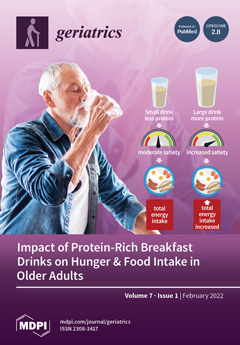
Cover Story: Inadequate regulation of food and protein intake increases the risk of developing conditions such as sarcopenia. Thus, protein–energy homeostasis is considered a fundamental dietary determinant of healthy aging. The main aim of this study is to determine the acute effects of two breakfast drinks, varying in protein and energy content, on appetite and free-living, whole-day protein and energy intake in older adults. Consuming a very high-protein drink to reach energy requirements suppressed appetite more than a low-energy, high-protein drink, though free-living protein and energy intake was unaffected. Consequently, breakfast protein pulse feeding can result in high daily protein and energy intake. The long-term effects of such a breakfast strategy in older adults at high risk of energy and protein malnutrition should be explored. View this paper
  • Issues are regarded as officially published after their release is announced to the table of contents alert mailing list .
  • You may sign up for email alerts to receive table of contents of newly released issues.
  • PDF is the official format for papers published in both, html and pdf forms. To view the papers in pdf format, click on the "PDF Full-text" link, and use the free Adobe Reader to open them.

Articles (22)

  • Case Report
  • Open Access
2 Citations
3,046 Views
6 Pages

Efficacy of Single Tocilizumab Administration in an 88-Year-Old Patient with Severe COVID-19 and a Mini Literature Review

  • Cid Ould Ouali,
  • Nadia Ladjouzi,
  • Khidher Tamas,
  • Hendriniaina Raveloson,
  • Jihene Ben Hassen,
  • Nesrine El Omeiri,
  • Georges Zouloumis,
  • Mohamed Moataz Al Zoabi,
  • Muneer Asadi and
  • Joël Schlatter
  • + 1 author

21 February 2022

The new coronavirus disease 2019 (COVID-19) could be associated with elevated inflammatory cytokine levels, suggesting the involvement of cytokine release syndrome. This syndrome is characterized by release of interleukin 6 correlated with COVID-19 s...

  • Brief Report
  • Open Access
5 Citations
3,130 Views
7 Pages

Pitfalls of Early Systemic Corticosteroids Home Therapy in Older Patients with COVID-19 Pneumonia

  • Chukwuma Okoye,
  • Sara Rogani,
  • Riccardo Franchi,
  • Igino Maria Pompilii,
  • Alessia Maria Calabrese,
  • Tessa Mazzarone,
  • Elena Bianchi,
  • Bianca Lemmi,
  • Valeria Calsolaro and
  • Fabio Monzani

17 February 2022

Corticosteroids have been widely used for acute respiratory distress syndrome (ARDS), but their role in the early phase of SARS-CoV-2 infection is controversial. Our study aimed to determine the effectiveness of early corticosteroid therapy (ECT) in...

  • Article
  • Open Access
1 Citations
4,434 Views
11 Pages

Non-Vitamin K Oral Anticoagulants Assessment in High Risk of Bleeding Patients with Non-Valvular Atrial Fibrillation

  • Pedro Silva Cunha,
  • André Viveiros Monteiro,
  • Madalena Coutinho Cruz,
  • Paula Malveiro,
  • João Pedro Reis,
  • Guilherme Portugal,
  • Ana Dias,
  • Rui Cruz Ferreira and
  • Mário Martins Oliveira

17 February 2022

Atrial fibrillation (AF) is commonly associated with advanced age and the presence of multiple, concomitant acute and chronic health conditions, placing this population at high risk for serious therapeutic side effects. Nonvitamin K antagonist oral a...

  • Article
  • Open Access
11 Citations
6,302 Views
16 Pages

15 February 2022

Background: Due to the increasing care needs of older adults, family caregivers are more and more solicited. This can have a negative impact on their quality of life related to a lack of preparedness for caregiving and feelings of burden. Objectives:...

  • Article
  • Open Access
2 Citations
2,989 Views
11 Pages

14 February 2022

This study aimed to examine the primary arthroplasty attitudes of Turkish orthopedics and traumatology specialists and residents to patients with intertrochanteric fractures, of various ages, comorbidity situations and fracture types, using an intern...

  • Article
  • Open Access
10 Citations
4,741 Views
12 Pages

Ageist No More: Interprofessional Training for Undergraduate Healthcare Students

  • Aniela Mendez,
  • Mildred Lopez,
  • Karina Rodriguez-Quintanilla and
  • Belinda Carrion

Ageism seeps deep into our society, whether in law, policies, or healthcare practices it segregates individuals based on their age. The aim of this work was to evaluate the impact of an educational strategy in ageist attitudes against older adults in...

  • Article
  • Open Access
2 Citations
5,907 Views
13 Pages

The Acute Effects of Breakfast Drinks with Varying Protein and Energy Contents on Appetite and Free-Living Energy Intake in UK Older Adults

  • Daniel R. Crabtree,
  • Adrian Holliday,
  • William Buosi,
  • Claire L. Fyfe,
  • Graham W. Horgan,
  • Alexandra M. Johnstone and
  • on behalf of the Full4Health-study Group

Proposed strategies for preventing protein deficiencies in older patients include increasing protein intake at breakfast. However, protein is highly satiating and the effects of very high protein intakes at breakfast on subsequent appetite and free-l...

  • Article
  • Open Access
1 Citations
3,660 Views
22 Pages

The LuBAIR™ Paradigm is a novel approach to ascribe meaning to behavioral expressions in advanced neurocognitive disorders when the reliability of a clinical assessment is limited. The meaning ascribed to each behavioral category was used to id...

  • Article
  • Open Access
8 Citations
4,477 Views
8 Pages

A Randomized, Open-Label Study to Assess Efficacy of Weekly Assumption of Cholecalciferol versus Calcifediol in Older Patients with Hypovitaminosis D

  • Chukwuma Okoye,
  • Valeria Calsolaro,
  • Filippo Niccolai,
  • Alessia Maria Calabrese,
  • Riccardo Franchi,
  • Sara Rogani,
  • Giulia Coppini,
  • Virginia Morelli,
  • Nadia Caraccio and
  • Fabio Monzani

The aim of this single-center, open-label, randomized controlled study was to evaluate which formulation of vitamin D—between cholecalciferol and calcifediol—is most effective in the treatment of hypovitaminosis D in older adults. Demogra...

of 3

Get Alerted

Add your email address to receive forthcoming issues of this journal.

XFacebookLinkedIn
Geriatrics - ISSN 2308-3417