You are currently viewing a new version of our website. To view the old version click .

Bioengineering, Volume 4, Issue 2

June 2017 - 34 articles

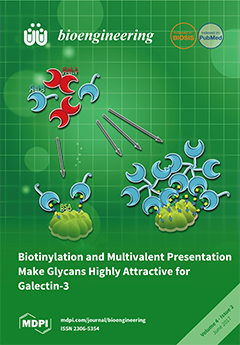
Cover Story: Biotinylation and multivalent presentation of N-acetyllactosamine- and N’,N’’-diacetyllactosamine-based tetrasaccharides affect galectin-3 binding positively. Biotin conjugation to the C6-position of the terminal sugar leads to high-affinity ligands with selectivity for galectin-3 over galectin-1. The inhibitory potential is significantly increased when glycans are presented on serum albumin. These biotinylated neo-glycoproteins are promising candidates for targeting galectin-3 and open new possibilities for galectin inhibitor design in cancer research. View this paper
  • Issues are regarded as officially published after their release is announced to the table of contents alert mailing list .
  • You may sign up for email alerts to receive table of contents of newly released issues.
  • PDF is the official format for papers published in both, html and pdf forms. To view the papers in pdf format, click on the "PDF Full-text" link, and use the free Adobe Reader to open them.

Articles (34)

  • Article
  • Open Access
1 Citations
8,185 Views
17 Pages

Metabolic flux analysis (MFA) is an indispensable tool in metabolic engineering. The simplest variant of MFA relies on an overdetermined stoichiometric model of the cell’s metabolism under the pseudo-steady state assumption to evaluate the intracellu...

  • Article
  • Open Access
27 Citations
9,284 Views
12 Pages

Extensive expansion of mesenchymal stem cells (MSCs) for cell-based therapies remains challenging since long-term cultivation and excessive passaging in two-dimensional conditions result in a loss of essential stem cell properties. Indeed, low surviv...

  • Review
  • Open Access
33 Citations
11,333 Views
14 Pages

Microtechnology-Based Multi-Organ Models

  • Seung Hwan Lee and
  • Jong Hwan Sung

Drugs affect the human body through absorption, distribution, metabolism, and elimination (ADME) processes. Due to their importance, the ADME processes need to be studied to determine the efficacy and side effects of drugs. Various in vitro model sys...

  • Article
  • Open Access
95 Citations
15,680 Views
17 Pages

Biochips, or digital labs-on-chip, are developed with the purpose of being used by laboratory technicians or biologists in laboratories or clinics. In this article, we expand this vision with the goal of enabling everyone, regardless of their experti...

  • Article
  • Open Access
4 Citations
9,597 Views
12 Pages

Comparative N-Glycosylation Analysis of the Fc Portions of a Chimeric Human Coagulation Factor VIII and Immunoglobulin G1

  • Christoph Kannicht,
  • Mario Kröning,
  • Barbara A. Solecka-Witulska,
  • Guido Kohla and
  • Julia Rosenlöcher

Prevention and treatment of bleeding in patients suffering from hemophilia A are inconvenient due to repeated intravenous infusions owing to the short half-life of coagulation factor VIII (FVIII) in circulation. Besides (glyco-)pegylation of the FVII...

  • Article
  • Open Access
9 Citations
9,413 Views
14 Pages

In Vitro Growth of Human Keratinocytes and Oral Cancer Cells into Microtissues: An Aerosol-Based Microencapsulation Technique

  • Wai Yean Leong,
  • Chin Fhong Soon,
  • Soon Chuan Wong,
  • Kian Sek Tee,
  • Sok Ching Cheong,
  • Siew Hua Gan and
  • Mansour Youseffi

Cells encapsulation is a micro-technology widely applied in cell and tissue research, tissue transplantation, and regenerative medicine. In this paper, we proposed a growth of microtissue model for the human keratinocytes (HaCaT) cell line and an ora...

  • Article
  • Open Access
12 Citations
11,566 Views
27 Pages

IgA antibodies have great potential to improve the functional diversity of current IgG antibody-based cancer immunotherapy options. However, IgA production and purification is not well established, which can at least in part be attributed to the more...

  • Article
  • Open Access
6 Citations
7,287 Views
13 Pages

One recent area of cancer research is irreversible electroporation (IRE). Irreversible electroporation is a minimally invasive procedure where needle electrodes are inserted into the body to ablate tumor cells with electricity. The aim of this paper...

  • Review
  • Open Access
72 Citations
15,723 Views
14 Pages

The Role of Microfluidics for Organ on Chip Simulations

  • Aziz Ur Rehman Aziz,
  • Chunyang Geng,
  • Mengjie Fu,
  • Xiaohui Yu,
  • Kairong Qin and
  • Bo Liu

A multichannel three-dimensional chip of a microfluidic cell culture which enables the simulation of organs is called an “organ on a chip” (OC). With the integration of many other technologies, OCs have been mimicking organs, substituting animal mode...

  • Article
  • Open Access
15 Citations
7,993 Views
21 Pages

We extend the nonstandard finite difference method of solution to the study of pharmacokinetic–pharmacodynamic models. Pharmacokinetic (PK) models are commonly used to predict drug concentrations that drive controlled intravenous (I.V.) transfers (or...

of 4

Get Alerted

Add your email address to receive forthcoming issues of this journal.

XFacebookLinkedIn
Bioengineering - ISSN 2306-5354