

You are currently viewing a new version of our website. To view the old version click .

Foods, Volume 14, Issue 8

April-2 2025 - 155 articles

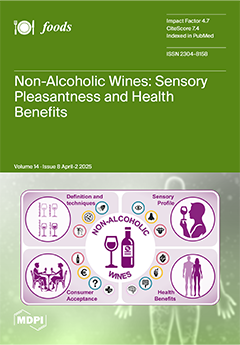
Cover Story: Non-alcoholic wine is gaining popularity as a healthier alternative to traditional wine, offering potential health benefits without the risks associated with alcohol. Key sensory attributes like taste and aroma are important for consumer preferences, with sweeter and balanced notes being preferred. Moderate red wine consumption has been linked to reduced cardiovascular mortality due to beneficial compounds like resveratrol and quercetin, which are found in both alcoholic and non-alcoholic wines. Health-conscious consumers are increasingly drawn to these advantages. However, most research in this area is observational, highlighting the need for additional studies on non-alcoholic alternatives. The challenges we face include isolating the effects of bioactive compounds and enhancing non-alcoholic wine production through innovative methods. View this paper
  • Issues are regarded as officially published after their release is announced to the table of contents alert mailing list .
  • You may sign up for email alerts to receive table of contents of newly released issues.
  • PDF is the official format for papers published in both, html and pdf forms. To view the papers in pdf format, click on the "PDF Full-text" link, and use the free Adobe Reader to open them.

Articles (155)

  • Review
  • Open Access
2,195 Views
23 Pages

20 April 2025

In the context of the global food system transformation towards sustainable and healthy diets, risk–benefit assessment supported by quantitative dose–response relationships between nutrients and health outcomes is crucial for evaluating t...

  • Article
  • Open Access
1 Citations
875 Views
19 Pages

Ozone Aeration Enhance Flowability, Structure, and Antioxidant Activity in Blueberry Pulp Powder

  • Newton C. Santos,
  • Raphael L. J. Almeida,
  • Anna E. S. Tomé,
  • Fábio G. Teles,
  • Railene H. C. R. Araújo,
  • Juanne Q. Farias,
  • Maria T. S. d. Fonseca,
  • Virgínia M. d. A. Silva,
  • Victor H. d. A. Ribeiro and
  • Márcia R. d. S. Pedrini
  • + 2 authors

20 April 2025

Spray drying (SD) is widely used for fruit powder production, but hygroscopic compounds can affect flowability and cause stickiness. This study evaluated rice protein and rice starch as encapsulating agents during SD of blueberry pulp (BPP and BPS, r...

  • Article
  • Open Access
1,280 Views
18 Pages

From Hen Nutrition to Baking: Effects of Pomegranate Seed and Linseed Oils on Egg White Foam Stability and Sponge Cake Quality

  • Marcin Lukasiewicz,
  • Maja Dymińska-Czyż,
  • Beata Szymczyk,
  • Magdalena Franczyk-Żarów,
  • Renata Kostogrys,
  • Adam Florkiewicz,
  • Paweł Ptaszek,
  • Gabriela Zięć and
  • Agnieszka Filipiak-Florkiewicz

20 April 2025

This study aimed to verify that enriching hens’ diets with pomegranate seed (PSO) and linseed oils (LSO) would maintain egg foaming and leavening capacity and improve the nutritional profile of egg-based products without compromising technologi...

  • Article
  • Open Access
3 Citations
1,701 Views
19 Pages

Lactobacillus murinus ZNL-13 Modulates Intestinal Barrier Damage and Gut Microbiota in Cyclophosphamide-Induced Immunosuppressed Mice

  • Yihan Dong,
  • Luyao Zhang,
  • Di Qiu,
  • Renxin Yao,
  • Haitao Jia,
  • Haiyang Wang,
  • Luyao Zhou,
  • Jiantao Zhang and
  • Na Zhang

19 April 2025

Cyclophosphamide (CTX) is a widely used anticancer drug in clinical practice; however, its administration can lead to gastrointestinal damage and immune suppression. Lactobacillus murinus (L. murinus) has been shown to regulate immune cell activity a...

  • Review
  • Open Access
5 Citations
1,634 Views
21 Pages

Recent Advances in Polysaccharides from Cornus officinalis: Extraction, Purification, Structural Features, and Bioactivities

  • Shengfang Wang,
  • Baotang Zhao,
  • Xuemei Ma,
  • Jing Zhang,
  • Guofeng Li,
  • Mingze Li and
  • Qi Liang

19 April 2025

Cornus officinalis, as a medicinal plant, is rich in biologically active components, including polysaccharides, flavonoids, triterpenoids, and organic acids, which offer a variety of health benefits and significant potential for development in the fo...

  • Article
  • Open Access
1 Citations
1,226 Views
9 Pages

Metagenomic Analysis of Raw Milk and the Inactivation of Foodborne Pathogens Using Ultraviolet-C

  • Ju-Hui Lee,
  • Hyeonjun Moon,
  • Hye-Rim Park,
  • Ji-In Noh and
  • Sang-Soon Kim

19 April 2025

The purpose of this study was to identify the microbial community of raw milk samples before and after UV-C irradiation and to establish fundamental data on UV-C treatment to improve the safety and shelf life of raw milk. Metagenomic analysis reveale...

  • Article
  • Open Access
1 Citations
1,521 Views
17 Pages

19 April 2025

The aim of this study was to compare selected physicochemical properties and sensory attributes of ricotta cheeses supplied by different producers and purchased from retail outlets in Poland. The experiment was performed on 40 fresh, unripened ricott...

  • Article
  • Open Access
1,104 Views
18 Pages

18 April 2025

This study aims to comprehensively evaluate the internal quality changes in apples during storage via near-infrared spectroscopy. Specifically, we focus on the performance differences in different apple varieties under diverse storage conditions and...

  • Article
  • Open Access
1 Citations
2,385 Views
28 Pages

18 April 2025

Navigating cross-cultural food choices is complex, influenced by cultural nuances and various factors, with flavor playing a crucial role. Understanding cultural flavor preferences helps individuals make informed food choices in cross-cultural contex...

  • Review
  • Open Access
2,880 Views
23 Pages

Significance of Whole-Genome Sequencing for the Traceability of Foodborne Pathogens: During the Processing of Meat and Dairy Products

  • Kai Dong,
  • Danliangmin Song,
  • Shihang Li,
  • Xu Wang,
  • Lina Dai,
  • Xiaoyan Pei,
  • Xinyan Yang and
  • Yujun Jiang

18 April 2025

The complexity of tracing foodborne pathogens in the food chain has increased significantly due to the long and complicated chain, the involvement of numerous links, and the presence of various types of pathogens at different stages and environments....

of 16

Get Alerted

Add your email address to receive forthcoming issues of this journal.

XFacebookLinkedIn
Foods - ISSN 2304-8158