




Dent. J., Volume 14, Issue 1 (January 2026) – 70 articles
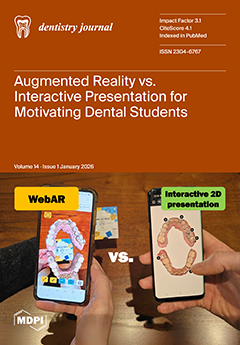
Cover Story (view full-size image):
Augmented Reality is a technology that overlays interactive virtual objects onto the real world, with the potential to make learning more engaging. Two resources to train caries detection skills were designed using low-cost authoring tools: a web-based (WebAR) image-tracking experience and, as an active comparator, a 2D interactive presentation. Third-year dental students participated in a randomized controlled experimental study and completed the Reduced Instructional Materials Motivation Survey (RIMMS). As a result, WebAR achieved higher RIMMS motivation scores and higher mean scores in the Attention, Confidence, Satisfaction, and Relevance dimensions. These findings suggest that incorporating 3D spatial interaction may enhance learners’ motivation for caries detection training. View this paper
- Issues are regarded as officially published after their release is announced to the table of contents alert mailing list.
- You may sign up for e-mail alerts to receive table of contents of newly released issues.
- PDF is the official format for papers published in both, html and pdf forms. To view the papers in pdf format, click on the "PDF Full-text" link, and use the free Adobe Reader to open them.
Previous Issue
Next Issue
