
Obstructive Sleep Apnea: The Expanding Role of Dental Sleep Medicine—A Systematic Review of Mandibular Advancement Devices, Treatment Efficacy, and Occlusal Complications



Abstract
1. Introduction
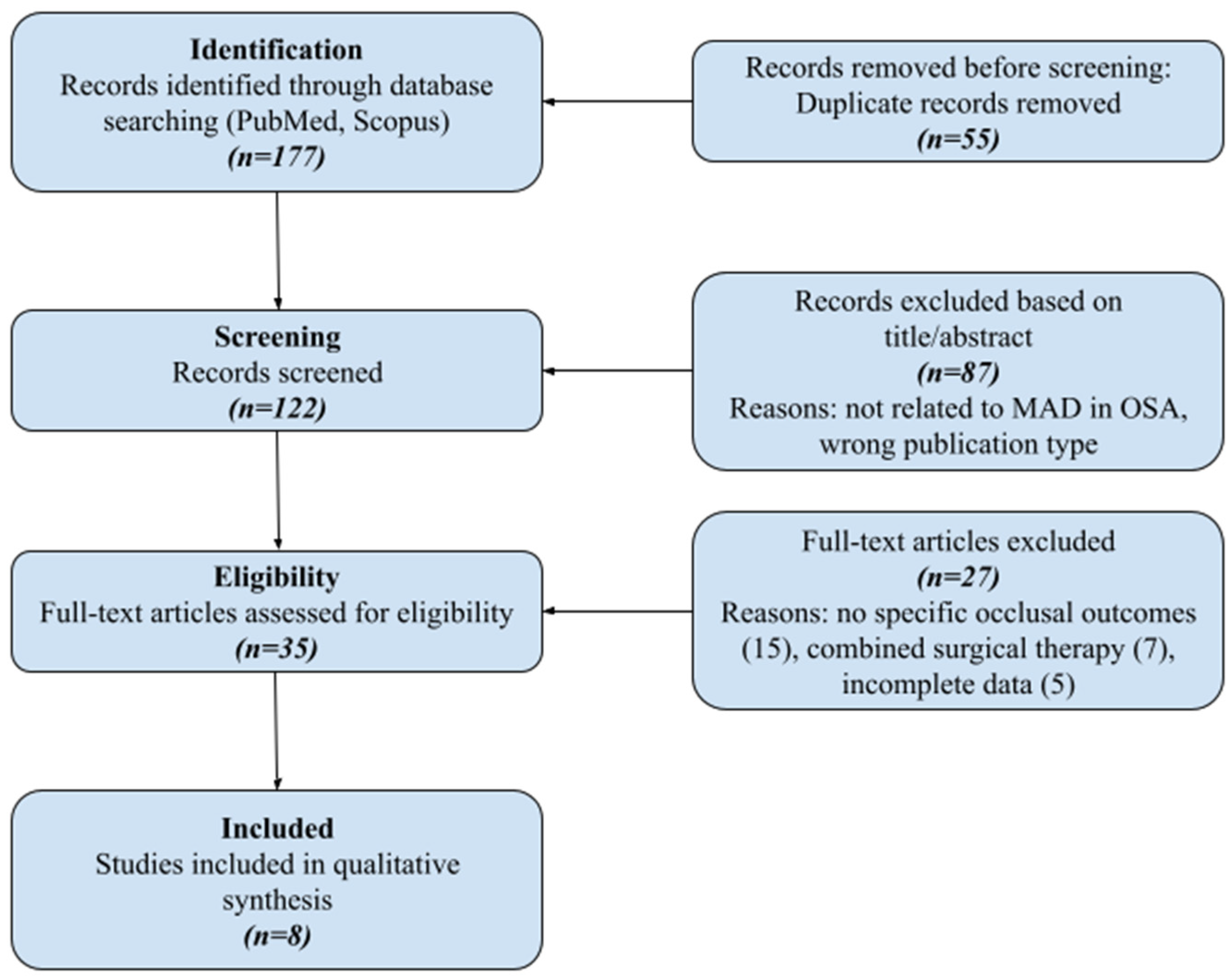
2. Materials and Methods
- OSA diagnostic criteria, particularly questionnaires (STOP-BANG) and polysomnography (PSG);
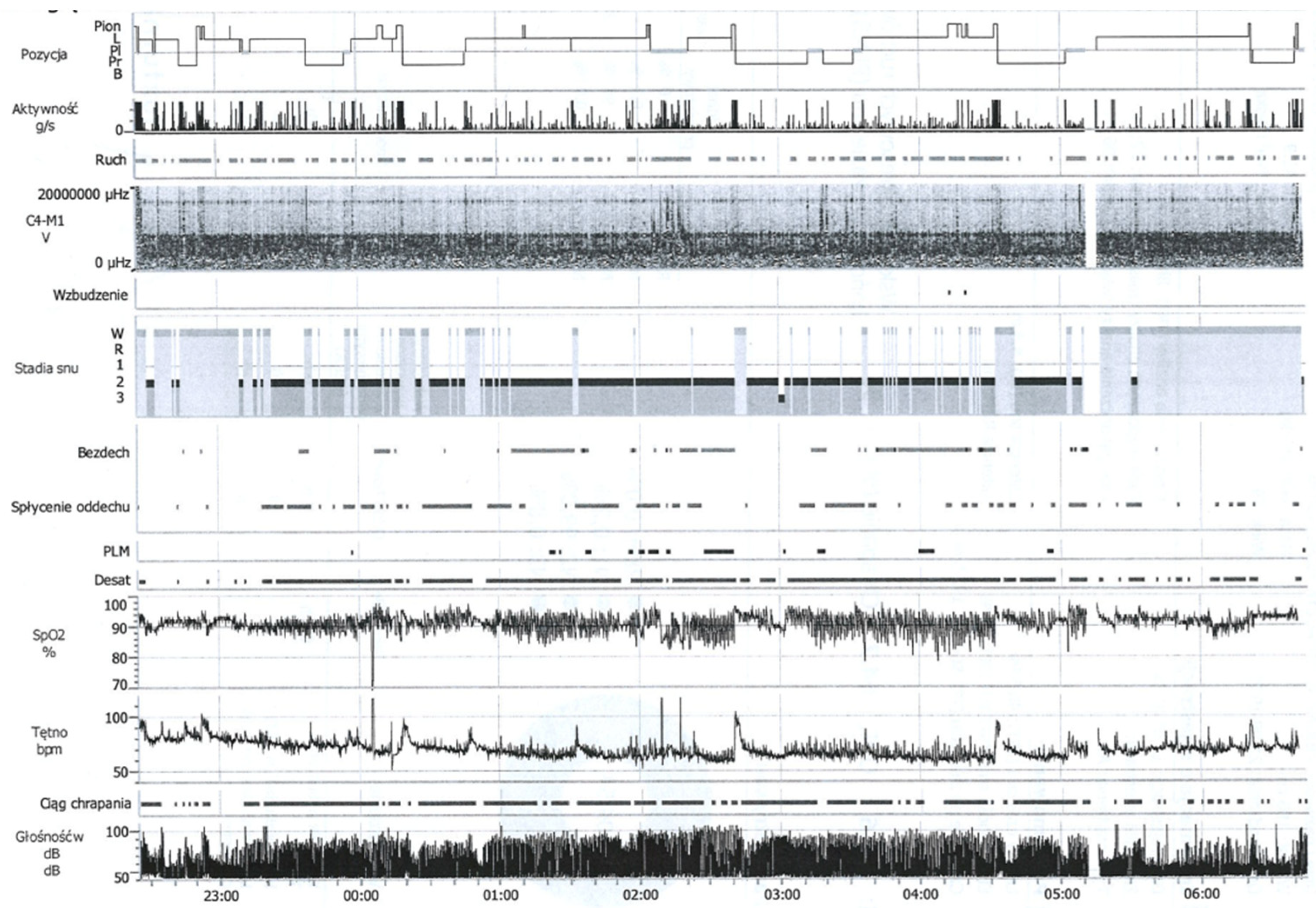
- values of the apnea–hypopnea index (AHI) and respiratory disturbance index (RDI), used to determine the severity of the disease;
- patient populations eligible for MAD therapy,
- effectiveness of oral appliances in reducing the number of apneic events, improving oxygen saturation, and enhancing subjective sleep quality;
- potential adverse effects, including occlusal changes, temporomandibular joint symptoms, and the impact of therapy on dentition and periodontal tissues.
3. Literature Review
3.1. Diagnosis of Obstructive Sleep Apnea
3.2. Treatment
4. Conclusions
Supplementary Materials
Author Contributions
Funding
Data Availability Statement
Acknowledgments
Conflicts of Interest
References
- Aalaei, S.; Rezaeitalab, F.; Tabesh, H.; Amini, M.; Afsharisaleh, L.; Mostafavi, S.M.; Asadpour, H.; Eslami, S. Factors Affecting Patients’ Adherence to Continuous Positive Airway Pressure Therapy for Obstructive Sleep Apnea Disorder: A Multi-Method Approach. Iran. J. Med. Sci. 2020, 45, 170–178. [Google Scholar] [CrossRef] [Scilit] [PubMed]
- Yu, M.; Ma, Y.; Han, F.; Gao, X. Long-term efficacy of mandibular advancement devices in the treatment of adult obstructive sleep apnea: A systematic review and meta-analysis. PLoS ONE 2023, 18, e0292832. [Google Scholar] [CrossRef] [Scilit]
- Pachiou, A.; Roulias, P.; Steiropoulos, P.; Halazonetis, D.J.; Kourtis, S. Association of edentulism and obstructive sleep apnea: A systematic review. J. Prosthodont. 2025, 34, 90–99. [Google Scholar] [CrossRef] [Scilit]
- Nanda, N.; Robertson, A.; Upton, D.C. Patient Selection for Efficacious Mandibular Advancement Device Therapy in Obstructive Sleep Apnea: An Institutional Outcomes Analysis. Ann. Otol. Rhinol. Laryngol. 2025, 134, 575–582. [Google Scholar] [CrossRef] [Scilit]
- Rana, A.; Raut, A.; Mathur, A. The Occlusal Side Effects of Mandibular Advancement Device Therapy in Adult Sleep Apnea Patients: A Systematic Review. Cureus 2023, 15, e48682. [Google Scholar] [CrossRef] [Scilit] [PubMed]
- Kim, H.K.; Kim, M.E. Treatment Outcomes of Mandibular Advancement Devices in Mild, Moderate, and Severe Obstructive Sleep Apnea: A Preliminary Study. J. Oral Med. Pain 2023, 48, 96–105. [Google Scholar] [CrossRef] [Scilit]
- Scherr, S.C.; Dort, L.C.; Almeida, F.R.; Bennett, K.M.; Blumenstock, N.T.; Demko, B.G.; Essick, G.K.; Katz, S.G.; McLornan, P.M.; Phillips, K.S.; et al. Definition of an Effective Oral Appliance for the Treatment of Obstructive Sleep Apnea and Snoring. J. Dent. Sleep Med. 2014, 1, 39–50. [Google Scholar] [CrossRef] [Scilit]
- Tan, W.M.N.; Lye, K.W.; Saffari, S.E.; Poon, C.Y. Mandibular advancement devices, irrespective of amount of movement, are effective in treating young patients with obstructive sleep apnea. Sleep Sci. Pract. 2025, 9, 5. [Google Scholar] [CrossRef] [Scilit]
- Lo Giudice, A.; La Rosa, S.; Palazzo, G.; Federico, C. Diagnostic and Therapeutic Indications of Different Types of Mandibular Advancement Design for Patients with Obstructive Sleep Apnea Syndrome: Indications from Literature Review and Case Descriptions. Diagnostics 2024, 14, 1915. [Google Scholar] [CrossRef] [Scilit]
- Uyaner, A.; Schneider, H.; Parikh, A.; Paeske-Hinz, K.; Konermann, A. Mandibular Advancement Devices in OSA Patients: Impact on Occlusal Dynamics and Tooth Alignment Modifications-A Pilot Prospective and Retrospective Study. Dent. J. 2024, 12, 370. [Google Scholar] [CrossRef] [Scilit]
- Venema, J.A.M.U.; Doff, M.H.J.; Joffe-Sokolova, D.S.; Wijkstra, P.J.; van der Hoeven, J.H.; Stegenga, B.; Hoekema, A. Dental side effects of long-term obstructive sleep apnea therapy: A 10-year follow-up study. Clin. Oral. Investig. 2020, 24, 3069–3076. [Google Scholar] [CrossRef] [Scilit]
- Mejza, F. Obturacyjny Bezdech Senny—Przyczyny, Objawy, Leczenie. Available online: http://www.mp.pl/social/article/74636 (accessed on 27 September 2025).
- Boers, E.; A Barrett, M.; Benjafield, A.V.; Barnet, J.H.; A Ravelo, L.; Kaye, L.; A Cistulli, P.; Pépin, J.-L.; Armitstead, J.; Sterling, K.L.; et al. Projecting the 30-year burden of obstructive sleep apnoea in the USA: A prospective modelling study. Lancet Respir. Med. 2025, 13, 1078–1086. [Google Scholar] [CrossRef] [Scilit]
- Lv, R.; Liu, X.; Zhang, Y.; Dong, N.; Wang, X.; He, Y.; Yue, H.; Yin, Q. Pathophysiological mechanisms and therapeutic approaches in obstructive sleep apnea syndrome. Signal Transduct. Target. Ther. 2023, 8, 218. [Google Scholar] [CrossRef] [Scilit]
- Gambino, F.; Zammuto, M.M.; Virzì, A.; Conti, G.; Bonsignore, M.R. Treatment options in obstructive sleep apnea. Intern. Emerg. Med. 2022, 17, 971–978. [Google Scholar] [CrossRef] [Scilit]
- Shah, F.; Stål, P. Myopathy of the upper airway in snoring and obstructive sleep apnea. Laryngoscope Investig. Otolaryngol. 2022, 7, 636–645. [Google Scholar] [CrossRef] [Scilit]
- Schütz, S.G.; Dunn, A.; Braley, T.J.; Pitt, B.; Shelgikar, A.V. New frontiers in pharmacologic obstructive sleep apnea treatment: A narrative review. Sleep Med. Rev. 2021, 57, 101473. [Google Scholar] [CrossRef] [Scilit]
- Dowgierd, K.; Larysz, D.; Szymor, P.; Kozakiewicz, M. Alterations of upper airway volume caused by Le Fort III osteodistraction in children. J. Cranio-Maxillofac. Surg. 2020, 48, 825–831. [Google Scholar] [CrossRef] [Scilit] [PubMed]
- Liu, S.Y.C.; Bosschieter, P.F.N.; Abdelwahab, M.; Chao, P.-Y.; Chen, A.; Kushida, C. Association of Backscattered Ultrasonographic Imaging of the Tongue with Severity of Obstructive Sleep Apnea in Adults. JAMA Otolaryngol.-Head Neck Surg. 2023, 149, 580–586. [Google Scholar] [CrossRef] [Scilit] [PubMed]
- Du, M.; Gui, Y.; Guo, Y.; Liu, J.; Deng, W.; Huang, J.; Liu, T.; Zhang, X.; Pang, F. Predicting OSA Using Radiographs of the Airway Anatomy. Nat. Sci. Sleep. 2024, 16, 1797–1809. [Google Scholar] [CrossRef] [Scilit]
- Sands, S.A.; Alex, R.M.; Mann, D.; Vena, D.; Terrill, P.I.; Gell, L.K.; Zinchuk, A.; Sofer, T.; Patel, S.R.; Taranto-Montemurro, L.; et al. Pathophysiology Underlying Demographic and Obesity Determinants of Sleep Apnea Severity. Ann. Am. Thorac. Soc. 2023, 20, 440–449. [Google Scholar] [CrossRef] [Scilit] [PubMed]
- Ghavami, T.; Kazeminia, M.; Ahmadi, N.; Rajati, F. Global Prevalence of Obstructive Sleep Apnea in the Elderly and Related Factors: A Systematic Review and Meta-Analysis Study. J. PeriAnesthesia Nurs. 2023, 38, 865–875. [Google Scholar] [CrossRef] [Scilit]
- Wadden, D.; Saad, M.; Chandy, G.; Aaron, S.D.; Gao, Z.; Farrell, J.; Sabri, E.; Yazji, B.; Kendzerska, T. The Association of Body Mass Index and Adiposity-Estimating Equations with Measures of Obstructive Sleep Apnea Severity: A Cross-Sectional Study. Nat. Sci. Sleep 2025, 17, 1003–1019. [Google Scholar] [CrossRef] [Scilit]
- D’ANgelo, G.F.; de Mello, A.A.; Schorr, F.; Gebrim, E.; Fernandes, M.; Lima, G.F.; Grad, G.F.; Yanagimori, M.; Lorenzi-Filho, G.; Genta, P.R. Muscle and visceral fat infiltration: A potential mechanism to explain the worsening of obstructive sleep apnea with age. Sleep Med. 2023, 104, 42–48. [Google Scholar] [CrossRef] [Scilit] [PubMed]
- Udayakumar, S.I.V.; Jo, H.J.; Kim, H.Y.; Joo, E.Y.; Paeng, J.Y. Gender differences in the upper airway, craniofacial morphological and polysomnographic parameters in patients with obstructive sleep apnoea. J. Oral Rehabil. 2024, 51, 581–592. [Google Scholar] [CrossRef] [Scilit]
- Chang, J.L.; Goldberg, A.N.; Alt, J.A.; Mohammed, A.; Ashbrook, L.; Auckley, D.; Ayappa, I.; Bakhtiar, H.; Barrera, J.E.; Bartley, B.L.; et al. International Consensus Statement on Obstructive Sleep Apnea. Int. Forum Allergy Rhinol. 2023, 13, 1061–1482. [Google Scholar] [CrossRef] [Scilit]
- Liu, K.; Zang, C.; Wang, J.; Liu, J.; Chen, Z.; He, M.; Liu, B.; Su, X.; Zhang, Y.; Yi, M.; et al. Effects of common lifestyle factors on obstructive sleep apnea: Precautions in daily life based on causal inferences. Front. Public Health 2024, 12, 1264082. [Google Scholar] [CrossRef] [Scilit] [PubMed]
- Kim, K.S.; Kim, J.H.; Park, S.Y.; Won, H.-R.; Lee, H.-J.; Yang, H.S.; Kim, H.J. Smoking Induces Oropharyngeal Narrowing and Increases the Severity of Obstructive Sleep Apnea Syndrome. J. Clin. Sleep Med. 2012, 8, 367–374. [Google Scholar] [CrossRef] [Scilit]
- Akset, M.; Poppe, K.G.; Kleynen, P.; Bold, I.; Bruyneel, M. Endocrine disorders in obstructive sleep apnoea syndrome: A bidirectional relationship. Clin. Endocrinol. 2023, 98, 3–13. [Google Scholar] [CrossRef] [Scilit] [PubMed]
- Wang, Y.; Luo, L.; Huang, P.; Jiang, S.; Pan, X. Effects of Obstructive Sleep Apnea on Cognition: An Analysis of Electroencephalography Microstates and Alpha Peak Frequency. CNS Neurosci. Ther. 2025, 31, e70553. [Google Scholar] [CrossRef] [Scilit]
- Daccò, S.; Grassi, M.; Wolpe, Z.; Bruner, M.; Caldirola, D.; Perna, G.; Defillo, A. Uncovering hidden depression: The critical role of depression screening in sleep disorders at U.S. sleep centers. Front. Psychiatry 2025, 16, 1449360. [Google Scholar] [CrossRef] [Scilit]
- Jang, J.-W.; Ju, H.-M.; Jeon, H.-M.; Ahn, Y.-W.; Jeong, S.-H.; Ok, S.-M. Obstructive Sleep Apnea: Pathophysiology and Treatment. J. Oral Med. Pain 2024, 49, 71–78. [Google Scholar] [CrossRef] [Scilit]
- Amiri, D.; Bracko, O.; Nahouraii, R. Revealing inconsistencies between Epworth scores and apnea-hypopnea index when evaluating obstructive sleep apnea severity: A clinical retrospective chart review. Front. Neurol. 2024, 15, 1387924. [Google Scholar] [CrossRef] [Scilit] [PubMed]
- Slowik, J.M.; Sankari, A.; Collen, J.F. Obstructive Sleep Apnea. In StatPearls; StatPearls Publishing: Petersburg, FL, USA, 2025. Available online: http://www.ncbi.nlm.nih.gov/books/NBK459252/ (accessed on 28 September 2025).
- The Official STOP-Bang Questionnaire Website. Available online: http://www.stopbang.ca/osa/screening.php (accessed on 28 September 2025).
- Polysomnography: Overview of Polysomnography, Parameters Monitored, Staging of Sleep. Available online: https://emedicine.medscape.com/article/1188764-overview?utm_source=chatgpt.com&form=fpf (accessed on 7 October 2025).
- Abu, K.; Khraiche, M.L.; Amatoury, J. Obstructive sleep apnea diagnosis and beyond using portable monitors. Sleep Med. 2024, 113, 260–274. [Google Scholar] [CrossRef] [Scilit] [PubMed]
- Henning, R.J.; Anderson, W.M. Sleep apnea is a common and dangerous cardiovascular risk factor. Curr. Probl. Cardiol. 2025, 50, 102838. [Google Scholar] [CrossRef] [Scilit]
- Shiffman, H.S.; Khorsandi, J.; Cauwels, N.M. Minimally Invasive Combined Nd:YAG and Er:YAG Laser-Assisted Uvulopalatoplasty for Treatment of Obstructive Sleep Apnea. Photomed. Laser Surg. 2021, 39, 550–557. [Google Scholar] [CrossRef] [Scilit] [PubMed]
- Dembicka-Mączka, D.; Gryka-Deszczyńska, M.; Sitkiewicz, J.; Makara, A.; Fiegler-Rudol, J.; Wiench, R. Effectiveness of the Er:YAG Laser in Snoring Treatment Based on Systematic Review and Meta-Analysis Results. J. Clin. Med. 2025, 14, 4371. [Google Scholar] [CrossRef] [Scilit]
- Page, M.J.; McKenzie, J.E.; Bossuyt, P.M.; Boutron, I.; Hoffmann, T.C.; Mulrow, C.D.; Shamseer, L.; Tetzlaff, J.M.; Akl, E.A.; Brennan, S.E.; et al. The PRISMA 2020 statement: An updated guideline for reporting systematic reviews. BMJ 2021, 372, n71. [Google Scholar] [CrossRef] [Scilit]



| Number of the Citation in the Publication | Article |
|---|---|
| [4] | Nanda N, Robertson A, Upton DC. “Patient Selection for Efficacious Mandibular Advancement Device Therapy in OSA.” Ann Otol Rhinol LaryngdES2025. |
| [5] | Rana A, Raut A, Mathur A. “The Occlusal Side Effects of Mandibular Advancement Device Therapy.” Cureus. 2023. |
| [6] | Kim HK, Kim ME. “Treatment Outcomes of Mandibular Advancement Devices in OSA.” J Oral Med Pain. 2023. |
| [7] | “Definition of an Effective Oral Appliance for Treatment of OSA and Snoring.” JDSM. 2025. |
| [8] | Tan WMN, Lye KW, Saffari SE, Poon CY. “MAD effectiveness in young OSA patients.” Sleep Sci Pract. 2025. |
| [9] | “Diagnostic & Therapeutic Indications of Different MAD Types for OSA.” 2025. |
| [10] | Uyaner A et al. “Impact of MADs on Occlusal Dynamics & Tooth Alignment.” Dent J. 2024. |
| [11] | Uniken Venema JAM et al. “Dental side effects of long-term OSA therapy.” Clin Oral Investig. 2020. |
| Methods of Treating Obstructive Sleep Apnea [32] | |
|---|---|
| CPAP (Continuous Positive Airway Pressure) | This involves maintaining continuous positive airway pressure during sleep through the use of a nasal mask. |
| Lifestyle modifications and weight loss | This is particularly recommended for patients who are overweight or obese. |
| Positional therapy | This involves encouraging patients to sleep in specific positions to reduce the frequency of apneic episodes. |
| Hypoglossal Nerve Stimulation (HNS) | This therapy involves stimulating the hypoglossal nerve to help keep the airways open during sleep. |
| STOP-BANG Questionnaire | YES | NO |
|---|---|---|
| Snoring: Do you snore loudly (enough to be heard through closed doors)? | ||
| Fatigue: Do you often feel tired, exhausted, or sleepy during the day (e.g., falling asleep while driving)? | ||
| Observations by others: Has anyone noticed that you stop breathing during sleep or choke/gasp? | ||
| Blood pressure: Do you have hypertension or take medications for hypertension? | ||
| BMI: Is your body mass index (BMI) greater than 35 kg/m2? | ||
| Age: Are you over 50 years old? | ||
| Neck circumference: Do you have a collar size of 41 cm or larger (for women) or 43 cm or larger (for men)? | ||
| Gender: Are you male? | ||
| For the general population, the results of the STOP-BANG questionnaire are as follows: Low Risk of OSA: “Yes” to 0–2 questions Medium Risk of OSA: “Yes” to 3–4 questions High Risk of OSA: “Yes” to 5–8 questions | ||
| The Severity of Obstructive Sleep Apnea | Level of AHI |
|---|---|
| Mild OSA | 5 to 15 |
| Moderate OSA | 15 to 30 |
| Severe OSA | Above 30 |
| The Criteria for Children | Level of AHI |
| Mild OSA | 1 to 5 |
| Moderate OSA | 5 to 10 |
| Severe OSA | Above 10 |
Disclaimer/Publisher’s Note: The statements, opinions and data contained in all publications are solely those of the individual author(s) and contributor(s) and not of MDPI and/or the editor(s). MDPI and/or the editor(s) disclaim responsibility for any injury to people or property resulting from any ideas, methods, instructions or products referred to in the content. |
© 2026 by the authors. Licensee MDPI, Basel, Switzerland. This article is an open access article distributed under the terms and conditions of the Creative Commons Attribution (CC BY) license.
Share and Cite
Szmyt, J.; Szczapa, T.; Chyła, M.; Bęben, A.; Maciejewska, I. Obstructive Sleep Apnea: The Expanding Role of Dental Sleep Medicine—A Systematic Review of Mandibular Advancement Devices, Treatment Efficacy, and Occlusal Complications. Dent. J. 2026, 14, 62. https://doi.org/10.3390/dj14010062
Szmyt J, Szczapa T, Chyła M, Bęben A, Maciejewska I. Obstructive Sleep Apnea: The Expanding Role of Dental Sleep Medicine—A Systematic Review of Mandibular Advancement Devices, Treatment Efficacy, and Occlusal Complications. Dentistry Journal. 2026; 14(1):62. https://doi.org/10.3390/dj14010062
Chicago/Turabian StyleSzmyt, Jędrzej, Tymoteusz Szczapa, Maksymilian Chyła, Adam Bęben, and Izabela Maciejewska. 2026. "Obstructive Sleep Apnea: The Expanding Role of Dental Sleep Medicine—A Systematic Review of Mandibular Advancement Devices, Treatment Efficacy, and Occlusal Complications" Dentistry Journal 14, no. 1: 62. https://doi.org/10.3390/dj14010062
APA StyleSzmyt, J., Szczapa, T., Chyła, M., Bęben, A., & Maciejewska, I. (2026). Obstructive Sleep Apnea: The Expanding Role of Dental Sleep Medicine—A Systematic Review of Mandibular Advancement Devices, Treatment Efficacy, and Occlusal Complications. Dentistry Journal, 14(1), 62. https://doi.org/10.3390/dj14010062