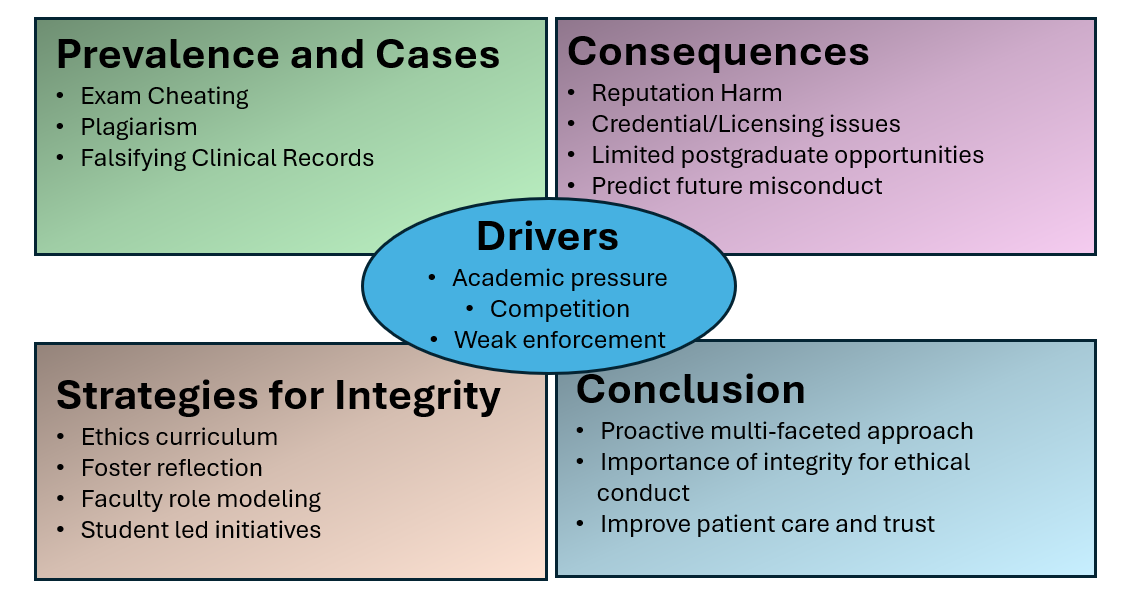

Academic Integrity and Cheating in Dental Education: Prevalence, Drivers, and Career Implications


 , , ,
, , ,  and
and 
Abstract
1. Introduction
2. Methodology
- Empirical studies reporting prevalence, forms, or manifestations of academic dishonesty within dental education.
- Studies examining determinants, motivations, or consequences of dishonest behaviors in dental students.
- Peer-reviewed quantitative (e.g., cross-sectional surveys, longitudinal studies) or qualitative (e.g., interviews, focus groups) research.
- Opinion pieces, commentaries, or editorials lacking original empirical data.
- Research conducted outside of dental education, unless findings from medical or allied health education provide directly comparable insights relevant to dental training.
3. Results
3.1. The Foundations of Integrity in Dental Education
3.2. Cheating in Dental Schools: Forms, Causes, and Prevalence
3.3. Career Consequences of Academic Dishonesty
3.4. Institutional Strategies to Uphold Integrity
3.5. Cultivating Ethical Future Dentists: Proactive Approaches
4. Discussion
Limitation
5. Conclusions
Supplementary Materials
Author Contributions
Funding
Data Availability Statement
Conflicts of Interest
References
- Hanafi, I.; Kassem, L.H.; Hanafi, M.; Ahmad, S.; Abbas, O.; Hajeer, M.Y.; Alsalkini, M.; Alahdab, F. Medical Research Conduct and Publication during Higher Education in Syria: Attitudes, Barriers, Practices, and Possible Solutions. Avicenna J. Med. 2022, 12, 127–137. [Google Scholar] [CrossRef]
- American Dental Association. Principles of Ethics and Code of Professional Conduct; American Dental Association: Chicago, IL, USA, 2018. [Google Scholar]
- FDI World Dental Federation. FDI policy statement on dental ethics. Int. Dent. J. 2018, 68, 171–172. [Google Scholar]
- Swick, H.M. Toward a normative definition of medical professionalism. Ann. Intern. Med. 2000, 132, 609–614. [Google Scholar] [CrossRef] [PubMed]
- Masella, R.S. Renewing professionalism in dental education: Overcoming the market environment. J. Dent. Educ. 2007, 71, 205–216. [Google Scholar] [CrossRef] [PubMed]
- Lantz, M.S.; Bebeau, M.J.; Zarkowski, P. The status of ethics teaching and learning in U.S. dental schools. J. Dent. Educ. 2011, 75, 1295–1309. [Google Scholar] [CrossRef]
- Artioli, F. Academic integrity and professional ethics in dentistry: A foundation for career success. Eur. J. Dent. Educ. 2011, 15, 203–208. [Google Scholar]
- Papadakis, M.A.; Teherani, A.; Banach, M.A.; Knettler, T.R.; Rattner, S.L.; Stern, D.T.; Veloski, J.J.; Hodgson, C.S. Disciplinary action by medical boards and prior behavior in medical school. N. Engl. J. Med. 2005, 353, 2673–2682. [Google Scholar] [CrossRef]
- Ellis, M.; Johnson, I. Exploring dentists’ professional behaviours reported in United Kingdom newspaper media. Br. Dent. J. 2020, 2020, 1–5. [Google Scholar] [CrossRef]
- Graham, B.S.; Knight, G.W.; Graham, L. Dental Student Academic Integrity in U.S. Dental Schools: Current Status and Recommendations for Enhancement. J. Dent. Educ. 2016, 80, 5–13. [Google Scholar] [CrossRef]
- Mosavi, R.; Foroughipour, F.; Kazemipoor, M.; Keshmiri, F. Moral competence of dental students: An explanatory mixed-methods study. BMC Med. Educ. 2025, 25, 118. [Google Scholar] [CrossRef]
- Choi, J. Cheating behaviors and related factors at a Korean dental school. Korean J. Med. Educ. 2019, 31, 239–249. [Google Scholar] [CrossRef] [PubMed]
- Kadayam Guruswami, G.; Mumtaz, S.; Gopakumar, A.; Khan, E.; Abdullah, F.; Parahoo, S.K. Academic Integrity Perceptions Among Health-Professions’ Students: A Cross-Sectional Study in The Middle East. J. Acad. Ethics 2023, 21, 231–249. [Google Scholar] [CrossRef] [PubMed]
- van Dyk, E.C.; van Rensburg, G.H.; van Rensburg, E.S.J. A model to foster and facilitate trust and trusting relationships in the nursing education context. Health SA Gesondheid 2021, 26, 1645. [Google Scholar] [CrossRef] [PubMed]
- Beemsterboer, P.L.; Odom, J.G.; Pate, T.D.; Haden, N.K. Academic integrity in U.S. dental schools: A survey of policies and practices. J. Dent. Educ. 2000, 64, 833–838. [Google Scholar] [CrossRef]
- Al-Dwairi, Z.N.; Al-Waheidi, E.M. Cheating behaviors of dental students. J. Dent. Educ. 2004, 68, 1192–1195. [Google Scholar] [CrossRef]
- Asokan, S.; John, J.B.; Janani, D.; Jessy, P.; Kavya, S.; Sharma, K. Attitudes of students and teachers on cheating behaviors: Descriptive cross-sectional study at six dental colleges in India. J. Dent. Educ. 2013, 77, 1379–1383. [Google Scholar] [CrossRef]
- Fuller, J.R.; Killip, D.E. Cheating in dental school: A preliminary survey. J. Dent. Educ. 1979, 43, 144–146. [Google Scholar]
- Warman, J.; Hissong, K.; Levitt, R. Academic dishonesty: A survey of dental school students. J. Dent. Educ. 1994, 58, 724–727. [Google Scholar]
- Muhney, K.A.; Gutmann, M.E.; Schneiderman, E.; DeWald, J.P.; McCann, A.L. Predictors of academic dishonesty among dental hygiene students. J. Dent. Educ. 2008, 72, 780–789. [Google Scholar] [CrossRef]
- Mulisa, F.; Ebessa, A.D. The carryover effects of college dishonesty on the professional workplace dishonest behaviors: A systematic review. Cogent Educ. 2021, 8, 1935408. [Google Scholar] [CrossRef]
- Reeck, C.; Ariely, D. Dishonest behavior can transition to continuous ethical transgressions. Sci. Rep. 2025, 15, 24484. [Google Scholar] [CrossRef] [PubMed]
- Andrews, K.G.; Smith, L.A.; Henzi, D.; Demps, E. Faculty and student perceptions of academic integrity U.S. and Canadian dental schools. J. Dent. Educ. 2007, 71, 1027–1039. [Google Scholar] [CrossRef]
- Hook, H.; Woolley, J. A Consideration of Professionalism for Dental Professionals. Prim. Dent. J. 2021, 10, 69–72. [Google Scholar] [CrossRef]
- Bebeau, M.J.; Rest, J.R.; Yamoor, C.M. Measuring dental students’ ethical sensitivity. J. Dent. Educ. 1985, 49, 225–235. [Google Scholar] [CrossRef]
- Bertolami, C.N. Why our ethics curricula don’t work. J. Am. Coll. Dent. 2006, 73, 35–46. [Google Scholar] [CrossRef]
- Veerabhadrappa, S.K.; Pandarathodiyil, A.K.; Ghani, W.M.N.; Termizi Bin Zamzuri, A. Evaluation of Self-Reported professionalism lapses among dental undergraduate students: A cross-sectional study from a Malaysian dental faculty. Eur. J. Dent. Educ. 2023, 27, 1011–1022. [Google Scholar] [CrossRef]
- Miles, P.J.; Campbell, M.; Ruxton, G.D. Why Students Cheat and How Understanding This Can Help Reduce the Frequency of Academic Misconduct in Higher Education: A Literature Review. J. Undergrad. Neurosci. Educ. 2022, 20, A150–A160. [Google Scholar] [CrossRef]
- Homayouni, L.; Zare, A.; Padam, Z.; Fereidouni, A. Investigating academic dishonesty and its relationship with moral competence and professional identity of nursing students: A cross-sectional study. BMC Nurs. 2024, 23, 662. [Google Scholar] [CrossRef]
- Jordan, A.E. College Student Cheating: The Role of Motivation, Perceived Norms, Attitudes, and Knowledge of Institutional Policy. Ethics Behav. 2001, 11, 233–247. [Google Scholar] [CrossRef]
- Benson, L.; Enstroem, R. A model for preventing academic misconduct: Evidence from a large-scale intervention. Int. J. Educ. Integr. 2023, 19, 25. [Google Scholar] [CrossRef]
- Ladera-Castañeda, M.; León-Málaga, F.; Espinoza-Olórtegui, M.; Nicho-Valladares, M.; Cervantes-Ganoza, L.; Verástegui-Sandoval, A.; Solís-Dante, F.; Castro-Rojas, M.; Cayo-Rojas, C.F. Factors associated with the perception of university professors about academic dishonesty in dental students from two peruvian universities: Analysis under multivariable regression model. BMC Med. Educ. 2023, 23, 297. [Google Scholar] [CrossRef]
- Henning, M.A.; Ram, S.; Malpas, P.; Shulruf, B.; Kelly, F.; Hawken, S.J. Academic dishonesty and ethical reasoning: Pharmacy and medical school students in New Zealand. Med. Teach. 2013, 35, e1211–e1217. [Google Scholar] [CrossRef]
- Fukami, T. Enhancing Healthcare Accountability for Administrators: Fostering Transparency for Patient Safety and Quality Enhancement. Cureus 2024, 16, e66007. [Google Scholar] [CrossRef] [PubMed]
- California Dental Board. Licensure Requirements. Available online: https://www.dbc.ca.gov (accessed on 1 April 2025).
- Texas State Board of Dental Examiners. Licensure Requirements. Available online: https://tsbde.texas.gov (accessed on 1 April 2025).
- New York State Education Department. Dentistry: License Requirements. Available online: https://www.op.nysed.gov (accessed on 1 April 2025).
- Yaylaci, S.; Ulman, Y.I.; Vatansever, K.; Senyurek, G.; Turkmen, S.; Aldinc, H.; Gun, C. Integrating patient management, reflective practice, and ethical decision-making in an emergency medicine intern boot camp. BMC Med. Educ. 2021, 21, 536. [Google Scholar] [CrossRef]
- American Dental Association. ADA Code of Ethics (November 2018); American Dental Association: Chicago, IL, USA, 2018; Available online: https://commons.ada.org/codeethics/1 (accessed on 1 April 2025).
- Keshmiri, F. The experiences of unprofessionalism among students in dental education: A qualitative study. BMC Med. Educ. 2025, 25, 24. [Google Scholar] [CrossRef]
- Stone, A. Student Perceptions of Academic Integrity: A Qualitative Study of Understanding, Consequences, and Impact. J. Acad. Ethics 2022, 21, 357–375. [Google Scholar] [CrossRef]
- Castro Rodríguez, Y.; Yoplac-Lopez, B.; Carpio-Tello, A.; Sihuay-Torres, K.; Cósar-Quiroz, J. Percepción del plagio académico en estudiantes de Odontología. Educ. Médica 2018, 19, 141–145. [Google Scholar] [CrossRef]
- Tammeleht, A.; Löfström, E.; Rajando, K. Effectiveness of research ethics and integrity competence development—What do learning diaries tell us about learning? Int. J. Ethics Educ. 2024, 9, 3–27. [Google Scholar] [CrossRef]
- Alhomsi, A.; Aldoss, H.; Aljoujou, A.A.; Mashlah, A.M.; Hajeer, M.Y.; Alyafi, A.; Almasri, I.A. Exploring How People Interact with Dental Misinformation on Social Media: A Cross-Sectional Study. Cureus 2024, 16, e56625. [Google Scholar] [CrossRef]
- Sozon, M.; Mohammad Alkharabsheh, O.H.; Fong, P.W.; Chuan, S.B. Cheating and plagiarism in higher education institutions (HEIs): A literature review. F1000Research 2024, 13, 788. [Google Scholar] [CrossRef]

| Reference | Prevalence of Cheating/Misconduct | Primary Drivers Identified | Professionalism/Career Outcomes | Institutional Responses/Policies |
|---|---|---|---|---|
| [18] | 43% admitted cheating; 94% believed peers cheated | High workload; peer norms (“everyone does it”) | Early normalization of dishonesty | Weak enforcement; lack of clear definitions |
| [19] | ~30% acknowledged cheating; widespread perception of dishonesty | Stress; competitive environment | Credibility issues with faculty; trust erosion | Limited documentation; informal handling |
| [20] | 86.5% committed ≥1 dishonest act | Prior cheating; peer influence | Predictor of low professional integrity | Need for structured ethics curriculum |
| [23] | 57.5–74% admitted misconduct across categories | Weak policy clarity; hidden curriculum; peer norms | Reduced trust between faculty & students | Honor codes inconsistently enforced |
| [12] | 92.2% committed ≥1 dishonest behavior | Cultural norms; exam stress; pressure to perform | Risk of long-term tolerance of unethical conduct | Stronger supervision and policy clarity recommended |
| [15] | Policy study; no prevalence data | Variability in enforcement | Inconsistent faculty modeling undermines values | Wide variability in U.S. dental school policies |
| [32] | Misconduct frequently observed by faculty | Stress; unclear expectations; inequities | Weak moral-competence development | Standardized policy development needed |
| [42] | High plagiarism prevalence (exact % not reported) | Digital access; unclear plagiarism norms | Weak academic-ethics foundation | Need for digital-ethics instruction |
| [16] | Cheating reported as common (no % but high frequency) | Poor proctoring; opportunity; peer behavior | Ethical desensitization | Recommended stronger proctoring & monitoring |
| [17] | High prevalence across six dental colleges (“common practice”) | Peer norms; unclear penalties | Undermining of professional values | Student–faculty perception gap highlighted |
| [13] | Moderate–high dishonesty rates (varied: 40–70% depending on behavior) | Cultural expectations; low reporting; stress | Erosion of trust culture | Advocates trust-building & clarity of policies |
| [11] | Not prevalence; focused on moral competence | Low ethical reasoning ability | Poor professional performance trajectory | Need for structured moral-competence training |
| [7] | Not prevalence; conceptual professional ethics | Weak ethical identity | Long-term reputational risk | Dental ethics integration required |
| [24] | Not prevalence; focuses on professionalism | Weak professionalism training | Threat to licensure, patient trust | Advocates stronger training in professionalism |
| Mechanism/Driver | How it Promotes Academic Dishonesty | Representative Evidence (Dental/Health-Professions) | Professionalism/Career Implications | Institutional Levers/Responses |
|---|---|---|---|---|
| Lack of safe reporting mechanisms | Students may witness cheating but avoid reporting due to fear of retaliation, social isolation, or belief that “nothing will happen” | Refs. [13,41] emphasize fear and distrust as barriers to reporting academic misconduct | Silence in the face of misconduct can become a habit, later affecting willingness to report unsafe care, impaired colleagues, or fraud. | Anonymous reporting tools, anti-retaliation policies, faculty champions for integrity, and feedback to students on how reports are handled. |
| Digital environment and information ecosystems | Easy access to online materials, group chats, and contract cheating platforms lowers the barrier to plagiarism and answer-sharing; exposure to misinformation can blur lines for acceptable practice. | Ref. [44] (Interaction with dental misinformation online) highlight digital pressures and weak digital literacy. | Poor digital professionalism may extend to online patient communication, marketing, and representation of clinical outcomes. | Digital-ethics training (use of AI, plagiarism, social media), clear guidelines on online conduct, and use of plagiarism-detection and exam-security technologies. |
| Documented professionalism concerns predicting later sanctions | Repeated unaddressed lapses in professionalism during training signal risk for future regulatory problems | Ref. [8] shows that students with professionalism citations are significantly more likely to face later board disciplinary action. | Direct evidence that “small” lapses in training can translate into serious career consequences (License restriction, board action) | Systemic documentation of professionalism issues, structured remediation plans, and using integrity metrics as part of progression/advancement decisions. |
| High academic stress and workload | Heavy course load, dense exams, and perceived impossibility of success push students toward shortcuts (copying, unauthorized collaboration, exam cheating) as “survival strategies.” | Dental and health-professions students consistently cite stress, workload, and high-stakes exams as primary reasons for cheating (e.g., [12,17,32,33]. | Habitual use of shortcuts under pressure can normalize rule-bending and undermine resilience when facing stressful clinical situations. | Rationalize assessment design (focus on high-yield content), reduce “busy work,” distribute workload more evenly, and integrate wellness and time-management support. |
| Perceived peer norms (“everyone does it”) | When students believe most classmates cheat, dishonesty becomes socially acceptable; fear of being at a “competitive disadvantage” overrides personal values. | Ref. [18] (43% self-reported cheating, 94% perceived peer cheating); Refs. [23,28] highlight peer norms and perceived prevalence as central drivers. | Aligns students with group norms rather than professional codes; can carry into practice as tolerance for “what everyone does” (upcoding, cutting corners). | Visible enforcement of policies, peer-led honor systems, ethics clubs, and campaigns that reshape norms around integrity and reporting. |
| Ambiguous or weakly enforced policies | Unclear definitions of cheating or inconsistent consequences lead students to view rules as negotiable or symbolic rather than binding. | Refs. [15,23] show that many schools have policies but uneven communication and enforcement; students often are unsure what counts as misconduct. | Early experience that rules are not applied consistently may generalize to future disregard of regulations (documentation, billing, infection control). | Clear, accessible policies; orientation sessions; consistent documentation of violations; faculty training to reduce variability in responses. |
| Opportunity and low perceived risk of detection | Poorly proctored exams, recycled questions, and undetectable copying create a high-reward, low-risk environment for cheating. | Refs. [10,16,17] describe frequent classroom and exam-related misconduct where surveillance is weak. | Encourages a mindset that unethical behavior is acceptable if one can “get away with it,” undermining internalized professionalism. | Secure assessment platforms, proctoring, randomized questions, plagiarism-detection tools, and audit trails for clinical documentation. |
| Cultural and contextual norms | In some contexts, sharing answers or “helping friends” is seen as loyalty rather than misconduct; hierarchies may discourage reporting. | Refs. [12,13,32] describe culture-specific attitudes that shape what behaviors are considered cheating or reportable. | If unaddressed, students may carry culture-specific rationalizations to global practice environments where standards differ, leading to conflicts with licensing and regulatory expectations. | Culturally sensitive ethics teaching, explicit discussion of global professional standards, safe/anonymous reporting channels, and faculty role-modeling of how to handle misconduct. |
| Prior cheating history and learned rationalizations | Students who have cheated previously (school or college) are more likely to repeat dishonesty and to develop justifying narratives (“no one is hurt,” “grades don’t reflect real ability”). | Ref. [20] identifies prior dishonest behavior as a predictor of current academic dishonesty; Ref. [21] show “carryover” from academic dishonesty to workplace misconduct. | Entrenched rationalizations can later support insurance fraud, falsifying records, or misrepresentation of outcomes in clinical practice. | Early identification and remediation of dishonesty, reflective exercises on past behavior, and longitudinal professionalism mentoring. |
| Low moral competence/weak ethical reasoning | Students who struggle to recognize ethical dimensions or weigh consequences are more prone to rationalize or minimize cheating. | Refs. [11,25,26,29] show links between lower moral competence/ethical sensitivity and higher tolerance or incidence of dishonest acts. | Weak moral reasoning in school predicts vulnerability to unethical decisions in complex clinical scenarios (e.g., consent, financial conflicts, over-treatment). | Longitudinal ethics curricula, case-based discussions, structured reflection, and explicit assessment/feedback on moral reasoning and professional judgment. |
| Underdeveloped professional identity | When students see themselves primarily as “test-takers” rather than future clinicians, they view cheating as an academic issue, not a professional breach. | Refs. [4,11,40] highlight that weak professional identity correlates with tolerance of unprofessional behaviors. | Delays the internalization of obligations to patients and society; increases risk that dishonest habits persist into clinical practice. | Early, explicit professional-identity formation (white-coat ceremonies, mentorship, patient contact), linking classroom behavior to future patient safety and trust. |
| Faculty modeling and hidden curriculum | If faculty cut corners, ignore misconduct, or send mixed messages, students learn that rules are negotiable despite official policies. | Refs. [10,23] describe discrepancies between formal policies and what students see faculty tolerate or do in practice. | “Hidden curriculum” can override formal ethics teaching, leading students to emulate unethical patterns they observe in authority figures. | Faculty development on role-modeling, explicit expectations in evaluations, recognition for faculty who exemplify integrity, and addressing faculty misconduct transparently. |
| Assessment design and grading culture | Overemphasis on high-stakes, norm-referenced exams and opaque grading fosters competition and grade obsession, which encourages cheating. | Refs. [5,30,33] link competitive, high-stakes assessment with increased likelihood of misconduct. | Encourages performance-orientation rather than mastery or patient-centered learning, eroding intrinsic ethical motivation. | Diversify assessment (formative OSCEs, reflective assignments), increase transparency, and align grading with demonstrated competence and professionalism. |
Disclaimer/Publisher’s Note: The statements, opinions and data contained in all publications are solely those of the individual author(s) and contributor(s) and not of MDPI and/or the editor(s). MDPI and/or the editor(s) disclaim responsibility for any injury to people or property resulting from any ideas, methods, instructions or products referred to in the content. |
© 2026 by the authors. Licensee MDPI, Basel, Switzerland. This article is an open access article distributed under the terms and conditions of the Creative Commons Attribution (CC BY) license.
Share and Cite
Kasula, A.; Zahran, G.; Munkhsaikhan, U.; Diaz, V.; Walker, M.; Johnson, C.; Lefevers, K.; Abidi, A.H.; Kassan, M. Academic Integrity and Cheating in Dental Education: Prevalence, Drivers, and Career Implications. Dent. J. 2026, 14, 65. https://doi.org/10.3390/dj14010065
Kasula A, Zahran G, Munkhsaikhan U, Diaz V, Walker M, Johnson C, Lefevers K, Abidi AH, Kassan M. Academic Integrity and Cheating in Dental Education: Prevalence, Drivers, and Career Implications. Dentistry Journal. 2026; 14(1):65. https://doi.org/10.3390/dj14010065
Chicago/Turabian StyleKasula, Akhilesh, Gadeer Zahran, Undral Munkhsaikhan, Vivian Diaz, Michelle Walker, Candice Johnson, Kathryn Lefevers, Ammaar H. Abidi, and Modar Kassan. 2026. "Academic Integrity and Cheating in Dental Education: Prevalence, Drivers, and Career Implications" Dentistry Journal 14, no. 1: 65. https://doi.org/10.3390/dj14010065
APA StyleKasula, A., Zahran, G., Munkhsaikhan, U., Diaz, V., Walker, M., Johnson, C., Lefevers, K., Abidi, A. H., & Kassan, M. (2026). Academic Integrity and Cheating in Dental Education: Prevalence, Drivers, and Career Implications. Dentistry Journal, 14(1), 65. https://doi.org/10.3390/dj14010065