You are currently viewing a new version of our website. To view the old version click .

Separations, Volume 5, Issue 3

September 2018 - 13 articles

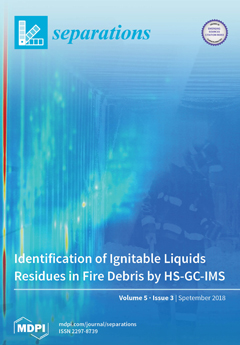
Cover Story: A new method, based on Headspace Gas Chromatography-Ion Mobility Spectrometry (HS-GC-IMS) in combination with suitable chemometric tools, is proposed as a novel methodology for a fast identification of ignitable liquid residues in fire debris samples. HS-GC-IMS presents several advantages, for example, it is fast, inexpensive and the sample does not require sample pre-concentration. HS-GC-IMS is also eco-friendly and safer as it does not use any solvents. This method has also high sensitivity, good accuracy and the data interpretation allows automatization. View paper here.
  • Issues are regarded as officially published after their release is announced to the table of contents alert mailing list .
  • You may sign up for email alerts to receive table of contents of newly released issues.
  • PDF is the official format for papers published in both, html and pdf forms. To view the papers in pdf format, click on the "PDF Full-text" link, and use the free Adobe Reader to open them.

Articles (13)

  • Communication
  • Open Access
5 Citations
6,551 Views
13 Pages

In cases of suspected arson, a body may be intentionally burnt to cause loss of life, dispose of remains, or conceal identification. A primary focus of a fire investigation, particularly involving human remains, is to establish the cause of the fire;...

  • Feature Paper
  • Communication
  • Open Access
22 Citations
7,637 Views
15 Pages

Volatile organic compounds (VOCs) are monitored in numerous fields using several commercially-available sampling options. Sorbent-based sampling techniques, such as solid-phase microextraction (SPME), provide pre-concentration and focusing of VOCs pr...

  • Feature Paper
  • Article
  • Open Access
9 Citations
4,704 Views
14 Pages

Model Distribution Effects on Likelihood Ratios in Fire Debris Analysis

  • Alyssa Allen,
  • Mary R. Williams,
  • Nicholas A. Thurn and
  • Michael E. Sigman

Computational models for determining the strength of fire debris evidence based on likelihood ratios (LR) were developed and validated against data sets derived from different distributions of ASTM E1618-14 designated ignitable liquid class and subst...

  • Article
  • Open Access
21 Citations
14,714 Views
27 Pages

Detection and Characterization of Ignitable Liquid Residues in Forensic Fire Debris Samples by Comprehensive Two-Dimensional Gas Chromatography

  • Andjoe A. S. Sampat,
  • Brenda Van Daelen,
  • Martin Lopatka,
  • Hans Mol,
  • Guido Van der Weg,
  • Gabriel Vivó-Truyols,
  • Marjan Sjerps,
  • Peter J. Schoenmakers and
  • Arian C. Van Asten

This study covers an extensive experimental design that was developed for creating simulated fire debris samples under controlled conditions for the detection and identification of ignitable liquids (IL) residues. This design included 19 different su...

  • Article
  • Open Access
9 Citations
5,252 Views
12 Pages

Heterogeneous Catalytic Ozonation of p-Chlorobenzoic Acid in Aqueous Solution by FeMnOOH and PET

  • Savvina Psaltou,
  • Stylianos Stylianou,
  • Manasis Mitrakas and
  • Anastasios Zouboulis

The oxidation of p-chlorobenzoic acid (p-CBA), used as a typical-model refractory organic compound, in aqueous solutions during the heterogeneous catalytic ozonation treatment process by applying the hydrophilic tetravalent manganese feroxyhyte (TMFx...

  • Article
  • Open Access
23 Citations
8,481 Views
9 Pages

Application of Headspace Gas Chromatography-Ion Mobility Spectrometry for the Determination of Ignitable Liquids from Fire Debris

  • María José Aliaño-González,
  • Marta Ferreiro-González,
  • Gerardo F. Barbero,
  • Miguel Palma and
  • Carmelo G. Barroso

A fast and correct identification of ignitable liquid residues in fire debris investigation is of high importance in forensic research. Advanced fast analytical methods combined with chemometric tools are usually applied for these purposes. In the pr...

  • Review
  • Open Access
53 Citations
7,694 Views
23 Pages

Fabric Phase Sorptive Extraction: Current State of the Art and Future Perspectives

  • Eirini Zilfidou,
  • Abuzar Kabir,
  • Kenneth G. Furton and
  • Victoria Samanidou

Fabric phase sorptive extraction (FPSE) is a novel and green sample preparation technique introduced in 2014. FPSE utilizes a natural or synthetic permeable and flexible fabric substrate chemically coated with a sol-gel organic-inorganic hybrid sorbe...

  • Article
  • Open Access
21 Citations
6,426 Views
13 Pages

Gac (Momordica cochinchinensis Spreng.) seeds contain bioactive compounds with medicinal properties. This study aimed to determine a suitable solvent and extraction technique for recovery of important compounds, namely, trypsin inhibitors, saponins,...

  • Feature Paper
  • Review
  • Open Access
17 Citations
12,749 Views
13 Pages

Natural products are in high demand these days due to rising awareness among consumers. Healthy diets, especially those in emerging markets, growth in populations with nutritional deficiencies, and supporting government regulations provide high growt...

  • Article
  • Open Access
15 Citations
8,577 Views
13 Pages

NSAIDs Determination in Human Serum by GC-MS

  • Adamantios Krokos,
  • Elisavet Tsakelidou,
  • Eleni Michopoulou,
  • Nikolaos Raikos,
  • Georgios Theodoridis and
  • Helen Gika

Non-steroidal anti-inflammatory drugs (NSAIDs) are being widely consumed without medical prescription and are often the cause of intoxication, usually in young children. For this, there is a special need in their determination in routine toxicology a...

of 2

Get Alerted

Add your email address to receive forthcoming issues of this journal.

XFacebookLinkedIn
Separations - ISSN 2297-8739