


Abstract
The work is a continuation of studies , focused on the development of fundamental principles of aluminum activation by low-melting metals forming eutectic alloys with fine-grained structure and limited solid solubility. The aim of this work is to investigate the mechanism and kinetics of the interaction of aluminum-based eutectic alloys with water and aqueous electrolytes. Analysis of phase diagrams of binary systems (Al–Ga, Al–In, In–Ga, Al–Sn, Sn–Ga, Al–Zn, Zn–Ga) shows that alloy composition governs surface heterogeneity and reactivity. Ternary and quaternary systems (Al–In–Ga, Al–Sn–Ga, Al–In–Sn–Ga) exhibit enhanced interaction with water due to increased heterogeneity, leading to the formation of numerous microgalvanic couples and accelerated aluminum dissolution. The process is characterized by the stationary potential of aluminum and involves coupled chemical, electrochemical, and topochemical stages described by the Avrami–Erofeev equation, with n ≈ 1.27–2.07. An increase in the In–Ga or In–Sn–Ga fraction reduces the activation energy: 9.1 kcal/mol (82% Al–9% Ga–9% Sn), 11.4 kcal/mol (92% Al–4% Ga–4% In), and 15.5 kcal/mol (91% Al–3% Ga–3% In–3% Sn).
Keywords:
aluminum; gallium; indium; tin; alloys; phase diagram; eutectic; kinetics; activation energy 1. Introduction
This work is a continuation of a series of studies aimed at developing the fundamental principles of aluminum activation by low-melting-point metals that form eutectic systems with it, characterized by a fine-grained structure and limited mutual solid solubility [1,2]. According to [3,4], the phase equilibrium characteristics of binary systems (Al–Ga, Al–In, In–Ga, Al–Sn, Sn–Ga, Al–Zn, Zn–Ga) determine the degree of alloy heterogeneity, their operating temperature range, and their chemical reactivity. These results served as the basis for further study of the relationship between phase composition, structural features of eutectic alloys, and the efficiency of aluminum activation.
Up to 90% of the world’s energy is currently obtained by burning fossil fuels such as oil, gas, and coal. The significant increase in global interest in hydrogen energy observed in recent decades—particularly approaches based on the interaction of activated aluminum alloys with water for hydrogen production as a fuel and energy carrier—is determined by its key features [5,6,7,8,9,10,11,12,13,14]. Hydrogen resources are virtually unlimited, and hydrogen is a universal energy carrier.
Hydrogen has the highest calorific value per unit mass (28,630 kcal/kg), which is 2.8 times higher than that of gasoline, while its ignition energy is 15 times lower than that of hydrocarbon fuels. In addition, hydrogen is an environmentally clean energy source: the product of its combustion is water, which can be reintroduced into the hydrogen energy cycle [15,16,17,18,19].
The concept of aluminum–hydrogen energy is based on the use of aluminum as an intermediate energy carrier [5,7].
The work began with the study of combustion mechanisms of components in rocket and torpedo fuels, as well as with issues related to hydrogen energy. The main objective was to develop a new class of EAW (activated aluminum substances) based on aluminum—one of the most abundant elements on Earth [6,8]—to determine the chemical composition of aluminum alloys, and to investigate the influence of composition and microstructure at phase boundaries on the properties and reactivity of the alloy in oxidation reactions with protic solvents (acids, water, alcohols) [1,5,9,10,11,12,13].
Aluminum is an active metal with a strongly negative potential; its standard electrode potential is E0= −1.76 V, indicating high reducing ability, thermodynamic instability in aqueous solutions, and a tendency toward active corrosion [5,14,18,19]. Despite this, under normal conditions, it is highly resistant to water in air, as well as in neutral and mildly acidic solutions. Passivation is provided both by atmospheric oxygen or oxygen dissolved in water, and by water itself. In the passive state, the surface of aluminum is covered by an Al2O3 film with a thickness of 50 to 1000 A.
The stationary potential of such aluminum is −0.4 to −0.5 V [5].
According to [4,5,6], the passivity of aluminum is determined by the presence on its surface of hydrargillite (gibbsite, γ-Al(OH)3; Al2O3·3H2O), containing 65.4% Al2O3, with a Gibbs free energy of formation of 554.6 kcal, which is higher compared to other oxide modifications (Al2O3·H2O—boehmite; Al2O3·3H2O—bayerite).
According to the Pourbaix diagram (standard potential–pH), which clearly illustrates the thermodynamically stable forms of elements in aqueous solutions at different pH values and redox potentials (E), the regions of existence of various aluminum corrosion products can be identified. At aluminum potentials of approximately −1.4 to −1.6 V in neutral solutions (pH 4–8), aluminum reacts with water according to the following scheme:
2AI + 3 H20 — AI203 + 6H+ + 6e
The relatively high corrosion resistance of pure aluminum and some of its alloys is explained not only by the presence of protective films (anodic inhibition), but also, to a significant extent, by the high hydrogen overpotential of these alloys (so-called cathodic inhibition). Therefore, impurities of heavy metals, such as iron or copper, significantly reduce chemical stability not only due to disruption of the protective films, but also due to facilitation of the cathodic process.
The magnitude of the standard electrode potential can be used to assess the thermodynamic instability of aluminum in electrolyte solutions. The transition of a metal from the metallic state to the ionic state varies for different metals and is generally characterized by a decrease in free energy during the corresponding corrosion reaction.
Thus, when gallium is added to aluminum, micro-galvanic elements (nano-couples) of the Al–Ga type form on the surface of the aluminum–gallium alloy. In this case, hydrogen evolution occurs on gallium, since the hydrogen evolution overpotential on gallium is significantly lower than on aluminum and is about 90–100 mV at a current density of 1 × 10⁻² A/cm2. During the dissolution of the aluminum–gallium alloy, the alloy surface becomes enriched with the more electropositive element, and the efficiency of the short-circuited Al–Ga galvanic couple in the corrosion process increases.
During the dissolution of the aluminum–gallium alloy in water, the rate-limiting step of the corrosion process is the ionization of aluminum. In this case, the overall reaction of aluminum corrosion dissolution in water can be represented by the following equation [20,21,22,23,24]:
being the overall result of two coupled electrochemical reactions
AI + 3H20 —AI(OH)3 + 3/2H2
cathodic 3H20 + 3e —3/2H2 + 3OH−
anodic AI + 3OH−— AI(OH)3 + 3e
Aluminum hydroxide is poorly soluble in water and forms a protective layer on the aluminum surface, preventing water molecules from reaching it. Upon further dehydration, aluminum hydroxide transforms into a highly durable aluminum oxide film. Therefore, during the dissolution of aluminum–gallium alloys in water, passivation of the alloy surface occurs.
For continuous dissolution of aluminum and its alloys in water, the corrosion product—aluminum hydroxide—must have a loose, porous structure that does not hinder the access of water to the aluminum surface. When the oxide film is removed from the aluminum surface by any means, the process of self-dissolution begins, proceeding via a mechanism similar to that of metal dissolution in acids. The electrochemical characteristic of this process is the stationary potential, and the self-dissolution of aluminum is governed by the laws of electrochemical kinetics.
2. Materials and Methods
2.1. Starting Materials
Aluminum granules were supplied by JSC Aluminium of Kazakhstan, Pavlodar. The material specifications were as follows: melting point—660.0 °C, density—2.70 g/cm3, and purity—99.85%.
Gallium (Ga) in the form of cylindrical ingots weighing 900–1000 g was obtained from JSC Aluminium of Kazakhstan, Pavlodar. The metal had a melting point of 29.80 °C, a density of 5.904 g/cm3 at 20 °C, and a purity of 99.99%.
Indium (In) in the form of cylindrical ingots weighing 0.05 g to 1000 g was supplied by JSC Aluminium of Kazakhstan, Pavlodar, Kazakhstan. The material properties were melting point—156.59 °C, density—7.362 g/cm3 at 20 °C, and purity—99.999%.
Tin (Sn) was supplied in ingots weighing 22–26 kg from Granhim LLC, Chelyabinsk, Russia. The tin content was 99.565%, and the melting point was 231.91 °C.
Zinc (Zn). ISO 752:2004 ZN-2 Zinc ingots. Geneva, Switzerland [25].
Salts NaCl, NaBr, NaI, Na2CO3, Na2SO4, and NaNO3 of “analytical grade” (pure and chemically pure).
2.2. Preparation of Multicomponent Aluminum Alloys
Binary aluminum–gallium alloys, ternary alloys (Ga–Sn–Al, Ga–In–Al), and quaternary alloys (Ga–In–Sn–Al) were prepared according to the procedure described in a previous study [1].
The aluminum potential was measured using a potentiometer (P-307).
2.3. Experiment for Measuring the Volume of Evolved Hydrogen
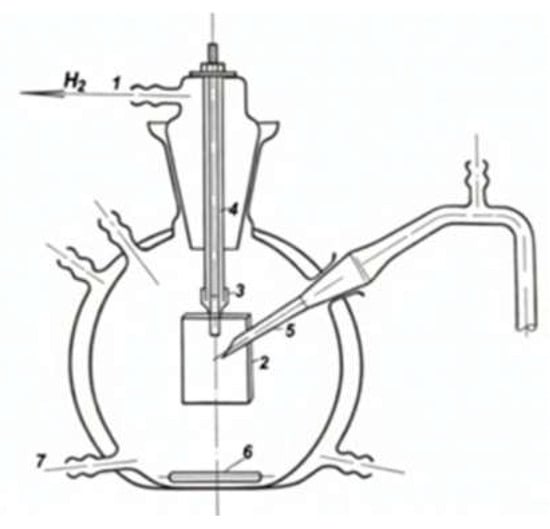
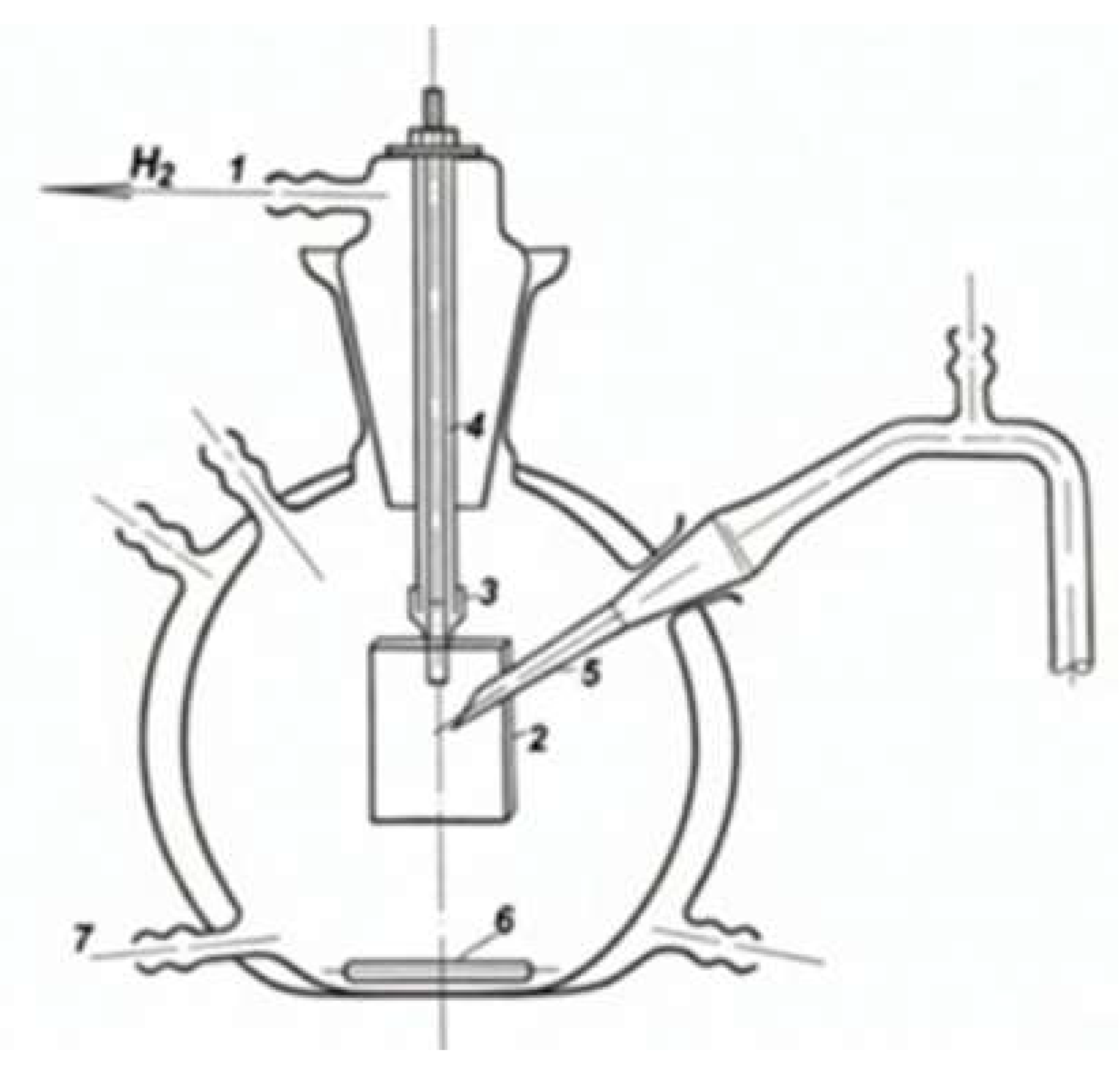
Alloys with defined geometric dimensions (37 × 25 × 0.9 mm) were placed in an electrochemical cell (Figure 1) containing a fixed volume of water (350 mL). The reactor was equipped with a gas outlet for the removal of evolved hydrogen and a water jacket to maintain a constant temperature using a U-3 thermostat. Mixing of the water was carried out using a magnetic stirrer.
Figure 1.
Electrochemical cell. 1—hydrogen outlet, 2—aluminum sample, 3—Teflon sleeve, 4—steel rod, 5—Luggin capillary, 6—magnetic stirrer, 7—electrolyte sampling port.
The average hydrogen evolution rate was calculated based on the volume of hydrogen released per unit time, normalized to standard conditions and per unit surface area.
The gas volume was measured using a drum-type gasometer. The released hydrogen was converted to an equivalent volume of H2 under standard conditions (273 K. 1 atm) using the ideal gas equation.
To convert the measured gas volume to standard conditions, the following equation was used:
where
V = Vt ((P + B) × (273 + 20)/(101,325 × (273 + t)))
V—gas volume corrected to standard conditions (20 °C, 101,325 Pa), dm3;
t—temperature of the measured gas, °C;
Vt—gas volume measured by the gas meter at temperature t and pressure P, dm3;
P—pressure of the gas entering the meter, Pa;
B—atmospheric pressure, Pa.
The hydrogen yield was evaluated using the ratio:
where V—the measured volume of hydrogen generated during the reaction, L;
YH2 = V/V0
V0—the theoretical (stoichiometric) hydrogen yield, calculated as 1.244 L per gram of Al under standard conditions (20 °C, 101,325 Pa).
2.4. Statistical Analysis
All experimental measurements were performed in triplicate (n = 3) to ensure reproducibility and reliability of the results. Experimental data are presented as mean values with the corresponding standard deviation (mean ± SD). Differences were considered statistically significant at a significance level of p < 0.05.
Alloy compositions were selected according to the specific objectives of each experimental series.
In experiments studying temperature dependence, alloys containing 6 wt.% Ga were used. This composition provided stable activation and sufficiently reproducible hydrogen evolution within the investigated temperature range.
In experiments examining the influence of different electrolytes/salts, alloys containing 3 wt.% Ga were used in order to minimize the contribution of the alloy activation effect and to more accurately identify the influence of electrolyte composition.
To determine the optimal Ga content in the alloy required for activation, a dedicated series of alloys containing (1–5) wt.% Ga was specially developed.
To study the synergistic effect of additional low-melting activating metals at various temperatures and electrolyte compositions, multicomponent alloys were investigated (wt.%): (5–9)Ga(5–9)Sn, 4Ga4In, 3Ga3In, (6–9)Ga(6–9)Zn, 3Ga3In3Sn.
3. Results
3.1. Study of the Kinetics and Mechanism of Interaction of the Aluminum–Gallium Binary System with Water
As noted above, aluminum in its pure state does not react with water due to the formation of a dense oxide film. In order to select active compositions of aluminum alloys, the phase diagrams of binary systems—aluminum–gallium, gallium–tin, and aluminum–tin—were analyzed. These phase diagrams belong to the eutectic type [3]. Above the liquidus line, the alloy exists entirely in the liquid state, while below this line, the formation of the first solid-phase crystals from the melt begins.
According to corrosion theory, alloys and metals with heterogeneous surfaces exhibit the greatest tendency toward self-dissolution. A particularly high degree of surface heterogeneity arises when the metal contains foreign inclusions [20,21,22,23,24]. In such cases, regions with physical and chemical properties different from those of the base metal form on the surface. These inclusions may also have a very low hydrogen evolution overpotential.
Analysis of the phase diagram of the aluminum–gallium binary system shows that it is possible to obtain alloys with a heterogeneous surface. Alloys in the α-phase can exhibit a homogeneous surface; however, this requires prolonged annealing and slow cooling. In contrast, alloys corresponding to the two-phase region (L + α) are characterized by surface heterogeneity, leading to the formation of numerous microscopic galvanic cells. Therefore, the highest activity is expected for alloys with compositions within the two-phase equilibrium region (L + α).
To obtain active aluminum–gallium alloys with a heterogeneous structure and a large number of galvanic microelements at relatively low gallium content, thorough mixing during alloy preparation is required. Rapid cooling of the melt from 800–700 °C to 400–100 °C promotes the formation of highly active alloys containing 5–10 wt.% Ga.
Experimental results confirm that increasing gallium content (from 5 to 9 wt.%) at 25 °C leads to a significant increase in hydrogen evolution. The total hydrogen volume increases from 950 to 9100 L/m2 (approximately 9.6 times), while the hydrogen evolution rate rises from 160 to 1250 L/m2·min (about 7.8 times). The most intensive hydrogen evolution occurs during the initial minutes of the reaction, followed by a decline.
The decrease in hydrogen evolution rate is associated with the formation of a loose precipitate of Al(OH)3, which spreads throughout the volume and covers the alloy surface, limiting water access. Upon dehydration, aluminum hydroxide transforms into an oxide film (Al2O3), resulting in surface passivation of the alloy [1,4,5,6].
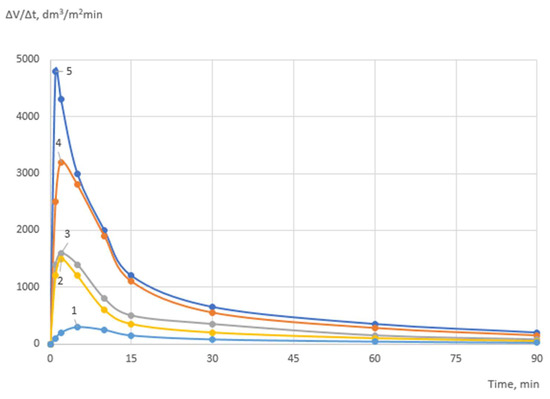
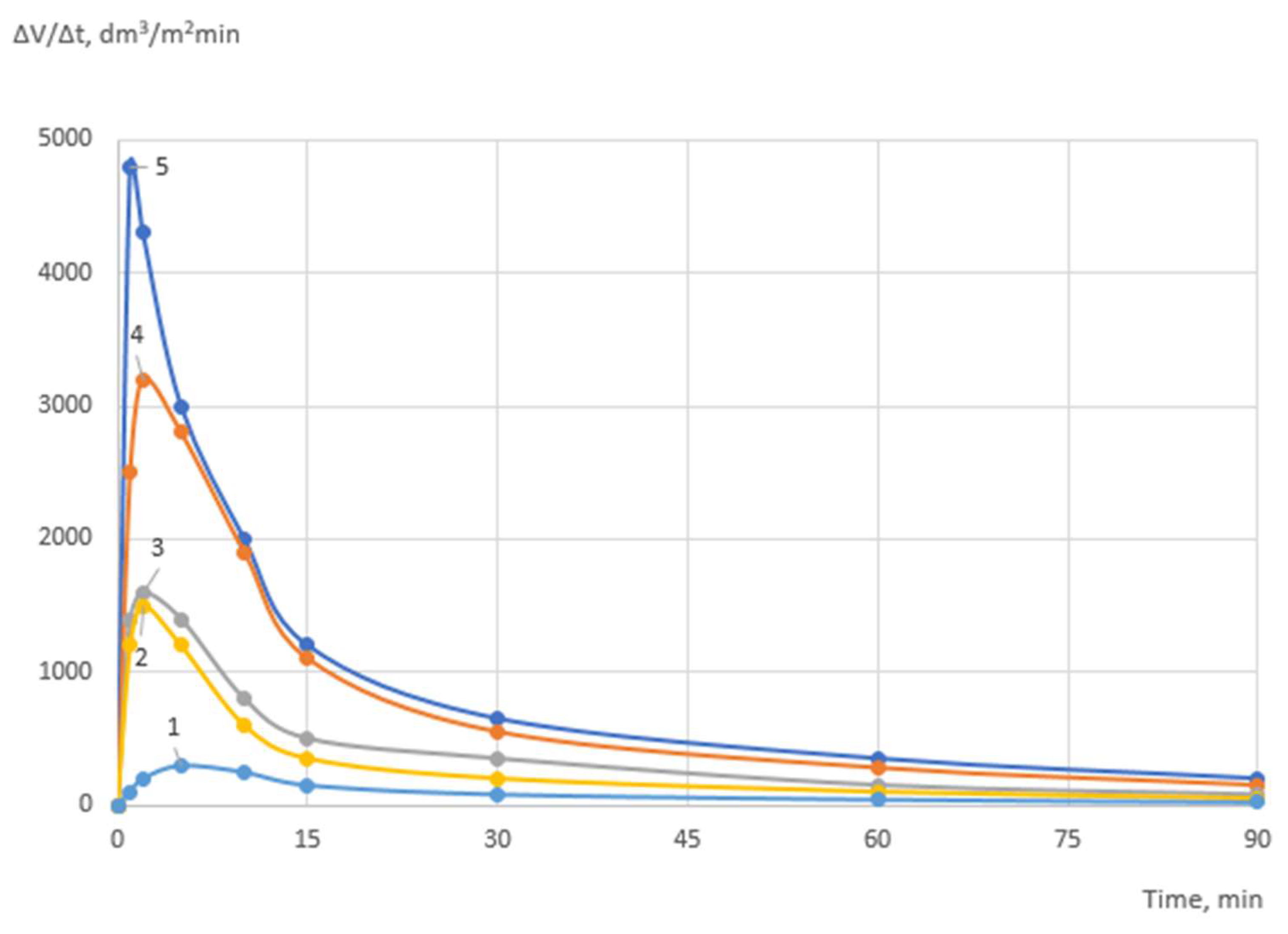
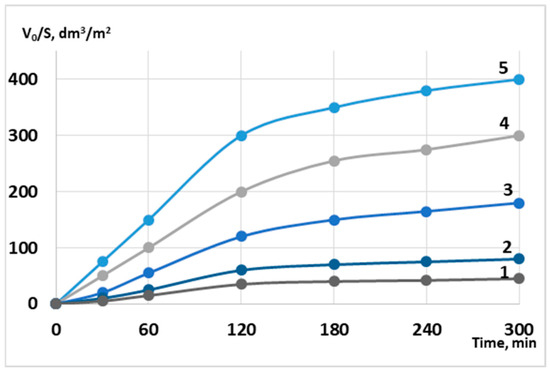
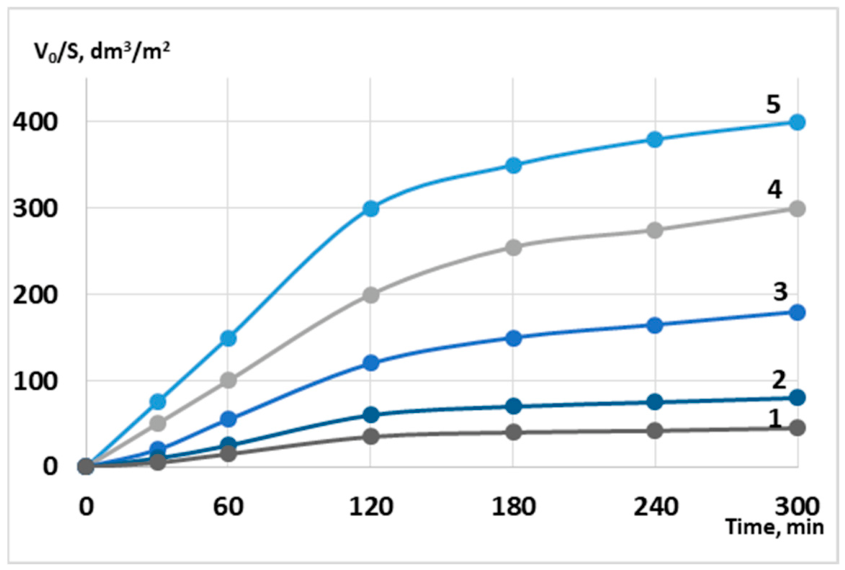
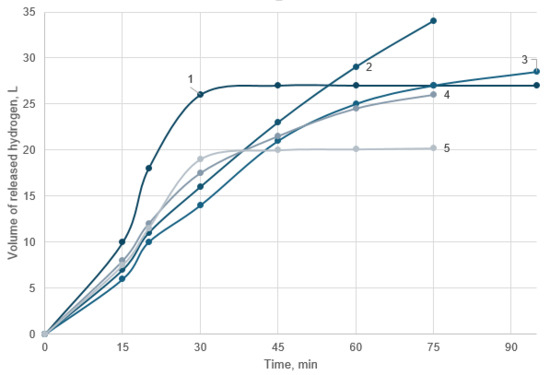
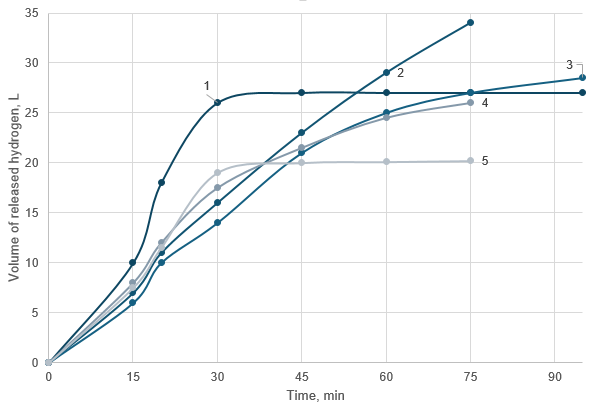
Temperature has a significant effect on the hydrogen evolution rate. For the binary alloy 6% Ga–94% Al, the maximum hydrogen evolution rate at 25 °C reaches 300 L/m2·min, while at 90 °C it increases to 4700 L/m2·min, i.e., the rate rises sharply with increasing temperature (Figure 2). When the temperature increases from 25 °C to 90 °C, the hydrogen evolution rate increases by a factor of 15.7.
Figure 2.
Dependence of the hydrogen evolution rate on temperature during the dissolution of the binary alloy 6% Ga–94% Al in water. 1—25, 2—40, 3—70, 4—85, 5—90 (°C).
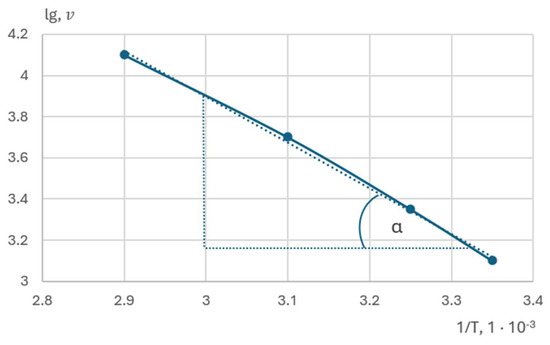
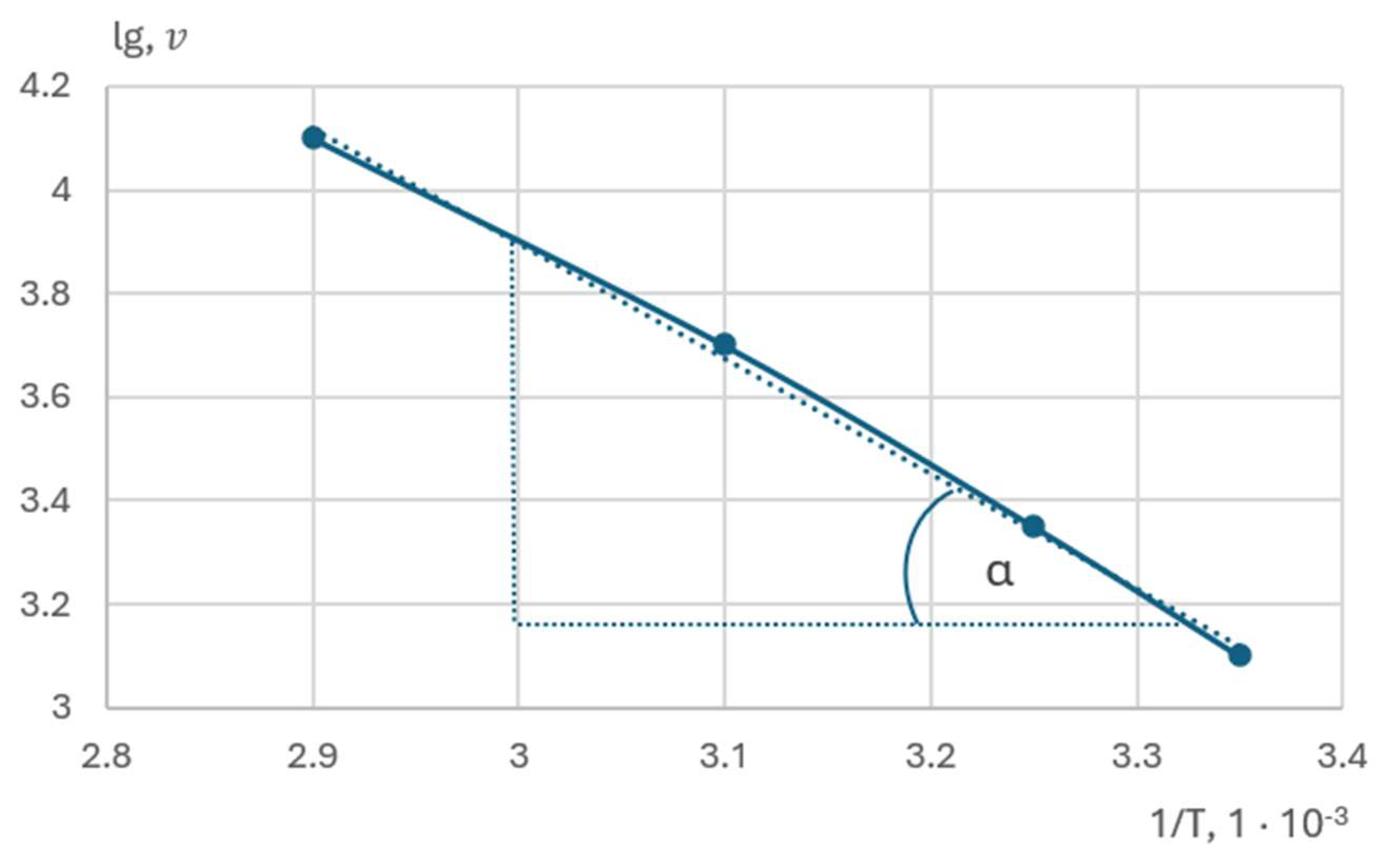
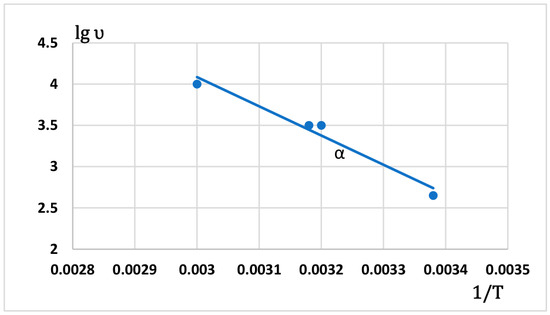
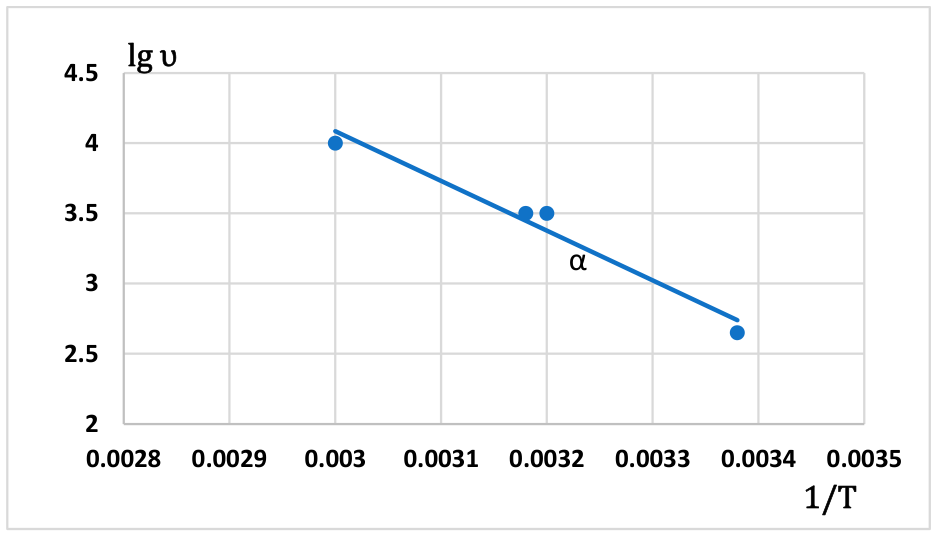
With increasing temperature, the total amount of evolved hydrogen also increases. At 25 °C, the alloy containing 6% Ga produces 2050 L/m2 of hydrogen, whereas at 90 °C the hydrogen volume reaches 26,540 L/m2, i.e., 8.4 times higher. The activation energy of the reaction was determined from the temperature dependence of the logarithm of the hydrogen evolution rate (Figure 3).
Figure 3.
Dependence of the logarithm of the hydrogen evolution rate on reciprocal temperature during the dissolution of the binary alloy 6% Ga–94% Al in water. Ea = 9.14 ± 0.1 kcal/mol.
The activation energy for the alloy containing 6% Ga is 9.14 kcal/mol.
Of particular interest is the effect of various additives—salts (NaCl, NaBr, Na2CO3, NaNO3)—on the hydrogen evolution rate from water using aluminum–gallium alloys. The dissolution of the binary alloy 3% Ga–97% Al at 25 °C was studied in 1 M electrolyte solutions of NaCl, NaBr, Na2CO3, and NaNO3 (Figure 4).
Figure 4.
Effect of electrolyte nature on hydrogen yield during the dissolution of the binary alloy 3% Ga–97% Al at 25 °C. 1—NaNO3, 2—NaCO3, 3—NaBr, 4—NaCI, 5—H2O.
Analysis of Figure 5 shows that introducing the aluminum–gallium alloy into various electrolytes results in a decrease in the amount of evolved hydrogen compared to pure water (Figure 5, curve 5), in the following order:
H2O > NaCl > NaBr > Na2 CO3 > NaNO3.
Figure 5.
Dependence of hydrogen yield on electrolyte concentration during the dissolution of the binary alloy 5% Ga–95% Al at 25 °C. 1—5 M NaCl, 2—1 M NaCl, 3—H2O.
The observed decrease in the alloy dissolution rate in these electrolytes is likely due to differences in the adsorption behavior of Cl−, Br−, CO32−, and NO3− ions. It is known that the hydrogen evolution overpotential depends on the adsorption ability of halide anions on the electrode surface [24]. To determine whether a given anion is adsorbed on a metal surface, the potential of zero charge (PZC) must be considered. According to [18], the PZC of aluminum in aqueous solutions is −0.685 V versus the normal hydrogen electrode (NHE).
The stationary potential of aluminum in the studied solutions is −1.3 to −1.6 V (vs. NHE) [5], which reflects its high electrochemical activity and the formation of a passive oxide film on the surface. Therefore, the aluminum surface under these conditions is negatively charged, and anions from the solution are not expected to adsorb on it or significantly affect the corrosion process.
In contrast, the potentials of zero charge for gallium, zinc, tin, and indium are −0.69, −0.70, −0.38, and −0.65 V (vs. NHE), respectively [24]. Their stationary potentials are considerably more positive, indicating that the cathodic regions of the alloy surface are positively charged. This is also consistent with the standard electrode potentials of gallium (−0.529 V), indium (−0.370 V), and tin (−0.136 V) vs. NHE.
Under these conditions, anions are adsorbed on positively charged cathodic sites, blocking them and hindering the access of water, thereby reducing the rate of the coupled electrochemical reaction, namely aluminum ionization.
The effect of electrolyte concentration on the dissolution rate of the aluminum–gallium alloy 5% Ga–95% Al was investigated (Figure 5). The amount of evolved hydrogen decreases sharply with increasing NaCl concentration (Figure 6). When water is used as the solvent, the calculated hydrogen evolution rate is 10 L/m2·min; in 1 M NaCl, it decreases to 3.5 L/m2·min, and in 5 M NaCl to 1 L/m2·min.
Figure 6.
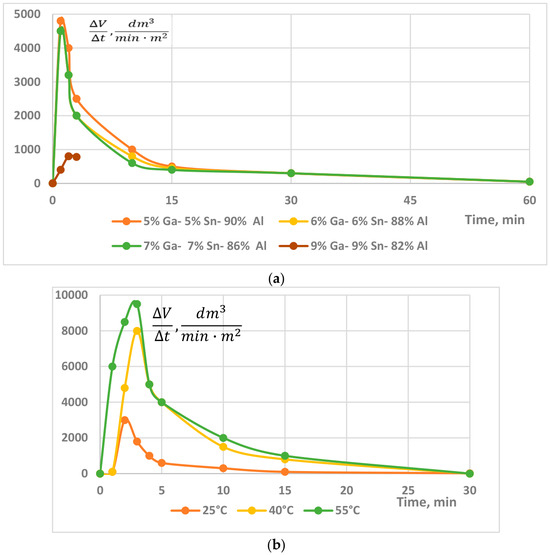
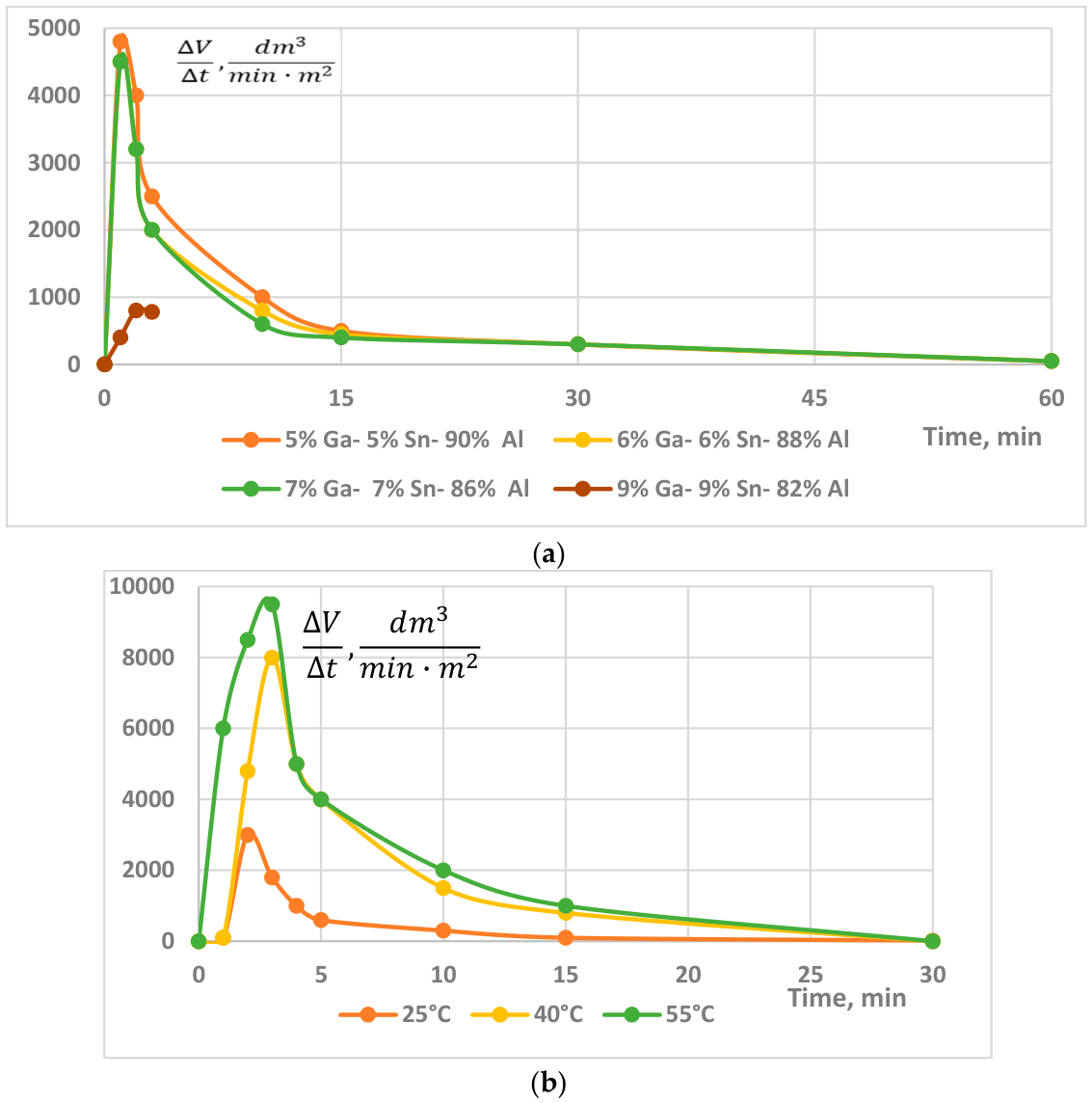
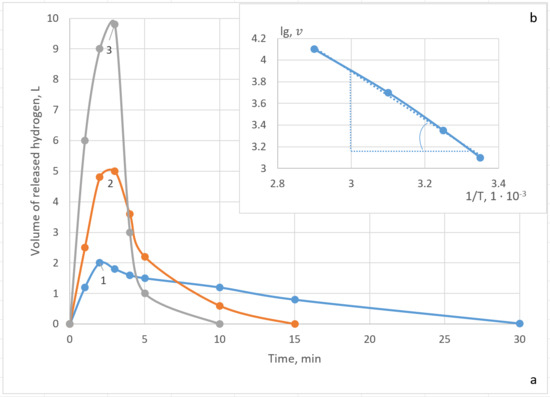
(a) Dependence of the rate of hydrogen release upon dissolution of the alloy Al in water depends on the percentage of the injected metal. (b). The dependence of the rate of hydrogen release upon dissolution of the 9% Ga–9% Sn–82% alloy in water depends on the temperature.
The dissolution of the aluminum–gallium alloy 3% Ga–97% Al in 1 M NaCl is strongly influenced by temperature. As in pure water, an increase in temperature leads to an increase in the hydrogen evolution rate. At 25 °C, the hydrogen evolution rate is 3.5 L/m2·min, while at 70 °C it reaches 13 L/m2·min, i.e., the rate increases by a factor of 3.7. The activation energy (Ea), calculated from the plot of the logarithm of the rate versus reciprocal temperature, is 6.9 ± 0.1 kcal/mol.
The effect of gallium content in the Al–Ga system in 1 M NaCl shows that increasing Ga concentration from 1 to 5 wt.% leads to an increase in the amount of hydrogen evolved over 1 h from 300 to 675 L/m2 (approximately twofold), while the hydrogen evolution rate increases from 3.2 to 6.0 L/m2·min. However, the formation of aluminum hydroxide on the alloy surface significantly inhibits the hydrogen evolution rate.
The dissolution mechanism of many metals includes the formation of an oxide film on the surface. During dissolution, the passive film forms and dissolves simultaneously. If the rate of film formation exceeds the rate of its dissolution, deep passivation of the metal may occur [23]. For alloys containing 1–3 wt.% Ga, electrode passivation occurs within 20–30 min, whereas for alloys with 4–9 wt.% Ga, passivation is observed after 4–5 h.
Thus, increasing the gallium content from 1 to 5 wt.% shifts the equilibrium potential to more negative values (from −1.41 to −1.55 V) and, consequently, increases the hydrogen evolution rate.
3.2. Study of the Kinetics of the Interaction of Gallium- and Tin-Activated Aluminum with Water
In the binary systems aluminum–tin, tin–gallium, and aluminum–gallium, only the latter exhibits the formation of a narrow α-phase of solid solutions. Therefore, in the ternary aluminum–tin–gallium system, no significant increase in solid-state solubility is expected. However, this system is likely to exhibit increased surface heterogeneity and, consequently, a higher number of microgalvanic elements per unit surface area.
It should be noted that tin has a more electropositive potential (−0.13 V) compared to aluminum (−1.66 V) and gallium (−0.529 V). The hydrogen evolution overpotential on tin is relatively high and equals 0.68 V at a current density of 0.1 mA/cm2, and 1.20 V at 1 A/cm2 [5,7]. Therefore, for the aluminum–tin–gallium alloy, the rate of interaction with water depends on the balance between hydrogen evolution kinetics and the degree of surface heterogeneity (i.e., the number and electromotive force of microgalvanic elements).
Experimental results confirm that increasing the content of gallium and tin in the Al–Ga–Sn alloy leads to a significant increase in the hydrogen evolution rate during interaction with water (Figure 6a,b) For an alloy containing 5% Ga and 5% Sn the maximum hydrogen evolution rate reaches 625 L/m2·min (Figure 6a), whereas for the binary Al–Ga alloy with 5% Ga, the maximum rate is 160 L/m2·min (Figure 2). Thus, the introduction of a third component (5% Sn) increases the hydrogen evolution rate by a factor of 3.2.
The total amount of evolved hydrogen also increases significantly. For the ternary alloy, the total hydrogen volume released within 5 min reaches 1700 L/m2, whereas for the binary aluminum–gallium alloy it is only 160 L/m2. Increasing the content of gallium and tin in the ternary alloy (from 5% to 9%, Ga:Sn = 1:1) results in a 9-fold increase in hydrogen yield. The maximum hydrogen volume, corresponding to the alloy composition 9% Ga–9% Sn–82% Al at 25 °C, reaches 20,000 L/m2.
During the dissolution of the ternary alloy 9% Ga–9% Sn–82% Al at temperatures of 25, 40, and 55 °C, both the hydrogen evolution rate (3000, 8000, and 9600 L/m2·min, respectively) and the total hydrogen volume (over 2.5 min: 10,000, 16,000, and 24,500 L/m2, respectively) increase significantly. The activation energy calculated from the temperature dependence of lgV versus 1/T is 9.1 ± 0.1 kcal/mol.
Thus, the experimental results show that, as expected, the interaction rate of aluminum with water in the ternary Al–Sn–Ga system is significantly higher than that of the binary Al–Ga alloy. This increase is attributed to enhanced alloy heterogeneity and the corresponding increase in the number of microgalvanic elements.
3.3. Study of the Kinetics of the Interaction of Gallium- and Indium-Activated Aluminum with Water
The introduction of a third component—indium—into the aluminum–gallium system is expected to increase surface heterogeneity. In the binary aluminum–indium system, even in the liquid state, phase separation into two immiscible liquids occurs. This feature leads to an increase in the number of microgalvanic elements on the alloy surface and, consequently, to a higher dissolution rate of the aluminum–gallium–indium alloy in water.
In the aluminum–indium and gallium–indium binary systems, there is no formation of solid solutions on the sides rich in aluminum or gallium. Thus, the solubility of indium in Al–Ga alloys in the solid state is not expected to increase. On the contrary, indium contributes to the heterogeneity of the surface and the formation of microgalvanic cells in the Al–Ga–In system.
Indium has a significantly more electropositive standard electrode potential (−0.340 V) compared to aluminum (−1.662 V) and gallium (−0.529 V), as well as a relatively low hydrogen evolution overpotential (η ≈ 0.486 V at near-zero current density and 25 °C) [16]. Thus, indium-rich regions act as cathodic sites where hydrogen reduction occurs, while aluminum serves as anodic sites undergoing ionization with the formation of aluminum hydroxide.
Experimental results confirm that introducing indium into the Al–Ga system significantly increases the hydrogen evolution rate. For comparison, hydrogen evolution rates for Al–5% Ga, Al–5% Ga–5% Sn, and Al–5% Ga–5% In alloys are 160, 625, and 1373 L/m2·min, respectively. The total hydrogen evolved per hour increases accordingly from 250 to 2200 and 3700 L/m2. Thus, the Al–Ga–In ternary alloy demonstrates the highest efficiency.
Temperature also has a strong influence on the dissolution of the Ga–In–Al alloy (Figure 7). Increasing temperature from 25 to 55 °C leads to a significant increase in both the hydrogen evolution rate and total hydrogen volume. The rate rises from 1200 to 9500 L/m2·min (a 7.9-fold increase), while the total hydrogen evolved over 10 min for the alloy 4% Ga–4% In–92% Al increases from 12,500 to 24,900 and 30,000 L/m2 at 25, 40, and 55 °C, respectively.
Figure 7.
Dependence of the hydrogen evolution rate during the dissolution of the ternary alloy 4% Ga–4% In–92% Al in water: (a) on temperature and (b) logarithm of the hydrogen evolution rate versus reciprocal temperature. 1—30 °C, 2—50 °C, 3—60 °C.
The activation energy calculated graphically for this alloy is Ea = 11.4 ± 0.1 kcal/mol.
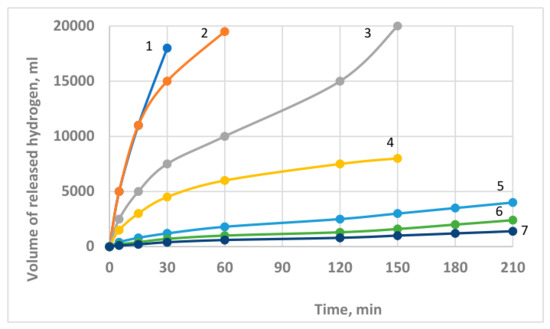
Various additives (1 M KI, NaCl, NaBr, Na2SO4, Na2CO3, KNO3) have a significant effect on the dissolution of aluminum in the alloy 3% Ga–3% In–94% Al (Figure 8).
Figure 8.
Dependence of the amount of evolved hydrogen during the dissolution of the ternary alloy 3% Ga–3% In–94% Al on the nature of the electrolyte at 25 °C. 1—1 N KI, 2—H2O, 3—1 N NaCl, 4—1 N NaBr, 5—1 N Na2SO4, 6—1 N Na2CO3, 7—1 N KNO3.
As shown, the addition of KI has the strongest effect on the dissolution of the Ga–In–Al alloy, where the hydrogen evolution rate is higher than in pure water. In contrast, the other additives reduce the hydrogen evolution rate at the same temperature (25 °C).
3.4. Study of the Kinetics of the Interaction of Gallium- and Zinc-Activated Aluminum with Water
As shown in Section 3.2 and Section 3.3, an increase in surface heterogeneity in ternary systems (Ga–In–Al and Ga–Sn–Al) leads to an increase in the aluminum dissolution rate. This effect is attributed to the formation of microscopic galvanic elements on the alloy surface, where aluminum acts as the anode and the more electropositive alloying components serve as cathodes. Aluminum ionization occurs at anodic sites, while hydrogen evolution takes place at cathodic sites.
Therefore, both the nature of the cathodic metal and its phase state (solid solution, eutectic, multiphase structure, etc.) significantly influence the rate of the coupled electrochemical reaction, since the hydrogen evolution overpotential depends on these factors. In this context, it is of interest to examine the effect of zinc and gallium additions on the dissolution rate of aluminum.
Analysis of the phase diagram of the ternary Al–Zn–Ga system, based on the binary systems Al–Zn, Zn–Ga, and Al–Ga [3], indicates that the solid solution region on the aluminum-rich side is relatively wide. Therefore, the introduction of a third component (e.g., Ga into Al–Zn or Zn into Al–Ga) results only in a moderate increase in surface heterogeneity.
At the same time, the hydrogen evolution overpotential of the cathodic metals must be considered. As shown earlier, the addition of tin (with a high hydrogen overpotential) to the Al–Ga system significantly increased the aluminum dissolution rate. In this case, the observed effect reflects a balance between the number of microgalvanic elements (determined by alloy heterogeneity) and the hydrogen evolution overpotential.
The hydrogen overpotential depends on current density. With a high density of microgalvanic elements on the surface, the effective overpotential decreases. For zinc, the hydrogen evolution overpotential is 1.24 V at a current density of 1 A/cm2, with a Tafel slope B = RT/nd ≈ 0.12 V. At a current density of 0.1 A/cm2, the overpotential decreases to approximately 0.72 V.
Additionally, during the dissolution of aluminum from the ternary alloy in water, the surface becomes enriched in zinc and gallium, which are mutually soluble. Therefore, the hydrogen evolution overpotential on Zn–Ga phases becomes an important factor in determining the overall reaction rate.
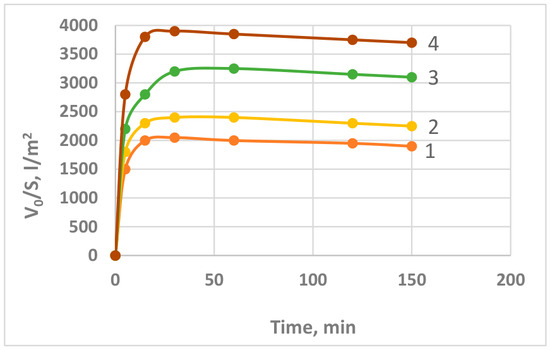
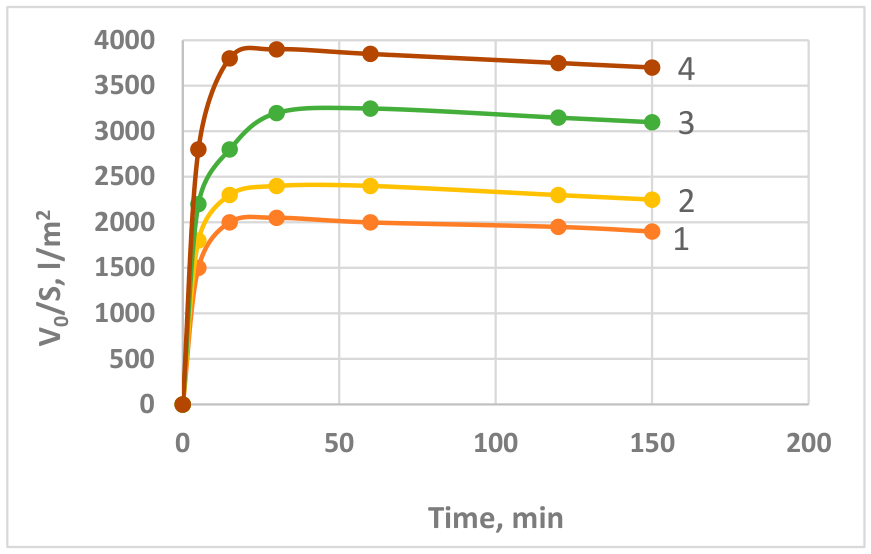
In the study of the Ga–Zn–Al ternary system with a Ga:Zn ratio of 1:1, it was found that increasing the concentration of gallium and zinc from 6% to 9% in the aluminum alloy enhances its dissolution in water, as evidenced by the increased hydrogen evolution (Figure 9).
Figure 9.
Dependence of the amount of evolved hydrogen on zinc content in the Ga–Zn–Al alloy at 25 °C. 1—6% Ga–6% Zn–88% AI; 2—7% Ga–7% Zn–86% AI; 3—8% Ga—8% Zn–84% AI; 4—9% Ga—9% Zn–82% AI.
For the alloy containing 6% Ga–6% Zn–88% Al, the total amount of evolved hydrogen over 10 min is 2100 L/m2, with a hydrogen evolution rate of 418 L/m2·min. For the alloy 9% Ga–9% Zn–82% Al, the hydrogen volume increases to 3850 L/m2 over 10 min, and the rate reaches 2500 L/m2·min.
Thus, the total hydrogen yield increases by a factor of 1.8, while the hydrogen evolution rate increases by approximately 6 times.
Compared with the binary Al–Ga alloy containing 7% Ga, the ternary alloy with zinc (7% Ga–7% Zn–86% Al) produces 2.1 times less hydrogen during dissolution in water. This is attributed to a decrease in surface heterogeneity and, consequently, a reduction in the number of microgalvanic elements.
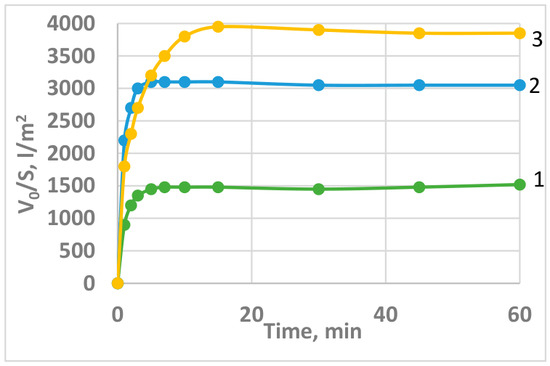
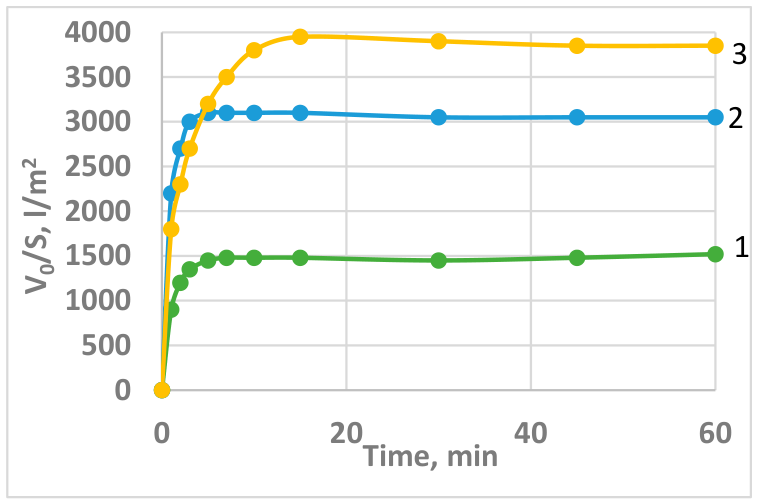
Temperature also has a significant effect on hydrogen evolution in the ternary alloy 7% Ga–7% Zn–86% Al. As shown in Figure 10, the total amount of evolved hydrogen decreases sharply with increasing temperature, and electrode passivation occurs earlier at higher temperatures. At 25 °C, 4000 L/m2 of hydrogen is evolved before passivation; at 55 °C, 3200 L/m2; and at 70 °C, 1520 L/m2.
Figure 10.
Dependence of the amount of evolved hydrogen on temperature during the dissolution of the alloy 7% Ga–7% Zn–86% Al in water. 1—70 °C, 2—55 °C, 3—25 °C.
Upon passivation, the hydrogen evolution rate decreases with increasing temperature. The rate is 2500 L/m2·min at 25 °C, 2250 L/m2·min at 55 °C, and 1500 L/m2·min at 70 °C.
The decrease in both the hydrogen evolution rate and the total amount of evolved hydrogen with increasing temperature under electrode passivation conditions is evidently related to the structural features of the aluminum–zinc–gallium alloy. As noted above, based on the phase behavior of the corresponding binary subsystems, a reduced degree of surface heterogeneity and a lower number of microgalvanic elements at the alloy–water interface can be expected.
From the temperature dependence of the logarithm of the hydrogen evolution rate versus reciprocal temperature, the effective activation energy was determined. In this case, it is negative and equal to −3.2 ± 0.1 kcal/mol.
3.5. Kinetics of the Interaction of Aluminum Activated by Gallium, Tin, and Indium with Water
The experimental results presented above show that increasing surface heterogeneity in ternary systems (Ga–In–Al and Ga–Sn–Al) leads to an increase in the aluminum dissolution rate due to the formation of microgalvanic elements. Therefore, the introduction of a fourth component into a ternary alloy is expected to further enhance surface heterogeneity.
Indeed, the dissolution of the quaternary Ga–In–Sn–Al alloy in water strongly depends on the content of the alloying metals (Ga, In, Sn), taken in a ratio of 1:1:1. For the alloy 1% Ga–1% In–1% Sn–97% Al at 25 °C, 20,400 L/m2 of hydrogen is evolved over 30 min, with a maximum rate of 1500 L/m2·min. For the alloy 3% Ga–3% In–3% Sn–91% Al, the hydrogen volume reaches 26,500 L/m2 with a rate of 1900 L/m2·min, while for the alloy 5% Ga–5% In–5% Sn–85% Al, 45,000 L/m2 of hydrogen is evolved with a rate of 3500 L/m2·min.
The degree of aluminum dissolution also increases with alloying content. For the alloy 1% Ga–1% In–1% Sn–97% Al, aluminum dissolution reaches 50% within 30 min; for 3% Ga–3% In–3% Sn–91% Al, it is 68%; and for 5% Ga–5% In–5% Sn–85% Al, complete dissolution (100%) is achieved within the same time.
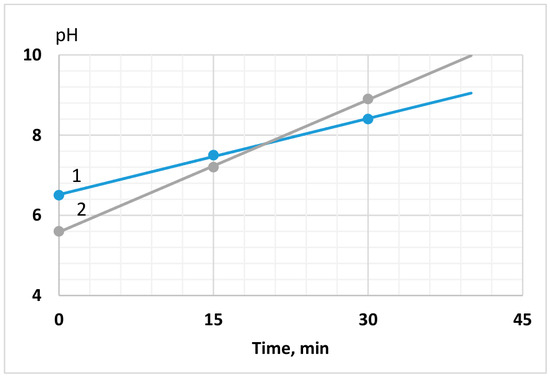
A significant change in the pH of the solution is also observed (Figure 11).
Figure 11.
Dependence of solution pH on time during the dissolution of the quaternary alloy. 1—alloy 3 % Ga–3 % In–3 % Sn–91 % Al; 2—alloy 5 % Ga–5 % In–5 % Sn–85 % Al.
For the quaternary alloy 3% Ga–3% In–3% Sn–91% Al, the solution pH increases from 5.6 to 8.9 within 30 min, while for the alloy 5% Ga–5% In–5% Sn–85% Al, it changes from 6.5 to 8.5. Temperature has a significant effect on the hydrogen evolution rate. For the alloy 3% Ga–3% In–3% Sn–91% Al, increasing the temperature from 25 to 55 °C leads to an increase in both the hydrogen volume and evolution rate.
At 25 °C, 6600 L/m2 of hydrogen is evolved within 5 min; at 40 °C, 29,000 L/m2; and at 55 °C, 33,000 L/m2. The corresponding hydrogen evolution rates are 2900, 6600, and 11,500 L/m2·min, respectively.
Thus, increasing the temperature from 25 to 55 °C significantly enhances the hydrogen evolution rate, resulting in more intensive aluminum dissolution. As shown in Figure 12, within 5 min at 25 °C, 20% of aluminum dissolves in the quaternary alloy 3% Ga–3% In–3% Sn–91% Al; at 40 °C, 94% dissolves; and at 55 °C, complete dissolution (100%) is achieved.
Figure 12.
Dependence of the dissolution degree of the quaternary alloy 3% Ga–3% In–3% Sn–91% Al in water on temperature. 1—25 °C, 2—40 °C, 3—55 °C.
The activation energy for this system, determined from the temperature dependence of the logarithm of the hydrogen evolution rate versus reciprocal temperature, is 15.5 kcal/mol (Figure 13).
Figure 13.
Dependence of the logarithm of the dissolution rate of the quaternary alloy 3% Ga–3% In–3% Sn–91% Al in water on reciprocal temperature, E = 15.5 kcal/mol.
The effect of various additives (1 M NaCl, NaBr, Na2CO3, NaNO3, Na2SO4) on the dissolution of the quaternary alloy 3% Ga–3% In–3% Sn–91% Al at 25 °C was investigated. It was found that the addition of any of these electrolytes leads to a decrease in the hydrogen evolution rate (Figure 14).
Figure 14.
Dependence of the amount of evolved hydrogen during the dissolution of the quaternary alloy 3% Ga–3% In–3% Sn–91% Al in water and various electrolytes at 25 °C. 1—H2O, 2—1 N KI, 3—1 N NaBr, 4—1 N NaCI, 5—1 N Na2SO4.
According to their effect, the additives can be arranged in the following order:
H2O > KI > NaBr > NaCl > Na2CO3 > NaNO3 > Na2SO4.
This behavior is likely related to the specific adsorption of anions [26,27,28,29].
3.6. Mechanism of Aluminum Activation by Gallium and Other Low-Melting Alloys (Al + Darcet Alloy (50% Bismuth + 25% Lead + 25% Tin), Al + Rose Alloy (46% Bismuth + 34% Tin + 20% Lead), Al + Wood’s Alloy (50% Bismuth + 24% Lead + 14% Tin + 12% Cadmium)) During Interaction with Water for Hydrogen Production
The structure and mechanical properties of binary and multicomponent alloys in eutectic and eutectoid regions, based on the use of surface-active elements that reduce surface energy and promote embrittlement, are described in [1,2]. It has been shown that the regions of eutectic segregation in both binary and multicomponent systems act as active centers of intergranular corrosion due to the contact of areas with different electrochemical potentials.
This is confirmed by the activation effect of low-melting eutectic alloys such as Wood’s, Rose’s, and Darcet alloys, which promote the segregation of eutectic phases along aluminum grain boundaries, refinement of the microstructure, and a more uniform distribution along grain boundaries.
X-ray phase analysis confirmed the eutectic nature of the studied multicomponent aluminum alloys. A characteristic feature of eutectic alloys was observed: the chemical composition at grain boundaries differs significantly from that in the grain interior, indicating intraphase nonequilibrium [1,2].
Table 1 presents comparative data on the hydrogen evolution rate during the interaction of activated aluminum with water as a function of temperature, nature, and concentration of activating metals in the alloy.
Table 1.
Hydrogen evolution rate during the interaction of activated aluminum with water as a function of temperature, type, and content of activating metals in the alloy.
3.7. Formal Kinetic Regularities of the Interaction of Aluminum-Based Alloys with Water
The reactivity of aluminum alloys toward water is largely determined by the preparation conditions. The highest activity is observed for alloys quenched in liquid nitrogen. The introduction of activating metals into aluminum, combined with rapid cooling, promotes the formation of a fine-grained structure and increases the number of microgalvanic elements. Processes that lead to grain refinement (such as quenching and increasing additive content) enhance reactivity.
The interaction of activated aluminum with water occurs at the metal surface, resulting in hydrogen evolution and the formation of a new phase—aluminum hydroxide. For a quantitative description of the reactivity of activated aluminum toward water, the Avrami–Erofeev equation was applied.
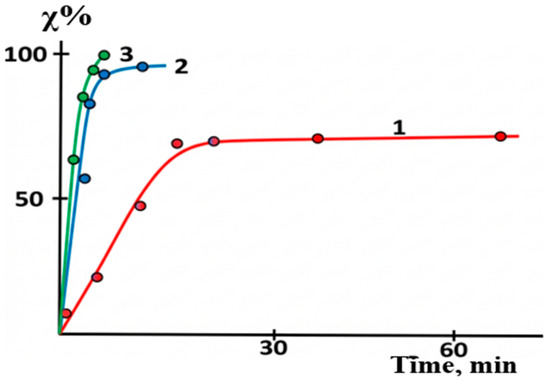
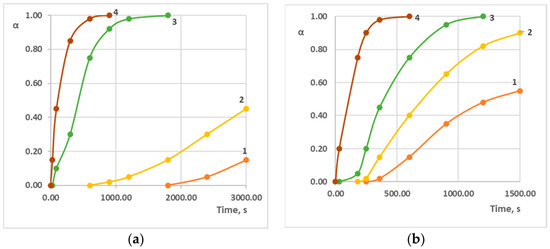
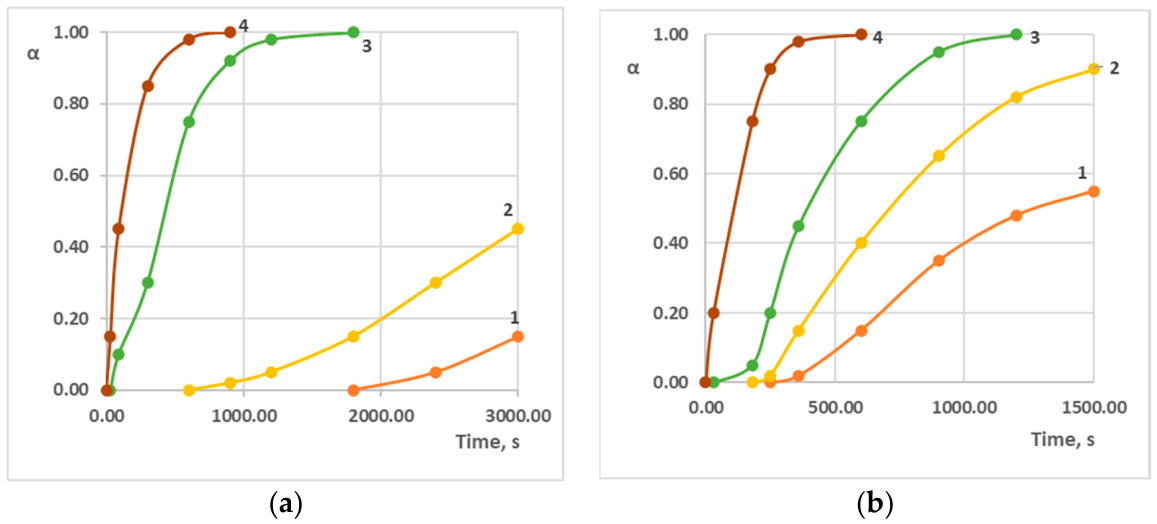
A typical form of kinetic curves for topochemical reactions is shown in Figure 15.
Figure 15.
Dependence of the degree of conversion (α) during the interaction of alloys with water on time: (a) 1—Al–Ga; 2—Al–Ga–Sn; 3—Al–Ga–In; 4—Al–Ga–In–Sn (5.0 wt.% activator metals); (b) Al–Ga–In–Sn alloy with activator content (wt.%): 1—0.5; 2—1.0; 3—3.0; 4—5.0.
The shape of the kinetic curves is determined by the nature of the processes involved in the reaction. The induction period, corresponding to the initial stage of system transformation, is 1800, 600, 90, and 30 s for Al–Ga, Al–Ga–Sn, Al–Ga–In, and Al–Ga–In–Sn alloys, respectively. Increasing the content of activating metals in the alloy leads to a reduction in the induction period. For the quaternary alloy Al–Ga–In–Sn with 0.5, 1.0, 3.0, and 5.0 wt.% of activators, the induction period is 360, 250, 180, and 30 s, respectively (Figure 15b).
The period of rapid increase in the hydrogen evolution rate is apparently associated with nucleation and growth of the reaction product within the reaction zone. This process involves the interaction of activated aluminum with water, followed by the formation of nuclei of aluminum hydroxide. Regions of complex eutectic segregation along grain boundaries act as nucleation centers for the new phase. After reaching a maximum, the reaction rate decreases as the growing aluminum hydroxide nuclei coalesce, forming a continuous layer that gradually penetrates into the reacting particles.
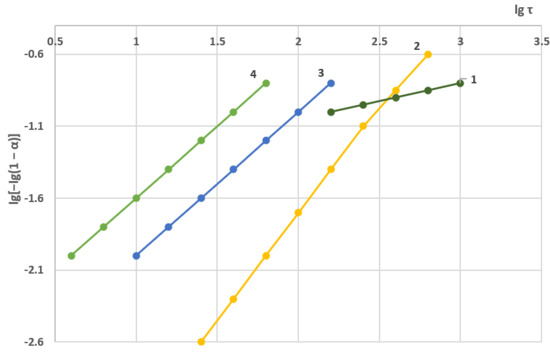
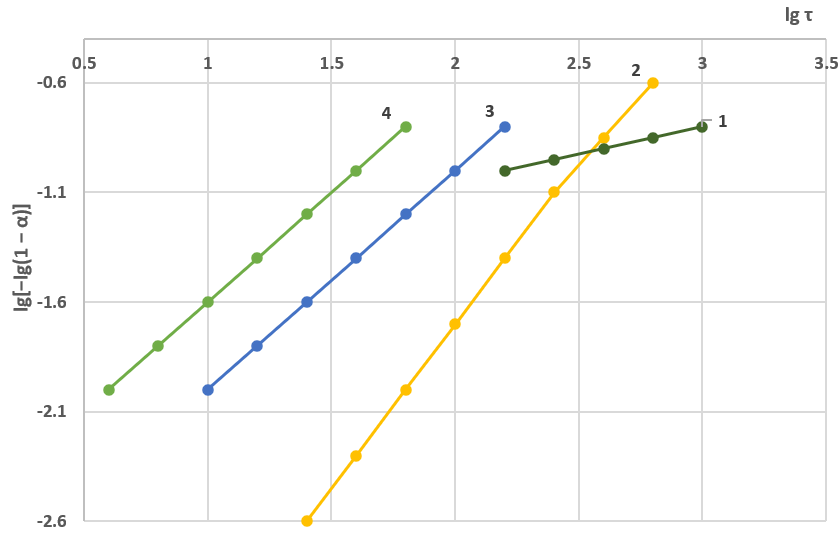
Figure 16 shows the dependence of lg[−lg(1 − α)] versus lg τ for aluminum alloys with different contents of gallium, indium, and tin, which exhibit a linear relationship.
Figure 16.
Dependence of lg[−lg(1 − α)] on lg τ at different contents of activating metals (wt.%): Ga, In, Sn: 1—0.5; 2—1.0; 3—3.0; 4—5.0.
The coefficient n, determined from the slope of the straight lines, is 1.27, 1.38, 1.72, and 2.07 for the respective alloys. Since n characterizes the reaction regime and the number of nuclei of the new phase, the process under these conditions occurs in the kinetic region. With increasing temperature (Table 2), the slope of the lines gradually decreases, and the coefficient n changes from 1.72 to 0.39, indicating a transition of the process from the kinetic to the diffusion-controlled regime.
Table 2.
Calculated values of the constants n and k for the alloy 91% Al–3.0% Ga–3.0% In–3.0% Sn at different reaction temperatures.
This transition occurs at different degrees of conversion and is likely associated with diffusion limitations in the transport of water to the aluminum surface through the layer of reaction products. In addition, depending on the nature and content of activating metals in the alloy, as well as temperature, reaction products with different properties are formed, leading to diffusion limitations manifesting at different degrees of conversion.
During the interaction of activated aluminum with water under the specified conditions, various modifications of aluminum hydroxide (boehmite, pseudoboehmite, bayerite) may form.
Figure 17 shows the dependence of the hydrogen evolution rate on ν (the nucleation density or concentration of nuclei at the initial moment) and on BS(i), a dimensionless parameter equal to one quarter of the average number of nuclei, calculated using the following equation:
where α is the initial radius of a spherical grain. As can be seen, the hydrogen evolution rate increases with decreasing grain size.
BS(i) = π × υ α2 (1.7)
Figure 17.
Dependence of the hydrogen evolution rate on ν (1) and BS(i) (2).
During the interaction of activated aluminum with various electrolytes, the hydrogen evolution rate decreases compared to pure water in the following order: H2O > NaCl > NaBr > Na2CO3 > NaNO3. Moreover, increasing salt concentration leads to a sharp decrease in the hydrogen evolution rate. This behavior is likely explained by the different adsorption abilities of anions (Cl−, Br−, I−, CO32−, NO3−, SO42−) on the aluminum surface, which inhibit one of the stages of the chemical or electrochemical oxidation of aluminum.
Thus, it has been established that the degree of conversion α is a function of the nature of activating metals, their concentration, temperature, preparation method, electrolyte type, and interaction time.
The addition of bismuth, cadmium, antimony, or components of eutectic alloys to the Al–Ga–In–Sn system further increases the reaction rate with water. The most pronounced effect is observed with the combined presence of cadmium and antimony, especially at elevated temperatures (Table 1). This is confirmed by the activation of aluminum using Wood’s, Rose’s, and Darcet alloys containing bismuth, tin, lead, and cadmium.
Thus, the reactivity of aluminum alloys toward protic solvents can be controlled by varying the type and concentration of additives, as well as temperature and heat treatment conditions.
It is shown that the mechanism and kinetics of the interaction of activated aluminum with water represent a complex process involving chemical, electrochemical, and accompanying topochemical reactions.
4. Conclusions
1. Binary alloy systems Al–Ga, Al–In, In–Ga, Al–Sn, Sn–Ga, Al–Zn, and Zn–Ga are characterized by eutectic-type phase diagrams, the absence of intermetallic compounds, and extremely limited solid solubility of components. These features make them suitable for aluminum activation and intensification of hydrogen generation processes.
Analysis of phase diagrams shows that binary alloys exhibit different degrees of surface heterogeneity. Only the Al–Ga system forms a narrow α-solid solution phase of gallium in aluminum and a wide two-phase region (L + α). The maximum solubility of gallium in aluminum at 28.4 °C is 9.5 wt.%. Surface heterogeneity leads to the formation of microscopic galvanic cells, where aluminum acts as the anode and more electropositive elements act as cathodes, resulting in an increased rate of aluminum interaction with water.
2. Ternary systems Al–In–Ga, Al–Zn–Ga, Al–Sn–Ga, and the quaternary system Al–In–Sn–Ga are characterized by extended liquid-phase regions at low temperatures, the absence of intermetallic compounds, and the formation of multicomponent eutectics. These features promote oxide film disruption, high mobility of the liquid phase, and increased reactivity of aluminum.
Phase diagram analysis indicates that these alloys exhibit a higher degree of surface heterogeneity. More electropositive components in binary, ternary, and quaternary alloys form various phase structures (solid solutions and multiphase equilibria such as α + L, α + β + L, α + β + γ + L).
The hydrogen evolution reaction occurs at cathodic sites, and its rate depends on hydrogen overpotential, which is governed by the nature of the metal, its surface state, and alloy composition. In particular, the addition of tin to the Al–Ga system, due to its high hydrogen overpotential, significantly increases the aluminum dissolution rate.
3. It was established that the hydrogen evolution overpotential generally increases with anion substitution in the following order:
I− < Br− < Cl− < SO42− < ClO3− < NO3− < PO43−.
The effect of anions on hydrogen overpotential is attributed to their adsorption on positively charged cathodic sites of microgalvanic elements. This adsorption blocks active sites, hinders water access, and thus reduces the rate of the coupled electrochemical reaction, namely aluminum ionization.
4. The Avrami–Erofeev equation was used for the quantitative description of the reactivity of activated aluminum toward water. The activation energy (Ea) was determined from the temperature dependence of the logarithm of the hydrogen evolution rate versus reciprocal temperature.
An increase in the fraction of In–Ga or In–Sn–Ga components leads to a decrease in activation energy. The following values were obtained: 9.1 kcal/mol for 82% Al–9% Ga–9% Sn, 11.4 kcal/mol for 92% Al–4% Ga–4% In, and 15.5 kcal/mol for 91% Al–3% Ga–3% In–3% Sn.
5. It was shown that the introduction of electropositive low-melting metals such as gallium, indium, and tin into aluminum increases the degree of aluminum utilization and enhances its reaction rate with water. During the reaction, only aluminum is consumed, while the activating metals (Ga, In, Sn) are not consumed and accumulate as liquid droplets at the bottom of the reactor.
Based on the phase behavior of the corresponding binary systems, the mutual solubility of gallium, indium, and tin is expected to increase in the ternary system, contributing to the stability and effectiveness of the activating phase.
The solubility of gallium, indium, and tin at the eutectic temperature (5 °C) is 62, 25, and 13 wt.%, respectively [15]. At higher temperatures, the solubility of these metals increases significantly, which facilitates their regeneration and reuse.
6. The reaction mechanism represents a complex process involving chemical, electrochemical, and topochemical stages and is described by the Avrami–Erofeev kinetic equation, which accounts for nucleation and growth of a new phase.
The presence of a stable liquid metallic phase, predicted by phase diagrams of ternary systems (Al–In–Ga, Al–Sn–Ga) and the quaternary system (Al–In–Sn–Ga), ensures continuous formation of active reaction centers and three-dimensional growth of the reaction zone. This justifies the applicability of the Avrami–Erofeev model with an exponent n ≈ 1.27–2.07 and elevated effective rate constants.
The kinetics of the process are often limited by diffusion through the reaction products, while the overall reaction rate strongly depends on temperature and alloy composition.
Thus, the interaction kinetics are governed by a transition from oxide film breakdown to diffusion-controlled transport through the product layer, with significant acceleration observed upon alloy activation.
Author Contributions
Conceptualization, R.S., G.B. and U.K.; methodology, R.S., G.B. and N.L.; software, R.S. and G.B.; formal analysis, Y.P.; investigation, R.S., N.L. and Y.P.; resources, G.B. and B.K.; data curation, G.B., N.L., Y.P. and A.K.; writing—original draft preparation, R.S.; writing—review and editing, G.B., R.S. and N.L.; visualization, R.S. and Y.P.; supervision, G.B.; project administration, G.B. and A.K.; funding acquisition, G.B., B.K. and R.S. All authors have read and agreed to the published version of the manuscript.
Funding
This research was funded by the Committee of Science of the Ministry of Science and Higher Education of the Republic of Kazakhstan (Grant No. BR24992868).
Data Availability Statement
The original data pertaining to this study are included in the article. Further inquiries can be directed to the corresponding author.
Conflicts of Interest
Authors Raushan Sarmurzina, Galina Boiko, Nina Lyubchenko, and Bagdaulet Kenzhaliyev were employed by the company Institute of Metallurgy and Ore Benefication JSC. Author Askhat Khasenov was employed by the company Joint Stock Company “National Company “KazMunayGas”. The remaining authors declare that the research was conducted in the absence of any commercial or financial relationships that could be construed as a potential conflict of interest. The authors declare that this study received funding from the Committee of Science of the Ministry of Science and Higher Education of the Republic of Kazakhstan (Grant No. BR24992868). The funder was not involved in the design of the study; the collection, analysis, or interpretation of data; the writing of the article; or the decision to submit it for publication.
References
- Boiko, G.; Sarmurzina, R.; Lyubchenko, N.; Kenzhaliyev, B.; Makhanov, A.; Pulatov, Y.; Malbagarov, A.; Boiko, Y.; Panova, Y. Activated Aluminum Alloys as an Alternative to Technological Solutions for Increasing Well Productivity. Processes 2026, 14, 448. [Google Scholar] [CrossRef] [Scilit]
- Sarmurzina, R.G.; Presnyakov, A.A.; Morozova, O.I.; Mofa, N.N. Physics of Metals and Metallography. Fiz. Met. I Metalloved. 1988, 66, 504–508. [Google Scholar]
- Lyakishev, N.P. (Ed.) Phase Diagrams of Binary Metallic Systems: Handbook; Mashinostroenie: Moscow, Russia, 1996–2000; Volume 1, 992p.; Volume 2, 1024p.; Volume 3, 872p. Available online: https://lib-bkm.ru/12245 (accessed on 16 June 2026).
- Alexandrov, V.D.; Zozulya, A.P.; Frolova, S.A. Construction of a nonequilibrium diagram of the gallium–tin system and its analysis. Izv. vuzov. Non-Ferr. Metall. 2019, 39–47. [Google Scholar] [CrossRef]
- Yang, Y.; Guo, S.-K.; Yu, Q. A Review of Applications of Surface-Modified Aluminum in Hydrogen Generation and Water Treatment. Water 2025, 14, 83–88. [Google Scholar] [CrossRef]
- Sheindlin, A.E.; Zhuk, A.Z. The concept of aluminum–hydrogen energy. Russ. Chem. J. 2006, 50, 105–108. [Google Scholar]
- Perumal, A.; Elumalai, V.; Perumalsamy, M.; Sathyaseelan, A.; Sivasankaran, R.P.; Madhu, D.K.; Kim, S.J. Complexation chemistry as a corrosion control of aluminum anode in neutral aluminum-based electrochemical energy systems. Energy Storage Mater. 2025, 81, 104540. [Google Scholar] [CrossRef] [Scilit]
- Musicco, N.; Gelfia, M.; Iora, P.; Venturelli, M.; Artioli, N.Y.; Montorsib, L.; Milani, M. A review of hydrogen generation methods via aluminum–water reactions. Int. J. Thermofluids 2025, 27, 101152. [Google Scholar] [CrossRef] [Scilit]
- Liu, D.; An, Q.; Wei, C. Experimental Study on Zn-Doped Al-Rich Alloys for Fast on-Board Hydrogen Production. Crystals 2020, 10, 167. [Google Scholar] [CrossRef] [Scilit]
- Kumar, D.; Muthukumar, K. An overview on activation of aluminium-water reaction for enhanced hydrogen production. J. Alloys Compd. 2020, 835, 155189. [Google Scholar] [CrossRef] [Scilit]
- Elyas, M.; Ashour, F.; Gadalla, M.; Khalil, N.A.; Deyab, M.A. Hydrogen evolution using aluminum alloys and saline waste water. Chem. Eng. Trans. 2025, 119, 37–42. [Google Scholar] [CrossRef]
- Amelia, I.; Rohendi, D.; Rachmat, A.; Syarif, N.; Yulianti, D.H.; Sya’Baniah, N.F.; Adhiyanti, N.; Adelia, O.; Normah, N. Hydrogen Production from Aluminum Waste Using the Aluminum–Water Method with Potassium as Activator Indonesian. J. Fundam. Appl. Chem. 2024, 9, 111–116. [Google Scholar] [CrossRef] [Scilit]
- Kader, M.S.; Zeng, W.; Johnston, E.; Jelliss, P.A. A Novel Method for Generating H2 by Activation of the μAl–Water System Using Aluminum Nanoparticles. Appl. Sci. 2022, 12, 5378. [Google Scholar] [CrossRef] [Scilit]
- Yang, S.; Zheng, D.; Chang, S.; Shi, C. Zero Valent Aluminum Based Oxidation/Reduction Technology Applied in Water Treatment. Prog. Chem. 2016, 28, 754–762. [Google Scholar] [CrossRef]
- Bagotsky, V.S. Fundamentals of Electrochemistry; John Wiley & Sons: Hoboken, NJ, USA, 2005; p. P722. [Google Scholar] [CrossRef] [Scilit]
- Leung, K. First Principles Determination of the Potential-of-Zero-Charge in an Alumina-Coated Aluminum/Water Interface Model for Corrosion Applications Kevin Leung. J. Electrochem. Soc. 2022, 169, 081502. [Google Scholar] [CrossRef] [Scilit]
- Yu, L.; Ning, M.; Wang, Y.; Yuan, C.; Ren, Z. Direct seawater electrolysis for hydrogen production. Nat. Rev. Mater. 2025, 10, 857–873. [Google Scholar] [CrossRef] [Scilit]
- Ren, J.; Chen, L.; Wang, H.; Tian, W.-W.; Yuan, Z.-Y. Water electrolysis for hydrogen production: From hybrid systems to self-powered/catalyzed devices. Energy Environ. Sci. 2024, 17, 49–113. [Google Scholar] [CrossRef] [Scilit]
- Li, J.; Ma, Y.; Mu, X.; Wang, X.; Li, Y.; Ma, H.; Guo, Z. Recent Advances and Perspectives on Coupled Water Electrolysis for Energy-Saving Hydrogen Production. Adv. Sci. 2025, 12, e2411964. [Google Scholar] [CrossRef] [Scilit] [PubMed]
- Senel, E.; Nisancioglu, K. Effect of small concentrations of gallium and lead on anodic activation of aluminium in chloride solution. Corros. Sci. 2018, 131, 330–339. [Google Scholar] [CrossRef] [Scilit]
- Gudić, S.; Radošević, J.; Smoljko, I.; Kliškić, M. Cathodic breakdown of anodic oxide film on Al and Al–Sn alloys in NaCl solution. Electrochim Acta 2005, 50, 5624–5632. [Google Scholar] [CrossRef] [Scilit]
- Xiong, H.; Yin, X.; Yan, Y.; Dai, Y.; Fan, S.; Qiao, X.; Yu, K. Corrosion and discharge behaviors of Al–Mg–Sn–Ga–In in different solutions. J. Mater. Eng. Perform. 2016, 25, 3456–3464. [Google Scholar] [CrossRef] [Scilit]
- Li, J.; Zhang, B.; Wei, Q.; Wang, N.; Hou, B. Effect of Indium on the Negative Difference Effect for Magnesium Alloy. J. Electrochem. Soc. 2021, 168, 031515. [Google Scholar] [CrossRef] [Scilit]
- Nashim, A.; Mohanty, R.; Ray, P.K.; Parida, K.M. Gallium-based nascent electrode materials towards promising supercapacitor applications: A review. RSC Adv. 2023, 13, 24536–24553. [Google Scholar] [CrossRef] [Scilit] [PubMed]
- ISO 752:2004 ZN-2; Zinc Ingots. International Organization for Standardization: Geneva, Switzerland, 2004.
- Guo, L.; Ou, Y.; Shen, X.; Kaya, S.; Shi, W.; Zhang, R.; Zheng, X.; Wang, J. Specific Adsorption of Halide Ions on Iron Surface: A Combined Electrochemical and Monte Carlo Simulation Investigation. Int. J. Electrochem. Sci. 2017, 12, 7064–7074. [Google Scholar] [CrossRef] [Scilit]
- Alom, S.; Kananke-Gamage, C.C.; Ramezanipour, F. Perovskite Oxides as Electrocatalysts for Hydrogen Evolution Reaction. ACS Omega 2022, 7, 7444–7451. [Google Scholar] [CrossRef] [Scilit] [PubMed]
- Lamy-Pitara, E.; El Mouahid, S.; Barbier, J. Effect of anions on catalytic and electrocatalytic hydrogenations and on the electrocatalytic oxidation and evolution of hydrogen on platinum. Electrochim. Acta 2000, 45, 4299–4308. [Google Scholar] [CrossRef] [Scilit]
- Wu, J.; Kang, Z.; Zhang, X. Recent progress in alkaline electrocatalytic hydrogen oxidation reaction: Mechanisms, catalysts design and perspectives. Coord. Chem. Rev. 2025, 528, 216427. [Google Scholar] [CrossRef] [Scilit]

Disclaimer/Publisher’s Note: The statements, opinions and data contained in all publications are solely those of the individual author(s) and contributor(s) and not of MDPI and/or the editor(s). MDPI and/or the editor(s) disclaim responsibility for any injury to people or property resulting from any ideas, methods, instructions or products referred to in the content. |
© 2026 by the authors. Licensee MDPI, Basel, Switzerland. This article is an open access article distributed under the terms and conditions of the Creative Commons Attribution (CC BY) license.