You are currently viewing a new version of our website. To view the old version click .

Risks, Volume 5, Issue 3

September 2017 - 19 articles

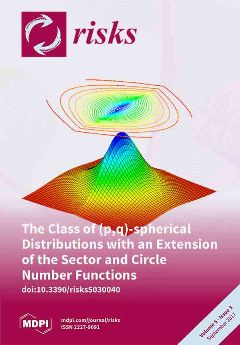
Cover Story: The new class of (p,q)-spherical distributions allows modeling heavy and light tails data from various applied areas. The density level lines above the density hill of such a distribution may drastically change their main orientation when switching from the distribution's center to its tails. The adequate mathematical description of such distributions deals with new types of generalized uniform distributions, radius functionals and stochastic representations, generalized circle numbers of non-Euclidean circles, and a corresponding new geometric disintegration method. Due to a suitable coordinate system, the evaluation of probabilities of arbitrary events becomes tractable, also for the Gauss-exponential distribution appearing in high risk limit scenarios. View the paper
  • Issues are regarded as officially published after their release is announced to the table of contents alert mailing list .
  • You may sign up for email alerts to receive table of contents of newly released issues.
  • PDF is the official format for papers published in both, html and pdf forms. To view the papers in pdf format, click on the "PDF Full-text" link, and use the free Adobe Reader to open them.

Articles (19)

  • Article
  • Open Access
3 Citations
7,597 Views
30 Pages

26 July 2017

Value-at-Risk (VaR) is a well-accepted risk metric in modern quantitative risk management (QRM). The classical Monte Carlo simulation (MCS) approach, denoted henceforth as the classical approach, assumes the independence of loss severity and loss fre...

  • Feature Paper
  • Article
  • Open Access
5 Citations
3,700 Views
17 Pages

21 July 2017

For evaluating the probabilities of arbitrary random events with respect to a given multivariate probability distribution, specific techniques are of great interest. An important two-dimensional high risk limit law is the Gauss-exponential distributi...

  • Feature Paper
  • Article
  • Open Access
7 Citations
5,963 Views
13 Pages

Stress Testing German Industry Sectors: Results from a Vine Copula Based Quantile Regression

  • Matthias Fischer,
  • Daniel Kraus,
  • Marius Pfeuffer and
  • Claudia Czado

19 July 2017

Measuring interdependence between probabilities of default (PDs) in different industry sectors of an economy plays a crucial role in financial stress testing. Thereby, regression approaches may be employed to model the impact of stressed industry sec...

  • Feature Paper
  • Article
  • Open Access
5 Citations
4,832 Views
28 Pages

Valuation of Non-Life Liabilities from Claims Triangles

  • Mathias Lindholm,
  • Filip Lindskog and
  • Felix Wahl

19 July 2017

This paper provides a complete program for the valuation of aggregate non-life insurance liability cash flows based on claims triangle data. The valuation is fully consistent with the principle of valuation by considering the costs associated with a...

  • Article
  • Open Access
4,306 Views
20 Pages

18 July 2017

This paper proposes a model-free approach to hedging and pricing in the presence of market imperfections such as market incompleteness and frictions. The generality of this framework allows us to conduct an in-depth theoretical analysis of hedging st...

  • Article
  • Open Access
9 Citations
9,945 Views
17 Pages

4 July 2017

Much of the debate around a potential British exit (Brexit) from the European Union has centred on the potential macroeconomic impact. In this paper, we instead focus on understanding market expectations for price action around the Brexit referendum...

  • Article
  • Open Access
12 Citations
8,062 Views
23 Pages

4 July 2017

This work proposes a backtesting analysis that compares the Lee–Carter and the Cairns–Blake–Dowd mortality models, employing Italian data. The mortality data come from the Italian National Statistics Institute (ISTAT) database and span the period 197...

  • Article
  • Open Access
2 Citations
3,328 Views
12 Pages

27 June 2017

Pareto processes are suitable to model stationary heavy-tailed data. Here, we consider the auto-regressive Gaver–Lewis Pareto Process and address a study of the tail behavior. We characterize its local and long-range dependence. We will see that cons...

of 2

Get Alerted

Add your email address to receive forthcoming issues of this journal.

XFacebookLinkedIn
Risks - ISSN 2227-9091