You are currently viewing a new version of our website. To view the old version click .

Plants, Volume 10, Issue 12

December 2021 - 275 articles

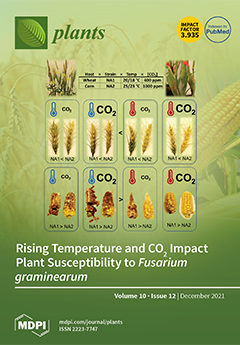
Cover Story: The impacts of CO2 and temperature on Fusarium graminearum disease are dependent on the host and the pathogen strain. On wheat, NA2 was more aggressive than NA1, and elevated CO2 further increased the severity of disease caused by NA2 but had no significant effect on NA1. In contrast, on corn, NA1 caused more disease, and there was no interaction between strain and CO2. Warmer temperature increased disease on wheat but reduced symptoms on corn. Deoxynivalenol contamination in wheat and corn was both greater at elevated CO2 and cool temperature treatment. However, NA2 caused more DON contamination in wheat, while NA1 caused more DON contamination in corn. View this paper.
  • Issues are regarded as officially published after their release is announced to the table of contents alert mailing list .
  • You may sign up for email alerts to receive table of contents of newly released issues.
  • PDF is the official format for papers published in both, html and pdf forms. To view the papers in pdf format, click on the "PDF Full-text" link, and use the free Adobe Reader to open them.

Articles (275)

  • Article
  • Open Access
7 Citations
5,336 Views
18 Pages

20 December 2021

Shifts in microbiota undoubtedly support host plants faced with abiotic stress, including low temperatures. Cold-resistant perennials prepare for freeze stress during a period of cold acclimation that can be mimicked by transfer from growing conditio...

  • Article
  • Open Access
2 Citations
4,368 Views
16 Pages

Analyses of MADS-box Genes Suggest HvMADS56 to Regulate Lateral Spikelet Development in Barley

  • Mohammed A. Sayed,
  • Mohamed Allam,
  • Quinn Kalby Heck,
  • Ieva Urbanavičiūtė,
  • Twan Rutten,
  • David Stuart,
  • Shakhira Zakhrabekova,
  • Andreas Börner,
  • Klaus Pillen and
  • Mats Hansson
  • + 1 author

20 December 2021

MADS-box transcription factors are crucial regulators of inflorescence and flower development in plants. Therefore, the recent interest in this family has received much attention in plant breeding programs due to their impact on plant development and...

  • Article
  • Open Access
6 Citations
3,332 Views
13 Pages

Biogeographical Patterns of Herbivore Arthropods Associated with Chenopodium quinoa Grown along the Latitudinal Gradient of Chile

  • Rodrigo A. Chorbadjian,
  • María I. Ahumada,
  • Francisco Urra,
  • Mario Elgueta and
  • Todd M. Gilligan

19 December 2021

Identifying the particular guilds of herbivore arthropods that affect the production of crops is key to developing sustainable pest-management strategies; however, there is incomplete information about the identity of herbivore arthropods that could...

  • Article
  • Open Access
13 Citations
4,446 Views
18 Pages

Vulnerability of the Ancient Peat Plateaus in Western Siberia

  • Alexander Pastukhov,
  • Tatiana Marchenko-Vagapova,
  • Sergey Loiko and
  • Dmitry Kaverin

19 December 2021

Based on the data of the plant macrofossil and palynological composition of the peat deposits, the evolution and current state of polygonal peatlands were analyzed at the southern limit of continuous permafrost in the Pur-Taz interfluve. Paleoreconst...

  • Article
  • Open Access
9 Citations
4,248 Views
18 Pages

Selection Gain of Maize Haploid Inducers for the Tropical Savanna Environments

  • Abil Dermail,
  • Sompong Chankaew,
  • Kamol Lertrat,
  • Thomas Lübberstedt and
  • Khundej Suriharn

19 December 2021

Lacking elite haploid inducers performing high haploid induction rate (HIR) and agronomic performance is one of fundamental factors hindering the rapid adoption of doubled haploid technology in maize hybrid breeding, especially under tropical savanna...

  • Feature Paper
  • Article
  • Open Access
104 Citations
10,067 Views
16 Pages

CottonGen: The Community Database for Cotton Genomics, Genetics, and Breeding Research

  • Jing Yu,
  • Sook Jung,
  • Chun-Huai Cheng,
  • Taein Lee,
  • Ping Zheng,
  • Katheryn Buble,
  • James Crabb,
  • Jodi Humann,
  • Heidi Hough and
  • Don Jones
  • + 3 authors

18 December 2021

Over the last eight years, the volume of whole genome, gene expression, SNP genotyping, and phenotype data generated by the cotton research community has exponentially increased. The efficient utilization/re-utilization of these complex and large dat...

  • Article
  • Open Access
9 Citations
4,005 Views
19 Pages

Chemical Composition and Content of Biologically Active Substances Found in Cotinus coggygria, Dactylorhiza maculata, Platanthera chlorantha Growing in Various Territories

  • Stanislav Sukhikh,
  • Lyudmila Asyakina,
  • Maxim Korobenkov,
  • Liubov Skrypnik,
  • Artem Pungin,
  • Svetlana Ivanova,
  • Timothy Larichev,
  • Viktoria Larina,
  • Olesia Krol and
  • Elena Ulrikh
  • + 2 authors

18 December 2021

Medicinal plants (Cotinus coggygria, Dactylorhiza maculata, Platanthera chlorantha) growing in various territories (Kaliningrad, Moscow, and Minsk regions) were the objects of research. This paper presents a study of the chemical composition of these...

  • Review
  • Open Access
21 Citations
10,502 Views
12 Pages

Stories from the Greenhouse—A Brief on Cotton Seed Germination

  • Andrea B. Maeda,
  • Leslie W. Wells,
  • Monica A. Sheehan and
  • Jane K. Dever

18 December 2021

Seed germination is the basis for the proliferation of sexual-reproducing plants, efficient crop production, and a successful crop improvement research program. Cotton (Gossypium spp.), the subject of this review, can be often sensitive to germinatio...

  • Article
  • Open Access
9 Citations
3,975 Views
19 Pages

18 December 2021

Concepts of semi-closed greenhouses can be used to save energy, whereas their technical equipment often causes a decrease in the light received by the plants. Nevertheless, higher yields are achieved, which are presumably triggered by a higher CO2 co...

  • Article
  • Open Access
7 Citations
3,226 Views
16 Pages

Oxidative Stress and DNA Lesion Reduction of a Polyphenolic Enriched Extract of Thymus marschallianus Willd. in Endothelial Vascular Cells Exposed to Hyperglycemia

  • Irina Ielciu,
  • Gabriela Adriana Filip,
  • Ilioara Oniga,
  • Neli-Kinga Olah,
  • Ioana Bâldea,
  • Diana Olteanu,
  • Ramona Flavia Burtescu,
  • Violeta Turcuș,
  • Alexandra C. Sevastre-Berghian and
  • Daniela Benedec
  • + 1 author

18 December 2021

The present study aimed to compare two polyphenolic-enriched extracts obtained from the Thymus marschallianus Willd. (Lamiaceae) species, harvested from culture (TMCE in doses of 0.66 μg GAE/mL and 0.066 μg GAE/mL) and from spontaneous flora (T...

of 28

Get Alerted

Add your email address to receive forthcoming issues of this journal.

XFacebookLinkedIn
Plants - ISSN 2223-7747