


You are currently viewing a new version of our website. To view the old version click .

Biosensors, Volume 10, Issue 11

November 2020 - 38 articles

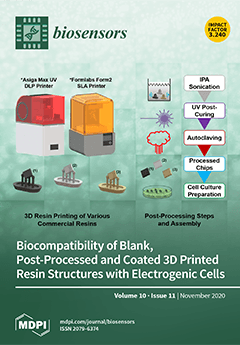
Cover Story: The widespread adaptation of 3D printing in the microfluidic, bioelectronic, and Bio-MEMS communities has been stifled by the lack of investigation into the biocompatibility of commercially available printer resins. By introducing an in-depth post-printing treatment of these resins, their biocompatibility can be dramatically improved up to that of a standard cell culture vessel (99.99%). Additionally, encapsulating resins that are less biocompatible with materials that are common constituents in biosensors further enhances the biocompatibility of the material. This investigation provides a clear pathway toward developing fully functional and biocompatible 3D printed biosensor devices, especially for interfacing with electrogenic cells, utilizing benchtop-based microfabrication, and post-processing techniques. View this paper.
  • Issues are regarded as officially published after their release is announced to the table of contents alert mailing list .
  • You may sign up for email alerts to receive table of contents of newly released issues.
  • PDF is the official format for papers published in both, html and pdf forms. To view the papers in pdf format, click on the "PDF Full-text" link, and use the free Adobe Reader to open them.

Articles (38)

  • Article
  • Open Access
23 Citations
4,913 Views
14 Pages

Detection of Lethal Bronzing Disease in Cabbage Palms (Sabal palmetto) Using a Low-Cost Electronic Nose

  • Martin J. Oates,
  • Nawaf Abu-Khalaf,
  • Carlos Molina-Cabrera,
  • Antonio Ruiz-Canales,
  • Jose Ramos and
  • Brian W. Bahder

23 November 2020

Lethal Bronzing Disease (LB) is a disease of palms caused by the 16SrIV-D phytoplasma. A low-cost electronic nose (eNose) prototype was trialed for its detection. It includes an array of eight Taguchi-type (MQ) sensors (MQ135, MQ2, MQ3, MQ4, MQ5, MQ9...

  • Article
  • Open Access
45 Citations
6,925 Views
12 Pages

21 November 2020

Paper-based microfluidic analysis devices (μPADs) have attracted attention as a cost-effective platform for point-of-care testing (POCT), food safety, and environmental monitoring. Recently, three-dimensional (3D)-μPADs have been developed to i...

  • Review
  • Open Access
93 Citations
9,714 Views
20 Pages

Recent Advances in MXene Nanocomposite-Based Biosensors

  • Jinho Yoon,
  • Minkyu Shin,
  • Joungpyo Lim,
  • Ji-Young Lee and
  • Jeong-Woo Choi

20 November 2020

The development of advanced biosensors with high sensitivity and selectivity is one of the most demanded concerns in the field of biosensors. To meet this requirement, up until now, numerous nanomaterials have been introduced to develop biosensors fo...

  • Review
  • Open Access
121 Citations
12,738 Views
46 Pages

Electrochemical Biosensors for Detection of MicroRNA as a Cancer Biomarker: Pros and Cons

  • Maliana El Aamri,
  • Ghita Yammouri,
  • Hasna Mohammadi,
  • Aziz Amine and
  • Hafsa Korri-Youssoufi

20 November 2020

Cancer is the second most fatal disease in the world and an early diagnosis is important for a successful treatment. Thus, it is necessary to develop fast, sensitive, simple, and inexpensive analytical tools for cancer biomarker detection. MicroRNA (...

  • Article
  • Open Access
1 Citations
5,445 Views
28 Pages

Dual-Channel Stopped-Flow Apparatus for Simultaneous Fluorescence, Anisotropy, and FRET Kinetic Data Acquisition for Binary and Ternary Biological Complexes

  • Roberto F. Delgadillo,
  • Katie A. Carnes,
  • Nestor Valles-Villarreal,
  • Omar Olmos,
  • Kathia Zaleta-Rivera and
  • Lawrence J. Parkhurst

19 November 2020

The Stopped-Flow apparatus (SF) tracks molecular events by mixing the reactants in sub-millisecond regimes. The reaction of intrinsically or extrinsically labeled biomolecules can be monitored by recording the fluorescence, F(t), anisotropy, r(t), po...

  • Review
  • Open Access
141 Citations
24,710 Views
18 Pages

Surface Modification Techniques for Endothelial Cell Seeding in PDMS Microfluidic Devices

  • Fahima Akther,
  • Shazwani Binte Yakob,
  • Nam-Trung Nguyen and
  • Hang T. Ta

19 November 2020

Microfluidic lab-on-a-chip cell culture techniques have been gaining popularity by offering the possibility of reducing the amount of samples and reagents and greater control over cellular microenvironment. Polydimethylsiloxane (PDMS) is the commonly...

  • Article
  • Open Access
9 Citations
4,860 Views
16 Pages

19 November 2020

Rapid antimicrobial susceptibility testing (AST) is an effective measure in the treatment of infections and the prevention of bacterial drug resistance. However, diverse antibiotic types and bacterial characteristics have formed complicated barriers...

  • Review
  • Open Access
25 Citations
5,730 Views
19 Pages

19 November 2020

Whilst it is universally accepted that the energy support of the brain is glucose, the form in which the glucose is taken up by neurones is the topic of intense debate. In the last few decades, the concept of lactate shuttling between glial elements...

  • Article
  • Open Access
21 Citations
4,487 Views
14 Pages

Drug-Based Gold Nanoparticles Overgrowth for Enhanced SPR Biosensing of Doxycycline

  • Syed Akif Raza Kazmi,
  • Muhammad Zahid Qureshi and
  • Jean-Francois Masson

19 November 2020

In clinical chemistry, frequent monitoring of drug levels in patients has gained considerable importance because of the benefits of drug monitoring on human health, such as the avoidance of high risk of over dosage or increased therapeutic efficacy....

  • Review
  • Open Access
29 Citations
6,152 Views
24 Pages

State-of-the-Art Optical Microfiber Coupler Sensors for Physical and Biochemical Sensing Applications

  • Maolin Dai,
  • Zhenmin Chen,
  • Yuanfang Zhao,
  • Manthangal Sivanesan Aruna Gandhi,
  • Qian Li and
  • Hongyan Fu

18 November 2020

An optical fiber coupler is a simple and fundamental component for fiber optic technologies that works by reducing the fiber diameter to hundred nanometers or several micrometers. The microfiber coupler (MFC) has regained interest in optical fiber se...

of 4

Get Alerted

Add your email address to receive forthcoming issues of this journal.

XFacebookLinkedIn
Biosensors - ISSN 2079-6374