



Next Issue
Volume 16, December
Previous Issue
Volume 16, October


Religions, Volume 16, Issue 11 (November 2025) – 143 articles
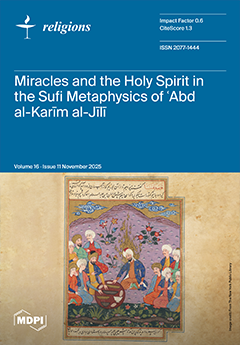
Cover Story (view full-size image): This paper treats the account of miracles given by ʿAbd al-Karīm al-Jīlī (d. 811/1408), a major interpreter of the Sufi metaphysics of Ibn ʿArabī (d. 638/1240), through a close reading of the chapter on the Holy Spirit in his major work, al-Insān al-kāmil. It sets al-Jīlī’s theory of miracles in the context of both his miracle-saturated Yemeni environment and the wider history of Sufi thinking about miracles. It finds that al-Jīlī articulates a hierarchy of the miraculous, distinguishing between bodily miracles, which indicate the dominance of the Holy Spirit, and the higher level of creative speech acts, which reflect the dominance of God’s creative attributes. It also compares al-Jīlī’s analysis of miracles and the Holy Spirit to Christian ideas rooted in the New Testament. View this paper
  • Issues are regarded as officially published after their release is announced to the table of contents alert mailing list.
  • You may sign up for e-mail alerts to receive table of contents of newly released issues.
  • PDF is the official format for papers published in both, html and pdf forms. To view the papers in pdf format, click on the "PDF Full-text" link, and use the free Adobe Reader to open them.
Order results
Result details
Section
Select all
Export citation of selected articles as:
19 pages, 1639 KB  
Article
Science Translation in Late Qing Christian Periodicals and the Disciplinary Transformation of Chinese Lixue
by Mingyu Lu and Aiai Lin
Religions 2025, 16(11), 1472; https://doi.org/10.3390/rel16111472 - 20 Nov 2025
Viewed by 455
Abstract
Missionary periodicals during the late Qing dynasty played a crucial role in introducing, translating, and systematizing Western scientific knowledge, thereby facilitating China’s transition from the traditional epistemic frameworks of “Lixue” to modern academic disciplines. Situated within a framework of knowledge transmission and disciplinary [...] Read more.
Missionary periodicals during the late Qing dynasty played a crucial role in introducing, translating, and systematizing Western scientific knowledge, thereby facilitating China’s transition from the traditional epistemic frameworks of “Lixue” to modern academic disciplines. Situated within a framework of knowledge transmission and disciplinary formation mediated by Chinese Christianity, this study moves beyond prior scholarship that mainly focused on individual missionary figures such as Young John Allen or specific publications like The Church News. Instead, it adopts a broader perspective, employing an integrated quantitative and qualitative analysis to examine their collective role in scientific modernization and disciplinization. The research argues that translational activities in these publications fundamentally reshaped China’s knowledge landscape. It specifically traces the semantic evolution of “Gezhi” (格致) and the transformation of “Lixue” from a moral-philosophical tradition toward the modern natural sciences. By reconstructing this process, the paper illuminates how Chinese Christianity contributed to knowledge structuring and academic modernization, highlighting its significant impact on contemporary disciplines such as Translation Studies. The findings underscore the multifaceted interactions among religious media, knowledge production, and social change. Full article
(This article belongs to the Special Issue Chinese Christianity and Knowledge Development)
Show Figures

Figure 1

16 pages, 313 KB  
Article
Recontextualizing Nanyang Buddhism Based on the Guangzhou Guangxiao Si
by Yi Miao, Metteyya Beliatte, Yaoping Liu and Pharatt Run
Religions 2025, 16(11), 1471; https://doi.org/10.3390/rel16111471 - 20 Nov 2025
Viewed by 381
Abstract
This study examined the recontextualization of Nanyang Buddhism and its practices at the Guangzhou Guangxiao Si, considering their adaptation to the requirements of contemporary urban communities in China and Southeast Asia, as well as local cultural values. This research employed historical methodologies alongside [...] Read more.
This study examined the recontextualization of Nanyang Buddhism and its practices at the Guangzhou Guangxiao Si, considering their adaptation to the requirements of contemporary urban communities in China and Southeast Asia, as well as local cultural values. This research employed historical methodologies alongside a qualitative framework that included semi-structured interviews. This investigation analyzed the recontextualization of Nanyang Buddhism by conducting a textual analysis of the Lankavatara Sutra and Avatamsaka Sutra, which was further supported by interviews with nine participants which included senior monks, scholars, and members of the Chinese diaspora in Guangzhou, South China; Malaysia; and Singapore. The results revealed that the Guangxiao Si plays a strategic role in the adaptation of Mahāyāna Buddhism to meet the social and spiritual needs of the Chinese diaspora community by integrating spiritual teachings with local cultural practices. This process illustrates Buddhism’s adaptability to evolving socio-economic conditions and highlights the significance of temples in influencing the spiritual identity of the Chinese community in Southeast Asia. We recommend that other researchers compare the recontextualization processes of Buddhism in Southeast Asia and analyze the role of the Guangxiao Si in cultural diplomacy and international relations. Full article
19 pages, 311 KB  
Article
The Religious Authority over Literature: Christian Influences in the Formation of Anatolian Turkish Literature in the 14th Century
by Murat Ali Karavelioğlu, İsmail Abalı and Abdulhakim Tuğluk
Religions 2025, 16(11), 1470; https://doi.org/10.3390/rel16111470 - 19 Nov 2025
Viewed by 460
Abstract
Art is the most aesthetic creation produced by humankind, and it is quite unthinkable that art should exist independently of religion. Even in works of a profane nature, a sense of divinity can still be felt at some level. In the revealed religions—Judaism, [...] Read more.
Art is the most aesthetic creation produced by humankind, and it is quite unthinkable that art should exist independently of religion. Even in works of a profane nature, a sense of divinity can still be felt at some level. In the revealed religions—Judaism, Christianity, and Islam—the teachings of the sacred scriptures, intermingled with certain pagan beliefs, have a profound influence on the shaping of art. In the works of the fourteenth century, when Classical Turkish literature began to flourish in Anatolia, numerous Christian elements appear in the form of metaphors, allusions, or similes. The early period of intense interaction with the Orthodox Byzantine Empire, the proliferation of written literary texts, the introduction of the devşirme (child-levy) system, Ottoman settlements in Rumelia, and the expanding military, commercial, and social relations all accelerated the entry of Christian motifs into daily life and literature. This article examines how Christianity—the religion with the largest number of adherents today—was reflected in fourteenth-century Turkish literary texts and how it influenced the cultural life of the period. Full article
10 pages, 277 KB  
Article
Feminized While Domesticated: How Yü Chun-Fang Avoids Feminist Interpretive Biases in Her Study of Avalokiteśvara
by Xiaoyi Liu
Religions 2025, 16(11), 1469; https://doi.org/10.3390/rel16111469 - 19 Nov 2025
Viewed by 366
Abstract
Bodhisattva Guanyin, or Avalokiteśvara, has undergone a series of transformations and has become one of the most widely worshiped bodhisattvas in the history of Chinese Buddhism. Yü Chun-fang’s work, Kuan-Yin: The Chinese Transformation of Avalokiteśvara, with a Chinese version out in 2012, [...] Read more.
Bodhisattva Guanyin, or Avalokiteśvara, has undergone a series of transformations and has become one of the most widely worshiped bodhisattvas in the history of Chinese Buddhism. Yü Chun-fang’s work, Kuan-Yin: The Chinese Transformation of Avalokiteśvara, with a Chinese version out in 2012, has meticulously documented this process. This article reviews Yü’s seminal methodology, which has been adopted in her study of the imported deity’s feminization and domestication course, and analyses how she avoids the feminist interpretive biases that are common to the present-day Buddhology. Full article
10 pages, 313 KB  
Article
Can We Speak of an “Interaction” Between Ancient Christian Thought and Classical Greek Literature? Two Case Studies (The Trinity and Gen. 1:26)
by Sébastien Morlet
Religions 2025, 16(11), 1468; https://doi.org/10.3390/rel16111468 - 19 Nov 2025
Viewed by 358
Abstract
This paper tries to analyse what “interaction” with classical Greek literature may mean in the case of ancient Christian texts. Two case studies show the existence of a “hermeneutical circle” between the reception of Greek texts among Christians and Christian ideas. The Christians [...] Read more.
This paper tries to analyse what “interaction” with classical Greek literature may mean in the case of ancient Christian texts. Two case studies show the existence of a “hermeneutical circle” between the reception of Greek texts among Christians and Christian ideas. The Christians were influenced by the Greek texts they commented on, but, on the other hand, their reception of such texts was determined by their Christian intellectual presuppositions. The first case (the emergence of the “Trinity” among the “apologists”) illustrates a cross-reading of Matthew 28:19 and Ps.-Plato’s Letter 2. The second case shows how the term ὁμοίωσις, in Genesis 1:26, was read in the light of Theaetetus 176a-b, and vice versa. Full article
(This article belongs to the Special Issue The Interaction of Early Christianity with Classical Literature)
17 pages, 252 KB  
Article
The Moral Argument for the Existence of God: An Evaluation of Some Recent Discussions
by Henry Hock Guan Teh and Andrew Loke
Religions 2025, 16(11), 1467; https://doi.org/10.3390/rel16111467 - 19 Nov 2025
Viewed by 1041
Abstract
This paper contributes to the discussion on the Moral Argument for the existence of God—an important argument of natural theology which is relevant to science and religion dialogues—by showing that the argument can be formulated in a such way that avoids the lack [...] Read more.
This paper contributes to the discussion on the Moral Argument for the existence of God—an important argument of natural theology which is relevant to science and religion dialogues—by showing that the argument can be formulated in a such way that avoids the lack of comprehensiveness in Andrew Loke’s original formulation and the unnecessarily complicated reformulation offered in Jack et al.’s criticism of Loke. This paper also contributes to the discussion by demonstrating the failure of relaxed (moral) realism proposed by Jack et al. to rebut the Moral Argument and offers replies to their other objections concerning moral obligations and social relations, the law-like character of moral obligations, and moral truths and responsibilities. Full article
(This article belongs to the Special Issue Science and Religion: Natural Theology in the Contemporary Context)
18 pages, 272 KB  
Article
Religeopolitics and Evangelical Place-Making: An Interpretative Phenomenological Study of Transnational Mission Partnerships
by Tanner Morrison
Religions 2025, 16(11), 1466; https://doi.org/10.3390/rel16111466 - 19 Nov 2025
Viewed by 386
Abstract
Evangelical churches increasingly engage in transnational partnerships that shape spiritual identity and moral belonging across borders. This study investigates how such partnerships function not simply as organizational strategies but as lived spatial practices grounded in faith. Drawing on Interpretative Phenomenological Analysis (IPA) of [...] Read more.
Evangelical churches increasingly engage in transnational partnerships that shape spiritual identity and moral belonging across borders. This study investigates how such partnerships function not simply as organizational strategies but as lived spatial practices grounded in faith. Drawing on Interpretative Phenomenological Analysis (IPA) of interviews with Canadian and Mexican participants in a long-term church-planting relationship, the article explores how theological commitments, emotional ties, and embodied rituals generate spatial meaning. Participants framed their engagement not through institutional goals, but through metaphors of family, covenant, and companionship, suggesting a grassroots geopolitics rooted in care, hospitality, and spiritual presence. The findings reveal that space is produced not only through ideology or policy, but through practices like shared meals, cross-cultural mentorship, and prayerful presence—acts that reconfigure belonging along theological and affective lines. The article introduces the concept of religeopolitics to describe this phenomenon, arguing that evangelical actors are not merely influenced by global geopolitics but actively create alternative spatial imaginaries through faith. Foregrounding religious subjectivity in spatial production, this article advances scholarship on lived religion and critical geopolitics, highlighting how spiritual communities shape geopolitical belonging through theological imagination, relational duration, and embodied moral practice. Full article
24 pages, 607 KB  
Article
Enhancing School Safety Frameworks Through Religious Education: Developing a Curriculum Framework for Teaching About World Religions in General Education
by Jahyun Gu and Juhwan Kim
Religions 2025, 16(11), 1465; https://doi.org/10.3390/rel16111465 - 18 Nov 2025
Viewed by 454
Abstract
Current school safety frameworks in South Korea concentrate on physical and infrastructure-related risks (e.g., natural disasters, traffic accidents, and facility management), overlooking safety challenges that emerge from the gradual multicultural transition of Korean society. This work attempts to address this critical gap in [...] Read more.
Current school safety frameworks in South Korea concentrate on physical and infrastructure-related risks (e.g., natural disasters, traffic accidents, and facility management), overlooking safety challenges that emerge from the gradual multicultural transition of Korean society. This work attempts to address this critical gap in school safety frameworks. To do so, we first examine how issues related to increasing religious diversity in South Korea create safety challenges. Through our examination of specific cases in university settings, we demonstrate not only that these issues manifest as sociocultural challenges extending beyond the physical risks that current frameworks prioritize, but also that higher education institutions lack adequate institutional responses. Based on this analysis, we develop a curriculum framework for teaching about world religions in general education as an institutional approach to these challenges. By engaging with the concept of religion alongside various religious traditions and discourses, this curriculum aims to develop students’ religious literacy—a competency for better understanding and navigating complex religious and cultural dynamics in daily life. With this curriculum, we suggest an effective way to enhance current school safety frameworks through religious education that is essential for addressing the challenges entwined deeply with the sociocultural transition in South Korea. In doing so, we also highlight that religion continues to maintain significant influence in contemporary Korean society, contrary to widespread assumptions that undermine its ongoing roles and impact. Full article
(This article belongs to the Special Issue Social Justice in Theological Education: Challenges and Opportunities)
Show Figures

Figure 1

22 pages, 463 KB  
Article
Beyond Good or Evil: “Human Nature Is Good” Reinterpreted
by Fei Lan
Religions 2025, 16(11), 1464; https://doi.org/10.3390/rel16111464 - 18 Nov 2025
Viewed by 550
Abstract
This paper discusses Dai Zhen’s 戴震 (1724–1777) interpretation of human nature against the backdrop of Mencius’s claim that human nature is good. I argue that Dai Zhen ingeniously reinterprets the “shan” 善 (good; goodness) in terms of “fen” 分 [...] Read more.
This paper discusses Dai Zhen’s 戴震 (1724–1777) interpretation of human nature against the backdrop of Mencius’s claim that human nature is good. I argue that Dai Zhen ingeniously reinterprets the “shan” 善 (good; goodness) in terms of “fen” 分 (allotments; distinction) to view the claimed “goodness” as the unique and finest physical makeup of human nature that possesses the potential ability to know moral goodness, viz. liyi 理義 (principle & righteousness). Nonetheless, rather than a transcendental principle or some heavenly endowed virtue, liyi is present in human relationships and everyday life. At the crux of the issue is how to activate the given ability and advance our intelligent mind for principle and righteousness. By ridding “xingshan” 性善 (human nature is good) of its inherent moral properties as Mencius posits in his theory of human nature, Dai Zhen, from a naturalistic and empirical stance, proposes an unconventional approach to the longstanding debate over whether human nature is good or evil in Confucian discourse. While his interpretation may unsettle us that are accustomed to the traditional view of the “goodness” of human nature as one’s innate moral feelings of ren yi li zhi 仁義禮智 (benevolence, righteousness, wisdom, and propriety), Dai Zhen’s reading has undoubtedly thrown a new light on this famed Mencian thesis. Full article
19 pages, 2056 KB  
Article
From Kasaya to Haiqing: The Evolution of Monastic Robes and Identity Reformation in Chinese Buddhism
by Han Chen, Peiqi Han and Lixian Liu
Religions 2025, 16(11), 1463; https://doi.org/10.3390/rel16111463 - 18 Nov 2025
Viewed by 463
Abstract
Religious clothing serves as the external manifestation of religious culture, and its evolutionary process not only reflects the developmental trajectory of religion but also demonstrates cultural exchange and social transformation in specific historical periods. This study focuses on the localization and evolution of [...] Read more.
Religious clothing serves as the external manifestation of religious culture, and its evolutionary process not only reflects the developmental trajectory of religion but also demonstrates cultural exchange and social transformation in specific historical periods. This study focuses on the localization and evolution of Chinese Buddhism monks’ robes as its research subject. Through analyzing historical documents, archaeological materials, and artistic works, it explores the transformation process from Indian Kasaya to Chinese Haiqing 海青 (Chinese Buddhist Ceremonial Robe) and its cultural implications. The research findings reveal that the localization process of Chinese Buddhism monks’ robes exhibits characteristics of gradual Cultural Adaptation: while maintaining the core of Buddhist doctrine, it achieved organic integration with traditional Chinese culture through systematic reconstruction of material forms. This is specifically manifested in three aspects: formal adaptation responding to environmental constraints, the integration of craftsmanship and materials embodying cultural dialogue, and the color hierarchy system reflecting the dynamic interplay between secular power and religious authority. This process facilitated the reconstruction of monks’ multidimensional Identity Reconstruction—forming a new balance model among religious transcendence, cultural belonging, and social participation. This study provides a theoretical framework for understanding the internal logic of religious localization and the adaptive mechanisms of Cross-cultural Communication. Full article
Show Figures

Figure 1

14 pages, 585 KB  
Article
Wawa Pampay”: Andean Ritual for the Emotional Transformation of Grief in an Andean Community
by Edgar Gutiérrez-Gómez, Yanina Marleni Tristan-Quispe, Rosa Cecilia González-Ríos, Sonia Beatriz Munaris-Parco, Vidalina Andía-Ayme and Gilmar Peña-Rojas
Religions 2025, 16(11), 1462; https://doi.org/10.3390/rel16111462 - 18 Nov 2025
Viewed by 752
Abstract
The “Wawa Pampay” is an Andean funeral ritual that allows Quechua-speaking communities to collectively process grief over the death of a child, integrating ancestral beliefs and symbolic practices that have been passed down over generations. This study aimed to understand the [...] Read more.
The “Wawa Pampay” is an Andean funeral ritual that allows Quechua-speaking communities to collectively process grief over the death of a child, integrating ancestral beliefs and symbolic practices that have been passed down over generations. This study aimed to understand the cultural and emotional significance of this ritual, as well as to document its symbolic elements in light of the risk of its disappearance due to sociocultural changes. A qualitative approach integrating ethnographic methodology was used, combining participant observation, in-depth interviews in the Quechua language, and photographic and audiovisual recording, while always respecting the beliefs and privacy of the participants. The fieldwork was carried out in a rural community in the Peruvian Andes, with extended visits and cohabitation with the families. The findings show that the “Wawa Pampay” not only bids farewell to the deceased child but also reaffirms social cohesion and strengthens collective memory. Its preservation is key to keeping local cultural identity alive. Full article
Show Figures

Figure 1

22 pages, 355 KB  
Article
Marriage and Family: Their Value, Tasks and Protection in Christianity, Islam, and Judaism
by Urszula Dudziak, Atila Kartal and Walter Homolka
Religions 2025, 16(11), 1461; https://doi.org/10.3390/rel16111461 - 18 Nov 2025
Viewed by 809
Abstract
Exploring different religions allows us to identify not only differences, but also similarities between them. The search for these similarities and differences regarding such fundamental matters in human life as marriage and family justifies the creation of this article. This comparison of positions [...] Read more.
Exploring different religions allows us to identify not only differences, but also similarities between them. The search for these similarities and differences regarding such fundamental matters in human life as marriage and family justifies the creation of this article. This comparison of positions considers world religions that have existed for centuries and have a significant number of followers, such as Judaism, Christianity, and Islam. Based on holy books, documents of religious communities, and scientific publications, the authors have undertaken to answer the following questions: what are marriage and family, and how are they treated in each specific religion? How are marriages formed? What are the responsibilities of spouses/parents, and what functions do families serve? What moral norms protecting marital and family life do specific religions indicate? The value of human beings and interpersonal relationships, the succession of generations and educational needs, the responsibility of the older for the younger, and also the not uncommon permissive and corrupting trends in the world, oblige us to transmit normative content approved by individual religions that is essential for the life and development of individuals and societies. Full article
25 pages, 2567 KB  
Article
Intersecting Identities in 18th Century Jerusalem: Conversion to Islam
by Alaattin Dolu
Religions 2025, 16(11), 1460; https://doi.org/10.3390/rel16111460 - 17 Nov 2025
Viewed by 560
Abstract
This paper examines conversion to Islam in eighteenth-century Ottoman Jerusalem as a multifaceted transformation negotiated across social, legal, and economic domains. Drawing on Jerusalem Court Registers and the scholar al-Khalīlī’s (d. 1734, Jerusalem) fatwās, the study suggests that conversion was both a [...] Read more.
This paper examines conversion to Islam in eighteenth-century Ottoman Jerusalem as a multifaceted transformation negotiated across social, legal, and economic domains. Drawing on Jerusalem Court Registers and the scholar al-Khalīlī’s (d. 1734, Jerusalem) fatwās, the study suggests that conversion was both a declaration of faith and a mechanism for restructuring social boundaries. The removal of the yellow turban after the shahāda signalled a symbolic rupture that reshaped kinship, property and legal status. Court cases and fatwās reveal that marriage, dowry, custody, inheritance, and debts were governed not only by Islamic law but also by social negotiation. While the situation of the children illustrates the fragility of social boundaries, the principle of subordination to one’s origins was a crucial factor in the transmission of identity. Through the amalgamation of normative discourse with judicial practices, this article provides a nuanced micro-sociological contribution to the comprehension of Ottoman Jerusalem. Conversion transcends a personal change in belief and emerges as a social experience that reorganizes family ties, property relations, and social belonging. Consequently, conversion functions as a boundary-making site where integration and exclusion are contested and where symbolic authority intersects with material interests. Full article
Show Figures

Figure 1

18 pages, 345 KB  
Article
Textual Transmission and the Construction of Spiritual Authority: The Early Reception of Jerome of Stridon
by Elisabet Göransson and Katarina Pålsson
Religions 2025, 16(11), 1459; https://doi.org/10.3390/rel16111459 - 17 Nov 2025
Viewed by 312
Abstract
The life of Jerome of Stridon (d. 419/420), who was regarded as a father of the church and one of the most important authorities in the Middle Ages, has often been depicted as highly controversial: In modern reconstructions, Jerome is typically described as [...] Read more.
The life of Jerome of Stridon (d. 419/420), who was regarded as a father of the church and one of the most important authorities in the Middle Ages, has often been depicted as highly controversial: In modern reconstructions, Jerome is typically described as an outsider, constantly involved in controversies and frequently criticized and questioned by his contemporaries. This begs the question of how Jerome could have received such an esteemed reputation during the following centuries. While it has been acknowledged in previous scholarship that Jerome had an extensive reception in the Middle Ages, a comprehensive study of the transmission of his works in the first centuries after his death has not been undertaken. Likewise, the mechanisms involved in constructing an image of Jerome as an authority of exegesis and asceticism and as a defender of orthodoxy are yet to be studied. Combining philological and historical approaches, the present article seeks to contribute to Hieronymian scholarship by studying the reception of Jerome during his lifetime and during the first centuries after his death, taking into account two different but interrelated aspects of this reception: First, an analysis of manuscripts will answer questions concerning the transmission of Jerome’s texts. Secondly, the article will consider the earliest reception of Jerome’s works and how this was managed by Jerome himself, in collaboration with his friends and patrons, in addition to how he was commonly referred to and described during the first decades after his death. The article examines how these aspects of reception contributed to the creation of an image of Jerome, and an interpretation of his work that would become important in medieval Christianity. Full article
15 pages, 369 KB  
Article
Big History and Little People: The Historical Images of Ordinary Individuals in Quan Huo Ji
by Jianbin Guo
Religions 2025, 16(11), 1458; https://doi.org/10.3390/rel16111458 - 17 Nov 2025
Viewed by 338
Abstract
The Boxer Rebellion, as a significant historical episode in modern Chinese history, has been primarily studied through official archives and Boxer propaganda Posters. Chinese Christian literature remain underutilized in current scholarship. Quan Huo Ji 拳祸记 (The Record of Boxer Rebellion), is an important [...] Read more.
The Boxer Rebellion, as a significant historical episode in modern Chinese history, has been primarily studied through official archives and Boxer propaganda Posters. Chinese Christian literature remain underutilized in current scholarship. Quan Huo Ji 拳祸记 (The Record of Boxer Rebellion), is an important ecclesiastical document, compiled by the Catholic priest Li Wenyu. While reflecting an apologetic stance, it nonetheless provides valuable insights from the perspective of common people and narrates the experiences of marginalized individuals, offering a systematic account of the suffering endured by various dioceses. Within this text, three categories of common people emerge. First, the lay faithful, who, under the violent threat of “apostasy or death”, remained steadfast in their faith. Second, anti-Christian civilians, whose motivations—though often framed as expressions of national or social grievance—may in fact reflect a release of personal frustrations and desires. Third, those sympathetic to Christians either maintained a neutral stance or offered assistance within their limited capacity. These individual experiences, often overlooked by mainstream historiography, compensate for the limitations of conventional analytical frameworks. They also vividly illustrate how ordinary people navigated between forced compromise and active resistance. Through a microhistorical lens, these personal trajectories offer a multi-dimensional portrayal of the survival dilemmas. Full article
(This article belongs to the Special Issue Chinese Christianity and Knowledge Development)
17 pages, 278 KB  
Article
Sacrifice and Sacredness in Youth in a Context of Precariousness
by Xabier Tirapu Intxaurrondo, Marta Rodríguez Fouz and Maite Posada Arechabala
Religions 2025, 16(11), 1457; https://doi.org/10.3390/rel16111457 - 17 Nov 2025
Viewed by 330
Abstract
This article proposes to analyze how different concepts of the sociology of religion operate in today’s youth. Specifically, it starts from the concepts of “enterprise of the self” and “performance/enjoyment device”, proposed by Christian Laval and Pierre Dardot in The New Way of [...] Read more.
This article proposes to analyze how different concepts of the sociology of religion operate in today’s youth. Specifically, it starts from the concepts of “enterprise of the self” and “performance/enjoyment device”, proposed by Christian Laval and Pierre Dardot in The New Way of the World, to try to identify the reconfiguration of sacredness and sacrifice in the younger generation, in a context that is identified as precarious. The analysis delves into a precariousness that goes beyond the system of modeling subjectivities and the device for controlling action proposed by Laval and Dardot. This does not imply the ineffectiveness of these concepts, but rather their intensification and rearticulation in accordance with the different realities of youth. Full article
17 pages, 529 KB  
Article
The East Asian Transmission of the Chuanlao Song (川老頌) of the Diamond Sūtra: Centering on Versions from Premodern Korea and Edo Japan
by Mingjia Li
Religions 2025, 16(11), 1456; https://doi.org/10.3390/rel16111456 - 17 Nov 2025
Viewed by 331
Abstract
The Chuanlao Song, composed by the Southern Song Chan monk Daochuan 道川 (1104–1163, Southern Song), represents a hybrid form of exegetical lecture text from the Diamond Sūtra (金剛經). Neither a standard commentary (zhu 註) nor a ritual manual (keyi 科儀), [...] Read more.
The Chuanlao Song, composed by the Southern Song Chan monk Daochuan 道川 (1104–1163, Southern Song), represents a hybrid form of exegetical lecture text from the Diamond Sūtra (金剛經). Neither a standard commentary (zhu 註) nor a ritual manual (keyi 科儀), it fuses rhetorical features of Chan sermons with versified praise, often associated with chanting. From the twelfth century onward, the Chuanlao Song circulated across China, Korea, and Japan, yet its textual identity has long been obscured. In particular, the Zokuzōkyō (續藏經) recension misclassified it as a commentary, resulting in interpretive confusions that have persisted into modern scholarship. This study reconsiders the Chuanlao Song within broader contextual frameworks of textual form, ritual practice, and editorial strategy. While grounded in philological analysis, three regional trajectories are highlighted: the Chuanlao Song’s preservation in China as an appended text within collective annotations; its transformation in Korea through royal patronage and the multiplication of textual forms; and its reinterpretation in Edo-period Japan as an object of sectarian commentary. By tracing these transregional movements, this study argues that the Chuanlao Song offers a valuable case study of how Buddhist texts were circulated and adapted across East Asia, shedding light on the intra-Chinese domestication and, beyond China, regional vernacularization and recontextualization. Full article
15 pages, 1009 KB  
Article
A Bicorp—Who I Was: How Many Head Phylacteries (Tefillin Shel Rosh) Should Conjoined Twins Wear?
by Sergey Dolgopolski
Religions 2025, 16(11), 1455; https://doi.org/10.3390/rel16111455 - 17 Nov 2025
Viewed by 246
Abstract
The paper renegotiates two regnant and interconnected modern assumptions, a reduction of forgetting to memory loss, and insistence on a self-remembering individual as the social atom, from which one builds molar and molecular social structures. In the article, a critical conceptual retrieval of [...] Read more.
The paper renegotiates two regnant and interconnected modern assumptions, a reduction of forgetting to memory loss, and insistence on a self-remembering individual as the social atom, from which one builds molar and molecular social structures. In the article, a critical conceptual retrieval of the notion of bicorp extends beyond the doctrinal frameworks of rabbinic and patristic traditions to afford a heuristic scope in which to access the significance and limitations of a modern individual as an atom of the society. The main result is a detection of the central rather than marginal role of bicorp in creating legally imputable and responsible individuals in society. This result is accompanied by a connected detection of the long-term reversal, in which memory, including the memory the individual has of oneself, becomes primary and forgetting plays a deceptively secondary role of a memory loss in society. Full article
(This article belongs to the Special Issue Rabbinic Thought between Philosophy and Literature)
21 pages, 330 KB  
Article
Walking to/with Queen Saint Elizabeth: “Where Your Very Steps Lead Me”
by Vera Lúcia Rodrigues
Religions 2025, 16(11), 1454; https://doi.org/10.3390/rel16111454 - 15 Nov 2025
Viewed by 615
Abstract
The cult of Queen Saint Elizabeth constitutes one of the most persistent manifestations of popular religiosity in central Portugal, especially in Coimbra. Following her death, popular veneration of this saint rapidly consolidated, later legitimized by her beatification in 1516 and canonization in 1625. [...] Read more.
The cult of Queen Saint Elizabeth constitutes one of the most persistent manifestations of popular religiosity in central Portugal, especially in Coimbra. Following her death, popular veneration of this saint rapidly consolidated, later legitimized by her beatification in 1516 and canonization in 1625. This article aims to understand how Elizabethan devotion currently constructs an identity in Coimbra, Portugal. To characterize the pilgrimage and expressions of faith, I observe the biennial festivities, the processional routes, sacrifices, adherence, and generational beliefs in this feminine cult, relating them to the pursuit of health. The article studies the main institutions that regulate devotion in modern times (notably the Confraternity of Queen Saint Elizabeth) and explores some processes of its patrimonialization and touristification. Finally, I also analyze the performativity of rituals and the identity of pilgrims, highlighting how expressions of faith also constitute social, cultural and economic practices. The study is based on ethnographic fieldwork, interviews and documentary analysis. The ethnography (still ongoing) on this very Portuguese pilgrimage already reveals points of differentiation and of commonality with other more famous pilgrimages, such as Fátima and Lourdes, while remaining a significant and unique part of the character of popular religiosity and the local identity of Coimbra. Full article
(This article belongs to the Special Issue Pilgrimage: Diversity, Past and Present of Sacred Routes)
28 pages, 4134 KB  
Article
Towards an Evolutionary Science of Sacred Architecture: When Atmosphere Meets Narrative
by Michael Anthony Arbib
Religions 2025, 16(11), 1453; https://doi.org/10.3390/rel16111453 - 15 Nov 2025
Viewed by 547
Abstract
This paper forwards the claim that our early human ancestors had protosacred experiences long before they had languages, architecture, or religions. A mountain may create feelings of awe while a grove in the forest may create feelings of serenity. In some circumstances (and [...] Read more.
This paper forwards the claim that our early human ancestors had protosacred experiences long before they had languages, architecture, or religions. A mountain may create feelings of awe while a grove in the forest may create feelings of serenity. In some circumstances (and very much dependent on the mental set of the individual), such protosacred experiences may create a sense of ultimacy that may be interpreted by the faithful as a religious experience in terms of their own beliefs. We chart an evolutionary account of the path of human ancestors from experiences of the protosacred to the diversity of religions, with a focus on the emergence of culturally varied architected sacred spaces designed to offer a religious group a sense of shared community and the sacred in the experience of their religion. We argue that the cultural evolution of languages was necessary for this transition. It made our species both Homo quaerens (the humans who ask questions) and Homo narrans (the humans who tell stories), able to ask existential questions and to offer answers that a group could accept. The answers took the form of narratives and scripts for ritual behaviors that could harmonize the community with the world around and beyond it. We suggest that both affordances and atmospheres relate to the aesthetics of space, stressing the atmospheric flow as the performance of various rituals proceeds. This paper offers examples from diverse religions or cosmologies and closes with suggestions for a range of empirical and experimental investigations to address the hypotheses raised herein. Full article
(This article belongs to the Special Issue Experimental Theological Aesthetics)
Show Figures

Figure 1

12 pages, 216 KB  
Article
Re-Imagining Fundamentalism in Traditional African Religious Thought: The Case of Ombatse in Nigeria
by Benson Ohihon Igboin
Religions 2025, 16(11), 1452; https://doi.org/10.3390/rel16111452 - 14 Nov 2025
Viewed by 284
Abstract
This article re-imagines the conceptual and existential dimensions of religious fundamentalism, which is generally conceived as a belief in the literal interpretation of texts and their application in contemporary society. A major argument in fundamentalism discourse centres on textual religious or sacred texts [...] Read more.
This article re-imagines the conceptual and existential dimensions of religious fundamentalism, which is generally conceived as a belief in the literal interpretation of texts and their application in contemporary society. A major argument in fundamentalism discourse centres on textual religious or sacred texts of organised religions, from which inspiration is usually drawn to counter the corrosive effects of modernisation. The militarisation of sacred texts by religious fundamentalists—a kind of hardware—is predicated on the interpretation of the texts—the software—which provides ideological scaffold to religious fundamentalism. This article argues that though religious fundamentalism is extensively considered textual-based, the Ombatse traditional religious movement—a non-text-based religious movement—challenges not only many of the fundaments of traditional African religious thought but also the text-based thesis of religious fundamentalism. I suggest that Ombatse could be situated, epistemologically, in the locale of resistance to religious colonialism and political marginalisation. Full article
29 pages, 389 KB  
Article
The Father’s Power and Will to Generate: Aquinas’s Development of Lombard’s Doctrine
by Kenny Ang
Religions 2025, 16(11), 1451; https://doi.org/10.3390/rel16111451 - 14 Nov 2025
Viewed by 312
Abstract
Peter Lombard’s First Book of the Sentences presents formidable questions concerning the principle of the Son’s generation. Addressing a gap in contemporary scholarship, this article examines Lombard’s foundational exposition of the Father’s power and will to generate. Placing Lombard in dialogue with Thomas [...] Read more.
Peter Lombard’s First Book of the Sentences presents formidable questions concerning the principle of the Son’s generation. Addressing a gap in contemporary scholarship, this article examines Lombard’s foundational exposition of the Father’s power and will to generate. Placing Lombard in dialogue with Thomas Aquinas, this study traces the development of this doctrine across Aquinas’s career, from his commentary on the Sentences to De potentia and the Summa theologiae. Our analysis adopts Aquinas’s own framework to investigate a series of questions: whether generation is an act of nature or will; whether the power to generate is part of omnipotence; whether it is essential or relational; and whether the Son possesses this power. This study finds that Aquinas’s conclusions often converge with Lombard’s intuitions. Both affirm that generation is by nature while simultaneously accompanied by a concomitant will, and that the generative power is rooted in the divine essence. Aquinas’s analysis, however, represents a significant metaphysical development. A key evolution is traced in Aquinas’s understanding of the power to generate, which shifts from being a quasi-natural power distinct from omnipotence to a form of paternal omnipotence. His characterization of this power also matures from being a middle ground between the essential and the relational to being principally essential, signifying the relation of paternity only obliquely. This trajectory toward a firmer grounding in the divine essence is supported by an increasingly refined set of arguments for the Son’s unicity, with principles like the determination of nature and divine simplicity becoming more prominent in his later works. By charting these developments, this article demonstrates how Aquinas builds upon Lombard’s foundational intuitions to construct a more systematic and robust Trinitarian theology. Ultimately, our analysis illuminates the intellectual journey from sound doctrinal intuition to profound metaphysical articulation, where the tenets of faith are secured by a cogent intellectual framework. Our analysis also offers a counter-narrative to contemporary assumptions, challenging modern conceptions of power as a zero-sum game and of freedom as mere arbitrary choice. Full article
Show Figures

Figure 1

6 pages, 169 KB  
Editorial
Aquinas and the Sciences: Exploring the Past, Present, and Future
by Simon Maria Kopf and Ignacio Silva
Religions 2025, 16(11), 1450; https://doi.org/10.3390/rel16111450 - 14 Nov 2025
Viewed by 385
Abstract
The 21st century has witnessed a renewed interest in Thomas Aquinas and the Thomistic tradition within the field of science and religion [...] Full article
(This article belongs to the Special Issue Aquinas and the Sciences: Exploring the Past, Present, and Future)
35 pages, 554 KB  
Article
Asian Perspectives and Ritual Politics in Recent Popular Film and Television
by Patricia J. Sohn
Religions 2025, 16(11), 1449; https://doi.org/10.3390/rel16111449 - 13 Nov 2025
Viewed by 1635
Abstract
Asian film displays a range of perspectives on ritual and political issues of contest and contestation. Using modified snowball and purposive sampling, film and some television is selected for the presence of ritual politics, political theater, and important Asian cultural, religious, and/or political [...] Read more.
Asian film displays a range of perspectives on ritual and political issues of contest and contestation. Using modified snowball and purposive sampling, film and some television is selected for the presence of ritual politics, political theater, and important Asian cultural, religious, and/or political perspectives. Some perspectives identified are localized, regional, or may have resonance (not representativeness) in many parts of Asia from Kazakhstan, Nepal, India, and eastward; a few preliminary observations are offered in this regard. The current work is an effort in cultural de-coding, and perhaps cultural translation, using qualitative content analysis, coding, and comparative historical–institutional analysis at the intersection of culture and politics. The argument is methodological (qualitative), encouraging political scientists and others with interests in cross-national, comparative, and international religion and politics to delve into thick description using international, foreign-language film as a (relatively unmined) source of cultural data and cultural, values-oriented, and political messaging. Ritual politics is treated herein as formal or informal ritual involving symbolic activities occurring in a religious, semi-religious, or secular context that is used for political purposes, in a political context, or to effect a political message. The current work is preliminary and is part of a larger project; it provides a preliminary spreadsheet of 24 out of over 100 canvassed films seeking to combine conceptual variables with binary coding. Full article
25 pages, 1708 KB  
Article
Between Faith and Family: Buddhist Devotion and Secular Obligations in the Life of Yuan Nanzi
by Zewei Zhang
Religions 2025, 16(11), 1448; https://doi.org/10.3390/rel16111448 - 13 Nov 2025
Viewed by 867
Abstract
The Epitaph of Yuan Nanzi reveals the complex situation of aristocratic women in Northern Dynasties, caught between Buddhist devotion and familial obligations. Though burdened by secular hardships, Yuan Nanzi devoted herself to raising her children and restoring the family’s fortunes, highlighting the pivotal [...] Read more.
The Epitaph of Yuan Nanzi reveals the complex situation of aristocratic women in Northern Dynasties, caught between Buddhist devotion and familial obligations. Though burdened by secular hardships, Yuan Nanzi devoted herself to raising her children and restoring the family’s fortunes, highlighting the pivotal role of mothers in sustaining family continuity. In later life, she developed a deep interest in Buddhist scriptures, yet due to familial resistance, she did not formally ordain as a bhikṣuṇī until the age of seventy-three. Even then, she chose to practice Buddhism at home and was eventually buried in the clan cemetery, embodying a distinct model of “faith at home.” This path of practice, which integrated religious pursuit with familial responsibilities, was not only present among bhikṣuṇīs in the Northern Dynasties but also became widespread in the Tang dynasty, reflecting Buddhism’s adaptation to traditional Chinese family-centered social structures and Confucian ideology. Full article
(This article belongs to the Special Issue Monastic Lives and Buddhist Textual Traditions in China and Beyond)
Show Figures

Figure 1

11 pages, 160 KB  
Article
Theological Empiricism, Natural Science and Sacred Art
by Gordon Graham
Religions 2025, 16(11), 1447; https://doi.org/10.3390/rel16111447 - 13 Nov 2025
Viewed by 235
Abstract
Theological empiricism is the view that knowledge of God must ultimately rest on human experience. This puts it in opposition to theologies that rely exclusively on conceptual analysis and biblical revelation, or some combination of the two. Theological empiricism is not new. It [...] Read more.
Theological empiricism is the view that knowledge of God must ultimately rest on human experience. This puts it in opposition to theologies that rely exclusively on conceptual analysis and biblical revelation, or some combination of the two. Theological empiricism is not new. It has forerunners in the natural theology of the 18th century, and the appeal to feeling and intuition characteristic of some 19th-century theologians. What is new is the concept of ‘experimental theology’ and the suggestion that in seeking to secure an empirical basis for knowledge of God, theology should turn to the methods characteristic of the natural sciences. This paper argues that empiricism in theology is more plausible if it resists this suggestion. It gives special attention to the faculty of imagination in both science and art, and seeks to articulate the ways in which literature, painting, music and architecture can be said to embody empirical knowledge of a broadly theological kind. Full article
(This article belongs to the Special Issue Experimental Theological Aesthetics)
13 pages, 243 KB  
Article
Human Dignity and Its Role in Shaping Sustainable Development Within Catholic Teaching
by Luciano Settimio, Marian Šuráb, Josef Dolista, Patrik Maturkanič and Eva Ďurková
Religions 2025, 16(11), 1446; https://doi.org/10.3390/rel16111446 - 13 Nov 2025
Viewed by 506
Abstract
The article examines human dignity as a fundamental category of Christian anthropology and its role as a basis for sustainable development. It highlights the continuity of the Church’s teaching on the inseparability of human dignity, justice, and solidarity, and interprets them in the [...] Read more.
The article examines human dignity as a fundamental category of Christian anthropology and its role as a basis for sustainable development. It highlights the continuity of the Church’s teaching on the inseparability of human dignity, justice, and solidarity, and interprets them in the context of current social and ecological challenges. Methodologically, the study applies a conceptual and theological analysis of magisterial documents (from Leo XIII to Francis), complemented by the relevant secondary literature in the fields of theology, philosophy, and ethics. The results show that human dignity is not only a theological concept but also a practical criterion for shaping social, economic, and environmental policies aimed at sustainability. The discussion emphasizes the interdisciplinary potential of human dignity to serve as a bridge between religious and secular discourses on sustainable development. The study concludes that integrating the principle of human dignity into the sustainability agenda provides a stable anthropological foundation and strengthens the ethical dimension of global responsibility. Full article
(This article belongs to the Section Religions and Humanities/Philosophies)
20 pages, 304 KB  
Article
W.A. Mozart’s Music and Karl Barth’s Das Nichtige
by Nils Holger Petersen
Religions 2025, 16(11), 1445; https://doi.org/10.3390/rel16111445 - 12 Nov 2025
Viewed by 269
Abstract
This article discusses Karl Barth’s use of W.A. Mozart’s music in the doctrine of creation (in Barth’s Church Dogmatics) in relation to Mozart’s music. I propose an approach for understanding how and why Mozart’s music was able to contribute to the theological [...] Read more.
This article discusses Karl Barth’s use of W.A. Mozart’s music in the doctrine of creation (in Barth’s Church Dogmatics) in relation to Mozart’s music. I propose an approach for understanding how and why Mozart’s music was able to contribute to the theological delimitation of das Nichtige, a key concept in Barth’s theodicy, in a way that Barth’s discursive argumentation could not. Scholars have discussed whether the music for Barth functions as a parable about the Kingdom of God or as a secular artistic statement that feeds into Barth’s theological argument. Whereas Barth may have used Mozart playfully in some places, he uses Mozart strictly as a secular artist in the discussion of das Nichtige. Therefore, it becomes important to establish the extent to which Barth’s use of Mozart is musically well-founded. I use recent musicological discussions of Mozart’s piano concertos as a background for my own description and close reading of the first movement of Mozart’s piano concerto K. 451 (1784), concluding that Barth’s brief and unsubstantiated description of Mozart’s music in the Church Dogmatics can be substantiated to a large extent, precisely as what Barth claimed it to be: an artistic and secular statement, not a theological one. Full article
19 pages, 257 KB  
Essay
Atheist Morality Without God
by John W. Loftus
Religions 2025, 16(11), 1444; https://doi.org/10.3390/rel16111444 - 12 Nov 2025
Viewed by 1350
Abstract
This essay is a response to James Sterba’s “An Ethics without God That Is Compatible with Darwinian Evolution.” As an atheist philosopher I show that atheist morality is essentially and thoroughly a secular morality, and that the most reasonable ethics are secular systems [...] Read more.
This essay is a response to James Sterba’s “An Ethics without God That Is Compatible with Darwinian Evolution.” As an atheist philosopher I show that atheist morality is essentially and thoroughly a secular morality, and that the most reasonable ethics are secular systems in that they do not require a God, gods, or goddesses. I go on to defend an atheist morality based on polls showing that countries with atheist populations are healthier than religious ones. Then I point out the sources of human morality, arguing that there is a common neighborly morality that matters, based on facts about who we are as a species, which includes the pre-human sources in the animal world. Finally, I mention how that Sterbaian Ethics, as it should henceforth be called, can succeed. Full article
(This article belongs to the Special Issue Is an Ethics without God Possible?)
29 pages, 8422 KB  
Article
Searching for Traces of Hindu/Buddhist Heritage in the World’s Largest Muslim Country: Indonesia’s Linguistic and Semiotic Landscape as a ‘Palimpsest’
by Chonglong Gu
Religions 2025, 16(11), 1443; https://doi.org/10.3390/rel16111443 - 12 Nov 2025
Viewed by 777
Abstract
Southeast Asia has historically been shaped by the Indian subcontinent, China and the Middle East, due to civilizational contact. For several centuries, current-day Indonesia and the Malay world experienced extended periods of Hinduization and Indianization. The once-thriving Hinduism/Buddhism-dominated culture gradually gave way to [...] Read more.
Southeast Asia has historically been shaped by the Indian subcontinent, China and the Middle East, due to civilizational contact. For several centuries, current-day Indonesia and the Malay world experienced extended periods of Hinduization and Indianization. The once-thriving Hinduism/Buddhism-dominated culture gradually gave way to Islam when the area became Islamized. Indonesia now is believed to have the largest number of Muslims in the world. While the Islamic aspects of Indonesia are well-documented in recent scholarship, the country’s Hindu/Buddhist past remains significantly under-explored, especially as far as the linguistic and semiotic landscape is concerned. Conceptualizing linguistic/semiotic landscape as a polyphonic site and a ‘palimpsest’ that is often historically (re)written and constantly updated, this interdisciplinary study documents and reveals the concrete material traces of Hinduism/Indianness evidenced in Jakarta’s linguistic and semiotic landscape at different levels (e.g., various Sanskrit/Hinduism-related place names, slogans and mottos, portrayals of Vishnu, Garuda, Hanuman, Ganesha and depictions of scenes from Hindu epics Ramayana and Mahabharata). Aiming to explore how elements of Hinduism/Indianness may manifest in Indonesia in such cross-region linguistic and religious (re)contextualization across time and space, this study contributes to linguistic and semiotic landscape research, sociolinguistics, Indonesia and Malay studies, Hindu studies, religious studies, Southeast Asia studies and beyond: Full article
(This article belongs to the Section Religions and Humanities/Philosophies)
Show Figures

Figure 1

Previous Issue
Next Issue
Back to TopTop