You are currently viewing a new version of our website. To view the old version click .

Microorganisms, Volume 10, Issue 11

November 2022 - 215 articles

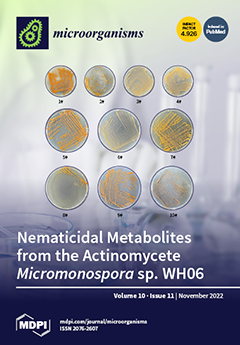
Cover Story: A nematicidal actinomycete strain, WH06, was isolated from soil samples and identified using 16S rRNA as Micromonospora sp. It was cultured on 10 media (1#–10#) to observe its growth status. It has no aerial mycelium, and its colonies had an orange–red color when cultured for 10 days. Through medium screening, large fermentation, the collection of the ethyl acetate phase, and the purification of the secondary metabolites, 10 compounds were identified. Among them, N-acetyltyramine, benzenepropanoic acid, 3-hydroxybenzoic acid, and 4-hydroxybenzoic acid exhibited nematicidal activity against Meloidogyne incognita. Meanwhile, benzenepropanoic acid showed an inhibitory effect on M. incognita egg hatching. View this paper
  • Issues are regarded as officially published after their release is announced to the table of contents alert mailing list .
  • You may sign up for email alerts to receive table of contents of newly released issues.
  • PDF is the official format for papers published in both, html and pdf forms. To view the papers in pdf format, click on the "PDF Full-text" link, and use the free Adobe Reader to open them.

Articles (215)

  • Article
  • Open Access
3 Citations
2,117 Views
13 Pages

Protective Effect of [Cu(NN1)2](ClO4) Complex in Rainbow Trout Challenged against Flavobacterium psychrophilum

  • Maialen Aldabaldetrecu,
  • Mick Parra,
  • Sarita Soto-Aguilera,
  • Pablo Arce,
  • Amaya Paz de la Vega Quiroz,
  • Rodrigo Segura,
  • Mario Tello,
  • Juan Guerrero and
  • Brenda Modak

Previously, we reported an in vitro evaluation regarding antibacterial effects against F. psychrophilum by a new Cu (I) complex, [Cu(NN1)2](ClO4). This study presents the results of an in vivo evaluation of [Cu(NN1)2](ClO4) added as a dietary supplem...

  • Article
  • Open Access
21 Citations
4,114 Views
16 Pages

Improvement of the Nutraceutical Profile of Brewer’s Spent Grain after Treatment with Trametes versicolor

  • Anđela Zeko-Pivač,
  • Anja Bošnjaković,
  • Mirela Planinić,
  • Jelena Parlov Vuković,
  • Predrag Novak,
  • Tomislav Jednačak and
  • Marina Tišma

Brewer’s spent grain (BSG) is an important secondary raw material that provides a readily available natural source of nutraceuticals. It finds its largest application as animal feed and part of the human diet, while the future perspective predi...

  • Article
  • Open Access
1 Citations
2,321 Views
14 Pages

Pheromone Activity after Stimulation with Ampicillin in a Plasmid-Free Enterococcus faecalis Strain

  • José Arellano-Galindo,
  • Sergio Zavala-Vega,
  • Rosario Vázquez-Larios,
  • Sara A. Ochoa,
  • Ariadnna Cruz-Córdova,
  • Adolfo Sierra-Santoyo,
  • Lourdes López-González,
  • Rigoberto Hernández-Castro,
  • Silvia Giono-Cerezo and
  • Juan Xicohtencatl-Cortes

Enterococci exhibit clumping under the selective pressure of antibiotics. The aim of this study was to analyze the effect of supernatants from a plasmid-free clone (C29) of Enterococcus faecalis subjected to 0.25×, 0.5×, and 0.75× o...

  • Article
  • Open Access
21 Citations
4,451 Views
16 Pages

Probiotic Therapy with Lactobacillus acidophilus and Bifidobacterium animalis subsp. lactis Results in Infarct Size Limitation in Rats with Obesity and Chemically Induced Colitis

  • Yury Y. Borshchev,
  • Inessa Y. Burovenko,
  • Alena B. Karaseva,
  • Sarkis M. Minasian,
  • Egor S. Protsak,
  • Victor Y. Borshchev,
  • Natalia Y. Semenova,
  • Olga V. Borshcheva,
  • Alexander N. Suvorov and
  • Michael M. Galagudza

In this study, we investigated the effect of three different probiotics, namely, a combination of Lactobacillus acidophilus (LA–5) and Bifidobacterium animalis subsp. lactis (BB–12), Saccharomyces boulardii, and Enterococcus faecium L3 on...

  • Article
  • Open Access
5 Citations
2,839 Views
19 Pages

Modulation of Virulence-Associated Traits in Aspergillus fumigatus by BET Inhibitor JQ1

  • Anastasia Orekhova,
  • Marta De Angelis,
  • Andrea Cacciotti,
  • Massimo Reverberi,
  • Dante Rotili,
  • Alessandra Giorgi,
  • Virginia Protto,
  • Graziana Bonincontro,
  • Francesco Fiorentino and
  • Victor Zgoda
  • + 3 authors

Aspergillus fumigatus is a disease-causing, opportunistic fungus that can establish infection due to its capacity to respond to a wide range of environmental conditions. Secreted proteins and metabolites, which play a critical role in fungal–ho...

  • Review
  • Open Access
24 Citations
5,305 Views
19 Pages

Red microalgae represent a natural reservoir of beneficial substances with applications in different industrial sectors. They are rich in natural biomolecules known for their antihypertensive, antioxidant, antimicrobial, antiviral, anti-inflammatory,...

  • Review
  • Open Access
4 Citations
4,818 Views
16 Pages

From Mouth to Muscle: Exploring the Potential Relationship between the Oral Microbiome and Cancer-Related Cachexia

  • Shreya R. Raman,
  • Christopher Liu,
  • Kelly M. Herremans,
  • Andrea N. Riner,
  • Vignesh Vudatha,
  • Devon C. Freudenberger,
  • Kelley L. McKinley,
  • Eric W. Triplett and
  • Jose G. Trevino

Cancer cachexia is a multifactorial wasting syndrome associated with skeletal muscle and adipose tissue loss, as well as decreased appetite. It affects approximately half of all cancer patients and leads to a decrease in treatment efficacy, quality o...

  • Review
  • Open Access
56 Citations
7,171 Views
20 Pages

Probiotics in Periodontal and Peri-Implant Health Management: Biofilm Control, Dysbiosis Reversal, and Host Modulation

  • Massimo Amato,
  • Federica Di Spirito,
  • Francesco D’Ambrosio,
  • Giovanni Boccia,
  • Giuseppina Moccia and
  • Francesco De Caro

Periodontitis and peri-implantitis are microbially associated diseases of the tissues supporting the teeth and dental implants that are mediated by host inflammation and eventually lead to tooth and dental implant loss. Given the probiotics’ ro...

  • Article
  • Open Access
8 Citations
3,418 Views
14 Pages

The Spouses of Stroke Patients Have a Similar Oral Microbiome to Their Partners with an Elevated Risk of Stroke

  • Huidi Wang,
  • Mengjia Yang,
  • Sanping Cheng,
  • Yueran Ren,
  • Yiting Deng,
  • Jingru Liang,
  • Xiaofei Lin,
  • Jie Li,
  • Jia Yin and
  • Qiheng Wu

Spousal members who share no genetic relatedness show similar oral microbiomes. Whether a shared microbiome increases the risk of cerebrovascular disease is challenging to investigate. The aim of this study was to compare the oral microbiota composit...

  • Article
  • Open Access
12 Citations
3,011 Views
21 Pages

Coriander (Coriandrum sativum L.) in Combination with Organic Amendments and Arbuscular Mycorrhizal Inoculation: An Efficient Option for the Phytomanagement of Trace Elements-Polluted Soils

  • Joël Fontaine,
  • Jérome Duclercq,
  • Natacha Facon,
  • Dorothée Dewaele,
  • Frédéric Laruelle,
  • Benoit Tisserant and
  • Anissa Lounès-Hadj Sahraoui

The cultivation of coriander (Coriandrum sativum L.) destined for essential oils production was recently presented as an innovative and economically viable alternative for the phytomanagement of trace elements (TE)-polluted soils. However, Cd accumul...

of 22

Get Alerted

Add your email address to receive forthcoming issues of this journal.

XFacebookLinkedIn
Microorganisms - ISSN 2076-2607