

Skip to Content

Pathogens, Volume 12, Issue 5

2023 May - 117 articles

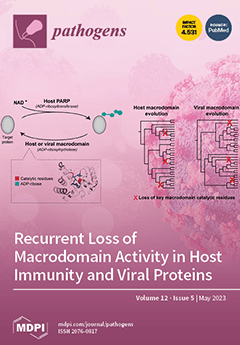
Cover Story: ADP ribosylation is an important post-translational modification in the evolutionary arms race between host immunity and viruses. Critical to this host–virus conflict is the reversal of ADP ribosylation by macrodomain-containing proteins. Here, we characterize the ADP ribosylhydrolase activity of individual macrodomains from host macrodomain-containing PARPs (known as macroPARPs), alphaviruses, and coronaviruses. Strikingly, we find that most macroPARP macrodomains either lack catalytic activity, or catalytic activity has been recurrently lost during mammalian evolution. Similarly, we reveal a recurrent loss of macrodomain enzymatic activity throughout alphavirus evolution, while coronavirus macrodomain activity is well conserved. Together, our work highlights a surprising turnover of macrodomain enzymatic activity in both hosts and viruses. View this paper
  • Issues are regarded as officially published after their release is announced to the table of contents alert mailing list .
  • You may sign up for email alerts to receive table of contents of newly released issues.
  • PDF is the official format for papers published in both, html and pdf forms. To view the papers in pdf format, click on the "PDF Full-text" link, and use the free Adobe Reader to open them.

Articles (117)

  • Article
  • Open Access
1 Citations
3,412 Views
19 Pages

Insights into the Genetic Diversity of Leishmania (Viannia) panamensis in Panama, Inferred via Multilocus Sequence Typing (MLST)

  • Daniel Mendieta,
  • Vanessa Vásquez,
  • Luis Jaén,
  • Vanessa Pineda,
  • Azael Saldaña,
  • José Eduardo Calzada and
  • Franklyn Samudio

Leishmaniasis is a disease caused by parasites of the genus Leishmania and transmitted by sand fly vectors. Tegumentary leishmaniasis is the most prevalent clinical outcome in Latin America, afflicting people from 18 countries. In Panama, the annual...

  • Review
  • Open Access
28 Citations
9,666 Views
37 Pages

The current antibiotic crisis and the global phenomena of bacterial resistance, inherited and non-inherited, and tolerance—associated with biofilm formation—are prompting dire predictions of a post-antibiotic era in the near future. These...

  • Article
  • Open Access
5 Citations
2,524 Views
18 Pages

Peptidases Are Potential Targets of Copper(II)-1,10-Phenanthroline-5,6-dione Complex, a Promising and Potent New Drug against Trichomonas vaginalis

  • Graziela Vargas Rigo,
  • Fernanda Gomes Cardoso,
  • Matheus Mendonça Pereira,
  • Michael Devereux,
  • Malachy McCann,
  • André L. S. Santos and
  • Tiana Tasca

Trichomonas vaginalis is responsible for 156 million new cases per year worldwide. When present asymptomatically, the parasite can lead to serious complications, such as development of cervical and prostate cancer. As infection increases the acquisit...

  • Article
  • Open Access
2 Citations
2,321 Views
18 Pages

Anthelmintic-Like Activity and Ultrastructure Changes Produced by Two Polyphenolic Combinations against Cooperia punctata Adult Worms and Infective Larvae

  • Elke von Son-de Fernex,
  • Estefanía Zúñiga-Olivos,
  • Luis Felipe Jiménez-García and
  • Pedro Mendoza-de Gives

Cooperia punctata is one of the most prevalent gastrointestinal nematodes affecting cattle under grazing conditions, and the increasing reports of anthelmintic resistance forces researchers to look for novel control measures. Previous reports have pr...

  • Review
  • Open Access
28 Citations
5,855 Views
24 Pages

ESKAPE and Beyond: The Burden of Coinfections in the COVID-19 Pandemic

  • Miguel Ángel Loyola-Cruz,
  • Luis Uriel Gonzalez-Avila,
  • Arturo Martínez-Trejo,
  • Andres Saldaña-Padilla,
  • Cecilia Hernández-Cortez,
  • Juan Manuel Bello-López and
  • Graciela Castro-Escarpulli

The ESKAPE group constitute a threat to public health, since these microorganisms are associated with severe infections in hospitals and have a direct relationship with high mortality rates. The presence of these bacteria in hospitals had a direct im...

  • Article
  • Open Access
6 Citations
3,231 Views
12 Pages

Comparative study of Plasmodium falciparum msp-1 and msp-2 Genetic Diversity in Isolates from Rural and Urban Areas in the South of Brazzaville, Republic of Congo

  • Marcel Tapsou Baina,
  • Abel Lissom,
  • Naura Veil Assioro Doulamo,
  • Jean Claude Djontu,
  • Dieu Merci Umuhoza,
  • Jacques Dollon Mbama-Ntabi,
  • Steve Diafouka-Kietela,
  • Jolivet Mayela,
  • Georges Missontsa and
  • Francine Ntoumi
  • + 4 authors

Polymorphisms in the genes encoding the merozoite surface proteins msp-1 and msp-2 are widely used markers for characterizing the genetic diversity of Plasmodium falciparum. This study aimed to compare the genetic diversity of circulating parasite st...

  • Article
  • Open Access
9 Citations
2,837 Views
10 Pages

Hatchability of Fascioloides magna Eggs in Cervids

  • Tibor Halász,
  • Tamás Tari,
  • Eszter Nagy,
  • Gábor Nagy and
  • Ágnes Csivincsik

The giant liver fluke (Fascioloides magna) is an invasive parasite found permanently in three foci in Europe. The fluke has an indirect life cycle involving a final and an intermediate host. The currently accepted terminology determines three types o...

  • Article
  • Open Access
10 Citations
5,598 Views
18 Pages

Mapping the Dynamics of Contemporary PRRSV-2 Evolution and Its Emergence and Spreading Hotspots in the U.S. Using Phylogeography

  • Nakarin Pamornchainavakul,
  • Igor A. D. Paploski,
  • Dennis N. Makau,
  • Mariana Kikuti,
  • Albert Rovira,
  • Samantha Lycett,
  • Cesar A. Corzo and
  • Kimberly VanderWaal

The repeated emergence of new genetic variants of PRRSV-2, the virus that causes porcine reproductive and respiratory syndrome (PRRS), reflects its rapid evolution and the failure of previous control efforts. Understanding spatiotemporal heterogeneit...

  • Article
  • Open Access
1 Citations
3,798 Views
12 Pages

Kudoa septempunctata is a myxosporean parasite that infects the trunk muscles of olive flounder (Paralichthys olivaceus) and has been reported to cause foodborne illnesses in humans. However, the molecular mechanisms underlying K. septempunctata spor...

  • Article
  • Open Access
5 Citations
2,798 Views
11 Pages

For commercial swine producers, the natural variation in body weight amongst pigs in a herd presents a challenge in meeting the standards of meat processors who incentivize target carcass weights by offering more favorable purchase prices. Body weigh...

  • Article
  • Open Access
6 Citations
2,231 Views
14 Pages

Bovine viral diarrhea virus (BVDV) induces immune dysfunction that often results in a secondary bacterial infection in the infected animals. The underlying mechanism of BVDV-induced immune dysfunction is not well understood. The role of BVDV-infected...

  • Article
  • Open Access
7 Citations
2,871 Views
16 Pages

Effect of Temperature, Water Activity and Incubation Time on Trichothecene Production by Fusarium cerealis Isolated from Durum Wheat Grains

  • Jessica G. Erazo,
  • Sofía A. Palacios,
  • Nuria A. Veliz,
  • Agostina Del Canto,
  • Silvana Plem,
  • María L. Ramirez and
  • Adriana M. Torres

Fusarium cerealis is a causal agent of Fusarium Head Blight in wheat, and it produces both deoxynivalenol (DON) and nivalenol (NIV). Nevertheless, the effect of environmental factors on the growth and mycotoxin production of this species has not been...

  • Review
  • Open Access
12 Citations
6,895 Views
22 Pages

Human T lymphotropic virus-1 (HTLV-1) was the first identified oncoretrovirus, which infects and establishes a persistent infection in approximately 10–20 million people worldwide. Although only ~5% of infected individuals develop pathologies s...

  • Article
  • Open Access
4 Citations
2,459 Views
17 Pages

Monodelphis domestica as a Fetal Intra-Cerebral Inoculation Model for Zika Virus Pathogenesis

  • John Thomas,
  • Juan Garcia,
  • Matthew Terry,
  • Susan Mahaney,
  • Oscar Quintanilla,
  • Dionn Carlo Silva,
  • Marisol Morales and
  • John L VandeBerg

Monodelphis domestica (the laboratory opossum) is a marsupial native to South America. At birth, these animals are developmentally equivalent to human embryos at approximately 5 weeks of gestation, which, when coupled with other characteristics inclu...

  • Article
  • Open Access
6 Citations
6,477 Views
13 Pages

The Ascosphaera apis Infection (Chalkbrood Disease) Alters the Gut Bacteriome Composition of the Honeybee

  • Dae Yoon Kim,
  • Soohyun Maeng,
  • Sung-Jin Cho,
  • Hui Jin Park,
  • Kyungsu Kim,
  • Jae Kwon Lee and
  • Sathiyaraj Srinivasan

The declining honeybee populations are a significant risk to the productivity and security of agriculture worldwide. Although there are many causes of these declines, parasites are a significant one. Disease glitches in honeybees have been identified...

  • Systematic Review
  • Open Access
58 Citations
13,630 Views
18 Pages

Systematic Review and Meta-Analysis of the Efficacy and Effectiveness of Pneumococcal Vaccines in Adults

  • Jennifer L. Farrar,
  • Lana Childs,
  • Mahamoudou Ouattara,
  • Fahmina Akhter,
  • Amadea Britton,
  • Tamara Pilishvili and
  • Miwako Kobayashi

New pneumococcal conjugate vaccines (PCVs), 15- and 20-valent (PCV15 and PCV20), have been licensed for use among U.S. adults based on safety and immunogenicity data compared with the previously recommended 13-valent PCV (PCV13) and 23-valent pneumoc...

  • Communication
  • Open Access
6 Citations
3,147 Views
8 Pages

Plasmodium falciparum Chloroquine-pfcrt Resistant Haplotypes in Brazilian Endemic Areas Four Decades after CQ Withdrawn

  • Rebecca de Abreu-Fernandes,
  • Natália Ketrin Almeida-de-Oliveira,
  • Bianca Ervatti Gama,
  • Larissa Rodrigues Gomes,
  • Aline Rosa De Lavigne Mello,
  • Lucas Tavares de Queiroz,
  • Jacqueline de Aguiar Barros,
  • Maria das Graças Costa Alecrim,
  • Rodrigo Medeiros de Souza and
  • Maria de Fátima Ferreira-da-Cruz
  • + 3 authors

(1) Background: Malaria is a public health problem worldwide. Despite global efforts to control it, antimalarial drug resistance remains a great challenge. In 2009, our team identified, for the first time in Brazil, chloroquine (CQ)-susceptible Plasm...

  • Article
  • Open Access
16 Citations
3,149 Views
22 Pages

Ranaviruses are promiscuous pathogens that threaten lower vertebrates globally. In the present study, two ranaviruses (SCRaV and MSRaV) were isolated from two fishes of the order Perciformes: mandarin fish (Siniperca chuatsi) and largemouth bass (Mic...

  • Communication
  • Open Access
4 Citations
2,729 Views
9 Pages

Following the publication a few months ago of the new WHO guidelines for malaria, the European pharmacist, even out of endemic areas, as a health care professional and advisor, has a major role to play in their effective implementation and in the int...

  • Article
  • Open Access
2 Citations
3,014 Views
14 Pages

Thermal Tolerance Data and Molecular Identification Are Useful for the Diagnosis, Control and Modeling of Diseases Caused by Thielaviopsis paradoxa

  • Abiodun Abeeb Azeez,
  • Daniel Ofeoritse Esiegbuya,
  • Emad Jaber,
  • Wenzi Ren,
  • Adebola Azeez Lateef,
  • Amarachi Ojieabu and
  • Fred O. Asiegbu

Several economically important diseases of forest trees and agricultural crops in many parts of the world have been linked to the ascomycete fungal pathogen Thielaviopsis paradoxa. This study compared the growth rate of 41 isolates of T. paradoxa sou...

  • Review
  • Open Access
3 Citations
2,778 Views
9 Pages

An estimated 19 million people are infected with rifampicin-resistant/multidrug-resistant strains of tuberculosis worldwide. There is little done to prevent these individuals from becoming sick with RR/MDR-TB, a disease that is associated with high r...

  • Review
  • Open Access
1 Citations
2,986 Views
12 Pages

Bacterial Pathogens Causing Pneumonia Post Hematopoietic Stem Cell Transplant: The Chronic GVHD Population

  • Said Chaaban,
  • Andrea Zimmer,
  • Vijaya Raj Bhatt,
  • Cynthia Schmidt and
  • Ruxana T. Sadikot

Allogeneic stem cell transplantation is a lifesaving treatment for many malignancies. Post-transplant patients may suffer from graft versus host disease in the acute and/or the chronic form(s). Post-transplantation immune deficiency due to a variety...

  • Brief Report
  • Open Access
9 Citations
2,499 Views
11 Pages

The Burden of HPV-Related Hospitalizations: Analysis of Hospital Discharge Records from the Years 2015–2021 from a Southern Italian Region

  • Giuseppe Di Martino,
  • Fabrizio Cedrone,
  • Pamela Di Giovanni,
  • Livia Tognaccini,
  • Edoardo Trebbi,
  • Ferdinando Romano and
  • Tommaso Staniscia

(1) Background: The human papillomavirus (HPV) is the most common agent related to sexually transmitted infections in the general population. Its genotypes are classified into two main classes, high-risk genotypes and low-risk genotypes, according to...

  • Communication
  • Open Access
5 Citations
2,564 Views
6 Pages

Do Seropositive Wild Boars Pose a Risk for the Spread of African Swine Fever? Analysis of Field Data from Latvia and Lithuania

  • Edvīns Oļševskis,
  • Marius Masiulis,
  • Mārtiņš Seržants,
  • Kristīne Lamberga,
  • Žanete Šteingolde,
  • Laura Krivko,
  • Svetlana Cvetkova,
  • Jūratė Buitkuvienė,
  • Simona Pilevičienė and
  • Klaus Depner
  • + 2 authors

In 2020, ASF occurred in wild boars throughout Latvia and Lithuania, and more than 21,500 animals were hunted and tested for the presence of the virus genome and antibodies in the framework of routine disease surveillance. The aim of our study was to...

  • Review
  • Open Access
12 Citations
5,613 Views
15 Pages

Old and Novel Enteric Parvoviruses of Dogs

  • Paolo Capozza,
  • Alessio Buonavoglia,
  • Annamaria Pratelli,
  • Vito Martella and
  • Nicola Decaro

Parvovirus infections have been well known for around 100 years in domestic carnivores. However, the use of molecular assays and metagenomic approaches for virus discovery and characterization has led to the detection of novel parvovirus species and/...

  • Article
  • Open Access
2 Citations
3,214 Views
13 Pages

Static Aerated Composting of African Swine Fever Virus-Infected Swine Carcasses with Rice Hulls and Sawdust

  • Mark Hutchinson,
  • Hoang Minh Duc,
  • Gary A. Flory,
  • Pham Hong Ngan,
  • Hoang Minh Son,
  • Tran Thi Khanh Hoa,
  • Nguyen Thi Lan,
  • Dale W. Rozeboom,
  • Marta D. Remmenga and
  • Renée Flory
  • + 4 authors

Identifying and ensuring the inactivation of the African Swine Fever virus in deadstock is a gap in the swine industry’s knowledge and response capabilities. The results of our study demonstrate that ASFv in deadstock was inactivated using stat...

  • Article
  • Open Access
12 Citations
2,584 Views
10 Pages

The African swine fever virus (ASFV) was first detected in Estonia, in September 2014. In the subsequent three years, the virus spread explosively all over the country. Only one county, the island of Hiiumaa, remained free of the disease. Due to the...

  • Article
  • Open Access
16 Citations
4,121 Views
14 Pages

Droplet digital PCR (ddPCR) recently has been shown to be a potential diagnostic tool for adults with bloodstream infections (BSIs); however, its application in children remains obscure. In this study, 76 blood samples of children with suspected BSIs...

  • Article
  • Open Access
1 Citations
2,689 Views
13 Pages

Poly ADP-ribose polymerases (PARPs) catalyze ADP-ribosylation, a subclass of post-translational modification (PTM). Mono-ADP-ribose (MAR) moieties bind to target molecules such as proteins and nucleic acids, and are added as part of the process which...

  • Communication
  • Open Access
1 Citations
2,789 Views
10 Pages

Morphologic and Genetic Analysis of Synhimantus (Synhimantus) laticeps from a Long-Eared Owl (Asio otus)

  • Carolina Lopes,
  • Sérgio Santos-Silva,
  • Carolina Nunes,
  • Susana Mendes,
  • Catarina Costa,
  • Erica Brazio,
  • Teresa Coutinho,
  • Filipa Teixeira Rodrigues,
  • João R. Mesquita and
  • Ana Patrícia Lopes
  • + 2 authors

The long-eared owl (Asio otus) is a medium-sized owl species that is well-distributed in almost all of the territories in Portugal. Nematodes were found in the oral cavity of a long-eared owl (A. otus) admitted to CRASSA (Wildlife Rehabilitation Cent...

  • Article
  • Open Access
1 Citations
3,396 Views
21 Pages

Individual Epitope-Specific CD8+ T Cell Immune Responses Are Shaped Differently during Chronic Viral Infection

  • Sebastian Klein,
  • Jasmin Mischke,
  • Finn Beruldsen,
  • Immo Prinz,
  • Dinler A. Antunes,
  • Markus Cornberg and
  • Anke R. M. Kraft

A hallmark in chronic viral infections are exhausted antigen-specific CD8+ T cell responses and the inability of the immune system to eliminate the virus. Currently, there is limited information on the variability of epitope-specific T cell exhaustio...

  • Review
  • Open Access
9 Citations
6,031 Views
36 Pages

Japanese encephalitis virus (JEV), a zoonotic flavivirus, is principally transmitted by hematophagous mosquitoes, continually between susceptible animals and incidentally from those animals to humans. For almost a century since its discovery, JEV was...

  • Perspective
  • Open Access
10 Citations
4,470 Views
10 Pages

Controlling the abundance of blacklegged ticks is considered the foundation for the prevention of human exposure to pathogens transmitted by these vectors in eastern North America. The use of broadcast or host-targeted acaricides is generally found t...

  • Review
  • Open Access
9 Citations
3,499 Views
24 Pages

The human immune repertoire retains the molecular memory of a very great diversity of target antigens (epitopes) and can recall this upon a second encounter with epitopes against which it has previously been primed. Although genetically diverse, prot...

  • Article
  • Open Access
6 Citations
3,884 Views
14 Pages

Host Cells of Leucocytozoon (Haemosporida, Leucocytozoidae) Gametocytes, with Remarks on the Phylogenetic Importance of This Character

  • Carolina Romeiro Fernandes Chagas,
  • Mélanie Duc,
  • Germán Alfredo Gutiérrez-Liberato and
  • Gediminas Valkiūnas

Leucocytozoon parasites remain poorly investigated in comparison to other haemosporidians. The host cell inhabited by their blood stages (gametocytes) remains insufficiently known. This study aimed to determine the blood cells inhabited by Leucocytoz...

  • Case Report
  • Open Access
3 Citations
2,594 Views
4 Pages

Entrapment Syndrome in a Kidney Transplant Recipient with Cryptococcal Meningitis

  • Laya Reddy,
  • George R. Thompson,
  • Alan Koff and
  • Stuart H. Cohen

Cryptococcus neoformans primarily affects immunocompromised individuals and the central nervous system (CNS) is the most common site of dissemination. Entrapped temporal horn syndrome (ETH) remains a rare CNS manifestation and has not previously been...

  • Article
  • Open Access
5 Citations
2,747 Views
11 Pages

Cryptosporidium proventriculi in Captive Cockatiels (Nymphicus hollandicus)

  • Mariele Fernanda da Cruz Panegossi,
  • Giovanni Widmer,
  • Walter Bertequini Nagata,
  • Bruno César Miranda Oliveira,
  • Elis Domingos Ferrari,
  • Jancarlo Ferreira Gomes,
  • Marcelo Vasconcelos Meireles,
  • Alex Akira Nakamura,
  • Thaís Rabelo do Santos-Doni and
  • Katia Denise Saraiva Bresciani
  • + 1 author

Cockatiels (Nymphicus hollandicus) are among the most commonly sold psittacines pets. The aim of this study was to evaluate the occurrence of Cryptosporidium spp. in domestic N. hollandicus and identify risk factors for this infection. We collected f...

  • Article
  • Open Access
6 Citations
2,630 Views
13 Pages

Semi-Quantitative Risk Assessment of African Swine Fever Virus Introduction in Outdoor Pig Farms

  • Alessia Rusinà,
  • Francesco Valentini,
  • Annalisa Scollo,
  • Giorgio Franceschini,
  • Sara Salvato,
  • Veronica Cappa,
  • Alessandro Bellato,
  • Alessandro Mannelli and
  • Silvia Bellini

In a previous study, a semi-quantitative risk assessment was developed to rank pig holdings in terms of likelihood of introducing African swine fever virus (ASFV) by assessing their compliance with biosecurity and exposure to geographical risk factor...

  • Review
  • Open Access
1 Citations
2,629 Views
14 Pages

ADP-ribosylation is a reversible post-translational protein modification, which is evolutionarily conserved in prokaryotic and eukaryotic organisms. It governs critical cellular functions, including, but not limited to cellular proliferation, differe...

  • Article
  • Open Access
6 Citations
3,635 Views
24 Pages

The phylogenetic relationships of ninety-five rose rosette virus (RRV) isolates with full-length genomic sequences were analyzed. These isolates were recovered mostly from commercial roses that are vegetatively propagated rather than grown from seed....

  • Article
  • Open Access
5 Citations
2,559 Views
11 Pages

Potential Biomarkers for Asymptomatic Visceral Leishmaniasis among Iraq-Deployed U.S. Military Personnel

  • Fernanda Fortes de Araujo,
  • Ines Lakhal-Naouar,
  • Nancy Koles,
  • Sorana Raiciulescu,
  • Rupal Mody and
  • Naomi Aronson

Visceral leishmaniasis (VL) is a chronic infection caused by Leishmania (L.) donovani or L. infantum parasites. Despite having the infection, most individuals never develop the clinical disease and are able to control the parasite and remain asymptom...

  • Article
  • Open Access
7 Citations
3,811 Views
14 Pages

Characterisation of a Staphylococcus aureus Isolate Carrying Phage-Borne Enterotoxin E from a European Badger (Meles meles)

  • Sindy Burgold-Voigt,
  • Stefan Monecke,
  • Anne Busch,
  • Herbert Bocklisch,
  • Sascha D. Braun,
  • Celia Diezel,
  • Helmut Hotzel,
  • Elisabeth M. Liebler-Tenorio,
  • Elke Müller and
  • Ralf Ehricht
  • + 3 authors

Staphylococcus (S.) aureus colonizes up to 30% of all humans and can occasionally cause serious infections. It is not restricted to humans as it can also often be found in livestock and wildlife. Recent studies have shown that wildlife strains of S. ...

  • Review
  • Open Access
42 Citations
8,076 Views
36 Pages

Leishmaniasis, a category 1 neglected protozoan disease caused by a kinetoplastid pathogen called Leishmania, is transmitted through dipteran insect vectors (phlebotomine, sand flies) in three main clinical forms: fatal visceral leishmaniasis, self-h...

  • Review
  • Open Access
4 Citations
7,871 Views
28 Pages

Heartbreaking Decisions: The Dogma and Uncertainties of Antimicrobial Therapy in Infective Endocarditis

  • Jennifer L. Adema,
  • Aileen Ahiskali,
  • Madiha Fida,
  • Krutika Mediwala Hornback,
  • Ryan W. Stevens and
  • Christina G. Rivera

Infective endocarditis (IE) is a rare but increasingly prevalent disease with high morbidity and mortality, requiring antimicrobials and at times surgical intervention. Through the decades of healthcare professionals’ experience with managing I...

  • Review
  • Open Access
16 Citations
3,954 Views
31 Pages

Anaplasma species, belonging to the family Anaplasmataceae in the order Rickettsiales, are obligate intracellular bacteria responsible for various tick-borne diseases of veterinary and human significance worldwide. With advancements in molecular tech...

  • Article
  • Open Access
3 Citations
2,078 Views
12 Pages

Arylimidamides Have Potential for Chemoprophylaxis against Blood-Transmitted Chagas Disease

  • Bruno Lisboa Timm,
  • Aline Nefertiti Silva da Gama,
  • Marcos Meuser Batista,
  • Denise da Gama Jaén Batista,
  • David W. Boykin,
  • Harry P. De Koning and
  • Maria de Nazaré Correia Soeiro

Chagas disease (CD) affects over 6 million people worldwide and can be transmitted iatrogenically. Crystal violet (CV) was previously used for pathogen reduction but has harmful side-effects. In the present study, three arylimidamides (AIAs) and CV w...

  • Article
  • Open Access
5 Citations
3,046 Views
20 Pages

Reliability of E-Tests and the Phoenix Automated Method in Assessing Susceptibility to IV Fosfomycin—Comparative Studies Relative to the Reference Method

  • Beata Kowalska-Krochmal,
  • Beata Mączyńska,
  • Danuta Smutnicka,
  • Anna Secewicz,
  • Grzegorz Krochmal,
  • Klaudyna Laufer and
  • Ruth Dudek-Wicher

The agar dilution method (ADM) recommended for IV fosfomycin (IV FOS) is complex and labor-intensive. Keeping in mind the reality of everyday laboratory work, we have evaluated the agreement of IV FOS susceptibility results obtained using the E-test...

  • Article
  • Open Access
11 Citations
2,447 Views
14 Pages

Reservoirs of Staphylococcus spp. and Streptococcus spp. Associated with Intramammary Infections of Dairy Cows

  • Svenja Woudstra,
  • Nicole Wente,
  • Yanchao Zhang,
  • Stefanie Leimbach,
  • Carsten Kirkeby,
  • Maya Katrin Gussmann and
  • Volker Krömker

To design cost-effective prevention strategies against mastitis in dairy cow farms, knowledge about infection pathways of causative pathogens is necessary. Therefore, we investigated the reservoirs of bacterial strains causing intramammary infections...

  • Review
  • Open Access
38 Citations
6,554 Views
14 Pages

Infectious bronchitis virus (IBV) is an enveloped and positive-sense single-stranded RNA virus. IBV was the first coronavirus to be discovered and predominantly causes respiratory disease in commercial poultry worldwide. This review summarizes severa...

of 3

Get Alerted

Add your email address to receive forthcoming issues of this journal.

XFacebookLinkedIn
Pathogens - ISSN 2076-0817