You are currently viewing a new version of our website. To view the old version click .

Insects, Volume 15, Issue 1

January 2024 - 79 articles

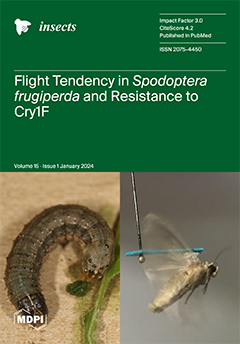
Cover Story: The fall armyworm (Spodoptera frugiperda) is a devastating pest for multiple crops, especially corn. Transgenic corn producing insecticidal proteins from Bacillus thuringiensis (Bt corn) controls S. frugiperda, although practical resistance exists in the Western Hemisphere. The long-distance flight capacity of S. frugiperda is of concern given its ongoing global spread and possible resistance dispersal. We used rotational flight mills in testing exposure to Bt insecticidal proteins on flight tendency in S. frugiperda moths, including susceptible and resistant populations. Results support that a generally lethal exposure of S. frugiperda larvae to Bt proteins increases the tendency for longer female moth flights in susceptible but not resistant moths. This information helps understand factors affecting the migratory spread of S. frugiperda and its implications for resistance management. View this paper
  • Issues are regarded as officially published after their release is announced to the table of contents alert mailing list .
  • You may sign up for email alerts to receive table of contents of newly released issues.
  • PDF is the official format for papers published in both, html and pdf forms. To view the papers in pdf format, click on the "PDF Full-text" link, and use the free Adobe Reader to open them.

Articles (79)

  • Review
  • Open Access
14 Citations
4,618 Views
16 Pages

Critical Review on the Use of Extractives of Naturally Durable Woods as Natural Wood Protectants

  • Grant T. Kirker,
  • Babar Hassan,
  • Mark E. Mankowski and
  • Fred J. Eller

18 January 2024

Naturally durable wood pre-dates preservative-treated wood and has been demonstrated to offer a suitable service life for certain applications where preservative-treated wood is not feasible. Heartwood extractives have been demonstrated to impart bio...

  • Article
  • Open Access
3 Citations
2,793 Views
19 Pages

The Lifespan of D. melanogaster Depends on the Function of the Gagr Gene, a Domesticated gag Gene of Drosophila LTR Retrotransposons

  • Yevgenia Balakireva,
  • Maria Nikitina,
  • Pavel Makhnovskii,
  • Inna Kukushkina,
  • Ilya Kuzmin,
  • Alexander Kim and
  • Lidia Nefedova

17 January 2024

(1) Background: The Gagr gene in Drosophila melanogaster’s genome originated from the molecular domestication of retrotransposons and retroviruses’ gag gene. In all Drosophila species, the Gagr protein homologs exhibit a conserved structu...

  • Article
  • Open Access
3 Citations
3,124 Views
11 Pages

Evaluation of the Potential Effect of Postbiotics Obtained from Honey Bees against Varroa destructor and Their Combination with Other Organic Products

  • Eduardo José García-Vicente,
  • María Benito-Murcia,
  • María Martín,
  • Ismael Rey-Casero,
  • Ana Pérez,
  • María González,
  • Juan Manuel Alonso and
  • David Risco

17 January 2024

The Varroa destructor mite infests Apis mellifera colonies and causes significant harm. Traditional treatments have become less effective because of mite resistance development and can also generate residues inside beehives. This study aimed to gauge...

  • Article
  • Open Access
1 Citations
2,221 Views
10 Pages

Sperm Competition and Paternity in the Endangered Firefly Pyrocoelia pectoralis (Coleoptera: Lampyridae: Lampyrinae)

  • Xinhua Fu,
  • Victor Benno Meyer-Rochow,
  • Lesley Ballantyne,
  • Xinlei Zhu and
  • Qiyulu Zhang

17 January 2024

The endangered terrestrial firefly Pyrocoelia pectoralis (Olivier) is endemic to China. Populations of P. pectoralis have decreased dramatically due to urbanization and pollution. Breeding and re-introduction to a suitable habitat may save the specie...

  • Article
  • Open Access
1 Citations
2,814 Views
10 Pages

Reproductive Behavior and Development of the Global Insect Pest, Cotton Seed Bug Oxycarenus hyalinipennis

  • Ahmed M. Saveer,
  • Jing Hu,
  • Jaime Strickland,
  • Robert Krueger,
  • Shannon Clafford and
  • Aijun Zhang

17 January 2024

Understanding the fundamental life cycle and reproductive behavior of a pest insect is essential for developing efficient control strategies; however, much of this knowledge remains elusive for a multitude of insects, including the cotton seed bug, O...

  • Article
  • Open Access
2 Citations
3,303 Views
26 Pages

Insufficient Cold Resistance as a Possible Reason for the Absence of Darkling Beetles (Coleoptera, Tenebrionidae) in Pleistocene Sediments of Siberia

  • Roman Yu. Dudko,
  • Arcady V. Alfimov,
  • Anna A. Gurina,
  • Ekaterina N. Meshcheryakova,
  • Sergei V. Reshetnikov,
  • Andrei A. Legalov and
  • Daniil I. Berman

16 January 2024

The level of diversity and abundance of darkling beetles (Coleoptera, Tenebrionidae) is the main difference between the late Pleistocene and modern insect faunas of arid regions. In the Pleistocene assemblages they are extremely rare, whereas in the...

  • Article
  • Open Access
3 Citations
3,651 Views
13 Pages

New Gall-Forming Insect Model, Smicronyx madaranus: Critical Stages for Gall Formation, Phylogeny, and Effectiveness of Gene Functional Analysis

  • Ryo Ushima,
  • Ryoma Sugimoto,
  • Yota Sano,
  • Hinako Ogi,
  • Ryuichiro Ino,
  • Hiroshi Hayakawa,
  • Keisuke Shimada and
  • Tsutomu Tsuchida

16 January 2024

The molecular mechanisms underlying insect gall formation remain unclear. A major reason for the inability to identify the responsible genes is that only a few systems can be experimentally validated in the laboratory. To overcome these problems, we...

  • Article
  • Open Access
5 Citations
2,213 Views
11 Pages

16 January 2024

The African citrus psyllid, Trioza erytreae, is one of the two vectors of Huanglongbing, the most serious citrus disease worldwide. The first detection of T. erytreae in the European mainland was on the northwest of the Iberian Peninsula in 2014. Sin...

  • Article
  • Open Access
9 Citations
3,257 Views
19 Pages

The Population Dynamics and Parasitism Rates of Ceratitis capitata, Anastrepha fraterculus, and Drosophila suzukii in Non-Crop Hosts: Implications for the Management of Pest Fruit Flies

  • María Josefina Buonocore-Biancheri,
  • Xingeng Wang,
  • Segundo Ricardo Núñez-Campero,
  • Lorena Suárez,
  • Pablo Schliserman,
  • Marcos Darío Ponssa,
  • Daniel Santiago Kirschbaum,
  • Flávio Roberto Mello Garcia and
  • Sergio Marcelo Ovruski

15 January 2024

Understanding the seasonal dynamics inherent to non-crop host–fruit fly–parasitoid interactions is vitally important for implementing eco-friendly pest control strategies. This study assessed the abundance and seasonal infestation levels...

  • Article
  • Open Access
1 Citations
2,535 Views
25 Pages

Diabrotica v. virgifera Seems Not Affected by Entomotoxic Protease Inhibitors from Higher Fungi

  • Stefan Toepfer,
  • Szabolcs Toth,
  • Tanja Zupan,
  • Urban Bogataj,
  • Nada Žnidaršič,
  • Marta Ladanyi and
  • Jerica Sabotič

15 January 2024

Certain soil insects, such as the root-damaging larvae of the maize pest Diabrotica virgifera virgifera (Coleoptera: Chrysomelidae), are increasingly difficult to control because of recent bans of some insecticides. An alternative and safer approach...

of 8

Get Alerted

Add your email address to receive forthcoming issues of this journal.

XFacebookLinkedIn
Insects - ISSN 2075-4450