You are currently viewing a new version of our website. To view the old version click .

Insects, Volume 12, Issue 2

February 2021 - 104 articles

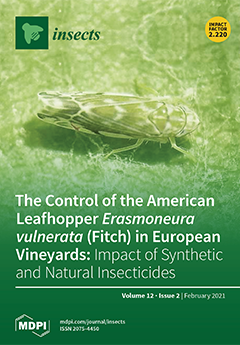
Cover Story: Erasmoneura vulnerata, a Nearctic leafhopper not damaging in North America, has become a new pest in North Italian vineyards. Winegrowers are worried because of severe leaf symptoms and the nuisance caused at harvest time. The selection of effective insecticides and the timing of their application are crucial for pest control. Field trials were carried out in Northeastern Italy to evaluate the impact of a number of insecticides against second-generation E. vulnerata. Among synthetic insecticides, the most effective were acetamiprid, flupyradifurone, and lambda-cyhalothrin. Regarding natural products, the most effective was kaolin. The identification of pest threshold levels and the evaluation of pesticide side effects on key natural enemies occurring in vineyards are required. View this paper
  • Issues are regarded as officially published after their release is announced to the table of contents alert mailing list .
  • You may sign up for email alerts to receive table of contents of newly released issues.
  • PDF is the official format for papers published in both, html and pdf forms. To view the papers in pdf format, click on the "PDF Full-text" link, and use the free Adobe Reader to open them.

Articles (104)

  • Article
  • Open Access
14 Citations
3,787 Views
15 Pages

22 February 2021

Morphometrics has been used on Triatomines, a well-known phenotypically variable insect, to understand the process of morphological plasticity and infer the changes of this phenomenon. The following research was carried out in two regions of the inte...

  • Review
  • Open Access
10 Citations
4,066 Views
17 Pages

Filtering the Junk: Assigning Function to the Mosquito Non-Coding Genome

  • Elise J. Farley,
  • Heather Eggleston and
  • Michelle M. Riehle

22 February 2021

The portion of the mosquito genome that does not code for proteins contains regulatory elements that likely underlie variation for important phenotypes including resistance and susceptibility to infection with arboviruses and Apicomplexan parasites....

  • Review
  • Open Access
22 Citations
5,538 Views
24 Pages

Toxicity of Insecticides and Miticides to Natural Enemies in Australian Grains: A Review

  • Kathy Overton,
  • Ary A. Hoffmann,
  • Olivia L. Reynolds and
  • Paul A. Umina

22 February 2021

Continued prophylactic chemical control to reduce pest populations in Australian grain farming systems has limited the effectiveness of biological control via natural enemies in crops within an integrated pest management (IPM) framework. While a vari...

  • Article
  • Open Access
6 Citations
4,643 Views
15 Pages

22 February 2021

Damage from Amyelois transitella, a key pest of almonds in California, is managed by destruction of overwintering hosts, timely harvest, and insecticides. Mating disruption has been an increasingly frequent addition to these management tools. Efficac...

  • Article
  • Open Access
16 Citations
3,141 Views
13 Pages

21 February 2021

The Mediterranean flour moth, Ephestia kuehniella Zeller (Lepidoptera: Pyralidae) and the confused flour beetle, Tribolium confusum Jacquelin du Val (Coleoptera: Tenebrionidae) are worldwide spread and notorious organisms of numerous stored-products....

  • Article
  • Open Access
12 Citations
4,538 Views
16 Pages

The Eco-Bio-Social Factors That Modulate Aedes aegypti Abundance in South Texas Border Communities

  • Jose G. Juarez,
  • Selene M. Garcia-Luna,
  • Matthew C. I. Medeiros,
  • Katherine L. Dickinson,
  • Monica K. Borucki,
  • Matthias Frank,
  • Ismael Badillo-Vargas,
  • Luis F. Chaves and
  • Gabriel L. Hamer

21 February 2021

Aedes aegypti control requires dedicated resources that are usually scarce, limiting the reach and sustainability of vector control programs. This generates a need to focus on areas at risk of disease transmission and also understand the factors that...

  • Article
  • Open Access
16 Citations
6,272 Views
12 Pages

Behavioral Responses of the Common Bed Bug to Essential Oil Constituents

  • María A. González-Morales,
  • Martín Terán and
  • Alvaro Romero

21 February 2021

Botanical-derived pesticides have arisen as an attractive alternative to synthetic insecticides to effectively manage infestations of bed bugs (Cimex lectularius L.). While information on contact, residual, and fumigant toxicity of plant-essential oi...

  • Article
  • Open Access
10 Citations
5,006 Views
9 Pages

Vector Transmission of Tomato Yellow Leaf Curl Thailand Virus by the Whitefly Bemisia tabaci: Circulative or Propagative?

  • Wei-Hua Li,
  • De-Fen Mou,
  • Chien-Kuei Hsieh,
  • Sung-Hsia Weng,
  • Wen-Shi Tsai and
  • Chi-Wei Tsai

20 February 2021

Viruses that cause tomato yellow leaf curl disease are part of a group of viruses of the genus Begomovirus, family Geminiviridae. Tomato-infecting begomoviruses cause epidemics in tomato crops in tropical, subtropical, and Mediterranean climates, and...

  • Article
  • Open Access
32 Citations
4,631 Views
24 Pages

Unexpected Effects of Local Management and Landscape Composition on Predatory Mites and Their Food Resources in Vineyards

  • Stefan Möth,
  • Andreas Walzer,
  • Markus Redl,
  • Božana Petrović,
  • Christoph Hoffmann and
  • Silvia Winter

19 February 2021

Viticultural practices and landscape composition are the main drivers influencing biological pest control in vineyards. Predatory mites, mainly phytoseiid (Phytoseiidae) and tydeoid mites (Tydeidae), are important to control phytophagous mites (Tetra...

  • Article
  • Open Access
10 Citations
2,840 Views
16 Pages

Inhibitory Copulation Effect of Vibrational Rival Female Signals of Three Stink Bug Species as a Tool for Mating Disruption

  • Aline Moreira Dias,
  • Miguel Borges,
  • Maria Carolina Blassioli Moraes,
  • Matheus Lorran Figueira Coelho,
  • Andrej Čokl and
  • Raúl Alberto Laumann

18 February 2021

Stink bugs are major pests in diverse crops around the world. Pest management strategies based on insect behavioral manipulation could help to develop biorational management strategies of stink bugs. Insect mating disruption using vibratory signals i...

of 11

Get Alerted

Add your email address to receive forthcoming issues of this journal.

XFacebookLinkedIn
Insects - ISSN 2075-4450