You are currently viewing a new version of our website. To view the old version click .

Toxins, Volume 14, Issue 6

June 2022 - 57 articles

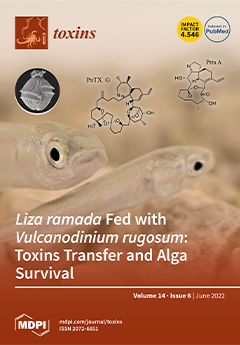
Cover Story: The harmful dinoflagellate Vulcanodinium rugosum produces potent neurotoxic and cytotoxic toxins, pinnatoxins (PnTX), and portimines (Prtn). The transfer of these toxins in the marine food chain and the dissemination of the microalga cells are essential concerns in understanding its environmental and health impacts. This work provides the first experimental evidence of the ability of a fish, the planktivorous and heavily predated juvenile grey mullet (Liza ramada), to feed on V. rugosum, to accumulate its toxins and to release viable cells through its feces. This highlights its potential to be a vector of toxins to the upper trophic levels and to disseminate toxic microalga in the environment. View this paper
  • Issues are regarded as officially published after their release is announced to the table of contents alert mailing list .
  • You may sign up for email alerts to receive table of contents of newly released issues.
  • PDF is the official format for papers published in both, html and pdf forms. To view the papers in pdf format, click on the "PDF Full-text" link, and use the free Adobe Reader to open them.

Articles (57)

  • Article
  • Open Access
12 Citations
4,734 Views
16 Pages

Contextual Constraints: Dynamic Evolution of Snake Venom Phospholipase A2

  • Vivek Suranse,
  • Timothy N. W. Jackson and
  • Kartik Sunagar

20 June 2022

Venom is a dynamic trait that has contributed to the success of numerous organismal lineages. Predominantly composed of proteins, these complex cocktails are deployed for predation and/or self-defence. Many non-toxic physiological proteins have been...

  • Article
  • Open Access
6 Citations
3,339 Views
16 Pages

Computer-Aided Analysis of West Sub-Saharan Africa Snakes Venom towards the Design of Epitope-Based Poly-Specific Antivenoms

  • Albert Ros-Lucas,
  • Pascal Bigey,
  • Jean-Philippe Chippaux,
  • Joaquim Gascón and
  • Julio Alonso-Padilla

18 June 2022

Snakebite envenomation is a neglected tropical disease that causes over 100,000 deaths each year. The only effective treatment consists of antivenoms derived from animal sera, but these have been deemed with highly variable potency and are usually in...

  • Article
  • Open Access
5 Citations
3,686 Views
9 Pages

Incobotulinum Toxin Type A for Treatment of Ultraviolet-B-Induced Hyperpigmentation: A Prospective, Randomized, Controlled Trial

  • Vasanop Vachiramon,
  • Tanaporn Anuntrangsee,
  • Pasita Palakornkitti,
  • Natthachat Jurairattanaporn and
  • Sarawin Harnchoowong

17 June 2022

Incobotulinum toxin A (IncoBoNT-A) is effective in preventing ultraviolet B (UVB)-induced hyperpigmentation. This prospective, randomized, controlled study aimed to evaluate the effect of IncoBoNT-A on the treatment of UVB-induced hyperpigmentation i...

  • Article
  • Open Access
10 Citations
3,501 Views
13 Pages

17 June 2022

Pistachio nuts can become colonized by mycotoxigenic fungi, especially Aspergillus flavus, resulting in contamination with aflatoxins (AFs). We examined the effect of gaseous O3 (50–200 ppm; 30 min; 6 L/min) on (a) in vitro germination, (b) myc...

  • Article
  • Open Access
14 Citations
5,588 Views
12 Pages

17 June 2022

Effects of the combined task-oriented trainings with botulinum toxin A (BoNT-A) injection on improving motor functions and reducing spasticity remains unclear. This study aims to investigate effects of 3 task-oriented trainings (robot-assisted therap...

  • Article
  • Open Access
2 Citations
2,144 Views
11 Pages

Investigation of Weather Triggers Preceding Outbreaks of Acute Bovine Liver Disease in Australia

  • Eve M. Manthorpe,
  • Grant T. Rawlin,
  • Mark A. Stevenson,
  • Lucy Woolford and
  • Charles G. B. Caraguel

17 June 2022

Acute bovine liver disease (ABLD) is a hepatic disease affecting cattle sporadically in southern Australia, characterised histologically by striking periportal hepatocellular necrosis. The cause of ABLD is unknown; however, the seasonality and acute...

  • Article
  • Open Access
6 Citations
3,075 Views
16 Pages

Effects of Chronic Exposure to Diets Containing Moldy Corn or Moldy Wheat Bran on Growth Performance, Ovarian Follicular Pool, and Oxidative Status of Gilts

  • Yong Zhuo,
  • Pu Yang,
  • Lun Hua,
  • Lei Zhu,
  • Xin Zhu,
  • Xinfa Han,
  • Xiaoxue Pang,
  • Shengyu Xu,
  • Xuemei Jiang and
  • Yan Lin
  • + 8 authors

17 June 2022

Background: We investigated the effect of replacing normal corn (NC) or normal wheat bran (NW) with moldy corn (MC) or moldy wheat bran (MW) on growth, ovarian follicular reserves, and oxidative status. Methods: Sixty-three Landrace × Yorkshire...

  • Article
  • Open Access
11 Citations
3,484 Views
11 Pages

Lipid Profile Is Negatively Associated with Uremic Toxins in Patients with Kidney Failure—A Tri-National Cohort

  • Sam Hobson,
  • Henriette de Loor,
  • Karolina Kublickiene,
  • Joachim Beige,
  • Pieter Evenepoel,
  • Peter Stenvinkel and
  • Thomas Ebert

16 June 2022

Patients with kidney failure (KF) have a high incidence of cardiovascular (CV) disease, partly driven by insufficient clearance of uremic toxins. Recent investigations have questioned the accepted effects of adverse lipid profile and CV risk in uremi...

  • Case Report
  • Open Access
6 Citations
3,371 Views
9 Pages

Subcutaneous BoNT/A Injection for Intractable Pain and Disability in Complex Regional Pain Syndrome: A Case Report

  • Yan Tereshko,
  • Chiara Dalla Torre,
  • Christian Lettieri,
  • Enrico Belgrado,
  • Gian Luigi Gigli and
  • Mariarosaria Valente

16 June 2022

We treated a 51-year-old woman with refractory Complex Regional Pain Syndrome type I (CRPS-I) involving her left hand and forearm with subcutaneous injections of BoNT/A. The injections were performed every 3 months, with a total of six treatments. Ea...

of 6

Get Alerted

Add your email address to receive forthcoming issues of this journal.

XFacebookLinkedIn
Toxins - ISSN 2072-6651