

You are currently viewing a new version of our website. To view the old version click .

Nutrients, Volume 14, Issue 5

March-1 2022 - 212 articles

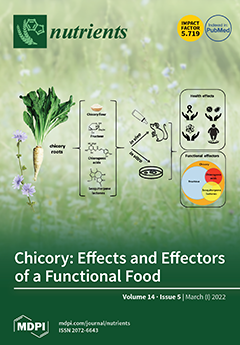
Cover Story: Three classes of molecules present in chicory root were analyzed: fructose, chlorogenic acids, and sesquiterpene lactones. Experiments on the murine model led us to a nutrigenomic analysis, a metabolic hormone assay, and a gut microbiota analysis, associated with in vitro observations for different responses. We have highlighted a large number of effects of all these classes of molecules that suggest a pro-apoptotic activity, an anti-inflammatory, antimicrobial, antioxidant, hypolipidemic, and hypoglycemic effect, and a prebiotic role. Fructose seems to be the most involved in these activities, contributing to approximately 83% of recorded responses, but the other classes of tested molecules have shown a specific role for these different effects, with an estimated contribution of 23–24%. View this paper
  • Issues are regarded as officially published after their release is announced to the table of contents alert mailing list .
  • You may sign up for email alerts to receive table of contents of newly released issues.
  • PDF is the official format for papers published in both, html and pdf forms. To view the papers in pdf format, click on the "PDF Full-text" link, and use the free Adobe Reader to open them.

Articles (212)

  • Comment
  • Open Access
1 Citations
1,974 Views
2 Pages

7 March 2022

The European soft drinks industry fully supports efforts to monitor nutrition composition of food products [...]

  • Article
  • Open Access
6 Citations
7,308 Views
9 Pages

Adverse Effects of Infant Formula Made with Corn-Syrup Solids on the Development of Eating Behaviors in Hispanic Children

  • Hailey E. Hampson,
  • Roshonda B. Jones,
  • Paige K. Berger,
  • Jasmine F. Plows,
  • Kelsey A. Schmidt,
  • Tanya L. Alderete and
  • Michael I. Goran

7 March 2022

Few studies have investigated the influence of infant formulas made with added corn-syrup solids on the development of child eating behaviors. We examined associations of breastmilk (BM), traditional formula (TF), and formula containing corn-syrup so...

  • Article
  • Open Access
63 Citations
43,858 Views
16 Pages

7 March 2022

Determinants of length of life are not well understood, and therefore increasing lifespan is a challenge. Cardinal theories of aging suggest that oxidative stress (OxS) and mitochondrial dysfunction contribute to the aging process, but it is unclear...

  • Comment
  • Open Access
3 Citations
2,795 Views
2 Pages

7 March 2022

Sobczyk and Gaunt genetically predicted circulating zinc, selenium, copper, and vitamin K1 levels—instead of directly measuring nutrients in blood—and hypothesized that these levels would associate with SARS-CoV-2 infection and COVID-19 s...

  • Article
  • Open Access
10 Citations
4,185 Views
12 Pages

Lifestyle-Related Risk Factors of Orthorexia Can Differ among the Students of Distinct University Courses

  • Monica Guglielmetti,
  • Ottavia Eleonora Ferraro,
  • Ilaria Silvia Rossella Gorrasi,
  • Elisabetta Carraro,
  • Simona Bo,
  • Giovanni Abbate-Daga,
  • Anna Tagliabue and
  • Cinzia Ferraris

6 March 2022

Orthorexia nervosa (ON) is defined as the excessive attention on healthy eating, and studies especially focused on food quality ON prevalence in university students can be extremely variable. The objective of this study is to investigate whether ther...

  • Article
  • Open Access
16 Citations
4,071 Views
17 Pages

6 March 2022

Intuitive (IE) and mindful (ME) eating share internally focused eating, yet previous studies have shown that these concepts are not strongly correlated, which suggests that they might be differently related to food intake. The study aimed to adapt th...

  • Article
  • Open Access
8 Citations
6,364 Views
12 Pages

Nutrition Risk, Resilience and Effects of a Brief Education Intervention among Community-Dwelling Older Adults during the COVID-19 Pandemic in Alberta, Canada

  • Michelle Capicio,
  • Simran Panesar,
  • Heather Keller,
  • Leah Gramlich,
  • Naomi Popeski,
  • Carlota Basualdo-Hammond,
  • Marlis Atkins and
  • Catherine B. Chan

6 March 2022

Up to two-thirds of older Canadian adults have high nutrition risk, which predisposes them to frailty, hospitalization and death. The aim of this study was to examine the effect of a brief education intervention on nutrition risk and use of adaptive...

  • Article
  • Open Access
7 Citations
4,344 Views
13 Pages

6 March 2022

Background: to evaluate the prevalence and predictors of insufficient plasma vitamin C among adults in a subtropical region and its associations with cardiovascular disease risk factors including dyslipidemia and lipid-independent markers, namely hom...

  • Review
  • Open Access
29 Citations
13,255 Views
39 Pages

The Problem of Malnutrition Associated with Major Depressive Disorder from a Sex-Gender Perspective

  • Cielo García-Montero,
  • Miguel A. Ortega,
  • Miguel Angel Alvarez-Mon,
  • Oscar Fraile-Martinez,
  • Adoración Romero-Bazán,
  • Guillermo Lahera,
  • José Manuel Montes-Rodríguez,
  • Rosa M. Molina-Ruiz,
  • Fernando Mora and
  • Roberto Rodriguez-Jimenez
  • + 2 authors

6 March 2022

Major depressive disorder (MDD) is an incapacitating condition characterized by loss of interest, anhedonia and low mood, which affects almost 4% of people worldwide. With rising prevalence, it is considered a public health issue that affects economi...

of 22

Get Alerted

Add your email address to receive forthcoming issues of this journal.

XFacebookLinkedIn
Nutrients - ISSN 2072-6643