You are currently viewing a new version of our website. To view the old version click .

Pharmaceutics, Volume 15, Issue 6

June 2023 - 213 articles

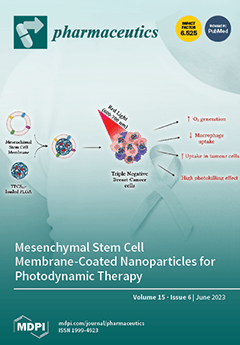
Cover Story: Localized photodynamic therapy (PDT) is a promising approach to treating breast cancer since it triggers immunity against recurrence and metastasis distant from the treated area. Despite that, the widespread application of PDT is limited by a photosensitizer's (PS) tendency to aggregate and lack of selectivity for cancer cells. In this work, we report a nanotechnological biomimetic formulation for transporting the PS meso-tetraphenylchlorin disulfonate (TPCS2a). Poly(lactic-co-glycolic) acid nanoparticles efficiently loaded TPCS2a and were coated with mesenchymal stem cell-derived plasma membranes to avoid premature clearance by the mononuclear phagocytes system and favor tumor accumulation. Encapsulation of TPCS2a into nanoparticles prevents its aggregation, facilitating the administration while maintaining therapeutic efficacy. View this paper
  • Issues are regarded as officially published after their release is announced to the table of contents alert mailing list .
  • You may sign up for email alerts to receive table of contents of newly released issues.
  • PDF is the official format for papers published in both, html and pdf forms. To view the papers in pdf format, click on the "PDF Full-text" link, and use the free Adobe Reader to open them.

Articles (213)

  • Article
  • Open Access
11 Citations
3,794 Views
21 Pages

Synthesis, Characterization, and In Vitro Cytotoxicity Evaluation of Doxorubicin-Loaded Magnetite Nanoparticles on Triple-Negative Breast Cancer Cell Lines

  • Jano Markhulia,
  • Shalva Kekutia,
  • Vladimer Mikelashvili,
  • Liana Saneblidze,
  • Tamar Tsertsvadze,
  • Nino Maisuradze,
  • Nino Leladze,
  • Zsolt Czigány and
  • László Almásy

In this study, we investigated the cytotoxicity of doxorubicin (DOX)-loaded magnetic nanofluids on 4T1 mouse tumor epithelial cells and MDA-MB-468 human triple-negative breast cancer (TNBC) cells. Superparamagnetic iron oxide nanoparticles were synth...

  • Article
  • Open Access
2 Citations
3,730 Views
28 Pages

Development of a Minimalistic Physiologically Based Pharmacokinetic (mPBPK) Model for the Preclinical Development of Spectinamide Antibiotics

  • Keyur R. Parmar,
  • Pradeep B. Lukka,
  • Santosh Wagh,
  • Zaid H. Temrikar,
  • Jiuyu Liu,
  • Richard E. Lee,
  • Miriam Braunstein,
  • Anthony J. Hickey,
  • Gregory T. Robertson and
  • Mercedes Gonzalez-Juarrero
  • + 2 authors

Spectinamides 1599 and 1810 are lead spectinamide compounds currently under preclinical development to treat multidrug-resistant (MDR) and extensively drug-resistant (XDR) tuberculosis. These compounds have previously been tested at various combinati...

  • Article
  • Open Access
16 Citations
4,925 Views
16 Pages

Mechanistic Insights into the Antibiofilm Mode of Action of Ellagic Acid

  • Alessandro Ratti,
  • Enrico M. A. Fassi,
  • Fabio Forlani,
  • Matteo Mori,
  • Federica Villa,
  • Francesca Cappitelli,
  • Jacopo Sgrignani,
  • Gabriella Roda,
  • Andrea Cavalli and
  • Stefania Villa
  • + 1 author

Bacterial biofilm is a major contributor to the persistence of infection and the limited efficacy of antibiotics. Antibiofilm molecules that interfere with the biofilm lifestyle offer a valuable tool in fighting bacterial pathogens. Ellagic acid (EA)...

  • Review
  • Open Access
32 Citations
9,175 Views
23 Pages

Research Progress of Aluminum Phosphate Adjuvants and Their Action Mechanisms

  • Ting Zhang,
  • Peng He,
  • Dejia Guo,
  • Kaixi Chen,
  • Zhongyu Hu and
  • Yening Zou

Although hundreds of different adjuvants have been tried, aluminum-containing adjuvants are by far the most widely used currently. It is worth mentioning that although aluminum-containing adjuvants have been commonly applied in vaccine production, th...

  • Article
  • Open Access
4 Citations
2,784 Views
25 Pages

Protein Corona Attenuates the Targeting of Antitumor Sialyl Lewis X-Decorated Liposomes to Vascular Endothelial Cells under Flow Conditions

  • Natalia R. Onishchenko,
  • Alexey A. Moskovtsev,
  • Maria K. Kobanenko,
  • Daria S. Tretiakova,
  • Anna S. Alekseeva,
  • Dmitry V. Kolesov,
  • Anna A. Mikryukova,
  • Ivan A. Boldyrev,
  • Marina R. Kapkaeva and
  • Olga N. Shcheglovitova
  • + 4 authors

Previously, we showed in the human umbilical vein endothelial cells (HUVECs) model that a liposome formulation of melphalan lipophilic prodrug (MlphDG) decorated with selectin ligand tetrasaccharide Sialyl Lewis X (SiaLeX) undergoes specific uptake b...

  • Article
  • Open Access
7 Citations
2,449 Views
19 Pages

In Vitro Cytotoxicity and In Vivo Antitumor Activity of Lipid Nanocapsules Loaded with Novel Pyridine Derivatives

  • Amr Selim Abu Lila,
  • Mohammed Amran,
  • Mohamed A. Tantawy,
  • Ehssan H. Moglad,
  • Shadeed Gad,
  • Hadil Faris Alotaibi,
  • Ahmad J. Obaidullah and
  • El-Sayed Khafagy

This study demonstrates high drug-loading of novel pyridine derivatives (S1–S4) in lipid- and polymer-based core–shell nanocapsules (LPNCs) for boosting the anticancer efficiency and alleviating toxicity of these novel pyridine derivative...

  • Article
  • Open Access
5 Citations
2,537 Views
18 Pages

Novel Fluorescent Benzimidazole-Hydrazone-Loaded Micellar Carriers for Controlled Release: Impact on Cell Toxicity, Nuclear and Microtubule Alterations in Breast Cancer Cells

  • Rayna Bryaskova,
  • Nikolai Georgiev,
  • Nikoleta Philipova,
  • Ventsislav Bakov,
  • Kameliya Anichina,
  • Maria Argirova,
  • Sonia Apostolova,
  • Irina Georgieva and
  • Rumiana Tzoneva

Fluorescent micellar carriers with controlled release of a novel anticancer drug were developed to enable intracellular imaging and cancer treatment simultaneously. The nanosized fluorescent micellar systems were embedded with a novel anticancer drug...

  • Article
  • Open Access
7 Citations
2,551 Views
22 Pages

The spread of colistin-resistant bacteria is a serious threat to public health. As an alternative to traditional antibiotics, antimicrobial peptides (AMPs) show promise against multidrug resistance. In this study, we investigated the activity of the...

  • Review
  • Open Access
11 Citations
3,272 Views
30 Pages

Hyaluronic Acid-Mediated Phenolic Compound Nanodelivery for Cancer Therapy

  • Simona Serini,
  • Sonia Trombino,
  • Federica Curcio,
  • Roberta Sole,
  • Roberta Cassano and
  • Gabriella Calviello

Phenolic compounds are bioactive phytochemicals showing a wide range of pharmacological activities, including anti-inflammatory, antioxidant, immunomodulatory, and anticancer effects. Moreover, they are associated with fewer side effects compared to...

  • Review
  • Open Access
28 Citations
5,162 Views
19 Pages

Toward a New Generation of Bio-Scaffolds for Neural Tissue Engineering: Challenges and Perspectives

  • Francisca Villanueva-Flores,
  • Igor Garcia-Atutxa,
  • Arturo Santos and
  • Juan Armendariz-Borunda

Neural tissue engineering presents a compelling technological breakthrough in restoring brain function, holding immense promise. However, the quest to develop implantable scaffolds for neural culture that fulfill all necessary criteria poses a remark...

of 22

Get Alerted

Add your email address to receive forthcoming issues of this journal.

XFacebookLinkedIn
Pharmaceutics - ISSN 1999-4923