Skip to Content

Journal of Composites Science

Journal of Composites Science is an international, peer-reviewed, open access journal on the science and technology of composites, published monthly online by MDPI.

Quartile Ranking JCR - Q2 (Materials Science, Composites)

Get Alerted

Add your email address to receive forthcoming issues of this journal.

All Articles (3,162)

Multifunctional polymer–ferrite composites based on poly(vinylidene fluoride) (PVDF) and magnetic fillers are of increasing interest for applications requiring coupled electrical, dielectric, and magnetic responses. However, the relationship between magnetic filler concentration, PVDF phase composition, and the resulting multifunctional properties remains insufficiently understood. In this work, PVDF/BaFe12O19 (PVDF/BaF) composite membranes containing 2–20 wt.% BaF were fabricated using a combined non-solvent and thermally induced phase-inversion (NIPS–TIPS) method. Structural evolution was analyzed by X-ray diffraction and quantitative FTIR spectroscopy, thermal behavior by differential scanning calorimetry, optical properties by diffuse reflectance spectroscopy, dielectric response in the frequency range 103–106 Hz, and magnetic characteristics by vibrating sample magnetometry. At moderate filler concentrations (2–10 wt.%), BaFe12O19 nanoparticles acted as effective β-phase nucleating centers, leading to electroactive phase fractions of 97.7–99.9% and a maximum β-phase content of 86.7% for PVDF/BaF10. At higher loadings (15–20 wt.%), particle agglomeration and restricted chain mobility promoted a transition toward α-phase-dominated crystallization. Thermal analysis indicated competing nucleation and confined crystallization processes, while optical and dielectric measurements revealed nonmonotonic changes associated with interfacial interactions and Maxwell–Wagner–Sillars polarization. Magnetic measurements showed a linear increase in saturation magnetization with filler concentration and a nonmonotonic coercivity dependence with a pronounced change near the critical agglomeration concentration. These results demonstrate that the multifunctional response of PVDF/BaFe12O19 membranes is governed by the interplay between β-phase nucleation, interfacial polarization, and magnetic particle interactions, with approximately 10 wt.% ferrite providing the most balanced electrical, dielectric, and magnetic characteristics.

19 May 2026
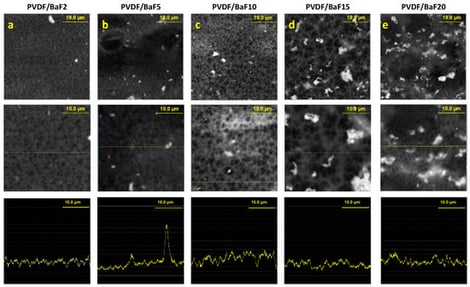
SEM images of PVDF/BaF composite films at various filler loadings: (a) 2, (b) 5, (c) 10, (d) 15, and (e) 20 wt.%. Top row—morphology within a 50 × 50 μm scan area; middle row—magnified 30 × 30 μm region with profiling line; bottom row—surface height profile along the selected line. (Surface height profile values were quantified using ImageJ 1.54d image analysis software with pixel-to-length calibration performed from the scale bar of each SEM image).

The free vibration of functionally graded (FG) beams under thermal environments is fundamental to understanding forced vibration, flutter, and thermal buckling in high-temperature structures. However, current research primarily focuses on theoretical modeling and numerical solutions, with limited mechanistic insights into temperature-dependent frequency variations and multi-factor effects. This study presents an analytical investigation coupled with experimental validation to characterize the vibration behavior of FG beams under thermal environments. First, governing equations for thermal vibration of FG beams are derived under uniform, linear, and nonlinear temperature fields based on the power-law assumption, the rule of mixtures, Timoshenko beam theory, and Hamilton’s principle. Subsequently, analytical expressions for natural frequencies and mode shapes are obtained using the state-space method. Then, experimental validation is performed to verify the model’s accuracy. Finally, the combined effects of temperature field, power-law index, slenderness ratio, and boundary conditions on the natural frequencies are systematically analyzed.

18 May 2026

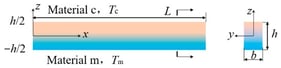
Coordinate definition and dimensions of the FG beam.

In this study, the two-dimensional aligned steel fiber-reinforced micro-expansive concrete (2D) was prepared, aiming to address the inherent vulnerabilities of concrete, such as early-age shrinkage cracking and low tensile ductility. For this purpose, the steel fibers and expansive agent were utilized. Furthermore, the planar rotating magnetic field was used to randomly distribute the steel fibers in a two-dimensional plane. In order to verify its superior mechanical and shrinkage properties, the compressive, fracture and drying shrinkage tests were carried out. The results demonstrate that the 2D alignment method enhances the fiber utilization efficiency. Compared with fiber-free groups, the compressive strength and fracture parameters of specimens incorporating steel fibers were improved. Furthermore, compared with randomly distributed steel fiber-reinforced micro-expansive concrete (RD), the 2D alignment method made the cubic compressive strength and fracture energy improve 8–14.2% and 19.4–110%, respectively. Additionally, the advantage of the fiber 2D alignment method was also reflected in the inhibition of drying shrinkage. Compared with normal concrete, the 180-day shrinkage strain of the 2D1.2 group was reduced to 200 με (only 19.5% of that of normal concrete, or 30.6% of that of micro-expansive concrete). Mechanistically, these superior performances are fundamentally governed by a coupling effect: chemical shrinkage compensation and physical alignment constraint.

17 May 2026

A schematic diagram of steel fibers rotating in a rotating magnetic field [15].

Precise Defect Reconstruction of CPVs by Adaptive Ultrasonic Imaging

  • Jie Ding,
  • Jinming Cao and
  • Hui Ding
  • + 3 authors

Composite hydrogen storage vessels exhibit pronounced anisotropy, multilayered winding architectures, and strong ultrasonic attenuation, which severely degrade the focusing accuracy and defect visibility of the conventional isotropic total focusing method (TFM). To address these challenges, this study proposes an enhanced TFM framework for defect inspection in composite hydrogen storage vessels by integrating anisotropic delay correction, Gray-code coded excitation, and coherence-weighted reconstruction. First, an anisotropic propagation delay model is established using forward ray tracing to compensate for beam deviation and focusing mismatch induced by the anisotropic winding structure. Then, Gray-code excitation and pulse compression are introduced to improve signal energy and echo detectability under high-attenuation conditions. Finally, coherence-weighted imaging is applied to suppress incoherent background noise and structural artifacts, thereby enhancing defect contrast and image readability. The proposed method is validated on hydrogen storage vessel specimens containing artificial defects, with CT results used as references. Experimental results show that, compared with conventional isotropic TFM, the proposed collaborative approach significantly improves defect imaging quality for defects of different sizes and depths. The signal-to-noise ratio is increased from 7.2, 12.8, 14.8, and 7.4 dB for isotropic TFM to 32.5, 29.9, 52.6, and 42.7 dB, respectively, for the combined anisotropic, coded-excitation, and coherence-weighted TFM. In addition, the defect depth estimation remains stable and agrees well with the CT references, yielding approximately 9.0–9.6 mm for shallow defects and 18.7–19.3 mm for deeper defects. These results demonstrate that the proposed method can effectively improve defect detectability, image contrast, and depth characterization for embedded delamination-like artificial defects in composite hydrogen storage vessels, providing a promising ultrasonic imaging strategy for thick-walled anisotropic composite pressure structures.

15 May 2026

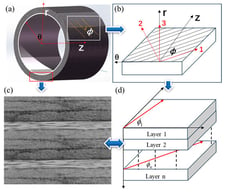
Schematical illustration of coordinate system under vessel axis and fiber axis: (a) global vessel coordinates; (b) local ply coordinates; (c) cross-sectional overwrap image; (d) layer-wise overwrap model.

News & Conferences

Volumes

Latest Issues

Open for Submission

Editor's Choice

Reprints of Collections

Composite Materials for Civil Engineering Applications
Reprint

Composite Materials for Civil Engineering Applications

Editors: Yanshuai Wang, Dong Guo, Jun He, Bai Zhang
Sustainable Composite Construction Materials, Volume II
Reprint

Sustainable Composite Construction Materials, Volume II

Editors: Krishanu Roy, G. Beulah Gnana Ananthi
XFacebookLinkedIn
J. Compos. Sci. - ISSN 2504-477X