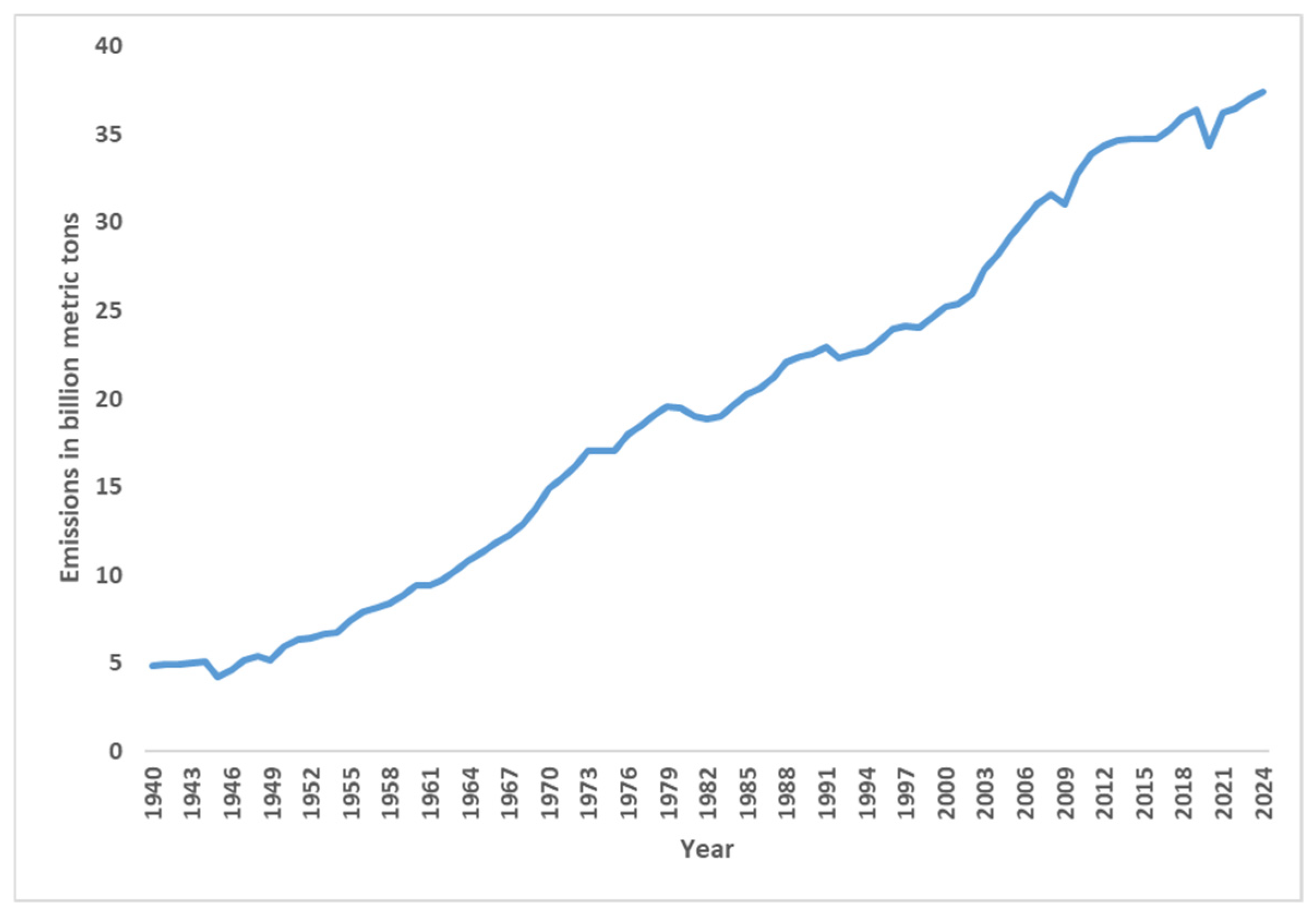


Decarbonising the Cement and Concrete Industry—A Step Forward to a Sustainable Future




Abstract
1. Introduction
1.1. Methodology of Literature Review
1.1.1. Data Sources and Search Strategy
1.1.2. Inclusion and Exclusion Criteria
- (i)
- Peer-reviewed journal articles and high-quality conference papers;
- (ii)
- Studies focusing on cement, concrete, and construction-related emissions reduction;
- (iii)
- Publications addressing technological, environmental, or policy aspects of decarbonisation;
- (iv)
- Articles published primarily between 2000 and 2025 to ensure relevance and recency.
- (i)
- Lacked sufficient technical or scientific rigor;
- (ii)
- Were not directly related to cement or concrete production;
- (iii)
- Focused on unrelated industrial sectors without clear applicability.
1.1.3. Data Analysis and Synthesis
2. Challenges of Adverse Eco-Impacts and Intense Operational Energy Consumption in the Cement and Concrete Industry
2.1. Eco-Challenges in Cement and Concrete Industry
2.1.1. Environmental Challenges of Cement Production

| Data | Details | Ref. |
|---|---|---|
| Main CO2-Releasing Reactions | (1) CaCO3 + Heat (1400 °C) → CaO + CO2 ↑ (2) C + O2 → CO2 ↑ (3) CH4 + 2O2 → 2H2O + CO2 ↑ | Equations (1)–(3) |
| Historical Emissions | 38.3 ± 2.4 Gt CO2 (1928–2018); ~71% post-1990 | [49] |
| Updated Emission Range | Dataset extended to 1880–2020 | [50] |
| Global Budget Contribution | Emission data used in Global Carbon Budget (GCB) by Global Carbon Project (GCP) | [51,52,53] |
| Data Source | CDIAC/CDIAC-FF using USGS cement production data | [54] |
| Clinker Ratio Adjustments | SCMs like GGBFS and FA lower clinker ratio, improving emission estimates | [54] |
| Primary Clinker Data | Available since 1990 | [54] |
| Recent Emission Range | 2.3–2.6 Gt CO2/year (2015–2019) | [11,55] |
| Breakdown of Emissions | ~0.8 Gt (energy use) + ~1.5 Gt (process chemistry) + >0.4 Gt (indirect energy) = ~3.1 Gt total | [11,55] |
| CO2 Intensity (Global) | Increased from 0.54 to 0.59 tCO2/t cement (2015–2020), ~1.8% annual rise | [14,15] |
| GCCA Plants Emissions | Dropped from 0.614 to 0.604 tCO2/t (2015–2019); total: 0.544 Gt CO2 in 2019 from 0.85 Gt cement | [24] |
| Emissions Variability (GCCA) | 0.623 ± 0.145 tCO2/t cement across 609 plants (2019) | [24] |
| Granular Emission Insights | Chen et al. provided detailed assessments for evaluating decarbonisation strategies | [56] |
2.1.2. CO2 Emissions from Concrete Production
| Data | Details | Ref. |
|---|---|---|
| US Concrete Emissions (2003) | Accounted for ~12% of total emissions from the cement and concrete industry (excluding cement phase) | [57] |
| US Concrete Emissions (2022) | Reduced to <8% of total lifecycle emissions from cement and concrete industry | [58] |
| Scope 3 Emissions (WEF) | 0.7–0.8 Gt CO2 out of the total ~3.4 Gt CO2 in the cement value chain | [43] |
| Scope 3—Downstream Transport | Contributes ~10–15% of Scope 3 emissions | [43] |
| Scope 3—Processing Sold Products | Processing (including concrete use) accounts for ~35% of Scope 3 emissions | [43] |
| China Concrete Output (2017) | 5.51 Gt concrete produced with 0.83 Gt CO2 emissions | [59] |
| Carbon Intensity of Concrete | ~0.08–0.12 tCO2/t concrete | [60] |
| Emissions Focus | Cement production phase is the dominant contributor to concrete’s overall CO2 impact | [61] |
2.2. Intense Operational Energy Consumption in Cement and Concrete Industry
2.2.1. Highly Energy-Intensive Contemporary Process of OPC
| Category | Details | Ref. |
|---|---|---|
| Fuel Dependency (2020) | Fossil fuels dominate; biomass = 3% and waste-derived = 6% of total thermal energy | [62] |
| GCCA Plants (2019) | Fossil = 1.92 EJ (81.1%), biomass = 0.157 EJ (6.6%), waste = 0.291 EJ (12.3%) | [24] |
| Theoretical Thermal Demand | 1.76 GJ/t clinker (ideal) | – |
| Best Actual Energy Use | ~2.8 GJ/t clinker (modern plants) due to heat losses | [63] |
| Efficient Kiln Target | 2.07 GJ/t clinker (ideal modern dry kiln) | [64] |
| Wet Process Kilns (Obsolete) | 5.86–6.28 GJ/t clinker | [65] |
| Electricity Use (1990–2018) | Reduced from ~120 to just over 100 kWh/t cement | [11] |
| Best Electricity Efficiency | <72 kWh/t cement | – |
| Electricity Use Breakdown | Raw grinding: ~16 kWh/t Pyroprocessing: ~47 kWh/t Finish grinding: 20–63 kWh/t Transport: ≤8 kWh/t | [65,66] |
| Direct Decarbonisation Approaches | Low-temp clinkers with fluxes/mineralisers (e.g., CaF2, AlF3); CSA, belite, celitement binders | [67,68,69,70,71] |
| Indirect Approaches | Blended cements (e.g., PSC, PPC), production upgrades, waste heat recovery (WHR) | [67,68,69,70,71] |
| Emerging Innovations | Electric clinkerization, hydrogen fuel use, renewable-powered calcination | [72] |
2.2.2. Energy Utilization in Concrete Manufacturing
| Category | Details | Ref. |
|---|---|---|
| Energy Use Breakdown | Mixing: <6% Transportation: >11% Quarrying & aggregate processing: ~3% | [66] |
| Embodied Energy (General Range) | 1–2.8 GJ/m3 (based on mix, strength, and materials) | [66] |
| Embodied Energy (Concrete Products) | 450–850 MJ/m3 depending on application and material efficiency | [77] |
| Key Influencing Factors | 1. Use of SCMs (e.g., FA, slag, and silica fume) reduces embodied energy | – |
| 2. Aggregate type & sourcing—local materials lower transport energy | – | |
| 3. Efficient production (automated batching, advanced mixers) lowers operational energy | – | |
| 4. Curing methods—energy-intensive methods (e.g., steam curing) raise total energy use | – |
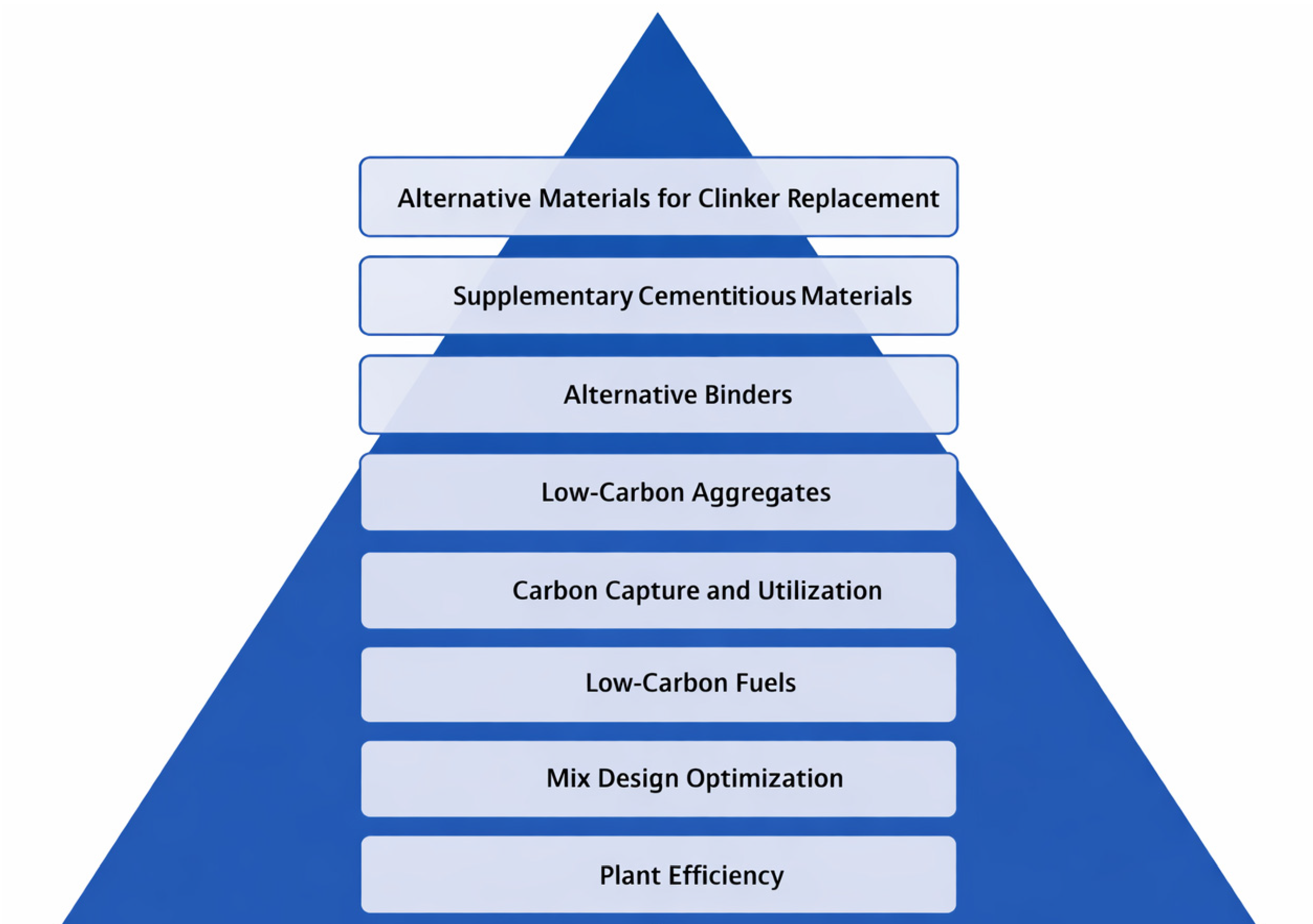
3. Material Incorporations, Efficiencies and Substitutions for Decarbonising the Cement and Concrete Sector
3.1. Integration of SCMs
| SCM | Source | Max Replacement | Key Benefits | CO2 Reduction Potential | Ref. |
|---|---|---|---|---|---|
| Fly Ash (FA) | Coal combustion by-product | Up to 70% (HVFA) | Pozzolanic activity, lowers heat, enhances durability | Up to 30% | [80,81,82,83] |
| Ground Granulated Blast Furnace Slag (GGBFS) | Steel industry (blast furnace) | Up to 50% | Cementitious, enhances strength & durability | 22–40% | [84,85,86,87] |
| Silica Fume (SF) | Silicon/ferrosilicon industry | ~5% | High strength, workability improvement | Not specified | [88,89] |
| Rice Husk Ash (RHA) | Agro-waste (rice husk) | Up to 30% | Densifies matrix, improves durability | Moderate | [90,91] |
| Bagasse Ash (BA) | Sugarcane residue | ~20% | Carbon footprint reduction | Moderate | [91] |
| Natural Pozzolans | Perlite, pumice | Up to 30% | Igneous origin, widespread availability | Not specified | [92] |
| Calcined Clay | Metakaolin, kaolinite | Up to 50% (LC3) | Early strength, low carbon calcination | 15–30% | [93,94,95,96,97,98] |
| Category | Material/Strategy | Source/Process/Ingredients | Impact/Benefits | CO2/GWP Reduction | Remarks/Notes | Ref. |
|---|---|---|---|---|---|---|
| Alternative SCMs | Ye’elimite-based CSA cements | Bauxite, limestone, sulphates | Reduced clinker demand | >20% | Lower CaCO3 need; phase-sensitive blends | [99,100] |
| Calcined clays | Thermal treatment (<900 °C) | Lower energy vs. OPC | 27–35% | Efficient activation | [101,102,103,104,105] | |
| Zeolite | Natural pozzolan | High reactivity | Up to 70% GWP | Optimal at 10–30 wt%; calcination improves reactivity | [106,107,108,109,110,111] | |
| Recycled glass powder (RGP) | Glass waste | Suitable for UHPC | 42–53% | Limited LCA studies | [112,113] | |
| Iron/Copper tailings | Mining waste | SCM potential | Under study | Needs chemical/thermal activation | [114,115,116,117] | |
| MSW incineration ash | Waste-to-energy ash | Waste utilization | Regional (~125,000 tons/year) | Reduces clinker use | [118,119,120,121,122,123,124,125] | |
| SCM Source Categories | Industrial by-products | FA, GGBFS, SF, calcined clay | Cost-effective, consistent | — | Widely used | [126,127,128,129,130,131] |
| Raw & calcined minerals | Kaolinite, zeolite, bentonite | Moderate energy input | — | Requires calcination | [101,102,103,104,132,133,134,135] | |
| Agricultural solid waste | Corn cob ash, eggshell powder | Sustainable potential | — | Early stage research | [136,137,138,139,140] | |
| Agricultural ashes | RHA, SCBA, bamboo, palm oil ash | High pozzolanic activity | — | 600–800 °C processing | [137,141,142,143,144] | |
| MSW ash | APC residue, bottom ash | Clinker/aggregate use | — | May affect cement chemistry | [118,119,120,121,122,123,124,125] | |
| Blended Cement Strategies | FA + GGBFS | Binary blend | Durable, widely validated | 2.745 billion tons CO2 reduction | Established approach | [145,146] |
| Limestone + SCMs (ternary) | Multi-component blends | Improved rheology | 10–28% GHG; 20–38% GWP | Maintains strength | [130,131] | |
| Diatomaceous earth + limestone | Hybrid blend | High sustainability | 37% total; 56% (28-day GWP) | Promising mix | [109] | |
| Zeolite blends (10–30%) | Pozzolanic substitution | Optimized at 20% | Up to 70% GWP | High efficiency | [110,111] | |
| Clinker-Free/Novel Binders | Belite-rich cement | Lime sludge + sponge iron | Lower sintering temp | Energy reduction | ~1390 °C processing | [147] |
| Sulphur-activated binder | Ferrous + sulphur waste | Carbonation potential | CO2 capture (4.75 g/kg) | Waste reuse | [148] | |
| Wet-ground GGBFS blend | Phosphogypsum + carbide slag | High strength (45 MPa) | 12% CO2; 51% cost saving | Efficient process | [149] | |
| Clinker-free binders | PPW + ISWs | Low-energy systems | — | Needs activation/carbonation | [149,150] | |
| General Insights/Challenges | SCM substitution | OPC replacement | Resource efficiency | 12–20% (20% vol.); 6–28% (30 MPa) | Proven emission reduction | [151,152] |
| Quarry dust | Mineral addition | Improves microstructure | — | Functional SCM | [153] | |
| Circular economy | Waste-derived SCMs | Resource valorisation | — | Sustainability driver | [154] | |
| Industry trends | Low-carbon binders | Innovation focus | — | SCM shortages emerging | — | |
| Emerging research | Durability & performance | Environmental benefits | — | Limited carbon assessments | [79,155,156,157] | |
| Industrial by-products | GGBFS, gypsum, kiln dust | SCM potential | — | Logistics affect sustainability | [147,158,159,160,161,162,163,164] | |
| Mining tailings | Iron/Copper tailings | Alternative SCM | — | Requires activation | [165] | |
| Mechanical impact | Strength–performance trade-off | — | — | May offset CO2 gains | — |
3.2. Recycling of Materials
| Category | Summary | Ref. |
|---|---|---|
| Downcycling Use | Mostly secondary aggregates for non-structural use; some landfill | [168] |
| Open vs. Closed Loop | Open loop common; closed loop (reuse in concrete) rare | — |
| Strength & Emissions | Unseparated aggregates lower strength, may increase cement use and emissions | [169] |
| Transport Influence | Transport mode/distance affects emissions slightly | — |
| Fines Recycling | Binder fines recycled as clinker/SCMs via separation or calcining | [170,171,172] |
| Tech & Standards | Need better quality control, sorting, standards, modular design | — |
| Limestone Aggregate | Possible direct kiln feed; impact unclear | [173] |
| Utilization of Unprocessed Discarded Binder in a Cement Manufacturing Kiln | Shown to produce clinker with a mineral composition comparable to that of PC clinker, while reducing pyro-processing emissions by around 33% | [174] |
| Overall Impact | Emission reduction uncertain, no clear estimate | — |
3.3. Construction Material Substitutions
3.4. High-Performance Materials
3.5. Material Efficiency
3.6. Recycled OPC Powders (RCPs)
| Category | Summary | Refs |
|---|---|---|
| Production | Thermal treatment (600–800 °C); crushing/grinding tested | [171,171,186,187,188,189,190] |
| Techniques | Two-step carbonation; mechanical + magnetic separation | [186,190] |
| Reactivity | α’H–C2S phase drives early hydration and microstructure | [186,190] |
| Heat-treatment Effects | 450 °C - best strength; 650 °C - portlandite decomposes | [188,191] |
| Concrete Use | Up to 20% substitution maintains strength; >20% may affect workability; durability OK up to 50% | [189,192] |
| Carbon Emissions | 94% lower CO2 at 450 °C vs. OPC; emissions 58–75% of clinker; ~13% without pre-treatment | [63,193] |
3.7. Integration of Eco-Friendly Aggregates to Develop Recycled Aggregate Concrete (RAC)
| Data | Key Points | Refs |
|---|---|---|
| Types | Fine/coarse; natural from river/crushed rock | [205,206] |
| Environmental Issues | High CO2 from extraction/transport | [205] |
| Recycled Materials | CDW, glass, tires, bricks, asphalt | [195,206,207,208] |
| Benefits | Cuts raw extraction, landfill, CO2, and cost | [200,201,202] |
| Challenges | High absorption, strength loss, energy use | [207,208] |
| Solutions | SCMs, carbon mineralization (CRAC), treatments | [202,203] |
| Global Supply | Large CDW/glass availability | [197,198,199,209,210] |
| Emissions Reduction | 22–46% less CO2 vs. natural aggregates | [200,201] |
| Key Factors | Transport distances crucial | [211,212] |
| Research & Collaboration | Ongoing studies; need cross-sector efforts | [213] |
4. Alternative Clinker/Binder Materials
| Category | Type/Description | Key Features & Challenges | Refs |
|---|---|---|---|
| A. Hydraulic Clinkers | (i) Reactive belite-rich PC (RBPC) (ii) Belite-ye’elimite-ferrite (BYF) | Harden with water only; suitable for reducing emissions in standard concrete applications | — |
| B. Carbonatable Clinker | Carbonatable calcium silicate clinker (CCSC) | Harden by reacting with CO2; promotes carbon uptake | — |
| C. Dual-reacting Clinker | Magnesium oxides from magnesium silicates (MOMSs) | Undergo both hydration and carbonation reactions, enabling dual-reactivity for strength development and CO2 uptake | — |
| Waste-based Hydraulic Binders | Derived from municipal waste, CDW, industrial/agro by-products | Enables clinker-free production; dual benefit—emissions reduction & waste valorisation | — |
| Raw Material Substitution | Early research: partial clinker replacement with waste Recent research: 100% waste-derived binders | Transition from partial to full waste substitution | — |
| CO2 Emission Source | Emissions from limestone calcination during clinker production | Major contributor to CO2 emissions due to high-temperature decarbonation | — |
| Waste Alternatives | GGBFS, pulverised fuel ash, residual foundry sand | Potential substitutes but often low in CaO; cannot fully replace limestone | — |
| Adoption in Europe | ~5% high-CaO waste used in cement; only ~10% clinker replacement achievable | Limited by strength loss and CaO content | [204] |
| Benefits | Lower CO2 emissions and energy demand | Reduction in limestone use and calcination energy | — |
| Challenges | Early strength reduction; limitations in substituting limestone completely | Technical performance barriers for full-scale implementation | — |
4.1. Reactive Belite-Rich Portland Clinkers (RBPCs)
| Key Point | Details | Refs |
|---|---|---|
| Energy Savings | RBPC clinker production saves 500–540 kJ/kg clinker vs. OPC | [215] |
| Carbon Emission Reduction | ~32 kg CO2/t clinker (6% reduction) with 62% belite, 16% alite RBPC vs. OPC; overall 10% reduction from energy savings | [214] |
| Industrial By-product Use | Substituting limestone/clay with rock and calcium carbonate sludge allows firing at 1100 °C; ~24% CO2 reduction | [216] |
| Historical Use & Composition | Belite-rich binders date back to Roman times; require ~10% less limestone; lower firing temp than alite clinkers | [217] |
| Advantages | Lower heat of hydration, improved rheology, better long-term durability (compact structure, less Ca(OH)2) | [217] |
| Limitations | Lower early age strength due to slower hydration (4x less at 28 days); strength equalizes after 1 year | [217] |
| Causes of Slow Reactivity | Dense structure limits water penetration; lower Ca2+ solubility attached to SiO4 tetrahedron | [218] |
| Enhancement Methods | Metal oxide doping in belite lattice to increase water penetration and dissolution | — |
| Novel dendritic belite + amorphous C-S phase clinker with C/S = 1.4, two-step cooling improves strength up to 4× traditional belite | — | |
| Applications | Suited for low-heat, high-strength later-age concrete, large volume/high-performance structures | [219] |
| Overall Impact | Up to 10% CO2 process emission reduction; insufficient alone to meet cement industry climate goals | — |
4.2. Oil Shale Portland Clinker
4.3. Reduce Intensity of PC Clinker
4.3.1. Reduce Overdesign
4.3.2. Clinker Factor Reduction
4.4. Low-Carbon Alternative Binders
| Key Point | Details | Refs |
|---|---|---|
| Definition & Sustainability | GP binders are alkali-activated industrial by-products (fly ash, slag, and clays) offering a sustainable alternative to OPC | [232] |
| CO2 Emission Reduction | Up to 80–90% CO2 reduction vs. OPC; e.g., 0.18 kg CO2/kg geopolymer cement (~1/5 of OPC emissions) | [1,231] |
| Precursors & Activators | Common precursors: Type F fly ash (low Ca) and blast furnace slag; activators: NaOH, sodium silicate, and potassium hydroxide | [233,234,235] |
| Curing Requirements | Alkali-activated fly ash requires ~55 °C curing; lower temperatures reduce strength | [234] |
| Performance | Slag activated with NaOH/silicate shows improved mechanical properties; fast strength gain for repair materials | [235] |
| GP Types | One-part (“just add water”) and two-part binders; aluminosilicate precursors include fly ash, GGBFS, metakaolin, and clays | [236] |
| Additional Sustainable Precursors | Rice husk ash, recycled glass powder, and lime kiln dust improve sustainability and reduce carbon footprint | [237] |
| Commercial & Market Potential | Growing commercial interest; market projected to reach $19 B by 2028; recognized for sustainability and performance | [238,239,240] |
| Large-scale Applications | University of Queensland GCI building (33% GPC in floors), Brisbane West Wellcamp Airport (~40,000 m3 GPC; 6600 tons CO2 saved) | [241] |
| Environmental & Energy Benefits | GPC reduces carbon footprint by ~90%, operational energy by ~60%; supports circular economy and waste valorisation | [1] |
4.5. Portland Limestone Cement (PLC) Binder
4.6. Limestone Calcined Clay Cement (LC3) Binder
| Key Point | Details | Refs |
|---|---|---|
| CO2 Reduction Potential | Substituting half of the clinker content with a blend of calcined clay and limestone can lower CO2 emissions by approximately 25% to 40% | [251,252] |
| Clinker Substitution Range | LC3 can replace up to 60% of clinker; higher than traditional limestone (~15%) or calcined clay (~25%) | [97] |
| Mechanical & Durability Properties | Maintains or improves strength, chloride resistance, and durability | [251,253] |
| Source & Availability | Calcined clay is often an industrial by-product; widely available and viable for global use | — |
| Calcination Method Impact | Flash calcination improves clay reactivity over static/rotary kilns | — |
| Hydration Chemistry | Al from kaolinite forms C-A-S-H; interlayer water increases after early delay, enhancing long-term strength | [254,255] |
| Environmental Benefits | Energy efficiency, lower GHGs, waste valorisation; 16–38% CO2 footprint reduction shown in different regions | [251,256] |
| Cost & Plant Compatibility | No major plant changes needed; ball mills adequate; retrofitting old kilns is more cost-effective than new calcination tech | [251,257] |
| Process Optimization | Requires adjustment in particle size distribution, inter-grinding for rheology and early strength | [258] |
| Adoption & Scale-Up | Commercial/pilot production in India, Brazil, Cuba; successful use of low-grade clays with alternative fuels | [256,257] |
| Clay Source Flexibility | Environmental impact varies <7% between high vs. low kaolinite clays; supports use of waste-derived clays | [256] |
| Underrepresented in LCA | LC3 is not yet fully captured in LCA studies for global decarbonisation targets | — |
| Strategic Role | Promising for near- to mid-term cement decarbonisation; scalable with existing infrastructure | — |
4.7. Belite Portland Cement (BPC) Binder
5. Alternative/Emerging Technologies
5.1. Calcium Sulphoaluminate Cement (CSA) or Belite-Ye’elimite Binder
| Type of Cement/Clinker | Key Components/Phases | Advantages | Limitations/Challenges | References |
|---|---|---|---|---|
| Aerther Clinker (Lafarge) | High belite concentration, reduced lime content | Reduces CO2 emissions by 20–30%; uses cost-effective raw materials | Not yet fully scaled up; different reactivity than OPC | [278,279] |
| Calcium Sulphoaluminate (CSA) Cement | Ye’elimite [Ca4(AlO2)6SO4], belite [Ca2SiO4], calcium sulphate | Lower sintering temperature (~1250 °C); early strength; low shrinkage; freeze–thaw resistance | Limited alumina-rich raw materials; carbonation susceptibility | [276,280,281] |
| Belite-Ye’elimite-Ferrite (BYF) Cement | Belite, ye’elimite, ferrite [4CaO·Al2O3·Fe2O3] | Lower cost; less aluminum dependency; similar strength to OPC | Susceptible to carbonation; slower ferrite hydration | [100,214,282] |
5.2. Carbonatable Calcium Silicate and Alternative Binders
5.3. Emerging Clinker Technologies
5.3.1. Magnesium Oxides Derived from Magnesium Silicates (MOMSs) Clinkers
5.3.2. Solidia Clinker Technology
5.3.3. Celitement Clinker
5.3.4. X-Clinker
5.4. Magnesia Cements
5.5. Solidia Cement
5.6. Celitement or Calcium Hydrosilicate Cement
6. Use of Alternative Fuels in the Cement–Concrete Industry
| Category | Details | Advantages | Challenges/Limitations | Refs |
|---|---|---|---|---|
| Conventional Fuels | Coal was traditionally dominant; now partially replaced by natural gas in EU cement kilns. | Natural gas offers lower CO2 emissions than coal. | Fossil fuels remain high-carbon sources. | [324,325] |
| Alternative Fuels (AFs) | EU cement industry uses ~45% AFs; potential to increase to 90%. Include RDF, wood chips, and biomass. | Reduce fossil fuel use and CO2 emissions; can reach 100% replacement theoretically. | Temperature control and technical constraints limit full replacement. | [324,326] |
| Biomass-based Fuels | Agricultural/forest residues (e.g., wheat, rye, wood) with sustainability safeguards. Biomass emits CO2 equal to what plants absorb. | Renewable, net-zero CO2; produces SCM-rich ash for cement. | Limited availability; still causes pollution when combusted. | [327] |
| Fuel Usage Trends | AF use rose ~9× from 1990–2017; now ~5% in developing vs. 20% in developed countries. Expected to reach 40% and 80% by 2050. | Supports waste management, lowers landfill use, and reduces emissions. | Infrastructure and policy adaptation required. | [328] |
| Hydrogen as a Fuel | Used for kiln heating or heat recovery. Co-produced oxygen helps in oxyfuel carbon capture. | Zero emissions; 44–55% carbon reduction potential; high adaptability. | Costly; still under development; dependent on electricity source. | [72,329,330,331,332,333] |
| Hybrid Hydrogen Systems | On-site hydrogen from waste gasification; potential integration with natural gas systems. | Reduces costs; utilizes fuel ash in clinker; improves energy recovery (up to 55%). | Technology still experimental. | [333,334] |
| High-energy Waste Fuels | Includes waste plastics, tires (28–40 MJ/kg), industrial oils/solvents (29–36 MJ/kg), sewage sludge. | Readily available; similar energy profile to fossil fuels; energy recovery possible. | Pollutants during combustion; needs emissions control. | [335,336] |
| Sustainability & Circularity | Using industrial/agri/municipal waste as AFs or SCMs. Promotes circular economy and decarbonisation. | Reduces CO2, conserves resources, cuts energy demand. | Availability, uniform quality, and emissions control. | — |
6.1. Hydrogen (H2) as a Fuel for Cement Kilns
6.2. Biomass and Waste as Optional Fuels
6.3. Oxyfuel and Oxyfuel Carbon Capture
6.4. Application of Electricity in Cement Production
6.5. Electrolysis to Produce Calcium Hydroxide
6.6. Plasma and Microwave Technologies
6.7. Electromagnetic Heating
6.7.1. Induction Heating
6.7.2. Microwave Heating
6.8. Resistive Electrical Heating
6.9. Enhancing Thermal Energy Efficiency
6.10. Enhancing Electrical Energy Efficiency
6.11. Enhancing Energy and Feedstock Efficiency
6.12. Enhancing Energy Efficiency in Cement Production
7. Advanced Technologies for Decarbonising the Cement and Concrete Sector
7.1. Carbon Capturing
| Key Point | Details | Refs |
|---|---|---|
| Role of CCS | Critical for deep CO2 reductions in cement sector; needed to meet 2050 climate targets (552–707 Mt CO2/yr) | — |
| Post-combustion Capture | Uses amine solvents; 95% capture rate, 99% purity; energy-intensive (3 MJ/t CO2); solvent degradation affected by kiln gases | [370,389,390,391] |
| Membrane Capture | No regeneration needed; ~80% capture yield; low TRL, not yet tested industrially in cement flue gases | [370,392] |
| Calcium Looping (CaL) | Reversible CaO ↔ CaCO3 carbonation–calcination cycle; promising CO2 capture technology; requires high-temperature calciner (>900°C); under development | [393] |
| Oxyfuel Combustion | Uses pure O2; CO2-rich exhaust allows 60–99% capture; requires plant retrofit, air separation, and gas recirculation | [379,380,381,394,395,396] |
| Retrofit Feasibility | Retrofit needs 6-month plant stoppage; equipment upgrades required; energy-efficient if fully integrated | [395] |
| Transport & Storage | CO2 transported by pipeline or ship; stored in geological formations; costs: 1–15 €/t (transport), 1–20 €/t (storage) | [382,397] |
| Existing Storage Sites | Sleipner gas field (North Sea) operational; >230 Mt CO2 injected globally; 18 CCS plants capture ~40 Mt CO2/year | [398,399] |
| CO2 Utilization (CCU) | CO2 can be used for chemicals/fuels (via hydrogenation); limited by market size and life-cycle CO2 release | [389,400] |
| Algae-based Capture | Surface area constraints limit feasibility; may work at niche sites | [370] |
| Policy & Infrastructure Needs | CO2 networks (e.g., North Sea) essential; EU funding and Market Maker model proposed for CCS infrastructure | [401,402] |
| Cost Outlook | CCS cost expected to drop (~40 €/t CO2); progress depends on industrial-scale deployment and political will | [399] |
| Integration Potential | CCS complements renewables for deep decarbonisation; long-term policy support is essential | [399] |
7.2. Carbon Capture and Storage (CCS)
| Category | Key Points | References |
|---|---|---|
| CCS in Cement Production | CCS is central to Portland cement (PC) clinker decarbonisation. Can target combined process + fuel emissions or process-only emissions. | [386] |
| Integrated CCS | Extracts CO2 from combined process and fuel emissions through the application of various techniques like amine scrubbing, calcium looping, or oxyfuel combustion to reduce non-CO2 gases. | [374,386] |
| Direct CCS | Separates limestone calcination from fuel combustion; extracts high-purity CO2, typically sourced from units such as the preheater or precalciner. | [414] |
| Flexible Systems | Some systems like pre-combustion CCS can act as combined or direct CCS, depending on use of H2 for combustion or indirect heating. | [415] |
| Kiln Electrification | Plasma/microwave heating technologies align with direct CCS by separating heat source from calcination. | – |
| Preferred CCS Route | For producing Portland cement clinker, combined CCS using oxyfuel combustion is considered the most suitable option. | [374] |
| Implementation Challenges | High cost is a major hurdle; currently, the European Union hosts just a single operational CCS demonstration facility. | [354,416,417] |
| CCU for Revenue | CCU improves financial feasibility by creating products from CO2; must match PC production scale and durability to be effective. | [183,418] |
| CCS Impact Potential | Could contribute ~21% decarbonisation assuming 50% adoption rate in cement industry. | [354,374] |
| Oxyfuel + Biomass | Can reduce CO2 emissions to 24–169 g/kg clinker; climate impacts lowered by 74–91%. | [419] |
| LCA & Emission Estimates | More in-depth LCA studies needed to assess CCUS impact; methodologies emerging. | [388] |
| CCUS Market Growth | US market projected to reach USD 4.3–8.5 billion by 2027; promising but still in development. | – |
| CCU Process Summary | CO2 captured (via absorption/adsorption), activated chemically, then mixed in batching process to form stable carbonates in concrete. | – |
| Key Capture Techniques | Amine-based absorption, Ca-looping, oxygen-enriched combustion, and inherent separation processes. | [420,421,422] |
| Amine Scrubbing | CO2-selective solvent absorbs flue gases; solvent is regenerated and reused. Longstanding technology. | [420] |
| Calcium Looping | Uses CaO to form CaCO3; then calcined at 800–950 °C to release CO2. Challenges include sintering and high temperature. | [421] |
| Oxy-combustion | Uses oxygen-enriched air to produce CO2-rich flue gas with minimal N2; facilitates easier capture. | [422] |
| Concrete CO2 Utilization | Mineral carbonation during concrete production can sequester CO2. | [423] |
| CO2 Curing in Concrete | Since 1990s, accelerated carbonation improves strength, durability, and microstructure. | [423,424,425,426] |
| Commercial Examples | Carbon Cure (Canada) uses CO2 from power plants; Kajima (Japan) produces CO2-SUICOM with industrial by-product γ-C2S. | [427,428] |
| Limitations & Risks | Not a full substitute for renewables/efficiency; potential durability issues like steel corrosion in carbonated concrete due to lower pH. | – |
7.3. Carbon Capture and Storage (CCS) in Cement Plants
| Category | Description/Key Points | References |
|---|---|---|
| Oxy-combustion | • Replaces air with pure O2 in combustion, producing CO2- and H2O-rich flue gas. • Enables high CO2 capture efficiency. • High energy demand for oxygen production. • Requires infrastructure for CO2 handling. | [422] |
| Electrochemical Decarbonisation | • Novel ambient-temperature electrolyzer decomposes CaCO3. • Produces solid Ca(OH)2 for calcium silicate synthesis. • Generates H2 and O2 + CO2 gas streams for potential reuse. | [320] |
| CO2 Transport Methods | • Pipelines for large volumes over long distances. • Ships and trucks used for shorter distances. • Pipelines offer secure, cost-effective transport. | [434,435,436] |
| Geological CO2 Storage | • Depleted oil/gas reservoirs: reuse existing infrastructure. • Saline aquifers: store CO2 in porous rock. • Unmineable coal seams: enable enhanced methane recovery. | [437,438] |
| Site Characterization & Monitoring | • Assess permeability, porosity, and leakage potential. • Use seismic imaging, pressure monitoring, geochemical analysis. | [439] |
| CCS in Cement Industry | • Reduces CO2 emissions. • Lowers cement sector carbon footprint. • Supports sustainable cement production. | [440,441,442] |
| Strategies for Cost Reduction | • Capture process optimization. • Improve solvent efficiency. • Integrate waste heat recovery. | [440] |
| CO2 Utilization | • Use in enhanced oil recovery or other industrial processes. • Improves economic viability of CCS. | [440] |
| Benefits of CCS Adoption | • Substantial CO2 emission reductions. • Helps meet global climate targets. • Enables low-carbon cement production. • Promotes circular economy and offset markets. • Enhances company reputation and stakeholder interest. | [441,442] |
| Challenges of CCS | • High capital and operational costs. • Complex infrastructure requirements. • Transport/storage logistics and investment burdens. • Requires secure and long-term storage solutions. | [443,444,445] |
| R&D Focus Areas | • Improve solvent/sorbent performance. • Reduce energy requirements for capture. • Optimize regeneration and continuous operation. • Innovate pipeline, compression, and storage technologies. • Explore new financing models. | [446,447] |
7.4. Oxy-Combustion with CCS
7.5. Direct Separation with CCS
7.6. CO2 Extraction After Combustion via Physical Techniques
7.7. Mineral Carbonation for CO2 Removal After Combustion
7.8. Adsorption-Based Post-Combustion CO2 Capture
7.9. Membrane-Based Approaches for CO2 Capture After Combustion
7.10. Carbon Dioxide Removal via Solid Sorbents: Carbonate and Calcium Looping Approaches
7.11. Indirect Calcination as a Carbon Capture Strategy
8. Carbon Uptake in Concrete
8.1. Carbon-Cured Concrete
8.2. Biochar Concrete
8.3. Enhanced Recarbonation
9. Bio-Mineralized Cement and Engineered Living Building Materials (LBMs)
10. Grid Decarbonisation
11. Cutting-Edge Technological Advancements for GHG Reductions
12. Decarbonisation of Concrete Industry Through Innovative Technologies
12.1. Construction Technologies
12.2. Circular Economy for Prefabricated and Modular Construction
12.3. Utilization of Digital Technologies
12.4. Alternative Mixing Solutions
12.5. Greener Construction Processes
12.6. Advances in High-Performance and Specialty Concrete
12.7. Other Approaches
13. Key Advances in Reducing Carbon Emissions Within the Cement and Concrete Industry
- The LEILAC (Low Emissions Intensity Lime and Cement) initiative, led by the European Cement Research Academy, represents a significant advancement in applying carbon capture technology to cement production [530]. This project employs Calix’s Direct Separation Process to selectively extract CO2 from kiln flue gases, which is then utilized to manufacture synthetic limestone via mineral carbonation [531]. This method not only lowers greenhouse gas emissions but also generates a valuable by-product, highlighting the importance of carbon capture and utilization (CCU) in driving decarbonisation efforts in the cement industry.
- LafargeHolcim has actively involved sustainable practices by replacing fossil fuels with alternative energy sources [335]. The company incorporates waste-derived fuels and biomass, as well as non-recyclable plastics in its production. This strategy not only reduces reliance on fossil fuels but also removes waste plastics from landfills, supporting waste management principles. LafargeHolcim’s continued innovation and commitment to alternative fuel optimization demonstrate a significant step toward environmental sustainability in cement production.
- The GCCA has played a critical role in uniting the cement and concrete sectors, encouraging collaborative efforts for sustainability and decarbonisation. Through initiatives such as “2050 Climate Ambition,” the GCCA is uniting stakeholders in lowering carbon dioxide emissions and working toward achieving global climate goals. This platform facilitates knowledge exchange, fosters the development of low-carbon technologies, and encourages the adoption of circular economy principles across the industry. By engaging with policymakers, the GCCA is helping shape regulations that promote decarbonisation and sustainable practices.
- In 2021, leading cement manufacturers such as LafargeHolcim, HeidelbergCement as well as Cemex pledged their support to the Race to Zero campaign, a worldwide effort focused on reaching net-zero carbon emissions by 2050 [532]. This demonstrates the cement sector’s proactive approach to climate change mitigation. These companies are incorporating lower carbon methods, such as alternate fuels and innovative production techniques, to reduce emissions throughout the cement manufacturing process.
- Certification systems such as LEED, BREEAM, and DGNB provide a structured framework to assess building sustainability [533]. These certifications emphasize energy efficiency and the use of low-carbon materials, thereby creating demand for eco-friendly cement and concrete. They encourage builders to choose sustainable materials, fostering awareness of carbon reduction strategies and waste management. These certifications help guide the industry toward more sustainable practices and increase the value of certified structures.
14. Economic Aspects and Techno-Economic Feasibility of Decarbonisation Technologies
15. Strategies for Achieving Deep Decarbonisation
16. Research and Innovation Priorities
17. Challenges and Barriers in Adoption of Diverse Pathways to Decarbonising the Cement and Concrete Sector
18. Future Trends and Recommendations
- More Investment in Carbon Capture and Utilization (CCU): Expanding CCU technology to reduce emissions.
- Wider Use of SCMs, Geopolymers, Nanotechnology, and 3D-printing Technologies: Increasing adoption of sustainable alternatives.
- Policies and Incentives: Government encouragement for low-carbon materials.
- Better Industry Collaboration: Sharing knowledge to drive innovation and adoption.
- Ongoing Innovation in Sustainable Materials: Developing new eco-friendly solutions for construction.
19. Conclusions
Author Contributions
Funding
Institutional Review Board Statement
Informed Consent Statement
Data Availability Statement
Conflicts of Interest
Abbreviations
References
- Davidovits, J. Geopolymer Chemistry and Applications; Geopolymer Institute: Saint-Quentin, France, 2008. [Google Scholar]
- Wen, J.; Wang, B.; Dai, Z.; Shi, X.; Jin, Z.; Wang, H.; Jiang, X. New insights into the green cement composites with low carbon footprint: The role of biochar as cement additive/alternative. Resour. Conserv. Recycl. 2023, 197, 107081. [Google Scholar] [CrossRef] [Scilit]
- Luhar, S.; Chaudhary, S.; Luhar, I. Development of rubberized geopolymer concrete: Strength and durability studies. Constr. Build. Mater. 2019, 204, 740–753. [Google Scholar] [CrossRef] [Scilit]
- Luhar, S.; Chaudhary, S.; Luhar, I. Thermal resistance of fly ash based rubberized geopolymer concrete. J. Build. Eng. 2018, 19, 420–428. [Google Scholar] [CrossRef] [Scilit]
- Pearce, F. Can the World’s Most Polluting Heavy Industries Decarbonize? YaleEnronment360. Yale School of Environment. 2021. Available online: https://e360.yale.edu/features/can-the-worlds-most-polluting-heavy-industries-decarbonize (accessed on 1 December 2025).
- International Energy Agency; World Business Council for Sustainable Development. Technology Roadmap: Low-Carbon Transition in the Cement Industry; International Energy Agency: Paris, France, 2018. [Google Scholar]
- Monteiro, P.J.; Miller, S.A.; Horvath, A. Towards sustainable concrete. Nat. Mater. 2017, 16, 698–699. [Google Scholar] [CrossRef] [Scilit] [PubMed]
- International Energy Agency. Energy Technology Perspectives 2015: Mobilising Innovation to Accelerate Climate Action; International Energy Agency: Paris, France, 2014. [Google Scholar]
- Ali, M.B.; Saidur, R.; Hossain, M.S. A review on emission analysis in cement industries. Renew. Sustain. Energy Rev. 2011, 15, 2252–2261. [Google Scholar] [CrossRef] [Scilit]
- Ali, N.; Abbas, J.; Anwer, M.; Alwi, S.K.K.; Anjum, M.N.; Author, C.; Jaffar, A. The greenhouse gas emissions produced by cement production and its impact on environment: A review of global cement processing. Int. J. Res. 2015, 2, 488–500. [Google Scholar]
- Cao, Z.; Masanet, E.; Tiwari, A.; Akolawala, S. Decarbonizing Concrete Deep Decarbonization Pathways for the Cement and Concrete Cycle in the United States, India, and China; Northwestern University: Evanston, IL, USA, 2021. [Google Scholar]
- Van Oss, H.G.; Padovani, A.C. Cement manufacture and the environment, Part II: Environmental challenges and opportunities. J. Ind. Ecol. 2003, 7, 93–126. [Google Scholar] [CrossRef] [Scilit]
- Wächter, M.R.; Ionel, I.; Dan, D.; Negrea, A. Investigation of environmental leaching behavior of an innovative method for landfilling of waste incineration air pollution control residues. Energies 2021, 14, 1025. [Google Scholar] [CrossRef] [Scilit]
- International Energy Agency. Global Cement Production in the Net Zero Scenario, 2010–2030. Paris. 2021. Available online: https://www.iea.org/data-and-statistics/charts/global-cement-production-in-the-net-zero-scenario-2010-2030-5260 (accessed on 14 April 2026).
- International Energy Agency. Direct CO2 Emissions from Industry in the Net Zero Scenario, 2000–2030. Paris. 2021. Available online: https://www.iea.org/data-and-statistics/charts/direct-co2-emissions-from-industry-in-the-net-zero-scenario-2000-2030 (accessed on 14 April 2026).
- IPCC. Special Report: Global Warming of 1.5 °C; IPCC: Geneve, Switzerland, 2018. [Google Scholar]
- Habert, G. Habert, G., Miller, S. A., John, V. M., Provis, J. L., Favier, A., Horvath, A., & Scrivener, K. L. Environmental impacts and decarbonization strategies in the cement and concrete industries. Nat. Rev. Earth Environ. 2020, 1, 559–573. [Google Scholar] [CrossRef] [Scilit]
- World Resources Institute. Climate Watch. 2019. Available online: https://www.climatewatchdata.org/ (accessed on 14 April 2026).
- UN Industrial Development Organization. Advancing economic competitiveness. In UNIDO Annual Report; United Nations Industrial Development Organization: Vienna, Austria, 2019. [Google Scholar]
- Royal Dutch Shell. Sky Scenario; Royal Dutch Shell: The Hague, The Netherlands, 2018. [Google Scholar]
- International Energy Agency. Energy Technology Perspectives 2017; International Energy Agency: Paris, France, 2017. [Google Scholar]
- Energy Transitions Commission. Mission Possible: Reaching Net-Zero Carbon Emissions from Harder-to-Abate Sectors by Mid-Century; Energy Transitions Commission: London, UK, 2018. [Google Scholar]
- Schneider, M. The cement industry on the way to a low-carbon future. Cem. Concr. Res. 2019, 124, 105792. [Google Scholar] [CrossRef] [Scilit]
- Global Cement and Concrete Association. GNR Database. 2019. Available online: https://gccassociation.org/gnr/ (accessed on 14 April 2026).
- Leilac. LEILAC: Capturing Unavoidable CO2 Process Emissions in the Cement and Lime Industries. D3.6 Life Cycle Assessment. Low Emission Intensity Lime and Cement Project. 2021. Available online: https://ec.europa.eu/research/participants/documents/downloadPublic?documentIds=080166e5df29e8fc&appId=PPGMS (accessed on 14 April 2026).
- Voldsund, M.; Anantharaman, R.; Lena Ede Fu, C.; Gardarsdottir, S.; Jamali, A.; Pérez-Calvo, J.-F.; Romano, M.; Roussanaly, S.; Ruppert, J.; Stallmann, O.; et al. CEMCAP Comparative Techno-Economic Analysis of CO2 Capture in Cement Plants (D4.6); CEMCAP: Trondheim, Norway, 2019. [Google Scholar]
- Wasim, M.; Abadel, A.; Abu Bakar, B.; Alshaikh, I.M. Future directions for the application of zero carbon concrete in civil engineering—A review. Case Stud. Constr. Mater. 2022, 17. [Google Scholar] [CrossRef] [Scilit]
- Thonemann, N.; Zacharopoulos, L.; Fromme, F.; Nühlen, J. Environmental impacts of carbon capture and utilization by mineral carbonation: A systematic literature review and meta life cycle assessment. J. Clean. Prod. 2022, 332. [Google Scholar] [CrossRef] [Scilit]
- VDZ (Ed.) Decarbonisation Pathways for the Australian Cement and Concrete Sector; VDZ: Düsseldorf, Germany, 2021. [Google Scholar]
- Dekarbonisierung von Zement und Beton—Minderungspfade und Handlungsstrategien—Eine CO2-Roadmap für die Deutsche Zementindustrie; VDZ, Ed.; VZD: Düsseldorf, Germany, 2020; Summary in English. [Google Scholar]
- PCA (Ed.) Roadmap to Carbon Neutrality; PCA: Washington, DC, USA, 2021. [Google Scholar]
- SNIC; ABCP. Cement Technology Roadmap—Carbon Emissions Reduction Potential in the Brazilian Cement Industry by 2050; SNIC: Rio de Janeiro, Brazil; ABCP: Rio de Janeiro, Brazil, 2019. [Google Scholar]
- Cembureau (Ed.) Cementing the European Green Deal—Reaching Climate Neutrality Along the Cement and Concrete Value Chain by 2050; Cembureau: Brussels, Belgium, 2020. [Google Scholar]
- IEA (Ed.) Low-Carbon Technology for the Indian Cement Industry—Technology Roadmap; IEA: Paris, France, 2013. [Google Scholar]
- Vanderborght, B.; Koch, F.; Grimmeissen, L.; Wehner, S.; Heersche, P.; Degré, J.; Square, O. Low-Carbon Roadmap for the Egyptian Cement Industry; European Bank for Reconstruction and Development: London, UK, 2016. [Google Scholar]
- GCCA (Ed.) Concrete Future—The GCCA 2050 Cement and Concrete Industry Roadmap for Net Zero Concrete; Global Cement and Concrete Association: London, UK, 2021. [Google Scholar]
- Bhattacherjee, S.; Basavaraj, A.S.; Rahul, A.V.; Santhanam, M.; Gettu, R.; Panda, B.; Schlangen, E. Sustainable materials for 3D concrete printing. Cem. Concr. Compos. 2021, 122, 104156. [Google Scholar] [CrossRef] [Scilit]
- BRE Group. BREEAM—Building Research Establishment Environmental Assessment Method. 2022. Available online: https://www.breeam.com (accessed on 14 April 2026).
- Shan, M.; Hwang, B. Green building rating systems: Global reviews of practices and research efforts. Sustain. Cities Soc. 2018, 39, 172–180. [Google Scholar] [CrossRef] [Scilit]
- Dotson, G.; Maghamfar, D.J. The clean air act amendments of 2022: Clean air, climate change, and the inflation reduction act. Environ. Law Rep. 2023, 53, 10017. [Google Scholar]
- Holechek, J.L.; Geli, H.M.E.; Sawalhah, M.N.; Valdez, R. A global assessment: Can renewable energy replace fossil fuels by 2050? Sustainability 2022, 14, 4792. [Google Scholar] [CrossRef] [Scilit]
- Tiseo, I. Annual Carbon Dioxide (CO2) Emissions Worldwide from 1940 to 2024. Statista. 2025. Available online: https://www.statista.com/statistics/276629/global-co2-emissions/?srsltid=AfmBOooy0qtUjSILFvIPEs3tk6vFg2QgfhN6tQS5oKcuvr-ws49rfoZH (accessed on 14 April 2026).
- World Economic Forum. Net-Zero Industry Tracker—2022 Edition; World Economic Forum: Geneva, Switzerland, 2022. [Google Scholar]
- Global Infrastructure Emission Database. GID-Cement Emission Database. Available online: http://gidmodel.org.cn/?page_id=27 (accessed on 14 April 2026).
- Miller, S.A.; Horvath, A.; Monteiro, P.J.M. Readily implementable techniques can cut annual CO2 emissions from the production of concrete by over 20. Environ. Res. Lett. 2016, 11, 074029. [Google Scholar] [CrossRef] [Scilit]
- Prakasan, S.; Palaniappan, S.; Gettu, R. Study of energy use and CO2 emissions in the manufacturing of clinker and cement. J. Inst. Eng. Ser. A 2020, 101, 221–232. [Google Scholar] [CrossRef] [Scilit]
- Imbabi, M.S.; Carrigan, C.; McKenna, S. Trends and developments in green cement and concrete technology. Int. J. Sustain. Built Environ. 2012, 1, 194–216. [Google Scholar] [CrossRef] [Scilit]
- Antunes, M.; Santos, R.L.; Pereira, J.; Rocha, P.; Horta, R.B.; Colaço, R. Alternative clinker technologies for reducing carbon emissions in cement industry: A critical review. Materials 2021, 15, 209. [Google Scholar] [CrossRef] [Scilit]
- Andrew, R.M. Global CO2 emissions from cement production, 1928–2018. Earth Syst. Sci. Data 2019, 11, 1675–1710. [Google Scholar] [CrossRef] [Scilit]
- Andrew, R. Global CO2 emissions from cement production. Earth Syst. Sci. Data 2018, 10, 195–217. [Google Scholar] [CrossRef] [Scilit]
- Andrew, R.M.; Peters, G.P. The Global Carbon Project’s Fossil CO2 Emissions Dataset. 2021. Available online: https://cir.nii.ac.jp/crid/1883398392538407296 (accessed on 14 April 2026).
- Friedlingstein, P.; Jones, M.W.; O’Sullivan, M.; Andrew, R.M.; Bakker, D.C.E.; Hauck, J.; Le Quéré, C.; Peters, G.P.; Peters, W.; Pongratz, J.; et al. Global carbon Budget 2021. Earth Syst. Sci. Data 2022, 14, 1917–2005. [Google Scholar] [CrossRef] [Scilit]
- Global Carbon Project. Supplemental Data of Global Carbon Project 2021. 2021. Available online: https://meta.icos-cp.eu/objects/lApekzcmd4DRC34oGXQqOxbJ (accessed on 14 April 2026).
- Gilfillan, D.; Marland, G. CDIAC-FF: Global and national CO2 emissions from fossil fuel combustion and cement manufacture: 1751–2017. Earth Syst. Sci. Data 2021, 13, 1667–1680. [Google Scholar] [CrossRef] [Scilit]
- International Energy Agency. Direct CO2 Emissions from Selected Heavy Industry Sectors, 2019. 2020. Available online: https://www.iea.org/data-and-statistics/charts/direct-co2-emissions-from-selected-heavy-industry-sectors-2019 (accessed on 14 April 2026).
- Chen, C.; Xu, R.; Tong, D.; Qin, X.; Cheng, J.; Liu, J.; Zheng, B.; Yan, L.; Zhang, Q. A striking growth of CO2 emissions from the global cement industry driven by new facilities in emerging countries. Environ. Res. Lett. 2022, 17, 044007. [Google Scholar] [CrossRef] [Scilit]
- Choate, W.T. Energy and Emission Reduction Opportunities for the Cement Industry; BCS Inc.: Laurel, MD, USA, 2003. [Google Scholar]
- Hottle, T.; Hawkins, T.R.; Chiquelin, C.; Lange, B.; Young, B.; Sun, P.; Elgowainy, A.; Wang, M. Environmental life-cycle assessment of concrete produced in the United States. J. Clean. Prod. 2022, 363. [Google Scholar] [CrossRef] [Scilit]
- Guo, Z.; Jiang, T.; Zhang, J.; Kong, X.; Chen, C.; Lehman, D.E. Mechanical and durability properties of sustainable self-compacting concrete with recycled concrete aggregate and fly ash, slag and silica fume. Constr. Build. Mater. 2020, 231, 117115. [Google Scholar] [CrossRef] [Scilit]
- Gartner, E. Industrially interesting approaches to “low-CO2” cements. Cem. Concr. Res. 2004, 34, 1489–1498. [Google Scholar] [CrossRef] [Scilit]
- Concrete needs to lose its colossal carbon footprint. Nature 2021, 597, 593–594. [CrossRef] [Scilit]
- International Energy Agency. Global Thermal Energy Intensity and Fuel Consumption of Clinker Production in the Net Zero Scenario 2015–2030. 2021. Available online: https://www.iea.org/data-and-statistics/charts/global-thermal-energy-intensity-and-fuel-consumption-of-clinker-production-in-the-net-zero-scenario-2015-2030 (accessed on 14 April 2026).
- Sousa, V.; Bogas, J.A. Comparison of energy consumption and carbon emissions from clinker and recycled cement production. J. Clean. Prod. 2021, 306, 127277. [Google Scholar] [CrossRef] [Scilit]
- Summerbell, D.L.; Barlow, C.Y.; Cullen, J.M. Potential reduction of carbon emissions by performance improvement: A cement industry case study. J. Clean. Prod. 2016, 135, 1327–1339. [Google Scholar] [CrossRef] [Scilit]
- Taylor, M.; Tam, C.; Gielen, D. Energy Efficiency and CO2 Emissions from the Global Cement Industry; International Energy Agency: Paris, France, 2006. [Google Scholar]
- Visintin, P.; Xie, T.; Bennett, B. A large-scale life-cycle assessment of recycled aggregate concrete: The influence of functional unit, emissions allocation and carbon dioxide uptake. J. Clean. Prod. 2020, 248, 119243. [Google Scholar] [CrossRef] [Scilit]
- Atmaca, A.; Atmaca, N. Carbon footprint assessment of residential buildings, a review and a case study in Turkey. J. Clean. Prod. 2022, 340. [Google Scholar] [CrossRef] [Scilit]
- Chatziaras, N.; Psomopoulos, C.S.; Themelis, N.J. Use of alternative fuels in cement industry. In Proceedings of the 12th International Conference on Protection and Restoration of the Environment; Athens Institute for Education and Research (ATINER): Athens, Greece, 2014; ISBN 978-960-88490-6-8. [Google Scholar]
- Çimen, Ö. Construction and built environment in circular economy: A comprehensive literature review. J. Clean. Prod. 2021, 305. [Google Scholar] [CrossRef] [Scilit]
- International Energy Agency; World Business Council for Sustainable Development. Technology Roadmap Low-Carbon Transition in the Cement Industry; International Energy Agency: Paris, France; World Business Council for Sustainable Development: Geneva, Switzerland, 2009. [Google Scholar]
- Poerner, M.; Musgrove, G.; Beck, G.; Nolen, C.J. Waste Heat Recovery. In Fundamentals and Applications of Supercritical Carbon Dioxide (sCO2) Based Power Cycles; Brun, K., Friedman, P., Dennis, R., Eds.; Elsevier: Amsterdam, The Netherlands, 2017; pp. 255–267. [Google Scholar]
- Juangsa, F.B.; Cezeliano, A.S.; Darmanto, P.S.; Aziz, M. Thermodynamic Analysis of Hydrogen Utilization as Alternative Fuel in Cement Production. S. Afr. J. Chem. Eng. 2022, 42, 23–31. [Google Scholar] [CrossRef] [Scilit]
- Hossain, M.U.; Ng, S.T.; Antwi-Afari, P.; Amor, B. Circular economy and the construction industry: Existing trends, challenges and prospective framework for sustainable construction. Renew. Sustain. Energy Rev. 2020, 130, 109948. [Google Scholar] [CrossRef] [Scilit]
- Galvez-Martos, J.L.; Styles, D.; Schoenberger, H.; Zeschmar-Lahl, B. Construction and demolition waste best management practice in Europe. Resour. Conserv. Recycl. 2018, 136, 166–178. [Google Scholar] [CrossRef] [Scilit]
- Hasan, A.; Elmualim, A. Entire concrete waste reuse model. In Multi-Functional Concrete with Recycled Aggregates; Woodhead Publishing: Cambridge, UK, 2023; pp. 363–379. [Google Scholar]
- Hanifa, M.; Agarwal, R.; Sharma, U.; Thapliyal, P.C.; Singh, L.P. A Review on CO2 Capture and Sequestration in the Construction Industry: Emerging Approaches and Commercialised Technologies. J. CO2 Util. 2023, 67, 102292. [Google Scholar] [CrossRef] [Scilit]
- Cabeza, L.F.; Barreneche, C.; Miró, L.; Morera, J.M.; Bartolí, E.; Fernández, A.I. Low carbon and low embodied energy materials in buildings: A review. Renew. Sustain. Energy Rev. 2013, 23, 536–542. [Google Scholar] [CrossRef] [Scilit]
- Hussain, I.; Ali, B.; Rashid, M.U.; Amir, M.T.; Riaz, S.; Ali, A. Engineering properties of factory manufactured paving blocks utilizing steel slag as cement replacement. Case Stud. Constr. Mater. 2021, 15, e00755. [Google Scholar] [CrossRef] [Scilit]
- Juenger, M.C.G.; Snellings, R.; Bernal, S.A. Supplementary cementitious materials: New sources, characterization, and performance insights. Cem. Concr. Res. 2019, 122, 257–273. [Google Scholar] [CrossRef] [Scilit]
- Herath, C.; Gunasekara, C.; Law, D.W.; Setunge, S. Performance of High Volume Fly Ash Concrete Incorporating Additives: A Systematic Literature Review. Constr. Build. Mater. 2020, 258, 120606. [Google Scholar] [CrossRef] [Scilit]
- Sideris, K.; Justnes, H.; Soutsos, M.; Sui, T. Fly ash. In Properties of Fresh and Hardened Concrete Containing Supplementary Cementitious Materials; De Belie, N., Soutsos, M., Gruyaert, E., Eds.; State-Of-The-Art Report of the RILEM Technical Committee 238-SCM, Working Group; Springer International Publishing: Cham, Switzerland, 2018; Volume 4, pp. 55–98. [Google Scholar]
- Marinković, S.; Dragaš, J. 11—Fly ash. In Waste and Supplementary Cementitious Materials in Concrete; Siddique, R., Cachim, P., Eds.; Woodhead Publishing: Cambridge, UK, 2018; pp. 325–360. [Google Scholar]
- Lee, C.Y.; Lee, H.K.; Lee, K.M. Strength and microstructural characteristics of chemically activated fly ash—cement systems. Cem. Concr. Res. 2003, 33, 425–431. [Google Scholar] [CrossRef] [Scilit]
- Patra, R.K.; Mukharjee, B.B. Influence of Incorporation of Granulated Blast Furnace Slag as Replacement of Fine Aggregate on Properties of Concrete. J. Clean. Prod. 2017, 165, 468–476. [Google Scholar] [CrossRef] [Scilit]
- Huntzinger, D.N.; Eatmon, T.D. A life-cycle assessment of Portland cement manufacturing: Comparing the traditional process with alternative technologies. J. Clean. Prod. 2009, 17, 668–675. [Google Scholar] [CrossRef] [Scilit]
- Samad, S.; Shah, A. Role of binary cement including Supplementary Cementitious Material (SCM), in production of environmentally sustainable concrete: A critical review. Int. J. Sustain. Built Environ. 2017, 6, 663–674. [Google Scholar] [CrossRef] [Scilit]
- Higgins, D. Sustainable concrete: How can additions contribute. In Proceedings of the Institute of Concrete Technology Annual Technical Symposium; Institute of Concrete Technology: Camberley, UK, 2006. [Google Scholar]
- Adil, G.; Kevern, J.T.; Mann, D. Influence of Silica Fume on Mechanical and Durability of Pervious Concrete. Constr. Build. Mater. 2020, 247, 118453. [Google Scholar] [CrossRef] [Scilit]
- Van Oss, H. Iron and Steel Slag, Mineral Commodity Summaries; US Geological Survey: Reston, VA, USA, 2008.
- Siddika, A.; Al Mamun, M.A.; Alyousef, R.; Mohammad Hosseini, H. State-of-the-Art-Review on Rice Husk Ash: A Supplementary Cementitious Material in Concrete. J. King Saud Univ. Eng. Sci. 2021, 33, 294–307. [Google Scholar] [CrossRef] [Scilit]
- Gursel, A.P.; Maryman, H.; Ostertag, C. A life-cycle approach to environmental, mechanical, and durability properties of “green” concrete mixes with rice husk ash. J. Clean. Prod. 2016, 112, 823–836. [Google Scholar] [CrossRef] [Scilit]
- Diaz-Loya, I.; Juenger, M.; Seraj, S.; Minkara, R. Extending supplementary cementitious material resources: Reclaimed and remediated fly ash and natural pozzolans. Cem. Concr. Compos. 2019, 101, 44–51. [Google Scholar] [CrossRef] [Scilit]
- Scrivener, K.; Martirena, F.; Bishnoi, S.; Maity, S. Calcined clay limestone cements (LC3). Cem. Concr. Res. 2018, 114, 49–56. [Google Scholar] [CrossRef] [Scilit]
- Akindahunsi, A.A.; Avet, F.; Scrivener, K. The Influence of some calcined clays from Nigeria as clinker substitute in cementitious systems. Case Stud. Constr. Mater. 2020, 13, e00443. [Google Scholar] [CrossRef] [Scilit]
- Guan, J.; Wang, S.; Li, L.; Xie, C.; Khan, M.; Niu, L. Design of rock material parameters by cracked straight through Brazilian disc. Construct. Build. Mater. 2023, 402, 133049. [Google Scholar] [CrossRef] [Scilit]
- Trümer, A.; Ludwig, H.-M. Sulphate and ASR resistance of concrete made with calcined clay blended cements. In Calcined Clays for Sustainable Concrete: Proceedings of the 1st International Conference on Calcined Clays for Sustainable Concrete, Lausanne, Switzerland, 23–25 June 2015; Springer: Dordrecht, The Netherlands, 2015. [Google Scholar]
- Antoni, M.; Rossen, J.; Martirena, F.; Scrivener, K. Cement substitution by a combination of metakaolin and limestone. Cem. Concr. Res. 2012, 42, 1579–1589. [Google Scholar] [CrossRef] [Scilit]
- Scrivener, K.L. Options for the Future of Cement. Indian Concr. J. 2014, 88, 11–21. [Google Scholar]
- Nolting, U.; Dehn, F.; Haist, M.; Link, J. (Eds.) Betone der Zukunft-Herausforderungen und Chancen: 14. Symposium Baustoffe und Bauwerkserhaltung, Karlsruher Institut für Technologie (KIT), 21. März 2018; Karlsruhe Institute of Technology (KIT); Karlsruhe, Germany, 2018. [Google Scholar]
- Li, C.; Wu, M.; Yao, W. Eco-efficient cementitious system consisting of belite-ye’elimite-ferrite cement, limestone filler, and silica fume. ACS Sustain. Chem. Eng. 2019, 7, 7941–7950. [Google Scholar] [CrossRef] [Scilit]
- Zhou, D.; Wang, R.; Tyrer, M.; Wong, H.; Cheeseman, C. Sustainable infrastructure development through use of calcined excavated waste clay as a supplementary cementitious material. J. Clean. Prod. 2017, 168, 1180–1192. [Google Scholar] [CrossRef] [Scilit]
- Taylor-Lange, S.C.; Lamon, E.L.; Riding, K.A.; Juenger, M.C. Calcined kaolinite—bentonite clay blends as supplementary cementitious materials. Appl. Clay Sci. 2015, 108, 84–93. [Google Scholar] [CrossRef] [Scilit]
- Danner, T.; Norden, G.; Justnes, H. Characterisation of calcined raw clays suitable as supplementary cementitious materials. Appl. Clay Sci. 2018, 162, 391–402. [Google Scholar] [CrossRef] [Scilit]
- Mehsas, B.; Siline, M.; Zeghichi, L. Development of supplementary cementitious materials from Algerian kaolin: Elaboration of metakaolin and assessment of pozzolanicity. Innov. Infrastruct. Solut. 2021, 6, 50. [Google Scholar] [CrossRef] [Scilit]
- Bediako, M.; Valentini, L. Strength performance and life cycle assessment of high-volume low-grade kaolin clay pozzolan concrete: A Ghanaian scenario. Case Stud. Constr. Mater. 2022, 17, e01679. [Google Scholar] [CrossRef] [Scilit]
- Najimi, M.; Sobhani, J.; Ahmadi, B.; Shekarchi, M. An experimental study on durability properties of concrete containing zeolite as a highly reactive natural pozzolan. Constr. Build. Mater. 2012, 35, 1023–1033. [Google Scholar] [CrossRef] [Scilit]
- Ahmadi, B.; Shekarchi, M. Use of natural zeolite as a supplementary cementitious material. Cem. Concr. Compos. 2010, 32, 134–141. [Google Scholar] [CrossRef] [Scilit]
- Florez, C.; Restrepo-Baena, O.; Tobon, J.I. Effects of calcination and milling pre-treatments on natural zeolites as a supplementary cementitious material. Constr. Build. Mater. 2021, 310, 125220. [Google Scholar] [CrossRef] [Scilit]
- Li, J.; Zhang, W.; Li, C.; Monteiro, P.J. Green concrete containing diatomaceous earth and limestone: Workability, mechanical properties, and life-cycle assessment. J. Clean. Prod. 2019, 223, 662–679. [Google Scholar] [CrossRef] [Scilit]
- Valipour, M.; Yekkalar, M.; Shekarchi, M.; Panahi, S. Environmental assessment of green concrete containing natural zeolite on the global warming index in marine environments. J. Clean. Prod. 2014, 65, 418–423. [Google Scholar] [CrossRef] [Scilit]
- Shahmansouri, A.A.; Bengar, H.A.; AzariJafari, H. Life cycle assessment of eco-friendly concrete mixtures incorporating natural zeolite in sulfate-aggressive environment. Constr. Build. Mater. 2021, 268, 121136. [Google Scholar] [CrossRef] [Scilit]
- Jiang, X.; Xiao, R.; Bai, Y.; Huang, B.; Ma, Y. Influence of waste glass powder as a supplementary cementitious material (SCM) on physical and mechanical properties of cement paste under high temperatures. J. Clean. Prod. 2022, 340, 130778. [Google Scholar] [CrossRef] [Scilit]
- Deschamps, J.; Tagnit-Hamou, A.; Fournier, B.; Amor, B. Assessing the environmental benefits of using glass powder as a supplementary cementitious material in a context of open-loop recycling. In Life Cycle Assessment; Royal Society of Chemistry: London, UK, 2021; pp. 134–152. [Google Scholar]
- De Magalhaes, L.F.; França, S.; dos Santos Oliveira, M.; Peixoto, R.A.F.; Bessa, S.A.L.; da Silva Bezerra, A.C. Iron ore tailings as a supplementary cementitious material in the production of pigmented cements. J. Clean. Prod. 2020, 274, 123260. [Google Scholar] [CrossRef] [Scilit]
- Yao, G.; Wang, Q.; Wang, Z.; Wang, J.; Lyu, X. Activation of hydration properties of iron ore tailings and their application as supplementary cementitious materials in cement. Powder Technol. 2020, 360, 863–871. [Google Scholar] [CrossRef] [Scilit]
- Vargas, F.; Lopez, M. Development of a new supplementary cementitious material from the activation of copper tailings: Mechanical performance and analysis of factors. J. Clean. Prod. 2018, 182, 427–436. [Google Scholar] [CrossRef] [Scilit]
- Vargas, F.; Lopez, M.; Rigamonti, L. Environmental impacts evaluation of treated copper tailings as supplementary cementitious materials. Resour. Conserv. Recycl. 2020, 160, 104890. [Google Scholar] [CrossRef] [Scilit]
- Aubert, J.-E.; Husson, B.; Vaquier, A. Use of municipal solid waste incineration fly ash in concrete. Cem. Concr. Res. 2004, 34, 957–963. [Google Scholar] [CrossRef] [Scilit]
- Yin, K.; Ahamed, A.; Lisak, G. Environmental perspectives of recycling various combustion ashes in cement production—A review. Waste Manag. 2018, 78, 401–416. [Google Scholar] [CrossRef] [Scilit]
- Clavier, K.A.; Paris, J.M.; Ferraro, C.C.; Townsend, T.G. Opportunities and challenges associated with using municipal waste incineration ash as a raw ingredient in cement production–A review. Resour. Conserv. Recycl. 2020, 160, 104888. [Google Scholar] [CrossRef] [Scilit]
- Bogush, A.A.; Stegemann, J.A.; Zhou, Q.; Wang, Z.; Zhang, B.; Zhang, T.; Zhang, W.; Wei, J. Co-Processing of Raw and Washed Air Pollution Control Residues from Energy-from-Waste Facilities in the Cement Kiln. J. Clean. Prod. 2020, 254, 119924. [Google Scholar] [CrossRef] [Scilit]
- Quina, M.J.; Bontempi, E.; Bogush, A.; Schlumberger, S.; Weibel, G.; Braga, R.; Funari, V.; Hyks, J.; Rasmussen, E.; Lederer, J. Technologies for the Management of MSW Incineration Ashes from Gas Cleaning: New Perspectives on Recovery of Secondary Raw Materials and Circular Economy. Sci. Total Environ. 2018, 635, 526–542. [Google Scholar] [CrossRef] [Scilit]
- Jensen, P.E.; Kirkelund, G.M.; Parés Viader, R.; Magro, C.; Pedersen, K.B.; Ferreira, C.; Ottosen, L.M. Electrodialytic Upgrading of MSWI APC Residue from Hazardous Waste to Secondary Resource; Environmental Protection Agency: Odense, Denmark, 2016. [Google Scholar]
- Lam, C.H.K.; Barford, J.P.; McKay, G. Utilization of municipal solid waste incineration ash in Portland cement clinker. Clean Technol. Environ. Policy 2011, 13, 607–615. [Google Scholar] [CrossRef] [Scilit]
- Hashimoto, S.; Fujita, T.; Geng, Y.; Nagasawa, E. Realizing CO2 emission reduction through industrial symbiosis: A cement production case study for Kawasaki. Resour. Conserv. Recycl. 2010, 54, 704–710. [Google Scholar] [CrossRef] [Scilit]
- García-Gusano, D.; Herrera, I.; Garraín, D.; Lech´on, Y.; Cabal, H. Life cycle assessment of the Spanish cement industry: Implementation of environmental-friendly solutions. Clean Technol. Environ. Policy 2015, 17, 59–73. [Google Scholar] [CrossRef] [Scilit]
- Vargas, J.; Halog, A. Effective carbon emission reductions from using upgraded fly ash in the cement industry. J. Clean. Prod. 2015, 103, 948–959. [Google Scholar] [CrossRef] [Scilit]
- Al-Kutti, W.; Nasir, M.; Megat Johari, M.A.; Islam, A.B.M.S.; Manda, A.A.; Blaisi, N.I. An overview and experimental study on hybrid binders containing date palm ash, fly ash, OPC and activator composites. Construct. Build. Mater. 2018, 159, 567–577. [Google Scholar] [CrossRef] [Scilit]
- Shah, V.; Joseph, A.M.; Bishnoi, S. Durability characteristics of sustainable low clinker cements: A review. In Calcined Clays for Sustainable Concrete: Proceedings of the 1st International Conference on Calcined Clays for Sustainable Concrete, Lausanne, Switzerland, 23–25 June 2015; Springer: Dordrecht, The Netherlands, 2015; Volume 10, pp. 523–530. [Google Scholar]
- Shah, V.; Bishnoi, S. Use of marble dust as clinker replacement in cements. In Advances in Structural Engineering: Materials; Springer: New Delhi, India, 2015; pp. 1717–1724. [Google Scholar]
- Pal, A. Developing low-clinker ternary blends for Indian cement industry. J. Inst. Eng. Ser. A 2018, 99, 433–447. [Google Scholar] [CrossRef] [Scilit]
- Cao, Y.; Wang, Y.; Zhang, Z.; Ma, Y.; Wang, H. Turning sandstone clay into supplementary cementitious material: Activation and pozzolanic reactivity evaluation. Compos. B Eng. 2021, 223, 109137. [Google Scholar] [CrossRef] [Scilit]
- Nehdi, M. Clay in cement-based materials: Critical overview of state-of-the-art. Constr. Build. Mater. 2014, 51, 372–382. [Google Scholar] [CrossRef] [Scilit]
- Toledo Filho, R.; Gonçalves, J.; Americano, B.; Fairbairn, E. Potential for use of crushed waste calcined-clay brick as a supplementary cementitious material in Brazil. Cem. Concr. Res. 2007, 37, 1357–1365. [Google Scholar] [CrossRef] [Scilit]
- Jaskulski, R.; Jóźwiak-Niedźwiedzka, D.; Yakymechko, Y. Calcined clay as supplementary cementitious material. Materials 2020, 13, 4734. [Google Scholar] [CrossRef] [Scilit]
- He, J.; Kawasaki, S.; Achal, V. The utilization of agricultural waste as agro-cement in concrete: A review. Sustainability 2020, 12, 6971. [Google Scholar] [CrossRef] [Scilit]
- Martirena, F.; Monzó, J. Vegetable ashes as supplementary cementitious materials. Cem. Concr. Res. 2018, 114, 57–64. [Google Scholar] [CrossRef] [Scilit]
- Luhar, S.; Cheng, T.W.; Luhar, I. Incorporation of natural waste from agricultural and aquacultural farming as supplementary materials with green concrete: A review. Compos. Part. B Eng. 2019, 175, 107076. [Google Scholar] [CrossRef] [Scilit]
- Her, S.; Park, J.; Li, P.; Bae, S. Feasibility study on utilization of pulverized eggshell waste as an alternative to limestone in raw materials for Portland cement clinker production. Constr. Build. Mater. 2022, 324, 126589. [Google Scholar] [CrossRef] [Scilit]
- Adesanya, D.; Raheem, A. Development of corn cob ash blended cement. Constr. Build. Mater. 2009, 23, 347–352. [Google Scholar] [CrossRef] [Scilit]
- Yadav, A.L.; Sairam, V.; Muruganandam, L.; Srinivasan, K. An overview of the influences of mechanical and chemical processing on sugarcane bagasse ash characterisation as a supplementary cementitious material. J. Clean. Prod. 2020, 245, 118854. [Google Scholar] [CrossRef] [Scilit]
- Wang, H.; Qi, T.; Feng, G.; Wen, X.; Wang, Z.; Shi, X.; Du, X. Effect of Partial Substitution of Corn Straw Fly Ash for Fly Ash as Supplementary Cementitious Material on the Mechanical Properties of Cemented Coal Gangue Backfill. Constr. Build. Mater. 2021, 280, 122553. [Google Scholar] [CrossRef] [Scilit]
- Tekin, I.; Dirikolu, İ.; Gökçe, H.S. A regional supplementary cementitious material for the cement industry: Pistachio shell ash. J. Clean. Prod. 2021, 285, 124810. [Google Scholar] [CrossRef] [Scilit]
- Tosti, L.; van Zomeren, A.; Pels, J.R.; Damgaard, A.; Comans, R.N. Life cycle assessment of the reuse of fly ash from biomass combustion as secondary cementitious material in cement products. J. Clean. Prod. 2020, 245, 118937. [Google Scholar] [CrossRef] [Scilit]
- Tushar, Q.; Bhuiyan, M.A.; Zhang, G.; Maqsood, T.; Tasmin, T. Application of a harmonized life cycle assessment method for supplementary cementitious materials in structural concrete. Constr. Build. Mater. 2022, 316, 125850. [Google Scholar] [CrossRef] [Scilit]
- Hossain, M.U.; Poon, C.S.; Dong, Y.H.; Xuan, D. Evaluation of environmental impact distribution methods for supplementary cementitious materials. Renew. Sustain. Energy Rev. 2018, 82, 597–608. [Google Scholar] [CrossRef] [Scilit]
- Smirnova, O.; Kazanskaya, L.; Koplík, J.; Tan, H.; Gu, X. Concrete based on clinker-free cement: Selecting the functional unit for environmental assessment. Sustainability 2020, 13, 135. [Google Scholar] [CrossRef] [Scilit]
- Wang, H.; He, X.; Zhang, J.; Ju, C.; Wang, Y.; Hou, H. Green clinker-free binders: Simultaneous immobilization and carbonation of ferrous metallurgical residues activated by sulfur wastes. Constr. Build. Mater. 2022, 346, 128473. [Google Scholar] [CrossRef] [Scilit]
- Yang, J.; Zeng, J.; He, X.; Zhang, Y.; Su, Y.; Tan, H. Sustainable clinker-free solid waste binder produced from wet-ground granulated blast-furnace slag, phosphogypsum and carbide slag. Constr. Build. Mater. 2022, 330, 127218. [Google Scholar] [CrossRef] [Scilit]
- Buruberri, L.H.; Seabra, M.; Labrincha, J. Preparation of clinker from paper pulp industry wastes. J. Hazard. Mater. 2015, 286, 252–260. [Google Scholar] [CrossRef] [Scilit]
- Khan, M.; McNally, C. A holistic review on the contribution of civil engineers for driving sustainable concrete construction in the built environment. Dev. Built Environ. 2023, 16, 100273. [Google Scholar] [CrossRef] [Scilit]
- Knight, K.A.; Cunningham, P.R.; Miller, S.A. Optimizing supplementary cementitious material replacement to minimize the environmental impacts of concrete. Cem. Concr. Compos. 2023, 139, 105049. [Google Scholar] [CrossRef] [Scilit]
- Zhao, Y.; Qiu, J.; Xing, J.; Sun, X. Recycling of quarry dust for supplementary cementitious materials in low carbon cement. Construct. Build. Mater. 2020, 237, 117608. [Google Scholar] [CrossRef] [Scilit]
- Lothenbach, B.; Scrivener, K.; Hooton, R. Supplementary cementitious materials. Cem. Concr. Res. 2011, 41, 1244–1256. [Google Scholar] [CrossRef] [Scilit]
- Juenger, M.C.; Siddique, R. Recent advances in understanding the role of supplementary cementitious materials in concrete. Cem. Concr. Res. 2015, 78, 71–80. [Google Scholar] [CrossRef] [Scilit]
- Snellings, R.; Mertens, G.; Elsen, J. Supplementary cementitious materials. Rev. Mineral. Geochem. 2012, 74, 211–278. [Google Scholar] [CrossRef] [Scilit]
- Yang, K.-H.; Jung, Y.-B.; Cho, M.-S.; Tae, S.-H. Effect of supplementary cementitious materials on reduction of CO2 emissions from concrete. J. Clean. Prod. 2015, 103, 774–783. [Google Scholar] [CrossRef] [Scilit]
- Zhang, Y.; Zhang, J.; Luo, W.; Wang, J.; Shi, J.; Zhuang, H.; Li, Z. Effect of Compressive Strength and Chloride Diffusion on Life Cycle CO2 Assessment of Concrete Containing Supplementary Cementitious Materials. J. Clean. Prod. 2019, 218, 450–458. [Google Scholar] [CrossRef] [Scilit]
- Lee, J.; Lee, T.; Jeong, J.; Jeong, J. Sustainability and performance assessment of binary blended low-carbon concrete using supplementary cementitious materials. J. Clean. Prod. 2021, 280, 124373. [Google Scholar] [CrossRef] [Scilit]
- Caldas, L.R.; Da Gloria, M.H.Y.E.; Pittau, F.; Andreola, V.M.; Habert, G.; Toledo Filho, R.D. Environmental impact assessment of wood bio-concretes: Evaluation of the influence of different supplementary cementitious materials. Constr. Build. Mater. 2021, 268, 121146. [Google Scholar] [CrossRef] [Scilit]
- Miller, S.A. Supplementary cementitious materials to mitigate greenhouse gas emissions from concrete: Can there be too much of a good thing? J. Clean. Prod. 2018, 178, 587–598. [Google Scholar] [CrossRef] [Scilit]
- Arrigoni, A.; Panesar, D.K.; Duhamel, M.; Opher, T.; Saxe, S.; Posen, I.D.; MacLean, H.L. Life Cycle Greenhouse Gas Emissions of Concrete Containing Supplementary Cementitious Materials: Cut‑Off vs. Substitution. J. Clean. Prod. 2020, 263, 121465. [Google Scholar] [CrossRef] [Scilit]
- Singh, G.B.; Subramaniam, K.V. Production and characterization of low-energy Portland composite cement from post-industrial waste. J. Clean. Prod. 2019, 239, 118024. [Google Scholar] [CrossRef] [Scilit]
- Kolesnikov, A.; Fediuk, R.; Kolesnikova, O.; Zhanikulov, N.; Zhakipbayev, B.; Kuraev, R.; Akhmetova, E.; Shal, A. Processing of Waste from Enrichment with the Production of Cement Clinker and the Extraction of Zinc. Materials 2022, 15, 324. [Google Scholar] [CrossRef] [Scilit]
- Simonsen, A.M.T.; Solismaa, S.; Hansen, H.K.; Jensen, P.E. Evaluation of mine tailings’ potential as supplementary cementitious materials based on chemical, mineralogical and physical characteristics. Waste Manag. 2020, 102, 710–721. [Google Scholar] [CrossRef] [Scilit]
- Allwood, J.M. Chapter 30—Squaring the circular economy: The role of recycling within a hierarchy of material management strategies. In Handbook of Recycling; Worrell, E., Reuter, M.A., Eds.; Elsevier: Amsterdam, The Netherlands, 2014; pp. 445–477. [Google Scholar]
- Graedel, T.E.; Allwood, J.; Birat, J.-P.; Buchert, M.; Hagelüken, C.; Reck, B.K.; Sibley, S.F.; Sonnemann, G. What do we know about metal recycling rates. J. Ind. Ecol. 2011, 15, 355–366. [Google Scholar] [CrossRef] [Scilit]
- Mineral Products Association (MPA). MPA Cement Greenhouse Gas Reduction Strategy. 2015. Available online: https://cement.mineralproducts.org (accessed on 14 April 2026).
- Yazdanbakhsh, A.; Bank, L.C.; Baez, T.; Wernick, I. Comparative LCA of concrete with natural and recycled coarse aggregate in the New York City area. Int. J. Life Cycle Assess. 2018, 23, 1163–1173. [Google Scholar] [CrossRef] [Scilit]
- Oksri-Nelfia, L.; Mahieux, P.Y.; Amiri, O.; Turcry, P.; Lux, J. Reuse of recycled crushed concrete fines as mineral addition in cementitious materials. Mater. Struct. 2016, 49, 3239–3251. [Google Scholar] [CrossRef] [Scilit]
- Bordy, A.; Younsi, A.; Aggoun, S.; Fiorio, B. Cement substitution by a recycled cement paste fine: Role of the residual anhydrous clinker. Constr. Build. Mater. 2017, 132, 1–8. [Google Scholar] [CrossRef] [Scilit]
- Florea, M.V.A.; Ning, Z.; Brouwers, H.J.H. Activation of liberated concrete fines and their application in mortars. Constr. Build. Mater. 2014, 50, 1–12. [Google Scholar] [CrossRef] [Scilit]
- De Schepper, M.; Van den Heede, P.; Van Driessche, I.; De Belie, N. Life cycle assessment of completely recyclable concrete. Materials 2014, 7, 6010–6027. [Google Scholar] [CrossRef] [Scilit] [PubMed]
- Gastaldi, D.; Canonico, F.; Capelli, L.; Buzzi, L.; Boccaleri, E.; Irico, S. An investigation on the recycling of hydrated cement from concrete demolition waste. Cem. Concr. Compos. 2015, 61, 29–35. [Google Scholar] [CrossRef] [Scilit]
- Purnell, P. Material nature versus structural nurture: The embodied carbon of fundamental structural elements. Environ. Sci. Technol. 2012, 46, 454–461. [Google Scholar] [CrossRef] [Scilit]
- Hertwich, E.G.; Ali, S.; Ciacci, L.; Fishman, T.; Heeren, N.; Masanet, E.; Asghari, F.N.; Olivetti, E.; Puliuk, S.; Tu, Q.; et al. Material efficiency strategies to reducing greenhouse gas emissions associated with buildings, vehicles, and electronics—A review. Environ. Res. Lett. 2019, 14, 043004. [Google Scholar] [CrossRef] [Scilit]
- Oliver, C.D.; Nassar, N.T.; Lippke, B.R.; McCarter, J.B. Carbon, fossil fuel, and biodiversity mitigation with wood and forests. J. Sustain. For. 2014, 33, 248–275. [Google Scholar] [CrossRef] [Scilit]
- Heeren, N.; Hellweg, S. Tracking construction material over space and time: Prospective and geo-referenced modeling of building stocks and construction material flows. J. Ind. Ecol. 2019, 23, 253–267. [Google Scholar] [CrossRef] [Scilit]
- Göswein, V.; Krones, J.; Celentano, G.; Fernández, J.E.; Habert, G. Embodied GHGs in a fast growing city: Looking at the evolution of a dwelling stock using structural element breakdown and policy scenarios. J. Ind. Ecol. 2018, 22, 1339–1351. [Google Scholar] [CrossRef] [Scilit]
- Churkina, G.; Organschi, A.; Reyer, C.P.O.; Ruff, A.; Vinke, K.; Reck, B.K.; Graedel, T.E.; Schellnhuber, H.J. Buildings as a global carbon sink. Nat. Sustain. 2020, 3, 269–276. [Google Scholar] [CrossRef] [Scilit]
- John, V.M.; Damineli, B.L.; Quattrone, M.; Pileggi, R.G. Fillers in cementitious materials—Experience, recent advances and future potential. Cem. Concr. Res. 2018, 114, 65–78. [Google Scholar] [CrossRef] [Scilit]
- Monkman, S.; MacDonald, M. On carbon dioxide utilization as a means to improve the sustainability of ready-mixed concrete. J. Clean. Prod. 2017, 167, 365–375. [Google Scholar] [CrossRef] [Scilit]
- Favier, A.; DeWolf, C.; Scrivener, K.; Habert, G. A Sustainable Future for the European Cement and Concrete Industry: Technology Assessment for Full Decarbonisation of the Industry by 2050; ETH: Zurich, Switzerland, 2018. [Google Scholar]
- Shanks, W.; Dunant, C.F.; Drewniok, M.P.; Lupton, R.C.; Serrenho, A.; Allwood, J.M. How much cement can we do without? Lessons from cement material flows in the UK. Resour. Conserv. Recycl. 2019, 141, 441–454. [Google Scholar] [CrossRef] [Scilit]
- Yu, R.; Shui, Z. Influence of agglomeration of a recycled cement additive on the hydration and microstructure development of cement based materials. Constr. Build. Mater. 2013, 49, 841–851. [Google Scholar] [CrossRef] [Scilit]
- Bogas, J.A.; Carriço, A.; Tenza-Abril, A.J. Microstructure of thermoactivated recycled cement pastes. Cem. Concr. Res. 2020, 138, 106226. [Google Scholar] [CrossRef] [Scilit]
- Real, S.; Carriço, A.; Bogas, J.A.; Guedes, M. Influence of the treatment temperature on the microstructure and hydration behavior of thermoactivated recycled cement. Materials 2020, 13, 3937. [Google Scholar] [CrossRef] [Scilit]
- Wang, J.; Mu, M.; Liu, Y. Recycled cement. Constr. Build. Mater. 2018, 190, 1124–1132. [Google Scholar] [CrossRef] [Scilit]
- Bogas, J.; Carriço, A.; Pereira, M. Mechanical characterization of thermal activated low-carbon recycled cement mortars. J. Clean. Prod. 2019, 218, 377–389. [Google Scholar] [CrossRef] [Scilit]
- Bogas, J.A.; Real, S.; Carriço, A.; Abrantes, J.; Guedes, M. Hydration and phase development of recycled cement. Cem. Concr. Compos. 2022, 127, 104405. [Google Scholar] [CrossRef] [Scilit]
- Kalinowska-Wichrowska, K.; Kosior-Kazberuk, M.; Pawluczuk, E. The properties of composites with recycled cement mortar used as a supplementary cementitious material. Materials 2019, 13, 64. [Google Scholar] [CrossRef] [Scilit]
- Carriço, A.; Real, S.; Bogas, J.A.; Pereira, M.F.C. Mortars with thermo activated recycled cement: Fresh and mechanical characterisation. Constr. Build. Mater. 2020, 256, 119502. [Google Scholar] [CrossRef] [Scilit]
- He, Z.; Zhu, X.; Wang, J.; Mu, M.; Wang, Y. Comparison of CO2 emissions from OPC and recycled cement production. Constr. Build. Mater. 2019, 211, 965–973. [Google Scholar] [CrossRef] [Scilit]
- Yelton, R. Concrete recycling takes off: The renewal of Denver’s Stapleton Airport showcases concrete’s place as a sustainable material. Concr. Prod. 2004, 22, 28–31. [Google Scholar]
- Essam, A.; Mostafa, S.A.; Khan, M.; Tahwia, A.M. Modified particle packing approach for optimizing waste marble powder as a cement substitute in high-performance concrete. Construct. Build. Mater. 2023, 409, 133845. [Google Scholar] [CrossRef] [Scilit]
- Başaran, B.; Aksoylu, C.; Özkılıç, Y.O.; Karalar, M.; Hakamy, A. Shear behaviour of reinforced concrete beams utilizing waste marble powder. Structures 2023, 54, 1090–1100. [Google Scholar] [CrossRef] [Scilit]
- Bostanci, S.C.; Limbachiya, M.; Kew, H. Use of recycled aggregates for low carbon and cost effective concrete construction. J. Clean. Prod. 2018, 189, 176–196. [Google Scholar] [CrossRef] [Scilit]
- Arulrajah, A.; Imteaz, M.; Horpibulsuk, S.; Du, Y.-J.; Shen, J.S.-L. Recycled concrete aggregate/municipal glass blends as a low-carbon resource material for footpaths. Road Mater. Pavement Des. 2018, 19, 727–740. [Google Scholar] [CrossRef] [Scilit]
- Yang, H.; Xia, J.; Thompson, J.R.; Flower, R.J. Urban construction and demolition waste and landfill failure in Shenzhen, China. Waste Manag. 2017, 63, 393–396. [Google Scholar] [CrossRef] [Scilit]
- Sustainable Aggregates South Australia. Recycled Aggregates Bring Carbon Reduction Benefits—Info Sheet; Sustainable Aggregates South Australia: Adelaide, Australia, 2010. [Google Scholar]
- Wijayasundara, M.; Crawford, R.H.; Mendis, P. Comparative assessment of embodied energy of recycled aggregate concrete. J. Clean. Prod. 2017, 152, 406–419. [Google Scholar] [CrossRef] [Scilit]
- Tam, V.W.; Soomro, M.; Evangelista, A.C.J. A review of recycled aggregate in concrete applications (2000–2017). Construct. Build. Mater. 2018, 172, 272–292. [Google Scholar] [CrossRef] [Scilit]
- Nanayakkara, O.; Gunasekara, C.; Sandanayake, M.; Law, D.W.; Nguyen, K.; Xia, J.; Setunge, S. Alkali Activated Slag Concrete Incorporating Recycled Aggregate Concrete: Long Term Performance and Sustainability Aspect. Constr. Build. Mater. 2021, 271, 121512. [Google Scholar] [CrossRef] [Scilit]
- CEMBUREAU. The Role of Cement in the 2050 Low Carbon Economy; CEMBUREAU: Brussels, Belgium, 2013. [Google Scholar]
- Sharifi, Y.; Afshoon, I.; Asad-Abadi, S.; Aslani, F. Environmental protection by using waste copper slag as a coarse aggregate in self-compacting concrete. J. Environ. Manag. 2020, 271, 111013. [Google Scholar] [CrossRef] [Scilit]
- Roychand, R.; Gravina, R.J.; Zhuge, Y.; Ma, X.; Youssf, O.; Mills, J.E. A comprehensive review on the mechanical properties of waste tire rubber concrete. Constr. Build. Mater. 2020, 237, 117651. [Google Scholar] [CrossRef] [Scilit]
- Hansen, T.C. Recycling of Demolished Concrete and Masonry; Taylor and Francis Group: London, UK, 2014. [Google Scholar]
- Khan, M.N.N.; Sarker, P.K. Effect of waste glass fine aggregate on the strength, durability and high temperature resistance of alkali-activated fly ash and GGBFS blended mortar. Constr. Build. Mater. 2020, 263, 120177. [Google Scholar] [CrossRef] [Scilit]
- Özkılıç, Y.O.; Başaran, B.; Aksoylu, C.; Karalar, M.; Martins, C.H. Mechanical behavior in terms of shear and bending performance of reinforced concrete beam using waste fire clay as replacement of aggregate. Case Stud. Constr. Mater. 2023, 18, e02104. [Google Scholar] [CrossRef] [Scilit]
- Özkılıç, Y.O.; Karalar, M.; Aksoylu, C.; Beskopylny, A.N.; Stel’makh, S.A.; Shcherban, E.M.; Qaidi, S.; da Sa Pereira, I.; Monteiro, S.N.; Azevedo, A.R. Shear performance of reinforced expansive concrete beams utilizing aluminium waste. J. Mater. Res. Technol. 2023, 24, 5433–5448. [Google Scholar] [CrossRef] [Scilit]
- Yazdanbakhsh, A.; Lagouin, M. The effect of geographic boundaries on the results of a regional life cycle assessment of using recycled aggregate in concrete. Resour. Conserv. Recycl. 2019, 143, 201–209. [Google Scholar] [CrossRef] [Scilit]
- Mah, C.M.; Fujiwara, T.; Ho, C.S. Life cycle assessment and life cycle costing toward eco-efficiency concrete waste management in Malaysia. J. Clean. Prod. 2018, 172, 3415–3427. [Google Scholar] [CrossRef] [Scilit]
- Xing, W.; Tam, V.W.; Le, K.N.; Hao, J.L.; Wang, J. Life cycle assessment of recycled aggregate concrete on its environmental impacts: A critical review. Constr. Build. Mater. 2022, 317, 125950. [Google Scholar] [CrossRef] [Scilit]
- Gartner, E.; Sui, T. Alternative cement clinkers. Cem. Concr. Res. 2018, 114, 27–39. [Google Scholar] [CrossRef] [Scilit]
- Popescu, C.; Muntean, M.; Sharp, J. Industrial trial production of low energy belite cement. Cem. Concr. Compos. 2003, 25, 689–693. [Google Scholar] [CrossRef] [Scilit]
- Ribeiro, F.R.C.; Modolo, R.C.E.; Kulakowski, M.P.; Brehm, F.A.; Moraes, C.A.M.; Ferreira, V.M.; Bernardin, A.M.; Novaes de Oliveira, A.P.; Hotza, D. Production of Belite Based Clinker from Ornamental Stone Processing Sludge and Calcium Carbonate Sludge with Lower CO2 Emissions. Materials 2022, 15, 2352. [Google Scholar] [CrossRef] [Scilit]
- Kotsay, G.; Jaskulski, R. Belite Cement as an Ecological Alternative to Portland Cement—A Review. Mater. Struct. Technol. 2020, 2, 70–76. [Google Scholar]
- Chi, L.; Zhang, A.; Qiu, Z.; Zhang, L.; Wang, Z.; Lu, S.; Zhao, D. Hydration Activity, Crystal Structural, and Electronic Properties Studies of Ba—Doped Dicalcium Silicate. Nanotechnol. Rev. 2020, 9, 1027–1033. [Google Scholar] [CrossRef] [Scilit]
- Sui, T.; Fan, L.; Wen, Z.; Wang, J. Properties of Belite-Rich Portland Cement and Concrete in China. J. Civ. Eng. Archit. 2015, 9, 384–392. [Google Scholar]
- Al-Otoom, A.Y. Utilization of oil shale in the production of Portland clinker. Cem. Concr. Compos. 2006, 28, 3–11. [Google Scholar] [CrossRef] [Scilit]
- Khedaywi, T.; Yeginobali, A.; Smadi, M.; Cabrera, J. Pozzolanic activity of Jordanian oil shale ash. Cem. Concr. Res. 1990, 20, 843–852. [Google Scholar] [CrossRef] [Scilit]
- Smadi, M.M.; Haddad, R.H. The use of oil shale ash in Portland cement concrete. Cem. Concr. Compos. 2003, 25, 43–50. [Google Scholar] [CrossRef] [Scilit]
- Alaloul, W.S.; Al Salaheen, M.; Malkawi, A.B.; Alzubi, K.; Al-Sabaeei, A.M.; Musarat, M.A. Utilizing of oil shale ash as a construction material: A systematic review. Constr. Build. Mater. 2021, 299, 123844. [Google Scholar] [CrossRef] [Scilit]
- Goncharov, A.; Zhutovsky, S. Eco-friendly belite cement from crude calcareous oil shale with low calorific value. Cem. Concr. Res. 2022, 159, 106874. [Google Scholar] [CrossRef] [Scilit]
- Roe, D.C. Methods for Suppressing Cement Clinker Dust Emissions. U.S. Patent 4,780,143, 25 October 1988. [Google Scholar]
- Wei, J.; Cen, K.; Geng, Y. Evaluation and Mitigation of Cement CO2 Emissions: Projection of Emission Scenarios Toward 2030 in China and Proposal of the Roadmap to a Low-carbon World by 2050. Mitig. Adapt. Strateg. Glob. Change 2019, 24, 301–328. [Google Scholar] [CrossRef] [Scilit]
- Verein Deutscher Zementwerke. Zahlen und Daten, Stand: August 2018. Zementindustrie in Deutschland; Verein Deutscher Zementwerke, VDZ: Dusseldorf, Germany, 2018. [Google Scholar]
- World Business Council for Sustainable Development (WBCSD). Cement Sustainability Initiative (CSI) (2016) Getting the Numbers Right (GNR) Database: CO2 and Energy Performance of the Cement Industry. Available online: https://www.wbcsd.org (accessed on 14 April 2026).
- CEMBUREAU. Domestic Deliveries of Cement Types and Strength: Cembureau Countries—Synthesis; CEMBUREAU: Brussels, Belgium, 2016. [Google Scholar]
- Habert, G.; Ouellet-Plamondon, C. Recent update on the environmental impact of geopolymers. RILEM Tech. Lett. 2016, 1, 17–23. [Google Scholar] [CrossRef]
- Davidovits, J. Environmentally driven geopolymer cement applications. In Proceedings of the 2002 Geopolymer Conference, Melbourne, Australia, 28–29 October 2002. [Google Scholar]
- Awoyera, P.; Adesina, A. A critical review on application of alkali activated slag as a sustainable composite binder. Case Stud. Constr. Mater. 2019, 11, e00268. [Google Scholar] [CrossRef] [Scilit]
- Awoyera, P.O.; Adesina, A.; Sivakrishna, A.; Gobinath, R.; Kumar, K.R.; Srinivas, A. Alkali activated binders: Challenges and opportunities. Mater. Today Proc. 2020, 27, 40–43. [Google Scholar] [CrossRef] [Scilit]
- Xie, Z.; Xi, Y. Hardening mechanisms of an alkaline-activated class F fly ash. Cem. Concr. Res. 2001, 31, 1245–1249. [Google Scholar] [CrossRef] [Scilit]
- Laskar, S.M.; Talukdar, S. Preparation and tests for workability, compressive and bond strength of ultra-fine slag based geopolymer as concrete repairing agent. Construct. Build. Mater. 2017, 154, 176–190. [Google Scholar] [CrossRef] [Scilit]
- Luukkonen, T.; Abdollahnejad, Z.; Yliniemi, J.; Kinnunen, P.; Illikainen, M. One-part alkali-activated materials: A review. Cem. Concr. Res. 2018, 103, 21–34. [Google Scholar] [CrossRef] [Scilit]
- Samarakoon, M.; Ranjith, P.; Duan, W.H.; Haque, A.; Chen, B.K. Extensive use of waste glass in one-part alkaliactivated materials: Towards sustainable construction practices. Waste Manag. 2021, 130, 1–11. [Google Scholar] [CrossRef] [Scilit] [PubMed]
- Azad, N.M.; Samarakoon, S.M.S.M.K. Utilization of Industrial By-Products/Waste to Manufacture Geopolymer Cement/Concrete. Sustainability 2021, 13, 873. [Google Scholar] [CrossRef] [Scilit]
- Kumar, S.; Kumar, R. Geopolymer: Cement for Low Carbon Economy. Indian Concr. J. 2014, 88, 29–37. [Google Scholar]
- Waqas, R.M.; Butt, F. Behavior of Quarry Rock Dust, Fly Ash and Slag Based Geopolymer Concrete Columns Reinforced with Steel Fibers under Eccentric Loading. Appl. Sci. 2021, 11, 6740. [Google Scholar] [CrossRef] [Scilit]
- Madhavi, T.C.; Rameshwaran, P.M. Geopolymer Concrete—The Eco‑Friendly Alternate to Concrete. NBMCW. Available online: https://www.nbmcw.com/product-technology/construction-chemicals-waterproofing/concrete-admixtures/geopolymer-concrete-the-eco-friendly-alternate-to-concrete.html (accessed on 14 April 2026).
- Tsivilis, S.; Chaniotakis, E.; Badogiannis, E.; Pahoulas, G.; Ilias, A. A study on the parameters affecting the properties of Portland limestone cements. Cem. Concr. Compos. 1999, 21, 107–116. [Google Scholar] [CrossRef] [Scilit]
- Tsivilis, S.; Tsantilas, J.; Kakali, G.; Chaniotakis, E.; Sakellariou, A. The permeability of Portland limestone cement concrete. Cem. Concr. Res. 2003, 33, 1465–1471. [Google Scholar] [CrossRef] [Scilit]
- Barrett, T.J.; Sun, H.; Nantung, T.; Weiss, W.J. Performance of Portland limestone cements. Transp. Res. Record. 2014, 2441, 112–120. [Google Scholar] [CrossRef] [Scilit]
- Nadelman, E.; Kurtis, K. Durability of Portland-limestone cement-based materials to physical salt attack. Cem. Concr. Res. 2019, 125, 105859. [Google Scholar] [CrossRef] [Scilit]
- Voglis, N.; Kakali, G.; Chaniotakis, E.; Tsivilis, S. Portland-limestone cements. Their properties and hydration compared to those of other composite cements. Cem. Concr. Compos. 2005, 27, 191–196. [Google Scholar] [CrossRef] [Scilit]
- Bushi, L.; Meil, J. An Environmental Life Cycle Assessment of Portland-Limestone and Ordinary Portland Cements in Concrete; Cement Association of Canada: Ottawa, ON, Canada, 2014; 10p. [Google Scholar]
- Gupta, S.; Mohapatra, B.; Bansal, M. A review on development of Portland limestone cement: A step towards low carbon economy for Indian cement industry. Curr. Res. Green Sustain. Chem. 2020, 3, 100019. [Google Scholar] [CrossRef] [Scilit]
- Reddy, S.S.; Reddy, M.A.K. Lime calcined clay cement (LC3): A review. In IOP Conference Series: Earth and Environmental Science; IOP Publishing: Bristol, UK, 2021; Volume 796, p. 012037. [Google Scholar]
- Sharma, M.; Bishnoi, S.; Martirena, F.; Scrivener, K. Limestone calcined clay cement and concrete: A state-of-the-art review. Cem. Concr. Res. 2021, 149, 106564. [Google Scholar] [CrossRef] [Scilit]
- Sánchez Berriel, S.; Favier, A.; Domínguez, E.R.; Sánchez Machado, I.R.; Heierli, U.; Scrivener, K.; Martirena Hernández, J.F. Assessing the Environmental and Economic Potential of Limestone Calcined Clay Cement in Cuba. J. Clean. Prod. 2016, 124, 361–369. [Google Scholar] [CrossRef] [Scilit]
- Cancio Díaz, Y.; Sánchez Berriel, S.; Heierli, U.; Favier, A.R.; Sánchez Machado, I.R.; Scrivener, K.L.; Martirena Hernández, J.F.; Habert, G. Limestone Calcined Clay Cement as a Low‑Carbon Solution to Meet Expanding Cement Demand in Emerging Economies. Dev. Eng. 2017, 2, 82–91. [Google Scholar] [CrossRef] [Scilit]
- Pillai, R.G.; Gettu, R.; Santhanam, M.; Rengaraju, S.; Dhandapani, Y.; Rathnarajan, S.; Basavaraj, A.S. Service Life and Life Cycle Assessment of Reinforced Concrete Systems with Limestone Calcined Clay Cement (LC3). Cem. Concr. Res. 2019, 118, 111–119. [Google Scholar] [CrossRef] [Scilit]
- L’Hopital, E.; Lothenbach, B.; Le Saout, G.; Kulik, D.; Scrivener, K. Incorporation of aluminium in calcium-silicate-hydrates. Cem. Concr. Res. 2015, 75, 91–103. [Google Scholar] [CrossRef] [Scilit]
- Avet, F.; Boehm-Courjault, E.; Scrivener, K. Investigation of C-A-S-H composition, morphology and density in limestone calcined clay cement (LC3). Cem. Concr. Res. 2019, 115, 70–79. [Google Scholar] [CrossRef] [Scilit]
- Malacarne, C.S.; da Silva, M.R.C.; Danieli, S.; Maciel, V.G.; Kirchheim, A.P. Environmental and technical assessment to support sustainable strategies for limestone calcined clay cement production in Brazil. Constr. Build. Mater. 2021, 310, 125261. [Google Scholar] [CrossRef] [Scilit]
- Bishnoi, S.; Maity, S.; Kumar, M.; Saxena, S.; Wali, S. Pilot scale production of limestone calcined clay cement. In Calcined Clays for Sustainable Concrete; Springer: Dordrecht, The Netherlands, 2018; pp. 69–74. [Google Scholar]
- Perez, A.; Favier, A.; Martirena, F.; Scrivener, K. Influence of the manufacturing process on the performance of low clinker, calcined clay-limestone Portland cement. In Calcined Clays for Sustainable Concrete; Springer: Dordrecht, The Netherlands, 2015; pp. 283–289. [Google Scholar]
- Dahhou, M.; El Hamidi, A.; El Moussaouiti, M.; Arshad, M.A. Synthesis and Characterization of Belite Clinker by Sustainable Utilization of Alumina Sludge and Natural Fluorite (CaF2). Materialia 2021, 20, 101204. [Google Scholar] [CrossRef] [Scilit]
- Naqi, A.; Jang, J.G. Recent Progress in Green Cement Technology Utilizing Low-Carbon Emission Fuels and Raw Materials: A Review. Sustainability 2019, 11, 537. [Google Scholar] [CrossRef] [Scilit]
- Cuesta, A.; Ayuela, A.; Aranda, M.A.G. Belite Cements and Their Activation. Cem. Concr. Res. 2021, 140, 106319. [Google Scholar] [CrossRef] [Scilit]
- Glasser, F.P.; Zhang, L. High-Performance Cement Matrices Based on Calcium Sulfoaluminate—Belite Compositions. Cem. Concr. Res. 2001, 31, 1881–1886. [Google Scholar] [CrossRef] [Scilit]
- Coppola, L.; Bellezze, T.; Belli, A.; Bignozzi, M.C.; Bolzoni, F.; Brenna, A.; Cabrini, M.; Candamano, S.; Cappai, M.; Caputo, D.; et al. Binders Alternative to Portland Cement and Waste Management for Sustainable Construction—Part 1. J. Appl. Biomater. Funct. Mater. 2018, 16, 186–202. [Google Scholar] [CrossRef] [Scilit]
- Nie, S.; Zhou, J.; Yang, F.; Lan, M.; Li, J.; Zhang, Z.; Chen, Z.; Xu, M.; Li, H.; Sanjayan, J.G. Analysis of Theoretical Carbon Dioxide Emissions from Cement Production: Methodology and Application. J. Clean. Prod. 2022, 334, 130270. [Google Scholar] [CrossRef] [Scilit]
- Kumar, R. Recent progress in newer cementitious binders as an alternative to Portland cement: Need for the 21st century. In Recent Advances in Structural Engineering and Construction Management; Springer: Singapore, 2023; pp. 797–812. [Google Scholar]
- Phair, J.W. Green chemistry for sustainable cement production and use. Green Chem. 2006, 8, 763–780. [Google Scholar] [CrossRef] [Scilit]
- Marin, B.-C.; Kempler, K.; Winnefeld, F.; Lothenbach, B.; Haha, M.B.; Scrivener, K.; Matthes, J.; Gluth, G.; Stabler, C.; Bullerjahn, F.; et al. Synthesis of High-Performance CSA Cements as Low-Carbon OPC Alternative. Materials 2021, 14, 7057. [Google Scholar] [CrossRef] [Scilit]
- Yao, X.; Wang, K.; Chen, Y.; Zhang, Y.; Li, Q.; Guo, Y.; Liu, Z.; Wang, Q.; Zhang, Z.; Cao, Z.; et al. Effect of CaO Content in Raw Material on the Mineral Composition of Ferric-Rich Sulfoaluminate Clinker. Constr. Build. Mater. 2020, 263, 120431. [Google Scholar] [CrossRef] [Scilit]
- Taylor, M.G. Novel Cements: Low Energy, Low Carbon Cements; MPA Cement; Mineral Products Association: London, UK, 2013. [Google Scholar]
- Haha, M.B.; Winnefeld, F.; Pisch, A. Advances in understanding ye’elimite-rich cements. Cem. Concr. Res. 2019, 123, 105778. [Google Scholar] [CrossRef] [Scilit]
- Julphunthong, P.; Joyklad, P. Utilization of several industrial wastes as raw material for calcium sulfoaluminate cement. Materials 2019, 12, 3319. [Google Scholar] [CrossRef] [Scilit]
- Shen, Y.; Qian, J.; Huang, Y.; Yang, D. Synthesis of belite sulfoaluminate-ternesite cements with phosphogypsum. Cem. Concr. Compos. 2015, 63, 67–75. [Google Scholar] [CrossRef] [Scilit]
- Galluccio, S.; Beirau, T.; Pöllmann, H. Maximization of the reuse of industrial residues for the production of eco-friendly CSA-belite clinker. Constr. Build. Mater. 2019, 208, 250–257. [Google Scholar] [CrossRef] [Scilit]
- Rungchet, A.; Poon, C.S.; Chindaprasirt, P.; Pimraksa, K. Synthesis of low-temperature calcium sulfoaluminate-belite cements from industrial wastes and their hydration: Comparative studies between lignite fly ash and bottom ash. Cem. Concr. Compos. 2017, 83, 10–19. [Google Scholar] [CrossRef] [Scilit]
- Miller, S.A.; Myers, R.J. Environmental impacts of alternative cement binders. Environ. Sci. Technol. 2019, 54, 677–686. [Google Scholar] [CrossRef] [Scilit]
- Canbek, O.; Shakouri, S.; Erdoğan, S.T. Laboratory production of calcium sulfoaluminate cements with high industrial waste content. Cem. Concr. Compos. 2020, 106, 103475. [Google Scholar] [CrossRef] [Scilit]
- Miller, S.A.; John, V.M.; Pacca, S.A.; Horvath, A. Carbon dioxide reduction potential in the global cement industry by 2050. Cem. Concr Res 2018, 114, 115–124. [Google Scholar] [CrossRef] [Scilit]
- Habert, G. Assessing the Environmental Impact of Conventional and ‘green’ In cement Production. In Eco-Efficient Construction and Building Materials; Woodhead Publishing: Cambridge, UK, 2014; pp. 199–238. [Google Scholar]
- Scrivener, K.L.; John, V.M.; Gartner, E.M. Eco‑Efficient Cements: Potential Economically Viable Solutions for a Low‑CO2 Cement‑Based Materials Industry. Cem. Concr. Res. 2018, 114, 2–26. [Google Scholar] [CrossRef] [Scilit]
- Tan, B.; Okoronkwo, M.U.; Kumar, A.; Ma, H. Durability of Calcium Sulfoaluminate Cement Concrete. J. Zhejiang Univ. Sci. A 2020, 21, 118–128. [Google Scholar] [CrossRef] [Scilit]
- Aranda, M.A.G. Optimisation and Advanced Characterisation of Ye’elimite Based Ecocements; Woodhead Publishing Limited: Malaga, Spain, 2013; ISBN 9780857098993. [Google Scholar]
- Zajac, M.; Skocek, J.; Stabler, C.; Bullerjahn, F.; Ben Haha, M. Hydration and Performance Evolution of Belite-Ye’elimite-Ferrite Cement. Adv. Cem. Res. 2019, 31, 124–137. [Google Scholar] [CrossRef] [Scilit]
- Atakan, V.; Sahu, S.; Quinn, S.; Hu, X.; DeCristofaro, N. Why CO2 matters-advances in a new class of cement. ZKG Int. 2014, 3, 60–63. [Google Scholar]
- Kalkan, ŞO.; Yavaş, A.; Güler, S.; Kayalar, M.T.; Sütçü, M.; Gündüz, L. An experimental approach to a cementitious lightweight composite mortar using synthetic wollastonite. Constr. Build. Mater. 2022, 341, 127911. [Google Scholar] [CrossRef] [Scilit]
- Nair, N.A.; Sairam, V. Research initiatives on the influence of wollastonite in cement-based construction material-A review. J. Clean. Prod. 2021, 283, 124665. [Google Scholar] [CrossRef] [Scilit]
- Saxena, S.; Kumar, M.; Chundawat, D.; Singh, N. Utilization of wollastonite in cement manufacturing. Mater. Today Proc. 2020, 29, 733–737. [Google Scholar] [CrossRef] [Scilit]
- Nuaklong, P.; Jongvivatsakul, P.; Pothisiri, T.; Sata, V.; Chindaprasirt, P. Influence of rice husk ash on mechanical properties and fire resistance of recycled aggregate high-calcium fly ash geopolymer concrete. J. Clean. Prod. 2020, 252, 119797. [Google Scholar] [CrossRef] [Scilit]
- Huseien, G.F.; Shah, K.W. Durability and life cycle evaluation of self-compacting concrete containing fly ash as GBFS replacement with alkali activation. Constr. Build. Mater. 2020, 235, 117458. [Google Scholar] [CrossRef] [Scilit]
- Jiang, Y.; Ling, T.C.; Mo, K.H.; Shi, C. A critical review of waste glass powder multiple roles of utilization in cement-based materials and construction products. J. Environ. Manag. 2019, 242, 440–449. [Google Scholar] [CrossRef] [Scilit]
- Shayan, A.; Xu, A. Value-added utilisation of waste glass in concrete. Cem. Concr. Res. 2004, 34, 81–89. [Google Scholar] [CrossRef] [Scilit]
- Shayan, A.; Xu, A. Performance of glass powder as a pozzolanic material in concrete: A field trial on concrete slabs. Cem. Concr. Res. 2006, 36, 457–468. [Google Scholar] [CrossRef] [Scilit]
- Mastali, M.; Dalvand, A. Use of silica fume and recycled steel fibers self-compacting concrete (SCC). Constr. Build. Mater. 2016, 125, 196–209. [Google Scholar] [CrossRef] [Scilit]
- Abdulkareem, M.; Havukainen, J.; Horttanainen, M. How environmentally sustainable are fibre reinforced alkali-activated concretes? J. Clean. Prod. 2019, 236, 117601. [Google Scholar] [CrossRef] [Scilit]
- Vlasopoulos, N.; Cheeseman, C. Binder Composition. WO2009156740, 2009. [Google Scholar]
- Quinn, S.; Sahu, S. Compositions and Methods for Controling Setting of Carbonatable Calcium Silicate Cements Containing Hydrating Materials. U.S. Patent US20160096773A1, 2019. [Google Scholar]
- Meyer, V.; de Cristofaro, N.; Bryant, J.; Sahu, S. Solidia cement an example of carbon capture and utilization. Key Eng. Mater. 2018, 761, 197–203. [Google Scholar] [CrossRef] [Scilit]
- Beuchle, G.; Stemmermann, P.; Schweike, U.; Garbev, K. Single-Phase Hydraulic Binder, Methods for the Production Thereof and Building Material Produced Therewith. U.S. Patent US8382892B2, 2013. [Google Scholar]
- Horta, R.S.B.; Colaco, R.A.C.; Lopes, J.N.A.C.; Dos Santos, R.L.; Pereira, J.C.; Lebreiro, S.M.M. Amorphous Low-Calcium Content Silicate Hydraulic Binders and Methods for Their Manufacturing. US10414690B2, 2019. [Google Scholar]
- Santos, R.L.; Horta, R.B.; Pereira, J.; Nunes, T.G.; Rocha, P.; Colaço, R. Alkali activation of a novel calcium-silicate hydraulic binder with CaO/SiO2= 1.1. J. Am. Ceram. Soc. 2018, 101, 4158–4170. [Google Scholar] [CrossRef] [Scilit]
- Gomes, C.M.; Santos, S.F.; Rodrigues, M.S.; Silva, A.S.; Faria, P.; Camões, A.; Labrincha, J.A.; Hotza, D.; Gonçalves, M.R.F.; Ferreira, V.M.; et al. Chemical Phases and Microstructural Analysis of Pastes Based on Magnesia Cement. Constr. Build. Mater. 2018, 188, 615–620. [Google Scholar] [CrossRef] [Scilit]
- Walling, S.A.; Provis, J.L. Magnesia-Based Cements: A Journey of 150 Years, and Cements for the Future? Chem. Rev. 2016, 116, 4170–4204. [Google Scholar] [CrossRef] [Scilit]
- Abdel-Gawwad, H.A.; Heikal, M.; Mohamed, M.S.; El-Didamony, H.; Abo-El-Enein, S.A.; Abdeen, M.N.; Rashad, A.M.; El-Sayed, M.A.; Abd Elrahman, E.; Hussein, A.; et al. Towards a Clean Environment: The Potential Application of Eco-Friendly Magnesia—Silicate Cement in CO2 Sequestration. J. Clean. Prod. 2020, 252, 119875. [Google Scholar] [CrossRef] [Scilit]
- Singh, A.; Sharma, A.; Kumar, V.; Chaudhary, S.; Singh, S.; Kothari, A.; Singh, B.; Sharma, R.; Kumar, P.; Saini, B.; et al. Factors Influencing Strength of Magnesium Oxychloride Cement. Constr. Build. Mater. 2021, 303, 124571. [Google Scholar] [CrossRef] [Scilit]
- Soares, E.G.; Oliveira, L.A.; Borges, P.H.R.; Santos, S.F.; Gomes, C.M.; Diniz, A.N.; Faria, P.; Camões, A.; Labrincha, J.A.; Gonçalves, M.R.F.; et al. Carbonation Curing Influencing Factors of Carbonated Reactive Magnesia Cements (CRMC)—A Review. J. Clean. Prod. 2021, 305, 127210. [Google Scholar] [CrossRef] [Scilit]
- Zhang, T.; Cheeseman, C.R.; Vandeperre, L.J.; Maggs, S.; Lin, K.; Wang, D.; Li, S.; Shao, Y.; Qiu, J.; Pan, Z.; et al. Characterization of Magnesium Silicate Hydrate (MSH) Gel Formed by Reacting MgO and Silica Fume. Materials 2018, 11, 909. [Google Scholar] [CrossRef] [Scilit]
- Wang, D.; Li, S.; Shao, Y.; Zhang, T.; Zeng, X.; Pan, Z.; Liu, Y.; Qiu, J.; Lin, K.; Zhang, L.; et al. CO2 Carbonation-Induced Improvement in Strength and Microstructure of Reactive MgO–CaO–Fly Ash–Solidified Soils. Constr. Build. Mater. 2019, 229, 116914. [Google Scholar] [CrossRef] [Scilit]
- Nobre, J.; Gayo, A.; Faria, P.; Camões, A.; Fernandes, C.; Labrincha, J.A.; Ferreira, V.M.; Dinis, P.; Santos Silva, A.; Gomes, C.M.; et al. Magnesia (MgO) Production and Characterization, and Its Influence on the Performance of Cementitious Materials: A Review. Materials 2020, 13, 4752. [Google Scholar] [CrossRef] [Scilit]
- Holcim (formerly LafargeHolcim). LafargeHolcim Ramps Up Partnership to Capture CO2 in Building Materials. Media Release, 20 May 2020, Zug, Switzerland. Available online: https://www.holcim.com (accessed on 14 April 2026).
- Sahu, S.; Meininger, R.C. Sustainability and Durability of Solidia Cement Concrete. Concr. Int. 2020, 42, 29–34. [Google Scholar]
- Lehne, J. Making Concrete Change Innovation in Low-Carbon; The Royal Institute of International Affairs: London, UK, 2018. [Google Scholar]
- Solidia Technologies. The U.S. Department of Energy Awards $2.1 Million to Solidia Technologies to Develop CO2 Capture and Utilization Technologies for Building Materials; 2022; Business Wire: San Francisco, CA, USA. [Google Scholar]
- Solidia Technologies. Air Liquide Renews Its Collaboration with Solidia Technologies. 2020. Available online: https://www.airliquide.com/group/press-releases-news/2020-01-27/air-liquide-renews-its-collaboration-solidia-technologiesr (accessed on 14 April 2026).
- Beuchle, G.; Stemmermann, P.; Schweike, U.; Garbev, K. Single-Phase Hydraulic Binder, Methods for the Production Thereof and Structural Material Produced. U.S. Patent US 2010/0186634A1, 16 July 2008. [Google Scholar]
- Moller, H. Celitement—A Novel Cement Based on Hydraulic Calcium Hydrosilicates (HCHS)). Celitement.de. 2009. Available online: https://celitement.de/wp-content/uploads/2023/04/2023_04_27_Description_Celitement_MOE.pdf (accessed on 14 April 2026).
- Stemmermann, P.; Beuchle, G.; Garbev, K.; Schweike, U. Celitement—A New Sustainable Hydraulic Binder Based on Calcium Hydrosilicates. In Proceedings of the 13th International Congress on the Chemistry of Cement, Madrid, Spain, 3–8 July 2011; pp. 1–7. [Google Scholar]
- Garbev, K.; Beuchle, G.; Schweike, U.; Stemmermann, P. Hydration Behavior of Celitement: Kinetics, Phase Composition, Microstructure and Mechanical Properties. In Celitement; Karlsruhe Institute of Technology (KIT): Karlsruhe, Germany, 2016; pp. 41–50. [Google Scholar]
- Schneider, M.; Romer, M.; Tschudin, M.; Bolio, H. Sustainable cement production—Present and future. Cem. Concr. Res. 2011, 41, 642–650. [Google Scholar] [CrossRef] [Scilit]
- Garbev, K.; Beuchle, G.; Schwarz, T.; Stemmermann, P.; Black, L.; Neithalath, N.; Gilmour, R.; Scrivener, K.; Glasser, F.P. Hydration Behavior of Celitement: Kinetics, Phase Composition, Microstructure and Mechanical Properties. In Proceedings of the 13th International Congress on the Chemistry of Cement (ICCC), Madrid, Spain.
- Murray, A.; Price, L. Use of Alternative Fuels in Cement Manufacture: Analysis of Fuel Characteristics and Feasibility for Use in the Chinese Cement Sector; Lawrence Berkeley National Laboratory: Berkeley, CA, USA, 2008. [Google Scholar]
- Ellis, L.D.; Badel, A.F.; Chiang, M.L.; Park, R.J.-Y.; Chiang, Y.-M. Toward electrochemical synthesis of cement—An electrolyzer-based process for decarbonating CaCO3 while producing useful gas streams. Proc. Natl. Acad. Sci. USA 2020, 117, 12584–12591. [Google Scholar] [CrossRef] [Scilit] [PubMed]
- Gao, T.; Shen, L.; Shen, M.; Chen, F.; Liu, L.; Gao, L. Analysis on differences of carbon dioxide emission from cement production and their major determinants. J. Clean. Prod. 2015, 103, 160–170. [Google Scholar] [CrossRef] [Scilit]
- Nhuchhen, D.R.; Sit, S.P.; Layzell, D.B. Alternative fuels co-fired with natural gas in the pre-calciner of a cement plant: Energy and material flows. Fuel 2021, 295, 120544. [Google Scholar] [CrossRef] [Scilit]
- Chatterjee, A.; Sui, T. Alternative fuels—effects on clinker process and properties. Cem. Concr. Res. 2019, 123, 105777. [Google Scholar] [CrossRef] [Scilit]
- De Beer, J.; Cihlar, J.; Hensing, I.; Zabeti, M. Status and Prospects of Co-Processing of Waste in EU Cement Plants; Ecofys Publication: Utrecht, The Netherlands, 2017. [Google Scholar]
- Akhtar, S.S.; Ervin, E.; Raza, S.; Abbas, T. From coal to natural gas: Its impact on kiln production, clinker quality, and emissions. IEEE Trans. Ind. Appl. 2015, 52, 1913–1924. [Google Scholar] [CrossRef] [Scilit]
- Scarlat, N.; Fahl, F.; Lugato, E.; Monforti-Ferrario, F.; Dallemand, J.F. Integrated and spatially explicit assessment of sustainable crop residues potential in Europe. Biomass Bioenergy 2019, 122, 257–269. [Google Scholar] [CrossRef] [Scilit]
- Adesina, A.; Awoyera, P. Utilization of biomass energy in cement production: A pathway towards sustainable infrastructure. In Renewable Energy and Sustainable Buildings; Innovative Renewable Energy; Sayigh, A., Ed.; Springer: Cham, Switzerland, 2020. [Google Scholar]
- International Energy Agency. Technology Roadmap: Carbon Capture and Storage; International Energy Agency: Paris, France, 2009. [Google Scholar]
- HeidelbergCement Researches Use of Climate-Neutral Fuels in the United Kingdom. Heidelberg Materials. 2020. Available online: https://www.heidelbergmaterials.com/en/pr-26-02-2020 (accessed on 14 April 2026).
- Hoenig, V. Carbon dioxide control technologies for the cement industry. In Proceedings of the GCEP Workshop “Carbon Management in Manufacturing Industries”; ECRA: Düsseldorf, Germany, 2015; pp. 1–28. [Google Scholar]
- Nhuchhen, D.R.; Sit, S.P.; Layzell, D.B. Decarbonization of cement production in a hydrogen economy. Appl. Energy 2022, 317, 119180. [Google Scholar] [CrossRef] [Scilit]
- El-Emam, R.S.; Gabriel, K.S. Synergizing hydrogen and cement industries for Canada’s climate plan—case study. Energy Sources Part A Recovery Util. Environ. Effic. 2021, 43, 3151–3165. [Google Scholar]
- Ozturk, M.; Dincer, I. Utilization of waste heat from cement plant to generate hydrogen and blend it with natural gas. Int. J. Hydrogen Energy 2022, 47, 20695–20704. [Google Scholar] [CrossRef] [Scilit]
- Weil, S.; Hamel, S.; Krumm, W. Hydrogen energy from coupled waste gasification and cement production—A thermochemical concept study. Int. J. Hydrogen Energy 2006, 31, 1674–1689. [Google Scholar] [CrossRef] [Scilit]
- Rahman, A.; Rasul, M.; Khan, M.M.K.; Sharma, S. Recent development on the uses of alternative fuels in cement manufacturing process. Fuel 2015, 145, 84–99. [Google Scholar] [CrossRef] [Scilit]
- Chuah, T.; Wan Azlina, A.; Robiah, Y.; Omar, R. Biomass as the renewable energy sources in Malaysia: An overview. Int. J. Green Energy 2006, 3, 323–346. [Google Scholar] [CrossRef] [Scilit]
- Qazi, U.Y. Future of hydrogen as an alternative fuel for next-generation industrial applications; Challenges and expected opportunities. Energies 2022, 15, 4741. [Google Scholar] [CrossRef] [Scilit]
- Farfan, J.; Fasihi, M.; Breyer, C. Trends in the global cement industry and opportunities for long-term sustainable CCU potential for power-to-x. J. Clean. Prod. 2019, 217, 821–835. [Google Scholar] [CrossRef] [Scilit]
- Bataille, C.; Åhman, M.; Neuhoff, K.; Nilsson, L.J.; Fischedick, M.; Lechtenböhmer, S.; Solano-Rodriquez, B.; Denis-Ryan, A.; Stiebert, S.; Waisman, H.; et al. A review of technology and policy deep decarbonization pathway options for making energy-intensive industry production consistent with the paris agreement. J. Clean. Prod. 2018, 187, 960–973. [Google Scholar] [CrossRef] [Scilit]
- Demirbaş, A. Sustainable cofiring of biomass with coal. Energy Convers. Manag. 2003, 44, 1465–1479. [Google Scholar] [CrossRef] [Scilit]
- Kusuma, R.T.; Hiremath, R.B.; Rajesh, P.; Kumar, B.; Renukappa, S. Sustainable transition towards biomass-based cement industry: A review. Renew. Sustain. Energy Rev. 2022, 163, 112503. [Google Scholar] [CrossRef] [Scilit]
- Rahman, A.; Rasul, M.; Khan, M.M.K.; Sharma, S. Impact of alternative fuels on the cement manufacturing plant performance: An overview. Procedia Eng. 2013, 56, 393–400. [Google Scholar] [CrossRef] [Scilit]
- Rodríguez, N.H.; Martínez‑Ramírez, S.; Blanco‑Varela, M.T.; Donatello, S.; Guillem, M.; Puig, J.; Fos, C.; Larrotcha, E.; Flores, J. The Effect of Using Thermally Dried Sewage Sludge as an Alternative Fuel on Portland Cement Clinker Production. J. Clean. Prod. 2013, 52, 94–102. [Google Scholar] [CrossRef] [Scilit]
- Garg, A.; Smith, R.; Hill, D.; Longhurst, P.; Pollard, S.; Simms, N. An integrated appraisal of energy recovery options in the United Kingdom using solid recovered fuel derived from municipal solid waste. Waste Manag. 2009, 29, 2289–2297. [Google Scholar] [CrossRef] [Scilit] [PubMed]
- Bourtsalas, A.T.; Zhang, J.; Castaldi, M.; Themelis, N.; Karaiskakis, A.N. Use of non-recycled plastics and paper as alternative fuel in cement production. J. Clean. Prod. 2018, 181, 8–16. [Google Scholar] [CrossRef] [Scilit]
- Voldsund, M.; Gardarsdottir, S.O.; De Lena, E.; Pérez-Calvo, J.-F.; Jamali, A.; Berstad, D.; Fu, C.; Romano, M.; Roussanaly, S.; Anantharaman, R.; et al. Comparison of Technologies for CO2 Capture from Cement Production—Part 1: Technical Evaluation. Energies 2019, 12, 559. [Google Scholar] [CrossRef] [Scilit]
- Gardarsdottir, S.O.; De Lena, E.; Romano, M.; Roussanaly, S.; Voldsund, M.; Pérez-Calvo, J.-F.; Berstad, D.; Fu, C.; Anantharaman, R.; Sutter, D.; et al. Comparison of Technologies for CO2 Capture from Cement Production—Part 2: Cost Analysis. Energies 2019, 12, 542. [Google Scholar] [CrossRef] [Scilit]
- Carrasco-Maldonado, F.; Spörl, R.; Fleiger, K.; Hoenig, V.; Maier, J.; Scheffknecht, G. Oxy-Fuel Combustion Technology for Cement Production—State of the Art Research and Technology Development. Int. J. Greenh. Gas Control 2016, 45, 189–199. [Google Scholar] [CrossRef] [Scilit]
- Zhang, C.-Y.; Yu, B.; Chen, J.-M.; Wei, Y.-M. Green transition pathways for cement industry in China. Resour. Conserv. Recycl. 2021, 166, 105355. [Google Scholar] [CrossRef] [Scilit]
- Kroumian, C.; Fleiger, K.; Veckenstedt, I.; Voldsund, M.; Cavalett, O.; Roussanaly, S.; Maier, J.; Hoenig, V.; Peloriadi, K.; Scheffknecht, G.; et al. Description of the Work and Preliminary Results of the AC2OCEM Project in Facilitating Carbon Capture Technology in the Cement Industry Using Oxyfuel Combustion. In Proceedings of the TCCS‑11—Trondheim Conference on CO2 Capture, Transport and Storage; SINTEF: Trondheim, Norway, 2021; pp. 237–244. [Google Scholar]
- Van Der Giesen, C.; Kleijn, R.; Kramer, G.J. Energy and climate impacts of producing synthetic hydrocarbon fuels from CO2. Environ. Sci. Technol. 2014, 48, 7111–7121. [Google Scholar] [CrossRef] [Scilit]
- Swanson, R.M.; Platon, A.; Satrio, J.A.; Brown, R.C. Techno-economic analysis of biomass-to-liquids production based on gasification. Fuel 2010, 89, S11–S19. [Google Scholar] [CrossRef] [Scilit]
- Madeddu, S.; Ueckerdt, F.; Pehl, M.; Peterseim, J.; Lord, M.; Kumar, K.A.; Krüger, C.; Luderer, G. The CO2 Reduction Potential for the European Industry via Direct Electrification of Heat Supply (Power‑to‑Heat). Environ. Res. Lett. 2020, 15, 124004. [Google Scholar] [CrossRef] [Scilit]
- Material Economics. Industrial Transformation 2050—Pathways to Net-Zero Emissions from EU Heavy Industry; Material Economics: Stockholm, Sweden, 2019. [Google Scholar]
- Wei, M.; McMillan, C.A. Electrification of Industry: Potential, Challenges and Outlook. Curr. Sustain. Renew. Energy Rep. 2019, 6, 140–148. [Google Scholar] [CrossRef] [Scilit]
- Wilhelmsson, B.; Kollberg, C.; Larsson, J.; Eriksson, J.; Eriksson, M. CemZero—A Feasibility Study Evaluating Ways to Reach Sustainable Cement Production via the Use of Electricity; Vattenfall: Solna, Sweden; Cementa: Stokholm, Sweden, 2018. [Google Scholar]
- Cementa. Aims for Zero Emissions with Vattenfall; Vattenfall Press Office: Solna, Sweden, 2018. [Google Scholar]
- Low Emissions Intensity Lime & Cement—LEILAC. Available online: https://cordis.europa.eu/project/id/654465 (accessed on 14 April 2026).
- Tokheim, L.-A.; Mathisen, A.; Øi, L.E.; Jayarathna, C.; Eldrup, N.; Gautestad, T. Combined Calcination and CO2 Capture in Cement Clinker Production by Use of Electrical Energy. In Proceedings of the 10th International Trondheim CCS Conference, Trondheim, Norway, 17–19 June 2019; Volume 17. [Google Scholar]
- Lechtenböhmer, S.; Nilsson, L.J.; Åhman, M.; Schneider, C. Decarbonising the Energy Intensive Basic Materials Industry through Electrification—Implications for Future EU Electricity Demand. Energy 2016, 115, 1623–1631. [Google Scholar] [CrossRef] [Scilit]
- Bogaerts, A.; Berthelot, A.; Heijkers, S.; Kolev, S.; Snoeckx, R.; Sun, S.; Trenchev, G.; van Laer, K.; Wang, W. CO2 Conversion by Plasma Technology: Insights from Modeling the Plasma Chemistry and Plasma Reactor Design. Plasma Sources Sci. Technol. 2017, 26, 063001. [Google Scholar] [CrossRef] [Scilit]
- Shuanghui, H.; Baowei, W.; Yijun, L. Syngas Production via Methane Steam Reformingwith Oxygen: Plasma Reactors versus Chemicalreactors. J. Phys. D Appl. Phys. 2001, 34, 2798. [Google Scholar]
- Lord, M. Electrifying Industry, 2018—Zero Carbon Industry Plan; Technical Report; Beyond Zero Emissions: Melbourne, VIC, Australia, 2018. [Google Scholar]
- Wheeler, M.B.R.; Buckham, J.A.; Mcbride, J.A. A Comparison of Various Calcination Process for Processing High-Level Radioactive Wastes; U.S Atomic Energy Commission: Idaho Falls, ID, USA, 1964.
- Corrêa, B.H.B.C.; Neto, J.C.B.; França, A.B.; Cordeiro, A.C.C. New Process to Obtain Unslaked Lime through Microwave Hybrid Heating and Its Fluid Dynamics Computational Modeling. J. Eng. Exact Sci. 2021, 7, 12300–12301. [Google Scholar] [CrossRef] [Scilit]
- Priecel, P.; Lopez-Sanchez, J.A. Advantages and Limitations of Microwave Reactors: From Chemical Synthesis to the Catalytic Valorization of Biobased Chemicals. ACS Sustain. Chem. Eng. 2019, 7, 3–21. [Google Scholar] [CrossRef] [Scilit]
- Seo, K.; Edgar, T.F.; Baldea, M. Optimal Demand Response Operation of Electric Boosting Glass Furnaces. Appl. Energy 2020, 269, 115077. [Google Scholar] [CrossRef] [Scilit]
- Jebavá, M.; Hrbek, L.; Cincibusová, P.; Němec, L. Energy Distribution and Melting Efficiency in Glass Melting Channel: Effect of Configuration of Heating Barriers and Vertical Energy Distribution. J. Non-Cryst. Solids 2021, 562, 120776. [Google Scholar] [CrossRef] [Scilit]
- Hoenig, V.; Koring, K.; Fleiger, P.; Muller, C.; Palm, S. Energy efficiency in cement production part 1 and 2. Cem. Int. 2013, 11, 50–67. [Google Scholar]
- ECRA. Development of State of the Art-Techniques in Cement Manufacturing: Trying to Look Ahead; CSI/ECRA-Technology Papers 2017, A-2016/2305; European Cement Research Academy, ECRA: Dusseldorf, Germany, 2017. [Google Scholar]
- OECD; IEA; CSI. Low-Carbon Transition in the Cement Industry: Technology Roadmap; IEA: Paris, France, 2018. [Google Scholar]
- Harder, J. Onestone-consulting. Developments in the Global Cement Market. Cem. Int. 2014, 12, 34–41. [Google Scholar]
- Finke, C.E.; Leandri, H.F. Process to Make Calcium Oxide or Ordinary Portland Cement from Calcium Bearing Rocks and Minerals. U.S. Patent US20210070656A1, 2022. [Google Scholar]
- DECC. Industry Decarbonisation & Energy Efficiency Roadmaps to 2050: Cement. 2015. Available online: https://www.gov.uk/government/publications/industrial-decarbonisation-and-energy-efficiency-roadmaps-to-2050 (accessed on 14 April 2026).
- Hacker, J.N.; De Saulles, T.P.; Minson, A.J.; Holmes, M.J. Embodied and operational carbon dioxide emissions from housing: A case study on the effects of thermal mass and climate change. Energy Build. 2008, 40, 375–384. [Google Scholar] [CrossRef] [Scilit]
- Zajac, M.; Skocek, J.; Skibsted, J.; Haha, M.B. CO2 mineralization of demolished concrete wastes into a supplementary cementitious material—A new CCU approach for the cement industry. RILEM Tech. Lett. 2021, 6, 53–60. [Google Scholar] [CrossRef] [Scilit]
- Zhang, D.; Ghouleh, Z.; Shao, Y. Review on carbonation curing of cement-based materials. J. CO2 Util. 2017, 21, 119–131. [Google Scholar] [CrossRef] [Scilit]
- Plaza, M.G.; Martínez, S.; Rubiera, F. CO2 capture, use, and storage in the cement industry: State of the art and expectations. Energies 2020, 13, 5692. [Google Scholar] [CrossRef] [Scilit]
- The European Cement Research Academy; ECRA. ECRA CCS Project—Report About Phase II: TR 106/2009; ECRA: Düsseldorf, Germany, 2009. [Google Scholar]
- ECRA (Ed.) ECRA CCS Project—Report on Phase IV.A; ECRA: Düsseldorf, Germany, 2016. [Google Scholar]
- ECRA (Ed.) ECRA CCS Project—Report on Phase III; ECRA: Düsseldorf, Germany, 2012. [Google Scholar]
- Metz, B.; Davidson, O.; De Coninck, H.; Loos, M.; Meyer, L. IPCC Special Report on Carbon Dioxide Capture and Storage; Cambridge University Press: Cambridge, UK, 2005. [Google Scholar]
- Faria, D.G.; Carvalho, M.M.; Neto, M.R.; de Paula, E.C.; Cardoso, M.; Vakkilainen, E.K. Integrating oxyfuel combustion and power-to-gas in the cement industry: A process modeling and simulation study. Int. J. Greenh. Gas Control 2022, 114, 103602. [Google Scholar] [CrossRef] [Scilit]
- Hills, T.P.; Sceats, M.; Rennie, D.; Fennell, P. LEILAC: Low-cost CO2 capture for the cement and lime industries. Energy Proc. 2017, 114, 6166–6170. [Google Scholar] [CrossRef] [Scilit]
- Majchrzak‑Kucęba, I.; Wawrzyńczak, D.; Ściubidło, A. Experimental Investigation into CO2 Capture from the Cement Plant by VPSA Technology Using Zeolite 13X and Activated Carbon. J. CO2 Util. 2022, 61, 102027. [Google Scholar] [CrossRef] [Scilit]
- Boot-Handford, M.E.; Abanades, J.C.; Anthony, E.J.; Blunt, M.J.; Brandani, S.; Dowell, N.M.; Fernandez, J.R.; Ferrari, M.-C.; Gross, R.; Hallett, J.P.; et al. Carbon capture and storage update. Energy Environ. Sci. 2013, 7, 130–189. [Google Scholar] [CrossRef] [Scilit]
- Benson, S.M.; Orr, F.M. Carbon dioxide capture and storage. MRS Bull. 2008, 33, 303–305. [Google Scholar] [CrossRef] [Scilit]
- Izumi, Y.; Iizuka, A.; Ho, H.J. Calculation of greenhouse gas emissions for a carbon recycling system using mineral carbon capture and utilization technology in the cement industry. J. Clean. Prod. 2021, 312, 127618. [Google Scholar] [CrossRef] [Scilit]
- Chauvy, R.; Meunier, N.; Thomas, D.; De Weireld, G. Selecting emerging CO2 utilization products for short-to mid-term deployment. Appl. Energy 2019, 236, 662–680. [Google Scholar] [CrossRef] [Scilit]
- Knudsen, J.N.; Bade, O.M.; Askestad, I.; Gorset, O.; Mejdell, T. Pilot plant demonstration of CO2 capture from cement plant with advanced amine technology. Energy Procedia 2014, 63, 6464–6475 S. [Google Scholar] [CrossRef] [Scilit]
- Abanades, C.; Cinti, G.; Berstad, D.; Hoenig, V.; Hornberger, M.; Jordal, K. D2.11 CEMCAP Strategic Conclusions—Progressing CO2 Capture from Cement Towards Demonstration: WP2 WP Dissemination and Exploitation; CEMCAP 641185; CEMCAP: Trondheim, Norway, 2018. [Google Scholar]
- Lindqvist, K.; Roussanaly, S.; Anantharaman, R. Multi-stage membrane processes for CO2 capture from cement industry. Energy Procedia 2014, 63, 6476–6483. [Google Scholar] [CrossRef] [Scilit]
- De Lena, E.; Spinelli, M.; Romano, M.C. CO2 capture in cement plants by “Tail-End” calcium looping process. Energy Procedia 2018, 148, 186–193. [Google Scholar] [CrossRef] [Scilit]
- Jamali, A.; Fleiger, K.; Ruppert, J.; Hoenig, V.; Anantharaman, R. CO2 Capture from Cement Production, Optimised Operation of an Oxyfuel Cement Plant; CEMCAP: Trondheim, Norway, 2018. [Google Scholar]
- Hoppe, H.; Hoenig, V.; Ruppert, J.; Berstad, D.; Romano, M.; Sutter, D.; Voldsund, M. Cemcap CO2 Capture from Cement Production. Retrofitability Study for CO2 Capture Technologies in Cement Plants; CEMCAP: Trondheim, Norway, 2018. [Google Scholar]
- ECRA CCS Project. Cement Industry Launches an Industrial-Scale Carbon Capture Project. 2018. Available online: https://www.zkg.de/en/artikel/zkg_Cement_industry_launches_an_industrial-scale_carbon_capture_project_3129798.html (accessed on 14 April 2026).
- Advisory Council of the European Technology Platform for Zero Emission Fossil Fuel Power Plants. The Costs of CO2 Capture, Transport and Storage: Post-Demonstration CCS in the EU; ZEP: Brussels, Belgium, 2011. [Google Scholar]
- Chadwick, A. Chapter 10: Offshore CO2 Storage: Sleipner Natural Gas Field Beneath the North Sea. In Geological Storage of Carbon Dioxide (CO2): Geoscience, Technologies, Environmental Aspects and Legal Frameworks; Woodhead Publishing: Cambridge, UK, 2013. [Google Scholar]
- Consoli, C. CCS Storage Indicator (CCS-SI); Global CCS Institute: Melbourne, Australia, 2018. [Google Scholar]
- SAPEA, O.J. Novel Carbon Capture and Utilisation Technologies: Research and Climate Aspects; SAPEA: Berlin, Germany, 2018. [Google Scholar]
- Andreas, J.J.; Serdoner, A.; Whiriskey, K. An Industry’s Guide to Climate Action; The Bellona Foundation: Brussels, Belgium, 2018. [Google Scholar]
- Neele, F.; Mikunda, T.; Seebregts, A.; Santen, S.; van der Burgt, A.; Stiff, S.; Hustad, C. A roadmap towards a European CO2 transport infrastructure. Energy Procedia 2013, 37, 7774–7782. [Google Scholar] [CrossRef] [Scilit]
- Bains, P.; Psarras, P.; Wilcox, J. CO2 capture from the industry sector. Prog. Energy Combust. Sci. 2017, 63, 146–172. [Google Scholar] [CrossRef] [Scilit]
- Brandl, P.; Bui, M.; Hallett, J.P.; Mac Dowell, N. Beyond 90% capture: Possible, but at what cost? Int. J. Greenh. Gas Control 2021, 105, 103239. [Google Scholar] [CrossRef] [Scilit]
- Pilorgé, H.; McQueen, N.; Maynard, D.; Psarras, P.; He, J.; Rufael, T.; Wilcox, J. Cost Analysis of Carbon Capture and Storage of Process Emissions from the U.S. Industrial Sector. Environ. Sci. Technol. 2020, 54, 7524–7532. [Google Scholar] [CrossRef] [Scilit]
- Alcalde, J.; Flude, S.; Wilkinson, M.; Johnson, G.; Edlmann, K.; Bond, C.E.; Scott, V.; Gilfillan, S.M.V.; Ogaya, X.; Haszeldine, R.S. Estimating Geological CO2 Storage Security to Deliver on Climate Mitigation. Nat. Commun. 2018, 9, 2201. [Google Scholar] [CrossRef] [Scilit]
- Psarras, P.C.; He, J.; Pilorgé, H.; McQueen, N.; Jensen-Fellows, A.; Kian, K.; Wilcox, J. Cost Analysis of Carbon Capture and Sequestration from U.S. Natural Gas-Fired Power Plants. Environ. Sci. Technol. 2020, 54, 6272–6280. [Google Scholar] [CrossRef] [Scilit]
- Eiken, O.; Ringrose, P.; Hermanrud, C.; Nazarian, B.; Torp, T.A.; Høier, L. Lessons learned from 14 years of CCS operations: Sleipner, In Salah and Snøhvit. Energy Procedia 2011, 4, 5541–5548. [Google Scholar] [CrossRef] [Scilit]
- Snæbjörnsdóttir, S.Ó; Sigfússon, B.; Marieni, C.; Goldberg, D.; Gislason, S.R.; Oelkers, E.H. Carbon Dioxide Storage through Mineral Carbonation. Nat. Rev. Earth Environ. 2020, 1, 90–102. [Google Scholar] [CrossRef] [Scilit]
- Gíslason, S.R.; Sigurdard´ottir, H.; Arad´ottir, E.S.; Oelkers, E.H. A brief history of CarbFix: Challenges and victories of the project’s pilot phase. Energy Proc. 2018, 146, 103–114. [Google Scholar] [CrossRef] [Scilit]
- Abramson, E.; Thornley, E.; McFarlane, D. An Atlas of Carbon and Hydrogen Hubs for United States Decarbonization; Great Plains Institute: Minneapolis, MN, USA, 2022. [Google Scholar]
- HeidelbergCement to Install the World’s First Full-Scale CCS Facility in a Cement Plant. Available online: https://www.heidelbergmaterials.com/en/pr-15-12-2020.
- Mitsubishi Heavy Industries (MHI). Low Carbon on Cement Possible with CCS. News Release, 21 January 2021. 2021. Available online: https://www.mhi.com/news/21012102.html (accessed on 14 April 2026).
- Hills, T.; Leeson, D.; Florin, N.; Fennell, P. Carbon capture in the cement industry: Technologies, progress, and retrofitting. Environ. Sci. Technol. 2016, 50, 368–377. [Google Scholar] [CrossRef] [Scilit]
- Leung, D.Y.C.; Caramanna, G.; Maroto-Valer, M.M. An overview of current status of carbon dioxide capture and storage technologies. Renew. Sustain. Energy Rev. 2014, 39, 426–443. [Google Scholar] [CrossRef] [Scilit]
- Liang, X.; Li, J. Assessing the value of retrofitting cement plants for carbon capture: A case study of a cement plant in guangdong, China. Energy Convers. Manag. 2012, 64, 454–465. [Google Scholar] [CrossRef] [Scilit]
- Bjerge, L.-M.; Brevik, P. CO2 capture in the cement industry, Norcem CO2 capture project (Norway). Energy Procedia 2014, 63, 6455–6463. [Google Scholar] [CrossRef] [Scilit]
- Schneider, J. Decarbonizing construction through carbonation. Proc. Natl. Acad. Sci. USA 2020, 117, 12515–12517. [Google Scholar] [CrossRef] [Scilit]
- Cavalett, O.; Watanabe, M.D.; Fleiger, K.; Hoenig, V.; Cherubini, F. LCA and negative emission potential of retrofitted cement plants under oxyfuel conditions at high biogenic fuel shares. Sci. Rep. 2022, 12, 8924. [Google Scholar] [CrossRef] [Scilit]
- Gibbins, J.; Chalmers, H. Carbon capture and storage. Energy Pol. 2008, 36, 4317–4322. [Google Scholar] [CrossRef] [Scilit]
- Hornberger, M.; Spörl, R.; Scheffknecht, G. Calcium looping for CO2 capture in cement plants—Pilot scale test. Energy Proc. 2017, 114, 6171–6174. [Google Scholar] [CrossRef] [Scilit]
- Gopan, A.; Kumfer, B.M.; Phillips, J.; Thimsen, D.; Smith, R.; Axelbaum, R.L. Process design and performance analysis of a Staged, Pressurized Oxy-Combustion (SPOC) power plant for carbon capture. Appl. Energy 2014, 125, 179–188. [Google Scholar] [CrossRef] [Scilit]
- Ashraf, W. Carbonation of cement-based materials: Challenges and opportunities. Construct. Build. Mater. 2016, 120, 558–570. [Google Scholar] [CrossRef] [Scilit]
- Liu, B.; Qin, J.; Shi, J.; Jiang, J.; Wu, X.; He, Z. New perspectives on utilization of CO2 sequestration technologies in cement-based materials. Construct. Build. Mater. 2021, 272, 121660. [Google Scholar] [CrossRef] [Scilit]
- Ahmad, S.; Assaggaf, R.A.; Maslehuddin, M.; Al-Amoudi, O.S.B.; Adekunle, S.K.; Ali, S.I. Effects of carbonation pressure and duration on strength evolution of concrete subjected to accelerated carbonation curing. Construct. Build. Mater. 2017, 136, 565–573. [Google Scholar] [CrossRef] [Scilit]
- Zhang, D.; Shao, Y. Effect of early carbonation curing on chloride penetration and weathering carbonation in concrete. Construct. Build. Mater. 2016, 123, 516–526. [Google Scholar] [CrossRef] [Scilit]
- Monkman, S.; MacDonald, M. Carbon dioxide upcycling into industrially produced concrete blocks. Construct. Build. Mater. 2016, 124, 127–132. [Google Scholar] [CrossRef] [Scilit]
- Higuchi, T.; Morioka, M.; Yoshioka, I.; Yokozeki, K. Development of a new ecological concrete with CO2 emissions below zero. Construct. Build. Mater. 2014, 67, 338–343. [Google Scholar] [CrossRef] [Scilit]
- Cloete, S.; Giuffrida, A.; Romano, M.C.; Zaabout, A. The swing adsorption reactor cluster for post-combustion CO2 capture from cement plants. J. Clean. Prod. 2019, 223, 692–703. [Google Scholar] [CrossRef] [Scilit]
- Laribi, S.; Dubois, L.; De Weireld, G.; Thomas, D. Study of the post-combustion CO2 capture process by absorption-regeneration using amine solvents applied to cement plant flue gases with high CO2 contents. Int. J. Greenh. Gas Control 2019, 90, 102799. [Google Scholar] [CrossRef] [Scilit]
- Park, S.; Lee, S.; Lee, Y.; Lee, Y.; Seo, Y. Hydrate-based pre-combustion capture of carbon dioxide in the presence of a thermodynamic promoter and porous silica gels. Int. J. Greenh. Gas Control 2013, 14, 193–199. [Google Scholar] [CrossRef] [Scilit]
- Raganati, F.; Miccio, F.; Ammendola, P. Adsorption of carbon dioxide for post combustion capture: A review. Energy Fuels 2021, 35, 12845–12868. [Google Scholar] [CrossRef] [Scilit]
- Moon, D.K.; Park, Y.; Oh, H.T.; Kim, S.H.; Oh, M.; Lee, C.H. Performance analysis of an eight-layered bed PSA process for H2 recovery from IGCC with precombustion carbon capture. Energy Convers. Manag. 2018, 156, 202–214. [Google Scholar] [CrossRef] [Scilit]
- McCoy, S.T.; Rubin, E.S. An engineering-economic model of pipeline transport of CO2 with application to carbon capture and storage. Int. J. Greenh. Gas Control 2008, 2, 219–229. [Google Scholar] [CrossRef] [Scilit]
- Svensson, R.; Odenberger, M.; Johnsson, F.; Stromberg, L. Transportation systems for CO2—Application to carbon capture and storage. Energy Convers. Manag. 2004, 45, 2343–2353. [Google Scholar] [CrossRef]
- Onyebuchi, V.E.; Kolios, A.; Hanak, D.P.; Biliyok, C.; Manovic, V. A systematic review of key challenges of CO2 transport via pipelines. Renew. Sustain. Energy Rev. 2018, 81, 2563–2583. [Google Scholar] [CrossRef] [Scilit]
- War, K.; Arnepalli, D.N. A review on coupled phenomena in aquifers from the perspective of geological storage of carbon dioxide with ecological significance. In Building Materials for Sustainable and Ecological Environment; Spinger: Singapore, 2021; pp. 135–149. [Google Scholar]
- Yang, D.; Koukouzas, N.; Green, M.; Sheng, Y. Recent development on underground coal gasification and subsequent CO2 storage. J. Energy Inst. 2016, 89, 469–484. [Google Scholar] [CrossRef] [Scilit]
- Gholami, R.; Raza, A.; Iglauer, S. Leakage risk assessment of a CO2 storage site: A review. Earth Sci. Rev. 2021, 223, 103849. [Google Scholar] [CrossRef] [Scilit]
- Biermann, M.; Ali, H.; Sundqvist, M.; Larsson, M.; Normann, F.; Johnsson, F. Excess heat-driven carbon capture at an integrated steel mill—Considerations for capture cost optimization. Int. J. Greenh. Gas Control 2019, 91, 102833. [Google Scholar] [CrossRef] [Scilit]
- Wennersten, R.; Sun, Q.; Li, H. The future potential for Carbon Capture and Storage in climate change mitigation—An overview from perspectives of technology, economy and risk. J. Clean. Prod. 2015, 103, 724–736. [Google Scholar] [CrossRef] [Scilit]
- Bahman, A.M.; Abdal, A. Enhancing Energy Efficiency of Air-Conditioning Systems in Hot Climates through Refrigerant Vapor Injection: A Study of Kuwait and GCC Countries. Int. J. Energy Res. 2023, 2023, 8868546. [Google Scholar] [CrossRef] [Scilit]
- Budinis, S.; Krevor, S.; Mac Dowell, N.; Brandon, N.; Hawkes, A. An assessment of CCS costs, barriers and potential. Energy Strategy Rev. 2018, 22, 61–81. [Google Scholar] [CrossRef] [Scilit]
- Wilberforce, T.; Baroutaji, A.; Soudan, B.; Al-Alami, A.H.; Olabi, A.G. Outlook of carbon capture technology and challenges. Sci. Total Environ. 2019, 657, 56–72. [Google Scholar] [CrossRef] [Scilit]
- Bachu, S. CO2 storage in geological media: Role, means, status and barriers to deployment. Prog. Energy Combust. Sci. 2008, 34, 254–273. [Google Scholar] [CrossRef] [Scilit]
- Akinola, T.E.; Prado, P.L.B.; Wang, M. Experimental studies, molecular simulation and process modelling\simulation of adsorption-based post-combustion carbon capture for power plants: A state-of-the-art review. Appl. Energy 2022, 317, 119156. [Google Scholar] [CrossRef] [Scilit]
- Becattini, V.; Gabrielli, P.; Antonini, C.; Campos, J.; Acquilino, A.; Sansavini, G.; Mazzotti, M. Carbon dioxide capture, transport and storage supply chains: Optimal economic and environmental performance of infrastructure rollout. Int. J. Greenh. Gas Control 2022, 117, 103635. [Google Scholar] [CrossRef] [Scilit]
- Gimenez, M. CCUS Projects at LafargeHolcim Focusing on Oxy-Combustion, Industry presentation/report, LafargeHolcim. 2015.
- Lemke, J.; Willms, E. Clinker Production with Oxyfuel Process Without Recirculation of the Preheater Exhaust Gases. European Patent EP3752780B1, 17 February 2021. [Google Scholar]
- LEILAC. Public Leilac Feed Summary Report Project LEILAC, Low Emission Intensity Lime and Cement Project Public LEILAC Feed Summary Report; LEILAC: Lixhe, Belgium, 2017. [Google Scholar]
- Hovington, P.; Ghaffari-Nik, O.; Mariac, L.; Liu, A.; Henkel, B.; Marx, S. Rapid cycle temperature swing adsorption process using solid structured sorbent for CO2 capture from cement flue gas. In Proceedings of the 16th Greenhouse Gas Control Technologies Conference, Lyon, France, 23–27 October 2022. [Google Scholar]
- Rodrigues, G. Cryocap FG—A combination of cryo and adsorption technologies. In Update on Carbon Capture Technology; ECRA: Düsseldorf, Germany, 2021. [Google Scholar]
- Prigiobbe, V.; Hänchen, M.; Werner, M.; Baciocchi, R.; Mazzotti, M. Mineral carbonation process for CO2 sequestration. Energy Procedia 2009, 1, 4885–4890. [Google Scholar] [CrossRef] [Scilit]
- Mun, M.; Cho, H. Mineral carbonation for carbon sequestration with industrial waste. Energy Procedia 2013, 37, 6999–7005. [Google Scholar] [CrossRef] [Scilit]
- Scott, A.; Oze, C.; Shah, V.; Yang, N.; Shanks, B.; Cheeseman, C.; Marshall, A.; Watson, M. Transformation of abundant magnesium silicate minerals for enhanced CO2 sequestration. Commun. Earth Environ. 2021, 2, 25. [Google Scholar] [CrossRef] [Scilit]
- Di Maria, A.; Snellings, R.; Alaerts, L.; Quaghebeur, M.; Van Acker, K. Environmental assessment of CO2 mineralisation for sustainable construction materials. Int. J. Greenh. Gas Control 2020, 93, 102882. [Google Scholar] [CrossRef] [Scilit]
- Skocek, J.; Zajac, M.; Haha, M.B. Carbon capture and utilization by mineralization of cement pastes derived from recycled concrete. Nat. Sci. Rep. 2020, 10, 2. [Google Scholar] [CrossRef] [Scilit]
- Mouhoubi, S.; Dubois, L.; Fosbøl, P.L.; De Weireld, G.; Thomas, D. Thermodynamic modeling of CO2 absorption in aqueous solutions of N,N-diethylethanolamine (DEEA) and N-methyl-1,3-propanediamine (MAPA) and their mixtures for carbon capture process simulation. Chem. Eng. Res. Des. 2020, 158, 46–63. [Google Scholar] [CrossRef] [Scilit]
- Stéphenne, K. Start-up of world’s first commercial post-combustion coal fired CCS project. Energy Procedia 2014, 63, 6106–6110. [Google Scholar] [CrossRef] [Scilit]
- Carbon Capture is a Loss-Maker for Anhui Conch. 2019. Available online: https://www.cemnet.com/News/story/167315/carbon-capture-is-a-loss-maker-for-anhui-conch.html (accessed on 14 April 2026).
- Hägg, M.-B.; Lindbrathen, A.; He, X.; Nodeland, S.G.; Cantero, T. Pilot demonstration-reporting on CO2 capture from a cement plant using hollow fiber process. Energy Procedia 2017, 114, 6150–6165. [Google Scholar] [CrossRef] [Scilit]
- Berstad, D.; Traedal, S. D11.3 Membrane-Assisted CO2 Liquefaction for CO2 Capture from Cement Plants—WP11 Membrane-Assisted CO2 Liquefaction; SINTEF Energy Research: Trondheim, Norway, 2018. [Google Scholar]
- LEILAC. D2.5 Techno-Economics Report Summary—A Cost-Effective Path to Carbon Neutral Industrial Production; LEILAC: Lixhe, Belgium, 2021. [Google Scholar]
- Rennie, D. Update on the progress of the LEILAC projects. In Update on Carbon Capture Technology; Ecra, Ed.; Ecra: Düsseldorf, Germany, 2021. [Google Scholar]
- Shao, Y.; Mirza, M.S.; Wu, X. CO2 sequestration using calcium-silicate concrete. Can. J. Civ. Eng. 2006, 33, 776–784. [Google Scholar] [CrossRef] [Scilit]
- Dixit, A.; Du, H.; Dai, P.S. Carbon capture in ultra-high-performance concrete using pressurized CO2 curing. Constr. Build. Mater. 2021, 288, 123076. [Google Scholar] [CrossRef] [Scilit]
- Ravikumar, D.; Zhang, D.; Keoleian, G.; Miller, S.; Sick, V.; Li, V. Carbon dioxide utilization in concrete curing or mixing might not produce a net climate benefit. Nat. Commun. 2021, 12, 1–13. [Google Scholar] [CrossRef] [Scilit]
- Azzi, E.S.; Karltun, E.; Sundberg, C. Prospective life cycle assessment of large-scale biochar production and use for negative emissions in Stockholm. Environ. Sci. Technol. 2019, 53, 8466–8476. [Google Scholar] [CrossRef] [Scilit] [PubMed]
- Gupta, S.; Kua, H.W.; Low, C.Y. Use of biochar as carbon sequestering additive in cement mortar. Cem. Concr. Compos. 2018, 87, 110–129. [Google Scholar] [CrossRef] [Scilit]
- Gupta, S.; Kua, H.W. Factors determining the potential of biochar as a carbon capturing and sequestering construction material: Critical review. J. Mater. Civ. Eng. 2017, 29, 04017086. [Google Scholar] [CrossRef] [Scilit]
- Shao, Y.; Monkman, S.; Boyd, A. Recycling carbon dioxide into concrete: A feasibility study. In Proceedings of the 2010 Concrete Sustainability Conference, Tempe, AZ, USA, 13–15 April 2010. [Google Scholar]
- Shao, X.; Mehdizadeh, H.; Li, L.; Ling, T.-C. Life cycle assessment of upcycling waste slag via CO2 pre-treatment: Comparative study of carbonation routes. J. Clean. Prod. 2022, 378, 134115. [Google Scholar] [CrossRef] [Scilit]
- Aman, A.M.N.; Selvarajoo, A.; Lau, T.L.; Chen, W.-H. Biochar as cement replacement to enhance concrete composite properties: A review. Energies 2022, 15, 7662. [Google Scholar] [CrossRef] [Scilit]
- Tan, K.-H.; Wang, T.-Y.; Zhou, Z.-H.; Qin, Y.-H. Biochar as a partial cement replacement material for developing sustainable concrete: An overview. J. Mater. Civ. Eng. 2021, 33, 03121001. [Google Scholar] [CrossRef] [Scilit]
- Gupta, S.; Kua, H.W.; Koh, H.J. Application of biochar from food and wood waste as green admixture for cement mortar. Sci. Total Environ. 2018, 619, 419–435. [Google Scholar] [CrossRef] [Scilit]
- Chen, L.; Zhang, Y.; Wang, L.; Ruan, S.; Chen, J.; Li, H.; Yang, J.; Mechtcherine, V.; Tsang, D.C.W. Biochar‑Augmented Carbon‑Negative Concrete. Chem. Eng. J. 2022, 431, 133946. [Google Scholar] [CrossRef] [Scilit]
- Winters, D.; Boakye, K.; Simske, S. Toward carbon-neutral concrete through biochar—cement—calcium carbonate composites: A critical review. Sustainability 2022, 14, 4633. [Google Scholar] [CrossRef] [Scilit]
- Cao, Z.; Myers, R.J.; Lupton, R.C.; Duan, H.; Sacchi, R.; Zhou, T.; Miller, T.R.; Cullen, J.M.; Ge, Q.; Liu, G. The sponge effect and carbon emission mitigation potentials of the global cement cycle. Nat. Commun. 2020, 11, 3777. [Google Scholar] [CrossRef] [Scilit] [PubMed]
- Pade, C.; Guimaraes, M. The CO2 uptake of concrete in a 100 year perspective. Cem. Concr. Res. 2007, 37, 1348–1356. [Google Scholar] [CrossRef] [Scilit]
- Beatty, D.N.; Williams, S.L.; Srubar, W.V., III. Biomineralized materials for sustainable and durable construction. Annu. Rev. Mater. Res. 2022, 52, 411–439. [Google Scholar] [CrossRef] [Scilit]
- Qiu, J.; Artier, J.; Cook, S.; Srubar, W.V., III; Cameron, J.C.; Hubler, M.H. Engineering living building materials for enhanced bacterial viability and mechanical properties. iScience 2021, 24, 102083. [Google Scholar] [CrossRef] [Scilit] [PubMed]
- Heveran, C.M.; Williams, S.L.; Qiu, J.; Artier, J.; Hubler, M.H.; Cook, S.M.; Cameron, J.C.; Srubar, W.V. Biomineralization and Successive Regeneration of Engineered Living Building Materials. Matter 2020, 2, 481–494. [Google Scholar] [CrossRef] [Scilit]
- Srubar, W.V., III. Engineered living materials: Taxonomies and emerging trends. Trends Biotechnol. 2021, 39, 574–583. [Google Scholar] [CrossRef] [Scilit]
- Delesky, E.; Jones, R.; Cook, S.; Cameron, J.; Hubler, M.; Srubar, W., III. Hydrogel-assisted self-healing of biomineralized living building materials. J. Clean. Prod. 2023, 418, 138178. [Google Scholar] [CrossRef] [Scilit]
- Forgeron, P. Methods for Delivery of Carbon Dioxide to a Flowable Concrete Mix. U.S. Patent US9376345B2, 5 July 2016. [Google Scholar]
- Wagner, J.; Monkman, S.; MacDonald, J.; Rostami, V.; Kurdowski, W. Making an Impact: Sustainable Success Stories: CarbonCure. In How to Commercialize Chemical Technologies for a Sustainable Future; Platias, S., Ed.; Wiley: Hoboken, NJ, USA, 2021; pp. 255–262. [Google Scholar]
- Monkman, S.; MacDonald, J.; Rostami, V. Integrated Carbon Dioxide Capture. U.S. Patent 10,570,064 B2, 25 February 2020. [Google Scholar]
- Monkman, S. CarbonCure and Pore Solution pH Technical Note. SVP Technology Development, CarbonCure Technologies; CarbonCure Technologies Inc.: Dartmouth, NS, Canada, 2021. [Google Scholar]
- CarbonCure Technologies Inc. Carbon Dioxide Utilization in Concrete; Technical Report. CarbonCure Technologies Inc.: Dartmouth, Canada, 2021. Available online: https://www.carboncure.com (accessed on 14 April 2026).
- Heidelberg Cement. Sustainability Report 2021; Heidelberg Cement: Heidelberg, Germany, 2022. [Google Scholar]
- Heidelberg Cement. Leading the Way to Carbon Neutrality; Heidelberg Cement: Heidelberg, Germany, 2016. [Google Scholar]
- Heidelberg Cement. Sustainability Report 2016; Heidelberg Cement: Heidelberg, Germany, 2016. [Google Scholar]
- Heidelberg Cement. Sustainability Development Goals 2030; Heidelberg Cement: Heidelberg, Germany, 2023. [Google Scholar]
- Dienemann, W. Progress in the Development of Ternocem: A Belite Ye’elimite Ferrite Cement; Heidelberg Cement: Heidelberg, Germany, 2018. [Google Scholar]
- CEMEX S.A.B. de C.V. CEMEX Integrated Report: Innovating for a Better World. Monterrey, Mexico: CEMEX. 2019. Available online: https://www.cemex.com (accessed on 14 April 2026).
- Sustainalytics. Future of Cement: Low-Carbon Technologies and Sustainable Alternatives. 2020. Available online: https://www.sustainalytics.com/esg-research/resource/investors-esg-blog/future-of-cement-low-carbon-technologies-and-sustainable-alternatives (accessed on 14 April 2026).
- Vlasopoulos, N. Novacem Carbon Negative Cement. Low Carbon Cements: Recent Research and Developments on Alternatives to Portland Cements. In Proceedings of the Society of Chemistry and Industry Conference, London, UK, 3–4 November 2010. [Google Scholar]
- Hasanbeigi, A.; Price, L.; Lin, E. Emerging Energy-Efficiency and CO2 Emission-Reduction Technologies for Cement and Concrete Production. Renew. Sustain. Energy Rev. 2012, 16, 6220–6238. [Google Scholar]
- TecEco. TecEco Cements; TecEco Pty Ltd.: Glenorchy, TAS, Australia, 2013. [Google Scholar]
- Harrison, A.J.W. TecEco eco-cement masonry product update—carbonation= sequestration. In Proceedings of the 10th Canadian Masonry Conference, Banff, AB, Canada, 8–12 June 2005. [Google Scholar]
- Harrison, A.J.W. Practical Use of Tec and Eco-Cements; TecEco Pty Ltd.: Glenorchy TAS, Australia, 2015. [Google Scholar]
- Harrison, A.J.W. Reactive Magnesium Oxide Cements. U.S. Patent US20030041785A1, 2003. [Google Scholar]
- Harrison, A.J.W. New Cements Based on the Addition of Reactive Magnesia to Portland Cement with or without Added Pozzolan. In Proceedings of the CIA Conference: Concrete in the Third Millennium, Brisbane, QLD, Australia, 17–19 July 2003. [Google Scholar]
- Ojan, M.; Montenegro, p.; Borsa, M.; Altert, C.; Fielding, R. Development of New Types of Low Carbon Cement; Cement Sustainability Initiative (CSI), World Business Council for Sustainable Development (WBCSD): Geneva, Switzerland, 2016; Available online: https://www.wbcsd.org/Sector-Projects/Cement-Sustainability-Initiative/News/CSI-climate-and-energy-workshop (accessed on 14 April 2026).
- IEA. Carbon Capture, Utilisation and Storage; OECD Publishing: Paris, France, 2021. [Google Scholar]
- Mikhelkis, L.; Govindarajan, V. Techno-Economic and Partial Environmental Analysis of Carbon Capture and Storage (CCS) and Carbon Capture, Utilization, and Storage (CCU/S): Case Study from Proposed Waste-Fed District-Heating Incinerator in Sweden. Sustainability 2020, 12, 5922. [Google Scholar] [CrossRef] [Scilit]
- Li, N.; Mo, L.; Unluer, C. Emerging CO2 Utilization Technologies for Construction Materials: A Review. J. CO2 Util. 2022, 65, 102237. [Google Scholar] [CrossRef] [Scilit]
- Hahn, J. Carbicrete: Carbon-Capturing Concrete Company Is Taking CO2 Out of the System. Dezeen, 2021.
- Yoshioka, I.; Obata, D.; Nanjo, H.; Yokozeki, K.; Torichigai, T.; Morioka, M.; Higuchi, T. New Ecological Concrete that Reduces CO2 Emissions below Zero Level—New Method for CO2 Capture and Storage. Energy Procedia 2013, 37, 6018–6025. [Google Scholar] [CrossRef] [Scilit]
- Takeshi, T. Carbon Negative Concrete “CO2-SUICOM”; Kajima Corporation: Tokyo, Japan, 2021. [Google Scholar]
- DCCEEW. Transitioning to a More Circular Economy; Department of Climate Change, Energy, the Environment and Water (DCCEEW): Canberra, Australia, 2023.
- Asian Institute of Technology (AIT). Meet the Expert International Series: Prefabricated Modular Construction—Lecture by Prof. Priyan Mendis. Bangkok, Thailand. 2021; Available online: https://www.ait.ac.th (accessed on 1 December 2025).
- Gad, E.; Kumar, S. Interim Report: Regulatory Barriers Associated with Prefabricated and Modular Construction; Advanced Manufacturing Growth Centre Ltd.: Sydney, NSW, Australia, 2022. [Google Scholar]
- Vimonsatit, V.; Foo, A.C.M. Benefits of BIM In Construction Projects. In Implementing Innovative Ideas in Structural Engineering and Project Management; Saha, S., Zhang, Y., Yazdani, S., Singh, A., Eds.; ISEC Press: Fargo, ND, USA, 2015. [Google Scholar]
- Asadollahfardi, G.; Delnavaz, M.; Rashnoiee, V.; Ghonabadi, N. Use of treated domestic wastewater before chlorination to produce and cure concrete. Constr. Build. Mater. 2016, 105, 253–261. [Google Scholar] [CrossRef] [Scilit]
- Liu, Y.; Zhuge, Y.; Chow, C.W.K.; Keegan, A.; Li, D.; Pham, P.N.; Huang, J.; Siddique, R. Utilization of drinking water treatment sludge in concrete paving blocks: Microstructural analysis, durability and leaching properties. J. Environ. Manag. 2020, 262, 110352. [Google Scholar] [CrossRef] [Scilit]
- Borger, J.; Carrasquillo, R.L.; Fowler, D.W. Use of recycled wash water and returned plastic concrete in the production of fresh concrete. Adv. Cem. Based Mater. 1994, 1, 267–274. [Google Scholar] [CrossRef] [Scilit]
- Neville, A. Properties of Concrete, 5th ed.; Pearson Education Limited: London, UK, 2012. [Google Scholar]
- Mahasneh, B.Z. Assessment of replacing wastewater and treated water with tap water in making concrete mix. Electron. J. Geotech. Eng. 2014, 19, 2379–2386. [Google Scholar]
- Zeyad, A.M. Effect of fibers types on fresh properties and flexural toughness of self-compacting concrete. J. Mater. Res. Technol. 2020, 9, 4147–4158. [Google Scholar] [CrossRef] [Scilit]
- EFNARC. The European Guidelines for Self-Compacting Concrete: Specification, Production and Use; The European Guidelines for Self Compacting Concrete 68; EFNARC: Farnham, UK, 2005. [Google Scholar]
- Wu, P.; Wang, J.; Wang, X. A critical review of the use of 3-D printing in the construction industry. Autom. Constr. 2016, 68, 21–31. [Google Scholar] [CrossRef] [Scilit]
- Marchment, T.; Sanjayan, J. Mesh reinforcing method for 3D concrete printing. Autom. Constr. 2020, 109, 102992. [Google Scholar] [CrossRef] [Scilit]
- Khan, M.A. Mix suitable for concrete 3D printing: A review. Mater. Today Proc. 2020, 32, 831–837. [Google Scholar] [CrossRef] [Scilit]
- Adesina, A. Overview of workability and mechanical performance of cement-based composites incorporating nanomaterials. Silicon 2022, 14, 135–144. [Google Scholar] [CrossRef] [Scilit]
- Shaikh, F.U.A.; Luhar, S.; Arel, H.Ş.; Luhar, I. Performance evaluation of ultrahigh performance fibre reinforced concrete—A review. Constr. Build. Mater. 2020, 232, 117152. [Google Scholar] [CrossRef] [Scilit]
- Adesina, A. Sustainable application of cenospheres in cementitious materials—overview of performance. Dev. Built Environ. 2020, 4, 100029. [Google Scholar] [CrossRef] [Scilit]
- Ustaoglu, A.; Kurtoglu, K.; Gencel, O.; Kocyigit, F. Impact of a low thermal conductive lightweight concrete in building: Energy and fuel performance evaluation for different climate region. J. Environ. Manag. 2020, 268, 110732. [Google Scholar] [CrossRef] [Scilit]
- Wolter, A. Belite cements and low-energy clinker. Cem. Int. 2005, 3, 107–117. [Google Scholar]
- Guo, Y.; Luo, L.; Liu, T.; Hao, L.; Li, Y.; Liu, P.; Zhu, T. A review of low-carbon technologies and projects for the global cement industry. J. Environ. Sci. 2023, 136, 682–697. [Google Scholar] [CrossRef] [Scilit]
- Simoni, M.; Wilkes, M.D.; Brown, S.; Provis, J.L.; Kinoshita, H.; Hanein, T. Decarbonising the lime industry: State-of-the-art. Renew. Sustain. Energy Rev. 2022, 168, 112765. [Google Scholar] [CrossRef] [Scilit]
- Sevil, A.; Muñoz, G.; Godoy-Faúndez, A. Aligning global efforts for a carbon neutral world: The Race to zero campaign. J. Appl. Behav. Sci. 2022, 58, 779–783. [Google Scholar] [CrossRef] [Scilit]
- Doan, D.T.; Ghaffarianhoseini, A.; Naismith, N.; Zhang, T.; Ghaffarianhoseini, A.; Tookey, J. A critical comparison of green building rating systems. Build. Environ. 2017, 123, 243–260. [Google Scholar] [CrossRef] [Scilit]
- Sherif, Z.; Sarfraz, S.; Jolly, M.; Salonitis, K. Decarbonizing the Cement Industry: Technological, Economic, and Policy Barriers to CO2 Mitigation Adoption. Clean Technol. 2025, 7, 85. [Google Scholar]
- Sherif, Z.; Sarfraz, S.; Jolly, M.; Salonitis, K. A Critical Review of the Decarbonisation Potential in the U.K. Cement Industry. Materials 2025, 18, 292. [Google Scholar] [CrossRef] [Scilit]
- Zhang, X.; Liu, Y.; Wang, H. Techno-economic assessment of zero-carbon cement clinker production process based on limestone hydrogenation. Energy Convers. Manag. 2025, 341, 120022. [Google Scholar]
- Martínez, J.; Gomez, P.; Alvarez, R. Techno-economic analysis of the production of synthetic fuels using CO2 generated by the cement industry and green hydrogen. Int. J. Hydrogen Energy 2024, 80, 406–417. [Google Scholar]
- O’Riain, D. How Europe can turn cement into a quick win for climate. Reuters, 2026 February 16.
- Curcio, E. Techno-Economic Analysis of Hydrogen Production: Costs, Policies, and Scalability in the Transition to Net-Zero. arXiv 2025, arXiv:2502.12211. [Google Scholar] [CrossRef] [Scilit]
- Andoni, M.; Couraud, B.; Robu, V.; Blanche, J.; Norbu, S.; Chen, S.; Kanugrahan, S.P.; Flynn, D. Comparative Techno-Economic Assessment of Wind-Powered Green Hydrogen Pathways. arXiv 2025, arXiv:2509.00136. [Google Scholar] [CrossRef] [Scilit]
- Kumar, A.; Neithalath, N. Towards decarbonization of cement industry: A critical review of electrification technologies for sustainable cement production. npj Mater. Sustain. 2025, 3, 23. [Google Scholar] [CrossRef] [Scilit]
- Ali, M.; Hassan, S.; Gupta, R. Decarbonising cement and concrete production: Strategies, challenges and pathways for sustainable development. J. Build. Eng. 2024, 86, 108861. [Google Scholar] [CrossRef] [Scilit]
- Chen, Y.; Li, P.; Wang, J. A comprehensive review on integrating sustainable practices and circular economy principles in concrete industry. J. Environ. Manag. 2024, 370, 122702. [Google Scholar] [CrossRef] [Scilit]
- Rossi, F.; Moretti, L. A review of current practice for life cycle assessment of cement and concrete. Resour. Conserv. Recycl. 2024, 206, 107619. [Google Scholar] [CrossRef] [Scilit]
- Ramesh, V.; Muthramu, B.; Rebekhal, D. A review of sustainability assessment of geopolymer concrete through AI-based life cycle analysis. AI Civ. Eng. 2025, 4, 3. [Google Scholar] [CrossRef] [Scilit]
- Kermeli, K.; Edelenbosch, O.Y.; Crijns-Graus, W.; van Ruijven, B.J.; Mima, S.; van Vuuren, D.P.; Worrell, E. The scope for better industry representation in long-term energy models: Modeling the cement industry. Appl. Energy 2019, 240, 964–985. [Google Scholar] [CrossRef] [Scilit]

| Parameter | Value | Reference |
|---|---|---|
| Cement’s share in global CO2 emissions | ~8% | [2,3,4] |
| Projected cement demand increase by 2050 | 12–23% | [6] |
| Global cement production increase (2010–2021) | 30% | [14] |
| Sector GHG emissions escalation (2010–2021) | 31% | [15] |
| Energy for 1-ton OPC production | ~4667 MJ | [12,13] |
| Electrical energy for OPC | ~397 MJ | [12,13] |
| Heat energy for OPC | ~4270 MJ | [12,13] |
| Fossil fuel share in OPC energy use | 78.6% | [13] |
| GHG emissions from construction sector | ~37% | [17] |
| Projected CO2 emissions increase by 2050 without mitigation | ~40% | [16] |
Disclaimer/Publisher’s Note: The statements, opinions and data contained in all publications are solely those of the individual author(s) and contributor(s) and not of MDPI and/or the editor(s). MDPI and/or the editor(s) disclaim responsibility for any injury to people or property resulting from any ideas, methods, instructions or products referred to in the content. |
© 2026 by the authors. Licensee MDPI, Basel, Switzerland. This article is an open access article distributed under the terms and conditions of the Creative Commons Attribution (CC BY) license.
Share and Cite
Luhar, S.; Ashour, A.; Luhar, I. Decarbonising the Cement and Concrete Industry—A Step Forward to a Sustainable Future. J. Compos. Sci. 2026, 10, 226. https://doi.org/10.3390/jcs10050226
Luhar S, Ashour A, Luhar I. Decarbonising the Cement and Concrete Industry—A Step Forward to a Sustainable Future. Journal of Composites Science. 2026; 10(5):226. https://doi.org/10.3390/jcs10050226
Chicago/Turabian StyleLuhar, Salmabanu, Ashraf Ashour, and Ismail Luhar. 2026. "Decarbonising the Cement and Concrete Industry—A Step Forward to a Sustainable Future" Journal of Composites Science 10, no. 5: 226. https://doi.org/10.3390/jcs10050226
APA StyleLuhar, S., Ashour, A., & Luhar, I. (2026). Decarbonising the Cement and Concrete Industry—A Step Forward to a Sustainable Future. Journal of Composites Science, 10(5), 226. https://doi.org/10.3390/jcs10050226