Skip to Content
  • 2.2
    Impact Factor
  • 56 days
    Median Publication Time

Pharmacy

Pharmacy is an international, scientific, peer-reviewed, and open access journal dealing with pharmacy education and practice, and is published bimonthly online by MDPI.
The Academy of Pharmaceutical Sciences (APS) is affiliated with Pharmacy and its members receive discounts on the article processing charges.

Get Alerted

Add your email address to receive forthcoming issues of this journal.

All Articles (1,758)

Tailoring the CFIR to Medication Adherence Interventions: A Delphi and Living Lab Study

  • Mirthe A. M. Oude Lansink,
  • Bart J. F. van den Bemt and
  • Charlotte L. Bekker
  • + 3 authors

The implementation of medication adherence interventions is suboptimal. To guide implementation, this study aimed to tailor an existing implementation determinant framework to support the assessment of the implementability of such interventions in a specific context prior to implementation, and to investigate whether experts can assess in advance which determinants are important for implementing medication adherence interventions. In a Delphi study, experts rated determinants based on constructs of the Consolidated Framework for Implementation Research (CFIR) in terms of their importance for implementing medication adherence interventions. Determinants were then prospectively evaluated in four Dutch living labs implementing medication adherence interventions. The results were compared to assess agreement between expert opinion and real-world practice. Of 40 evaluated CFIR determinants, 16 were important in the majority of the living labs. These determinants concerned the inner setting, characteristics and roles of involved individuals, and implementation process domains of the CFIR. After comparing the prospective evaluation with Delphi results, expert opinions matched living lab observations for 18 out of 40 determinants (45%) regarding (un)importance. The CFIR was tailored to primary care medication adherence interventions based on practice observations, offering a potentially helpful framework to assess implementability of these interventions in specific contexts in advance. Determinant frameworks could benefit from incorporating real-world practice data.

22 June 2026
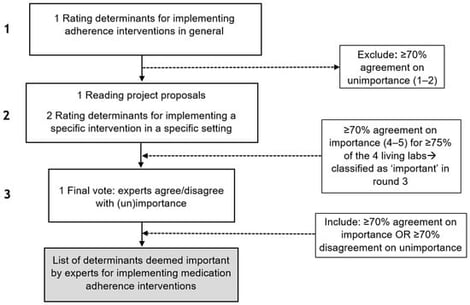
Flowchart describing three-round Delphi study.

Opioid misuse continues to be a major public health issue in the United States. Older adults (≥65) are at particular risk of harm from opioids due to changes in opioid pharmacokinetics with age; however, healthcare professionals lack training and confidence in addressing opioid harm reduction strategies in this population. Therefore, the purpose of this study was to improve healthcare professional knowledge and beliefs regarding opioid harm reduction strategies amongst older adults. An 8 h interprofessional conference was conducted 1 May 2025 to educate healthcare providers about opioid misuse prevention strategies for older adults. This study utilized a quasi-experimental one-group pretest–posttest design to assess changes in healthcare professional knowledge and beliefs before and after the conference. Healthcare professionals in the U.S. were recruited to participate in the conference via email listservs with national reach, predominantly concentrated in Alabama. Data were collected at pre- and post-conference via an anonymous online survey informed by the Theory of Planned Behavior and Health Belief Model. Primary outcome measures included: (1) knowledge of opioid use and misuse in older adults (5 items); (2) prescribing and dispensing attitudes surrounding opioids and medications for opioid use disorder (MOUD) (5 items); (3) perceived susceptibility to harm from opioids (4 items); and (4) perceived barriers to opioid harm reduction in older adults (17-items). Constructs were measured using multiple-choice questions (knowledge) and Likert-type scales (1 = strongly disagree, 5 = strongly agree). Secondarily, intention to join a Microsoft Teams working group for ongoing collaboration was assessed through a single categorical (Yes/No/Unsure) multiple-choice question at post-conference. Data were analyzed using descriptive statistics, and differences in mean knowledge, attitudes, susceptibility, and barriers scale scores from pre- to post-conference were analyzed using Wilcoxon signed-rank tests (alpha = 0.05). Of N = 75 survey respondents, the majority were White (86.7%), female (74.7%), 50 years of age on average, and employed as pharmacists (68%). Overall, mean (SD) knowledge (83.73% [19.92] versus 90.67% [12.45]; p = 0.011) and perceived susceptibility (3.82 [0.63] versus 4.03 [0.63]; p = 0.002) increased from pre- to post-conference, while perceived barriers decreased (2.71 [0.54] versus 2.54 [0.58]; p = 0.001). Despite an upward trend, there was no statistically significant change in the mean prescribing and dispensing attitudes from baseline to post-conference. Additionally, 34.7% intended to join the Microsoft Teams working group at post-conference. Findings support the utility of interprofessional educational interventions to increase healthcare provider knowledge and beliefs regarding opioid harm reduction strategies amongst older adults.

16 June 2026

Drug repurposing is often promoted as a faster, lower-risk alternative to de novo discovery, yet substantial barriers continue to limit successful implementation. We performed a scoping review of articles included in PubMed and ScienceDirect with the aim to identify and categorize challenges and analyze the intersections between them. Our review included 73 articles which revealed scientific, clinical, regulatory, economic, and implementation barriers, with the principal being the clinical translation of generated candidates. Scientific challenges include the necessity for new Phase II/III trials to validate efficacy, safety, and optimal dosing in new therapeutic contexts. Across disease areas, domain-specific barriers include subgroup-dependent responses in oncology, resistance and penetration challenges in anti-infectives, and data scarcity in rare diseases. Computational and AI-assisted approaches face fragmented data, model robustness, and insufficient validation. In addition, off-patent drugs face evidence requirements as rigorous as those for de novo entities, yet lack the market exclusivity incentives required to attract private investment. Additionally, an “institutional bottleneck” hinders academic researchers from bringing findings “on-label” due to a lack of regulatory infrastructure and collaborative frameworks. We conclude that drug repurposing requires a distinct translational paradigm involving multi-stakeholder collaboration and early regulatory engagement to bridge the gap between laboratory discovery and patient access.

11 June 2026

  • Systematic Review
  • Open Access

Background: Precision medicine aims to improve early, individualized risk stratification using biologically relevant biomarkers. In early pregnancy, markers reflecting placental function remain limited. Kisspeptin, a placentally derived peptide that rises during normal gestation, has emerged as a potential indicator of pregnancy viability. Objectives: We aimed to evaluate evidence on maternal serum kisspeptin levels and placental KISS1/KISS1R expression in early pregnancy loss, and to assess its potential relevance as a precision biomarker within personalized pharmacy and individualized monitoring frameworks. Methods: A systematic search of PubMed, Scopus, Web of Science, and Google Scholar (up to 2025) was conducted according to the PRISMA 2020 guidelines. Studies assessing circulating kisspeptin and/or placental expression in early pregnancy loss versus viable pregnancies were included. A formal meta-analysis was not performed due to substantial heterogeneity in study design, biological material, assay methods, gestational age, and outcome reporting formats. Under these conditions, quantitative pooling was considered methodologically inappropriate; therefore, qualitative synthesis was performed. Results: Six studies met the inclusion criteria. Most reported significantly lower maternal serum kisspeptin levels in early pregnancy loss, with good discriminatory accuracy. Immunohistochemical analyses showed reduced placental and choriodecidual KISS1/KISS1R expression in miscarriage and recurrent pregnancy loss, indicating disrupted local signaling. Concordant systemic and tissue findings suggest that circulating kisspeptin reflects placental dysfunction. Conclusions: Kisspeptin appears to be a promising precision biomarker for monitoring early pregnancy viability and supporting individualized pharmaceutical care. Standardized assays and large prospective studies are needed before routine clinical implementation.

9 June 2026

News & Conferences

Volumes

Latest Issues

Open for Submission

Editor's Choice

Reprints of Collections

Medicines Reuse
Reprint

Medicines Reuse

Editors: Parastou Donyai
Embedded Pharmacists in Primary Care
Reprint

Embedded Pharmacists in Primary Care

Editors: George E. MacKinnon III, PhD, MS, RPh, Nathan Lamberton, PharmD, BCPS
XFacebookLinkedIn
Pharmacy - ISSN 2226-4787