
- Review

Liquid Biopsies: Current Applications in Research, Diagnosis, and Therapy of Gastrointestinal Cancer
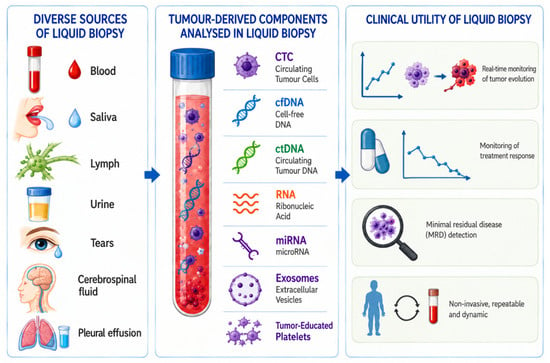
Gastrointestinal tumours represent a monumental challenge in global oncology, ranking among the most prevalent and lethal malignancies worldwide. Despite therapeutic advancements, patient outcomes remain severely constrained by late-stage diagnoses and a lack of dynamic monitoring tools. To shift the clinical paradigm, there is an urgent requirement for highly sensitive and specific biomarkers capable of early detection, real-time therapeutic assessment, and the precise tracking of minimal residual disease. Liquid biopsy has emerged as a minimally invasive tool uniquely positioned to address these clinical needs while overcoming the inherent limitations of traditional tissue biopsies, such as spatial tumour heterogeneity and procedural risks. Following a general overview of liquid biopsy, this review will focus on new emerging trends, critically evaluate technological advantages, and address current analytical and biological limitations within the field of nucleotide-based methods. A special focus is given to the clinical significance for diagnosis and prognosis of the four major gastrointestinal cancer subtypes: colorectal, gastroesophageal, hepatobiliary, and pancreatic cancer.
27 November 2026