Skip to Content

Journal of the Oman Medical Association

Journal of the Oman Medical Association (JOMA) is an international, peer-reviewed, open access journal on healthcare, clinical medicine, and other scientific areas related to medicine and surgery, published semiannually online. It is the official journal of the Oman Medical Association (OMA). Association members receive discounts.
  • Open Access— free for readers and authors (diamond open access), with article processing charges (APC) paid by the Oman Medical Association. OMA members receive a discount. 
  • Rapid Publication: first decisions in 18 days; acceptance to publication in 7 days (median values for MDPI journals in the first half of 2026).
  • Recognition of Reviewers: Reviewers whose reports are timely and of high quality receive an APC discount voucher for a future publication in an MDPI journal. Become a reviewer.

Get Alerted

Add your email address to receive forthcoming issues of this journal.

All Articles (44)

Despite guideline recommendations against routine prophylactic drainage following elective colectomy, surgical drains continue to be used selectively in colorectal practice. This study aimed to identify factors associated with drain placement and describe post-operative outcomes associated with selective drain use following colectomy for colon cancer. A retrospective cohort study of 400 patients undergoing colectomy for colon cancer between 2015 and 2021 at a tertiary academic centre was performed. Baseline, pre-operative, intra-operative and post-operative variables were compared between patients who received surgical drains (n = 267) and those who did not (n = 133). Univariable and multivariable regression analyses were performed to evaluate associations between drain placement and post-operative outcomes. Patients receiving drains had higher ASA scores, neoadjuvant chemoradiotherapy, longer operations, greater blood loss, and more emergency and open procedures. After multivariable adjustment, drain insertion was associated with higher Clavien–Dindo classification or post-operative morbidity, longer post-operative stay, delayed mobilisation, post-operative ileus, and re-operation within 30 days. Patients receiving drains represented a higher-risk surgical population with greater operative complexity and experienced poorer post-operative outcomes. These findings likely reflect selective drain placement in more complex cases rather than a causal effect of drainage itself. Prospective studies are needed to define the role of selective drainage in high-risk colorectal surgery.

J. Oman Med. Assoc.

3 September 2026
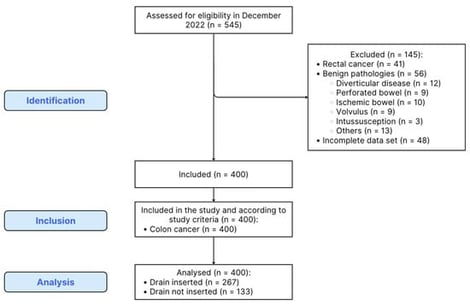
STROBE flow diagram.
  • Case Report
  • Open Access

Objective: To describe a prenatal case of congenital diaphragmatic eventration, describe prenatal presentation and summarize available postnatal outcomes of previously reported cases. Methods: We present a prenatally diagnosed case of congenital diaphragmatic eventration managed at our institution and a structured literature review to identify previously reported prenatal cases published between 1984 and 2025. Results: Congenital diaphragmatic eventration was diagnosed at 20 + 2 weeks’ gestation following suspicion of fetal dextrocardia. Fetal magnetic resonance imaging confirmed diaphragmatic continuity and excluded congenital diaphragmatic hernia. Mild neonatal respiratory distress required only transient continuous positive airway pressure. Nineteen prenatally suspected cases were identified from the literature, most of which were initially misdiagnosed as congenital diaphragmatic hernia (89.5%). Correct prenatal characterization was reported in 57% of cases evaluated with fetal MRI and 25% with ultrasound alone; however, these findings should be interpreted as a descriptive observation due to the limited number and heterogeneity of available reports. Conclusions: Congenital diaphragmatic eventration is a rare but important mimic of congenital diaphragmatic hernia. Fetal magnetic resonance imaging may provide additional anatomical information in selected cases and facilitate counselling and perinatal management.

J. Oman Med. Assoc.

2 September 2026

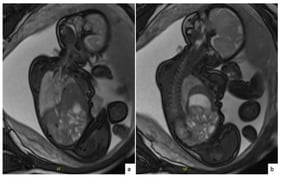
Fetal magnetic resonance imaging (MRI) at 31 weeks’ gestation. Coronal T2-weighted image (a) demonstrates marked elevation of the left hemidiaphragm with preserved diaphragmatic continuity. Axial T2-weighted image (b) shows intrathoracic displacement of the left hepatic lobe, spleen, and stomach, associated with compression of the left lung and preserved right lung volume and signal intensity.

Background: Haller cells (HCs) possess radiological and clinical significance because of their close relationship to the ostiomeatal complex and orbital floor. We aim to determine the prevalence of HCs in an Iraqi population, assess their morphometry, and evaluate their associations with selected sino-nasal anatomical variants, particularly concha bullosa (CB) and Onodi cells (OCs), as well as with sinusitis. Methods: In this retrospective study, high-resolution CT scans were obtained from Baghdad Medical City. Images were reviewed using RadiAnt DICOM Viewer version 2025.2. Haller cells were assessed for laterality and measured on coronal CT for length, width, and sectional area. Data were analyzed in IBM SPSS Statistics version 27. Results: Of 121 assessed CT scans, 103 were included in the final analysis. HCs were found in 36.9% of cases, most commonly as unilateral right-sided cells. Strong positive correlations were observed among HC morphometrics, especially between length and sectional area on both sides (left: ρ = 0.920, p < 0.001; right: ρ = 0.876, p < 0.001). No significant side- or sex-based differences were found concerning any of the morphometrics. Further, no significant associations were found between HCs and sex, nasal septum deviation (NSD), OCs, maxillary sinusitis, or sphenoid sinusitis. Nonetheless, the association between HCs and CB possessed borderline significance (OR = 2.37, 95% CI: 0.86–6.57; p = 0.091). Conclusions: Haller cells were the least common of the evaluated sino-nasal variants and showed generally symmetrical morphometrics despite more frequent right-sided unilateral occurrence. They were not significantly associated with sex, NSD, OCs, or sinusitis, although the borderline association with CB warrants further study.

J. Oman Med. Assoc.

1 September 2026

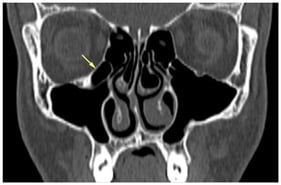
Coronal CT image showing right-sided HCs in an 18-year-old Iraqi male.

Tuberculosis (TB) and malnutrition remain major health challenges among migrant children living in low-resource urban settings. Identifying clinically relevant patterns associated with these conditions may support standardized clinical assessment and public health planning. The present study aimed to identify clinical, anthropometric and sociodemographic factors associated with TB and malnutrition among migrant children under five years of age in urban Pakistan. A community-based cross-sectional study was conducted in migrant settlements of Rachna Town, Lahore, Pakistan. Clinical, demographic and anthropometric data were collected from 300 children under five years of age. A Genetic Algorithm (GA) combined with Random Forest analysis was applied to identify the most informative variables associated with TB and malnutrition. Model performance was assessed using internal cross-validation. The analytical approach identified a concise subset of variables showing stable internal performance. Key factors associated with malnutrition included Bacillus Calmette-Guérin vaccination status, formula feeding, chest X-ray findings and gastrointestinal symptoms. The most relevant variables associated with TB were Bacillus Calmette-Guérin vaccination score, erythrocyte sedimentation rate, gastrointestinal indicators and parental occupation. The final models demonstrated good internal discrimination and substantial agreement. These findings suggest that routinely collected clinical, anthropometric, laboratory, radiological, and sociodemographic variables may support the identification of clinically relevant patterns associated with TB and malnutrition during standardized community-based assessments. The proposed data-driven approach should be interpreted as an analytical and decision-support framework for prioritizing informative variables and supporting clinical assessment, rather than as a pre-diagnostic or early risk prediction tool.

J. Oman Med. Assoc.

6 August 2026

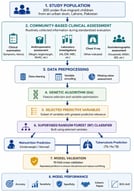
Study workflow and machine-learning framework for predicting malnutrition and tuberculosis among under-five migrant children. The analytical pipeline comprised community-based clinical assessment, data preprocessing, feature selection using a Genetic Algorithm (GA), supervised classification with a Random Forest (RF) algorithm, and internal model validation by 10-fold cross-validation. Model performance was evaluated using accuracy, sensitivity, specificity, Cohen’s kappa coefficient, and the area under the receiver operating characteristic curve (ROC-AUC). The workflow illustrates that the predictive models were developed using routinely collected information obtained during a standardized community-based clinical assessment, rather than solely baseline variables available before clinical evaluation.

Highly Accessed Articles

News & Conferences

Latest Issues

Open for Submission

Journal Sections

XFacebookLinkedIn
J. Oman Med. Assoc. - ISSN 2813-8759