


Abstract
This narrative review examines breast cancer detection and treatment in Tanzania, Kenya, Uganda, Rwanda, and Ethiopia, where late-stage diagnosis and delays in care remain major public health concerns. Although reported incidence is lower than in many high-income settings, mortality relative to incidence remains high. We synthesize evidence on risk factors, early detection, diagnostic pathways, treatment access, health-system barriers, policy responses, and emerging priorities. Studies from these settings identify limited diagnostic capacity, workforce shortages, referral delays, financial barriers, and uneven oncology services as important obstacles to timely care. Germline BRCA1/2 testing may inform risk assessment and selected treatment decisions, while assessment of ER, PR, and HER2 informs systemic therapy. Consistent with WHO guidance, strengthening timely evaluation and referral of symptomatic women is a priority where organized, quality-assured population screening and downstream services are not yet feasible. Patient navigation, improved pathology and treatment capacity, financial protection, and context-appropriate precision oncology may strengthen care. Better outcomes will require investment across the continuum from symptom recognition through diagnosis, treatment, and follow-up.
1. Introduction
Breast cancer is a heterogeneous disease with histopathological and molecular subtypes that differ in prognosis and treatment response. It is also the most commonly diagnosed cancer among women worldwide. In 2024, an estimated 2.43 million new cases of female breast cancer occurred globally, accounting for 11.8% of all new cancer cases, with approximately 694,000 deaths, representing 7.1% of all cancer deaths [1]. Triple-negative breast cancer (TNBC), defined by the lack of estrogen receptor (ER) and progesterone receptor (PR) expression and negative HER2 status, is clinically important because of its aggressive course and the lack of routinely targetable receptors [2,3]. Most breast cancers are sporadic, whereas approximately 5–10% are associated with inherited pathogenic variants in cancer predisposition genes, most prominently BRCA1 and BRCA2 [2,3].
Breast cancer risk reflects inherited susceptibility, reproductive and hormonal exposures, adiposity, alcohol use, and other lifestyle and environmental factors [4,5,6]. Population-specific evidence remains limited in East Africa, and extrapolation from predominantly non-African datasets may not accurately represent variant frequencies, risk estimates, or clinically relevant interactions in African populations.
Breast cancer survival remains substantially lower in many sub-Saharan African settings than in high-income countries, in association with later-stage diagnosis and unequal access to diagnostic and treatment services [7,8,9,10]. Studies from the five countries reviewed describe delayed presentation, weak referral pathways, limited imaging and pathology capacity, workforce shortages, and constrained access to multimodality treatment [8,10,11,12]. Tanzania illustrates these challenges through documented delays in presentation, referral, diagnostic confirmation, and specialist care [13,14,15]. Early detection comprises two distinct approaches: early diagnosis, which aims to identify and promptly evaluate people with breast symptoms, and screening, which tests asymptomatic people to identify disease before symptoms develop [16,17,18]. This review examines risk factors, diagnostic and treatment pathways, health-system responses, and future priorities in five selected East African countries.
Review Scope and Approach
This narrative review synthesizes peer-reviewed primary studies and reviews, national cancer-control documents, and World Health Organization (WHO) guidance relevant to female breast cancer in Tanzania, Kenya, Uganda, Rwanda, and Ethiopia. These five countries were purposively selected because published studies cover different components of the cancer care continuum in each setting; they were not selected as a representative sample of all East African countries. The aim is to relate evidence on risk, detection, diagnosis, treatment, and health-system constraints to practical service-delivery priorities. Unlike the regional estimates and thematic syntheses provided by previous systematic and scoping reviews [7,19,20], this article considers country-specific evidence across the full care pathway together with implications for implementation and service organization.
Published evidence was identified through targeted searches of PubMed and Google Scholar, complemented by examination of reference lists, WHO guidance, and national cancer-control documents. The literature was reviewed during manuscript preparation in 2025–2026, with relevant publications added during revisions through October 2026. Searches combined breast cancer with the individual country names (Tanzania, Kenya, Uganda, Rwanda, and Ethiopia) and terms concerning epidemiology, risk factors, hereditary susceptibility, early detection, screening, diagnosis, treatment, pathology, patient navigation, and health-system barriers. Peer-reviewed primary studies, systematic and scoping reviews, and relevant clinical or policy guidance were considered. Priority was given to recent evidence directly relevant to the care continuum; older studies were retained where they provided important country-specific information. Country-specific primary studies were used to illustrate local diagnostic and treatment pathways, while regional syntheses provided broader context. The number of published studies differed across the five countries, resulting in variations in the depth of coverage. Sources were selected purposively according to their relevance, setting, and study design. No prespecified protocol, exhaustive reproducible search, formal screening log, risk-of-bias assessment, or new meta-analysis was undertaken. Although breast cancer also occurs in men, this review focuses only on female breast cancer.
2. Risk Factors for Breast Cancer in the Five Countries Reviewed
Breast cancer is a public health concern in the five countries examined. Late-stage presentation has been reported in multiple study populations, although estimates vary by location and sampling [10,11,19]. Evidence on risk factors is heterogeneous and often derives from hospital-based or case–control studies; findings should be interpreted in light of study design, sample size, and population differences.
2.1. High-Penetrance Pathogenic Variants
Clinically relevant germline BRCA1/2 pathogenic variants have been identified among breast cancer patients in the countries reviewed. In a study of 100 patients recruited at the Ocean Road Cancer Institute in Tanzania, six participants (6%) carried a germline pathogenic BRCA1 or BRCA2 variant; five of these six patients had triple-negative breast cancer (TNBC), while one had luminal-B disease [21]. This small, hospital-based cohort demonstrates the potential clinical value of hereditary cancer assessment but does not establish a national or regional prevalence estimate.
In Kenya, a study of women with TNBC identified pathogenic BRCA1/2 variants, including a previously unreported BRCA1 variant [22]. In Uganda, pathogenic variants in hereditary breast cancer genes have also been reported among women with breast cancer [23]. Available studies differ in eligibility criteria, sequencing methods, and sample size; therefore, prevalence estimates should not be generalized to unselected national populations.
Family history alone may fail to identify some patients with inherited cancer susceptibility. In the Tanzanian cohort, only two of the six pathogenic BRCA1/2 variant carriers reported a relative who had died of breast cancer [21]. Family histories may also be incomplete when cancers in relatives have not been diagnosed or recorded. Decisions about genetic counselling and testing should therefore consider a patient’s age at diagnosis, tumour subtype, personal cancer history, and family history together rather than rely on pedigree history alone. The available studies do not allow the sensitivity of family-history-based testing criteria to be quantified for the wider region.
2.2. Nongenetic Risk Factors
Studies in Kenya, Uganda, and Tanzania have examined reproductive factors, breastfeeding, dietary patterns, body size, and alcohol consumption in relation to breast cancer. Reported associations differ by setting and study design, and most available studies are observational [24,25,26,27]. These findings do not establish population-level causal effects; larger prospective studies are needed to clarify modifiable risks in these populations.
2.2.1. Socioeconomic Factors
Socioeconomic status has a complex relationship with breast cancer risk and, more consistently, with access to timely diagnosis and treatment. A Tanzanian case–control study reported an inverse association between a property-based socioeconomic measure and breast cancer risk, but such observational findings may reflect residual confounding and should not be interpreted as a direct biological protective effect [24]. Across the region, lower educational attainment, rural residence, transport costs, distance from diagnostic facilities, and limited financial protection contribute to delayed presentation and difficulty completing diagnostic pathways [11,15]. Socioeconomic disadvantage is therefore particularly important as a determinant of access, delay, and continuity of care.
2.2.2. Reproductive and Hormonal Factors
Associations with parity, age at first birth, breastfeeding, menopausal status, and hormonal exposures have been examined in studies from Tanzania, Uganda, and Kenya [24,25,26]. Findings are not uniform, and differences in study design, population selection, tumour subtype, and exposure measurement may contribute to the variation. Results from individual clinical samples should not be assumed to apply to all women in the five countries.
2.2.3. Body Mass Index and Other Lifestyle Factors
Associations between body mass index (BMI) and breast cancer depend on age and menopausal status. A Tanzanian case–control study found that BMI at age 20 was positively associated with breast cancer, but its observational design limits causal interpretation [24]. More broadly, the relationship between obesity and breast cancer differs before and after menopause [28], and the estimated burden attributable to high BMI has risen in sub-Saharan Africa [29]. Alcohol use is also associated with breast cancer risk in African studies [27]. Prospective studies are needed to clarify these relationships in the populations considered here.
3. Early Detection and Diagnostic Pathways
3.1. Early Diagnosis of Breast Cancer
Late-stage diagnosis remains common in the settings reviewed. In a systematic review of 125 studies comprising 42,689 patients with staging information across sub-Saharan Africa, Fall et al. reported stage III–IV disease in 68.5% of patients in the Eastern African subgroup [19]. This is a pooled estimate for a wider geographical subgroup, not a separate estimate for each country in the present review. Tanzanian studies describe delays before presentation and during referral and diagnostic evaluation [13,14,15]. Kibret et al. also identified substantial variation in how care intervals are defined and reported across 29 African studies, including 11 from East Africa [20]. Together, these findings support efforts to improve evaluation of symptomatic women, diagnostic capacity, referral completion, and patient tracking [18].
3.2. Clinical and Imaging Approaches to Early Detection
Breast cancer screening and diagnostic evaluation should be distinguished clearly. Mammography is the standard imaging modality for population-based screening in health systems able to sustain quality assurance, diagnostic follow-up, and timely treatment. In many East African settings, however, imaging is used predominantly for diagnostic evaluation of symptomatic women. Ultrasound is often more accessible than mammography and is useful for characterizing palpable abnormalities and guiding tissue sampling, although performance is operator dependent [16,30,31,32].
3.2.1. Mammography
The benefit of mammography screening depends on appropriate age targeting, image quality, diagnostic follow-up, and timely access to treatment. In lower-resource settings with substantial symptomatic and late-stage disease, phased approaches emphasize strengthening early diagnosis and treatment capacity before large-scale population screening is introduced [16,32]. Mammographic sensitivity is also reduced in dense breasts, and implementation requires sustained investment in equipment, maintenance, radiology expertise, quality assurance, and referral systems. Routine population-wide mammography is therefore not yet feasible in many East African settings.
3.2.2. Clinical Breast Examination and Breast Awareness
Clinical breast examination (CBE) can support identification of suspicious breast abnormalities where mammography capacity is limited, provided it is linked to imaging, tissue sampling, pathology, and referral. Breast self-examination may support breast awareness but should not be presented as a substitute for diagnostic evaluation. The effectiveness of community- or facility-based early-detection activities ultimately depends on whether women with abnormal findings can complete diagnostic confirmation and treatment without avoidable delay [32,33].
In Tanzania, breast-awareness education and clinical breast examination may support symptom recognition and referral when they are linked to diagnostic services. A national survey analysis reported self-reported breast cancer screening in 3.39% of women aged 15–35 years; its combined measure included breast self-examination, clinical breast examination, or mammography and cannot establish uptake of each modality separately [34]. A qualitative study of screening messages highlighted the need for clearer communication adapted to the local context [35].
3.3. Breast Cancer Early-Detection Programmes
Effective early diagnosis requires a linked pathway from symptom recognition to clinical assessment, imaging, tissue sampling, pathology, and treatment. Tumour morphology, grade, lymph-node status, and immunohistochemical assessment of ER, PR, and HER2 are central to prognosis and treatment selection, yet access to pathology and timely reporting remains uneven across the region [32,36]. Strengthening workforce training, referral protocols, specimen handling, turnaround time, patient navigation, and communication of results is therefore as important as increasing the number of screening encounters.
3.3.1. Organized Screening and Symptomatic Early Diagnosis
In the five countries reviewed, symptomatic presentation is common while diagnostic capacity remains uneven. WHO guidance places priority on timely clinical assessment and diagnostic work-up of women with breast symptoms in settings where organized mammography screening and reliable follow-up are not yet feasible [16,17,18,32]. This is a resource-stratified recommendation; direct comparative evidence on the relative effectiveness of these approaches across the five countries is lacking. A functional pathway requires appropriate imaging, tissue sampling, pathology, communication of results, and referral for treatment [18,32,37].
3.3.2. Uganda
Uganda has strengthened breast-imaging practice through phased implementation of standardized reporting, including the Breast Imaging Reporting and Data System (BI-RADS), alongside efforts to improve ultrasound, diagnostic follow-up, and quality assurance [38,39]. Clinical assessment and imaging are mainly provided on presentation or referral rather than through organized population screening, and access to imaging is concentrated in higher-level facilities. Patient-navigation interventions have demonstrated potential to reduce time to diagnosis by linking abnormal findings to definitive evaluation and follow-up [40].
3.3.3. Kenya
Kenya has expanded breast cancer early-detection activities through facility-based clinical assessment, imaging, and outreach, but access to diagnostic and treatment services remains uneven [8,32]. In a mixed-methods study of 378 women with breast cancer at Kenyatta National Hospital, Ojuka et al. reported median intervals of 13 weeks from symptom onset to hospital presentation, 17.5 weeks from hospital presentation to diagnosis, and six weeks from diagnosis to the first intervention [41]. These findings describe a referral-hospital population and are not national estimates. They nevertheless illustrate delays at several points along the care pathway, particularly during diagnostic evaluation. Stronger referral links, timely tissue diagnosis and pathology, and coordination of appointments may help reduce avoidable delays.
3.3.4. Tanzania
Tanzania does not have an organized national mammography screening programme; early-detection activities are delivered through clinical services, cancer centres, outreach, and community-based initiatives. Evidence from women aged 15–35 years indicates low self-reported uptake of a combined breast-health screening measure, while qualitative work points to gaps in screening communication [34,35]. The immediate priority is to connect breast awareness and clinical assessment with timely imaging, tissue diagnosis, pathology, and treatment.
3.3.5. Rwanda and Ethiopia
Rwanda has pursued a phased model of breast cancer early detection integrated into primary care and women’s cancer services. Programmes have trained healthcare workers in CBE, developed district-level breast evaluation pathways, and used patient tracking to strengthen follow-up. Experience from the Women’s Cancer Early Detection Programme demonstrates both the feasibility of integrating breast and cervical cancer activities and the need to ensure that older and symptomatic women are not missed [42,43,44].
In Ethiopia, late-stage diagnosis is common in the published hospital-based literature. A systematic review and meta-analysis of 20 studies estimated that 72.6% of patients had advanced-stage disease at diagnosis (95% CI, 68.5–76.7%), with substantial between-study heterogeneity (I2 = 91.8%) [45]. A subsequent multicentre study of 458 women who had initiated treatment at three tertiary hospitals associated longer care intervals with factors including rural residence, limited breast cancer literacy, use of traditional healers, and failures in referral or initial clinical assessment [46]. As these studies largely represent patients reaching hospital services, they cannot describe the experiences of women who never obtain specialist assessment or treatment. These findings support investment in timely primary-level assessment, referral, diagnostic confirmation, and accessible treatment, alongside ongoing development of oncology services [47].
4. Common Barriers Across the Breast Cancer Care Continuum in the Five Countries Reviewed
Studies from the five countries identify low awareness of breast symptoms, delayed symptom appraisal, fear and stigma, direct and indirect costs, difficult travel, fragmented referral, limited imaging and pathology, workforce shortages, and concentration of oncology services in specialist centres [8,10,11,12,15,48,49]. Kibret et al. found that definitions and measurements of care intervals vary across Africa and that evidence on treatment completion and follow-up is particularly limited [20]. These problems can affect more than one stage of a patient’s pathway.
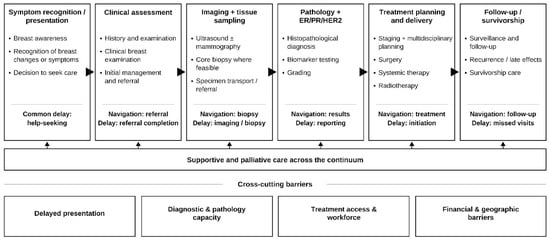
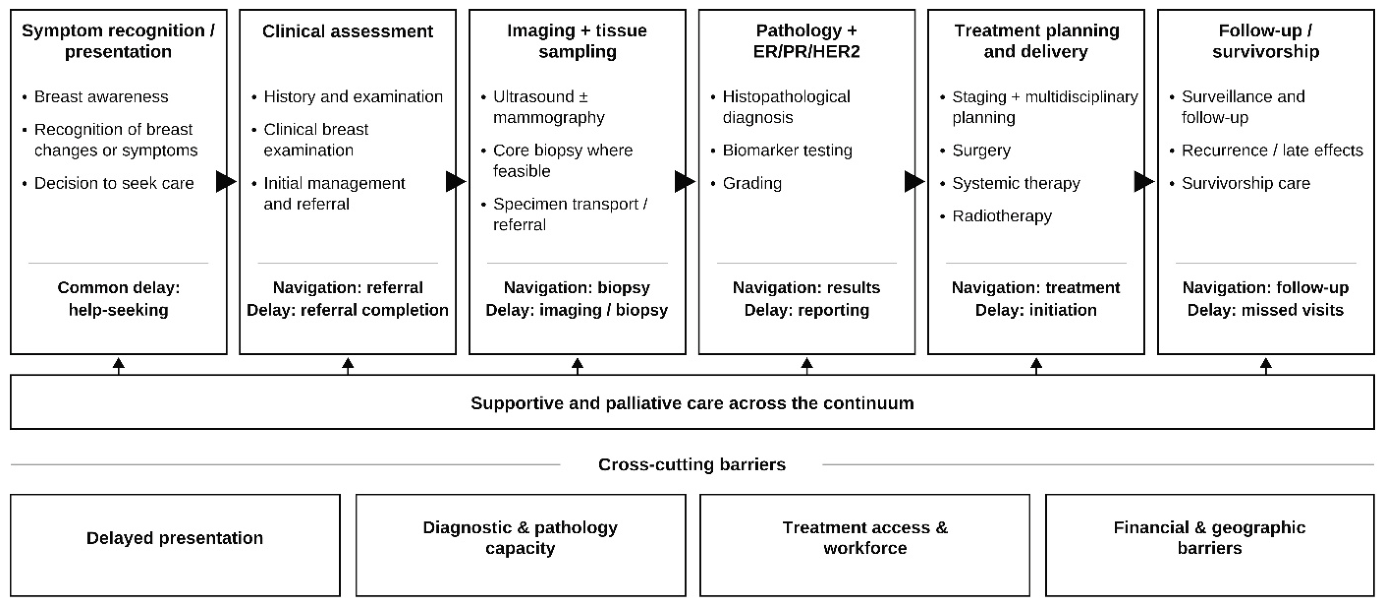
The barriers interact: awareness activities have limited value if referrals, biopsy, pathology, and treatment cannot be completed promptly. Patient navigation may assist with appointments, referral tracking, communication of results, treatment initiation, and follow-up [18,40]. Figure 1 indicates these intervention points and common sources of delay across the care continuum [12,15,17,40].
Figure 1.
Breast cancer care pathway, common points of delay, and patient-navigation interventions in the five countries reviewed. Navigation may support referral, diagnostic completion, communication of results, treatment initiation, and follow-up. Supportive and palliative care can be required throughout the pathway. ER, estrogen receptor; PR, progesterone receptor; HER2, human epidermal growth factor receptor 2.
5. Knowledge and Health-Seeking Behaviour for Breast Symptoms
Studies from Tanzania, Uganda, and Kenya describe gaps in knowledge of breast symptoms and delays in appraising them. Some women initially attribute breast changes to trauma, infection, or other benign conditions, while fear, stigma, social influences, and informal care-seeking may contribute to delayed presentation [15,48,49,50]. These observations are not uniform across populations and should be interpreted in their local contexts.
After women seek care, travel costs, referral difficulties and limited diagnostic services may prolong the time to diagnosis [15]. Kibret et al. found that the definitions and measurement of diagnostic and treatment intervals varied considerably between African studies [20]. Improving breast awareness therefore needs to go hand in hand with access to diagnostic confirmation and treatment.
6. Advances and Persistent Gaps in Treatment
Breast cancer treatment requires coordinated surgery, systemic therapy, radiotherapy, pathology, and supportive care. Treatment selection depends on stage, comorbidities, patient preferences, and tumour biomarkers, particularly ER, PR, and HER2. In the countries reviewed, uneven access to these services and continuity of care remains a major constraint [7,36,37].
6.1. Surgical Treatment: Mastectomy and Breast-Conserving Surgery
Surgery remains a cornerstone of treatment for operable breast cancer. Across African settings, mastectomy is performed more frequently than breast-conserving surgery, reflecting a later stage at presentation as well as limited access to radiotherapy, pathology, and multidisciplinary follow-up [37,51]. Breast-conserving surgery can be appropriate for selected patients with early-stage disease, but it requires reliable margin assessment and access to postoperative radiotherapy. Strengthening early diagnosis, surgical oncology capacity, pathology quality, and radiotherapy availability would increase the proportion of women who can safely receive breast-conserving treatment where clinically appropriate.
6.2. Systemic Therapy: Chemotherapy, Endocrine Therapy, and Targeted Treatment
Systemic treatment depends on stage and tumour biology. Anthracycline- and taxane-based chemotherapy regimens are used when cytotoxic therapy is indicated, while endocrine therapy is central to hormone receptor-positive disease. In a meta-analysis of receptor data from five East African countries, Popli et al. estimated that 55% of breast cancers were ER-positive (95% confidence interval [CI], 47–62%) and 23% were HER2-positive (95% CI, 20–26%) [7]. These are pooled estimates, not uniform national prevalences; between-study differences, testing methods, and country-level heterogeneity limit their generalizability. The findings support access to quality-assured immunohistochemistry, endocrine therapy, and, when indicated and feasible, HER2-directed treatment, alongside reliable chemotherapy services [7,36,37].
6.3. Radiotherapy Access
Radiotherapy is required for many patients after breast-conserving surgery and for selected patients after mastectomy, and it is also important for palliation. Capacity in Africa has expanded, but access remains constrained by the number and geographic distribution of machines, specialist workforce shortages, maintenance requirements, and treatment delays [37,52]. These limitations directly affect the feasibility of breast-conserving treatment and completion of guideline-concordant multimodality care. Investment in equipment must therefore be accompanied by maintenance systems, treatment planning, radiation-oncology training, and equitable referral pathways.
6.4. Treatment Access, Continuity, and Quality
Treatment services remain concentrated in a limited number of referral centres, creating substantial travel, accommodation, and out-of-pocket burdens for patients and families. Clinicians in Tanzania have identified specialist shortages, fragmented referral pathways, diagnostic delays, medicine shortages, and infrastructure limitations as barriers to timely cancer care [12]. Improving outcomes will require multidisciplinary care pathways, standardized protocols, reliable pathology turnaround, essential-medicine supply chains, patient navigation, psychosocial and palliative care, and carefully planned decentralization of services that can be delivered safely closer to patients.
7. East African Policies and Health-System Responses
7.1. National Cancer-Control Priorities
Breast cancer control requires coordinated action across prevention and health promotion, early diagnosis, pathology, treatment, palliative care, surveillance, financing, workforce development, and quality improvement. The WHO Global Breast Cancer Initiative organizes this agenda around three linked pillars: health promotion and early detection, timely diagnosis, and comprehensive breast cancer management [17]. National cancer-control plans need accountable referral pathways and measurable service targets, rather than relying on awareness or screening activities alone. Rwanda’s NCD strategy for 2020–2025 is an example of multisectoral planning, although the existence of a strategy does not itself demonstrate implementation or improved outcomes [53].
7.2. Financial Protection and Universal Health Coverage
Financial protection is fundamental to timely breast cancer care because diagnosis and treatment often require repeated visits, pathology and imaging, surgery, systemic therapy, radiotherapy, supportive medicines, and transport. Coverage on paper does not guarantee access when services are geographically distant, medicines are unavailable, or diagnostic tests require additional payment. Breast cancer should therefore be incorporated into universal health coverage benefit packages across the full care pathway, with attention to both direct medical costs and the indirect costs that contribute to treatment interruption or abandonment [12,17].
7.3. Essential Medicines, Pathology, and Radiotherapy
Access to essential cancer medicines is necessary but insufficient without the pathology and monitoring required to use them appropriately. Even relatively low-cost endocrine and cytotoxic therapies can be interrupted by procurement constraints and the geographic concentration of oncology services, while more costly targeted therapies remain particularly difficult to access [12]. Radiotherapy capacity is also insufficient relative to the needs across much of Africa, and service interruptions may arise from equipment downtime and shortages of trained personnel [52]. Procurement, pathology, pharmacy systems, maintenance, and human resources should therefore be treated as a single treatment-delivery agenda rather than as separate technology investments.
7.4. Early Diagnosis and Screening Policy
The countries reviewed have limited capacity for organized, quality-assured population mammography screening. National policies should distinguish tests offered to asymptomatic women from diagnostic assessment of women with breast symptoms. WHO guidance supports a phased approach that links clinical assessment, indicated imaging, tissue sampling, pathology, patient navigation, and treatment [16,17,18,32]. The balance and sequence of investments should be guided by local capacity to complete these steps.
7.5. Regional Partnerships and Capacity Building
Regional and international partnerships can accelerate workforce development, quality assurance, radiotherapy and pathology capacity, clinical research, and access to specialized expertise. Their value is greatest when activities align with national cancer-control priorities, strengthen local institutions, and build sustainable services rather than parallel programmes. Regional collaboration can also support harmonized training, referral networks for highly specialized care, multicountry research, and shared learning on procurement and maintenance [17,54,55].
8. Innovation and Future Directions
8.1. Community-Based Early Detection and Patient Navigation
Community breast awareness and early-detection activities are most useful when linked to diagnostic and treatment services. Studies from Uganda and Rwanda suggest that integrated programmes and patient-navigation approaches can support diagnostic completion and reduce delays in particular settings [40,42,43,44]. Consistent with WHO guidance [18], evaluation should examine time to diagnosis and treatment initiation, stage at diagnosis, completion of care, patient costs, and equity, rather than numbers reached alone.
8.2. Precision Medicine and Clinical Trials
Studies of hereditary susceptibility and tumour biology in African populations may support more locally relevant care [21,22,23]. Germline testing can inform hereditary-risk assessment, counselling of relatives, and selected treatment decisions; ER/PR/HER2 testing and, where available, additional tumour biomarkers guide systemic therapy. These uses are distinct and require appropriate clinical pathways. Implementation remains constrained by testing and treatment costs, limited counselling and laboratory capacity, workforce shortages, and difficulties classifying variants when African populations are underrepresented in reference datasets [56,57]. Priorities include appropriate patient selection, affordable high-quality testing, access to pre- and post-test genetic counselling, and strengthening locally led laboratories and studies. Variants of uncertain significance should not be treated as actionable pathogenic findings. The expansion of genomic services also needs to be weighed against other unmet treatment needs. In settings where pathology, receptor testing, essential medicines, and radiotherapy are not reliably available, these services require sustained attention alongside the selective introduction of germline testing. Cost alone does not establish cost-effectiveness; local data on clinical benefit, downstream treatment access, recurrent costs, and health outcomes are needed. Laboratory maintenance, quality assurance, trained staff, and equitable access beyond tertiary or private facilities will determine whether genomic services can be sustained. Phased implementation, guided by clinical indications and locally generated evidence, is therefore preferable to assuming that broad genomic testing is immediately feasible. Regional clinical trials and implementation research are needed to assess effectiveness, affordability, and equitable access [54,55,56,57].
9. Discussion and Conclusions
The available evidence highlights delays across the breast cancer care continuum, from symptom recognition to clinical evaluation, referral, tissue diagnosis, treatment initiation, and follow-up. Increasing screening activity without strengthening downstream diagnostic and treatment services may not improve timely access to effective care. Strengthening diagnostic evaluation of symptomatic women is consistent with the WHO resource-stratified approach [17,18].
The interpretation of breast cancer incidence and outcomes is limited by cancer-registration coverage and data completeness. GLOBOCAN 2024 country estimates draw on the best available national or subnational data and may use extrapolation or modelling where direct information is incomplete; they should not be treated as complete direct counts of events in every population [1,58]. Hospital-based stage and outcome estimates are also affected by referral patterns, incomplete documentation, and loss to follow-up. Improved population-based cancer registration, standardization of stage and receptor reporting, linkage to mortality data, and longitudinal follow-up would support more reliable comparisons [58,59]. This narrative review has additional limitations: the evidence was purposively selected without a prespecified protocol, exhaustive reproducible search, formal risk-of-bias assessment, or quantitative pooling. Evidence coverage differs between the five countries, partly reflecting the country-specific implementation examples emphasized in this review and differences in the accessible studies. The predominance of hospital-based reports may underrepresent women who never access specialist care, while potentially relevant unpublished or less accessible findings may have been missed. Findings from the five countries and their study populations should not be generalized to all of East Africa.
Three priorities emerge from this synthesis. First, improve timely diagnosis by linking symptom awareness, frontline assessment, patient navigation, biopsy, and reliable pathology. Second, strengthen treatment delivery as a coordinated package of surgery, systemic therapies, radiotherapy, receptor testing, supportive care, and financial protection. Third, expand cancer registration, prospective outcomes studies, genomic research, implementation evaluation, and context-appropriate clinical trials. The WHO Global Breast Cancer Initiative provides an organizing framework [17,18]. Progress depends on sustained, equitable services that allow women to move from an abnormal breast finding to diagnosis, appropriate treatment, and follow-up without avoidable delay.
Author Contributions
Conceptualization, M.Z.A. and M.Y.K.; Investigation, M.Y.K.; Writing—Original Draft Preparation, M.Y.K.; Writing—Review & Editing, M.Y.K., A.I.C., M.I.A., A.S.M. and M.Z.A.; Project Administration, M.Y.K. and M.Z.A.; Supervision, M.Z.A. All authors have read and agreed to the published version of the manuscript.
Funding
The authors received no specific funding for this work.
Institutional Review Board Statement
Not applicable.
Informed Consent Statement
Not applicable.
Data Availability Statement
No new data were created or analyzed in this study. Data sharing is not applicable to this article.
Conflicts of Interest
The authors declare that they have no competing interests.
Abbreviations
The following abbreviations are used in this manuscript:
| BMI | Body mass index |
| BI-RADS | Breast Imaging Reporting and Data System |
| CBE | Clinical breast examination |
| ER | Estrogen receptor |
| HER2 | Human epidermal growth factor receptor 2 |
| IHC | Immunohistochemistry |
| PR | Progesterone receptor |
| TNBC | Triple-negative breast cancer |
| WHO | World Health Organization |
References
- Sung, H.; Filho, A.M.; Laversanne, M.; Ferlay, J.; Siegel, R.L.; Soerjomataram, I.; Jemal, A.; Bray, F. Global cancer statistics 2024: GLOBOCAN estimates of incidence and mortality worldwide for 34 cancers in 186 countries. CA A Cancer J. Clin. 2026, 76, e70090. [Google Scholar] [CrossRef] [Scilit] [PubMed]
- Łukasiewicz, S.; Czeczelewski, M.; Forma, A.; Baj, J.; Sitarz, R.; Stanisławek, A. Breast Cancer—Epidemiology, Risk Factors, Classification, Prognostic Markers, and Current Treatment Strategies—An Updated Review. Cancers 2021, 13, 4287. [Google Scholar] [CrossRef] [Scilit] [PubMed]
- Harbeck, N.; Penault-Llorca, F.; Cortes, J.; Gnant, M.; Houssami, N.; Poortmans, P.; Ruddy, K.; Tsang, J.; Cardoso, F. Breast cancer. Nat. Rev. Dis. Primers 2019, 5, 66. [Google Scholar] [CrossRef] [Scilit] [PubMed]
- Roheel, A.; Khan, A.; Anwar, F.; Akbar, Z.; Akhtar, M.F.; Khan, M.I.; Sohail, M.F.; Ahmad, R. Global epidemiology of breast cancer based on risk factors: A systematic review. Front. Oncol. 2023, 13, 1240098. [Google Scholar] [CrossRef] [Scilit] [PubMed]
- Shi, M.; O’Brien, K.M.; Weinberg, C.R. Interactions between a Polygenic Risk Score and Non-genetic Risk Factors in Young-Onset Breast Cancer. Sci. Rep. 2020, 10, 3242. [Google Scholar] [CrossRef] [Scilit] [PubMed]
- Kachuri, L.; Graff, R.E.; Smith-Byrne, K.; Meyers, T.J.; Rashkin, S.R.; Ziv, E.; Witte, J.S.; Johansson, M. Pan-cancer analysis demonstrates that integrating polygenic risk scores with modifiable risk factors improves risk prediction. Nat. Commun. 2020, 11, 6084. [Google Scholar] [CrossRef] [Scilit] [PubMed]
- Popli, P.; Gutterman, E.M.; Omene, C.; Ganesan, S.; Mills, D.; Marlink, R. Receptor-Defined Breast Cancer in Five East African Countries and Its Implications for Treatment: Systematic Review and Meta-Analysis. JCO Glob. Oncol. 2021, 7, 289–301. [Google Scholar] [CrossRef] [Scilit] [PubMed]
- Magwesela, F.M.; Msemakweli, D.O.; Fearon, D. Barriers and enablers of breast cancer screening among women in East Africa: A systematic review. BMC Public Health 2023, 23, 1915. [Google Scholar] [CrossRef] [Scilit] [PubMed]
- Limenih, M.A.; Mekonnen, E.G.; Birhanu, F.; Jima, B.R.; Sisay, B.G.; Kassahun, E.A.; Hassen, H.Y. Survival Patterns Among Patients with Breast Cancer in Sub-Saharan Africa. JAMA Netw. Open 2024, 7, e2410260. [Google Scholar] [CrossRef] [Scilit] [PubMed]
- Pace, L.E.; Shulman, L.N. Breast Cancer in Sub-Saharan Africa: Challenges and Opportunities to Reduce Mortality. Oncologist 2016, 21, 739–744. [Google Scholar] [CrossRef] [Scilit] [PubMed]
- Mulugeta, C.; Emagneneh, T.; Kumie, G.; Ejigu, B.; Alamrew, A. Delayed presentation of breast cancer patients and contributing factors in East Africa: Systematic review and meta-analysis. PLoS ONE 2024, 19, e0309792. [Google Scholar] [CrossRef] [Scilit] [PubMed]
- Nyagabona, S.K.; Luhar, R.; Ndumbalo, J.; Mvungi, N.; Ngoma, M.; Meena, S.; Siu, S.; Said, M.; Mwaiselage, J.; Tarimo, E.; et al. Views from Multidisciplinary Oncology Clinicians on Strengthening Cancer Care Delivery Systems in Tanzania. Oncol. 2021, 26, e1197–e1204. [Google Scholar] [CrossRef] [Scilit] [PubMed]
- Cherlin, D.S.; Mwaiselage, J.; Msami, K.; Heisler, Z.; Young, H.; Cui, Q.; Soliman, A.S. Breast Cancer Screening in Low-Income Countries: A New Program for Downstaging Breast Cancer in Tanzania. BioMed Res. Int. 2022, 2022, 9795534. [Google Scholar] [CrossRef] [Scilit] [PubMed]
- Bishop, A.; Duggan, C.; Dvaladze, A. Tanzania Breast Health Care Assessment 2017: An Assessment of Breast Cancer Early Detection, Diagnosis and Treatment in Tanzania; Breast Cancer Initiative 2.5 (BIC2.5): Seattle, WA, USA, 2017; Available online: https://www.komen.org/wp-content/uploads/Full_Tanzania_Assessment_report.pdf (accessed on 12 December 2025).
- Sakafu, L.L.; Philipo, G.S.; Malichewe, C.V.; Fundikira, L.S.; Lwakatare, F.A.; Van Loon, K.; Mushi, B.P.; DeBoer, R.J.; Bialous, S.A.; Lee, A.Y. Delayed diagnostic evaluation of symptomatic breast cancer in sub-Saharan Africa: A qualitative study of Tanzanian women. PLoS ONE 2022, 17, e0275639. [Google Scholar] [CrossRef] [Scilit] [PubMed]
- World Health Organization. WHO Position Paper on Mammography Screening; World Health Organization: Geneva, Switzerland, 2014; Available online: https://iris.who.int/handle/10665/137339 (accessed on 4 November 2026).
- World Health Organization. Global Breast Cancer Initiative Implementation Framework: Assessing, Strengthening and Scaling-Up of Services for the Early Detection and Management of Breast Cancer; World Health Organization: Geneva, Switzerland, 2023. [Google Scholar]
- World Health Organization Regional Office for Africa. Evaluation and Workup for Suspected Breast Cancer Using a Primary Health Care Approach; WHO Regional Office for Africa: Brazzaville, Republic of the Congo, 2026; Available online: https://www.afro.who.int/publications/evaluation-and-workup-suspected-breast-cancer-using-primary-health-care-approach (accessed on 28 October 2026).
- Fall, A.D.; Veses, V.; Sheth, C.C. Stage at Diagnosis and Molecular Subtype Distribution of Breast Cancer in Sub-Saharan Africa: A Systematic Review. Cancer Rep. 2026, 9, e70594. [Google Scholar] [CrossRef] [Scilit] [PubMed]
- Kibret, A.A.; Jiang, H.; Yang, H.; Liu, C. Patient journey and timeliness of care for patients with breast cancer in Africa: A scoping review. BMJ Open 2025, 15, e098087. [Google Scholar] [CrossRef] [Scilit] [PubMed]
- Rweyemamu, L.P.; Gültaşlar, B.K.; Akan, G.; Dharsee, N.; Namkinga, L.A.; Lyantagaye, S.L.; Yazıcı, H.; Atalar, F. Breast cancer in East Africa: Prevalence and spectrum of germline SNV/indel and CNVs in BRCA1 and BRCA2 genes among breast cancer patients in Tanzania. Cancer Med. 2022, 12, 3395–3409. [Google Scholar] [CrossRef] [Scilit] [PubMed]
- Rioki, J.N.; Muchiri, L.; Mweu, M.; Nyagol, J.; Songok, E.; Mwangi, J.; Oyaro, M.; Ong’ang’o, L.B.; Rogena, E. BRCA1 and BRCA2 mutations and their clinical relevance in selected women diagnosed with triple-negative breast cancer in Kenya: A descriptive cross-sectional study. Pan Afr. Med. J. 2023, 45, 102. [Google Scholar] [CrossRef] [Scilit] [PubMed]
- Adedokun, B.; Zheng, Y.; Ndom, P.; Gakwaya, A.; Makumbi, T.; Zhou, A.Y.; Yoshimatsu, T.F.; Rodriguez, A.; Madduri, R.K.; Foster, I.T.; et al. Prevalence of Inherited Mutations in Breast Cancer Predisposition Genes among Women in Uganda and Cameroon. Cancer Epidemiol. Biomark. Prev. 2020, 29, 359–367. [Google Scholar] [CrossRef] [Scilit] [PubMed]
- Jordan, I.; Hebestreit, A.; Swai, B.; Krawinkel, M.B. Dietary patterns and breast cancer risk among women in northern Tanzania: A case–control study. Eur. J. Nutr. 2012, 52, 905–915. [Google Scholar] [CrossRef] [Scilit] [PubMed]
- Galukande, M.; Wabinga, H.; Mirembe, F.; Karamagi, C.; Asea, A. Breast Cancer Risk Factors among Ugandan Women at a Tertiary Hospital: A Case-Control Study. Oncology 2016, 90, 356–362. [Google Scholar] [CrossRef] [Scilit] [PubMed]
- Sayed, S.; Fan, S.; Moloo, Z.; Wasike, R.; Bird, P.; Saleh, M.; Shaikh, A.J.; Figueroa, J.D.; Naidoo, R.; Makokha, F.W.; et al. Breast cancer risk factors in relation to molecular subtypes in breast cancer patients from Kenya. Breast Cancer Res. 2021, 23, 68. [Google Scholar] [CrossRef] [Scilit] [PubMed]
- Qian, F.; Ogundiran, T.; Hou, N.; Ndom, P.; Gakwaya, A.; Jombwe, J.; Morhason-Bello, I.; Adebamowo, C.; Ademola, A.; Ojengbede, O.; et al. Alcohol Consumption and Breast Cancer Risk among Women in Three Sub-Saharan African Countries. PLoS ONE 2014, 9, e106908. [Google Scholar] [CrossRef] [Scilit] [PubMed]
- Agurs-Collins, T.; Ross, S.A.; Dunn, B.K. The Many Faces of Obesity and Its Influence on Breast Cancer Risk. Front. Oncol. 2019, 9, 765. [Google Scholar] [CrossRef] [Scilit] [PubMed]
- Igbokwe, K.K. Comparative examination of breast cancer burden in sub-Saharan Africa, 1990–2019: Estimates from Global Burden of Disease 2019 study. BMJ Open 2024, 14, e082492. [Google Scholar] [CrossRef] [Scilit] [PubMed]
- Yuan, W.-H.; Hsu, H.-C.; Chen, Y.-Y.; Wu, C.-H. Supplemental breast cancer-screening ultrasonography in women with dense breasts: A systematic review and meta-analysis. Br. J. Cancer 2020, 123, 673–688. [Google Scholar] [CrossRef] [Scilit] [PubMed]
- Tadesse, G.F.; Tegaw, E.M.; Abdisa, E.K. Diagnostic performance of mammography and ultrasound in breast cancer: A systematic review and meta-analysis. J. Ultrasound 2023, 26, 355–367. [Google Scholar] [CrossRef] [Scilit] [PubMed]
- Ginsburg, O.; Yip, C.; Brooks, A.; Cabanes, A.; Caleffi, M.; Yataco, J.A.D.; Gyawali, B.; McCormack, V.; de Anderson, M.M.; Mehrotra, R.; et al. Breast cancer early detection: A phased approach to implementation. Cancer 2020, 126, 2379–2393. [Google Scholar] [CrossRef] [Scilit] [PubMed]
- Huang, N.; Chen, L.; He, J.; Nguyen, Q.D. The Efficacy of Clinical Breast Exams and Breast Self-Exams in Detecting Malignancy or Positive Ultrasound Findings. Cureus 2022, 14, e22464. [Google Scholar] [CrossRef] [Scilit] [PubMed]
- Rweyemamu, L.P.; Mbotwa, C.H. Breast Cancer Screening among Young Women in Tanzania: Findings from the 2022 Demographic and Health Survey. Cancer Control 2025, 32, 10732748251384700. [Google Scholar] [CrossRef] [Scilit] [PubMed]
- Msami, K.; Nyamle, N.; Ruwaichi, T.; Chuwa, H.; Sirili, N. Strengthening uptake of breast cancer screening services in Tanzania; re-visiting the breast cancer screening messages. BMC Cancer 2024, 24, 1312. [Google Scholar] [CrossRef] [Scilit] [PubMed]
- Ismail, A.; Panjwani, S.; Ismail, N.; Ngimba, C.; Mosha, I.; Adebayo, P.; Mwanga, A.; Zehri, A.A.; Njau, A.; Athar, A. Breast cancer molecular subtype classification according to immunohistochemistry markers and its association with pathological characteristics among women attending tertiary hospitals in Tanzania. Heliyon 2024, 10, e38493. [Google Scholar] [CrossRef] [Scilit] [PubMed]
- Vanderpuye, V.; Grover, S.; Hammad, N.; Prabhakar, P.; Simonds, H.; Olopade, F.; Stefan, D.C. An update on the management of breast cancer in Africa. Infect. Agents Cancer 2017, 12, 13. [Google Scholar] [CrossRef] [Scilit] [PubMed]
- Scheel, J.R.; Giglou, M.J.; Segel, S.; Orem, J.; Tsu, V.; Galukande, M.; Okello, J.; Nakigudde, G.; Mugisha, N.; Muyinda, Z.; et al. Breast cancer early detection and diagnostic capacity in Uganda. Cancer 2020, 126, 2469–2480. [Google Scholar] [CrossRef] [Scilit] [PubMed]
- Lam, D.L.; Entezari, P.; Duggan, C.; Muyinda, Z.; Vasquez, A.; Huayanay, J.; Anderson, B.O.; Scheel, J.R. A phased approach to implementing the Breast Imaging Reporting and Data System (BI-RADS) in low-income and middle-income countries. Cancer 2020, 126, 2424–2430. [Google Scholar] [CrossRef] [Scilit] [PubMed]
- Muyinda, Z.; Davis, K.M.; Kalungi, S.; Walusansa, V.; Kiguli-Malwadde, E.; Fiat, L.; Fiat, R.; Okello, J.; Kawooya, M.; Bugeza, S.; et al. Using Patient Navigation to Reduce Time to Diagnosis of Breast Cancer in Uganda. J. Am. Coll. Radiol. 2024, 21, 1180–1187. [Google Scholar] [CrossRef] [Scilit] [PubMed]
- Daniel, O.; Ashrafi, A.; Muthoni, M.A.; Njoki, N.; Eric, H.; Marilynn, O.; Faith, A.B.; Beth, W.G.; Nyakio, M.; Odero-Marah, V.; et al. Delayed breast cancer presentation, diagnosis, and treatment in Kenya. Breast Cancer Res. Treat. 2023, 202, 515–527. [Google Scholar] [CrossRef] [Scilit] [PubMed]
- Pace, L.E.; Fata, A.M.; Cubaka, V.K.; Nsemgiyumva, T.; Uwihaye, J.d.D.; Stauber, C.; Dusengimana, J.-M.V.; Bhangdia, K.; Shulman, L.N.; Revette, A.; et al. Patients’ experiences undergoing breast evaluation in Rwanda’s Women’s Cancer Early Detection Program. Breast Cancer Res. Treat. 2023, 202, 541–550. [Google Scholar] [CrossRef] [Scilit] [PubMed]
- Pace, L.E.; Uwihaye, J.d.D.; Mukandayisenga, V.; Fata, A.M.; Rositch, A.F.; Byiringiro, J.; Nyinawabega, J.; Gaju, S.; Dusengimana, J.M.V.; Rugema, V.; et al. Early experience scaling up a breast cancer early detection initiative integrated with cervical cancer screening in Rwanda. BMJ Glob. Health 2025, 10, e021235. [Google Scholar] [CrossRef] [Scilit] [PubMed]
- Uwimana, A.; Dessalegn, S.; Dusengimana, J.-M.V.; Stauber, C.; Fata, A.; Hagenimana, M.; Uwinkindi, F.; Balinda, J.P.; Shulman, L.N.; Revette, A.; et al. Integrating Breast Cancer Early Detection Into a Resource-Constrained Primary Health Care System: Health Care Workers’ Experiences in Rwanda. JCO Glob. Oncol. 2022, 8, e2200181. [Google Scholar] [CrossRef] [Scilit] [PubMed]
- Zewdie, A.; Kassie, T.D.; Anagaw, T.F.; Mazengia, E.M.; Gelaw, S.S.; Fenta, E.T.; Eshetu, H.B.; Kebede, N.; Bogale, E.K. Advanced-stage breast cancer diagnosis and its determinants in Ethiopia: A systematic review and meta-analysis. BMC Women’s Health 2024, 24, 284. [Google Scholar] [CrossRef] [Scilit] [PubMed]
- Kibret, A.A.; Jiang, J.; Woldetsadik, E.S.; Tafese, M.D.; Deressa, B.T.; Liu, C. Factors Influencing Time to Treatment Initiation for Breast Cancer in Ethiopia. Cancer Med. 2025, 14, e71439. [Google Scholar] [CrossRef] [Scilit] [PubMed]
- Dandena, F.G.; Teklewold, B.T.; Darebo, T.D.; Suga, Y.D. Epidemiology and clinical characteristics of breast cancer in Ethiopia: A systematic review. BMC Cancer 2024, 24, 1102. [Google Scholar] [CrossRef] [Scilit] [PubMed]
- Chao, C.A.; Huang, L.; Visvanathan, K.; Mwakatobe, K.; Masalu, N.; Rositch, A.F. Understanding women’s perspectives on breast cancer is essential for cancer control: Knowledge, risk awareness, and care-seeking in Mwanza, Tanzania. BMC Public Health 2020, 20, 930. [Google Scholar] [CrossRef] [Scilit] [PubMed]
- Mwaka, A.D.; Walter, F.M.; Scott, S.; Harries, J.; Wabinga, H.; Moodley, J. Symptom appraisal, help-seeking and perceived barriers to healthcare seeking in Uganda: An exploratory study among women with potential symptoms of breast and cervical cancer. BMJ Open 2021, 11, e041365. [Google Scholar] [CrossRef] [Scilit] [PubMed]
- Sayed, S.; Ngugi, A.K.; Mahoney, M.R.; Kurji, J.; Talib, Z.M.; Macfarlane, S.B.; Wynn, T.A.; Saleh, M.; Lakhani, A.; Nderitu, E.; et al. Breast Cancer knowledge, perceptions and practices in a rural Community in Coastal Kenya. BMC Public Health 2019, 19, 180. [Google Scholar] [CrossRef] [Scilit] [PubMed]
- Sutter, S.A.; Slinker, A.; Balumuka, D.D.; Mitchell, K.B. Surgical Management of Breast Cancer in Africa: A Continent-Wide Review of Intervention Practices, Barriers to Care, and Adjuvant Therapy. J. Glob. Oncol. 2017, 3, 162–168. [Google Scholar] [CrossRef] [Scilit] [PubMed]
- Elmore, S.N.C.; Polo, A.; Bourque, J.-M.; Pynda, Y.; van der Merwe, D.; Grover, S.; Hopkins, K.; Zubizarreta, E.; Abdel-Wahab, M. Radiotherapy resources in Africa: An International Atomic Energy Agency update and analysis of projected needs. Lancet Oncol. 2021, 22, e391–e399. [Google Scholar] [CrossRef] [Scilit] [PubMed]
- Rwanda Biomedical Centre and Ministry of Health, Rwanda. National Strategy and Costed Action Plan for the Prevention and Control of Non-Communicable Diseases in Rwanda, July 2020–June 2025; Ministry of Health: Kigali, Rwanda, 2020. Available online: https://www.moh.gov.rw/fileadmin/user_upload/Moh/Publications/Strategic_Plan/Strategies/Rwanda_National_NCD_Strategy_Costed_Action_Plan_FINAL_12072021.pdf (accessed on 28 October 2026).
- Sharma, K.; Abuodha, J.; Mansour, M.H.; Karimi, N.; Omare, D.; Hussein, Y.; Saleh, M. Breast Cancer Clinical Trials in East Africa. Curr. Breast Cancer Rep. 2023, 15, 322–328. [Google Scholar] [CrossRef] [Scilit]
- Ntekim, A.; Olopade, O.I. Innovative Strategies for Developing Biomarker-Informed Cancer Clinical Trials to Accelerate Progress in Precision Oncology in Sub-Saharan Africa. Am. Soc. Clin. Oncol. Educ. Book 2022, 42, 438–446. [Google Scholar] [CrossRef] [Scilit] [PubMed]
- Iwai, Y.; Toumbou, K.; Zuze, T.; Morgan, J.S.; Simwinga, L.; Wright, S.T.; Fedoriw, Y.; Oladeru, O.T.; Balogun, O.D.; Roberson, M.L.; et al. Breast Cancer Germline Genetic Counseling and Testing for Populations of African Heritage Globally: A Scoping Review on Research, Practice, and Bioethical Considerations. JCO Glob. Oncol. 2023, 9, e2300154. [Google Scholar] [CrossRef] [Scilit] [PubMed]
- Amaeshi, L.C.; Okunade, K.S.; Anorlu, R.I. Current landscape of cancer genomics research in sub-Saharan Africa—A review of literature. Front. Oncol. 2025, 15, 1512005. [Google Scholar] [CrossRef] [Scilit] [PubMed]
- International Agency for Research on Cancer. Global Cancer Observatory, Cancer Today: Data and Methods by Country. Available online: https://gco.iarc.who.int/today/en/data-sources-methods-by-country-detailed (accessed on 28 October 2026).
- International Agency for Research on Cancer. Global Initiative for Cancer Registry Development: Sub-Saharan Africa Hub, Cancer Registration Status in Sub-Saharan Africa. Available online: https://gicr.iarc.who.int/hub/sub-saharan-africa/ (accessed on 28 October 2026).
Disclaimer/Publisher’s Note: The statements, opinions and data contained in all publications are solely those of the individual author(s) and contributor(s) and not of MDPI and/or the editor(s). MDPI and/or the editor(s) disclaim responsibility for any injury to people or property resulting from any ideas, methods, instructions or products referred to in the content. |
© 2026 by the authors. Published by MDPI on behalf of the Oman Medical Association. Licensee MDPI, Basel, Switzerland. This article is an open access article distributed under the terms and conditions of the Creative Commons Attribution (CC BY) license.