


Abstract
Suppressed thyroid-stimulating hormone (TSH) in older adults carries cardiovascular and skeletal risk, and the steps needed to evaluate it are well established. We describe an 83-year-old woman with type 2 diabetes, hypertension, coronary artery disease after bypass grafting, and atrial fibrillation, living in a rural district and educated to primary-school level, in whom these steps were not taken for several years. Between 2019 and 2026, TSH was 0.1 mIU/L or lower on 10 of 11 measurements. Free thyroxine was always within its reference interval; free triiodothyronine (FT3) was normal on most occasions, exceeded the upper reference limit once in 2022, and was not measured at the index visit. Thiamazole had been prescribed briefly in 2019 but remained on her medication list, and at cardiology and ophthalmology visits the low TSH was not pursued because the record showed antithyroid treatment. At a family medicine visit for renewal of her medication reports, review of her past records, a structured medication interview, and national dispensing records showed no continuing antithyroid treatment. Comprehensive geriatric assessment identified malnutrition risk and iron-deficiency anemia as additional explanations for her weight loss. TSH receptor antibody testing, thyroid imaging, and endocrinology referral were recommended. After the risks had been explained, she declined travel and further investigation, and monitoring was arranged locally. The cause of TSH suppression remains unknown, and T3 toxicosis cannot be excluded. The case does not describe a new disorder. It shows how a known diagnostic approach can go unused when care is divided among specialties and the medication list is accepted without checking. It supports reviewing the past record, confirming whether and at what dose a recorded drug is actually taken, informing the patient, and continuing follow-up with explicit criteria for renewed referral when investigation is declined.
1. Introduction
Subclinical hyperthyroidism is defined biochemically as a low or suppressed serum thyroid-stimulating hormone (TSH) concentration with free thyroxine (FT4) and free triiodothyronine (FT3) within their reference intervals. It is classified as grade 1 when TSH is between 0.1 and 0.39 mIU/L and as grade 2 when TSH is below 0.1 mIU/L [1,2]. Population surveys report a prevalence of less than 2% in adults, rising with age and in regions with a history of iodine deficiency, where toxic nodular goiter is a more frequent cause [1,3]. Both free hormones must be measured for correct classification, because an isolated rise in FT3 (T3 toxicosis) indicates overt rather than subclinical disease [4,5].
Grade 2 disease is of most concern in older adults. In individual participant data analyses, TSH below 0.1 mIU/L was associated with higher risks of coronary heart disease mortality, atrial fibrillation, and fracture [6,7], and a 2024 meta-analysis confirmed the association with incident atrial fibrillation [8]. European, American, and Turkish guidelines therefore recommend confirming persistence, identifying the cause, and considering treatment in people aged 65 years or older with grade 2 disease, particularly when cardiac or skeletal risk is present [2,5,9]. Evidence that treatment improves clinical outcomes is still limited [10,11], recommendations vary considerably between guidelines [12], and during primary care many low TSH values return to normal without treatment, although persistence is more likely when TSH is very low [13].
The diagnostic approach to a persistently suppressed TSH is therefore well described and familiar to most clinicians. In practice, the difficulty is often whether that approach is started at all. The medication list is one source of error. In recent studies, 50% to 65% of patients had at least one discrepancy between the electronic medication record and the medicines they actually took; this was frequently a drug that was listed but no longer used [14,15]. In electronic records, carried-forward entries can keep outdated information in place across encounters [16], and a label attached early in care can anchor later reasoning [17]. These problems are more likely when care is divided among several specialties, each seeing the patient for its own condition [14,18], and when patients have limited health literacy, which is associated with poorer medication adherence in older adults [19] and for which effective interventions remain poorly studied [20]. When the outdated item is an antithyroid drug, a suppressed TSH may be read as a residual abnormality under treatment rather than as an unexplained finding that requires investigation. Medication review and reconciliation are recommended for older adults and people with polypharmacy [21,22], but they are usually discussed as prescribing-safety measures rather than as part of diagnostic reasoning.
We report an older woman in rural Türkiye whose grade 2 TSH suppression remained uninvestigated for several years because a thiamazole prescription from 2019 was carried forward in her record. The case does not describe a new disorder or a new diagnostic method. We report it to show how a well-known approach was not applied in routine care, and to describe the steps that changed her management in a family medicine setting: a review of her past records, verification of her actual medication use, longitudinal review of laboratory results, comprehensive geriatric assessment, and shared decision-making, including follow-up after she declined further investigation. The report was prepared in accordance with the CARE guideline for case reports [23,24].
2. Case Presentation
2.1. Patient Information and Presenting Concerns
An 83-year-old woman attended the family medicine outpatient clinic of a district state hospital in a rural district of northern Türkiye, approximately 50 km from the provincial center, in May 2026. She came for renewal of her chronic-disease medication reports, a health review for older adults, and reassessment of long-standing abnormal thyroid tests. Her history included type 2 diabetes mellitus, hypertension, dyslipidemia, coronary artery disease treated with coronary artery bypass grafting, and atrial fibrillation. Her regular medicines were a beta-blocker, an angiotensin receptor blocker–thiazide combination, metformin, a statin, and antithrombotic therapy prescribed by cardiology. She lived independently in her village, managed her household and her own medicines, and still did outdoor and agricultural work. She had completed primary school, and her attendance at recommended follow-up visits and laboratory tests had been irregular.
At the index visit, she reported unintentional weight loss over the preceding months, reduced appetite, episodic sweating, and mild fatigue. She denied persistent tremor and heat intolerance. Because thyroid dysfunction in older adults often presents with weight loss, anorexia, or arrhythmia rather than classical adrenergic symptoms, the absence of these symptoms was not considered reassuring [4,25].
2.2. Longitudinal Thyroid and Cardiovascular History
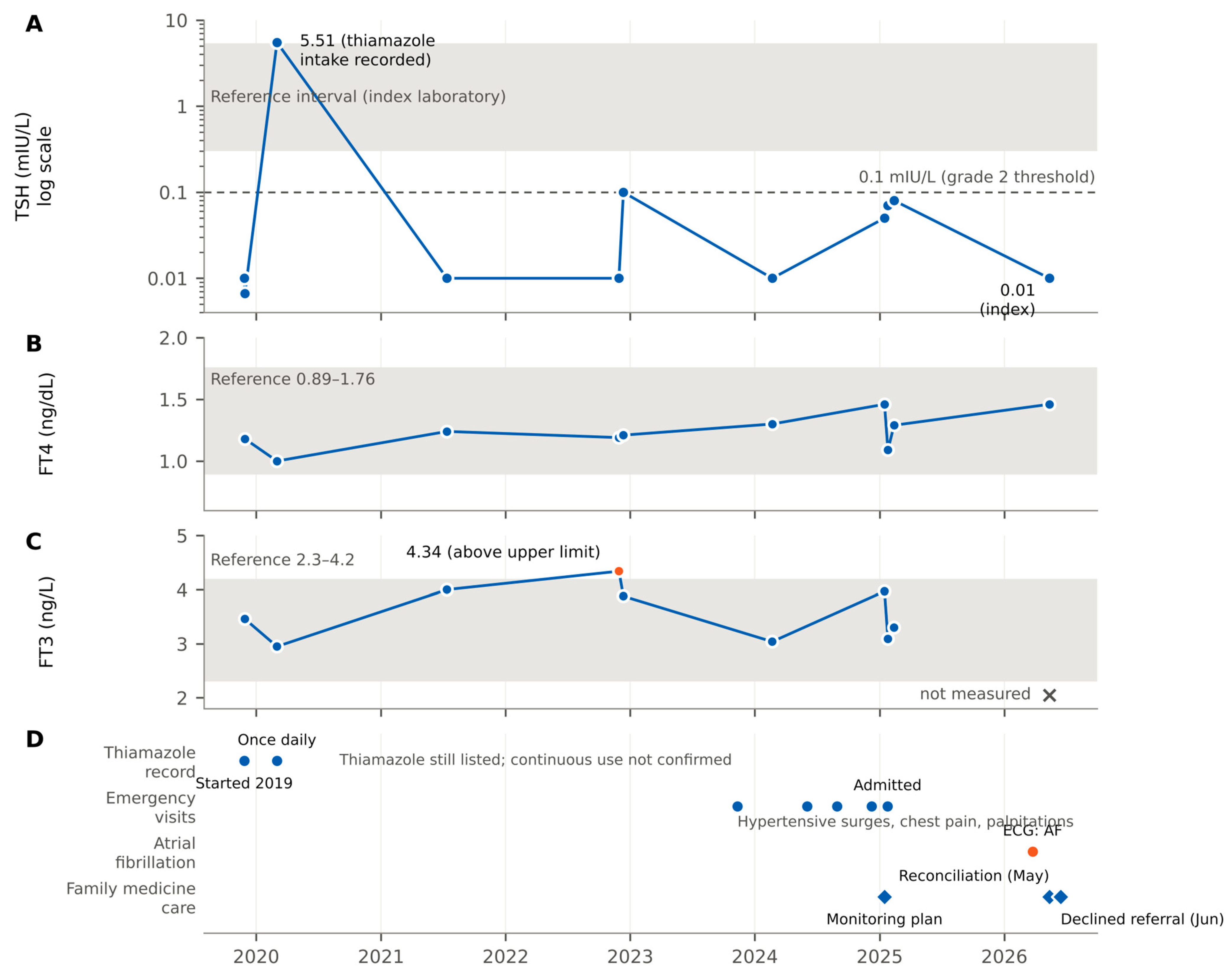
The patient’s thyroid tests had been abnormal since at least November 2019, when TSH was below 0.01 mIU/L with FT4 and FT3 within their reference intervals; thiamazole was prescribed in 2019. In March 2020, the record stated that she was taking thiamazole once daily, but the dose was not recorded; the TSH was 5.51 mIU/L and FT4 was in the lower part of its reference interval, a pattern consistent with an antithyroid drug effect. A note from December 2022 recorded that she had used approximately one package of thiamazole in 2019. From July 2021 onward, TSH was 0.1 mIU/L or lower at every measurement (Table 1, Figure 1), yet thiamazole remained on her medication list. A January 2025 note recorded subclinical hyperthyroidism, previous thiamazole use, no new antithyroid treatment, and a plan for thyroid tests every three months; the next tests were performed 15 months later, at the index visit.
Table 1.
Thyroid function tests and documented thiamazole use, 2019–2026.
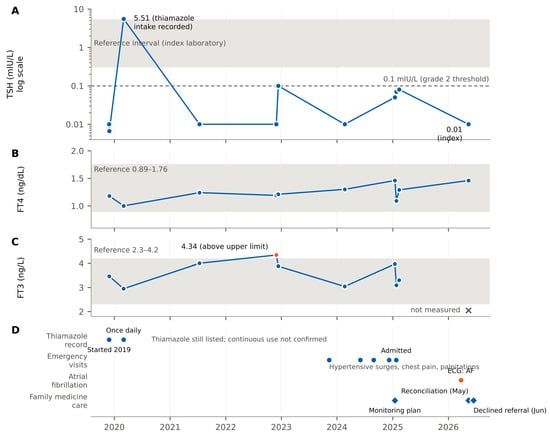
Figure 1.
Thyroid function tests and clinical events, 2019–2026. (A) TSH on a logarithmic scale; the shaded band shows the reference interval of the index laboratory and the dashed line marks the 0.1 mIU/L threshold for grade 2 suppression. The November 2019 value reported as <0.01 mIU/L is plotted at 0.01. (B) FT4 and (C) FT3; shaded bands show the reference intervals used by most of the laboratories (the index laboratory used 0.72–1.89 ng/dL for FT4). The FT3 value above the upper limit in November 2022 is shown in orange; FT3 was not measured at the index visit. (D) Documented thiamazole use, emergency visits, the emergency electrocardiogram showing atrial fibrillation (already listed in the history), and family medicine contacts. FT3—free triiodothyronine; FT4—free thyroxine; TSH—thyroid-stimulating hormone.
Over the same period, she attended emergency services several times with hypertensive episodes (systolic blood pressure up to 230 mmHg), palpitations, chest discomfort, or sweating, and she was admitted once with chest pain in January 2025. In March 2026, an electrocardiogram obtained in the emergency department showed atrial fibrillation with ST-segment depression; serial troponin results were negative, and outpatient cardiology follow-up was advised. She was also seen intermittently in cardiology and ophthalmology outpatient clinics, and each contact addressed the problem of that specialty. Because the record listed thiamazole, the low TSH values were regarded as a known, treated condition and were not investigated further, and none of the records linked her cardiovascular presentations with the thyroid findings. The clinical course is summarized in Figure 1.
2.3. Medication Reconciliation and Diagnostic Reframing
At the index visit, we reviewed her past records and undertook a structured medication interview with the patient and a relative. The patient did not recognize thiamazole (methimazole) as a current medicine and could not describe its package, dose, or schedule. Her relative could not confirm current use either, whereas both described her cardiovascular and metabolic medicines accurately. The national electronic prescription record showed no continuous dispensing of thiamazole compatible with maintenance treatment; the documented exposure was brief and remote. Dispensing data cannot prove non-use at every point in time, but they showed that the medication list was not reliable evidence of ongoing antithyroid therapy. Because she was fully independent in instrumental activities of daily living, including management of her own medicines, functional dependence was an unlikely explanation for the discrepancy. The working description therefore changed from subclinical hyperthyroidism under treatment to persistent grade 2 TSH suppression without current treatment and of undetermined cause.
FT4 was within its reference interval on all 10 occasions on which it was measured. FT3 was within its reference interval on eight of nine occasions; in November 2022 it was 4.34 ng/L (reference 2.3–4.2 ng/L) with a TSH of 0.01 mIU/L, consistent with mild T3 toxicosis at that time, and 13 days later it was 3.88 ng/L (Table 1). At the index visit on 13 May 2026, TSH was 0.01 mIU/L and FT4 was 1.46 ng/dL, but FT3 had not been included in the laboratory panel. Over seven years, the pattern was therefore compatible with subclinical hyperthyroidism on most occasions, but T3 toxicosis could not be excluded, either in the past or at the index visit. For this reason, we use the descriptive term persistent grade 2 TSH suppression in this report.
Thiamazole inhibits thyroid hormone synthesis and would be expected to raise rather than suppress TSH; the TSH of 5.51 mIU/L recorded in March 2020, when daily intake was documented, is consistent with this effect. Intermittent use could, however, have lowered FT4 and FT3 into their reference intervals while TSH remained suppressed, because recovery of TSH lags behind normalization of thyroid hormones by weeks to months [5]. Brief or irregular exposure may therefore have made overt hyperthyroidism appear subclinical at some time points. The dispensing record did not support continuous exposure over seven years, so this mechanism cannot explain the whole pattern, but it cannot be excluded for individual measurements.
2.4. Geriatric Assessment and Management
The index laboratory tests (Table 2) showed thyroid peroxidase and thyroglobulin antibodies within their reference intervals; microcytic anemia with an iron-deficiency pattern (hemoglobin 10.5 g/dL, compared with 14.4 g/dL in March 2020; transferrin saturation 4.7%); parathyroid hormone above the reference interval with normal calcium and phosphorus; normal renal and liver tests; and mildly raised C-reactive protein. Vitamin B12 deficiency had previously been treated with intramuscular replacement, and the index vitamin B12 level was in the low–normal range. These findings meant that her weight loss could not be attributed to the thyroid alone.
Table 2.
Selected laboratory results at the index visit (13 May 2026).
Comprehensive geriatric assessment was performed because chronological age alone was not an adequate basis for deciding whether to investigate further. The patient was independent in basic and instrumental activities of daily living (Katz 6/6; Lawton–Brody 8/8). Her Clinical Frailty Scale score was 4, indicating vulnerability rather than dependence. The Patient Health Questionnaire-2 score was 0, whereas the Geriatric Depression Scale-15 score was 5, which indicates depressive symptoms or risk but is not diagnostic on its own. The Mini Nutritional Assessment-Short Form and full Mini Nutritional Assessment scores were 10 and 20, respectively, both indicating risk of malnutrition. Her body mass index was 21.3 kg/m2, her mid-upper arm circumference was 21 cm, and her calf circumference was 29.5 cm (Table 3).
Table 3.
Comprehensive geriatric assessment at the index reassessment.
Thiamazole was not restarted in the clinic because ongoing treatment had not been confirmed, the cause of TSH suppression was unknown, and no index FT3 value was available. Normal thyroid antibody results did not establish a cause and could not replace TSH receptor antibody testing or thyroid imaging; toxic nodular goiter, Graves disease, thyroiditis, and medication or assay effects therefore remained possible [2,5]. We recommended endocrinology assessment with repeat TSH, FT4, and FT3; TSH receptor antibodies; thyroid ultrasonography with Doppler; and scintigraphy or uptake measurement if feasible [2,5,9]. Because the patient had recently undergone contrast-enhanced imaging, the timing of radionuclide testing was left to the endocrinology and nuclear medicine teams. Iron-deficiency anemia, raised parathyroid hormone, malnutrition risk, and weight loss were to be evaluated in parallel, with the family physician coordinating care.
2.5. Follow-Up and Patient Perspective
At a follow-up contact in June 2026, we reviewed with the patient the possible cardiovascular and skeletal consequences of persistent TSH suppression, the uncertainty about its cause, the proposed tests, and the option of endocrinology referral. She said that she felt well, did not want to travel from her village to the referral center, and did not wish to undergo further investigation; she preferred follow-up close to home. After acknowledging the risks and the alternatives, she declined further etiologic assessment. Her decision was documented, and re-referral was left open should her symptoms, clinical condition, or preferences change. The local plan included monitoring of thyroid tests, blood pressure, rhythm-related symptoms, weight, and nutritional status. No etiologic or treatment outcome is available, because the proposed investigations were declined.
3. Discussion
3.1. Why This Case Is Reported
The approach to a persistently suppressed TSH in an older adult is not new, and the tests needed to investigate it are widely known [2,5,9]. What this case shows is how that approach can remain unused for years. Several factors contributed in our patient: a thiamazole entry carried forward from a brief course in 2019; emergency, cardiology, and ophthalmology contacts that each addressed a single problem; irregular attendance at follow-up; and the distance between her village and the referral center. The decisive step at the index visit was not a new test but a review of her past records and a check of what she was actually taking. This changed the clinical question from why TSH remained low under treatment to what was causing untreated TSH suppression, and it determined the subsequent recommendations. We do not claim that this improved clinical outcomes; the etiology remains unknown, and the patient declined the investigations that could have established it.
3.2. The Medication Record as a Source of Diagnostic Error
Discrepancies between recorded and actual medication use are common [14,15], and medication review and reconciliation are recommended as routine safety processes for older adults and people with polypharmacy [21,22]. Most of this literature concerns prescribing errors, adverse drug events, and transitions between care settings. Our case illustrates a different consequence: an outdated entry changed how laboratory results were interpreted. Carried-forward entries persist across encounters [16], and once a problem has been labeled as under treatment, later clinicians may accept the label rather than re-examine it [17]. This is more likely when each specialist sees the patient for a single condition [18]. In our patient, cardiology and ophthalmology visits addressed their own problems, and the thyroid finding was left to a treatment she was no longer taking. No single source was conclusive. We compared the patient’s account, her relative’s account, the active medication list, and the national dispensing record, and limited the conclusion to what these sources could support: ongoing treatment was not confirmed, rather than thiamazole never having been taken. Verification also has to cover dose and schedule. In March 2020, once-daily intake was recorded without a dose, and at the index visit the patient could describe neither. A drug on the medication list therefore says little about actual exposure unless the patient, the dispensing record, or both confirm how it is being taken.
3.3. Biochemical Classification and the Role of Thiamazole
The absence of an FT3 result at the index visit is the main diagnostic weakness of this report. Subclinical hyperthyroidism can be diagnosed only when both free hormones are within their reference intervals; an isolated FT3 elevation indicates T3 toxicosis, which is typically associated with toxic nodular goiter or early Graves disease and is managed as overt hyperthyroidism [1,5]. The raised FT3 in November 2022 suggests that the patient may have moved between subclinical and T3-predominant states. For this reason, we do not describe her condition as subclinical hyperthyroidism without qualification. With negative thyroid antibodies, toxic nodular goiter or a solitary autonomous nodule would be the most frequent causes in an older adult, particularly where iodine intake has been insufficient [3,4], but without imaging and TSH receptor antibody testing this remains a hypothesis. The documented thiamazole exposure explains the transient TSH rise in March 2020 and may have masked overt disease at some measurements, as discussed in Section 2.3 [5]. FT3 can be measured in the local laboratory without travel, and in our view it should be included in her next routine blood test.
3.4. Cardiovascular and Skeletal Risk and Uncertain Benefit of Treatment
Persistent TSH below 0.1 mIU/L in an 83-year-old woman with coronary disease and atrial fibrillation falls within the group for which European and Turkish guidelines recommend considering treatment [2,9]. Observational data link this degree of suppression with atrial fibrillation, coronary mortality, and fracture [6,7,8], and atrial fibrillation guidelines advise assessment of thyroid status in patients with arrhythmia [25,26]. These associations do not show that thyroid dysfunction caused her atrial fibrillation, hypertensive episodes, or weight loss. The benefit of treatment is also uncertain. In a randomized trial in adults older than 50 years with thyroid autonomy, immediate treatment did not clearly reduce atrial fibrillation, and radioiodine-induced hypothyroidism was frequent [10]; an observational study found fewer cases of incident atrial fibrillation after treatment but could not establish causality [11]. Guidelines differ in their thresholds and diagnostic work-up [12], and in primary care cohorts a low TSH often resolves spontaneously, although less often when TSH is very low [13]. In this context, referral for etiologic assessment was more defensible than empirical reintroduction of thiamazole.
3.5. Geriatric Assessment and Competing Explanations
Comprehensive geriatric assessment informed the plan in two ways. Full independence in basic and instrumental activities and a Clinical Frailty Scale score of 4 argued against limiting investigation because of age, in line with guidance that decisions for older adults should be based on function, multimorbidity, and goals rather than chronological age [27]. At the same time, malnutrition risk, low calf circumference, iron-deficiency anemia, raised parathyroid hormone, and weight loss offered alternative or additional explanations for her symptoms. Iron-deficiency anemia in an older woman itself warrants gastrointestinal evaluation [28]. Thyroid hormone excess, low body weight, and raised parathyroid hormone may all add to fracture risk, which is relevant for a woman who still works outdoors [7,29]. The plan therefore covered nutrition, anemia, and bone health as well as thyroid and cardiac follow-up.
3.6. Informed Refusal, Continuity, and Criteria for Renewed Referral
Further investigation required travel to a regional center, and the patient declined it after the risks, the uncertainty about the cause, and the available tests had been discussed. Shared decision-making involves introducing the choice, comparing the options and their likely benefits and harms, and helping patients reach a decision that reflects their informed preferences [30]. In our view, with an older patient who has limited formal education, this also means explaining the risks in plain terms and checking that they have been understood; the patient may still decline, and that decision has to be respected. Her refusal was documented and did not end care. The commitment of family medicine to continuing, person-centered care [31], and evidence that continuity with the same doctor is associated with lower mortality [32], support keeping such patients under structured follow-up rather than closing the problem after refusal.
Monitoring after refusal is useful only if it is linked to explicit triggers. Guideline recommendations for follow-up intervals in subclinical hyperthyroidism range from 3 to 12 months [12]. In our view, endocrinology referral should be offered again if any of the following occurs: FT4 or FT3 above the reference interval; new or worsening atrial fibrillation, a rapid ventricular rate, heart failure, or angina; further unintentional weight loss of 5% or more of body weight within 6 to 12 months; a fragility fracture or newly diagnosed osteoporosis; new symptoms of thyrotoxicosis or a palpable goiter or nodule; or a change in the patient’s preferences. For this patient, thyroid function, including FT3, can be monitored locally every 3 to 6 months.
3.7. Limitations
This report has several limitations. The cause of TSH suppression was not established, because TSH receptor antibodies, thyroid ultrasonography, and scintigraphy were not performed, and FT3 was not measured at the index visit; T3 toxicosis therefore cannot be excluded. Dispensing records cannot exclude every episode of medication use, and the history of thiamazole exposure in 2019 and 2020 is based on brief clinical notes. Our account of the earlier specialty visits relies on the available records, which do not show the reasoning of each clinician. Laboratory results came from several laboratories with different reference intervals. No thyroid-specific outcome is available because the patient declined further investigation. As a single case, it cannot show that thyroid dysfunction caused or worsened her atrial fibrillation, hypertensive episodes, sweating, or weight loss, and its lessons concern the process of care rather than clinical outcomes. How often similar record discrepancies delay thyroid evaluation in primary care would require systematic study. The strengths of the report are seven years of laboratory data, a medication history checked against several sources, and a structured geriatric assessment.
4. Conclusions
This case does not describe a new disorder. In this older woman, a carried-forward antithyroid prescription gave the false impression that years of grade 2 TSH suppression were being treated, and a well-known diagnostic approach was not applied. Review of her past records and of her actual medication use corrected this impression, but the cause of the suppression remains unknown and T3 toxicosis has not been excluded. The case does not show that this approach improved clinical outcomes. Its practical lessons concern the process of care. In older patients followed by several specialties, the family physician is well placed to review the whole record rather than accept earlier entries. Before an abnormal thyroid result is attributed to treatment, it should be confirmed whether the recorded drug is actually being taken, and at what dose. FT3 should be measured whenever TSH is suppressed, and the patient should be told what the finding may mean. When a patient declines investigation after counseling, follow-up should continue with explicit criteria for renewed referral.
Supplementary Materials
The following supporting information can be downloaded at: https://www.mdpi.com/article/10.3390/joma3020032/s1, Reporting Guideline: This case report was prepared in accordance with the CARE guideline [23,24]. The completed CARE checklist (CARE Group, www.care-statement.org; licensed under CC BY-NC 4.0) is provided as Supplementary Material.
Author Contributions
Conceptualization, İ.E. and G.G.E.; methodology, İ.E.; validation, İ.E. and G.G.E.; formal analysis, İ.E.; investigation, İ.E. and G.G.E.; resources, İ.E. and G.G.E.; data curation, İ.E. and G.G.E.; writing—original draft preparation, İ.E.; writing—review and editing, G.G.E.; visualization, G.G.E.; supervision, İ.E. and G.G.E.; project administration, İ.E. and G.G.E. All authors have read and agreed to the published version of the manuscript.
Funding
This research received no external funding.
Institutional Review Board Statement
Ethical review and approval were not required for this single-patient case report because it describes routine clinical care and involved no research intervention or systematic study protocol, in accordance with local institutional policy. The report was prepared in accordance with the Declaration of Helsinki.
Informed Consent Statement
Written informed consent has been obtained from the patient to publish this paper.
Data Availability Statement
The original contributions presented in this study are included in the article/Supplementary Material. Further inquiries can be directed to the corresponding author.
Acknowledgments
The authors thank Kaan Cem Ottan, Chief Physician of Göynücek District State Hospital, for his support. We also thank the patient for her cooperation and for consenting to publication of her anonymized clinical information. During the preparation of this manuscript and its revision, the authors used generative artificial intelligence tools (GPT-6, OpenAI; Claude Opus 5.5, Anthropic) to improve language and organization and to check bibliographic details. The tools were not used to generate or analyze clinical data or to draw clinical conclusions. The authors reviewed and edited all text and take full responsibility for the content of this publication.
Conflicts of Interest
The authors declare no conflicts of interest.
References
- Biondi, B.; Cooper, D.S. Subclinical Hyperthyroidism. N. Engl. J. Med. 2018, 378, 2411–2419. [Google Scholar] [CrossRef] [Scilit]
- Biondi, B.; Bartalena, L.; Cooper, D.S.; Hegedüs, L.; Laurberg, P.; Kahaly, G.J. The 2015 European Thyroid Association Guidelines on Diagnosis and Treatment of Endogenous Subclinical Hyperthyroidism. Eur. Thyroid J. 2015, 4, 149–163. [Google Scholar] [CrossRef] [Scilit] [PubMed]
- Taylor, P.N.; Albrecht, D.; Scholz, A.; Gutierrez-Buey, G.; Lazarus, J.H.; Dayan, C.M.; Okosieme, O.E. Global Epidemiology of Hyperthyroidism and Hypothyroidism. Nat. Rev. Endocrinol. 2018, 14, 301–316. [Google Scholar] [CrossRef] [Scilit] [PubMed]
- Lee, S.Y.; Pearce, E.N. Hyperthyroidism: A Review. JAMA 2023, 330, 1472–1483. [Google Scholar] [CrossRef] [Scilit] [PubMed]
- Ross, D.S.; Burch, H.B.; Cooper, D.S.; Greenlee, M.C.; Laurberg, P.; Maia, A.L.; Rivkees, S.A.; Samuels, M.; Sosa, J.A.; Stan, M.N.; et al. 2016 American Thyroid Association Guidelines for Diagnosis and Management of Hyperthyroidism and Other Causes of Thyrotoxicosis. Thyroid 2016, 26, 1343–1421, Correction in Thyroid 2025, 35, 1097. [Google Scholar] [CrossRef] [Scilit] [PubMed]
- Collet, T.H.; Gussekloo, J.; Bauer, D.C.; den Elzen, W.P.J.; Cappola, A.R.; Balmer, P.; Iervasi, G.; Åsvold, B.O.; Sgarbi, J.A.; Völzke, H.; et al. Subclinical Hyperthyroidism and the Risk of Coronary Heart Disease and Mortality. Arch. Intern. Med. 2012, 172, 799–809. [Google Scholar] [CrossRef] [Scilit] [PubMed]
- Blum, M.R.; Bauer, D.C.; Collet, T.H.; Fink, H.A.; Cappola, A.R.; da Costa, B.R.; Wirth, C.D.; Peeters, R.P.; Åsvold, B.O.; Elzen, W.P.J.D.; et al. Subclinical Thyroid Dysfunction and Fracture Risk: A Meta-Analysis. JAMA 2015, 313, 2055–2065. [Google Scholar] [CrossRef] [Scilit] [PubMed]
- Singh, H.; Shahid, M.Z.; Harrison, S.L.; Lane, D.A.; Lip, G.Y.H.; Logantha, S.J.R.J. Subclinical Thyroid Dysfunction and the Risk of Incident Atrial Fibrillation: A Systematic Review and Meta-Analysis. PLoS ONE 2024, 19, e0296413. [Google Scholar] [CrossRef] [Scilit] [PubMed]
- Türkiye Endokrinoloji ve Metabolizma Derneği. Tiroid Hastalıkları Tanı ve Tedavi Kılavuzu [Guideline for the Diagnosis and Treatment of Thyroid Diseases], 8th ed.; Türkiye Endokrinoloji ve Metabolizma Derneği: Ankara, Türkiye, 2025; Available online: https://file.temd.org.tr/Uploads/publications/guides/documents/tiroid2025_11042025.pdf (accessed on 14 October 2026).
- Goichot, B.; Lefebvre, F.; Vinzio, S.; Cailleux, A.; Kuhn, J.M.; Schneegans, O.; Catargi, B.; Gilly, O.; Baltzinger, P.; Meyer, N.; et al. Treatment of Subclinical Hyperthyroidism in Patients Older than 50 Years: A Randomized Controlled Study. Eur. Thyroid J. 2024, 13, e240121. [Google Scholar] [CrossRef] [Scilit]
- Jay, M.; Huan, P.; Cliffe, N.; Rakoff, J.; Morris, E.; Kavsak, P.; Luthra, M.; Punthakee, Z. Treatment of Subclinical Hyperthyroidism and Incident Atrial Fibrillation. Clin. Endocrinol. 2025, 102, 315–323. [Google Scholar] [CrossRef] [Scilit] [PubMed]
- Ursem, S.R.; Boelen, A.; Bruinstroop, E.; Elders, P.J.M.; Gussekloo, J.; Poortvliet, R.K.E.; Heijboer, A.C.; Elzen, W.P.D. A Systematic Review of Subclinical Hyperthyroidism Guidelines: A Remarkable Range of Recommendations. Eur. Thyroid J. 2024, 13, e240036. [Google Scholar] [CrossRef] [Scilit] [PubMed]
- Ursem, S.R.; den Elzen, W.P.J.; van den Berg, J.M.; Boelen, A.; Elders, P.J.M.; Noordam, R.; Heijboer, A.C. Natural Course of Subclinical Hyperthyroidism in Primary Care in the Netherlands. Eur. Thyroid J. 2025, 14, e250142. [Google Scholar] [CrossRef] [Scilit] [PubMed]
- González-Colominas, E.; López-Mula, C.; Martínez-Casanova, J.; Luque, S.; Conde-Estévez, D.; Monge-Escartín, I.; Ferrández, O. Primary Care Electronic Medication Record Discrepancies in Patients Starting Treatment at a Hospital-Based Ambulatory Care Pharmacy and Impact on Prevalence of Potential Drug–Drug Interactions. Eur. J. Hosp. Pharm. 2023, 30, 333–338. [Google Scholar] [CrossRef] [Scilit] [PubMed]
- García González, D.; Teixeira-da-Silva, P.; Salvador Sánchez, J.J.; Sánchez Serrano, J.Á.; Calvo, M.V.; Martín-Suárez, A. Discrepancies in Electronic Medical Prescriptions Found in a Hospital Emergency Department: A Prospective Observational Study. Pharmaceuticals 2024, 17, 460. [Google Scholar] [CrossRef] [Scilit] [PubMed]
- Tsou, A.Y.; Lehmann, C.U.; Michel, J.; Solomon, R.; Possanza, L.; Gandhi, T. Safe Practices for Copy and Paste in the EHR: Systematic Review, Recommendations, and Novel Model for Health IT Collaboration. Appl. Clin. Inform. 2017, 8, 12–34. [Google Scholar] [CrossRef] [Scilit] [PubMed]
- Croskerry, P. The Importance of Cognitive Errors in Diagnosis and Strategies to Minimize Them. Acad. Med. 2003, 78, 775–780. [Google Scholar] [CrossRef] [Scilit] [PubMed]
- Ando, T.; Sasaki, T.; Abe, Y.; Nishimoto, Y.; Hirata, T.; Haruta, J.; Arai, Y. Measurement of Polydoctoring as a Crucial Component of Fragmentation of Care among Patients with Multimorbidity: Cross-Sectional Study in Japan. J. Gen. Fam. Med. 2023, 24, 343–349. [Google Scholar] [CrossRef] [Scilit] [PubMed]
- Schönfeld, M.S.; Pfisterer-Heise, S.; Bergelt, C. Self-Reported Health Literacy and Medication Adherence in Older Adults: A Systematic Review. BMJ Open 2021, 11, e056307. [Google Scholar] [CrossRef] [Scilit] [PubMed]
- Perpétuo, C.; Plácido, A.I.; Mateos-Campos, R.; Figueiras, A.; Herdeiro, M.T.; Roque, F. Effectiveness of Interventions to Improve Health Literacy on Medication Use Among Older Adults: A Systematic Review. J. Ageing Longev. 2025, 5, 47. [Google Scholar] [CrossRef] [Scilit]
- Beuscart, J.-B.; Pelayo, S.; Robert, L.; Thevelin, S.; Marien, S.; Dalleur, O. Medication Review and Reconciliation in Older Adults. Eur. Geriatr. Med. 2021, 12, 499–507. [Google Scholar] [CrossRef] [Scilit] [PubMed]
- Engels, L.; van den Akker, M.; Denig, P.; Stoffers, H.; Gerger, H.; Bohnen, J.; Jansen, J. Medication Management in Patients with Polypharmacy in Primary Care: A Scoping Review of Clinical Practice Guidelines. J. Evid. Based Med. 2025, 18, e70015. [Google Scholar] [CrossRef] [Scilit] [PubMed]
- Gagnier, J.J.; Kienle, G.; Altman, D.G.; Moher, D.; Sox, H.; Riley, D.; CARE Group. The CARE Guidelines: Consensus-Based Clinical Case Reporting Guideline Development. J. Clin. Epidemiol. 2014, 67, 46–51. [Google Scholar] [CrossRef] [Scilit] [PubMed]
- Riley, D.S.; Barber, M.S.; Kienle, G.S.; Aronson, J.K.; von Schoen-Angerer, T.; Tugwell, P.; Kiene, H.; Helfand, M.; Altman, D.G.; Sox, H.; et al. CARE Guidelines for Case Reports: Explanation and Elaboration Document. J. Clin. Epidemiol. 2017, 89, 218–235. [Google Scholar] [CrossRef] [Scilit] [PubMed]
- Kostopoulos, G.; Effraimidis, G. Epidemiology, Prognosis, and Challenges in the Management of Hyperthyroidism-Related Atrial Fibrillation. Eur. Thyroid J. 2024, 13, e230254. [Google Scholar] [CrossRef] [Scilit] [PubMed]
- Joglar, J.A.; Chung, M.K.; Armbruster, A.L.; Benjamin, E.J.; Chyou, J.Y.; Cronin, E.M.; Deswal, A.; Eckhardt, L.L.; Goldberger, Z.D.; Gopinathannair, R.; et al. 2023 ACC/AHA/ACCP/HRS Guideline for the Diagnosis and Management of Atrial Fibrillation: A Report of the American College of Cardiology/American Heart Association Joint Committee on Clinical Practice Guidelines. Circulation 2024, 149, e1–e156, Correction in Circulation 2024, 149, 9. https://doi.org/10.1161/CIR.0000000000001218. [Google Scholar] [CrossRef] [Scilit] [PubMed]
- Pilotto, A.; Aprile, P.L.; Veronese, N.; Lacorte, E.; Morganti, W.; Custodero, C.; Piscopo, P.; Fabrizi, E.; Della Gatta, F.; Merlo, A.; et al. The Italian Guideline on Comprehensive Geriatric Assessment (CGA) for the Older Persons: A Collaborative Work of 25 Italian Scientific Societies and the National Institute of Health. Aging Clin. Exp. Res. 2024, 36, 121. [Google Scholar] [CrossRef] [Scilit] [PubMed]
- Snook, J.; Bhala, N.; Beales, I.L.P.; Cannings, D.; Kightley, C.; Logan, R.P.; Pritchard, D.M.; Sidhu, R.; Surgenor, S.; Thomas, W.; et al. British Society of Gastroenterology Guidelines for the Management of Iron Deficiency Anaemia in Adults. Gut 2021, 70, 2030–2051. [Google Scholar] [CrossRef] [Scilit] [PubMed]
- Montero-Odasso, M.; van der Velde, N.; Martin, F.C.; Petrovic, M.; Tan, M.P.; Ryg, J.; Aguilar-Navarro, S.; Alexander, N.B.; Becker, C.; Blain, H.; et al. World Guidelines for Falls Prevention and Management for Older Adults: A Global Initiative. Age Ageing 2022, 51, afac205, Correction in Age Ageing 2023, 52, afad199. https://doi.org/10.1093/ageing/afad199. [Google Scholar] [CrossRef] [Scilit] [PubMed]
- Elwyn, G.; Durand, M.A.; Song, J.; Aarts, J.; Barr, P.J.; Berger, Z.; Cochran, N.; Frosch, D.; Galasiński, D.; Gulbrandsen, P.; et al. A Three-Talk Model for Shared Decision Making: Multistage Consultation Process. BMJ 2017, 359, j4891. [Google Scholar] [CrossRef] [Scilit] [PubMed]
- Windak, A.; Rochfort, A.; Jacquet, J. The Revised European Definition of General Practice/Family Medicine. A Pivotal Role of One Health, Planetary Health and Sustainable Development Goals. Eur. J. Gen. Pract. 2024, 30, 2306936. [Google Scholar] [CrossRef] [Scilit] [PubMed]
- Pereira Gray, D.J.; Sidaway-Lee, K.; White, E.; Thorne, A.; Evans, P.H. Continuity of Care with Doctors—A Matter of Life and Death? A Systematic Review of Continuity of Care and Mortality. BMJ Open 2018, 8, e021161. [Google Scholar] [CrossRef] [Scilit] [PubMed]

Disclaimer/Publisher’s Note: The statements, opinions and data contained in all publications are solely those of the individual author(s) and contributor(s) and not of MDPI and/or the editor(s). MDPI and/or the editor(s) disclaim responsibility for any injury to people or property resulting from any ideas, methods, instructions or products referred to in the content. |
© 2026 by the authors. Published by MDPI on behalf of the Oman Medical Association. Licensee MDPI, Basel, Switzerland. This article is an open access article distributed under the terms and conditions of the Creative Commons Attribution (CC BY) license.