

- Article

Retrospective Analysis of Moisture Conditions in Eastern Kazakhstan Using the Selyaninov Hydrothermal Coefficient Based on ERA5 and ERA5-Land Reanalyses (1960–2024)
- Egor Mordvin,
- Andrey Bondarovich and
- Markhaba Karmenova
- + 4 authors
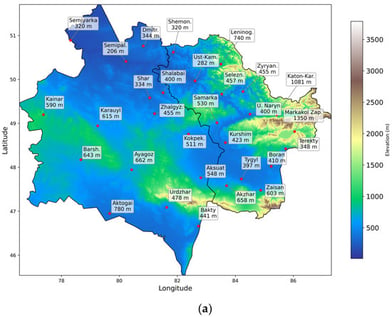
The Selyaninov hydrothermal coefficient (HTC) is widely used to characterize moisture conditions in agrometeorology. In arid regions of Central Asia, sparse observational networks increase reliance on reanalysis datasets; however, their applicability requires regional validation. This study presents the first comparative assessment of ERA5 and ERA5-Land for calculating the HTC in Eastern Kazakhstan over 1960–2024, using data from 28 Kazhydromet stations distributed from lowland steppes (200–660 m) to mountainous terrain (above 1000 m). Both products systematically overestimate HTC, primarily due to precipitation bias. Performance at lowland stations remains acceptable (median KGE ≈ 0.55, MAE ≈ 0.09–0.17), whereas in mountainous areas, KGE becomes negative. Nevertheless, interannual HTC variability is reasonably captured (Spearman’s correlation = 0.50–0.80). ERA5-Land provides only a moderate improvement over ERA5 in lowlands; in mountainous areas, its higher resolution offers no clear advantage, and both datasets require bias correction. Trend analysis reveals no consistent direction in moisture changes from Kazhydromet observations, while both reanalyses indicate aridification, with sign agreement at only 13 out of 28 stations. The results show that using ERA5/ERA5-Land as proxies in climate studies requires accounting for bias propagation, while their application in CMIP6-based regional projections remains a subject for future research.
3 June 2026