Article

Gas-Phase Formation of Acrylonitrile (CH2CHCN; X1A′) via the Reaction of the Methylidyne Radical (CH; X2Π) and Acetonitrile (CH3CN; X1A1)

by
Ashleigh G. Hartwig
and
Alexander M. Mebel
*
Department of Chemistry and Biochemistry, Florida International University, Miami, FL 33199, USA
*
Author to whom correspondence should be addressed.
Appl. Sci. 2026, 16(11), 5591; https://doi.org/10.3390/app16115591
Submission received: 23 April 2026 / Revised: 25 May 2026 / Accepted: 28 May 2026 / Published: 3 June 2026
(This article belongs to the Special Issue Development and Application of Computational Chemistry Methods)

Abstract

Nitrogen-containing molecules are fundamental components of astrobiology and play a key role in planetary environments. These species are particularly important because they may serve as key precursors to prebiotic molecules and contribute to chemical complexity. Reactions involving the highly reactive species methylidyne (CH) play a key role in complex organic formation in astrochemical environments, yet their interactions with nitriles such as acetonitrile (CH3CN) remain relatively unexplored. In this work, we investigate the reaction network of CH + CH3CN using high-level quantum-chemical calculations with RRKM and microcanonical transition-state theories to characterize the relative energies of reactants, intermediates, transition states, and products to identify the most favorable reaction pathways. Our results reveal that the most energetically favorable reaction channels proceed via barrierless CH addition to the triple CN bond and three-membered ring opening or CH insertion into a C-H bond, followed by a hydrogen elimination to form acrylonitrile (C2H3CN). This route highlights an efficient pathway toward a molecule of astrobiological interest. Acrylonitrile is particularly significant due to its stability and dual functional groups, which enable molecular growth complexity, both in planetary atmospheres and on surfaces, under astrochemical conditions. In addition to acrylonitrile, we identified a few other competing channels leading to an isonitrile species, which emphasizes a previously unexplored aspect of isomerization chemistry in the atmospheric planetary science. These isonitrile products, while less abundant, provide insight to the diversity of nitrogen-containing molecules that may form in environments such as Titan’s atmosphere or the interstellar medium. In these environments, acrylonitrile may serve as a reactive precursor that facilitates cyclization and molecular growth, which enables the formation of nitrogen-containing polycyclic aromatic molecules and N-heterocycles. This, in turn, contributes to the emergence of larger, more complex organic species relevant to prebiotic chemistry and potential origin of life in our solar system.

1. Introduction

Planetary atmospheres and interstellar environments host a wide range of chemical processes that lead to the formation of complex organic molecules. The identification and characterization of these molecules provide insight into atmospheric evolution and the potential pathways toward prebiotic chemistry in planetary environments. Among those in our Solar System, Titan, Saturn’s largest moon, stands out as one of the most compelling environments for studying complex organic chemistry [1]. Titan possesses a dense, nitrogen-dominated atmosphere rich in methane [2,3], which undergoes photochemistry driven by solar ultraviolet radiation and energetic particle interactions. These processes generate a wide variety of reactive intermediates and organic molecules [4], making Titan a natural laboratory for investigating nitrogen-bearing chemistry and the formation of complex organics under planetary conditions.
Over the last few decades, a plethora of nitrogen-bearing molecules have been detected in planetary atmospheres as well as in the interstellar medium (ISM). These species play an important role in prebiotic chemistry, as nitrogen is a key component in biologically relevant molecules such as amino acids and nucleobases. Titan’s thick haze layer, formed through molecular growth by covalent bonding and agglomeration [5,6,7], makes spectroscopic detection of molecules underneath difficult. Nevertheless, remote observations and in situ measurements have revealed a chemically rich atmospheric environment. A total of 24 species have been detected in Titan’s dense neutral atmosphere [8], with certain molecules exhibiting notably higher abundances, including nitriles and hydrocarbons that serve as key intermediates in Titan’s atmospheric chemistry and haze formation processes. One of the molecules on this list is vinyl cyanide (acrylonitrile, C2H3CN). The strongest evidence for its existence on Titan was its detection by the Atacama Large Millimeter/submillimeter Array (ALMA) [9] as well as the detection of C2H3CNH+ by the Cassini Ion and Neutral Mass Spectrometer (INMS) [10]. This cationic species was theorized to form primarily by proton attachment to neutral C2H3CN. Because protonated species are readily detected in ion mass spectrometry measurements, their presence can indirectly indicate the existence of the corresponding neutral molecules. The gas-phase synthesis of C2H3CN is not well understood. While the reaction between CN and C2H4 has been previously studied [11,12] and is generally considered a key formation pathway, additional mechanistic routes may also contribute to acrylonitrile production.
Many of Titan’s organic molecules are thought to originate primarily from photochemical processes occurring in its upper atmosphere. Ultraviolet radiation from the Sun and energetic particle interactions from Saturn [13,14,15] initiate the dissociation of methane and nitrogen, producing a variety of reactive radicals and ions [6,16]. These reactive intermediates subsequently participate in a complex network of ion-neutral and neutral-neutral reactions that lead to the formation of larger hydrocarbons and nitriles observed in Titan’s atmosphere [8,17,18]. The formation pathways of these molecules are essential for interpreting observational data and constraining atmospheric chemistry models. The photolysis of methane (Equation (1)), as well as an electron impact (Equation (2)), in Titan’s upper atmosphere [13] generate reactive radicals such as methyl (CH3), methylene (1CH2/3CH2), and methylidyne (CH), which initiate complex reaction pathways with other hydrocarbons and nitriles to form the organic molecules observed in its atmosphere. Among these, CH is especially important due to its high reactivity [19].
CH4 + hν ⟶ CH + 3H
CH4 + hν ⟶ CH3 + H
CH4 + hν1CH2 + 2H
CH4 + e3CH2 + 2H + e
Acetonitrile was the first molecule detected on Titan at millimeter-wavelengths by the IRAM 30 m telescope in Spain. It is abundant in the upper atmosphere of Titan and can be formed through the reaction of N atoms in the excited 2D state and ethylene (C2H4) [20] (Equation (3)) and by the termolecular reaction of H with cyanomethyl (CH2CN) in a chain that begins with acrylonitrile (C2H3CN) (Equation (4)) [8]. Termolecular reactions are much less common than unimolecular or bimolecular reactions because the probability of three molecules colliding simultaneously in the correct orientation and with enough energy is relatively low. Alternatively, an energized complex formed by a bimolecular collision can be stabilized by collisions with bath gas molecules, e.g., N2 in Titan’s atmosphere.
N(2D) + C2H4 ⟶ (c-CH2HCN or CH2(N)CH) + H
(c-CH2HCN or CH2(N)CH) + M ⟶ CH3CN + M*
H + C2H3CN + M ⟶ C2H4CN + M*
H + C2H4CN ⟶ CH2CN + CH3
H + CH2CN + M⟶ CH3CN + M*
Considering relatively high expected abundancies of CH and CH3CN [21,22], their reactions may play a key role in Titan’s atmospheric chemistry and may contribute to the formation of larger nitriles and other unsaturated N-containing organic molecules. In particular, the CH + CH3CN reaction represents a potential gas-phase pathway for the formation of acrylonitrile (C2H3CN). Understanding the kinetics and mechanisms of the CH + CH3CN reaction, along with other reactions leading to the growth of larger N-containing organic molecules, is therefore essential for accurately modeling Titan’s atmospheric composition. It is also important for interpreting observational data and for improving photochemical models for Titan’s atmosphere. The present work focuses on a theoretical study of the potential energy surface for the CH + CH3CN reaction, followed by calculations of its product branching ratios under Titan-like atmospheric conditions, which allows us to evaluate the efficiency of acrylonitrile production.

2. Materials and Methods

The geometric structures of all molecules (including reactants, products, intermediates, and transition states) were first optimized using the long-range corrected hybrid ωB97XD density functional [23] in combination with Pople’s split-valence 6-311G** basis set [24], as implemented in the GAUSSIAN 16 software package [25] through Florida International University’s High-Performance Computing (HPC) facility from the Instructional and Research Computing Center (IRCC). The ωB97XD/6-311G** level of theory typically predicts bond lengths and bond angles with an accuracy of 0.01–0.02 Å and 1.0°, respectively, and yields reaction energies with a mean absolute error (MAE) of approximately 3–5 kcal mol−1. Compared to older functionals such as B3LYP, which often overestimate bond distances, ωB97XD provides improved structural accuracy by accounting for dispersion interactions, resulting in more realistic and slightly more compact geometries [23,26].
To obtain more accurate energetics, single-point energies of all stationary points on the investigated potential energy surface (PES) were computed using the explicitly correlated coupled-cluster method with single and double excitations and a perturbative treatment of triple excitations, CCSD(T)-F12/cc-pVQZ-F12 [27,28]. The F12 formalism incorporates explicitly correlated terms that depend on the interelectronic distance, effectively accelerating basis-set convergence while maintaining high accuracy. The cc-pVQZ-F12 basis set is a correlation-consistent polarized valence quadruple-zeta basis optimized for use with F12 methods, further improving computational efficiency and precision. These calculations were performed using the MOLPRO 2021 program package to obtain reliable relative energies for all species involved. At this level of theory, the MAE for reaction energies is typically within 0.5 to 1.0 kcal mol−1 [29].
Rate constants for unimolecular reaction steps were computed using Rice–Ramsperger–Kassel–Marcus (RRKM) theory [30] where energy-dependent rate constants are evaluated using molecular parameters and energies derived from the PES (Equation (5)). Variational transition state theory (VTST) [31] was employed for unimolecular reaction steps occurring without a distinct transition state, i.e., barrierless reactions that lack a well-defined saddle point with a zero gradient along the reaction coordinate. While RRKM assumes a fixed dividing surface at the saddle point and separation of the reaction coordinate from other degrees of freedom [32], VTST instead optimizes the dividing surface along a minimum-energy path to find the kinetic bottleneck for reactions that lack a well-defined transition state. In the present work, a microcanonical formulation of VTST ( μ VTST) is used, which evaluates rate constants as a function of total internal energy rather than temperature. This approach is particularly well-suited for low-density, non-equilibrium environments such as Titan’s atmosphere, where energy transfer through collisions is limited. In summary, the energy-resolved rate constant is calculated using the RRKM expression:
k ( E ) = N ( E ) h ρ ( E )
where N ( E ) is the sum of states at the transition state, ρ ( E ) is the density of states of the reactant, and h is Planck’s constant. In μ VTST, this rate constant is minimized along the minimum energy reaction path to locate the optimal dividing surface [33]. In particular, in the μVTST scan between i2 and p4, we aimed to identify the structure along the reaction coordinate that produces the lowest rate constant, as VTST assumes the reaction rate is governed by the most restrictive kinetic bottleneck along the reaction pathway. The scan was performed by stretching the C2–C3 bond in increments of 0.05 Å over 30 steps while constraining the C1–C2–C3 angle to maintain the desired fragments’ orientation throughout the scan. The structure with the C2–C3 bond distance of 2.36 Å produced the lowest rate constants, 1.39 × 10¹⁰ and 1.52 × 10¹⁰ s−1 at collision energies of 0 and 1 kcal mol−1, respectively.
As a result, rate constants for each elementary step are evaluated in the zero-pressure limit, consistent with the conditions of low-density astrochemical environments. These rate constants are subsequently used to determine product branching ratios through the solution of the coupled reaction kinetic equations.

3. Results

3.1. Reaction Pathways

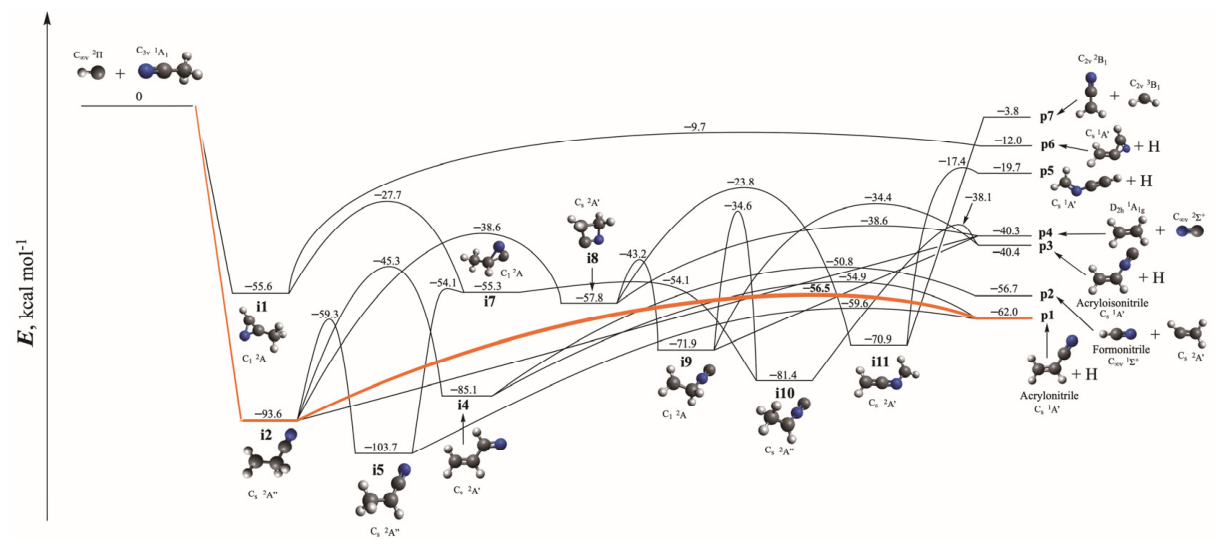
The PES profile, which includes various paths for the CH + CH3CN reaction, is shown in Figure 1. Here, the energies of all reactants, intermediates, transition states, and products were calculated at the CCSD(T)-F12/cc-pVQZ-F12//ωB97XD/6-311G** + ZPE(ωB97XD/6-311G**) level of theory, providing expected accuracy of ± 0.5 to 1 kcal mol−1 for the relative energies with respect to the initial reactants. The bimolecular reaction proceeds via two barrierless entrance channels: (i) addition of CH to the π -orbital of the C≡N bond forming intermediate i1, (−55.6 kcal mol−1 relative to the reactants) and (ii) C–H bond insertion forming i2 (−93.6 kcal mol−1).
Formation of i1 (−55.6 kcal mol−1) leads to multiple reaction pathways. A direct hydrogen-elimination via a transition state (TS) residing 9.7 kcal mol−1 below the reactants yields a cyclic nitrile product (p6). Although this represents a straightforward and entropically favorable pathway, i1 prefers to undergo an internal rearrangement via a 1,2-hydrogen shift to form i7, a nearly isoenergetic intermediate, via a TS lying 27.7 kcal mol−1 lower than the reactants. Thus, the barrier for the i1 to i7 rearrangement is 18 kcal mol−1 lower than that for the H loss from i1. From i7, two competing ring-opening pathways are identified via practically identical very low barriers, thus making this intermediate only metastable. Cleavage of the C–C bond in the three-membered ring can proceed to form i10, a significantly stabilized intermediate at −81.4 kcal mol−1. Subsequent hydrogen elimination from i10 leads to the formation of acryloisonitrile (p3). Alternatively, cleavage of the C–N bond in the ring of i7 produces i5, which resides in a deeper potential well (−103.7 kcal mol−1) and may undergo H loss from the methyl group to yield acrylonitrile (p1). This particular pathway is favorable due to both the thermodynamic stability of i5 and the relatively low barrier associated with hydrogen elimination to p1.
The second entrance channel, involving insertion of CH into a C–H bond of CH3CN, forms intermediate i2 at −93.6 kcal mol−1. From i2, a 1,2-hydrogen shift from the terminal methyl group leads to i5 (−103.7 kcal mol−1), overcoming a barrier of 34.3 kcal mol−1, while an alternative 1,2-hydrogen migration from the internal methylene group yields i4 (−85.1 kcal mol−1) with a higher barrier of 45.3 kcal mol−1. The lower barrier associated with the i2 to i5 pathway indicates a kinetic preference for the formation of i5 over i4. However, the i4 intermediate serves as a branching point: cleavage of the C–C bond produces a vinyl radical and hydrogen cyanide (p2), whereas a competitive hydrogen elimination leads directly to the dominant product, acrylonitrile (p1). Despite this increased thermodynamic stability, initial isomerization of i2 proceeds more rapidly than the corresponding i1 pathway, with calculated rate constants on the order of 1010 s−1 and 109 s−1, respectively. This suggests that the pathway from i2 remains readily accessible, allowing faster isomerization than in the i1-derived route.
In addition to direct rearrangement pathways, i2 can undergo intramolecular cyclization via formation of a strained four-membered ring intermediate, i8 (−57.8 kcal mol−1). Despite its ring strain, i8 is kinetically accessible and opens several additional channels. One pathway involves ring opening through cleavage of the H2C–CH2 bond to form intermediate i11, which can subsequently undergo hydrogen elimination to yield product acryloisonitrile (p3) or fragment via C–C bond cleavage to produce product p7 following loss of methylene, although the latter pathway is not energetically favorable. A second pathway from i8 involves simultaneous cleavage of the C–C and C–N bonds, resulting in fragmentation to ethene and the cyano radical (p4), a relatively low-energy and recurring product channel throughout the PES. A third pathway from i8 proceeds via an alternative ring-opening process that leads to intermediate i9 (−71.9 kcal mol−1), completing the cyano-to-isocyano isomerization of i2. This rearrangement alters the nitrogen connectivity and affects the stability and reactivity of subsequent intermediates. From i9, the hydrogen-elimination process also yields acryloisonitrile (p3), while subsequent 1,2-hydrogen shifts reform intermediates such as i10, therefore establishing a connection between the i2-derived pathways with pathways originating from i1. Furthermore, both i2 and i9 can undergo C–C bond cleavage between the methylene and cyano group, again producing ethene and the cyano radical (p4), highlighting this fragmentation as a common low-energy pathway across multiple regions of the PES. This reaction channel is consistent with results from the reverse p4 (CN + C2H4) reaction previously investigated using crossed molecular beam techniques and theoretical calculations [34]. In that study, several similar intermediates were identified, including i2, i5, i8, and i9. Notably, the relative energies of these species closely agree with the values determined in the present work. This correspondence provides further support for the plausibility of p4 formation through i2 via the reversed CN + C2H4 channel.
Overall, the reaction network is dominated by barrierless radical addition and insertion processes, followed by hydrogen migration and elimination steps. Among all products, acrylonitrile (p1) is identified as the most thermodynamically stable species (−62.0 kcal mol−1) and is formed via multiple independent pathways, particularly through the energetically favorable i2 intermediate. The direct hydrogen loss from i2 (C–H insertion/H-elimination mechanism) represents the most efficient route to p1. Less energetically favorable products, including acryloisonitrile (p3) and fragmentation products such as ethene and cyano radical (p4), arise from competing rearrangement and bond cleavage processes but are less favorable overall. These results emphasize the critical role of the i2 intermediate in dictating product distribution, as i2 readily formed either directly through the insertion-driven mechanism or via the i1-i7-i5-i2 pathway following the π-bond addition under the conditions explored.

3.2. Rate Constants and Product Branching Ratios

The branching ratios (Table 1 and Table 2) and rate constants (Table 3) along the constructed PES (Figure 1) were evaluated under single-collision conditions (zero pressure), indicating that acrylonitrile is the dominant product across the explored reaction channels. Statistical rate constants for each unimolecular elementary step were obtained using RRKM theory and subsequently employed to compute product branching ratios. This treatment captures the zero-pressure limit of the system, where unimolecular rearrangements and barrier crossings govern the product distribution.
Due to its high reactivity, CH can interact with acetonitrile via insertion into C–H bonds or addition to the electron-rich C≡N bond. Insertion into the C–C bond was not considered, as prior studies have shown this pathway to be energetically inaccessible [35]. The reaction initiated by CH addition to the nitrile triple bond proceeds through intermediate i1. Although no direct pathway to acrylonitrile (p1) exists from this intermediate, p1 remains the dominant product, with a computed yield of 79%, and is accessed through the i1i7i5p1 reaction sequence. The preference for this multistep pathway arises from a combination of relatively low-energy transition states and favorable isomerization kinetics which connect these intermediates.
Kinetic analysis indicates that the i1i7 step is the primary channel for the consumption of i1, while the subsequent i7i5 transformation occurs approximately four orders of magnitude faster than the reverse i7i1 process. This large kinetic asymmetry drives rapid interconversion of i7 toward the more thermodynamically stable intermediate i5, which directs the reaction away from competing pathways. As a result, progression toward p3 (acryloisonitrile) via i10 is comparatively less favored, although still accessible. Both the p1 and p4 channels originate from the common intermediate i1 and diverge after the i1i7 step, with the relative stability of i5 compared to i10 favoring the dominant formation of acrylonitrile. This illustrates how subtle differences in intermediate stability can significantly influence product branching. Despite this kinetic preference, the p3 channel still contributes approximately 18% to the total product yield, highlighting that the cyano-to-isocyano isomerization remains an important competing process. This result is particularly significant in the broader context of astrochemical isonitrile chemistry, which remains comparatively underexplored.
CH insertion into the C–H bond of acetonitrile generates intermediate i2, which predominantly progresses toward p1, accounting for approximately 79% of the products in this channel. The rate constant for the i2 to p1 pathway (6.60 × 10¹⁰ s−1 at zero collision energy) exceeds that of the competing formation of ethene and the cyano radical (p4), which occurs with a rate constant of 1.39 × 10¹⁰ s−1. This kinetic preference results in p4 constituting a minor fraction (~12%) of the total products arising from the i2 channel. Although p2 (vinyl radical + hydrogen cyanide) is thermodynamically accessible, its formation requires multistep rearrangements and is therefore kinetically disfavored under the present conditions. Similarly, the formation of p7 (nitrile + methylene) is noncompetitive because it is relatively high in energy compared to alternative channels. No formation of p5 was observed from either reaction channel, indicating that its formation is both kinetically inaccessible and not competitive with the dominant pathways. This further emphasizes that the reaction outcome is governed primarily by kinetic control rather than thermodynamic stability.
It is noteworthy that the product distributions formed following the addition channel (from the intermediate i1) and the insertion channel (from the intermediate i2) are somewhat different, despite the common feature—the preferential formation of acrylonitrile. Therefore, the relative yields of the other products, especially p3 (acryloisonitrile) vs. p4 (C2H4 + CN) would be governed by the branching in the entrance channel, i.e., addition vs. insertion. Both are barrierless, and hence, their relative contributions are determined by the entrance channel dynamics. While experimental data for the CH + CH3CN reaction are not available, a comparison can be made based on measured rate constants for the CH + CH4 (only insertion) and CH + C2H2 (preferential CH addition to the triple bond) [36]. At 100 K, the respective rate constants are 2.30 × 10⁻¹⁰ and 4.64 × 10⁻¹⁰ cm3 molecule−1 s−1. Correcting for the difference in the reaction path degeneracy for insertion between CH + CH4 and CH + CH3CN, we can estimate that the insertion channel is anticipated to be ~2.7 times slower than the addition channel. Using the experimental rate constants for CH + CH4/C2H2 at 200 K, one can predict that the ratio of the addition to insertion channels increases to 4.2 at this temperature. Thus, at Titan atmospheric temperatures, the addition channel and thus, the production of acryloisonitrile in the CH + CH3CN reaction is preferable over the formation of C2H4 + CN. At much lower temperatures of cold molecular clouds, the contributions of both channels would nearly equalize.
While the product branching ratios discussed in this section pertain to zero-pressure conditions, to assess possible pressure effects and third-body stabilization of the energized complexes, we evaluated collision frequencies of the complexes under Titan’s stratospheric conditions. Optimized geometries of i1, i2, and i5 and N2 as the collision partner were used to estimate collision cross sections. The resulting collision frequencies are shown in Table S1. One can see that at p = 1–3 mbar and T = 100–200 K, the collision frequencies are on the order of 106–107 s−1. The fastest rate constants for isomerization or dissociation of i1, i2, and i5 at zero collision energy are 3.78 × 10⁹, 6.60 × 10¹⁰, and 1.68 × 10¹¹ s−1, respectively (Table 3), 3–4 orders of magnitude faster that the rates for collisions, meaning that the C3H4N isomers disappear before they have a chance to collide and hence, no collisional stabilization can occur. The effect of the collision energy and hence, temperature on the product branching ratios appeared to be minor (Tables S2 and S3). Finally, it is informative to compare the product branching ratios of the CH + CH3CN reaction with those for CN + C2H4. The latter resides 40.3 kcal mol−1 lower in energy than the former, and hence, the CN + C2H4 reaction produces much less chemical activation energy. Therefore, while the formation of both i2 and i10 as initial intermediates is possible, all isomerization and dissociation pathways of i10 (except for the reverse reaction back to CN + C2H4) are inaccessible at low temperatures. Therefore, the CN + C2H4i2p1 + H reaction channel strongly prevails, making acrylonitrile a nearly exclusive reaction product (Table S4).
Summarizing, the most favorable pathways toward acrylonitrile (p1) can be initiated by either CH addition, CH + CH3CN → i1i7i5 → (i2 →) p1 + H, or insertion, CH + CH3CN → i2p1 + H. Alternatively, the production of acryloisonitrile is preferred via the initial CH addition, CH + CH3CN → i1i7i10p3 + H, whereas the production of C2H4 + CN (p4) occurs via the insertion-driven mechanism, CH + CH3CN → i2p4.

4. Discussion

The substantial predicted yield of acrylonitrile (~80%) in the CH + CH3CN reaction highlights its significance in the reaction network. Notably, acrylonitrile has been proposed as a building block for azotosomes, or hypothetical membrane-like structures capable of forming in liquid methane environments [37,38]. Prior theoretical studies indicate that these structures exhibit favorable thermodynamic stability, significant resistance to decomposition, and mechanical properties comparable to phospholipid membranes in aqueous systems. If experimentally validated, such assemblies could have profound implications for astrobiology, particularly as potential compartments for prebiotic or life-like chemical systems in non-aqueous environments.
On the other hand, isonitrile chemistry in astrophysical environments remains incompletely constrained, with only a limited number of species observationally identified. Many structurally related isonitriles remain unexplored observationally, motivating targeted searches for molecules such as acryloisonitrile, which may help bridge this gap. Hydrogen isocyanide (HNC) is the most widely detected isonitrile across diverse environments [39], while additional species such as methyl isocyanide (CH3NC), isocyanoacetylene (HCCNC), and isocyanodiacetylene (HC4NC) have been observed in cold, dark molecular clouds such as TMC-1 [40,41,42]. Despite these detections, HNC remains the most abundant and widely observed isonitrile species [21]. Notably, HNC is thermodynamically less stable than its isomer, hydrogen cyanide (HCN), and is typically converted exothermically to HCN as it descends through Titan’s atmosphere [8]. This underscores the broader complexity of nitrile and isonitrile chemistry and suggests that additional isonitrile species may be present but undetected due to limited targeted searches or incomplete spectroscopic data.
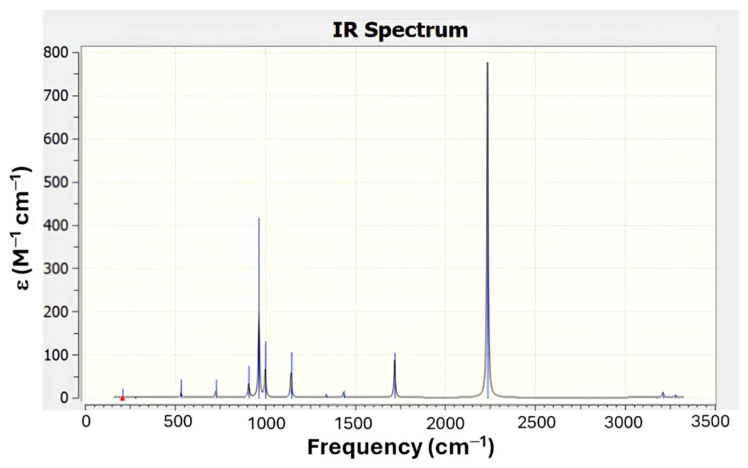
In this context, the formation of acryloisonitrile predicted in the present work is especially notable. The significant predicted yield of acryloisonitrile supports its viability as an observational target, suggesting that it may exist in sufficient abundance to be detectable with current or future instrumentation. As a relatively stable product within the reaction network, acryloisonitrile may contribute to the reservoir of nitrogen-bearing species available for subsequent chemical evolution in cold molecular clouds and Titan-like environments. To facilitate future observational efforts, the strongest predicted spectroscopic features of acryloisonitrile should be highlighted (Figure 2). Its most intense IR absorption bands occur at 2236 cm−1, 1720 cm−1, and 966 cm−1, corresponding to CN stretching, CC stretching, and CH2 wagging. These vibrational frequencies fall within the accessible infrared regions and could serve as diagnostic signatures in laboratory-observational comparisons. The relatively large dipole moment (3.49 D) increases the likelihood of detection of a pure rotational spectrum, with calculated rotational constants being A = 52.11, B = 5.40, and C = 4.89 GHz. Together, these IR-active vibrational bands and microwave rotational transitions provide complementary observational targets. Future targeted radioastronomical and/or infrared detection searches for acryloisonitrile and related species could therefore provide valuable constraints on isonitrile chemistry and the pathways leading to nitrogen incorporation in complex organic molecules.
The experimental reaction enthalpy was calculated using ΔHf° values from the Active Thermochemical Tables (ATcT) [43], which provides critically evaluated experimental and theoretical thermochemical data. Using these values, we found that the ΔHrxn = [ΔHf°(H, 51.6 kcal mol−1) + ΔHf°(C2H3CN, 46.4 kcal mol−1)] − [ΔHf°(CH, 141.7 kcal mol−1) + ΔHf°(CH3CN, 19.4 kcal mol−1)] = −63.1 kcal mol−1) This value is in close agreement with our calculated heat of formation for acrylonitrile (−62.0 kcal mol−1), demonstrating internal consistency between the computed thermochemical data and reference values. The small deviation (1.1 kcal mol−1) indicates that the computational methodology employed here reliably reproduces the overall thermodynamic driving force of the reaction. The reaction is therefore strongly exothermic, consistent with efficient stabilization of the final product.
Overall, the results demonstrate that the CH + CH3CN reaction proceeds predominantly toward acrylonitrile formation. The combination of favorable kinetics and thermodynamics leads to a strong bias toward this product across multiple reaction pathways. In addition, the observed branching behavior underscores the importance of intermediate stability and competitive rate processes in determining product distributions. Estimating the total rate constant for the CH + CH3CN reaction as a sum of rate constants for the addition and insertion channel, 6.37 × 10⁻¹⁰ cm3 molecule−1 s−1 at 100 K, and taking the branching ratio for the acrylonitrile channel as ~80%, we can evaluate the rate constant for the CH + CH3CN → C2H3CN + H product channel as 5.1 × 10⁻¹⁰ cm3 molecule−1 s−1. On the other hand, the C2H4 + CN → C2H3CN + H reaction exclusively yielding acrylonitrile was measured to have a rate constant of 4.2 × 10⁻¹⁰ cm3 molecule−1 s−1 at 100 K [44]. Thus, the two reactions have similar rate constants and therefore their relative contributions in the production of acrylonitrile would be mostly governed by the abundance of the respective reactants. Given its high thermodynamic stability and dominant branching ratio, acrylonitrile may serve as a key intermediate in the formation of more complex nitrogen-bearing organic species, both in the atmosphere and on the surface of Titan. Its reactivity toward radicals and small molecules suggests potential pathways leading to heterocycle formation and higher-molecular-weight nitrogen-containing compounds. These findings highlight acrylonitrile as a chemically significant species in Titan’s atmospheric chemistry and motivate further investigation into its role in prebiotic chemical evolution and aerosol formation processes.

5. Conclusions

In summary, acrylonitrile (C2H3CN) emerges as the most thermodynamically stable product within the explored reaction network, highlighting its potential role as a key intermediate in Titan’s complex organic chemistry. As a stable end point, acrylonitrile may serve as a new starting reactant for subsequent radical-driven processes, providing a foundation for the continued growth of nitrogen-bearing molecules. Its confirmed detection in Titan’s atmosphere [8] further supports its relevance, suggesting that it may also accumulate within methane lakes, where it could undergo additional chemical transformations under cryogenic conditions [38,45].
Beyond its astrobiological significance, acrylonitrile represents a versatile and multifunctional species within Titan’s chemical landscape as well as in astrochemical environments. Future work will focus on elucidating its reactivity with a broader range of hydrocarbon radicals, with the goal of mapping out extended reaction networks that may contribute to molecular complexity in Titan-like environments. Investigating these neutral species interactions will provide deeper insight into the mechanisms governing nitrogen incorporation and organic growth, ultimately advancing our understanding of prebiotic chemistry and the potential for life in planetary environments.

Supplementary Materials

The following supporting information can be downloaded at: https://www.mdpi.com/article/10.3390/app16115591/s1. Table S1: Calculated collision frequencies z (in s−1) of C3H4N intermediates under Titan’s stratospheric conditions; Table S2: Branching ratios (in %) at different collision energies through i1; Table S3: Branching ratios (in %) at different collision energies through i2; Table S4: Branching ratios (in %) for the CN + C2H4 reaction; and Data S1: Optimized Cartesian coordinates (Å) and vibrational frequencies (cm−1) of reactants, intermediates, products, and transition states involved in the methylidyne (CH) plus acetonitrile (CH3CN) reaction.

Author Contributions

Conceptualization, A.G.H. and A.M.M.; methodology, A.G.H.; software, A.M.M.; validation, A.G.H. and A.M.M.; investigation, A.G.H.; resources, A.M.M.; data curation, A.G.H.; writing—original draft preparation, A.G.H.; writing—review and editing, A.G.H. and A.M.M.; supervision, A.M.M.; project administration, A.M.M.; funding acquisition, A.M.M. All authors have read and agreed to the published version of the manuscript.

Funding

This research received no external funding.

Data Availability Statement

The original contributions presented in this study are included in the article/Supplementary Materials. Further inquiries can be directed to the corresponding author.

Acknowledgments

We acknowledge the Instructional and Research Computing Center (IRCC, web: http://ircc.fiu.edu) at FIU for providing HPC resources that have contributed to the research results reported within this paper. This research was supported by the International Space Science Institute (ISSI) in Bern, through ISSI International Team project ‘ATTACK International Team (Advancing Titan’s Atmospheric Chemistry Knowledge)’ (ISSI Team project #24-615). A.G.H. thanks the Florida Space Grant Consortium for her Dissertation Improvement Fellowship, which supported her presentations of preliminary results of this work at national conferences.

Conflicts of Interest

The authors declare no conflicts of interest.

References

  1. Spilker, L. Cassini-Huygens’ exploration of the Saturn system: 13 years of discovery. Science 2019, 364, 1046–1051. [Google Scholar] [CrossRef]
  2. Tillman, N.T. Titan: Facts About Saturn’s Largest Moon. 2018. Available online: https://www.Space.com (accessed on 15 February 2026).
  3. Hörst, S.M. Titan’s atmosphere and climate. J. Geophys. Res. Planets 2017, 122, 432–482. [Google Scholar] [CrossRef]
  4. Krijt, S.; Kama, M.; McClure, M.; Teske, J.; Bergin, E.A.; Shorttle, O.; Walsh, K.J.; Raymond, S.N. Chemical Habitability: Supply and Retention of Life’s Essential Elements During Planet Formation. arXiv 2022, arXiv:2203.10056. [Google Scholar]
  5. Trainer, M.G.; Pavlov, A.A.; DeWitt, H.L.; Jimenez, J.L.; McKay, C.P.; Toon, O.B.; Tolbert, M.A. Organic haze on Titan and the early Earth. Proc. Natl. Acad. Sci. USA 2006, 103, 18035–18042. [Google Scholar] [CrossRef]
  6. Waite, J.H.; Young, D.T.; Cravens, T.E.; Coates, A.J.; Crary, F.J.; Magee, B.; Westlake, J. The Process of Tholin Formation in Titan’s Upper Atmosphere. Science 2007, 316, 870–875. [Google Scholar] [CrossRef] [PubMed]
  7. Sagan, C.; Thompson, W.R.; Khare, B.N. Titan: A laboratory for prebiological organic chemistry. Acc. Chem. Res. 1992, 25, 286–292. [Google Scholar] [CrossRef]
  8. Nixon, C.A. The Composition and Chemistry of Titan’s Atmosphere. ACS Earth Space Chem. 2024, 8, 406–456. [Google Scholar] [CrossRef]
  9. Palmer, M.Y.; Cordiner, M.A.; Nixon, C.A.; Charnley, S.B.; Teanby, N.A.; Kisiel, Z.; Irwin, P.G.J.; Mumma, M.J. ALMA detection and astrobiological potential of vinyl cyanide on Titan. Sci. Adv. 2017, 3, e1700022. [Google Scholar] [CrossRef]
  10. Vuitton, V.; Yelle, R.V.; McEwan, M.J. Ion chemistry and N-containing molecules in Titan’s upper atmosphere. Icarus 2007, 191, 722–742. [Google Scholar] [CrossRef]
  11. Leonori, F.; Petrucci, R.; Wang, X.; Casavecchia, P.; Balucani, N. A crossed beam study of the reaction CN + C2H4 at a high collision energy: The opening of a new reaction channel. Chem. Phys. Lett. 2012, 553, 1–5. [Google Scholar] [CrossRef]
  12. Dutuit, O.; Carrasco, N.; Thissen, R.; Vuitton, V.; Alcaraz, C.; Pernot, P.; Balucani, N.; Casavecchia, P.; Canosa, A.; Picard, S.L.; et al. Critical review of N, N+, N2+, N++, and N2++ main production processes and reactions of relevance to Titan’s atmosphere. Astrophys. J. Suppl. Ser. 2013, 204, 20. [Google Scholar] [CrossRef]
  13. Vuitton, V.; Yelle, R.V.; Klippenstein, S.J.; Hörst, S.M.; Lavvas, P. Simulating the density of organic species in the atmosphere of Titan with a coupled ion-neutral photochemical model. Icarus 2019, 324, 120–197. [Google Scholar] [CrossRef]
  14. Cravens, T.E.; Robertson, I.P.; Clark, J.; Wahlund, J.E.; Waite, J.H., Jr.; Ledvina, S.A.; Niemann, H.B.; Yelle, R.V.; Kasprzak, W.T.; Luhmann, J.G.; et al. Titan’s ionosphere: Model comparisons with Cassini Ta data. Geophys. Res. Lett. 2005, 32. [Google Scholar] [CrossRef]
  15. Lavvas, P.; Galand, M.; Yelle, R.V.; Heays, A.N.; Lewis, B.R.; Lewis, G.R.; Coates, A.J. Energy deposition and primary chemical products in Titan’s upper atmosphere. Icarus 2011, 213, 233–251. [Google Scholar] [CrossRef]
  16. Sulaiman, A.H.; Achilleos, N.; Bertucci, C.; Coates, A.; Dougherty, M.; Hadid, L.; Holmberg, M.; Hsu, H.-W.; Kimura, T.; Kurth, W.; et al. Enceladus and Titan: Emerging worlds of the Solar System. Exp. Astron. 2022, 54, 849–876. [Google Scholar] [CrossRef]
  17. Teanby, N.A.; Sylvestre, M.; Sharkey, J.; Nixon, C.A.; Vinatier, S.; Irwin, P.G.J. Seasonal Evolution of Titan’s Stratosphere During the Cassini Mission. Geophys. Res. Lett. 2019, 46, 3079–3089. [Google Scholar] [CrossRef]
  18. Fulchignoni, M.; Ferri, F.; Angrilli, F.; Ball, A.J.; Bar-Nun, A.; Barucci, M.A.; Bettanini, C.; Bianchini, G.; Borucki, W.; Colombatti, G.; et al. In situ measurements of the physical characteristics of Titan’s environment. Nature 2005, 438, 785–791. [Google Scholar] [CrossRef]
  19. Zhou, J.; Fisher, E.R. Surface Reactivity and Energetics of CH Radicals during Plasma Deposition of Hydrogenated Diamondlike Carbon Films. J. Phys. Chem. B 2006, 110, 21911–21919. [Google Scholar] [CrossRef] [PubMed]
  20. Takayanagi, T.; Kurosaki, Y.; Sato, K.; Tsunashima, S. Ab Initio Molecular Orbital Calculations for the N(2D) + Ethylene Reaction. J. Phys. Chem. 1998, 102, 10391–10398. [Google Scholar] [CrossRef]
  21. Thelen, A.E.; Nixon, C.A.; Chanover, N.J.; Cordiner, M.A.; Molter, E.M.; Teanby, N.A.; Irwin, P.G.J.; Serigano, J.; Charnley, S.B. Abundance measurements of Titan’s stratospheric HCN, HC3N, C3H4, and CH3CN from ALMA observations. Icarus 2019, 319, 417–432. [Google Scholar] [CrossRef]
  22. Sylvestre, M.; Teanby, N.A.; Vinatier, S.; Lebonnois, S.; Irwin, P.G.J. Seasonal evolution of C2N2, C3H4, and C4H2 abundances in Titan’s lower stratosphere. Astron. Astrophys. 2018, 609, A64. [Google Scholar] [CrossRef]
  23. Chai, J.-D.; Head-Gordon, M. Long-range corrected hybrid density functionals with damped atom–atom dispersion corrections. Phys. Chem. Chem. Phys. 2008, 10, 6615–6620. [Google Scholar] [CrossRef] [PubMed]
  24. Krishnan, R.; Binkley, J.S.; Seeger, R.; Pople, J.A. Self-consistent molecular orbital methods. XX. A basis set for correlated wave functions. J. Chem. Phys. 1980, 72, 650–654. [Google Scholar] [CrossRef]
  25. Frisch, M.J.; Trucks, G.W.; Schlegel, H.B.; Scuseria, G.E.; Robb, M.A.; Cheeseman, J.R.; Scalmani, G.; Barone, V.; Mennucci, B.; Petersson, G.A.; et al. Gaussian 16 Rev. C.01; GaussView 5.0; Gaussian, Inc.: Wallingford, CT, USA, 2016. [Google Scholar]
  26. Halsey-Moore, C.; Jena, P.; McLeskey, J.T. Tuning range-separated DFT functionals for modeling the peak absorption of MEH-PPV polymer in various solvents. Comput. Theor. Chem. 2019, 1162, 112506. [Google Scholar] [CrossRef]
  27. Dunning, T.H., Jr. Gaussian basis sets for use in correlated molecular calculations. I. The atoms boron through neon and hydrogen. J. Chem. Phys. 1989, 90, 1007–1023. [Google Scholar] [CrossRef]
  28. Zhang, J.; Valeev, E.F. Prediction of Reaction Barriers and Thermochemical Properties with Explicitly Correlated Coupled-Cluster Methods: A Basis Set Assessment. J. Chem. Theory Comput. 2012, 8, 3175–3186. [Google Scholar] [CrossRef]
  29. Cleaves, H.J. Rice-Ramsperger-Kassel-Marcus. In Encyclopedia of Astrobiology; Gargaud, M., Amils, R., Quintanilla, J.C., Cleaves, H.J., Irvine, W.M., Pinti, D.L., Viso, M., Eds.; Springer: Berlin/Heidelberg, Germany, 2011; p. 1459. [Google Scholar]
  30. Garrett, B.C.; Truhla, D.G. Transition State Theory. In Encyclopedia of Computational Chemistry; Schleyer, P.V.R., Allinger, N.L., Clark, T., Gasteiger, J., Kollman, P.A., Schaefer, H.F., III, Eds.; John Wiley & Sons: Hoboken, NJ, USA, 1998; Volume 5, pp. 3094–3104. [Google Scholar]
  31. Gómez-Heredia, A.; Dzib, E.; Merino, G. Microcanonical Rate Constants with Rice-Ramsperger-Kassel-Marcus in Eyringpy. J. Comput. Chem. 2025, 46, e70259. [Google Scholar] [CrossRef]
  32. Fernandez-Ramos, A.; Miller, J.A.; Klippenstein, S.J.; Truhlar, D.G. Modeling the kinetics of bimolecular reactions. Chem. Rev. 2006, 106, 4518–4584. [Google Scholar] [CrossRef]
  33. Kislov, V.V.; Nguyen, T.L.; Mebel, A.M.; Lin, S.H.; Smith, S.C. Photodissociation of benzene under collision-free conditions: An ab initio/Rice–Ramsperger–Kassel–Marcus study. J. Chem. Phys. 2004, 120, 7008–7017. [Google Scholar] [CrossRef]
  34. Kaiser, R.I.; Balucani, N. The Formation of Nitriles in Hydrocarbon-Rich Atmospheres of Planets and Their Satellites:  Laboratory Investigations by the Crossed Molecular Beam Technique. Acc. Chem. Res. 2001, 34, 699–706. [Google Scholar] [CrossRef]
  35. Nguyen, T.L.; Perera, A. Reaction of Methylidyne with Ethane: The C-C Insertion Is Unimportant. J. Phys. Chem. A 2022, 126, 1966–1972. [Google Scholar] [CrossRef]
  36. Canosa, A.; Sims, I.R.; Travers, D.; Smith, I.W.M.; Rowe, B.R. Reactions of the methylidine radical with CH4, C2H2, C2H4, C2H6, and but-1-ene studied between 23 and 295 K with a CRESU apparatus. Astron. Astrophys. 1997, 323, 644–651. [Google Scholar]
  37. Stevenson, J.M.; Fouad, W.A.; Shalloway, D.; Usher, D.; Lunine, J.; Chapman, W.G.; Clancy, P. Solvation of nitrogen compounds in Titan’s seas, precipitates, and atmosphere. Icarus 2015, 256, 1–12. [Google Scholar] [CrossRef]
  38. Vu, T.H.; Hodyss, R. Experimental insights into the azotosome hypothesis in Titan’s lake fluids. Sci. Adv. 2026, 12, eaed1426. [Google Scholar] [CrossRef] [PubMed]
  39. Nickerson, S.; Rangwala, N.; Colgan, S.W.J.; DeWitt, C.; Huang, X.; Acharyya, K.; Drozdovskaya, M.; Fortenberry, R.C.; Herbst, E.; Lee, T.J. The First Mid-infrared Detection of HNC in the Interstellar Medium: Probing the Extreme Environment toward the Orion Hot Core. Astrophys. J. 2021, 907, 51. [Google Scholar] [CrossRef]
  40. Tennis, J.D.; Xue, C.; Talbi, D.; Changala, P.B.; Sita, M.L.; McGuire, B.; Herbst, E. Detection and modelling of CH3NC in TMC-1. Mon. Not. R. Astron. Soc. 2023, 525, 2154–2171. [Google Scholar] [CrossRef]
  41. Kawaguchi, K.; Ohishi, M.; Ishikawa, S.-I.; Kaifu, N. Detection of Isocyanoacetylene HCCNC in TMC-1. Astrophys. J. 1992, 386, L51. [Google Scholar] [CrossRef]
  42. Xue, C.; Willis, E.R.; Loomis, R.A.; Lee, K.L.K.; Burkhardt, A.M.; Shingledecker, C.N.; Charnley, S.B.; Cordiner, M.A.; Kalenskii, S.; McCarthy, M.C. Detection of Interstellar HC4NC and an Investigation of Isocyanopolyyne Chemistry under TMC-1 Conditions. Astrophys. J. Lett. (ApJL) 2020, 900, L9. [Google Scholar] [CrossRef]
  43. Active Thermochemical Tables (ATcT). Values Based on Version 1.220 of the Thermochemical Network. Argonne National Laboratory. Available online: https://atct.anl.gov/Thermochemical%20Data/version%201.220/index.php (accessed on 10 March 2026).
  44. Sims, I.R.; Queffelec, J.-L.; Travers, D.; Rowe, B.R.; Herbert, L.B.; Karthäuser, J.; Smith, I.W.M. Rate constants for the reactions of CN with hydrocarbons at low and ultra-low temperatures. Chem. Phys. Lett. 1993, 211, 461. [Google Scholar] [CrossRef]
  45. Cable, M.L.; Vu, T.H.; Malaska, M.J.; Maynard-Casely, H.E.; Choukroun, M.; Hodyss, R. Properties and Behavior of the Acetonitrile–Acetylene Co-Crystal under Titan Surface Conditions. ACS Earth Space Chem. 2020, 4, 1375–1385. [Google Scholar] [CrossRef]
Figure 1. PES for the reaction of methylidyne (CH) with acetonitrile (CH3CN) calculated at the CCSD(T)–F12/cc-pVQZ-F12//ωB97XD/6-311G** + ZPE(ωB97XD/6-311G**) level of theory. Point groups and electronic ground state term symbols are shown for the reactants, intermediates, and products, and the dark orange lines show the most probable pathway to p1, acrylonitrile.
Applsci 16 05591 g001
Figure 2. Calculated IR Spectrum of acryloisonitrile. Strong peaks shown at 2236 cm−1, 1720 cm−1, and 966 cm−1 correspond to CN stretching, CC stretching, and CH2 wagging.
Applsci 16 05591 g002
Table 1. Intermediate i1 entrance channel branching ratios of reaction products.
ProductsStructureBranching Ratio
at 0 kcal mol−1
Branching Ratio
at 5 kcal mol−1
p1Applsci 16 05591 i00179.1%72.3%
+ H
p2Applsci 16 05591 i0020.2%0.2%
+ C2H3
p3Applsci 16 05591 i00317.5%20.3%
+ H
p4Applsci 16 05591 i0041.6%1.6%
+ CN
p5Applsci 16 05591 i00500
+ H
p6Applsci 16 05591 i0061.6%5.5%
+ H
p7Applsci 16 05591 i00700
+ CH2
Table 2. Intermediate i2 entrance channel branching ratios of reaction products.
ProductsStructureBranching Ratio
at 0 kcal mol−1
Branching Ratio
at 5 kcal mol−1
p1Applsci 16 05591 i00886.2%84.8%
+ H
p2Applsci 16 05591 i0091.3%1.5%
+ C2H3
p3Applsci 16 05591 i0100.3%0.3%
+ H
p4Applsci 16 05591 i01112.2%13.4%
+ CN
p5Applsci 16 05591 i01200
+ H
p6Applsci 16 05591 i01300
+ H
p7Applsci 16 05591 i01400
Table 3. Rate constants of unimolecular steps in the reaction CH + CH3CN.
Reaction
Step
k, s−1
(0 kcal mol−1)
k, s−1
(5 kcal mol−1)
Reaction
Step
k, s−1
(0 kcal mol−1)
k, s−1
(5 kcal mol−1)
i1p66.18 × 1073.72 × 108i8i116.61 × 1091.32 × 1010
i1i73.78 × 1096.37 × 109i11i82.29 × 1075.02 × 107
i7i12.86 × 1094.79 × 109i8i94.21 × 10125.27 × 1012
i2i85.37 × 1089.62 × 108i9i81.83 × 1092.54 × 109
i8i29.79 × 10121.37 × 1013i8p59.76 × 10121.36 × 1013
i2p41.39 × 10102.11 × 1010i9p43.62 × 1096.40 × 109
i2p16.60 × 10109.14 × 1010i9i101.85 × 1093.11 × 109
i2i42.03 × 1093.23 × 109i10i91.16 × 1092.10 × 109
i4i25.25 × 10108.04 × 1010i10p41.31 × 10102.30 × 1010
i2i53.95 × 10105.17 × 1010i7i102.75 × 10132.83 × 1013
i5i22.92 × 10104.03 × 1010i10i75.19 × 10106.69 × 1010
i4p11.07 × 10121.45 × 109i5i77.72 × 10091.13 × 1010
i4p22.99 × 10124.25 × 1012i7i52.75 × 10132.83 × 1013
i11p32.17 × 10108.19 × 1010i5p11.68 × 10112.38 × 1011
Disclaimer/Publisher’s Note: The statements, opinions and data contained in all publications are solely those of the individual author(s) and contributor(s) and not of MDPI and/or the editor(s). MDPI and/or the editor(s) disclaim responsibility for any injury to people or property resulting from any ideas, methods, instructions or products referred to in the content.