Skip Content
You are currently on the new version of our website. Access the old version .

Actuators

Actuators is an international, peer-reviewed, open access journal on the science and technology of actuators and control systems, published monthly online by MDPI.

Quartile Ranking JCR - Q2 (Engineering, Mechanical | Instruments and Instrumentation)

All Articles (2,867)

Dynamic Parameter Identification of a Hip Exoskeleton Using RLS-GA

  • Wentao Sheng,
  • Yunxia Cao and
  • Tianyu Gao
  • + 2 authors

Lower-limb exoskeletons require accurate dynamic models to achieve stable and compliant human–robot interactions. However, least-squares-based identification often relies on demanding experiments and may yield limited accuracy for exoskeletons with non-standard structures and actuator-induced uncertainties. This paper proposes a two-stage dynamic parameter identification method that integrates recursive least squares (RLS) and a genetic algorithm (GA), denoted as RLS-GA. RLS is first executed offline to estimate the variation ranges of the inertial parameter vector and to construct a finite, physically meaningful search space. GA then refines the parameters within these bounds by minimizing the regression residual norm. Experiments on a hip exoskeleton show that RLS-GA achieves higher identification accuracy than LS and unconstrained GA, while converging faster than GA under identical conditions.

6 February 2026
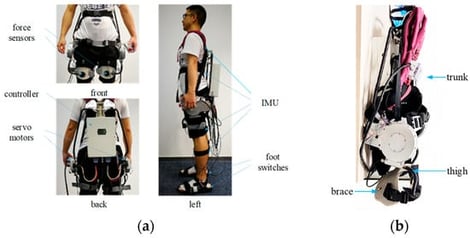
APHE platform: (a) prototype overview; (b) detailed mechanical structure.

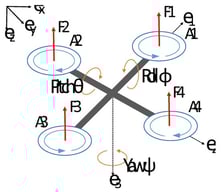
In many unmanned aerial vehicle (UAV) applications, achieving stable flight despite actuator failures is crucial. Among the many existing fault-tolerant control (FTC) methods, adaptive control is a practical approach. In this article, we present experimental verification of a backstepping-based adaptive fault-tolerant controller previously proposed by the authors. As the first step of the experimental verification, we focus on the attitude-loop control of the quadrotor. We construct a quadrotor testbed integrating a self-developed flight controller. After parameter identification, we implement the adaptive fault-tolerant controller on the quadrotor. Finally, real-time experiments on attitude stabilization following actuator faults are conducted. As a result, we confirmed that the controller can be implemented and can stabilize the attitude even in the presence of multi-actuator faults.

6 February 2026

Quadrotor UAV.

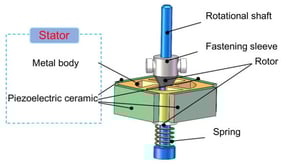
High-speed miniature rotary actuators are critical components in compact, high-performance systems. However, conventional electromagnetic micromotors face a prominent trade-off between miniaturization and output performance, which restricts their applicability in highly integrated devices. To address this challenge, a novel high-speed rotary piezoelectric ultrasonic motor is proposed. The proposed motor consists of a titanium alloy metal body with offset driving teeth, piezoelectric ceramic plates, two conical rotors, a compression spring, an output shaft, and a fastening sleeve. Four PZT-8 plates are bonded to the periphery of the metal body and excited to generate in-plane bending vibration modes; these vibrations are then transformed into unidirectional rotary motion through the periodic contraction and expansion of the offset driving teeth and frictional contact with the rotors. The operating principle and structural parameters of the proposed motor were analyzed and optimized using finite element analysis (FEA), including modal, harmonic response, and transient analyses. A prototype was fabricated to evaluate its mechanical properties. The stator has a compact size of 12 mm × 12 mm × 4 mm and a mass of 2.3 g. Experimental results demonstrate that under an excitation voltage of 350 Vp-p at the resonant frequency of 28.6 kHz, the motor achieves a maximum rotational speed of 4720 rpm and a maximum stall torque of 0.36 mN·m. With its simple structure, compact size, lightweight design, and excellent output performance, the proposed ultrasonic motor provides a solution for compact high-speed rotary actuation.

5 February 2026

Schematic of the motor.

Wind Tunnel Tests on a Piezo-Based Ice Protection System

  • Luigi Mangiacrapa,
  • Thorsten Klaas and
  • Salvatore Ameduri
  • + 6 authors

The requirements of the upcoming aircraft generation based on hybrid or electric propulsion discourage the use of Ice Protection Systems (IPSs) based on hot-air spilled from engine or demanding a large consumption of electrical power. In line with this need, a low-power IPS based on piezoelectric (PZT) technology is investigated in the current article. Its main objective is to protect an aerodynamic surface by removing ice accretions (de-icing). The idea at the basis of the concept is to drive mechanical waves at the interface between the skin and the ice layer to cause the breaking and the detachment. Moving from an assessed layout and numerical simulations providing the most effective design configuration, dedicated small-scale airfoil demonstrators (NACA 0012 with a chord of 310 mm and a span of 150 mm) were manufactured, with the aim of testing the technology within the representative environment of the IFAM Icing Wind Tunnel (IWT). The test results showed, for power consumption of 4.4 kW/m2, ice detachment levels -based on the ice-covered area- between 40 and 50% at −10 °C, about 40% at −20 °C, and a maximum of 15% at −4 °C. The results highlighted the impact of some specific parameters (environmental temperature, skin, and ice thickness) on the effectiveness of the IPS.

5 February 2026

Sketch of the fundamentals of the proposed Ice Protection System (IPS).

News & Conferences

Issues

Open for Submission

Editor's Choice

Reprints of Collections

Recent Developments in Precision Actuation Technologies
Reprint

Recent Developments in Precision Actuation Technologies

Editors: Bin-tang Yang, Yikun Yang, Xiaoqing Sun
Integrated Intelligent Vehicle Dynamics and Control
Reprint

Integrated Intelligent Vehicle Dynamics and Control

Editors: Wuwei Chen, Hongbo Wang

Get Alerted

Add your email address to receive forthcoming issues of this journal.

XFacebookLinkedIn
Actuators - ISSN 2076-0825