Abstract
The requirements of the upcoming aircraft generation based on hybrid or electric propulsion discourage the use of Ice Protection Systems (IPSs) based on hot-air spilled from engine or demanding a large consumption of electrical power. In line with this need, a low-power IPS based on piezoelectric (PZT) technology is investigated in the current article. Its main objective is to protect an aerodynamic surface by removing ice accretions (de-icing). The idea at the basis of the concept is to drive mechanical waves at the interface between the skin and the ice layer to cause the breaking and the detachment. Moving from an assessed layout and numerical simulations providing the most effective design configuration, dedicated small-scale airfoil demonstrators (NACA 0012 with a chord of 310 mm and a span of 150 mm) were manufactured, with the aim of testing the technology within the representative environment of the IFAM Icing Wind Tunnel (IWT). The test results showed, for power consumption of 4.4 kW/m2, ice detachment levels -based on the ice-covered area- between 40 and 50% at −10 °C, about 40% at −20 °C, and a maximum of 15% at −4 °C. The results highlighted the impact of some specific parameters (environmental temperature, skin, and ice thickness) on the effectiveness of the IPS.
1. Introduction
Ice accretes on several parts of the aircraft during the flight if certain conditions occur; in particular, ice grows quickly for specific combinations of wind speed, skin and environmental temperatures, droplet size and concentration [1]. If not prevented or quickly removed, ice accretions may lead to a sudden reduction of the efficiency and, above all, to a loss of safety. In fact, it dramatically affects the wing aerodynamic shape, the authority of the control surfaces, the capture area of the engine, and the sensitivity of the instruments for air navigation. The alteration of the original wing shape is at the basis of a sudden reduction of lift and of a dramatic rise of drag that, jointly with a degradation of the authority of the control surfaces, may lead to serious problems and, in the worst case, to the loss of the aircraft.
For all these reasons, IPSs play a key role in aircraft safety. IPSs can be divided into two main groups: anti-icing systems, which completely prevent the accretion of ice, and de-icing systems, which remove ice accretions before they appreciably affect the flight [2].
IPSs can also be classified into active systems, which require energy consumption, and passive systems, which do not require it. Conventional systems are mainly based on thermal or mechanical fundamentals. Thermal methods carry out two main anti-icing strategies: the first one prevents water from freezing by vaporizing it, while the second one keeps it in a liquid state. The first requires a large amount of power and prevents the whole profile from icing over, as the vaporized water does not liquify until the entire wing has been passed through. The second one requires lower power but protects mainly the fore zone of the airfoil. In this case, the impinged water droplets run on the profile over the heated surface, and they can freeze (runback ice). Typical thermal de-icing systems are based either on hot air spilled from the engine or electrical heating resistors. Even though they require less power than thermal anti-icing, they affect the fuel consumption in a significant way as well [2,3]. 62 kW/m2 is the power consumption of the electro-resistive anti/de-icing system [4].
The current requirements of the new generation aircraft, based on electrical propulsion and low power-demanding systems, have steered research towards the development of innovative and low power-consuming IPSs: several studies indicate mechanical and thermo-mechanical systems as the most promising; many of these rely upon ultrasonic waves and promise advantageous outcomes [4,5,6,7].
Piezoelectric transducers, in particular, represent an appealing technology in terms of ice protection. One of the most interesting aspects is, in fact, represented by the compactness of such a type of material, particularly relevant in the case of narrow rooms and, in general, for minimally invasive solutions [8,9]. Another important feature is the possibility of exciting these transducers directly through an electrical signal, dramatically reducing the need for intermediate energy conversions [10,11]; this aspect can play an important role, especially in the case of a full electric or hybrid aircraft [12,13]. Furthermore, the relatively modest power consumption is another appealing aspect when compared with other systems used for ice prevention. Even when used as sensors, PZTs pave the way to interesting solutions. They are, in fact, prone to a large variety of logics of control for the above-mentioned electric nature and can support a wide frequency bandwidth. All these aspects in some way justify the growing interest in this kind of technology, that results in studies and investigations of different types: theoretical and numerical with focus on the coupled electro-mechanical behavior [14,15]; experimental and demonstrative, to prove and quantify the effective capabilities of these transducers in practical problems [8,16]; chemical feasibility and manufacturability, targeting higher performing compositions, optimized for the specific applications and characterized by an adequate TRL [17,18,19].
Their applications to the ice protection field can be in some way classified on the basis of the frequency range [8,19]: low frequency bandwidth to excite the normal modes of the structure and high frequency bandwidth involving shear and Lamb waves. The main advantage of the former family is represented by the equipment, generally less expensive for the easier management of the electrical constraints against the driving frequency level (lower than kHz); however, inducing the resonance of a structure can lead to problems in terms of stability and aeroelasticity that must be carefully assessed [20,21]. The latter family, although it requires dedicated and generally more expensive equipment, is less invasive from a structural standpoint, even if side effects as potential delamination in composite laminates, must be prevented [22,23].
The synergic use of PZTs with passive superhydrophobic or icephobic coatings represents a promising strategy to significantly improve the efficiency of PZTs as active IPSs. When the substrate is treated with a low-adhesion coating, the inherent adhesion strength of the ice is reduced, thereby facilitating the detachment action of the PZTs [24]. The coating lowers the critical interfacial fracture toughness, enabling ice removal at lower actuation voltages or reduced duty cycles [25]. Compared to fully active systems, the combination significantly decreases power consumption [26]; compared to fully passive systems, it offers reliable performance even under conditions where superhydrophobic/icephobic coatings alone would lose effectiveness, e.g., coating wear or very low temperatures. As a result, the hybrid PZT-coating configurations enable significant energy saving and improved durability of the active components, representing a highly attractive direction for next-generation low-power de-icing technologies for aeronautical applications.
The complexity of the ice problem, together with the expectations from this innovative technology, justifies the number of research projects and programs focusing on the topics. Within the Clean Sky 2 program, part of the Horizon 2020 framework, several projects have explored alternatives to conventional de-icing systems [27]. Although many efforts focused on passive coatings and thermal approaches, research has increasingly considered vibrational and mechanical solutions as low-energy alternatives: an example is the Project of GAINS [28], investigating low-power piezoelectric de-icing architectures. SENS4ICE [29] and ICEGENESIS [30] are other European projects addressing the feasibility and the development of different IPSs aimed at detecting and removing ice. At the international level, another relevant initiative is JEDI ACE [31], a joint European-Japanese effort aimed at developing advanced de-icing technologies. This project investigated smart materials and surface treatments, while also evaluating vibration-based concepts to enhance efficiency and safety.
In line with the international trend, CIRA has adopted a dedicated plan for the development of ice-protection technologies based on innovative, minimally invasive systems requiring only a limited energy input. Within the national SMOS project, a feasibility study was carried out on PZT ice removal, leading to a laboratory test of a system applied to a metallic substrate with ice formed through controlled water solidification [32,33]. Following its involvement in the aforementioned GAINS project, CIRA developed a piezoelectric excitation logic aimed at maximizing local action and mitigating potential faults in individual transducers within the network. In the UP WING project, CIRA, jointly with IFAM and under the guidance of AIRBUS, addresses the challenge of raising the TRL of piezoelectric de-icing technology, reaching the stage of experimental testing on scaled demonstrators, as presented in this work [34]. Finally, within the national TECHICE [35] and MELA [36] projects, CIRA aims to further increase the technology’s TRL through wind-tunnel tests on a full-scale demonstrator and to resolve interface issues with other technologies (structural health monitoring, landing-gear monitoring, electromechanical actuation), with a view to the integration into innovative aircraft configurations, either hybrid or fully electric.
The present article focuses on the IWT test campaign on a piezo-based IPS and includes the main related activities, such as the modelling of the system (Section 3.2), the realization of the prototypes (Section 4), the laboratory test, and the commissioning of the abovementioned prototypes (Section 5). The next paragraph is focused on the generalities of the planned test campaign in the UP WING project and the description of the wind tunnel facility.
2. Scope of the Work
As part of the above-mentioned UP WING project, the general feasibility of a piezo-based de-icing system on aerodynamic profiles was investigated.
Small-scale IWT tests at Fraunhofer IFAM allow a focused and efficient assessment of available technologies and test parameters. In fact, this type of facility reproduces the icing conditions that aircraft could encounter. The presence of supercooled droplets, such as those found in clouds, combined with high wind speeds and sub-zero temperatures, is the most relevant parameter. Ice wind tunnels enable controlled experiments and help understand how ice forms on aerodynamic surfaces. By observing these ice accretions, the performance of de-icing and anti-icing systems can also be evaluated. The IWT used for this study, at Fraunhofer IFAM, enables testing on small-scale prototypes with a specific emphasis on surface-related effects for IPSs.
Suited airfoil prototypes were designed to fit the test section of this closed-loop wind tunnel, enabling experiments even at a maximum wind speed of 95 m/s and a minimum temperature of −30 °C. The test section is characterized by a width of 155 mm, a height of 200 mm, and a length of 1000 mm, while the spray bar system utilized to generate the icing cloud accommodates one spraying nozzle. Test conditions, encompassing cloud parameters such as liquid water content (LWC) and median volume diameter (MVD), adhere to the standards outlined in SAE ARP 5905 “Calibration and Acceptance of Icing Wind Tunnels”. The ice wind tunnel test conditions, selected for this feasibility study, are summarized in Table 1.
Table 1.
Fraunhofer IFAM ice wind tunnel test conditions.
3. The Proposed Ice Protection System
The ice protection approach investigated in this work belongs to the high frequency of excitation bandwidth. Mechanical waves are, in fact, driven by piezoelectric transducers within the skin element with the aim of generating shear action between the skin itself and the external ice accretion, as summarized in Figure 1.
Figure 1.
Sketch of the fundamentals of the proposed Ice Protection System (IPS).
The piezoelectric transducers are constituted by patches bonded on the inner surface. Since the in-plane expansions and contractions of the patches must be transmitted to the skin, some features of the system are particularly critical:
- The mechanical features of the transducers: the piezoelectric dielectric constant, d31, is particularly important to maximize the in-plane strain, while the stiffness of the composition determines the authority of the actuator.
- The bonding: the action of the piezoelectric is transmitted by the bonding; the thinner this layer, the better it is; moreover, the shear elastic modulus must be as high as possible to increase the shear transmitted to the skin; finally, the glue must be chemically compatible with both piezo and skin materials.
- The features of the skin: the bonding zone must be as flat as possible when planar piezoelectric transducers are used; then in case of metallic or conductive material, even in presence of an insulating adhesive, a coating is recommended to avoid any short circuit with the edges of the patches and the skin; this type of problem in fact can be avoided dispersing insulating spacing microspheres in the glue only in case of flat skin substrate.
- The layout of the piezoelectrics: when possible, the relative position of the patches must be driven by the specific design wavelength of excitation; this allows for keeping the travelling of the waves uniform through the medium.
The transducers are used to generate two types of ultrasound waves: the in-plane shear waves and the out-of-plane shear waves, namely “Lamb” waves. The former type breaks the ice while the latter detaches it.
The identification of the optimal condition of excitation is addressed by computing the dispersion curves in the case of a system geometrically simple (flat layers, constant thickness of the skin and of the ice layer). The present application, however, presents some specific features that fostered the use of a numerical modeling approach. In fact, the small size of the airfoil hosting the IPS, jointly with the proximity to the leading edge (LE), makes the curvature of the bonding zone extremely high with a consequent non-uniform thickness of the adhesive layer; in addition, a real distribution of ice is very far from uniform, as shown by the pictures reported in Section 3.2. All these considerations drove the choice towards a refined model.
3.1. The Specific Prototypes
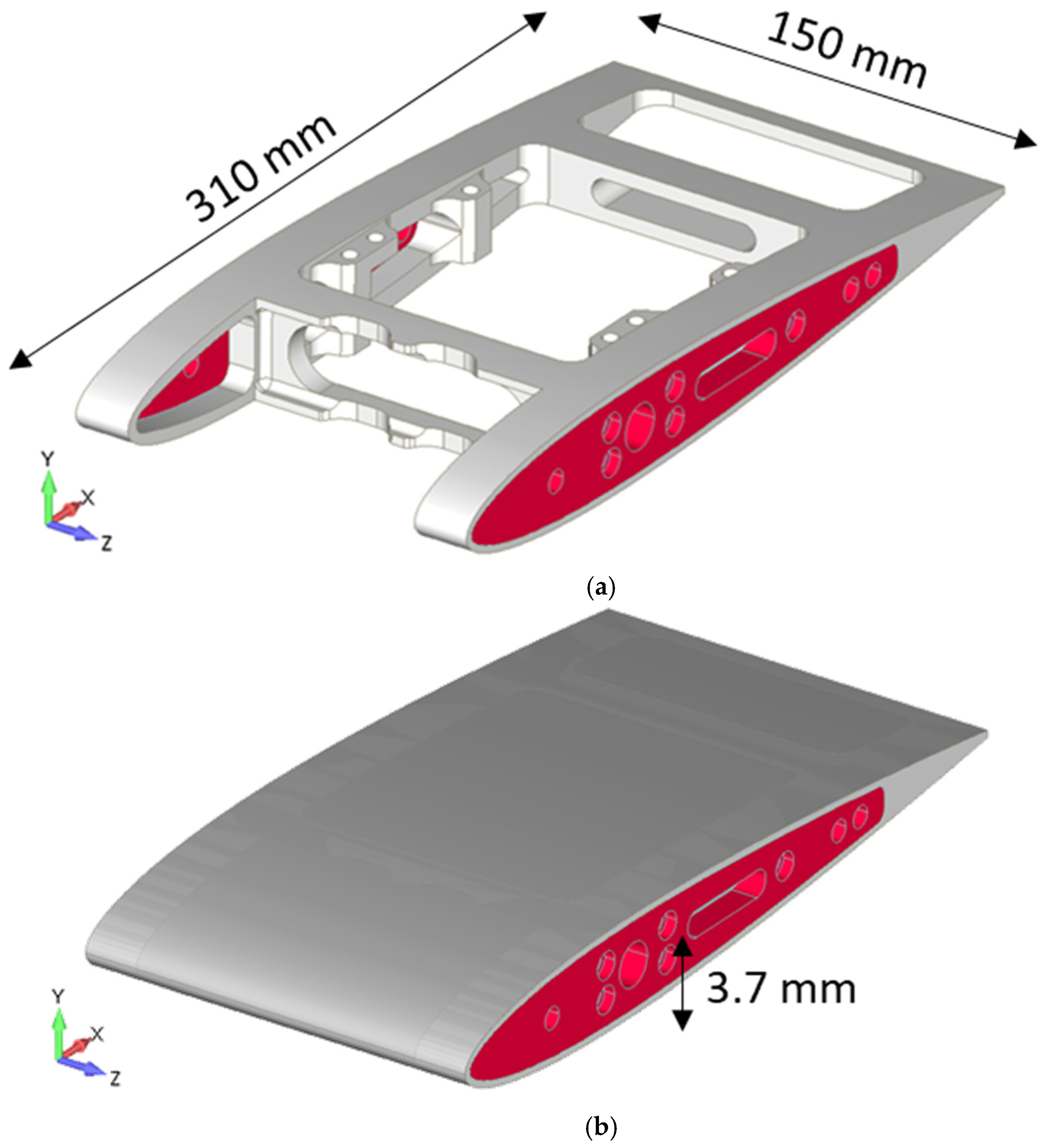
Two prototypes were designed to test the abovementioned technology in the IWT facility. The demonstrators reproduce the NACA 0012 profile and, consistent with the dimensions of the test chamber, they have a chord and span of 310 mm and 150 mm, respectively. The structure is constituted by two removable lateral caps, which allows to check the status of the actuators, the skeleton, and the aluminum skin, as shown in Figure 2; to evaluate the role played by the skin thickness on the effectiveness of the system, two different skins were mounted on the two demonstrators.
Figure 2.
Digital mockup of the structure of the prototypes: (a) Inner structure of the prototype and lateral caps; (b) the prototype as a whole.
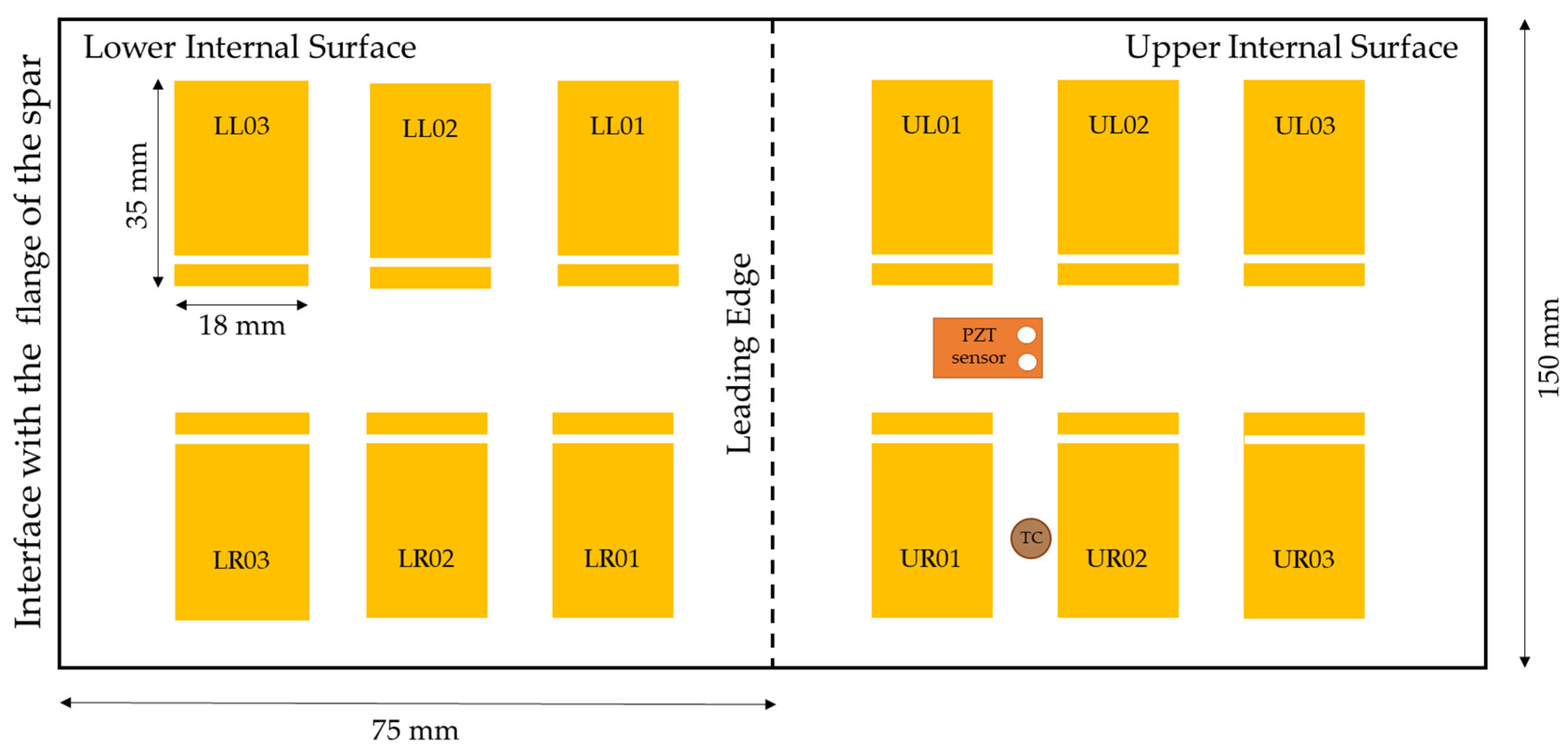
The two skins have thickness values of 0.5 and 0.8 mm. The first skin is 0.5 mm thick while the second one is 0.8 mm thick. Twelve rigid PZT patches were arranged on the interior surface of the skin: three rows on the top and three rows on the bottom; this configuration allowed for minimizing the effect of the curved substrate on the adhesion. The main properties of the material of the actuators are reported in Table 2; more details on the choice of piezoelectric composition are provided in Section 3.2.
The higher curvature on the LE zone discouraged any local integration of additional patches, even if this part is more prone to ice accretions. A PZT sensor is arranged on the upper internal surface, between the first and the second rows of the actuators, to evaluate the functionality of the system and the mechanical behavior of the prototypes. A T-type thermocouple is arranged close to the PZT actuators to measure the local temperature, as shown in Figure 3 [7,9,37,38].
Figure 3.
Sensors and actuators layout: internal view of the unwrapped skin (not to scale) with the 12 PZT actuators, the PZT sensor, and the thermocouple; leading edge highlighted by the dashed line. Actuator coding: 1st digit L = lower or U = upper; 2nd digit, L = left or R = right; 3rd digit, 01 closest to the LE, 02 intermediate, 03 far from the LE.
Table 2.
Material Data of P-51 composition [38].
Table 2.
Material Data of P-51 composition [38].
| P-51 | |
|---|---|
| Young Modulus * [GPa] | Dielectric constant, d31 [C/N] |
| 60 | −186 × 10−12 |
* along in-plane direction.
3.2. Modelling of the Prototypes and PZT Actuators Trade-Off
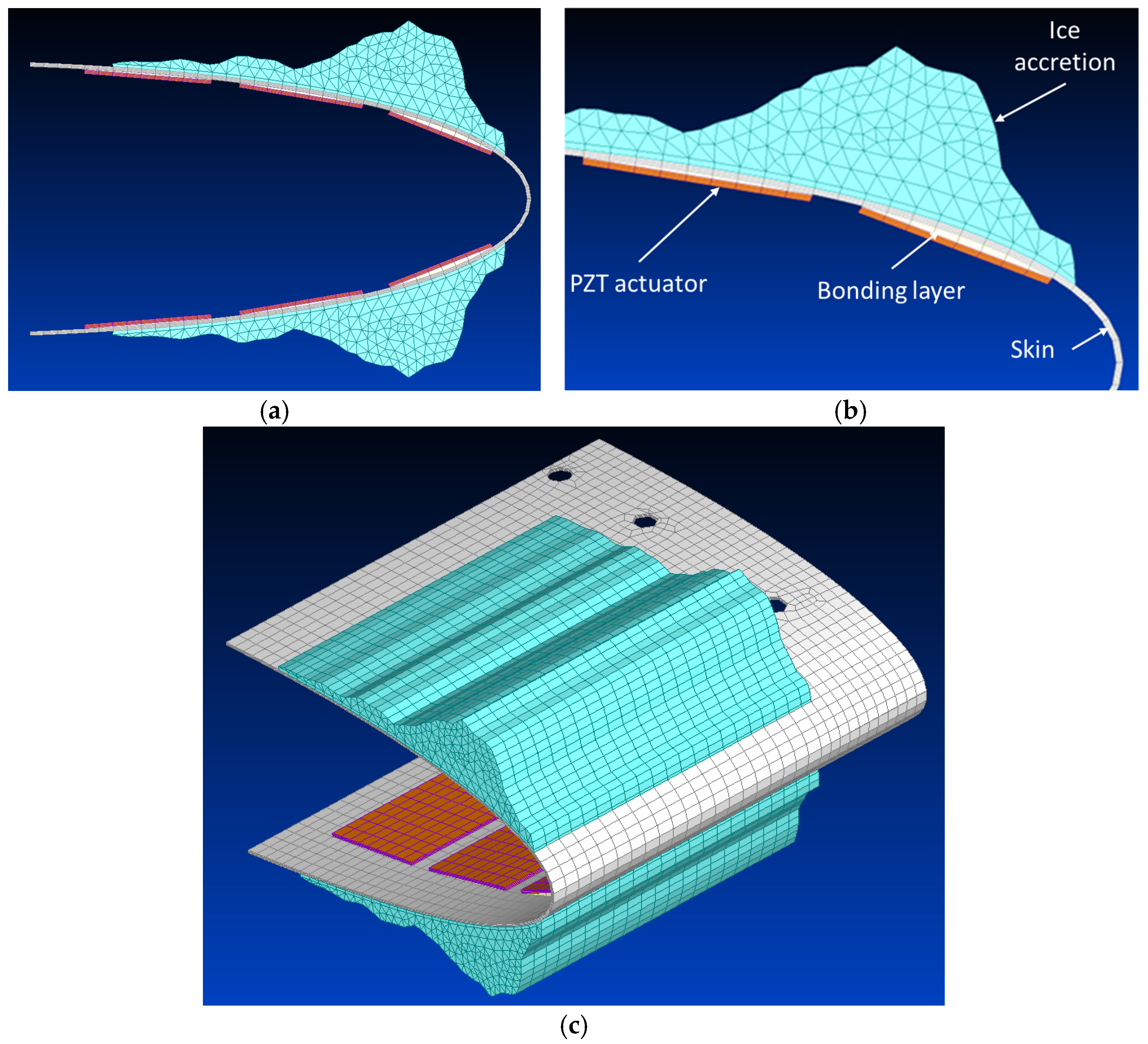
In the case of a system geometrically simple (flat layers, constant thickness of the skin and of the ice layer), the identification of the optimal condition of excitation is addressed by computing the dispersion curves. The present application, however, is characterized by some specific features that fostered the use of a numerical modeling approach. In fact, the high curvature of the metallic substrate, on one side, and the non-uniform distribution of ice, on the other side, increase the level of complexity of the system. The former aspect determines the above-discussed curved bonding zone that must be filled in with a non-uniform bonding layer, while the latter aspect causes wave reflections hardly predictable through a theoretical approach. The refined finite element (FE) model shown in Figure 4 was realized to study the behavior of the LE zone [8,9,38]. To reduce the computational weight of the model used for frequency and transient domain analyses, just the half span of the LE was reproduced. HEXA and WEDGE elements were used to simulate the three components of the system: the piezoelectric (orange), the adhesive (yellow), the skin (grey), and the ice accretion (light blue). A lateral view of the system is provided in Figure 4a. Note that the high curvature required the use of a total of six piezoelectric patches along the chord direction, symmetrically distributed between the upper and lower skin. The ice profile was generated by a real shape of the accretion occurring during the tests. As evident in the same picture and in the detail shown in Figure 4b, the thickness of the adhesive layer is progressively less uniform as the patches get closer to the LE. The same picture gives an idea of the number of elements used along the thickness. Finally, in Figure 4c, an isometric view of the model is presented to also give an idea of the extension of the ice accretions along the span. The holes are exploited to fix the device to the lateral wall of the wind tunnel; no ice extensions were considered on the hole surrounding area since this zone is practically not exposed to the ice.
Figure 4.
Finite element model of the LE portion: lateral view (a), detail of the LE zone (b), and isometric view (c).
Even if the focus of this work is on the wind tunnel test campaign, a summary of the main attainments of the numerical investigations is here reported for the sake of completeness. The final scope of the numerical analyses was to identify the most effective operational conditions in terms of excitation frequency peaks at which in-plane and out-of-plane shear are maximum. The same model was also used to finalize a trade-off among piezo actuators differing in thickness against skins of different thickness.
The MSC/Nastran transient solution was implemented; burst signals with an amplitude of 100 V and with progressive frequency content were built to drive the piezo transducers. The shear was thus estimated at the ice elements in contact with the skin. For each frequency, the following ratio was computed:
This ratio, in practice, compares the amount of elements at which the threshold shear of 1.5 MPa [39] is crossed over, with the total number of elements at the interface.
Any ice interface element whose shear crosses this threshold was considered detached. It is worth noting that this criterion is conservative, because in reality the fractured regions no longer contribute to adhesion, whereas in the simulation the ice elements that exceed the threshold remain attached to the surface.
The performance index (1) was estimated for the configurations summarized in Table 3, characterized by skin thicknesses of 0.5, 0.8, and 1.0 mm (even if this last value was not investigated in the current test campaign) and piezo thicknesses of 0.50, 0.75, and 1.5 mm. PIC-181 and P-51 piezoelectric compositions were considered for this application, because of the high elastic modulus along the in-plane direction (81.2 GPa vs. 60 GPa) and the dielectric constant, d31, (−120 × 10−12 vs. −186 × 10−12 C/N) [37,40]. The advantageous product of the elastic modulus by the dielectric constant, jointly with the value of the non-dimensional adhesion transmission parameter, Γ, higher than 20 [41] (24.5 vs. 25) for both types of piezos, led to choosing the P-51 for this application. The highest detachment level of 74.6% with an amplitude of 100 V was achieved for skin and piezo thickness of 0.5 mm; this level was used to normalize the other figures. The same thickness of the transducers gave better performance also for the thicker skins.
Table 3.
Configurations investigated and relevant ice detachment performance normalized with respect to the maximum level of 74.6%, obtained for skin and piezo thickness of 0.5 mm.
4. Realization of the Prototypes
Following the modeling, the prototypes were manufactured and integrated by Eurotech s.a.s.
The main activities of the realization included:
- the manufacturing of skeletons, skins, and lateral caps
- the integration and the routing of the PZT actuators (P-51 compound), the sensors (P-876 DuraAct [42]), and the T-type thermocouples.
To ensure comparable ice accretions, the skeletons were suitably reshaped to compensate for the different thicknesses and obtain the same overall dimensions. In this way, the water droplets run the same path and are prone to freezing in the same manner.
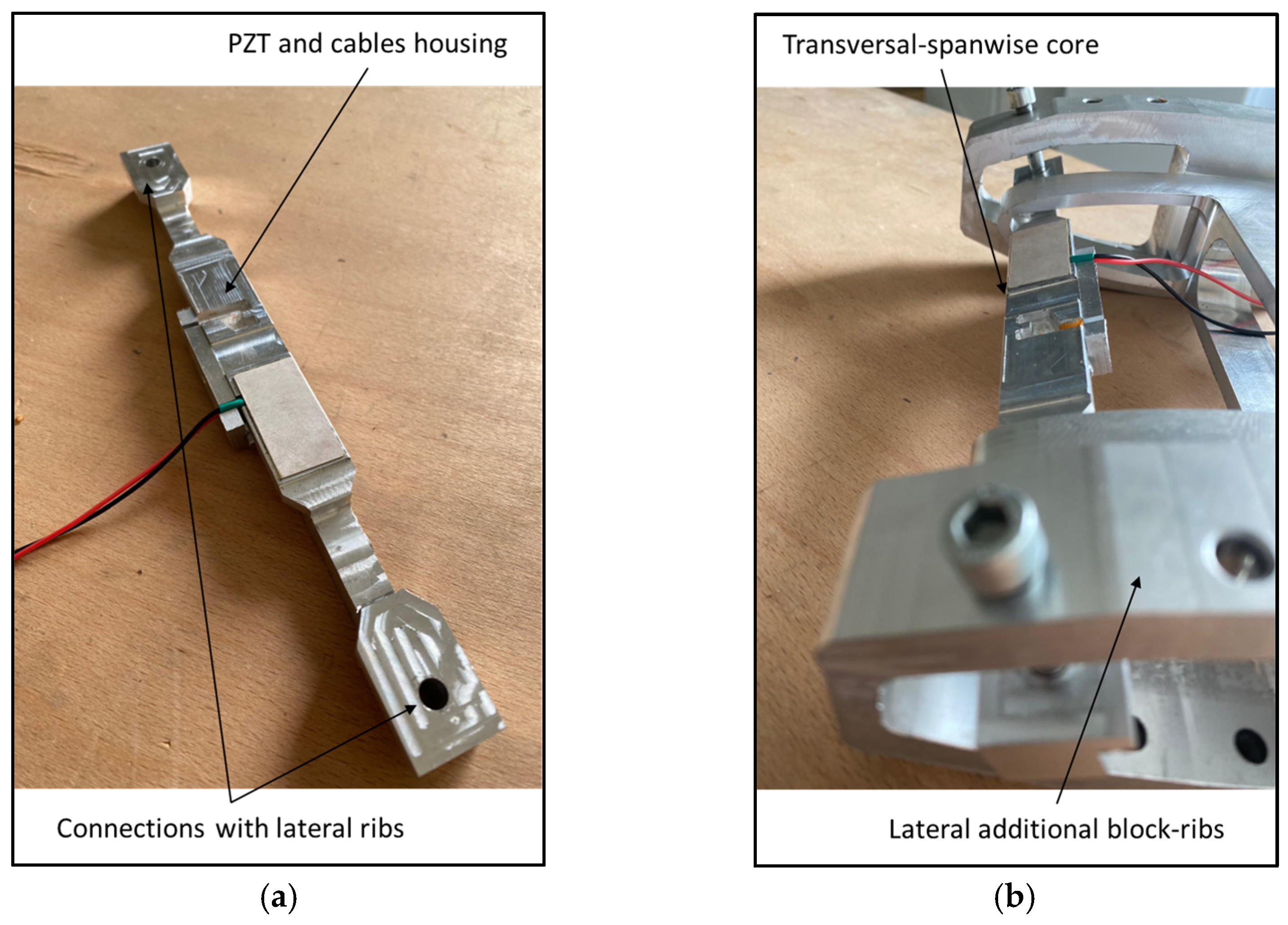
A critical activity was represented by the integration and bonding of PZT actuators. Due to the brittle behavior of PZTs, it was decided to integrate the actuators into the skin after wrapping and bonding it to the skeleton. A specific tool was developed to efficiently perform the installation despite the narrow available space. It consists of a transversal-spanwise aluminum core and two lateral additional-block ribs [7]. The core, shown in Figure 5a, was milled to obtain two rectangular recesses capable of housing and supporting a pair of PZT plates. The core is transversally inserted in the airfoil and screwed on the edges to the lateral block ribs at specific chord stations. By turning the screws, it is possible to bring the core closer or move it farther with respect to the skin and modulate the adhesion force. The abovementioned recesses avoid any bending of the plates despite the curvature of the skin; moreover, an anodized layer on the inner face of the skin ensures the electrical insulation of the piezos, even if their ends come into contact with the metal of the skin itself [7].
Figure 5.
Bonding tool core hosting a PZT patch (a) and screwed on the lateral block ribs and aligned to the skeleton for a functional test (b).
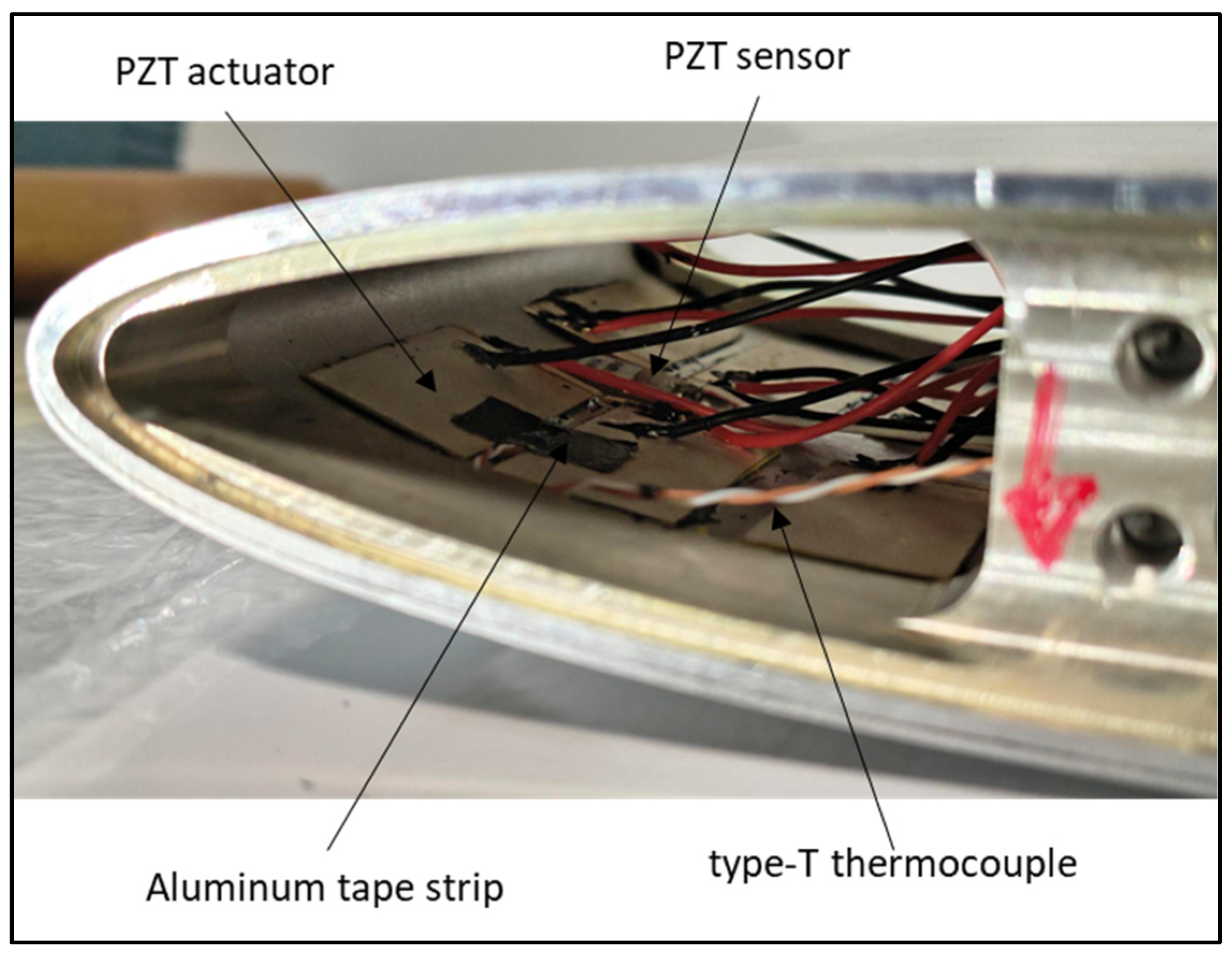
The PI P-876 DuraAct patch sensor (Physik Instrumente, Lederhose, Germany) and the TC Direct T-type thermocouple were integrated into the prototypes following the layout sketched in Figure 3; the piezoelectric sensor was bonded to the upper internal surface of the skin. The thermocouple was fastened to the skin by means of an aluminum tape, while its physical contact with the skin was secured with a heat sink mixture. Figure 6 shows a view of the internal part of the LE area of a prototype, which captures the PZT actuators and sensor and the thermocouple fastened on the upper surface of the skin [7].
Figure 6.
Actuators and sensors layout integration. Six P-51 actuators, the P-876 DuraAct sensor, and the T-type thermocouple fastened on the internal upper part of the skin.
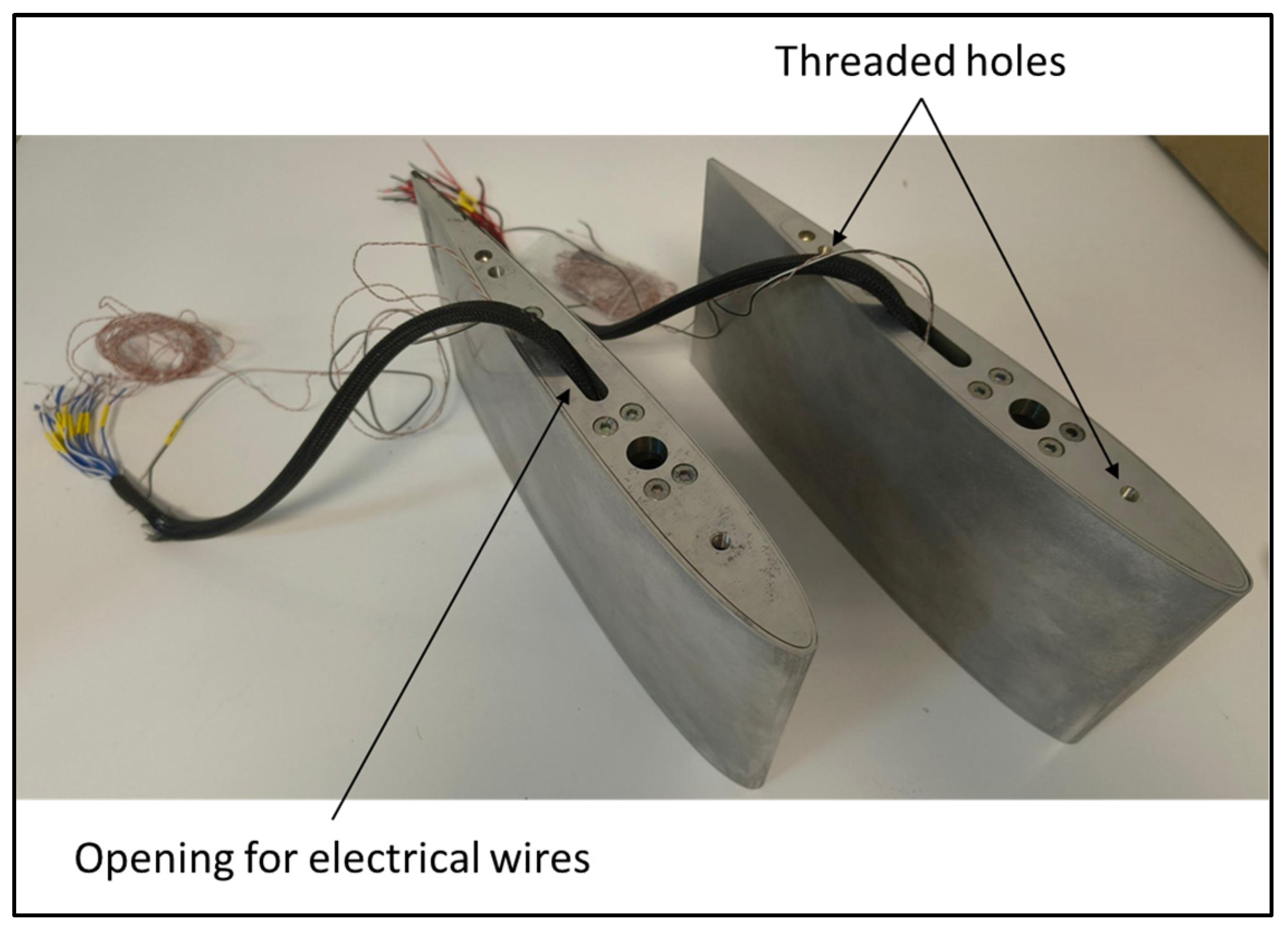
Two threaded holes were made on each of the side caps to secure the demonstrator to the walls of the test chamber. A lateral slot was also done on the caps, at mid chord, to route the internal transducer cables outward. The cables of the actuators were bundled together within a protective sleeve; the cables of the piezo sensors and of the thermocouples were kept separated. Figure 7 shows two demonstrators and relevant cabling [7].
Figure 7.
Finished prototypes.
5. Laboratory Tests and Commissioning
A commissioning operation was addressed both to evaluate the functionality of the prototypes and to define a reference for the wind tunnel tests. At first, each single PZT actuator was tested to verify that its functionality was not compromised during the realization; second, the responses of the prototypes were analyzed to evaluate the functionality of the complete system and the behavior of the prototypes at room temperature.
5.1. Laboratory Test Plan
The plan prepared for the commissioning consists of two types of tests, for a total number of 26: functionality tests of the 24 actuators individually excited and baseline tests of the two prototypes simultaneously activating all the actuators. A low-voltage sinusoidal signal is applied to each PZT to evaluate its functionality by analyzing the response of the PZT sensor installed on the prototype. To assess the functionality of the complete system, all actuators of each prototype were excited simultaneously using a low-voltage stepped sine signal in the frequency range of 10–50 kHz (sampled at 50 Hz). The characteristics of the stepped sine low-voltage signal are described below.
5.2. Experimental Setup
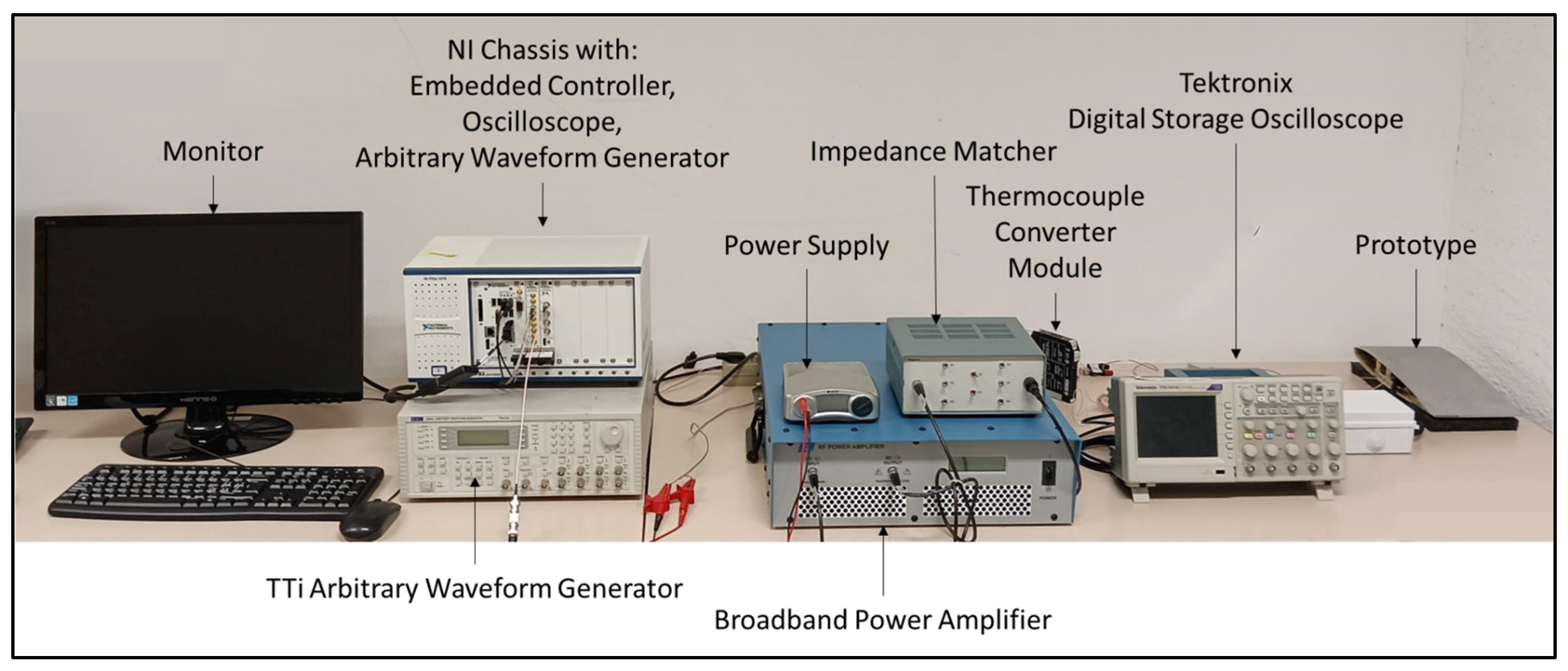
The first type of test was addressed by driving the PZT actuators through a TTi Arbitrary Waveform Generator and displaying the signal produced by the sensors by means of a Tektronix Digital Storage Oscilloscope. The second type of test was performed using a compact NI system including a controller, an arbitrary waveform generator, and an oscilloscope.
In both kinds of tests, the generated signal was divided into two paths: the first one to excite the actuators and the second one to the oscilloscope to check its shape and spectral content. Figure 8 illustrates the equipment used for these tests. Finally, the main characteristics of the instruments are summarized in Table 4, jointly with the role played.
Figure 8.
Experimental setup used for the commissioning test.
Table 4.
Main characteristics of experimental equipment and its role.
5.3. Software for Commissioning and IWT Tests
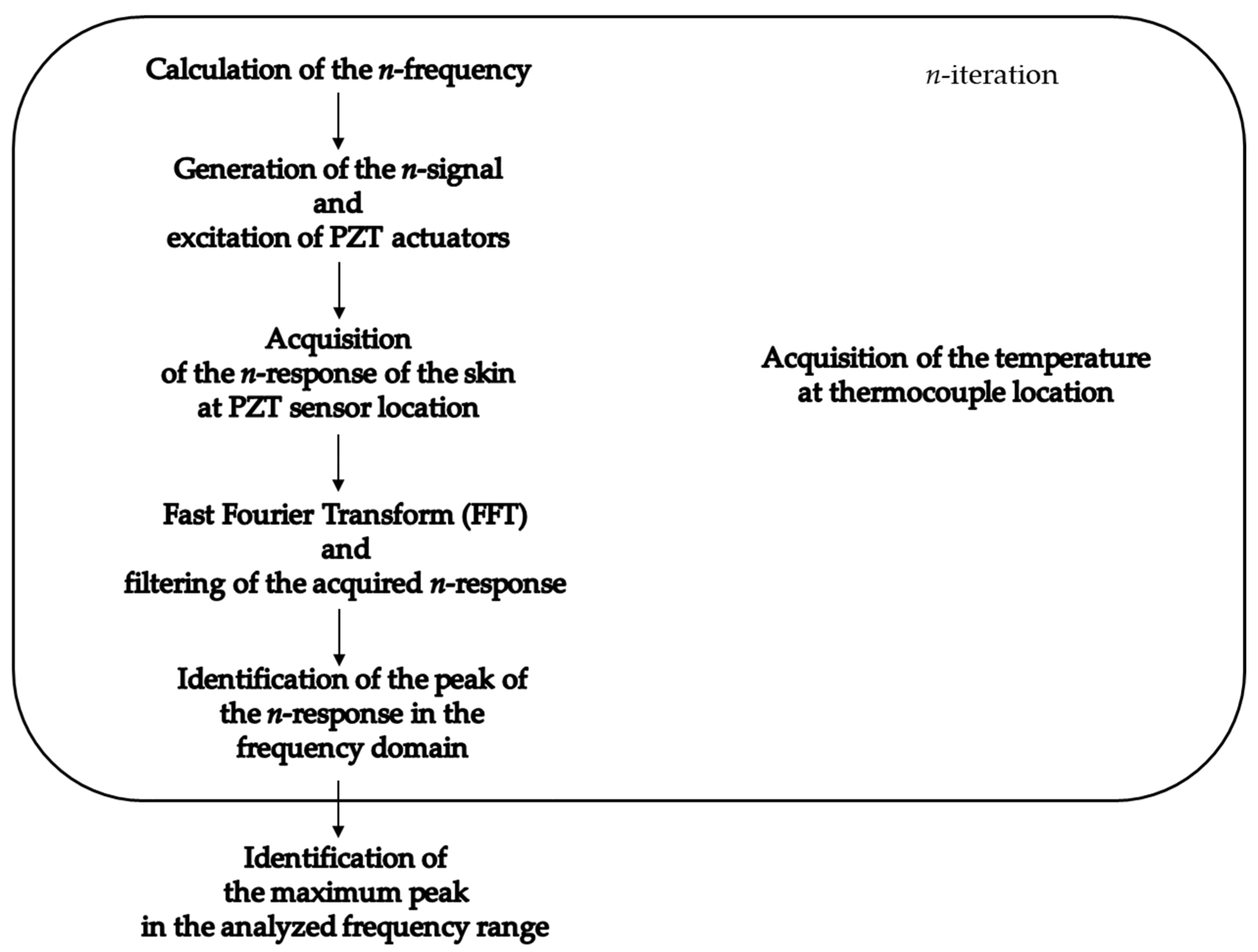
A dedicated software (SW) was prepared in the NI LabVIEW environment to generate, acquire, and process the electrical signals, as summarized in Figure 9. It allows the generation of both single sinusoidal signals and stepped sine functions within a preset frequency range. To this scope, the lowest and the highest frequencies of the bandwidth, and , and the frequency step, must be provided as input; on this basis, a number n of sinusoidal signals is defined. The system produces an excitation lasting 0.1 s for each frequency.
Figure 9.
Sketch of the main operations performed by the software.
Each generated signal excites the PZT actuators, which, in turn, drive mechanical waves into the skin. The deformations are then transduced by the P-876 DuraAct sensor. The response acquired during the excitation is analyzed in the frequency domain through the Fast Fourier Transform (FFT) algorithm. Filtering operations are also addressed to eliminate potential spectral contents not correlated to the actual sine signal and isolate the peak of excitation. Finally, the amplitude of the signal is computed and divided by the amplitude of the excitation. Repeating these tasks for each excitation frequency, the dynamic response of the system in the frequency domain is built, plotted, and stored for further investigations. During this process, the temperature signal is also acquired to prevent any undesired heating of the skin that would dramatically alter the functionality of the IPS.
This SW was used both for commissioning the system and to identify the most effective frequency peak of excitation during the IWT test campaign.
5.4. Commissioning Results
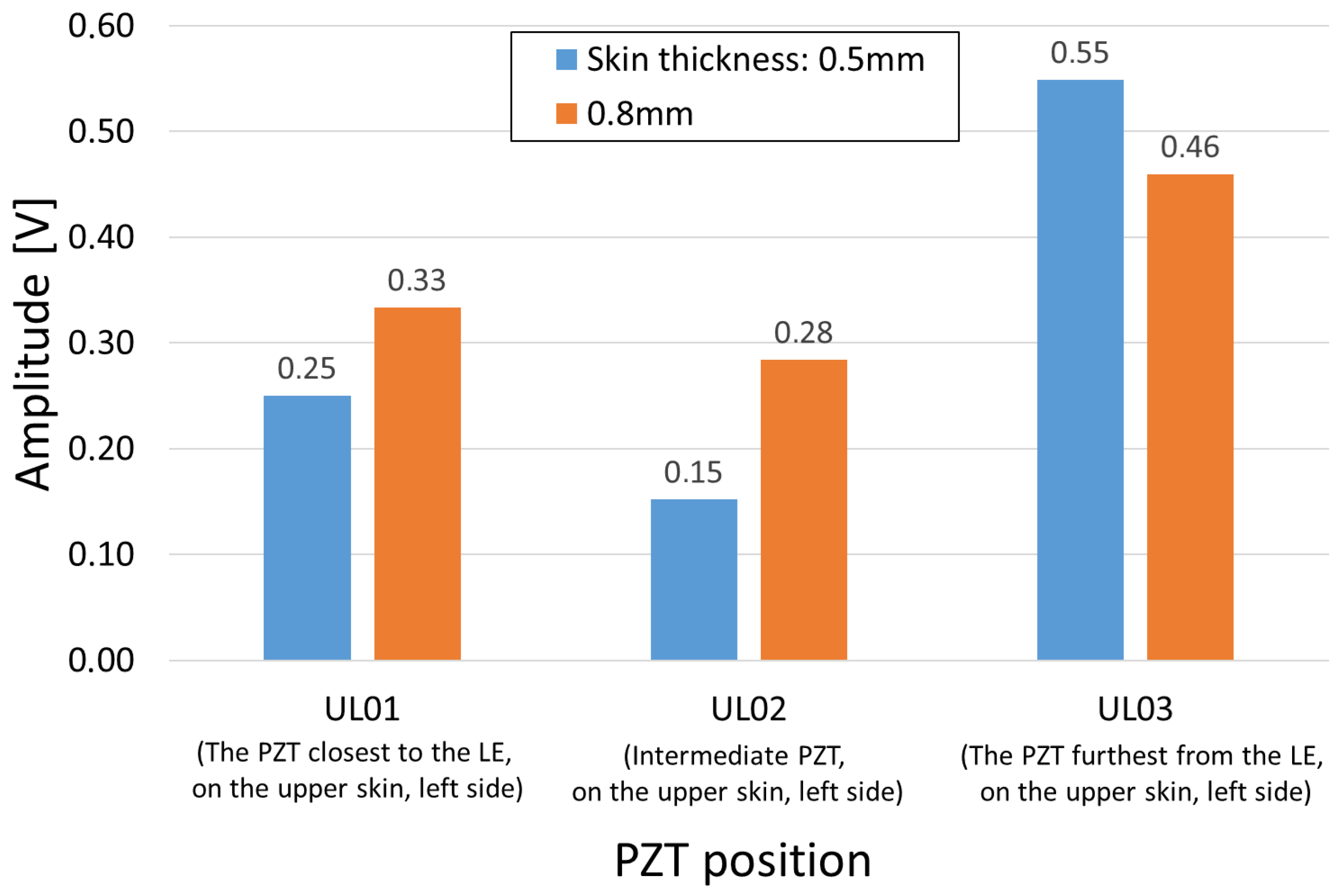
As an example, the amplitude recorded by the piezoelectric sensor due to the excitation of some PZT actuators is plotted in Figure 10. The data were produced with an excitation amplitude of 1 V, at a frequency of 15 kHz, identified as local resonance. In detail, the figure compares, for skin thicknesses of 0.5 (blue) and 0.8 mm (orange), the signals detected by the P-876 DuraAct sensor, corresponding to the individual excitation of the PZT on the upper skin and closer to the LE, UL01, the intermediate one, UL02, and the furthest one, UL03.
Figure 10.
Amplitudes of the signals detected by the piezoelectric sensor during the excitations of three different PZT actuators and for skin thicknesses of 0.5 (blue) and 0.8 mm (orange).
A similar transmission trend was observed for both the skins: the intermediate PZT exhibited the lowest response, whereas the farthest PZT showed the highest. This behavior can be attributed to the fact that, although the PZT actuator closest to the LE is more influenced by the local curvature, this effect is partially offset by its proximity to the PZT sensor. Conversely, the farthest actuator, operating on a less curved region, is more effective in transmitting strain than the central PZT, which is penalized both by the imperfect flatness of the support and by its distance from the piezoelectric sensor. Furthermore, for the PZT actuator located closest to the LE and for the intermediate one, a greater strain transmission is observed on the 0.8-mm-thick skin. This is consistent with the Concilio -Lecce transmission model [42], which predicts transmission ratios (skin strain/free PZT strain) of 0.44 and 0.53 for skin thicknesses of 0.5 mm and 0.8 mm, respectively.
6. Ice Wind Tunnel Testing
6.1. IWT Test Plan
Two types of tests were executed during the IWT experimental campaign, differing in the amplitude of the excitation signals, at a low, LV, and high voltage, HV, respectively.
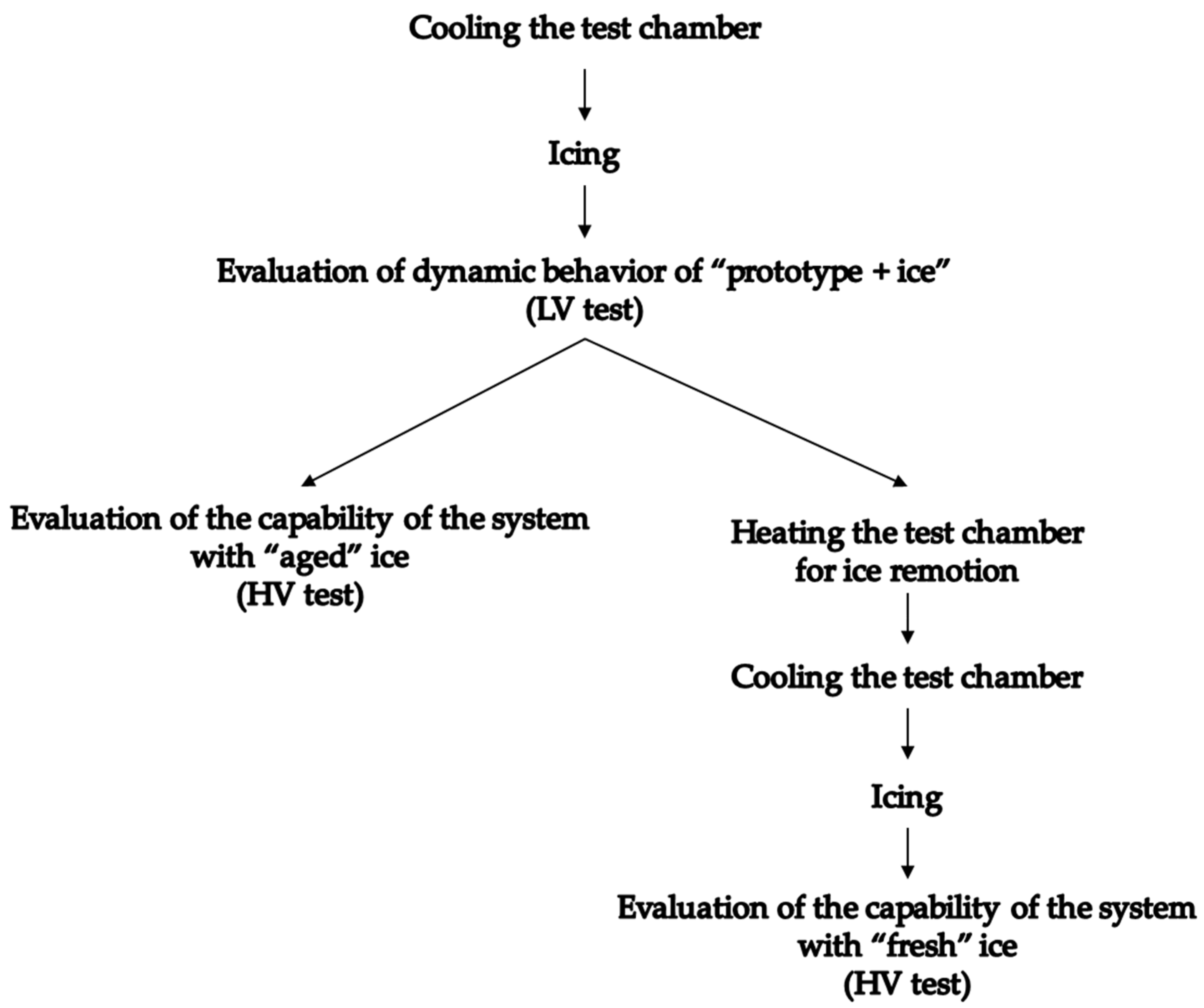
The LV tests were addressed to evaluate the dynamic behavior of the system and, in particular, to measure the most effective peak excitation frequency in the presence of ice accretions. The HV tests were performed to evaluate the capability of the proposed system and the impact of specific parameters such as environmental temperature, skin, and ice thickness. The tests were performed at three different temperatures, −4, −10, and −20 °C, on two different skins, 0.5 and 0.8 mm thick, with two different kinds of ice, namely “fresh” and “aged”. The first kind was accreted directly before the HV test, while the second one was formed for the LV test -to measure the peak frequency- and then used to perform the de-icing test. Table 5 summarizes the test plan.
Table 5.
Icing Wind Tunnel test plan.
The excitation frequency range at which the HV test was performed was previously determined on the basis of the LV test results, as shown in the flux diagram sketched in Figure 11. More thoroughly, the frequency peak was measured, and the frequency range was determined-as neighborhood of the peak-performing the LV test on the same ice accretion or in the same conditions (temperature, LWC, MVD), then later used for the HV test.
Figure 11.
Flux diagram of test operations.
6.2. IWT Experimental Setup
The LV tests were conducted in the same manner as the commissioning tests (Section 5), and their main scope was the identification of the most effective frequency range to remove ice. This range was defined as a neighborhood of the highest frequency peak, with a maximum width of 2 kHz to take into account the effect of the partial detachment of the ice. Both LV and HV tests foresaw the measure of the temperature to verify that it did not overshoot a limit of 0 °C. Indeed, on one hand, the objective of the tests is to quantify the standalone effectiveness of the mechanical waves, and on the other, it cannot be excluded that the heat generated may modify the brittleness characteristics of the ice. The HV tests were performed by amplifying the excitation signal up to 100 W.
The impedance matcher was set to minimize the difference between the impedance of the amplifier and that of the IPS system integrated on the prototypes. The effectiveness of this procedure was verified by monitoring the reflected power value on the amplifier display and minimizing it.
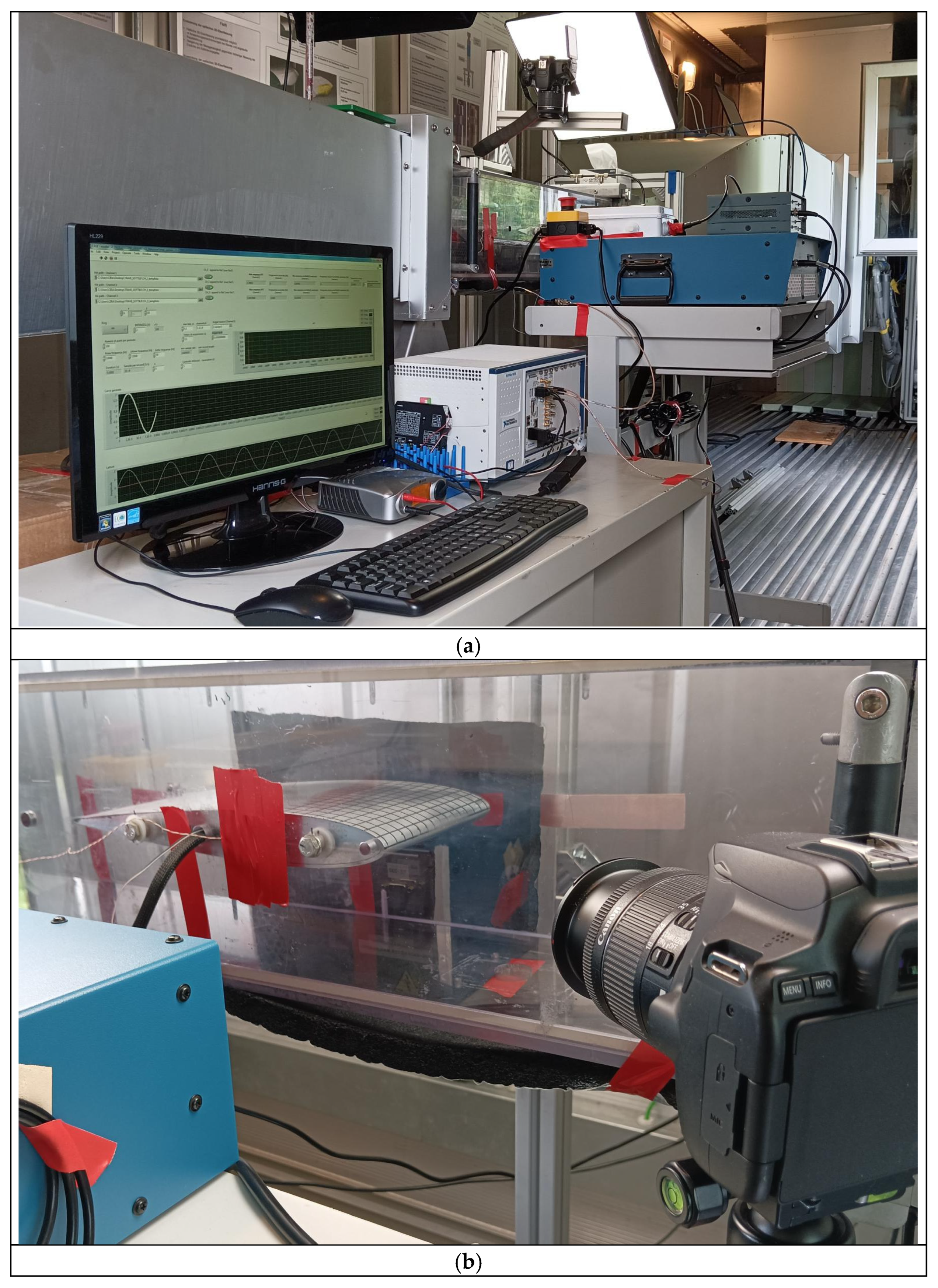
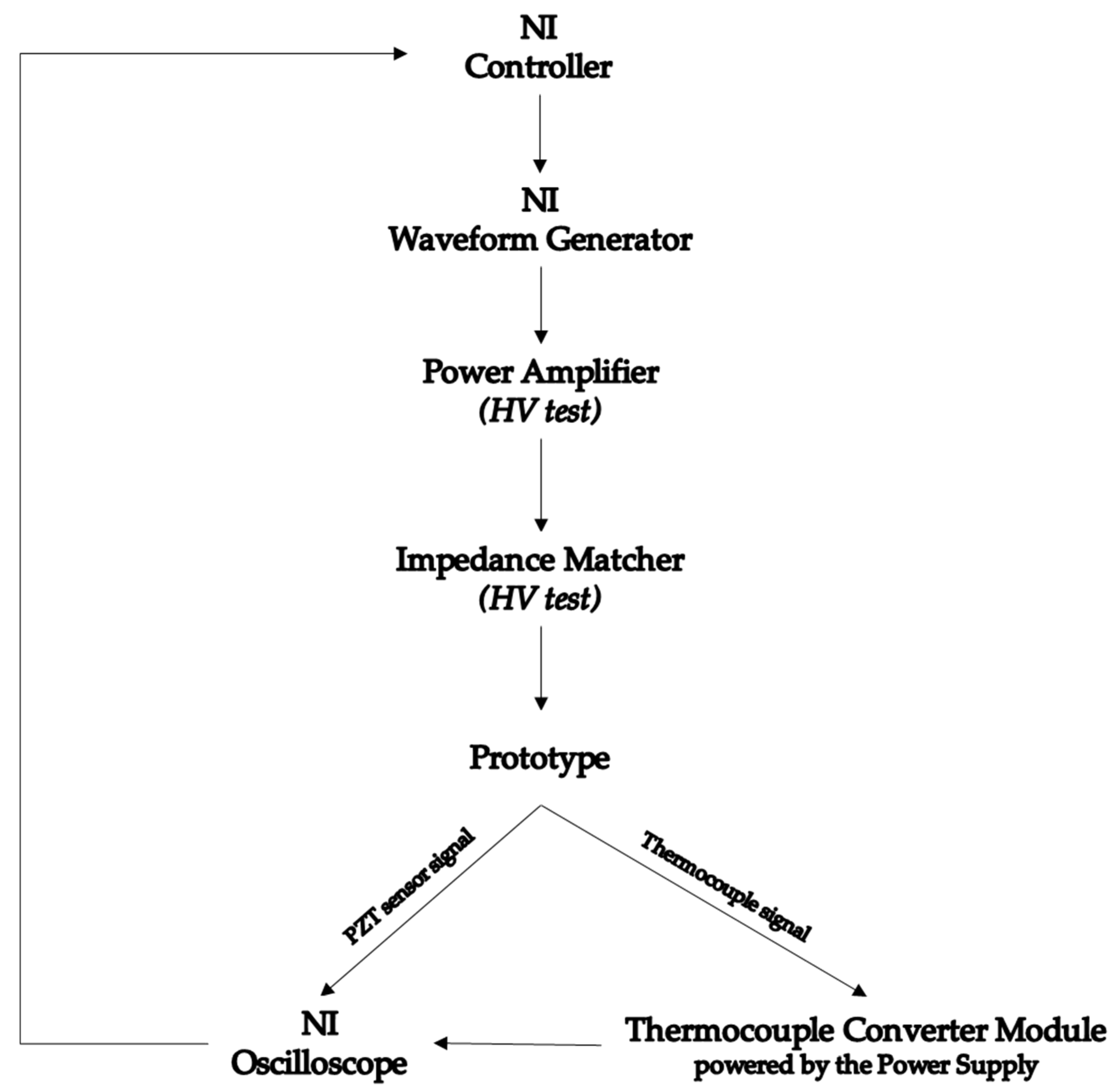
The setup used for commissioning and assembled also for wind tunnel tests was integrated with two cameras to record the tests from two different angles, as shown in Figure 12, while the procedure was illustrated in the flow chart shown in Figure 13.
Figure 12.
IWT test setup. (a) IPS setup and the top view camera (b) prototype-fastened to the wall of test chamber- and side view camera.
Figure 13.
Scheme of the LV and HV tests setup.
6.3. IWT Test Outcomes
In this section, the results of the IWT tests are reported and analyzed.
As illustrated in the previous section, for each test condition, the most effective excitation peak was identified during the LV test phase.
Table 6 reports the frequencies identified vs. the skin thickness and the temperature of the ice.
Table 6.
Peak frequencies of the demonstrators for High Voltage (HV) test conditions.
A qualitative analysis of the dataset indicates that, for a constant skin thickness of 0.8 mm, increasing the temperature from −20 °C to −10 °C results in a slight decrease in the peak frequency, followed by a substantial increase when the temperature is raised further to −4 °C. Additionally, when comparing different skin thicknesses at the same temperature, the data suggest that thinner skins (0.5 mm) generally exhibit lower peak frequencies than thicker skins (0.8 mm), indicating a possible dependency of resonance behavior on both thermal conditions and material thickness.
For each HV test, results pictures were taken to capture the status of the ice at the critical instants of the tests after the accretion or accretion followed by an ageing period. Moreover, a diagram was built to relate the percentage of detached ice on the upper side of the prototype to the maximum thickness of the ice before the use of the IPS, the temperature, the ageing of the ice, and the skin thickness. The reported ice status figures are those related at −10 °C test, which offers the chance to observe the difference in the ice removal while varying both the skin thickness and the ageing of the ice.
According to LV outcomes, the HV DAY2 TEST2 and DAY2 TEST3, on the prototype 1 (0.5 mm skin tick), were performed in the frequency range from 12,300 to 12,900 Hz, sampling at 50 Hz. The protected zone is sketched in Figure 3, and it has an area of 22.5 × 10⁻³ m2. Considering an estimated power supply of about 100 W, the power consumption results in 4.4 kW/m2, consistent with the PZT application for de-icing in [4].
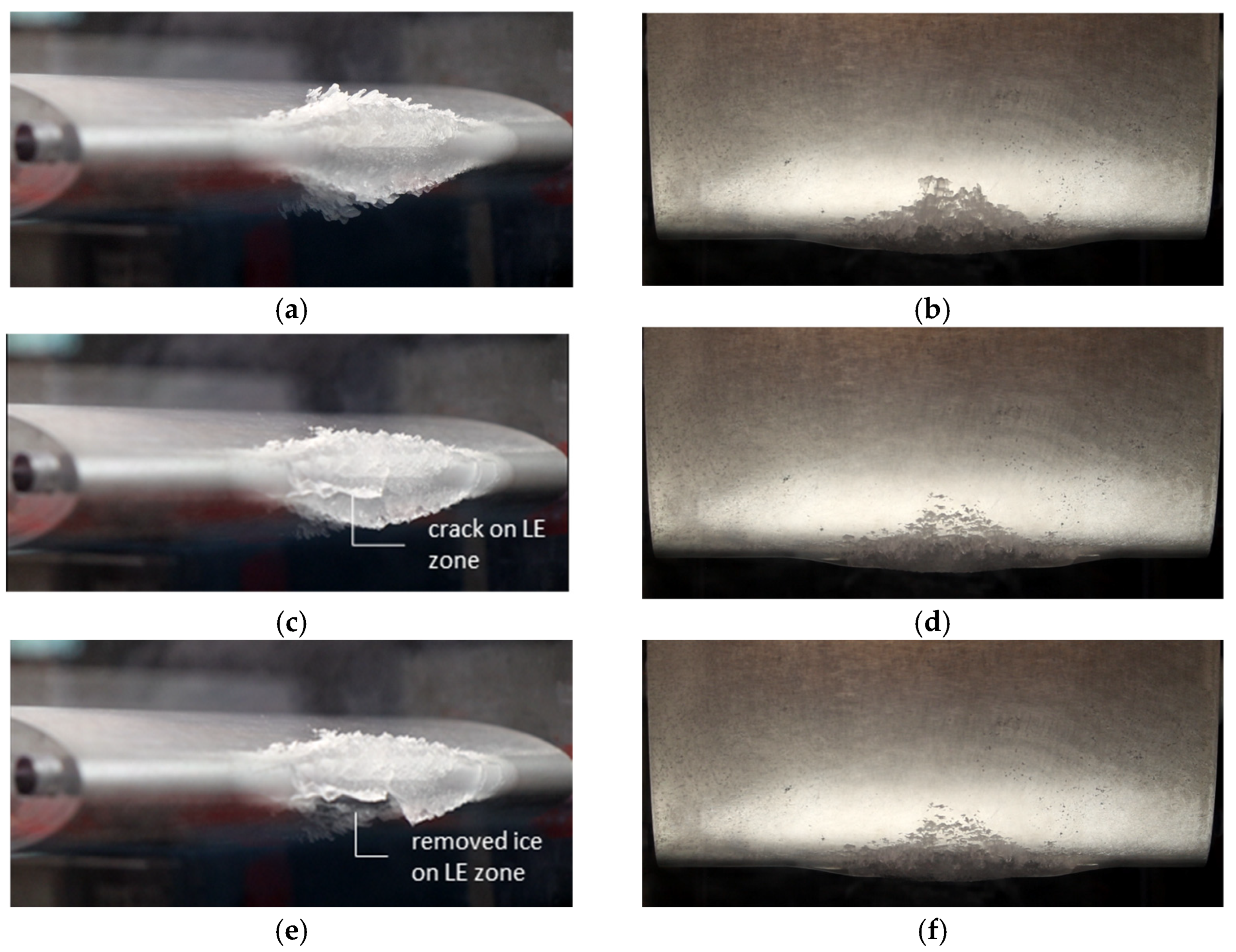
Figure 14 shows the initial status of the ice at the critical instants of the HV DAY2 TEST2. More in detail, pictures (a) and (b) depict the status of the ice before turning on the system, from a side-oblique and a top view. The pictures (c) and (d), taken after 2 s since the switching on of the IPS, show large cracks in the middle and at the edges of the ice on the LE. A piece of ice is subsequently removed from the LE, after 2 s since the appearance of the cracks; this scan can be seen in picture (e) on the bottom side of the LE.
Figure 14.
Status of ice before and during DAY2 TEST2. Side-oblique and top views are respectively reported on the left and right columns of the figure: (a,b), accreted ice; (c,d), status of the ice after 2 s since IPS activation; (e,f), status of the ice after 4 s from IPS activation.
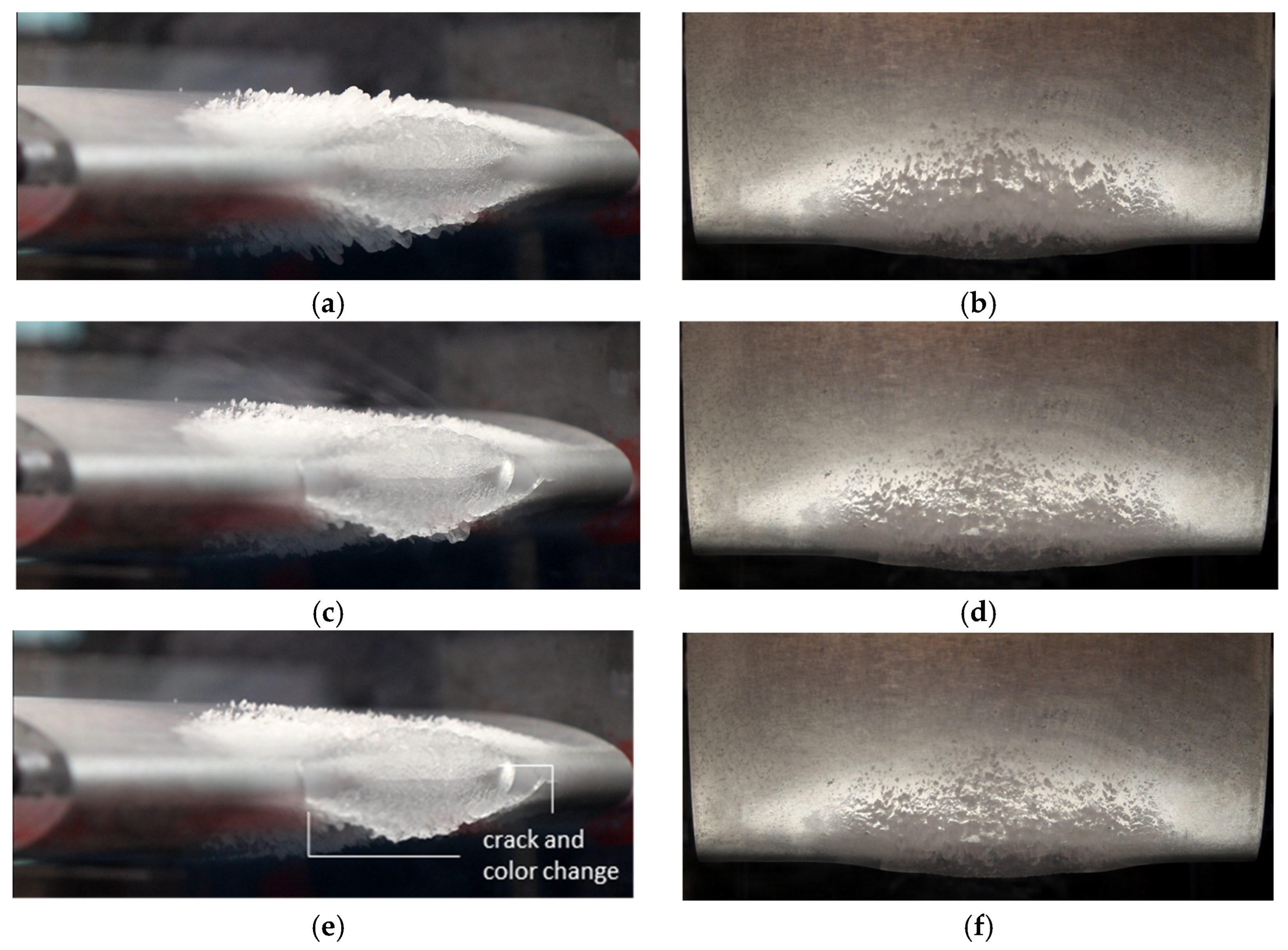
Figure 15 shows the status of the ice before and during DAY2 TEST3 performed on prototype 1 again on “fresh” ice. Ice cracks and de-icing of parts of the accreted ice can be observed: a certain amount of the accreted ice is shed off from the upper and lower surfaces of the prototype, and some cracks appear at the edge on the LE, where some other ice is shed off.
Figure 15.
Status of ice before and during DAY2 TEST3. Side-oblique and top views are respectively reported on the left and right columns of the figure: (a,b), accreted ice; (c,d), status of the ice after 2 s since IPS activation; (e,f), status of the ice after 3 s from IPS activation.
In accordance with LV outcomes, the HV DAY3 TEST4 and DAY3 TEST5, on prototype 2, were performed in the frequency range from 14,000 to 15,200 Hz, sampling at 50 Hz. As reported for DAY 2 TEST 2 and DAY 2 TEST 3, a power consumption of 4.4 kW/m2 has been estimated for DAY3 TEST4 and DAY3 TEST5.
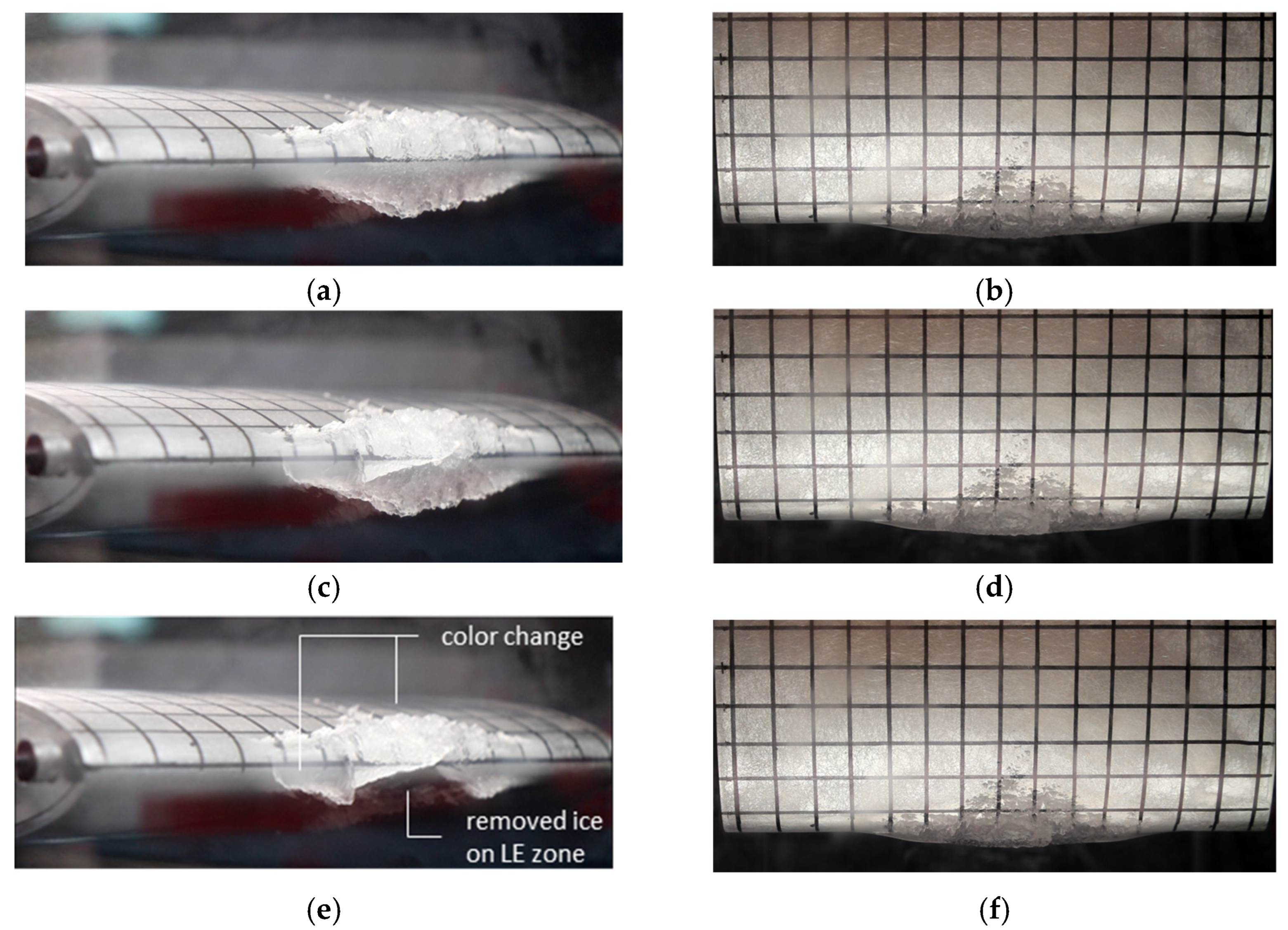
The status of ice during DAY3 TEST4 (“aged” ice) is shown in Figure 16. In this case, the ice is broken in the middle and at the edge of LE: large cracks appear on the main part of the accreted ice within 5 s, and the upper central part of the ice changes color (observable in both side and top view pictures), revealing its own detachment, pictures (b) and (c). Then, the bottom central part of the ice is shed off within 2 other seconds, while the whiter ice is stuck between the lateral sides of the ice, picture (e).
Figure 16.
Status of ice during DAY3 TEST4. Side-oblique and top views are respectively reported on the left and right columns of the figure: (a,b), accreted ice; (c,d), status of the ice after 5 s since IPS activation; (e,f), status of the ice after 7 s from IPS activation.
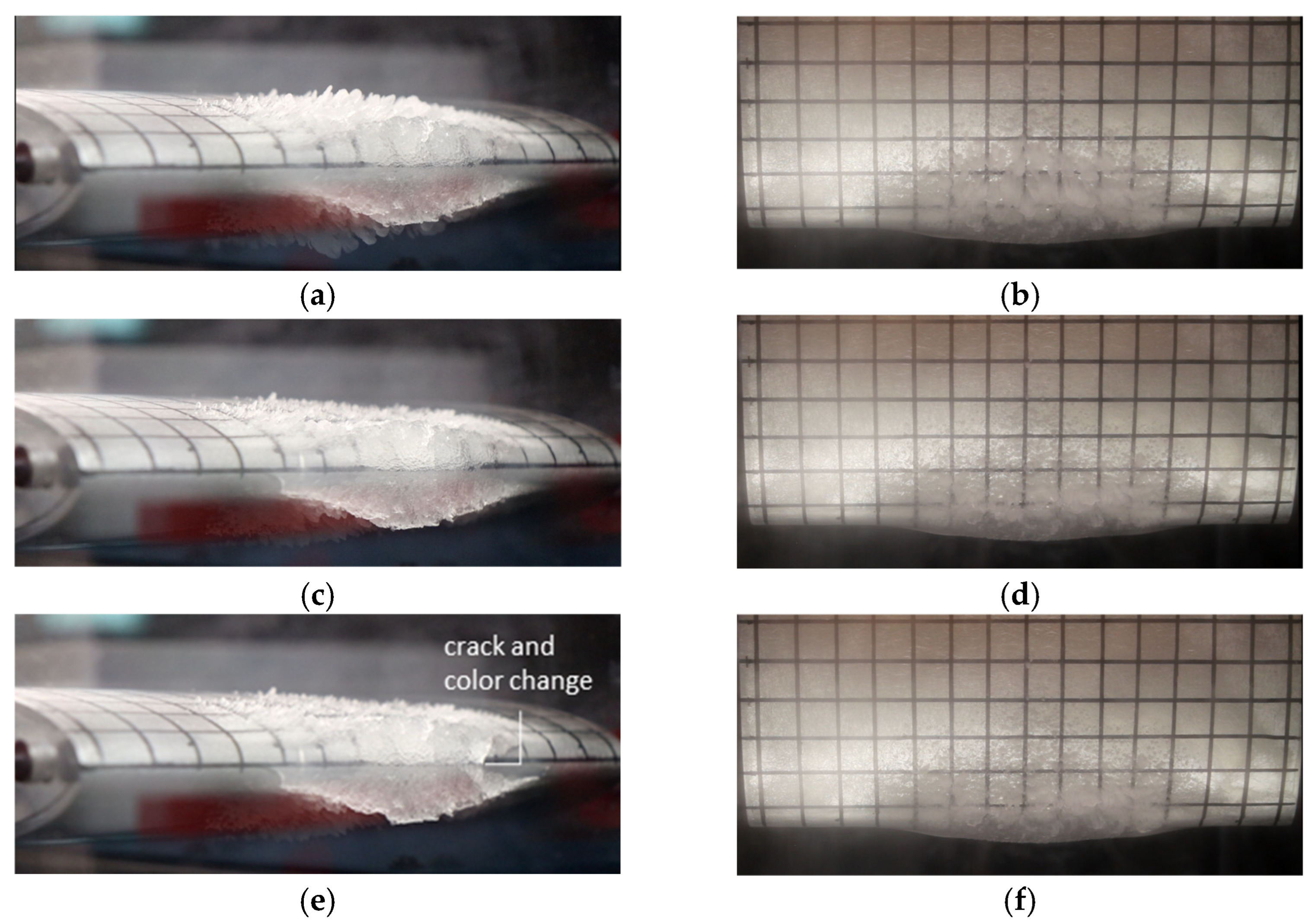
Figure 17 shows the status of ice during DAY3 TEST5 (“fresh” ice). In this case, during the first two seconds, a certain amount of accreted ice is shed off from the upper and lower surfaces of the skin and from the LE area, while a crack appears on the left; in the next two seconds, a certain amount of ice is detached at the edge and internal cracks are suggested on the right side by the color change.
Figure 17.
Status of ice during DAY3 TEST5. Side and top views are respectively reported on the left and right side of the figure: (a,b) Accreted ice; (c,d) Status of the ice after 2 s from IPS activation; (e,f) Status of the ice after 4 s from IPS activation.
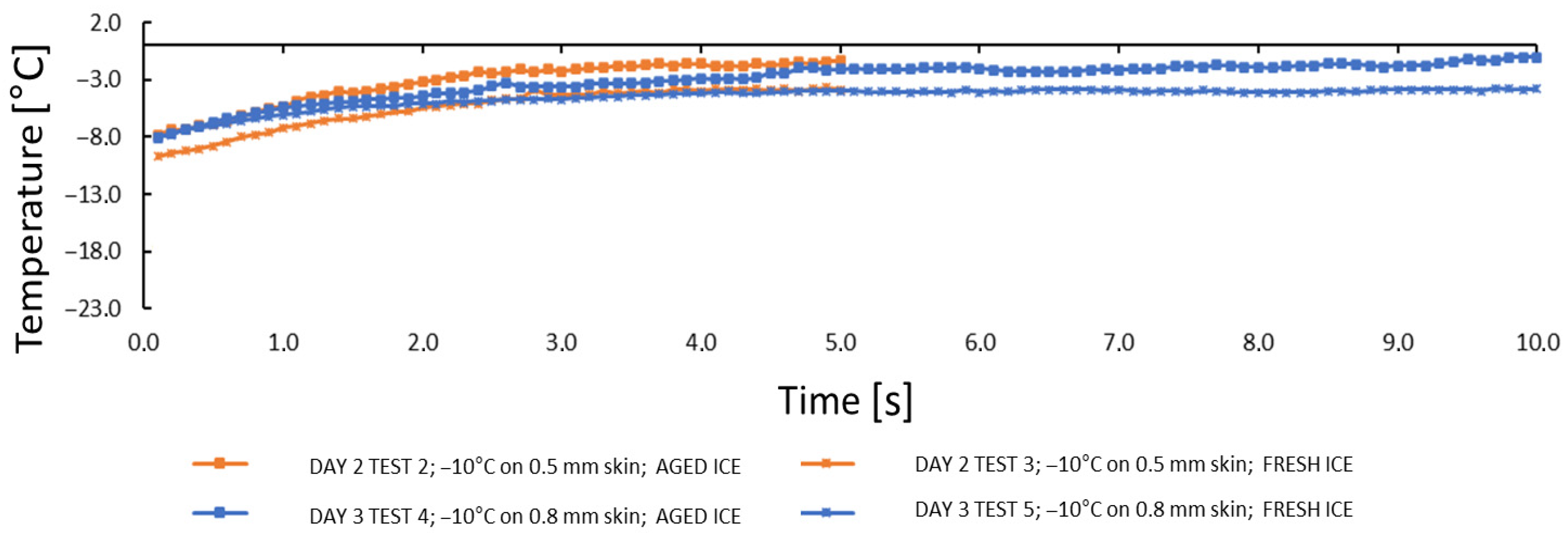
Then, the temperature of the skin during the tests, measured between the first and the second row of the actuators, in the position of the thermocouple shown in Figure 3, is reported in Figure 18. Temperature of the skin -close to PZT actuators- grows quickly: to cite an example, a temperature increase of 5.5 °C occurred within 2.5 s during DAY3 TEST4. The temperature was measured in the areas most at risk of temperature increase, i.e., close to the smallest side of the actuators. The HV tests lasted a few seconds and were stopped before the measured temperature reached or exceeded the melting temperature of the ice (0 °C). Although the temperature increased very rapidly in the monitored areas, it is reasonable to assume that the test duration was short enough to rule out a similar thermal phenomenon away from the actuators and at the LE, where most of the ice had accumulated.
Figure 18.
Temperature of the internal surface of the skin during the HV tests.
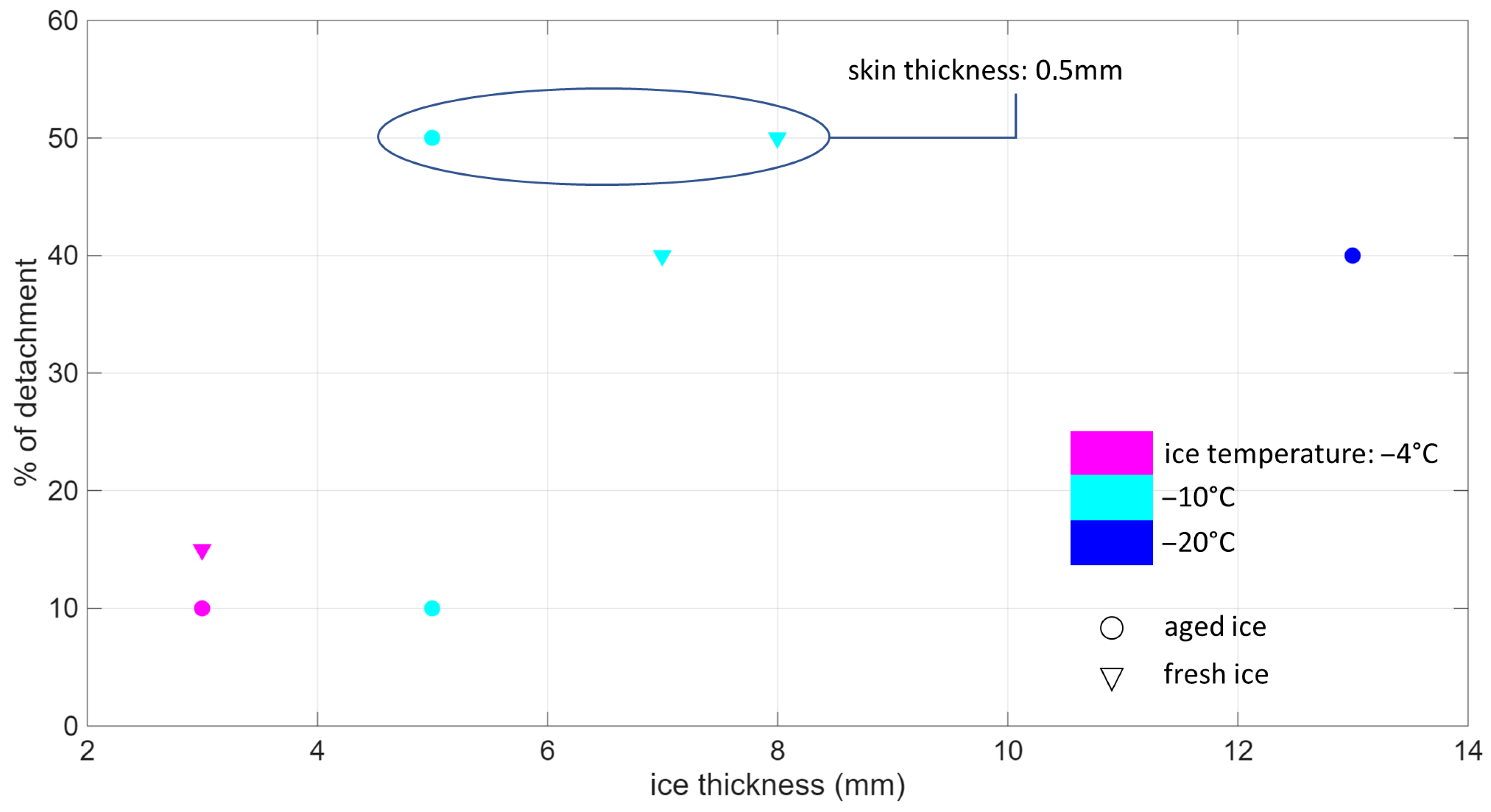
Finally, a summary of the level of detachment of the ice is presented in Figure 19 against the thickness of the accretion, the temperature, and the type of ice. These estimations are based on visual inspections, driven by a 1 cm mesh grid, which considered the area covered by ice before and after the HV test.
Figure 19.
Percentage of ice detachment vs. ice thickness, temperature, and type for 0.5 and 0.8 mm thick skin.
These results indicate a higher effectiveness of the IPS for a skin thickness of 0.5 mm, in line with the numerical findings. With the power employed, this configuration achieves the maximum de-icing level of 50%, followed by the 0.8 mm configuration, which does not produce ice removal exceeding 40%.
Another important aspect is the trend of de-icing capability as a function of ice temperature. At −10 °C (cyan), the system appears to operate at an optimal point, achieving detachment levels between 40% and 50% in three out of four tests. The test conducted at −20 °C (blue) also yields a high detachment level of about 40%, whereas those performed at −4 °C (pink) reach a maximum of only 15%. This trend is governed by the stiffness of the ice: at relatively high temperatures (−4 °C), the ice is less rigid, and the resulting shear reactions at the interface are insufficient to produce a high level of detachment; at −20 °C, by contrast, the stiffness is greater and, while it generates significant shear actions, it also provides higher resistance compared with the behavior at −10 °C, which in fact represents the best compromise. The functional dependence of the de-icing level on ice thickness is also noteworthy. Here as well, the best results are observed within an intermediate thickness range (5 to 8 mm), with peaks of 40–50% near the center of this interval. Once again, this trend appears to be driven by the stiffness of the ice layer: when the thickness is too low, the reduced stiffness does not generate sufficient interfacial shear, while when it is too high, the increased stiffness—though producing significant interfacial actions—ultimately hinders the detachment process. Higher levels of detachment, removal, and fracture in tests performed with thicker ice suggest cohesive, rather than adhesive, failure. The analysis of the experimental results is thus consistent with the numerical one [9], in which a greater contribution from in-plane actions was observed rather than from out-of-plane ones. Finally, it is not possible to establish a clear trend of the de-icing level with the type of ice (aged or fresh).
7. Conclusions and Future Steps
The present paper focuses on a wind tunnel experimental campaign aimed at estimating the effectiveness of a PZT-based IPS. To this purpose, small-sized prototypes of NACA0012 airfoils integrated with the just-mentioned IPS were designed and built, in line with a dedicated test plan. After addressing the commissioning and laboratory characterization of these demonstrators, the wind tunnel test campaign was finalized at the Fraunhofer IFAM plant.
Twelve PZT patches constitute the just-mentioned IPS. They were bonded on the inner face of the skin, in the region of the LE. The adopted layout foresees a symmetric distribution of the patches: 6 on the top and 6 on the bottom of the airfoil, each cluster, split into 3 rows along the chord direction to assure a uniform coverage of the zone, despite the high curvature.
Size and composition of the PZTs were defined by means of theoretical models on the transmission and using the FE numerical approach. This led to the identification of the most effective working condition in terms of excitation frequency.
Moving from these outcomes, the realization of the demonstrators was faced. The prototypes were commissioned in a laboratory environment by means of a dedicated SW developed in the NI LabVIEW environment. This SW allowed the definition of the PZT driving signal and to acquire and elaborate the output provided by a P-876 DuraAct sensor and a T-type thermocouple.
After verifying the correct functionality of each demonstrator, the installation within the IFAM IWT was addressed. The test campaign foresaw the investigation of the impact of different parameters on the IPS capability to remove ice: the thickness of the skin (0.5 and 0.8 mm) and of the ice (between 3 and 13 mm), the temperature of the ice accretion (−4,−10 and −20 °C) and the type of ice (fresh or aged).
Each test was generally split into two phases: (1) LV tests to investigate the dynamic response of the system and identify the most convenient operational condition; (2) HV tests at the excitation frequency bandwidth previously identified to estimate the detachment capability of the IPS.
Consistent with the numerical results, the greatest effectiveness was experimentally found on the prototype with the skin 0.5 mm thick. A trend of de-icing capability as a function of ice temperature was also found out: at −10 °C, the system appeared to operate optimally, achieving detachment levels between 40% and 50% for most of the executed tests; at −20 °C, the system also yielded a high detachment level of about 40%, while at −4 °C, a maximum of only 15% is reached. This trend is governed by the stiffness of the ice, which is affected by the temperature of accretion and the thickness of the ice itself. At the higher temperature (−4 °C), a less rigid and less thick ice accretes on the skin, so the resulting shear reactions at the interface are not sufficient to produce a high level of detachment, while at the lower temperature (−20 °C), a very rigid ice accretes, but the stiffness is so high that it hampers the detachment process. Finally, at −10 °C, a medium-stiffness ice accretes on the skin, forming a 5–8 mm thick shape which consents sufficient shear reactions at the interface to produce the highest level of detachment. It is worth noting that the just-mentioned percentages of detachment refer to the upper view of the airfoil; however, as evident in some lateral views, ice accretion was shed off the LE and/or cracks appeared on that zone, also accompanied by an altered coloration of the ice, denoting the incipient detachment.
Within a year, a hybrid system based on the same PZT technology and integrated with superhydrophobic/icephobic coating technologies will be tested on similar small-scale prototypes. The coating should reduce the ice adhesion with advantages in terms of either energy saving or the amount of detached ice.
Then, it is worth noting that the development path planned for the presented IPS technology foresees the investigation of further topics aimed at consolidating the results presented and enhancing the TRL. Within this vision, a critical role is played by the piezo actuators. Other types of piezoelectrics will be investigated with the scope of improving energy transfer. Among the others, PIN-PMN-PT and PMN-PT will be considered. A trade-off will be organized among the PZT currently used and those with a remarkably larger d31, accompanied by a lower elastic modulus [43,44,45]. Another critical role is played by the impedance of the entire system (piezos + structure + ice): in case of not perfect matching with the amplifier, energy reflection occurs with a consequent efficiency loss and potential damage to the equipment. In this work, an impedance matcher providing a limited set of impedance values was integrated in the excitation chain. Future developments will involve impedance matchers capable of impedance fine-tuning. Finally, with the aim of both increasing the efficiency of detachment and the reliability of the system, signal phasing multichannel configurations will be implemented [8]. The idea is to steer the signals generated by independent piezoelectrics to amplify their action on specific zones and potentially mitigate the failure of some broken transducers in the network.
Author Contributions
Conceptualization, L.M.; specifications, L.P., G.M. and N.R.; methodology, S.A. and N.R.; software preparation, L.M.; validation, L.M. and T.K.; formal analysis, L.M., N.R., A.C. and S.A.; supervision, L.P., S.A. and A.C.; writing, L.M., F.P., N.R. and S.A.; manufacturing, F.A.; original draft preparation, L.M., F.P. and N.R.; project administration, G.M. All authors have read and agreed to the published version of the manuscript.
Funding
This research was funded by the project Ultra Performance Wing (UP Wing, project number: 101101974), supported by the Clean Aviation Joint Undertaking and its members. Co-Funded by the European Union. Views and opinions expressed are, however, those of the author(s) only and do not necessarily reflect those of the European Union or Clean Aviation Joint Undertaking. Neither the European Union nor the granting authority can be held responsible for them.

Institutional Review Board Statement
Not applicable.
Informed Consent Statement
Not applicable.
Data Availability Statement
Data available on request due to restrictions.
Conflicts of Interest
Author F. Amoroso was employed by the company Eurotech s.a.s. The remaining authors declare that the research was conducted in the absence of any commercial or financial relationships that could be construed as a potential conflict of interest.
Abbreviations
The following abbreviations are used in this manuscript:
| d31 | Piezoelectric dielectric constant |
| Γ | Non-dimensional adhesion transmission parameter |
| FE | Finite Element |
| FFT | Fast Fourier Transform |
| HV | High Voltage |
| IPS | Ice Protection System |
| IWT | Icing Wind Tunnel |
| LE | Leading Edge |
| LV | Low Voltage |
| LWC | Liquid Water Content |
| MVD | Median Volume Diameter |
| PZT | Piezoelectric based on lead zirconate titanate |
| SW | Software |
References
- National Weather Service. Available online: https://www.weather.gov/source/zhu/ZHU_Training_Page/icing_stuff/icing/icing.htm (accessed on 10 January 2026).
- Yamazaki, M.; Jemcov, A.; Sakaue, H. A review on the current status of icing physics and mitigation in aviation. Aerospace 2021, 8, 188. [Google Scholar] [CrossRef]
- SKY Brary. Aircraft Ice Protection Systems|SKYbrary Aviation Safety. Available online: https://skybrary.aero/articles/aircraft-ice-protection-systems (accessed on 10 January 2026).
- Daniliuk, V.; Pamfilov, E.; Daniliuk, A.; Xu, Y. Feasibility Study of Ultrasonic De-Icing Technique for Aircraft Wing Ice Protection. In Proceedings of the International Conference on Aviamechanical Engineering and Transport (AviaENT 2019), Irkutsk, Russia, 27 May–1 June 2019; Available online: https://www.atlantis-press.com/proceedings/aviaent-19/125923956 (accessed on 10 January 2026).
- Shi, Z.; Kang, Z.; Xie, Q.; Tian, Y.; Zhao, Y.; Zhang, J. Ultrasonic Deicing Efficiency Prediction and Validation for a Flat Deicing System. Appl. Sci. 2020, 10, 6640. [Google Scholar] [CrossRef]
- Palacios, J.; Zhu, Y.; Smith, E.; Rose, J. Ultrasonic Shear and Lamb Wave Interface Stress for Helicopter Rotor De-Icing Purposes. In Proceedings of the 47th AIAA/ASME/ASCE/AHS/ASC Structures, Structural Dynamics, and Materials Conference, Newport, RI, USA, 1–4 May 2006. [Google Scholar] [CrossRef]
- Mangiacrapa, L.; Piscitelli, F.; Rehfeld, N.; Amoroso, F.; Mingione, G.; Ameduri, S. Realization of icing wind tunnel demonstrators for the characterization of a hybrid ice protection system. In Proceedings of the AIAA Aviation Forum and Ascend, Las Vegas, NV, USA, 21–25 July 2025. [Google Scholar] [CrossRef]
- Ameduri, S.; Concilio, A.; Brindisi, A.; Galasso, B. An Ice Protection System Based on Phased Piezoelectric Transducers. Actuators 2024, 13, 158. [Google Scholar] [CrossRef]
- Ameduri, S.; Mangiacrapa, L.; Piscitelli, F.; Rehfeld, N.; Becker, D.; Mingione, G.; Concilio, A. Piezoelectric Transducers, Coating and Ice Accretion Geometry: A Study on Their Influence on the Effectiveness of an Ultrasonic Ice Protection System. In Proceedings of the ASME SMASIS Conference Proceedings 2024, Atlanta, GA, USA, 9–11 September 2024. V001T04A011. [Google Scholar] [CrossRef]
- Feng, Y.; Zhao, Y.; Yan, H.; Cai, H. A Driving Power Supply for Piezoelectric Transducers Based on an Improved LC Matching Network. Sensors 2023, 23, 5745. [Google Scholar] [CrossRef]
- Pichardo, S.; Silva, R.R.C.; Rubel, O.; Curiel, L. Efficient Driving of Piezoelectric Transducers Using a Biaxial Driving Technique. PLoS ONE 2015, 10, e0139178. [Google Scholar] [CrossRef]
- Vo, T.V.K.; Lubecki, T.M.; Chow, W.T.; Gupta, A.; Li, K.H.H. Large-Scale Piezoelectric-Based Systems for More Electric Aircraft Applications. Micromachines 2021, 12, 140. [Google Scholar] [CrossRef]
- Boukabache, H.; Escriba, C.; Fourniols, J.-Y. Toward Smart Aerospace Structures: Design of a Piezoelectric Sensor and Its Analog Interface for Flaw Detection. Sensors 2014, 14, 20543–20561. [Google Scholar] [CrossRef]
- Isaf, M.L.; Rincón-Mora, G.A. Piezoelectric Transducers: Complete Electromechanical Model with Parameter Extraction. Sensors 2024, 24, 4367. [Google Scholar] [CrossRef]
- Ferreira, P.M.; Machado, M.A.; Vidal, C.; Carvalho, M.S. Modelling Electro-Mechanical Behaviour in Piezoelectric Composites: Current Status and Perspectives on Homogenisation. Adv. Eng. Softw. 2024, 193, 103651. [Google Scholar] [CrossRef]
- Pommier-Budinger, V.; Budinger, M.; Rouset, P.; Dezitter, F.; Huet, F.; Wetterwald, M.; Bonaccurso, E. Electro-Mechanical Resonant Ice Protection Systems: Initiation of Fractures with Piezoelectric Actuators. AIAA J. 2018, 56, 4400–4411. [Google Scholar] [CrossRef]
- Fei, C.; Zhang, L.; Chen, Z.; Yang, Y.; Ma, J. New Piezoelectric Materials and Devices: Fabrication, Structures, and Applications. Front. Mater. 2022, 8, 824345. [Google Scholar] [CrossRef]
- Zhang, W.; Zhang, Y.; Yang, Z. Challenges and Progress of Chemical Modification in Piezoelectric Composites and Their Applications. Soft Sci. 2023, 3, 19. [Google Scholar] [CrossRef]
- Yu, Z.; Yue, Y.; Liang, Z.; Zhao, X.; Li, F.; Peng, W.; Zhu, Q.; He, Y. Physical Sensors Based on Lamb Wave Resonators. Micromachines 2024, 15, 1243. [Google Scholar] [CrossRef] [PubMed]
- Moon, J.; Lim, S.; Kim, J.; Kang, G.; Kim, B. A Study on the Mechanical Resonance Frequency of a Piezo Element: Analysis of Resonance Characteristics and Frequency Estimation Using a Long Short-Term Memory Model. Appl. Sci. 2024, 14, 7833. [Google Scholar] [CrossRef]
- Louisnard, O. Understanding Ultrasonic Piezoelectric Transducers. HAL Archive. 2023. Available online: https://hal.science/hal-04142861 (accessed on 10 January 2026).
- Migot, A.; Saaudi, A.; Giurgiutiu, V. Delamination Depth Detection in Composite Plates Using the Lamb Wave Technique Based on Convolutional Neural Networks. Sensors 2024, 24, 3118. [Google Scholar] [CrossRef]
- Dragašius, E.; Eidukynas, D.; Jūrėnas, V.; Mažeika, D.; Galdikas, M.; Mystkowski, A.; Mystkowska, J. Piezoelectric Transducer-Based Diagnostic System for Composite Structure Health Monitoring. Sensors 2021, 21, 253. [Google Scholar] [CrossRef]
- He, Z.; Zhuo, Y.; Zhang, Z.; He, J. Design of icephobic surfaces by lowering ice adhesion strength: A mini review. Coatings 2021, 11, 1343. [Google Scholar] [CrossRef]
- Zhao, L.; Shen, Y.; Tao, J.; Liu, W.; Wang, T.; Liu, S. Review on Icephobicity of Materials Surface Enhanced by Interface Action Force. Adv. Mater. Interfaces 2025, 12, 2400665. [Google Scholar] [CrossRef]
- Piscitelli, F.; Ameduri, S.; Volponi, R.; Pellone, L.; De Nicola, F.; Concilio, A.; Albano, F.; Elia, G.; Notarnicola, L. Effect of Surface Modification on the Hybrid Ice Protection Systems Performances. In Proceedings of the International Conference on Icing of Aircraft, Engines, and Structures, Vienna, Austria, 20–22 June 2023. SAE Technical Paper 2023-01-1452. [Google Scholar] [CrossRef]
- Clean Sky 2. Breaking the Ice with Clean Sky Innovations. Available online: https://www.clean-aviation.eu/research-and-innovation/clean-sky-2/results-stories/breaking-the-ice-with-clean-sky-innovations (accessed on 5 December 2025).
- Meggitt PLC. GAINS—Green Airframe Icing Novel Systems. Available online: https://www.meggitt.com/insights/new-tunes-to-break-the-ice/ (accessed on 5 December 2025).
- European Commission. SENS4ICE—SENSors and Certifiable Hybrid Architectures FOR Safer Aviation in ICing Environment. Available online: https://www.sens4ice-project.eu/ (accessed on 5 December 2025).
- European Commission. ICE GENESIS Environment. Available online: https://www.ice-genesis.eu/page/bm/ldo-101.php (accessed on 5 December 2025).
- European Commission. JEDI ACE—Japanese-European De-Icing Aircraft Collaborative Exploration. Available online: https://cordis.europa.eu/project/id/314335 (accessed on 5 December 2025).
- Maio, L.; Ameduri, S.; Memmolo, V.; Ricci, F.; Concilio, A. Ultrasonic De-Icing System for Leading Edge in Composite Material. In Proceedings of the ASME SMASIS, Louisville, KY, USA, 9–11 September 2019. [Google Scholar] [CrossRef]
- Ameduri, S.; Brindisi, A.; Concilio, A.; Giusto, G.; Maio, L.; Memmolo, V.; Notarnicola, L.; Pellone, L.; Piscitelli, F.; Ricci, F. Design and Realisation of a Wind Tunnel Model for Ice Protection System Demonstration. In Proceedings of the 2022 IEEE 9th International Workshop on Metrology for AeroSpace (MetroAeroSpace), Pisa, Italy, 18 August 2022; Available online: https://ieeexplore.ieee.org/document/9160305 (accessed on 23 December 2025).
- Clean Aviation Joint Undertaking. UP Wing—Ultra Performance Wing. Available online: https://www.clean-aviation.eu/research-and-innovation/clean-aviation/clean-aviation-projects/up-wing (accessed on 6 December 2025).
- Piscitelli, F.; Volpe, A. Superhydrophobic Coatings for Corrosion Protection of Stainless Steel. Aerospace 2024, 11, 3. [Google Scholar] [CrossRef]
- Brindisi, A.; Vendittozzi, C.; Travascio, L.; Belardo, M.; Ignarra, M.; Fiorillo, V.; Concilio, A. An FBG-Based Hard Landing Monitoring System: Assessment for Drops on Different Soils. Photonics 2025, 12, 197. [Google Scholar] [CrossRef]
- Piezo Hannas. Piezo Material Parameter. Available online: https://www.piezohannas.com/PZT-material-parameter.html (accessed on 5 December 2025).
- Mangiacrapa, L.; Rehfeld, N.; Piscitelli, F.; Ameduri, S.; Concilio, A.; Mingione, G. Modelling of an ice protection system based on icephobic and piezoelectric technologies, for WT demonstration. In Proceedings of the ACTUATOR 2024 International Conference and Exhibition on New Actuator Systems and Applications, Wiesbaden, Germany, 13–14 June 2024; pp. 225–228, ISBN 978-3-8007-6391-7. Available online: https://ieeexplore.ieee.org/document/10652929 (accessed on 23 December 2025).
- Rønneberg, S.; Laforte, C.; Volat, C.; He, J.; Zhang, Z. The effect of ice type on ice adhesion. AIP Adv. 2019, 9, 055304. [Google Scholar] [CrossRef]
- PI Ceramic GmbH. Material Data—Specific Parameters of Standard Materials (rev. V2508), Lederhose, Germany. August 2025. Available online: https://www.piceramic.de/de/?type=5600&downloadUid=1385&downloadFileUid=1255 (accessed on 23 December 2025).
- Crawley, E.F.; Luis, J.D. Use of Piezoelectric Actuators as Elements of Intelligent Structures. AIAA J. 1987, 25, 1373–1385. [Google Scholar] [CrossRef]
- Concilio, A. Controllo Attivo del Rumore in Cabina Mediante Attuatori Piezoelettrici Distribuiti Sulla Struttura. Ph.D. Thesis, Università degli Studi di Napoli Federico II, Napoli, Italy, 1996. Available online: https://tesidottorato.depositolegale.it/handle/20.500.14242/239383 (accessed on 23 December 2025).
- Luo, C.; Qiu, C.; Xu, Z. Optimized orientation of PIN–PMN–PT single crystal for enhanced electromechanical properties via anisotropic structural engineering. APL Mater. 2025, 13, 071106. [Google Scholar] [CrossRef]
- Chen, C.-T.; Lin, S.-C.; Trstenjak, U.; Spreitzer, M.; Wu, W.-J. Comparison of Metal-Based PZT and PMN–PT Energy Harvesters Fabricated by Aerosol Deposition Method. Sensors 2021, 21, 4747. [Google Scholar] [CrossRef]
- Zhang, W.; Li, J.; Xing, Y.; Lang, F.; Zhao, C.; Hou, X.; Yang, S.; Xu, G. Determination of the Mechanical Properties of PIN–PMN–PT Bulk Single Crystals by Nanoindentation. Crystals 2020, 10, 28. [Google Scholar] [CrossRef]
Disclaimer/Publisher’s Note: The statements, opinions and data contained in all publications are solely those of the individual author(s) and contributor(s) and not of MDPI and/or the editor(s). MDPI and/or the editor(s) disclaim responsibility for any injury to people or property resulting from any ideas, methods, instructions or products referred to in the content. |
© 2026 by the authors. Licensee MDPI, Basel, Switzerland. This article is an open access article distributed under the terms and conditions of the Creative Commons Attribution (CC BY) license.