Next Article in Journal
Torque Ripple Suppression in BLDC Reaction Wheels Using Adaptive Composite Control Strategy Under Non-Ideal Back-EMF
Previous Article in Journal
Temperature Estimation of Thin Shape Memory Alloy Springs in a Small-Scale Hip Exoskeleton with System Identification and Adaptive Control
Previous Article in Special Issue
Fault Detection and Diagnosis for Human-Centric Robotic Actuation in Healthcare: Methods, Failure Modes, and a Validation Framework
error_outline You can access the new MDPI.com website here. Explore and share your feedback with us.
 
 
Article

Design and Feasibility Assessment of a Prototype Wearable Upper-Limb Device for Facilitating Arm Swing Training

Biorobotics & Biomechanics Laboratory, Mechanical Engineering Department, University of Maine, 75 Long Road, Orono, ME 04469, USA
*
Author to whom correspondence should be addressed.
Actuators 2026, 15(1), 27; https://doi.org/10.3390/act15010027
Submission received: 22 October 2025 / Revised: 13 December 2025 / Accepted: 24 December 2025 / Published: 3 January 2026

Abstract

This paper presents the design, development, and evaluation of a proof-of-concept arm swing facilitator device (ASFD) to promote proper arm swing during gait training. Although coordinated arm swing plays a critical role in human locomotion and neurorehabilitation, few wearable systems have been developed to integrate it into gait training. The ASFD was designed to test the feasibility of generating torque at the shoulder joint to initiate arm flexion–extension motion while allowing other shoulder degrees of freedom to move freely. The device induced cyclic arm motion at 1 Hz, producing sufficient torque while maintaining ergonomic criteria, such as a large workspace and back-mounted actuation to minimize arm load. The system incorporated a double-parallelogram mechanism to expand the workspace and a two-stage pulley–belt transmission to amplify torque. Testing showed that the ASFD produced up to 15 N·m and 11 N·m torques in static and dynamic load tests, respectively. Kinematic and experimental analyses confirmed sufficient motion freedom, except for some constraints in rotation. Human subject experiment demonstrated that the ASFD successfully induced arm swing within the 0.8–1.2 Hz frequency range and torques below 11 N·m. The ASFD met its design objectives, establishing a foundation for future development aimed at gait rehabilitation applications.

1. Introduction

Arm swing plays a key role in healthy human gait [1] through enhancing gait stability [2], making locomotion energetically efficient [3], and regaining balance after disruptions, particularly when unexpected disturbances occur [4]. Previous studies have demonstrated the coupling between upper and lower limbs during locomotion that can stem from interlimb neural connections [5,6]. Arm swing is suggested to be an active process that influences lower limb muscle activity through shared pathways in both the brain and spinal cord, helping to maintain coordinated and rhythmic gait patterns [6,7,8]. In addition to the arm swing role in healthy gait, proper arm swing can be critical for gait training of various populations, including older adults [9], individuals poststroke [10,11], and those with Parkinson’s disease [12]. Simultaneous arm and leg movements during training can enhance neural pathway excitability between limbs [13], supporting better leg function recovery after neurological injuries such as stroke [14] and spinal cord injury [15]. Greater arm swing amplitude is linked to improved interlimb coordination during walking, emphasizing the importance of training with sufficient amplitude [16]. The importance of coordinated arm swing for efficient and stable gait and the absence of proper arm swing in many clinical populations underscore the need for incorporating arm swing into gait rehabilitation, where it is currently lacking.
Most studies so far have been observational ones, mainly focusing on the role of arm swing on gait as well as the effects of disorders, speed, age, etc., on arm swing. However, some efforts have been made to integrate arm swing in gait rehabilitation, such as manual assistance by therapists via horizontally moving poles during walking on a treadmill [13], verbal instructions have been utilized for phase manipulation [17], using recumbent stepper machines [18], holding on sliding handrails during treadmill walking [19], and a simple rope-pulley system for mechanically coupling the arm and leg movements [20]. The aforementioned methods are relatively simplistic, as they predominantly rely on manual assistance from one or several therapists within clinical facilities, and they may lead to body weight compensation through hands, leading to the learning of incorrect gait patterns [21]. More recently, advances in wearable and intelligent systems have enabled the development of biofeedback systems for gait and arm swing training. Haptic feedback has been used to manipulate arm swing frequency and, thereby, walking speed in young [22] and older adults [6,9], showing significant improvements in key gait outcomes as well as enhanced arm swing range of motion and symmetry. Vibrotactile feedback was used at the wrists for individuals with Parkinson’s disease [23] and around the forearm for healthy young individuals and one poststroke individual [24]; however, the distal location of the feedback concerning the shoulder joint, as the main joint for arm swing, may lead to unnatural arm-swing patterns. While biofeedback devices offer significant potential for gait training [25,26], individuals who struggle to initiate or alter their arm swing due to insufficient strength or motor control require stronger assistance or guidance than tactile feedback can provide.
To address the limitations of manual therapist-dependent interventions as well as providing stronger assistance to instigate arm swing, one may consider using an upper-limb assistive device or exoskeleton. Although no exoskeletons currently exist specifically to facilitate arm swing during gait training, upper-limb exoskeletons come in various forms, including rigid linkage-based devices and soft textile exosuits, and employ a range of actuators such as pneumatic or cable-driven mechanisms. Rigid exoskeletons offer precise torque transmission and large workspace coverage [27,28]; however, they are often heavier and more restrictive for natural gait-related arm swing. In contrast, soft exosuits offer comfort and a lightweight, low-profile design but provide limited torque capacity and bandwidth [29,30,31]. For arm-swing rehabilitation where natural, unconstrained motion and minimal mechanical resistance are essential, devices must be lightweight, backdrivable, and capable of high transparency across a large range of motion [32,33]. Pneumatic actuators provide high torque-to-weight ratios and inherent compliance, making them attractive for assistive and rehabilitation robots [34,35]; however, they require external air sources and exhibit nonlinear, hysteretic pressure-force behavior that complicates precise and fast control during cyclic arm swing [29,36].
Cable-driven systems with soft garment-like components offer a reasonable compromise between power and comfort by relocating actuators away from the distal limb to reduce inertia and improve user comfort [37,38]. Their flexible cable routing supports natural multi-joint movements and better anatomical alignment [32]. However, cable-driven transmissions also present several well-documented limitations. In general, tendon- or cable-based actuation systems exhibit nonlinear and direction-dependent friction, which reduces transmission efficiency and leads to measurable torque loss at the joint. These effects have been consistently reported across a wide range of cable-driven wearable devices, including upper-limb, lower-limb, and soft tendon-driven exosuits, where friction, hysteresis, and tension losses accumulate along the cable path and degrade control accuracy and responsiveness [39,40]. In addition, cable jamming and squeezing can occur under high tension or curved routing paths, which affects responsiveness, control accuracy, and long-term reliability [41,42].
Recently, a significant number of upper-limb exoskeletons have been designed to reduce muscle strain and improve endurance during tasks that involve repetitive or overhead movements [43]. These devices primarily support the shoulder joint and have been shown to reduce muscle activity in the deltoid and trapezius muscles and, thereby, decrease perceived exertion and discomfort [44,45,46]. Using soft robotics, Proietti et al. [47] utilized integrated textile pneumatic actuators to fabricate a portable inflatable shoulder wearable robot for assisting industrial workers during shoulder-elevated tasks. Although many portable upper-limb exoskeletons are used to augment the strength of able-bodied individuals, mostly in industrial settings, there are exoskeletons to support individuals with decreased musculoskeletal strength. Lee et al. [34] presented an intelligent upper-extremity exoskeleton using pneumatic actuators and soft wearable sensors that can support shoulder and elbow flexion/extension by predicting the user’s intention. Textile-based pneumatic actuators were employed in a multi-joint soft wearable robot to assist the shoulder elevation and elbow extension to provide assistance and rehabilitation [48]. Although upper-limb exoskeletons are progressing quickly thanks to lightweight and low-profile actuation mechanisms that improve portability and usability, they remain unsuitable for promoting natural arm swing in users. Of those exoskeletons with shoulder support, they mostly focus on assisting shoulder elevation and abduction, with fewer systems concerned with shoulder flexion/extension.
While these examples and other shoulder exoskeletons aim to provide substantial assistive torques at the shoulder during low-frequency arm movements in tasks such as reaching and lifting, eliciting natural arm swing involves higher-frequency movements, determined by gait frequencies, with torques that remain within the physiological range of shoulder torque during walking. Although upper-extremity exoskeletons may be a suitable option for the tasks mentioned above, they may be too excessive for incorporating arm swing during gait rehabilitation. To induce arm swing, there is a need for a wearable upper-extremity device with key ergonomic and motion/torque generation features of: (1) onboard actuators located on the back to avoid additional load on the user’s arms for users’ ergonomic, (2) powered in just one degree of freedom (DOF) to assist in flexion/extension of the user’s shoulder, while allowing relatively unconstrained motion of the user’s arms in the remaining DOFs including shoulder abduction/adduction, internal/external rotations, and elevation/depression, (3) large workspace to allow unconstrained movements of the arm while unpowered, (4) capable of generating approximately sinusoidal trajectories with stride frequencies in the range of 0.8–1.1 Hz corresponding to walking with normal speed [5], and (5) torque generation capacity matching the physiological shoulder torque.
Building on our prior studies [33,49,50], this paper presents the design, fabrication, and analysis of a research prototype for an arm swing facilitator device (ASFD) designed to evaluate the feasibility of inducing arm swing for gait rehabilitation applications in the future. Unlike the well-characterized requirements for lower-limb exoskeletons and upper-limb assistive devices, a substantial knowledge gap remains regarding the torque and movement requirements for a device whose primary function is to induce arm swing. As a step toward the overall goal of integrating arm swing into gait training, this version of the ASFD was developed as a research tool to answer the central question of whether arm swing can be generated and altered by a programmable wearable device that satisfies the mentioned features. Here, the design objective was to quantify sufficient torque to swing arms at different stride frequencies corresponding to walking with normal self-selected speed in the most demanding scenario, in which the wearer’s arms were passively hanging on their side, requiring full assistance from the ASFD. However, this scenario was only used for a feasibility demonstration, where the users’ active contribution to swinging their arms was restricted as a confounding factor preventing an objective evaluation of the ASFD. It is plausible, and should be tested in the future, that the ASFD only provides kinesthetic feedback using a small torque, instead of full assistance to swing passive arms, to nudge the arm and direct the user to modify arm swing accordingly.
To mitigate these limitations while retaining the benefits of remote actuation, the ASFD uses a rigid-link mechanism combined with a Bowden cable transmission. The rigid linkage ensures precise kinematic control with minimal compliance, while the Bowden cable enables motor placement near the torso, reducing distal mass and increasing comfort during gait. This hybrid architecture provides a more predictable and efficient torque transfer than fully cable-driven or soft-tendon systems, making it well-suited for cyclic, high-frequency arm-swing rehabilitation. The paper is structured as follows. First, the design and fabrication of the ASFD, including its double parallelogram linkage (DPL) and cable-driven power transmission, are presented. Dynamic modeling of the arm as a 2-DOF pendulum and the shoulder joint torque during walking were used to inform the design of the actuation system. Forward kinematics analysis, using Denavit–Hartenberg (DH) parameters, is performed with a focus on kinematic compatibility between the device’s workspace and the natural movements of the human body. Ensuring kinematic compatibility is essential to minimize parasitic interaction forces, enhance user safety, and maximize comfort during rehabilitative exercises [31,51,52]. The evaluation of the torque and motion generation of the ASFD at different frequencies via static and dynamic load testing is presented next. Finally, the results of a human subject study demonstrate the ASFD’s capability in delivering sufficient torque to induce natural arm swing in the users at varying frequencies.


2. Materials and Methods

2.1. Arm Swing Torque Estimation

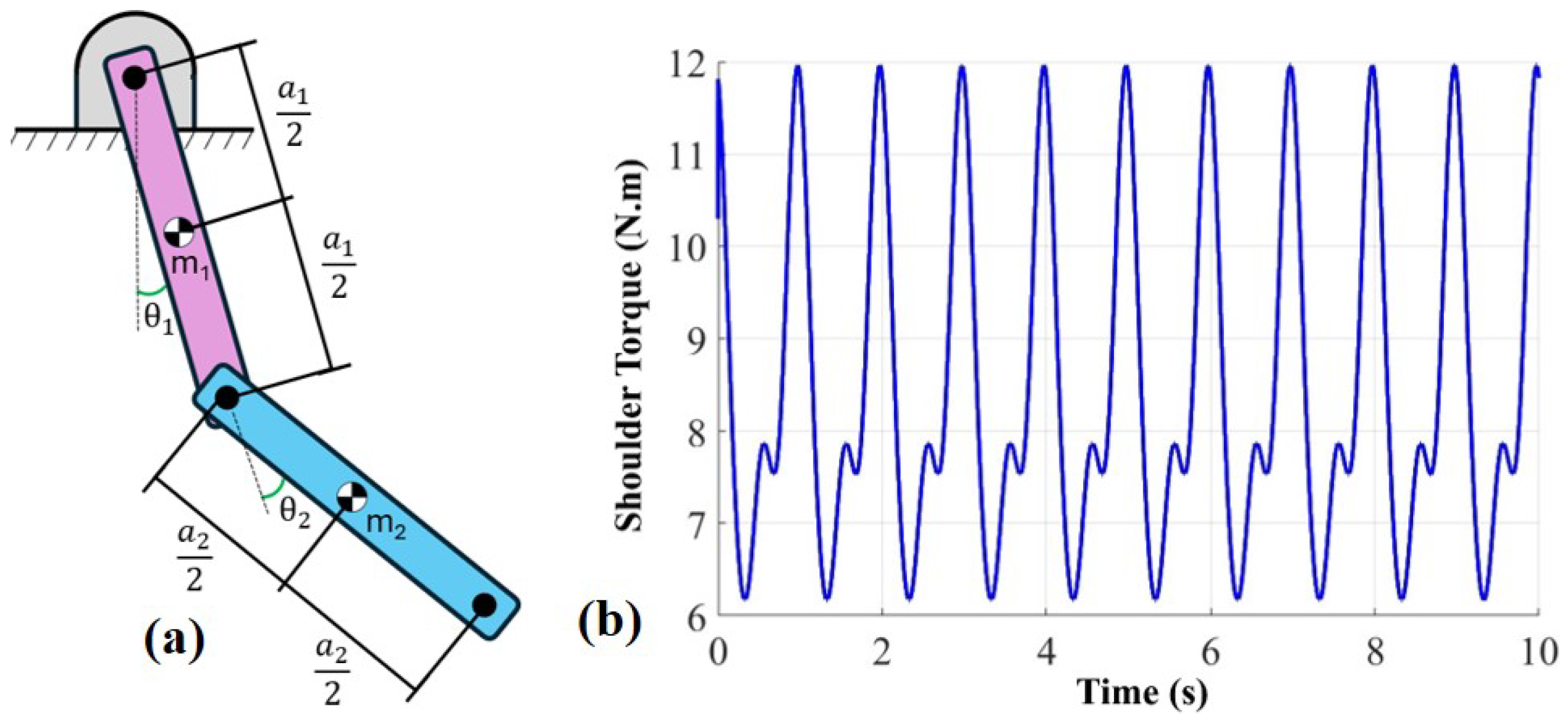
The purpose of this part was to approximately estimate the amount of required torque for inducing arm swing to inform the design of the actuation system for the ASFD. Unlike the numerous studies that quantify lower-extremity joint torques, studies on shoulder torque during normal walking are scarce and show significant variability in the reported values [53,54]. For example, Collins et al. [53] reported a range of up to 2 N·m, while Cimolin et al. [54] reported the average peak of 0.15 N·m/kg. Although Rajagopal’s full-body musculoskeletal model exists for OpenSim [55], the values of shoulder joint torques are sporadic and not reliable. Given that the bottom-up inverse dynamics method in OpenSim relies on the ground reaction forces to estimate the joint torques, this estimation becomes unreliable for distal joints such as the shoulder joints. Therefore, we developed our computational approach based on inverse dynamics analysis using models implemented in MATLAB R2024b (The MathWorks, Inc., Natick, MA, USA). We modeled the upper extremity and shoulder and elbow joints as a two-link planar elbow manipulator shown in Figure 1a, representing the arm and forearm, in Simulink R2024b (The MathWorks, Inc., Natick, MA, USA). Since our goal was to approximately estimate the shoulder torque, rather than creating an accurate model for arm swing, we neglected the viscosity and stiffness of the elbow and shoulder joints, modeling them as simple 1-DOF revolute joints.
Biomechanical studies indicate that healthy adults exhibit an arm swing frequency of 0.9 Hz during walking, with angular amplitudes reaching 36 during fast-paced ambulation [1,56]. To ensure adaptability across diverse subjects and experimental conditions, the system was designed to deliver sufficient torque for full arm mobilization at a conservative upper bound of 1 Hz and 40 amplitude. For the elbow angle, the amplitude and non-zero offset of 20 were considered, in which the non-zero offset ensures the elbow angle is always greater than 20 to avoid elbow hyperextension [1]. Considering the ultimate goal of the ASFD to augment rather than fully drive arm swing, the target torque was constrained to values of the shoulder peak torque observed in simulation. The Newton-Euler formulation method was employed to compute joint torques ( τ ) at the shoulder and elbow based on the standard dynamics model of a planar elbow manipulator:
τ = H ( θ ) θ ¨ + V ( θ , θ ˙ ) + G ( θ )
where τ = [ τ s , τ e ] T is the torque vector (shoulder τ s , elbow τ e ) in N · m , θ = [ θ s , θ e ] T denotes the shoulder and elbow joint angles, H ( θ ) is the 2 × 2 inertia matrix, V ( θ , θ ˙ ) represents centripetal and Coriolis torque components, and G ( θ ) accounts for gravitational effects denotes the angular displacements of the shoulder and elbow joints (see Appendix A).
The parameters used in the simulation were based on a height of 1.75 m and a weight of 76.7 kg, representing the average height and weight of a healthy U.S. male [57]. To ensure that the torque estimation is not limited to a single anthropometric profile, we expanded the model to include a broader range of adult body types. The baseline parameters used in the original model were derived from average U.S. adult anthropometry, which is well documented in biomechanics literature [57]. We tested three baseline cases were: (1) an average adult male (1.75 m, 90.3 kg), (2) a healthy-weight adult male based on BMI reference standards (1.75 m, 76.6 kg), and (3) an average adult female (1.61 m, 77.5–78 kg). To generalize the model beyond these U.S. averages, we performed a ± 10 % sensitivity analysis on both height and body mass for males and females. This produced eleven anthropometric conditions (i.e., three baselines and eight sensitivity cases) representing shorter, taller, lighter, and heavier adults. The arm and forearm lengths were calculated as a percentage of total body height using values provided by [58]. The arm length is defined as the distance between the glenohumeral joint and the elbow center, and the forearm length is defined as the distance between the centers of the elbow and wrist joints. A MATLAB script was written to calculate the mass and mass moment of inertia about the center of mass for both the upper arm and forearm, including the hand, based on the equations in [59]. All important simulation parameters and inputs are shown in Table 1, and the results of the shoulder torque are presented in Figure 1b. For our design purpose, we set 12 N·m as the target torque to be generated by the ASFD about the wearer’s shoulder joint. The results of the anthropometric sensitivity analysis are summarized in Table 2. Across these conditions, peak shoulder torques ranged from 4.3 N·m to 15.0 N·m. All typical adult body sizes remained within or close to the ASFD’s dynamic torque capability (approximately 12 N·m at gait-relevant frequencies), with only the extreme upper-bound height condition (a male with 10% increase, 1.93 m) slightly above this range. These findings demonstrate that the torque model is robust and generalizable across a wide range of adult body types.

2.2. Mechanism Design

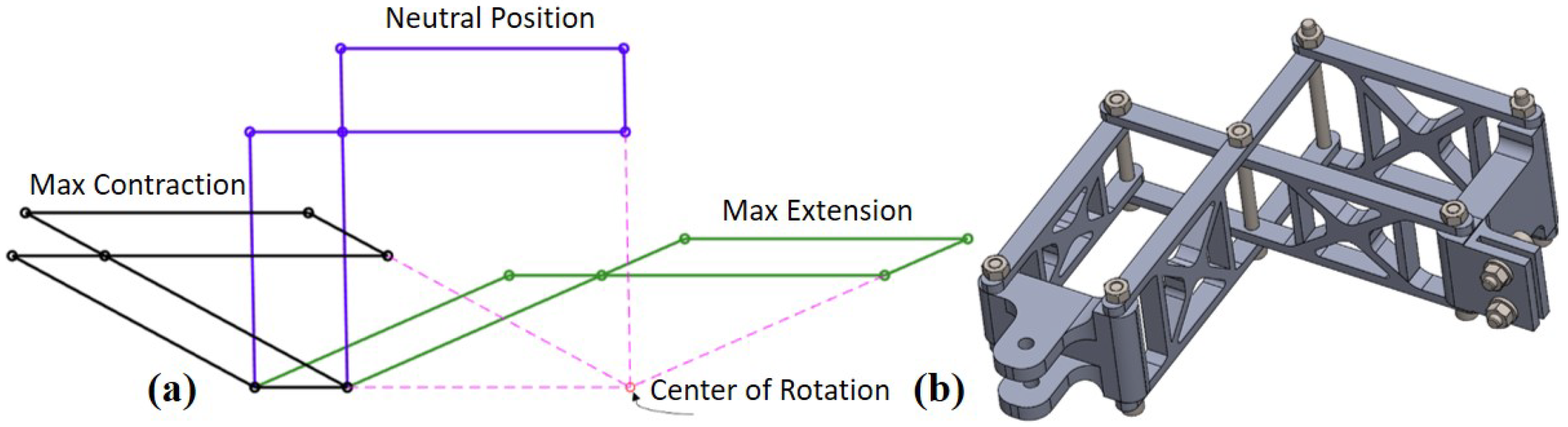
The glenohumeral joint is one of the most mobile joints in the human body and thus, one of the most difficult ones to deal with when developing an exoskeleton for the upper arm [60]. The shoulder complex consists of three articulations, the glenohumeral, acromioclavicular, and scapulothoracic joints, that together drive upper-extremity movement. We chose to simplify this biomechanics representation by approximating the shoulder as a ball-and-socket joint with three degrees of freedom: abduction/adduction, flexion/extension, and internal/external rotations. In many rigid exoskeleton designs, these degrees of freedom are achieved through a series of revolute joints [61,62]. These designs, however, tend to be more complex and bulkier than desirable. Christensen et al. [27] noted that in many cases, these types of designs are still unable to achieve the full range of motion due to singularities and collision with the user’s body, particularly during shoulder abduction/adduction. Modified versions of the DPL were used in other studies to develop arm rehabilitation exoskeletons. Qian et al. [32] used links with a curved geometry and an additional motor to support actuation of the DPL in a stationary exoskeleton, thus allowing for control of all degrees of freedom of the shoulder joint; Bloom et al. [33] used a modified DPL to allow for adjustments to the position of the remote center of rotation (CR), allowing personalization and reducing joint misalignment. Overall, a double parallelogram linkage (DPL) offers great potential due to its remote CR, which, when properly aligned, remains at a fixed location regardless of its position (see Figure 2a), reducing the DPL and the wearer’s shoulder joint from misaligned and contact during movements while enabling a large anatomical workspace coverage. Therefore, a DPL was incorporated in the design of the ASFD, as demonstrated in Figure 2a,b, to distally place the actuator, while enabling a wide fit and large workspace for its users.

2.3. Hardware and Fabrication

The ASFD was constructed around an ALICE rucksack chosen for its lightweight and rigid design. To induce arm swing, there were two major steps of power amplification and power transmission to be dealt with. We used a 260 W EC90 brushless motor (Maxon Precision Motors, Inc., Taunton, MA, USA) capable of generating 1.02 N·m nominal torque paired with a EPOS4 70/15 motor controller (Maxon Precision Motors, Inc., Taunton, MA, USA) as the actuator. The control system was written in C++17 and was executed on an HP laptop computer (HP Inc., Palo Alto, CA, USA) (Intel Core i5-8250U at 1.60–1.80 GHz) utilizing a Linux operating system (Ubuntu 22.04 LTS; Canonical Ltd., London, UK). This controller was chosen due to its ability to operate in both current (torque) and position modes, allowing enhanced flexibility in control software development.
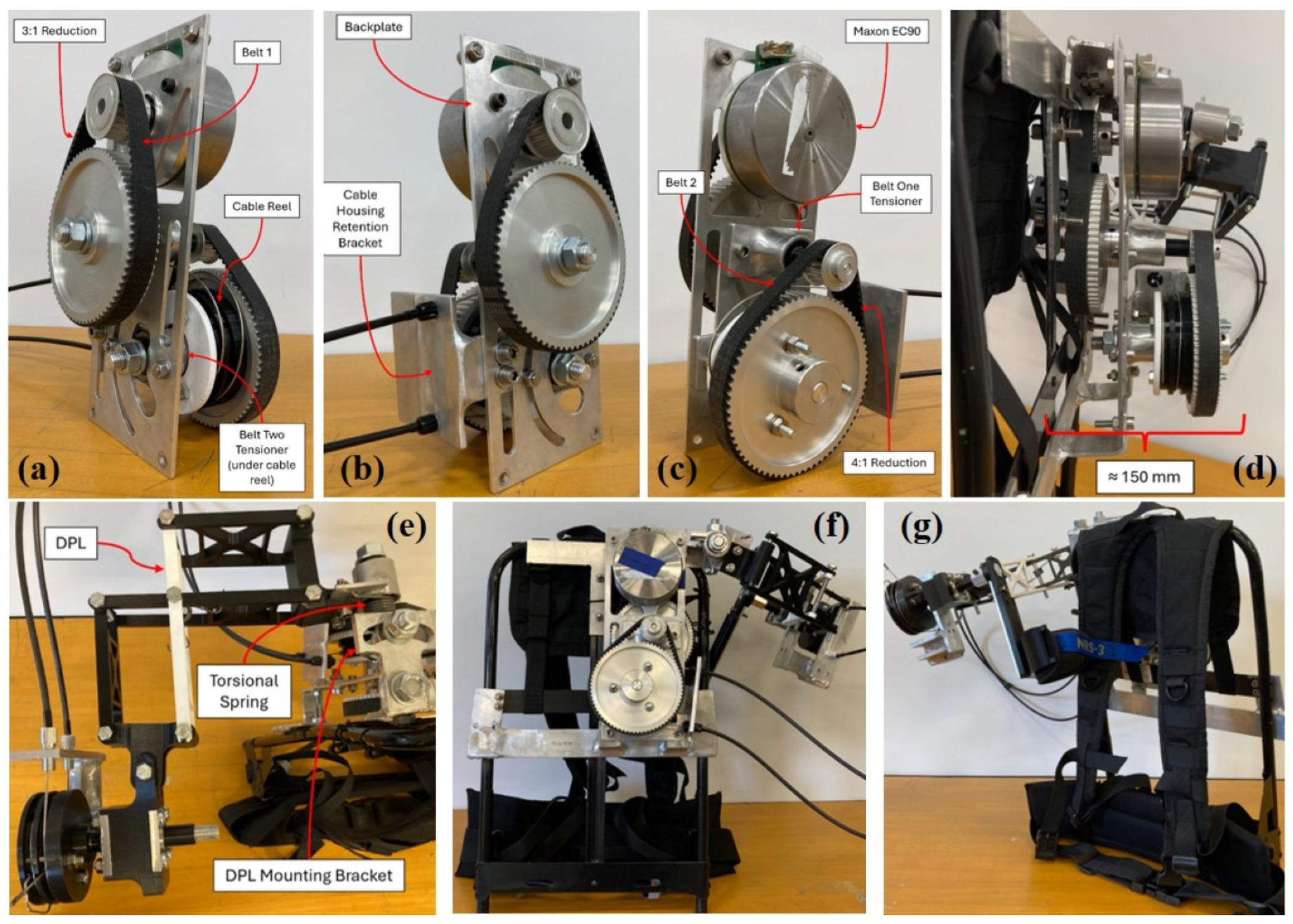
Two important design considerations for the power amplification of a drive system are the required output torque of about 12 N·m and the required output speed of the system to allow arm swing at the stride frequency of about 1 Hz. With the nominal torque of the motor being ≈1 N·m, a 1:12 amplification factor was required. To allow for more flexibility in testing, a frequency of 2 Hz and amplitude of 40 were considered as the maximum arm frequency and amplitude, respectively, for the powertrain to support. A 12:1 speed reduction and a 2 Hz frequency of a sinusoidal with 40 amplitude as the arm-swing trajectory’s requirement resulted in a 640 rpm rotation requirement well below the motor’s nominal speed of 1790 rpm. Although a gear train or a capstan transmission could be chosen for the power amplification, we developed a pulley/belt system for this purpose. Gear trains have high strength and a compact size; however, the lack of backdrivability is undesirable for systems interacting with humans. Sanjuan et al. [39] have reported that capstan transmissions are advantageous due to having low friction and minimal, if any, backlash; they suffer from a limited ability to transmit torque, depending on several factors, such as power shaft/cable material and number of times the cable is wound around the power shaft. To achieve the desired torque, we designed and fabricated a two-stage pulley-belt system (Figure 3a–c). We used a toothed belt to prevent belt slip. The pulley-belt systems are quiet, do not require lubrication, and are resistant to stresses associated with sudden load changes, as the belts offer some shock absorption ability. To make the pulley-belt system more compact, we achieved the desired 12:1 reduction in two stages, with 3:1 (Figure 3a) and 4:1 (Figure 3c) reductions in the first and second stages, respectively. Through this design, we could achieve a low-profile assembly for our power actuation system, not protruding more than 150 mm from the frame, as demonstrated in Figure 3d.
For the virtue of the user’s ergonomics, it is crucial to remove unnecessary weights of the actuators from their arms. Therefore, the motor and power amplification pulley/belt system were distally located on the ALICE frame on the user’s back. We then utilized a cable-driven system with the DPL mechanism (Figure 3e) to transfer the motor’s torque to the user’s arm. Distally locating the motor on the user’s back can reduce the mass on the user’s arm and improve the arm mobility [50]. The developed cable-driven system for transferring the torques and power amplification enabled backdrivability and the execution of high-frequency motions. The generated torque was transferred from the torque amplification system to the ASFD’s end effector using a Bowden cable system (Figure 3f). Bowden cables have the advantage of being lightweight, simple to implement, and highly flexible in the placement of all components; however, they increase friction in the drivetrain due to interactions between the cable and the cable housing. This additional friction is dependent mainly on the curvature, pretension, and length of the cable and housing [39].
Although a Bowden cable drive contains more friction than a direct drive system, the amount of friction torque was reported to be small (at 60 mN·m with the cable and housing containing a 270 bend) [63]. The end effector was supported by the DPL to allow the user a larger range of motion. The ASFD was attached to the user’s arm using a padded cuff as shown in Figure 3g. The ASFD features an active joint for controlling flexion/extension movements at the shoulder, with passive joints allowing for abduction/adduction and internal/external rotation. Since shoulder abduction/adduction is not actuated, and to eliminate the additional weight on the arm due to the weight of the DPL and end effector, a torsional spring was incorporated at the DPL mounting bracket on the ALICE rucksack (Figure 3e). The majority of the backplate assembly, including the motor and two-stage pulley-belt system (Figure 3f), was positioned in the middle section of the torso, where the heaviest components should be, and as close as possible to the user’s body to minimize undesired moments about the the medio-lateral axis that could lead to backward falls. The backplate assembly with Bowden cables and housing had a mass of 2.88 kg, while the combined mass of the DPL and end effector (i.e., the link attached to the user’s arm), compensated by the torsional spring, was 1.07 kg.

2.4. Forward Kinematics

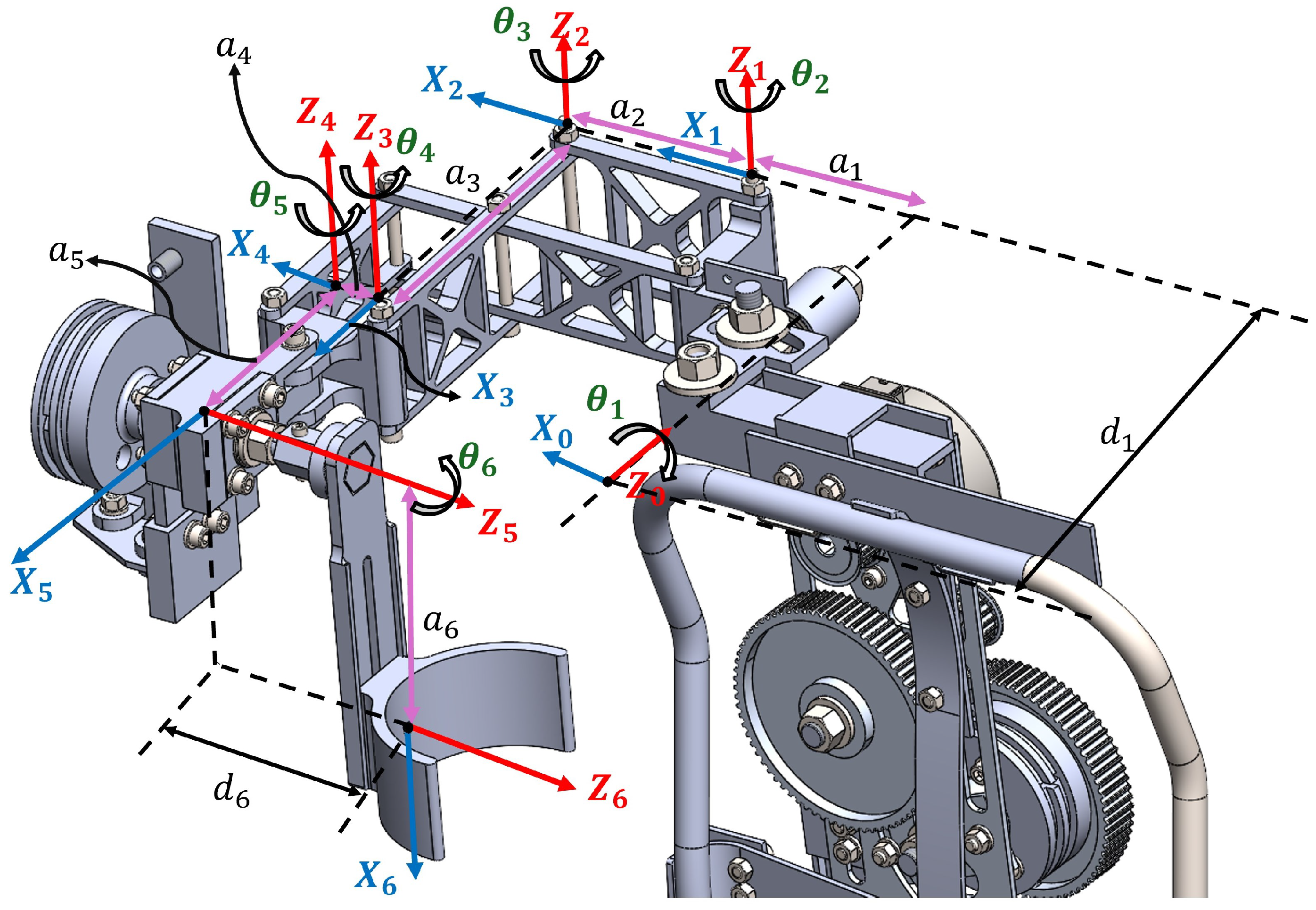
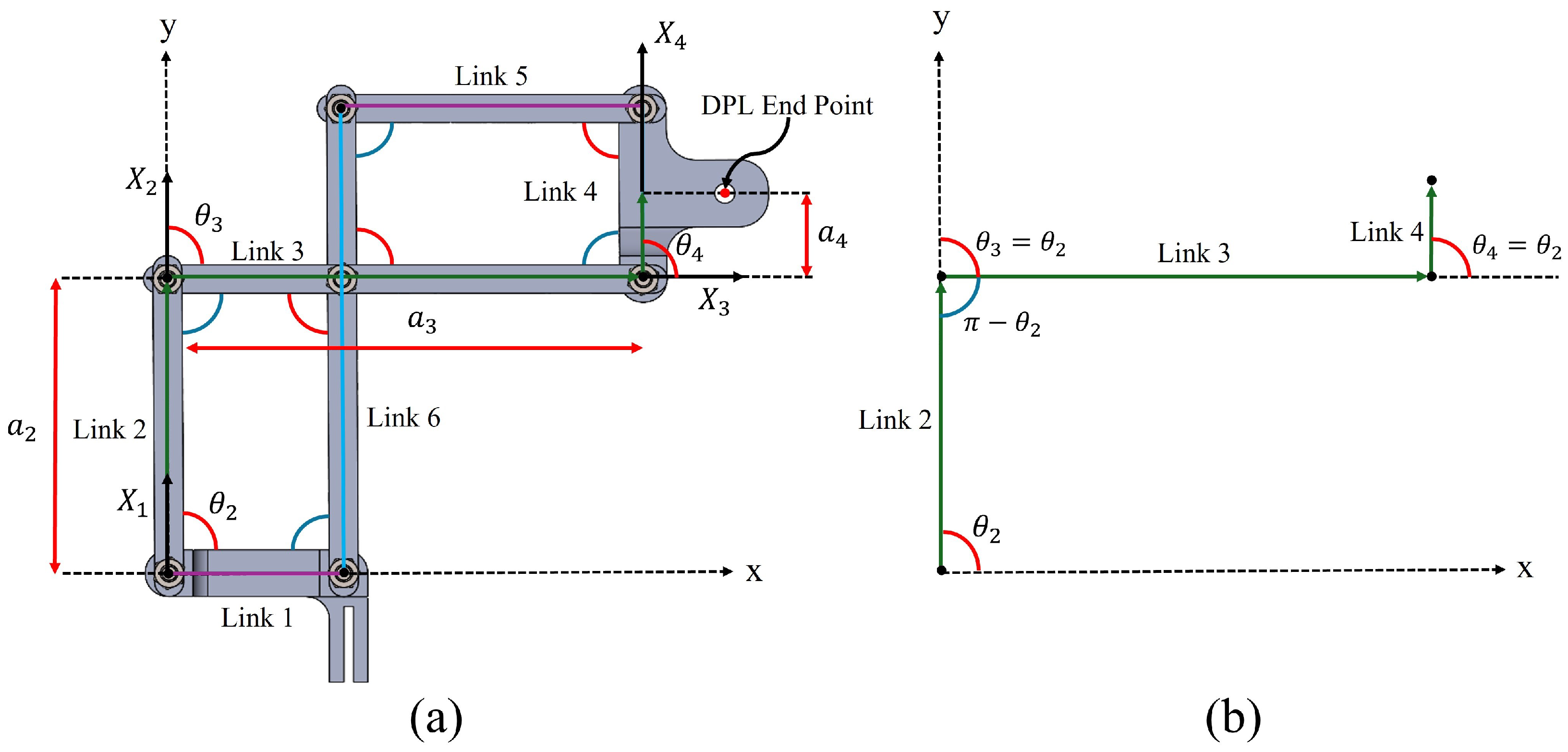
To perform forward kinematics analysis of the ASFD, we utilized Denavit–Hartenberg (DH) [64] coordinate systems and parameters, as shown in Figure 4, to model the ASFD as a serial-link manipulator. Here, the objective was to determine the position of the ASFD’s attachment point (end point) on the user’s arm, enabling workspace analysis of the system and comparison with the user. The end point, O 6 , was defined as a point located in the center of the padded cuff, and the origin, O 0 , was defined as the DPL’s CR. To allow the DH parameterization, the full DPL part of the ASFD, shown in Figure 5a, had to be simplified as demonstrated in Figure 5b. Using the properties of a parallelogram as described below, the position of the DPL endpoint can be described by a four-bar linkage only with 1 DOF (see Figure 5b) given that θ 2 = θ 3 = θ 4 . The approximate functional limits of the ASFD’s joints were determined using SolidWorks 2024 (Dassault Systems, Waltham, MA, USA) and given in Table 3. Using the DH parameters in Table 4, the forward kinematics of the ASFD was derived to find the homogeneous transformation, T 6 0 , that contains the end effector position ( d 6 0 ) and orientation ( R 6 0 ) expressed in the base frame { 0 } .
T i i 1 = R i i 1 d i 1 , i i 1 0 T 1 = cos θ i sin θ i cos α i sin θ i sin α i a i cos θ i sin θ i cos θ i cos α i cos θ i sin α i a i sin θ i 0 sin α i cos α i d i 0 0 0 1
T 6 0 = T 1 0 T 2 1 T 3 2 T 4 3 T 5 4 T 6 5
T 6 0 = R 6 0 d 06 0 0 T 1
where θ i , α i , a i , and d i are the DH parameters of the system, T i i 1 , R i i 1 , and d i 1 , i i 1 are the homogeneous transformation, rotation matrix, and inter-origin vector between two adjacent frames, respectively, and R 6 0 is the rotation matrix from the end effector to the base frame. The formulas in Equations (2)–(4) were used to obtain the workspace and exported to SolidWorks for visualization.

2.5. Workspace Analysis

To evaluate if the ASFD imposed kinematic constraints on the natural movement of the shoulder joint and record the shoulder’s range of motion (ROM) in each DOF, a male participant, who signed a consent form approved by the University of Maine’s IRB, completed several movements while wearing the ASFD. An inertial measurement unit (IMU) was attached to the participant’s arms using double-sided tape to record his arm movements. During all movements, the ASFD was unpowered, and the backdrivability of the system allowed the participant to perform the requested movements. The IMU’s recordings were compared to the ones obtained while performing the same movement without wearing the ASFD (i.e., the anatomical limits of each motion). The following three movements were completed: (1) To test the shoulder flexion/extension, the participant was asked to move his arm away from a neutral position with his arms on the side to behind their bodies (extension) and front of their bodies (flexion), as far as he could comfortably do, (2) To test the shoulder abduction, the participant was asked to raise his arm connected to the ASFD from the neutral position upward from the side of their body as high as they could comfortably do (i.e., performing the T-pose), and (3) To test the shoulder internal/external rotation, the participant was asked to perform a reaching task, in which they moved his forearm across his body to the opposite side (i.e., internal rotation) and moved his forearm away toward the same side (i.e., external rotation). Additionally, five male participants (age = 30 ± 7 years, weight = 90 ± 22 kg, height = 1.80 ± 0.07 m), who signed a consent, performed similar activities; however, their arm movements were not recorded by an IMU.

2.6. Static and Dynamic Load Testing

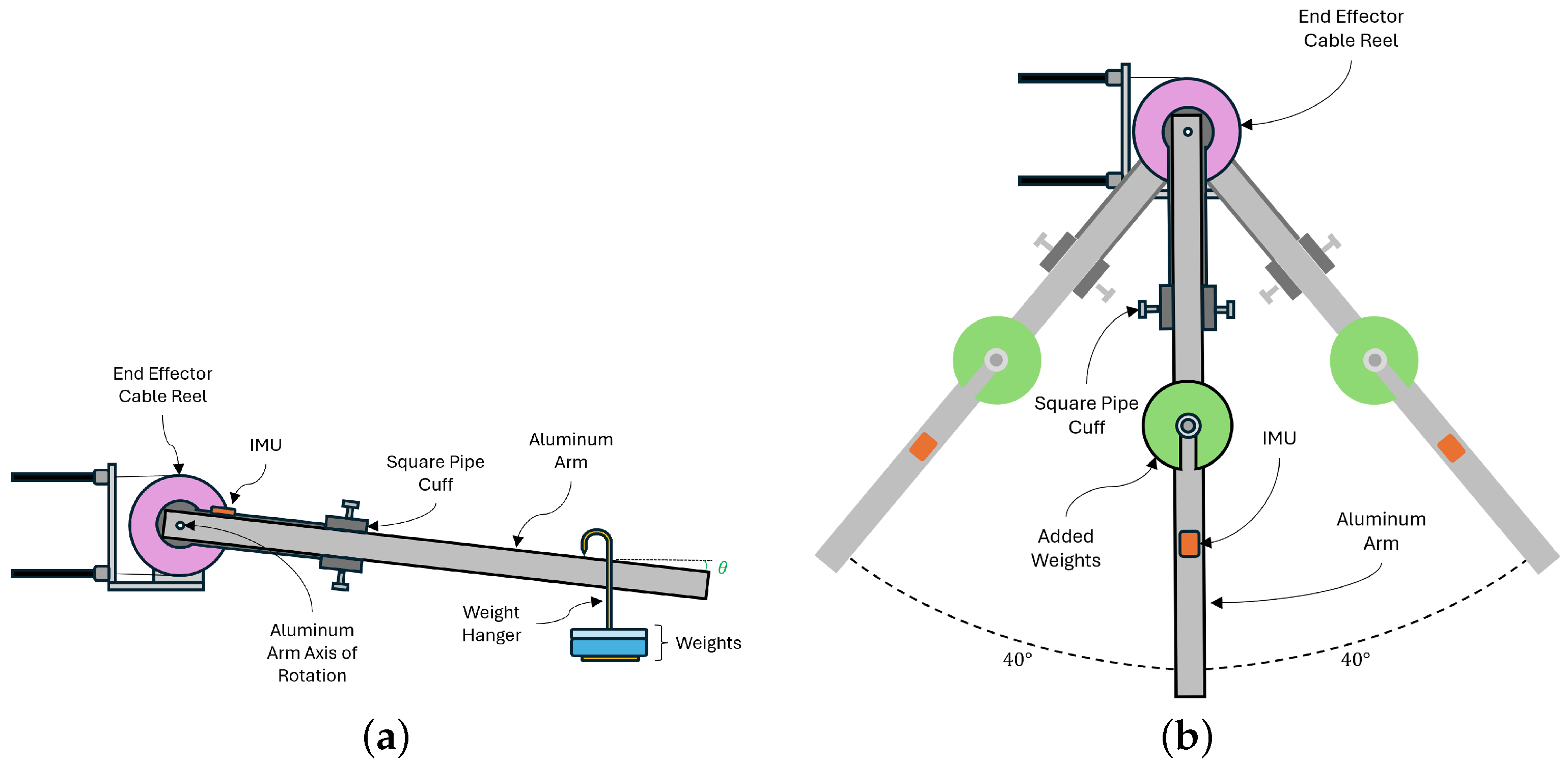
Static load testing was conducted to determine the maximum amount of applied torque the ASFD could tolerate before system failure. System failure was defined as one or more of the following conditions of (1) belt/drivetrain slippage, (2) EPOS4 controller fail state due to over-voltage, and (3) EPOS4 controller fail state due to encoder position being outside the acceptable error margin of the target position. A simplified diagram of the static load testing setup is shown in Figure 6a, in which an aluminum test arm was manufactured to represent the human arm, and weights were gradually added to the arm. An IMU was placed on the arm to measure its angle during testing, and all the static tests for each weight were repeated four times.
Dynamic testing was performed to determine the torque capabilities of the ASFD during dynamic operation as well as to evaluate the maximum achievable actuation frequency at the maximum arm swing amplitude of 40 with a given added weight; thus, all tests were completed with this amplitude. Each test consisted of nine full cycles at steady state, with ramp-up and ramp-down movements at the beginning and end of the trial to ensure consistent and reproducible measurements. Weights were added to the aluminum arm with a bolt passing through the arm’s center of mass. A simplified diagram of the dynamic test setup is shown in Figure 6b. Table 5 shows the attained frequencies at each tested weight, in which the highest frequency (i.e., trial 3) decreased from 1.5 Hz to 1.1 Hz as the weight increased.

2.7. Human Subject Experiment

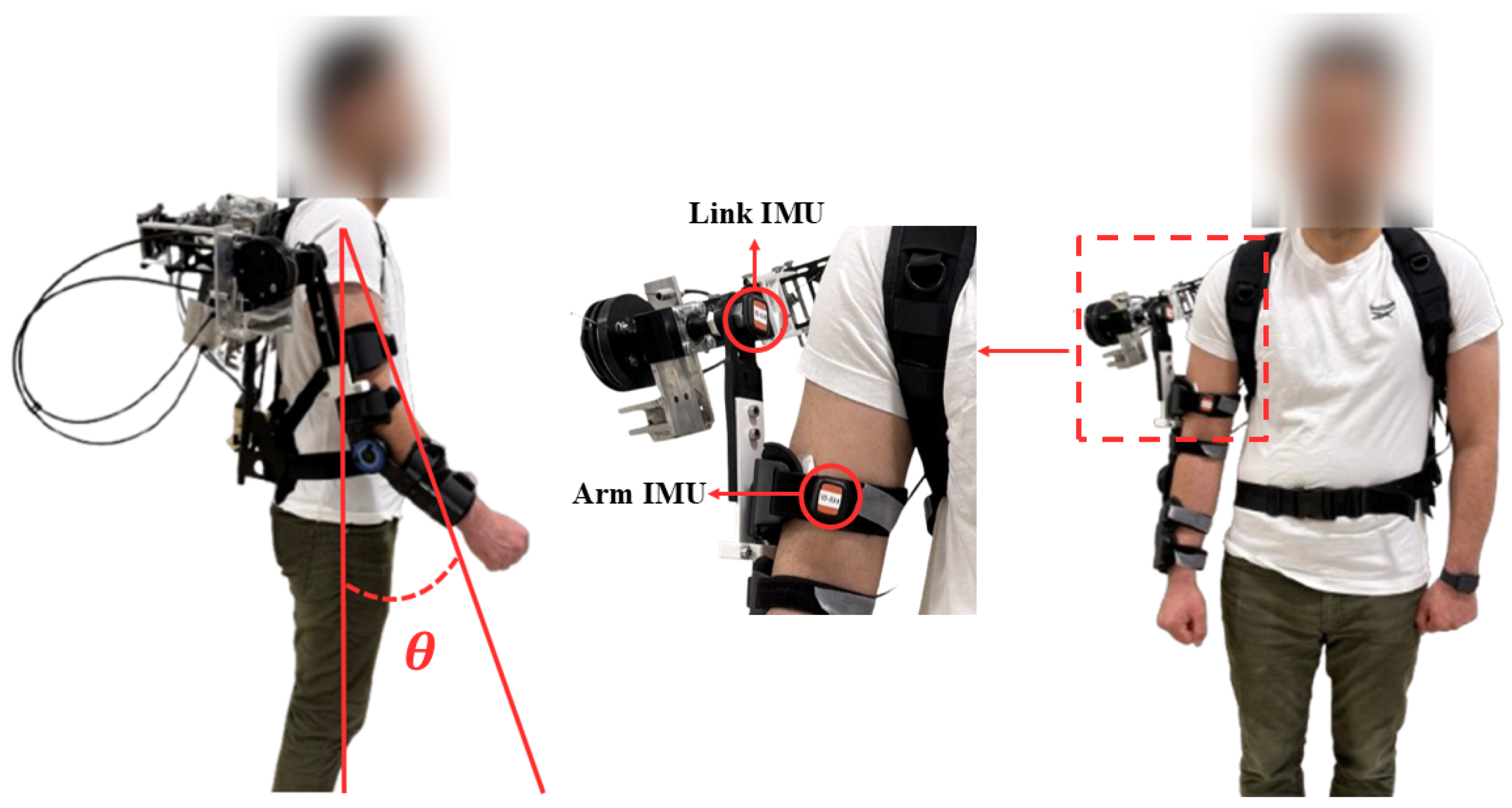
This experiment was approved by the University of Maine Institutional Review Board (IRB) for the 2024-25 academic year. Prior to participation, all participants signed the IRB consent form, ensuring they understood the study’s purpose, procedures, and any potential risks involved. In this study, we recruited five male participants (age = 30 ± 7 years, weight = 90 ± 22 kg, height = 180 ± 7 cm), who tested the system over the course of several weeks. These participants represent potential users who require high torque generation. Participants were selected based on their ability to provide informed consent and their general health status, ensuring they were fit for the physical demands of the experiment. To test the capability of the system to induce arm swing, we performed a human subject experiment using the same five healthy male participants mentioned earlier. Before the experiment, all the participants signed the consent form. Participants were selected to represent larger individuals with greater assistive torque demands, thereby enabling an evaluation of the ASFD’s capability to deliver adequate torque and motion. The participants were instructed to stand with their arms passively on their sides while wearing the device on their backs. Two IMUs were placed on the user’s arm, and the ASFD’s last link was connected to the arm as shown in Figure 7. The IMU data were wirelessly transmitted to a smartphone using the application developed [65] for data collection and storage. This setup allowed us to independently assess the ASFD and arm motions and detect discrepancies caused by backlash or asynchrony.
The testing protocol started at a frequency of 0.8 Hz , increased to 1.0 Hz , and then went back to 1.2 Hz . After reaching the maximum frequency, we decreased the frequency back to 1.0 Hz and finally returned to 0.8 Hz . Throughout these trials, participants were asked to provide feedback on their comfort level and whether they perceived the experience during the frequency changes. This experimental design aimed to observe how participants reacted to alterations in frequency and to identify which frequency provided the most comfortable transition for them. To evaluate the torque generated by the ASFD to induce arm swing, we employed two methods of inverse dynamics to calculate the shoulder torque: one using arm motion and the other using the DC motor’s torque, measured by its current. To calculate the shoulder torque using inverse dynamics, the arm was considered as a 1-DOF pendulum with a length of L, rotating about the glenohumeral joint in the sagittal plane, and the estimated shoulder torque, τ s h , was found using
τ s h = I s h α + m a r m g l C O M sin θ ,
where m is each user’s upper limbs total mass, g is the gravity constant, l C O M is the distance from the shoulder joint center to the limb’s center of mass (COM), I s h is the moment of inertia about the shoulder center of rotation, θ is the arm angle in the sagittal plane, recorded by an arm-worn IMU, and α is the angular acceleration. Segment properties such as mass, length, and inertia were derived from the measured body mass and stature of the participants using the established anthropometric ratios [66,67]. A discrete two-state Kalman filter was applied to the state vector [ θ , θ ˙ ] T to calculate angular acceleration α , while attenuating sensor noise and drift. Additionally, the torque generated by the DC motor was calculated from the measured motor current by
τ ASFD ( t ) = N K t i 1000 ,
where τ A S F D is the system’s generated torque, N = 12 is the gear ratio, K t = 80.7 mNm / A is the motor torque constant, and i is the motor current in amperes.
To evaluate short-term comfort and potential muscle fatigue during ASFD use, we conducted an electromyography-based (EMG-based) fatigue assessment following the procedures described by Hong et al. [68]. The same five participants wore the ASFD while muscle activity was recorded using a Noraxon Ultium wireless EMG system (Noraxon USA, Inc., Scottsdale, AZ, USA), a research-grade platform that offers high-fidelity signal acquisition, validated signal quality, and built-in fatigue analysis tools (e.g., median frequency and power spectral density). Nine electrodes were placed on key postural and shoulder muscles, including the upper and lower trapezius, rectus abdominis, and the anterior, middle, and posterior deltoid muscles of the right arm wearing the ASFD [68,69,70]. These placements allowed us to monitor trunk-stabilizing muscle activity as well as shoulder musculature engaged during arm-swing assistance. EMG signals were processed and analyzed using Noraxon’s integrated fatigue analysis tools.

3. Results

3.1. Power Generation Efficiency

To evaluate the transmission performance of the ASFD, we measured the angular velocities of the DC motor shaft, the stage 1 output shaft, and the stage 2 output shaft using three Movella DOT (Xsens) IMUs. All sensors were sampled synchronously at 120 Hz, and 30 s of steady-state motions were recorded at each tested frequency (i.e., 0.8 Hz, 1.0 Hz, and 1.2 Hz). The angular velocities were extracted from the IMUs’ Z-axis, which was aligned with the respective transmission rotation axes. Transmission efficiency, η at each stage, was computed from the measured angular velocities and the known reduction ratio. For each stage, the estimated reduction ratio was obtained from the input and output angular velocities, and the efficiency was calculated using
N 1 = ω m o t o r ω s t a g e 1 , η 1 = 3.0 N 1 × 100 %
N 2 = ω s t a g e 1 ω s t a g e 2 , η 2 = 4.0 N 2 × 100 %
N t o t a l = N 1 × N 2 = ω m o t o r ω s t a g e 2 , η t o t a l = η 1 × η 2 = 12.0 N t o t a l × 100 %
where ω m o t o r , ω s t a g e 1 , and ω s t a g e 2 are the DC motor, stage 1, and stage 2 angular velocities, respectively; N 1 , N 2 , and N t o t a l are the evaluated reductions in stage 1, stage 2, and the total reduction, respectively; and η 1 , η 2 , and η t o t a l are the corresponding efficiencies. The mechanical power loss in each stage and in total was calculated as 100 % η . The results in Table 6 show that stage 1 efficiency ranged from 90.3–94.4%, stage 2 efficiency ranged from 91.8–95.4%, and the total efficiency increased from 82.9 % at 0.8 Hz to 90.1 % at 1.2 Hz. The total mechanical loss decreased from 17.1 % to 9.9 % , indicating a reduced slip and improved belt engagement at higher speeds.

3.2. Workspace

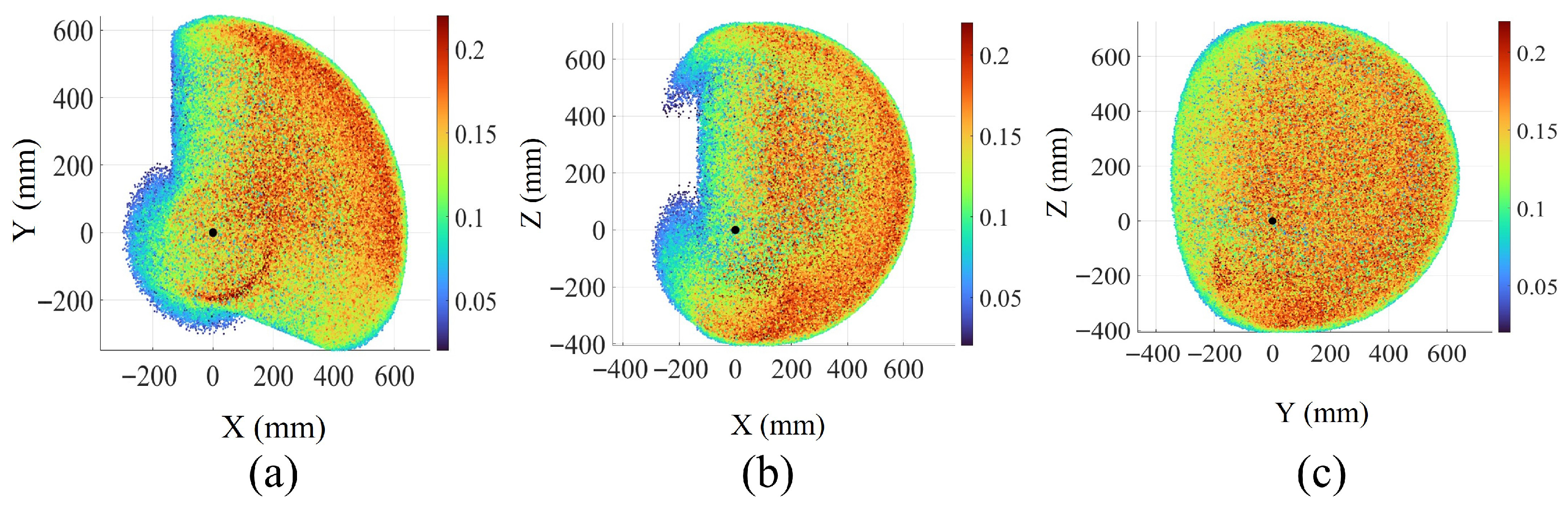
Using forward kinematic analysis, the workspace of the mechanism on three major anatomical planes (transverse, sagittal, and coronal planes) is shown in Figure 8, in which the axes belong to frame 0 set at the DPL’s CR coinciding with the shoulder joint. In addition to numerical investigation, the results of exploring the joint limits of the ASFD and its comparison with anatomical limits through the human subject experiment are shown in Table 7. As shown in Table 7, the flexion/extension and abduction/adduction movement limits of the participant wearing the ASFD closely match the full anatomical range of those movements, overlapping by 86.5 % and 72.2 % , respectively. However, the internal/external rotation limits only overlapped up to 50.5 % of the full anatomical range. Figure 9 shows three participants trying different arm movements, while wearing the ASFD, to demonstrate the absence of kinematic constraints on the user’s natural arm movements as well as the backdrivability of the system.

3.3. Static and Dynamic Load Testing

Using the added weights and considering the mass of the aluminum arm, the torque produced by the ASFD at its end effector during static load testing was calculated. Figure 10a shows the generated torque for the tested masses during several experimental trials with a maximum measured output torque of 15.09 N·m. The obtained results indicate the repeatability of the torque generation and linear behavior of the actuation system in response to increased mass. The primary objective of the dynamic load test was to evaluate the system’s response under varying loads and analyze the resulting torque. By incrementally adding different masses, we aimed to observe how the system would behave under increasing loads and assess its mechanical performance before testing with human subjects. We tested six different masses across three distinct frequencies to investigate the interaction between load magnitude and oscillation frequency. This approach enabled us to determine how changes in mass influenced system performance at different operating frequencies, ensuring that the system could handle varying loads efficiently before testing with human participants. Table 8 presents the total tested masses (starting with no added mass other than the aluminum arm’s original weight in the first experiment and increasing to a total mass of 3.41 kg in the final experiment) and frequencies tested for each mass during the dynamic load testing. Three frequencies for each mass ranged from the lowest frequency of 0.5 Hz to the maximum attainable frequency under that mass, where the maximum frequency decreased as the mass increased.
Additionally, Figure 10b shows the maximum generated torque for different frequencies as the mass increases. The plot shows increases in the torque proportional to the mass and frequency. The combined effect of increasing both the frequency and mass results in the most significant torque values. Although the frequency of 1.5 Hz was the desired even for the heavier masses, only the frequency of 1.1 Hz was attainable, indicating the bandwidth of the system under a full load scenario. It should be noted that 1.1 Hz was still the upper bound of the walking frequency range of 0.8 Hz–1.1 Hz observed during walking, as mentioned earlier. Overall, the maximum torque across all the tested conditions was 10.74 N·m for 3.41 kg at 1.1 Hz.

3.4. Human Subject Experiment

Several safety mechanisms through the software and in the form of a handheld dead man’s switch were implemented to ensure the participants could safely perform the experiments. The target amplitude of the arm swing trajectory was set at 10 to generate the ROM of 20 . The frequency range was selected based on the stride frequency and the results of the dynamic load testing, which resulted in three frequencies of 0.8 Hz, 1 Hz, and 1.2 Hz. To investigate the system performance during transitions in frequency, the frequency of the applied trajectory was gradually increased from 0.8 Hz to 1.2 Hz and vice versa. We used a stepwise up-and-down pattern in which the frequencies were repeated during the experiment, and the entire protocol was performed three times. Figure 11a shows a representative example of the arm-swing trajectory directly measured from a participant’s arm and the ASFD’s link. The results show that the arm closely followed the motion of the link, demonstrating minimum backlash or play between the user’s arm and the arm cuff and link. The power spectral density of the trajectories using fast Fourier transform (FFT) for all the participants is shown in Figure 11b. The power spectrum clearly shows the close match between the commanded and attained frequencies. The best agreement between frequencies occurred at 1 Hz, which is the typical stride frequency.
Statistical analyses were conducted using SPSS v29 (SPSS Inc., Chicago, IL, USA). Repeated measures mixed-model ANOVAs with a significance level of α = 0.05 were used to analyze the arm ROM and torque values as the dependent variables. For both analyses, the frequency condition (i.e., 0.8 Hz, 1.0 Hz, and 1.2 Hz) was the within-subjects factor, while the between-subjects factor was the location of the IMU (Arm and Link) for Arm ROM and the torque calculation (ASFD and shoulder) for the torque. We also considered the interaction effect of the two factors in our analyses. Mauchly’s test was used to assess the sphericity assumption, and if violated, the Greenhouse–Geisser correction was applied. Post-hoc analysis with Bonferroni correction was performed to identify pairs of conditions with statistically significant differences.
The statistical results for torque showed that frequency was a significant main effect ( F ( 1.15 , 9.26 ) = 43.24 , p < 0.001 , η 2 = 0.84 ). We found a significant difference between the ASFD and Shoulder torques as the between-subject factor ( F ( 1 , 8 ) = 18.19 , p = 0.003 , η 2 = 0.69 ). The interaction was also significant ( F ( 1.15 , 9.26 ) = 60.37 , p < 0.001 , η 2 = 0.88 ). A more detailed analysis showed that τ A S F D was significantly greater than τ s h at the first frequency (0.8 Hz, p < 0.001 ) and second frequency (1.0 Hz, p = 0.003 ), while no significant difference was found at the third frequency (1.2 Hz, p = 0.318 ).Additionally, τ s h increased with frequency, as shown in Figure 12a, showing significant differences across all frequency pairs, with the highest peak torque at 1.2 Hz remaining below 10 N·m. In contrast, τ A S F D did not significantly vary across frequencies. The statistical results showed that ROM significantly changed with frequency conditions ( F ( 2 , 16 ) = 69.640 , p < 0.001 , η 2 = 0.897 ). The arm swing and link ROMs increased by frequency, as shown in Figure 12b. There was no significant difference between the Arm and Link ROMs ( F ( 1 , 8 ) = 4.032 , p = 0.080 , η 2 = 0.335 ) and the interaction. Post-hoc analysis showed significant differences across all frequency pairs.
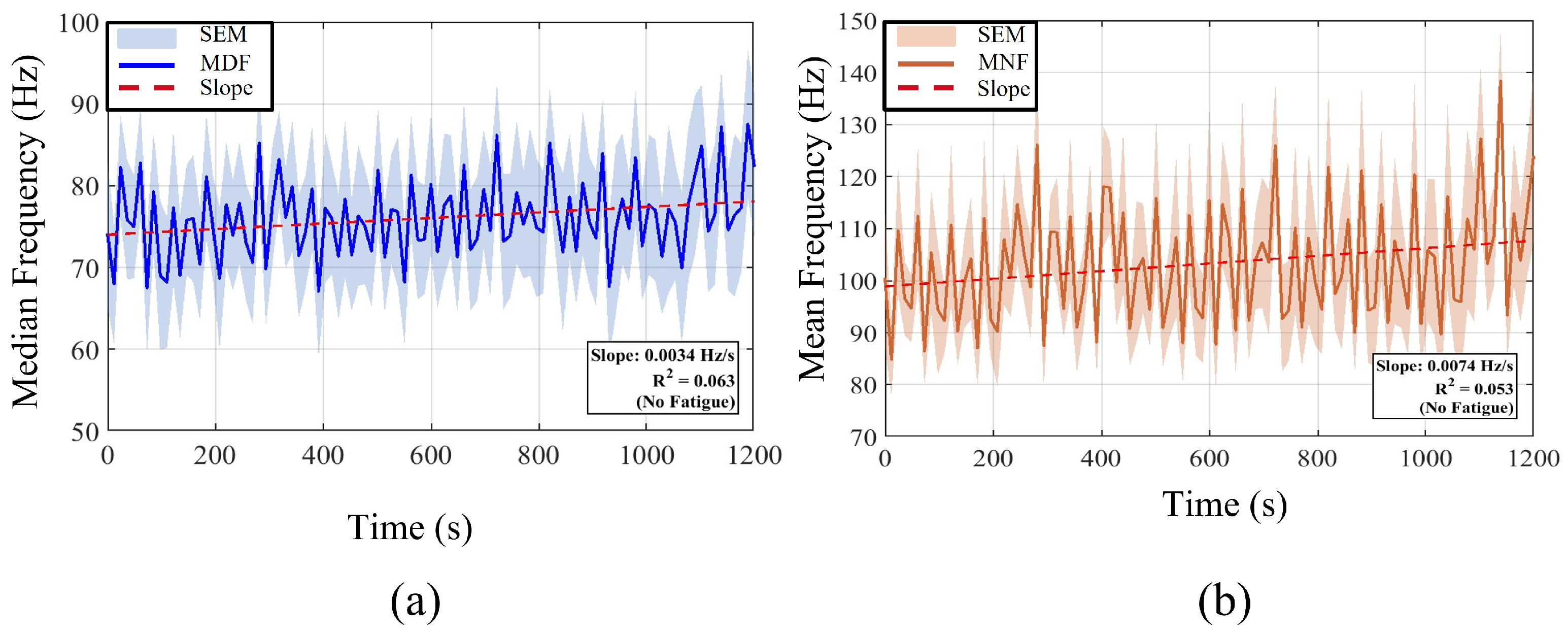
The participants wore the ASFD continuously for 20 min, consistent with prior work showing that load-induced muscle fatigue typically emerges within the first 15–20 min of use [70]. Muscle fatigue was assessed using frequency-domain EMG metrics, specifically the median frequency (MDF) and mean frequency (MNF) of the EMG power spectrum. Figure 13 shows the time evolution of the MDF and MNF averaged across five participants, with shaded regions indicating the standard error of the mean (SEM). Linear regression analysis revealed that both MDF and MNF exhibited near-zero slopes of 0.0074 Hz/s and 0.0034 Hz/s for the MDF and MNF, respectively over time, with low coefficients of determination, indicating no systematic frequency shift during device use.

4. Discussion

In this paper, we present a feasibility and performance evaluation conducted with healthy adults as a critical step toward developing a wearable system that integrates arm swing into gait rehabilitation. Our multi-stage development approach aligns with prior work on wearable and assistive devices that introduce novel concepts, where the primary objective is to establish a clear understanding of system function and limitations while avoiding potential confounding factors associated with recruiting clinical populations at an early stage. For example, Khodadadi et al. [72] evaluated a sensorized rollator using a single healthy participant in their preliminary study, and Noghani et al. [73] assessed a novel walking-assistive device with five healthy participants. Similarly, Lee et al. [34] tested their upper-limb exoskeleton on five healthy adults despite targeting individuals with neuromotor impairments. The current prototype was designed to test the feasibility of inducing arm swing before investing in a full-scale system. Transitioning to a bilateral configuration or adjusting the weight distribution of the unilateral design is relatively straightforward and planned for future development. In contrast, the current prototype allowed us to validate the concept while minimizing initial resources. As shown in Figure 3f, the prototype was specifically designed to accommodate an additional actuator for the left arm, which would naturally balance the load.

4.1. Efficiency Analysis

The improvement in efficiency with increasing frequency is consistent with the velocity-dependent friction behavior observed in belt drive systems, where higher relative velocities result in increased friction coefficients and reduced slip losses [74]. Bowden cable friction arises from the sliding interaction between the inner cable and the outer sheath, and prior studies have shown that transmission efficiency decreases with increasing bending angle, often modeled using the capstan relationship [75,76]. However, when routing avoids sharp curvature and abrupt direction changes, Bowden systems typically exhibit low effective friction coefficients (≈0.1–0.2) and maintain high transmission efficiency [76,77,78]. Reported force-transmission efficiencies of 78–95% in cable-driven wearable devices further indicate that Bowden friction is not generally the dominant factor limiting the actuator performance [38,76,78]. In this work, rather than isolating individual loss mechanisms, we quantified the overall transmission efficiency of the two-stage pulley-belt system using experimentally measured angular velocities of the motor and output shafts. This system-level approach follows established practices in wearable robotics, where aggregate transmission behavior is typically more informative than decomposing internal friction sources.

4.2. Workspace

The ASFD was evaluated to determine whether wearing the system significantly reduced the range of motion of the user’s arm and shoulder joint compared to their natural movements within anatomical limits. The passive degrees of freedoms are important for ergonomics to avoid any kinematic constraints on the users’ arms during arm swing assistance when the device is active as well as during natural arm movements within a break, while the system is not in use and the user needs to perform ordinary tasks such as reaching for a water bottle or scratching their nose without needing to take off the system. Although having 90 freedom in abduction and flexionise redundant for solely inducing arm swing, from an ergonomic standpoint, such freedoms combination are critical to enable tasks such as reaching when needed and to allow wearing and fitting the system without causing user discomfort and breaking the system. For example, during donning and fitting of the device, the user needs to abduct their arms while wearing the device to allow for adjusting the backpack’s straps. Given that flexion movement is a critical part of arm swing and reported benefits of excessive arm swing for gait training [79,80,81], allowing an extra range of motion in this direction enables the device to induce exaggerated arm swing, which involves large flexion movements.
For shoulder abduction/adduction and flexion/extension, the subject remained mostly unrestricted, with measured ranges of motion while wearing the ASFD overlapped 86.5 % and up to 72.2 % with anatomical workspace, respectively. For the shoulder external rotation, the participants were more restricted, achieving only 26.7 % of the anatomical workspace. The shoulder internal rotation achieved up to 80.3 % of the anatomical workspace. The large range of motion with the ASFD allowed for sufficient shoulder abduction/adduction and flexion/extension, allowing for the arm’s natural movements during walking, necessary for our intended application. Although the external rotation of the shoulder was limited, it was still acceptable for the ASFD’s purpose based on the observations during human subject testing. Overall, the ASFD allowed the wearer’s arm to reach out across the body without restricting reasonable motion. The end-effector workspace analysis using the forward kinematic model in Figure 8 demonstrated significant spatial coverage of the ASFD in the three planes of motion.
Additionally, the passive degrees of freedom provided by the backpack rotary joint, the DPL, and the joint connecting the DPL to the pulley link help position the active rotation axis as close as possible to the shoulder joint, thereby reducing misalignment during natural arm motions. These passive joints accommodate arm abduction, flexion, and internal/external rotation, minimizing kinematic constraints in a manner consistent with prior work by Christensen et al. [27]. Although misalignment cannot be fully eliminated, our workspace analysis and human-subject testing demonstrated that the design successfully avoided discomfort and kinematic lock during arm swing induction.

4.3. Static and Dynamic Load Testing

Static load testing revealed a linear trend between the generated torque from the motor and the added weight, achieving a goodness of fit quantified by the coefficient of determination of R 2 = 0.99 . The maximum achieved static torque was 15.09 N·m, exceeding the target 12 N·m. This result is consistent with the design objective of 12 N·m. The deflection of the aluminum arm from its starting position of approximately 90 increased with the added weight; however, it did not reach a point to cause failure of the system based on the four criteria discussed earlier. This deflection was mostly due to the flex in the Bowden cable retention bracket at the end effector (the leftmost right-angle bracket in Figure 6a), which held the cable tension adjusters, and not the ASFD structure.
Dynamic testing was conducted to evaluate the torque generation of the ASFD across different motion frequencies as a prior step to human subject testing. Also, dynamic testing allowed us to objectively test the system by eliminating the potential torque contribution of the wearer during arm movement. With a 40 amplitude, the maximum generated trajectory at 1.1 Hz was 10.74 N·m, slightly below our 12 N·m. Although the motor was capable of generating more torque, the main constraining factor stemmed from the drivetrain’s inability to change direction at higher frequencies with the added weight. At a very low frequency of 0.5 Hz, a lag was observed between the actuation of the drivetrain and the aluminum arm movement, possibly due to the friction in the power system. The backplate cable bracket, as shown in Figure 3b, began to show flexion at a higher frequency than 1.1 Hz when the added mass exceeded 4 kg. Given the average arm swing frequency is about 0.9–1 Hz, the system was capable of providing about 8 N·m to move the aluminum arm mimicking an actual arm swing. We expect the prototype’s performance to remain stable over time due to the robust design of the two-stage pulley–belt actuation module, and the 3D-printed DPL components can be easily reprinted or replaced if necessary. As this is a feasibility prototype, future iterations will prioritize long-term durability and performance over repeated use across the actuator’s lifespan.

4.4. Human Subject Experiment

The human subject study demonstrated that the ASFD could successfully induce arm swing among the participants in the most demanding scenario, where their arms were completely passive on their sides, and the device had to move their arms entirely. Since this study served as an initial feasibility evaluation of the ASFD, we intentionally recruited a small group of healthy participants to verify safe operation, torque capability, and user–device interaction before further device development and the recruitment of clinical populations. Small sample sizes (approximately 5 participants) are common in early-stage exoskeleton studies that prioritize device validation over broad generalization [34,82,83,84]. Future work will expand the participant cohort and specifically include individuals with diminished arm swing to assess the rehabilitative impact of the ASFD in its intended users.
Because this evaluation was performed during standing with passive arms, ground reaction forces (GRFs) were not included. When the arms hang freely, the primary contributors to shoulder torque are segment inertia, gravity, and the device-generated flexion/extension torque. In this passive configuration, GRFs do not meaningfully affect upper-limb dynamics because passive arm swing behaves like a simple pendulum, as reflected in our torque estimation, rather than being influenced by GRFs transmitted from the lower limbs. Even during walking, prior biomechanical studies have shown that the arms behave largely as passive mass–damping mechanisms driven by trunk motion rather than directly by GRFs [53,85]. Restricting arm swing has also been shown to increase the vertical ground-reaction free moment at the stance foot, indicating that natural arm swing helps attenuate GRF-related torques rather than being powered by them [53,86]. Even if GRFs contribute to arm swing during walking, such contributions would reduce the torque demands on the ASFD. Therefore, the absence of GRFs in our human-subject experiment, seeking to assess the ASFD’s torque generation capability, should not affect the applicability of the results.
The agreement between the target and attained frequencies, as shown by the arm trajectories (Figure 11a) and power spectral analysis (Figure 11b), provides support for the operation of the system. The similarity of the arm and link trajectories (see Figure 11a) and their ROMs (Figure 12b), which is confirmed by the lack of a statistically significant difference, indicates there was no play between the arm and link. The system could generate about 10 N·m, similar to the torque during dynamic testing, at the higher frequency of 1.2 Hz compared to the dynamic load testing. Individuals with neurological conditions may walk at very slow speeds with low stride frequency. While the device can initiate arm swing at very low frequencies down to 0.5 Hz, as demonstrated by dynamic testing, these individuals may exhibit minimal or inconsistent arm-swing patterns at such speeds, including atypical 2:1 arm-to-leg coordination [1]. Because these irregular patterns offer limited therapeutic value and typically require improvement, and many people with gait impairments walk at near-normal or only slightly reduced speeds, evaluating the device during the human subject experiment at frequencies near normal walking (0.8–1.2 Hz) provides a more meaningful assessment of its usability.
The main difference was observed in the torque generated by the ASFD and the applied torque at the user’s shoulder joint (based on inverse dynamics calculation), in which there was no statistical difference in the ASFD-generated torque as a function of frequency. The τ A S F D , calculated by the motor’s current and amplification ratio, was significantly higher than τ s h , calculated by inverse dynamics, at 0.8 Hz and 1.0 Hz. At the same time, both torques were similar at the most demanding frequency of 1.2 Hz. This can be due to the friction in the cable and pulley mechanism, requiring more motor torque and current to overcome. Overall, both torques remained under 12 N·m upper bound, while inducing arm swing in the participants. One observation from the human subject experiment was that the full torque required to move an entirely passive arm may not be necessary for inducing arm swing, as users may only need a small portion of the physiological torque to change and adjust their arm swing. Future studies should investigate the application of the ASFD or other wearable devices to provide tangible kinesthetic force feedback to wearers, informing them of the necessary changes and allowing them to adjust accordingly. While this paper aimed to present the concept of inducing arm swing in the most demanding scenario, such a system can be modified to enable more interaction between users and the system, and to exploit the ability of many potential users to adjust their own arm movements. The kinesthetic feedback strategy can lower the torque generation requirement and lead to a lighter and low-profile system.
Fatigue was assessed using median-frequency shifts in the EMG power spectrum. Across all the participants and all monitored muscles, no meaningful decrease in median frequency or compensatory increase in EMG amplitude was observed. Since muscle fatigue is commonly associated with a progressive decrease in MDF and MNF, the absence of a consistent negative trend suggests that no detectable muscle fatigue occurred during the 20-min testing period. These results support the short-term comfort and wearability of the ASFD. Given that the present system is a feasibility-stage prototype, future studies should incorporate longer-duration testing with larger participant cohorts to more fully characterize extended-use fatigue responses.

5. Conclusions

In this paper, an upper-extremity prototype device for inducing arm swing was designed, developed, and evaluated. We presented a systematic design process from the dynamic simulation of arm swing to the development of a wearable upper-extremity device for inducing arm swing. The main goal was to induce cyclic motion at a stride frequency of about 1 Hz via generating sufficient torque, while satisfying ergonomic criteria of a large workspace and locating the actuator and drivetrain on the back to avoid additional weight on the user’s arm. The design for torque generation was performed using a relatively simple double-pendulum model to estimate the necessary shoulder joint torque required to induce arm swing. The design utilized the double parallelogram mechanism and a two-stage pulley-and-belt system to achieve torque amplification and enhanced workspace. This design approach allowed us to place the actuators on the user’s back, reducing the weight and constraints on their arms. Our results indicate the potential of the developed system; however, several areas of improvement should be considered. Future studies should explore reducing the size and simplifying the actuation system to enable kinesthetic force feedback, in which the full range of physiological torque is not needed. Also, the system should be tested while walking to evaluate its function for changing arm swing during gait training.

Author Contributions

A.F.: Human subject testing, Data analysis, Software simulation, Writing—review and editing; L.H.: Device design, Static and dynamic load testing, Data analysis, Writing—original draft; B.H.: Conceptualization, Supervision, Funding acquisition, Writing—review and editing. All authors have read and agreed to the published version of the manuscript.

Funding

This research was funded by the National Science Foundation grant number 2145177.

Institutional Review Board Statement

The study was conducted in accordance with the Declaration of Helsinki, and approved by the Institutional Review Board of the University of Maine (IRB 15 April 2019).

Informed Consent Statement

Informed consent was obtained from all subjects involved in the study. Written informed consent has been obtained from the patient(s) to publish this paper.

Data Availability Statement

Dataset available on request from the authors.

Acknowledgments

The authors of this paper would like to thank Kyle Guerrette for his time and effort in training, assisting, and advising in the fabrication of the ASFD. The authors also gratefully acknowledge Jennifer Longo for providing access to the Noraxon wireless EMG system and for her support in conducting the muscle fatigue analysis.

Conflicts of Interest

The authors declare no conflicts of interest.

Abbreviations

The following abbreviations are used in this manuscript:
ASFDArm Swing Facilitator Device
IMUInertial Measurement Unit
DHDenavit–Hartenberg

Appendix A. Dynamic Model Matrices

For the two-link planar arm model representing the shoulder and elbow joints, the inverse dynamics formulation is expressed as
τ = H ( θ ) θ ¨ + V ( θ , θ ˙ ) + G ( θ ) ,
where θ = [ θ s , θ e ] T is the vector of joint angles for the shoulder ( θ s ) and elbow ( θ e ), τ = [ τ s , τ e ] T is the corresponding joint torque vector, H ( θ ) is the 2 × 2 inertia matrix, V ( θ , θ ˙ ) represents the Coriolis and centripetal torque vector, and G ( θ ) is the gravitational torque vector. The generalized coordinates are the shoulder joint angle, θ s , and elbow joint angle, θ e .
H ( θ ) = I 1 + m 1 a 1 2 4 + I 2 + m 2 a 2 2 4 + m 2 a 1 ( a 1 + a 2 cos θ e ) I 2 + m 2 a 2 2 4 + 1 2 m 2 a 1 a 2 cos θ e I 2 + m 2 a 2 2 4 + 1 2 m 2 a 1 a 2 cos θ e I 2 + m 2 a 2 2 4
V ( θ , θ ˙ ) = m 2 a 1 a 2 sin θ e θ ˙ s θ ˙ e 1 2 m 2 a 1 a 2 sin θ e θ ˙ e 2 1 2 m 2 a 1 a 2 sin θ e θ ˙ s 2
G ( θ ) = 1 2 a 1 m 1 g cos θ s + m 2 g a 1 cos θ s + 1 2 a 2 cos ( θ s + θ e ) 1 2 a 2 m 2 g cos ( θ s + θ e )
The physical and inertial parameters used in the model are listed in Table A1. These values correspond to an average male subject (169 kg, 1.75 m) and are used to represent the upper arm and forearm segments.
Table A1. Model parameters for the two-link arm dynamics.
ParameterDescriptionValue
m 1 Upper arm mass2.1463 kg
m 2 Forearm and hand mass1.6864 kg
I 1 Upper arm inertia0.0220 kg·m2
I 2 Forearm inertia0.0280 kg·m2
a 1 Upper arm length0.3014 m
a 2 Forearm length0.2752 m
gGravitational acceleration9.807 m/s2

References

  1. Hejrati, B.; Chesebrough, S.; Foreman, K.B.; Abbott, J.J.; Merryweather, A.S. Comprehensive quantitative investigation of arm swing during walking at various speed and surface slope conditions. Hum. Mov. Sci. 2016, 49, 104–115. [Google Scholar] [CrossRef]
  2. Bruijn, S.; Meijer, O.; Beek, P.; van Dieën, J.V. The effects of arm swing on human gait stability. J. Exp. Biol. 2010, 213, 3945–3952. [Google Scholar] [CrossRef]
  3. Bloom, J.; Hejrati, B. The effects of forearm movements on human gait during walking with various self-selected speeds. Hum. Mov. Sci. 2021, 79, 102835. [Google Scholar] [CrossRef]
  4. Punt, M.; Bruijn, S.; Wittink, H.; van Dieën, J.V. Effect of arm swing strategy on local dynamic stability of human gait. Gait Posture 2015, 41, 504–509. [Google Scholar] [CrossRef] [PubMed]
  5. Hejrati, B.; Merryweather, A.S.; Abbott, J.J. Generating arm-swing trajectories in real-time using a data-driven model for gait rehabilitation with self-selected speed. IEEE Trans. Neural Syst. Rehabil. Eng. 2017, 26, 115–124. [Google Scholar] [CrossRef] [PubMed]
  6. Khiyara, I.; Sidaway, B.; Hejrati, B. Modulating arm swing via haptic cueing alters interlimb neural coupling in older adults. Front. Physiol. 2025, 16, 1657092. [Google Scholar] [CrossRef] [PubMed]
  7. Weersink, J.B.; de Jong, B.D.; Halliday, D.; Maurits, N. Intermuscular coherence analysis in older adults reveals that gait-related arm swing drives lower limb muscles via subcortical and cortical pathways. J. Physiol. 2021, 599, 2283–2298. [Google Scholar] [CrossRef]
  8. Weersink, J.B.; Jong, B.M.; Maurits, N. Neural coupling between upper and lower limb muscles in Parkinsonian gait. Clin. Neurophysiol. 2021, 134, 65–72. [Google Scholar] [CrossRef]
  9. Khiyara, I.; Sidaway, B.; Hejrati, B. Utilizing Rhythmic Haptic Cueing in Arm Swing Training to Improve Gait Speed Among Older Adults. Ann. Biomed. Eng. 2025, 53, 855–866. [Google Scholar] [CrossRef]
  10. Stephenson, J.L.; De Serres, S.J.; Lamontagne, A. The effect of arm movements on the lower limb during gait after a stroke. Gait Posture 2010, 31, 109–115. [Google Scholar] [CrossRef]
  11. Dietz, V. Quadrupedal coordination of bipedal gait: Implications for movement disorders. J. Neurol. 2011, 258, 1406–1412. [Google Scholar] [CrossRef]
  12. Mainka, S.; Lauermann, M.; Ebersbach, G. Arm swing deviations in patients with Parkinson’s disease at different gait velocities. J. Neural Transm. 2023, 130, 655–661. [Google Scholar] [CrossRef]
  13. Kang, T.W.; Oh, D.W.; Lee, J.h.; Cynn, H.S. Rhythmic arm swing integrated into treadmill training in patients with chronic stroke: A single-subject experimental study. Physiother. Theory Pract. 2018, 34, 613–621. [Google Scholar] [CrossRef]
  14. Kaupp, C.; Pearcey, G.E.P.; Klarner, T.; Sun, Y.; Cullen, H.; Barss, T.S.; Zehr, E. Rhythmic arm cycling training improves walking and neurophysiological integrity in chronic stroke: The arms can give legs a helping hand in rehabilitation. J. Neurophysiol. 2018, 119, 1095–1112. [Google Scholar] [CrossRef] [PubMed]
  15. Zhou, R.; Alvarado, L.; Kim, S.; Chong, S.L.; Mushahwar, V. Modulation of corticospinal input to the legs by arm and leg cycling in people with incomplete spinal cord injury. J. Neurophysiol. 2017, 118, 2507–2519. [Google Scholar] [CrossRef]
  16. Galor, N.; Zeilig, G.; Plotnik, M. A New Measure for Quantifying Four-Limb Coordination of Human Gait Based on Mobility Sensors. Sensors 2024, 24, 6105. [Google Scholar] [CrossRef]
  17. Ford, M.P.; Wagenaar, R.C.; Newell, K.M. Phase manipulation and walking in stroke. J. Neurol. Phys. Ther. 2007, 31, 85–91. [Google Scholar] [CrossRef]
  18. Kao, P.C.; Ferris, D.P. The effect of movement frequency on interlimb coupling during recumbent stepping. Mot. Control 2005, 9, 144–163. [Google Scholar] [CrossRef] [PubMed]
  19. Stephenson, J.L.; Lamontagne, A.; De Serres, S.J. The coordination of upper and lower limb movements during gait in healthy and stroke individuals. Gait Posture 2009, 29, 11–16. [Google Scholar] [CrossRef] [PubMed]
  20. Vega, D.; Arellano, C.J. Using a simple rope-pulley system that mechanically couples the arms, legs, and treadmill reduces the metabolic cost of walking. J. Neuroeng. Rehabil. 2021, 18, 96. [Google Scholar] [CrossRef]
  21. Tester, N.J.; Howland, D.R.; Day, K.V.; Suter, S.P.; Cantrell, A.; Behrman, A.L. Device use, locomotor training and the presence of arm swing during treadmill walking after spinal cord injury. Spinal Cord 2011, 49, 451–456. [Google Scholar] [CrossRef]
  22. Noghani, M.A.; Hossain, M.T.; Hejrati, B. Modulation of arm swing frequency and gait using rhythmic tactile feedback. IEEE Trans. Neural Syst. Rehabil. Eng. 2023, 31, 1542–1553. [Google Scholar] [CrossRef]
  23. Thompson, E.; Agada, P.; Wright, W.G.; Reimann, H.; Jeka, J. Spatiotemporal gait changes with use of an arm swing cueing device in people with Parkinson’s disease. Gait Posture 2017, 58, 46–51. [Google Scholar] [CrossRef] [PubMed]
  24. Lee, H.; Eizad, A.; Kim, Y.; Park, Y.; Oh, M.K.; Yoon, J. Use of vibrotactile bracelets to study effects of arm swing variation on overground gait. IEEE Access 2021, 9, 90896–90907. [Google Scholar] [CrossRef]
  25. Alizadeh Noghani, M.; Sharafian, M.E.; Sidaway, B.; Hejrati, B. Increasing thigh extension with haptic feedback affects leg coordination in young and older adult walkers. J. Biomech. 2025, 181, 112525. [Google Scholar] [CrossRef]
  26. Sharafian, M.E.; Ellis, C.; Sidaway, B.; Hayes, M.; Hejrati, B. The Effects of Real-Time Haptic Feedback on Gait and Cognitive Load in Older Adults. IEEE Trans. Neural Syst. Rehabil. Eng. 2025, 33, 2335–2344. [Google Scholar] [CrossRef]
  27. Christensen, S.; Bai, S. Kinematic analysis and design of a novel shoulder exoskeleton using a double parallelogram linkage. J. Mech. Robot. 2018, 10, 041008. [Google Scholar] [CrossRef]
  28. Liu, C.; Liang, H.; Murata, Y.; Li, P.; Ueda, N.; Matsuzawa, R.; Zhu, C. A wearable lightweight exoskeleton with full degrees of freedom for upper-limb power assistance. Adv. Robot. 2021, 35, 413–424. [Google Scholar] [CrossRef]
  29. Nam, C.; Rong, W.; Li, W.; Cheung, C.; Ngai, W.; Cheung, T.; Pang, M.; Li, L.; Hu, J.; Wai, H.; et al. An exoneuromusculoskeleton for self-help upper limb rehabilitation after stroke. Soft Robot. 2022, 9, 14–35. [Google Scholar] [CrossRef] [PubMed]
  30. Bardi, E.; Gandolla, M.; Braghin, F.; Resta, F.; Pedrocchi, A.L.; Ambrosini, E. Upper limb soft robotic wearable devices: A systematic review. J. Neuroeng. Rehabil. 2022, 19, 87. [Google Scholar] [CrossRef]
  31. Gull, M.A.; Bai, S.; Bak, T. A Review on Design of Upper Limb Exoskeletons. Robotics 2020, 9, 16. [Google Scholar] [CrossRef]
  32. Qian, W.; Liao, J.; Lu, L.; Ai, L.; Li, M.; Xiao, X.; Guo, Z. CURER: A lightweight cable-driven compliant upper limb rehabilitation exoskeleton robot. IEEE/ASME Trans. Mechatron. 2022, 28, 1730–1741. [Google Scholar] [CrossRef]
  33. Bloom, J.; Noghani, M.A.; Hejrati, B. A Wearable Upper Extremity Rehabilitation Device for Inducing Arm Swing in Gait Training. In Proceedings of the 2023 International Conference on Rehabilitation Robotics (ICORR), Singapore, 24–28 September 2023; IEEE: Piscataway, NJ, USA, 2023; pp. 1–6. [Google Scholar]
  34. Lee, J.; Kwon, K.; Soltis, I.; Matthews, J.; Lee, Y.J.; Kim, H.; Romero, L.; Zavanelli, N.; Kwon, Y.; Kwon, S.; et al. Intelligent upper-limb exoskeleton integrated with soft bioelectronics and deep learning for intention-driven augmentation. npj Flex. Electron. 2024, 8, 11. [Google Scholar] [CrossRef]
  35. Chu, H.R.; Chiou, S.J.; Li, I.H.; Lee, L.W. Design, development, and control of a novel upper-limb power-assist exoskeleton system driven by pneumatic muscle actuators. Actuators 2022, 11, 231. [Google Scholar] [CrossRef]
  36. Zhang, H.; Fan, J.; Qin, Y.; Tian, M.; Han, J. Active neural network control for a wearable upper limb rehabilitation exoskeleton robot driven by pneumatic artificial muscles. IEEE Trans. Neural Syst. Rehabil. Eng. 2024, 32, 2589–2597. [Google Scholar] [CrossRef]
  37. Chen, T.; Casas, R.; Lum, P.S. An elbow exoskeleton for upper limb rehabilitation with series elastic actuator and cable-driven differential. IEEE Trans. Robot. 2019, 35, 1464–1474. [Google Scholar] [CrossRef]
  38. Dežman, M.; Asfour, T.; Ude, A.; Gams, A. Mechanical design and friction modelling of a cable-driven upper-limb exoskeleton. Mech. Mach. Theory 2022, 171, 104746. [Google Scholar] [CrossRef]
  39. Sanjuan, J.; Castillo, A.D.; Padilla, M.A.; Quintero, M.C.; Gutierrez, E.; Sampayo, I.P.; Hernandez, J.R.; Rahman, M.H. Cable driven exoskeleton for upper-limb rehabilitation: A design review. Robot. Auton. Syst. 2020, 126, 103445. [Google Scholar] [CrossRef]
  40. Chen, W.; Li, Z.; Cui, X.; Zhang, J.; Bai, S. Mechanical design and kinematic modeling of a cable-driven arm exoskeleton incorporating inaccurate human limb anthropomorphic parameters. Sensors 2019, 19, 4461. [Google Scholar] [CrossRef]
  41. Popov, D.; Gaponov, I.; Ryu, J.H. Portable Exoskeleton Glove with Soft Structure for Hand Assistance in Activities of Daily Living. IEEE/ASME Trans. Mechatron. 2017, 22, 865–875. [Google Scholar] [CrossRef]
  42. Chizhik, D.; Hejrati, B. Development and comprehensive evaluation of a new spring-steel-driven glove for grasping assistance during activities of daily living. Proc. Inst. Mech. Eng. Part J. Eng. Med. 2022, 236, 259–268. [Google Scholar] [CrossRef]
  43. Yu, H.; Choi, I.; Han, K.L.; Choi, J.Y.; Chung, G.; Suh, J. Development of a upper-limb exoskeleton robot for refractory construction. Control Eng. Pract. 2018, 72, 104–113. [Google Scholar] [CrossRef]
  44. Moeller, T.; Krell-Roesch, J.; Woll, A.; Stein, T. Effects of Upper-Limb Exoskeletons Designed for Use in the Working Environment—A Literature Review. Front. Robot. AI 2022, 9, 858893. [Google Scholar] [CrossRef]
  45. Harith, H.; Mohd, M.F.; Sowat, S.N. A preliminary investigation on upper limb exoskeleton assistance for simulated agricultural tasks. Appl. Ergon. 2021, 95, 103455. [Google Scholar] [CrossRef]
  46. Pacifico, I.; Molteni, F.; Giovacchini, F.; Vitiello, N.; Crea, S.; Scano, A.; Guanziroli, E.; Moise, M.; Morelli, L.; Chiavenna, A.; et al. An Experimental Evaluation of the Proto-MATE: A Novel Ergonomic Upper-Limb Exoskeleton to Reduce Workers’ Physical Strain. IEEE Robot. Autom. Mag. 2020, 27, 54–65. [Google Scholar] [CrossRef]
  47. Proietti, T.; O’Neill, C.; Gerez, L.; Cole, T.; Mendelowitz, S.; Nuckols, K.; Hohimer, C.; Lin, D.; Paganoni, S.; Walsh, C. Restoring arm function with a soft robotic wearable for individuals with amyotrophic lateral sclerosis. Sci. Transl. Med. 2023, 15, eadd1504. [Google Scholar] [CrossRef]
  48. Proietti, T.; O’Neill, C.; Hohimer, C.J.; Nuckols, K.; Clarke, M.E.; Zhou, Y.M.; Lin, D.J.; Walsh, C.J. Sensing and control of a multi-joint soft wearable robot for upper-limb assistance and rehabilitation. IEEE Robot. Autom. Lett. 2021, 6, 2381–2388. [Google Scholar] [CrossRef]
  49. Barnes, O.R.; Hejrati, B.; Abbott, J.J. An underactuated wearable arm-swing rehabilitator for gait training. In Proceedings of the 2015 IEEE International Conference on Robotics and Automation (ICRA), Seattle, WA, USA, 26–30 May 2015; IEEE: Piscataway, NJ, USA, 2015; pp. 4998–5003. [Google Scholar]
  50. Jones, M.; Bouffard, C.; Hejrati, B. A shoulder mechanism for assisting upper arm function with distally located actuators. In Proceedings of the 2019 41st Annual International Conference of the IEEE Engineering in Medicine and Biology Society (EMBC), Berlin, Germany, 23–27 July 2019; IEEE: Piscataway, NJ, USA, 2019; pp. 6233–6236. [Google Scholar]
  51. Li, J.; Cao, Q.; Dong, M.; Zhang, C. Compatibility evaluation of a 4-DOF ergonomic exoskeleton for upper limb rehabilitation. Mech. Mach. Theory 2021, 156, 104146. [Google Scholar] [CrossRef]
  52. Zakaryan, N.; Harutyunyan, M.; Sargsyan, Y. Bio-Inspired Conceptual Mechanical Design and Control of a New Human Upper Limb Exoskeleton. Robotics 2021, 10, 123. [Google Scholar] [CrossRef]
  53. Collins, S.H.; Adamczyk, P.G.; Kuo, A.D. Dynamic arm swinging in human walking. Proc. R. Soc. B Biol. Sci. 2009, 276, 3679–3688. [Google Scholar] [CrossRef]
  54. Cimolin, V.; Galli, M.; Albertini, G.; Crivellini, M.; Romkes, J.; Brunner, R. Quantitative analysis of upper limbs during gait: A marker set protocol. J. Appl. Biomater. Funct. Mater. 2012, 10, 49–55. [Google Scholar] [CrossRef]
  55. Rajagopal, A.; Dembia, C.L.; DeMers, M.S.; Delp, D.D.; Hicks, J.L.; Delp, S.L. Full-body musculoskeletal model for muscle-driven simulation of human gait. IEEE Trans. Biomed. Eng. 2016, 63, 2068–2079. [Google Scholar] [CrossRef]
  56. Warmerdam, E.; Romijnders, R.; Welzel, J.; Hansen, C.; Schmidt, G.; Maetzler, W. Quantification of arm swing during walking in healthy adults and parkinson’s disease patients: Wearable sensor-based algorithm development and validation. Sensors 2020, 20, 5963. [Google Scholar] [CrossRef]
  57. Fryar, C.D.; Gu, Q.; Afful, J.; Carroll, M.D.; Ogden, C.L. Anthropometric Reference Data for Children and Adults: United States, August 2021–August 2023; Vital and Health Statistics Series; National Center for Health Statistics (U.S.): Hyattsville, MD, USA; National Health and Nutrition Examination Survey: Hightstown, MD, USA, 2025. [Google Scholar]
  58. Plagenhoef, S.; Evans, F.G.; Abdelnour, T. Anatomical data for analyzing human motion. Res. Q. Exerc. Sport 1983, 54, 169–178. [Google Scholar] [CrossRef]
  59. Robertson, D.G.E.; Caldwell, G.E.; Hamill, J.; Kamen, G.; Whittlesey, S. Research Methods in Biomechanics; Human kinetics: Hong Kong, China, 2013. [Google Scholar]
  60. Goetti, P.; Denard, P.J.; Collin, P.; Ibrahim, M.; Hoffmeyer, P.; Lädermann, A. Shoulder biomechanics in normal and selected pathological conditions. EFORT Open Rev. 2020, 5, 508–518. [Google Scholar] [CrossRef]
  61. Zeiaee, A.; Zarrin, R.S.; Eib, A.; Langari, R.; Tafreshi, R. CLEVERarm: A lightweight and compact exoskeleton for upper-limb rehabilitation. IEEE Robot. Autom. Lett. 2021, 7, 1880–1887. [Google Scholar] [CrossRef]
  62. Dai, J.; Gu, Y.; Xia, K.; Huang, H. Structural Design and Kinematic Analysis of a 6-DOF Wearable Upper Limb Exoskeleton. In Proceedings of the 2021 3rd International Symposium on Robotics & Intelligent Manufacturing Technology (ISRIMT), Changzhou, China, 24–26 September 2021; IEEE: Piscataway, NJ, USA, 2021; pp. 434–438. [Google Scholar]
  63. Schiele, A. Performance difference of bowden cable relocated and non-relocated master actuators in virtual environment applications. In Proceedings of the 2008 IEEE/RSJ International Conference on Intelligent Robots and Systems, Nice, France, 22–26 September 2008; IEEE: Piscataway, NJ, USA, 2008; pp. 3507–3512. [Google Scholar]
  64. Moghaddam, E.S.; Saryazdi, M.G.; Taghvaeipour, A. Trajectory Optimization of a Spot-Welding Robot in Thejoint and Cartesian Spaces. Int. J. Robot. Autom. 2023, 38, 109–125. [Google Scholar]
  65. Sharafian, E.M.; Ellis, C.; Hejrati, B. Real-Time Activity Recognition Using Minimal Biomechanical Features: A Lightweight IMU-Based Classifier for Older Adults. IEEE Access 2025, 13, 156215–156234. [Google Scholar] [CrossRef]
  66. Winter, D.A. Anthropometry. In Biomechanics and Motor Control of Human Movement; John Wiley & Sons, Ltd.: Hoboken, NJ, USA, 2009; Chapter 4; pp. 82–106. [Google Scholar] [CrossRef]
  67. de Leva, P. Adjustments to Zatsiorsky-Seluyanov’s segment inertia parameters. J. Biomech. 1996, 29, 1223–1230. [Google Scholar] [CrossRef]
  68. Hong, Y.; Li, J.X.; Fong, D.T.P. Effect of prolonged walking with backpack loads on trunk muscle activity and fatigue in children. J. Electromyogr. Kinesiol. 2008, 18, 990–996. [Google Scholar] [CrossRef]
  69. Kurnia, M.; Suprijanto, S.; Putra, N.K.; Sriwarno, A.B. Electromyograph Processing Scheme For Quantification Muscle Workload in Use Suspended-Load Backpack during Running Activities. In Proceedings of the 2021 International Conference on Instrumentation, Control, and Automation (ICA), Bandung, Indonesia, 25–27 August 2021; IEEE: Piscataway, NJ, USA, 2021; pp. 38–42. [Google Scholar]
  70. Park, J.S.; Jung, M.C.; Kim, J.Y.; Mo, S.M. Developing Synthetic Parameters Using Frequency Band Ratios for Muscle Fatigue Analysis During Isometric Contractions by Using Shoulder Muscles. Sensors 2025, 25, 2191. [Google Scholar] [CrossRef]
  71. Chang, L.R.; Anand, P.; Varacallo, M. Anatomy, shoulder and upper limb, glenohumeral joint. In StatPearls [Internet]; StatPearls Publishing: Orlando, FL, USA, 2023. [Google Scholar]
  72. Khodadadi, M.; Baniasad, M.A.; Arazpour, M.; Farahmand, F.; Zohoor, H. Designing instrumented walker to measure upper-extremity’s efforts: A case study. Assist. Technol. 2019, 31, 267–275. [Google Scholar] [CrossRef]
  73. Alizadeh Noghani, M.; Browning, D.; Caccese, V.; DePoy, E.; Gilson, S.; Beaumont, R.; Hejrati, B. Design and evaluation of the Afari: A three-wheeled mobility and balance support device for outdoor exercise. Assist. Technol. 2024, 36, 378–387. [Google Scholar] [CrossRef]
  74. Čepon, G.; Manin, L.; Boltežar, M. Experimental identification of the contact parameters between a V-ribbed belt and a pulley. Mech. Mach. Theory 2010, 45, 1424–1433. [Google Scholar] [CrossRef]
  75. Jeong, U.; Cho, K.J. Control of a Bowden-Cable Actuation System with Embedded BoASensor for Soft Wearable Robots. IEEE Trans. Ind. Electron. 2020, 67, 7669–7680. [Google Scholar] [CrossRef]
  76. Hofmann, U.A.T.; Bützer, T.L.; Lambercy, O.; Gassert, R. Design and Evaluation of a Bowden-Cable-Based Remote Actuation System for Wearable Robotics. IEEE Robot. Autom. Lett. 2018, 3, 2101–2108. [Google Scholar] [CrossRef]
  77. Chen, D.; Yun, Y.; Deshpande, A. Experimental characterization of Bowden cable friction. In Proceedings of the 2014 IEEE International Conference on Robotics and Automation (ICRA), Hong Kong, China, 31 May–7 June 2014; pp. 5927–5933. [Google Scholar] [CrossRef]
  78. Li, X.; Liu, J.; Li, W.; Huang, Y.; Zhan, G. Force Transmission Analysis and Optimization of Bowden Cable on Body in a Flexible Exoskeleton. Appl. Bionics Biomech. 2022, 2022, 5552166. [Google Scholar] [CrossRef]
  79. Wu, Y.; Li, Y.; Liu, A.M.; Xiao, F.; Wang, Y.Z.; Hu, F.; Chen, J.L.; Dai, K.R.; Gu, D.Y. Effect of active arm swing to local dynamic stability during walking. Hum. Mov. Sci. 2016, 45, 102–109. [Google Scholar] [CrossRef]
  80. Jansen, J.A.; Buurke, T.J.; van de Venis, L.; Weerdesteyn, V.; Keijsers, N.; Nonnekes, J. Narrow-based gait in people with Parkinson’s disease: Its mechanisms explored. J. Park. Dis. 2025, 15, 329–337. [Google Scholar] [CrossRef]
  81. Hill, A.; Nantel, J. The effects of arm swing amplitude and lower-limb asymmetry on gait stability. PLoS ONE 2019, 14, e0218644. [Google Scholar] [CrossRef]
  82. Chen, Z.; Wu, J.; Ju, C.; Wang, X.; Tian, M.; Liu, B. Design and Control of a Cable-Driven Exoskeleton System for Upper-Extremity Rehabilitation. IEEE Access 2024, 12, 187964–187975. [Google Scholar] [CrossRef]
  83. Camardella, C.; Lippi, V.; Porcini, F.; Bassani, G.; Lencioni, L.; Mauer, C.; Haverkamp, C.; Avizzano, C.A.; Frisoli, A.; Filippeschi, A. User-centered evaluation of the wearable walker lower limb exoskeleton; preliminary assessment based on the experience protocol. Sensors 2024, 24, 5358. [Google Scholar] [CrossRef]
  84. Vouga, T.; Baud, R.; Fasola, J.; Bouri, M. INSPIIRE—A Modular and Passive Exoskeleton to Investigate Human Walking and Balance. In Proceedings of the 2023 International Conference on Rehabilitation Robotics (ICORR), Singapore, 24–28 September 2023; pp. 1–6. [Google Scholar] [CrossRef]
  85. Pontzer, H.; Holloway, J.H., 4th; Raichlen, D.A.; Lieberman, D.E. Control and function of arm swing in human walking and running. J. Exp. Biol. 2009, 212, 523–534. [Google Scholar] [CrossRef] [PubMed]
  86. De Graaf, M.L.; Hubert, J.; Houdijk, H.; Bruijn, S.M. Influence of arm swing on cost of transport during walking. Biol. Open 2019, 8, bio039263. [Google Scholar] [CrossRef]
Figure 1. (a) The two-link model representing an upper limb and (b) the resultant shoulder torque using the parameters in Table 1.
Actuators 15 00027 g001
Figure 2. (a) The DPL’s center of rotation at maximum extension, maximum contraction, and in a neutral position, and (b) the CAD model of DPL in the ASFD.
Actuators 15 00027 g002
Figure 3. The two-stage pulley-belt assembly’s (a) first stage, (b) cable housing, (c) second stage, and (d) protrusion profile. The ASFD’s (e) top view showing the DPL mechanism, (f) back view, and (g) front-left-side view.
Actuators 15 00027 g003
Figure 4. The CAD model of the ASFD with assigned Denavit–Hartenberg (DH) frames { 0 } to { 6 } and their axes ( Z i and X i ) as well as the DH parameters of a i , d i (length parameters), and θ i (joint variable).
Actuators 15 00027 g004
Figure 5. (a) Schematic of the double-parallelogram linkage (DPL) with labeled links, link lengths, and joint angles, and (b) a simplified top-view kinematic representation used for Denavit–Hartenberg parameter assignment.
Actuators 15 00027 g005
Figure 6. Schematic diagrams of (a) static and (b) dynamic test setups.
Actuators 15 00027 g006
Figure 7. A participant wearing the system while performing the experiment.
Actuators 15 00027 g007
Figure 8. End-effector workspace projected onto the base-frame planes, ordered as (a) X–Y (transverse), (b) X–Z (sagittal), and (c) Y–Z (frontal). The black dot marks the shoulder joint (origin). The color scale indicates the ease of movement at each point, with red representing the regions with greatest coverage.
Actuators 15 00027 g008
Figure 9. Movement about the shoulder joint while wearing the ASFD exoskeleton, where the left, middle, and right columns show arm abduction, flexion, and cross-body movement, respectively.
Actuators 15 00027 g009
Figure 10. Generated torque versus mass during (a) static loading test with a linear trend line, and (b) dynamic loading tests with the maximum torque of the ASFD.
Actuators 15 00027 g010
Figure 11. (a) Angular trajectories of the link and arm during varying movement frequencies, and (b) power spectral density (PSD) from FFT analysis highlighting the dominant frequency components across all subjects.
Actuators 15 00027 g011
Figure 12. (a) Comparison of the ASFD torque ( τ ASFD ), estimated from motor current using Equation (6), and the shoulder torque ( τ sh ), obtained from inverse dynamics using Equation (5), across different movement frequencies. (b) Range of motion (ROM) of the link (blue bars) and arm (red bars) across the same frequencies. Error bars represent standard deviations.
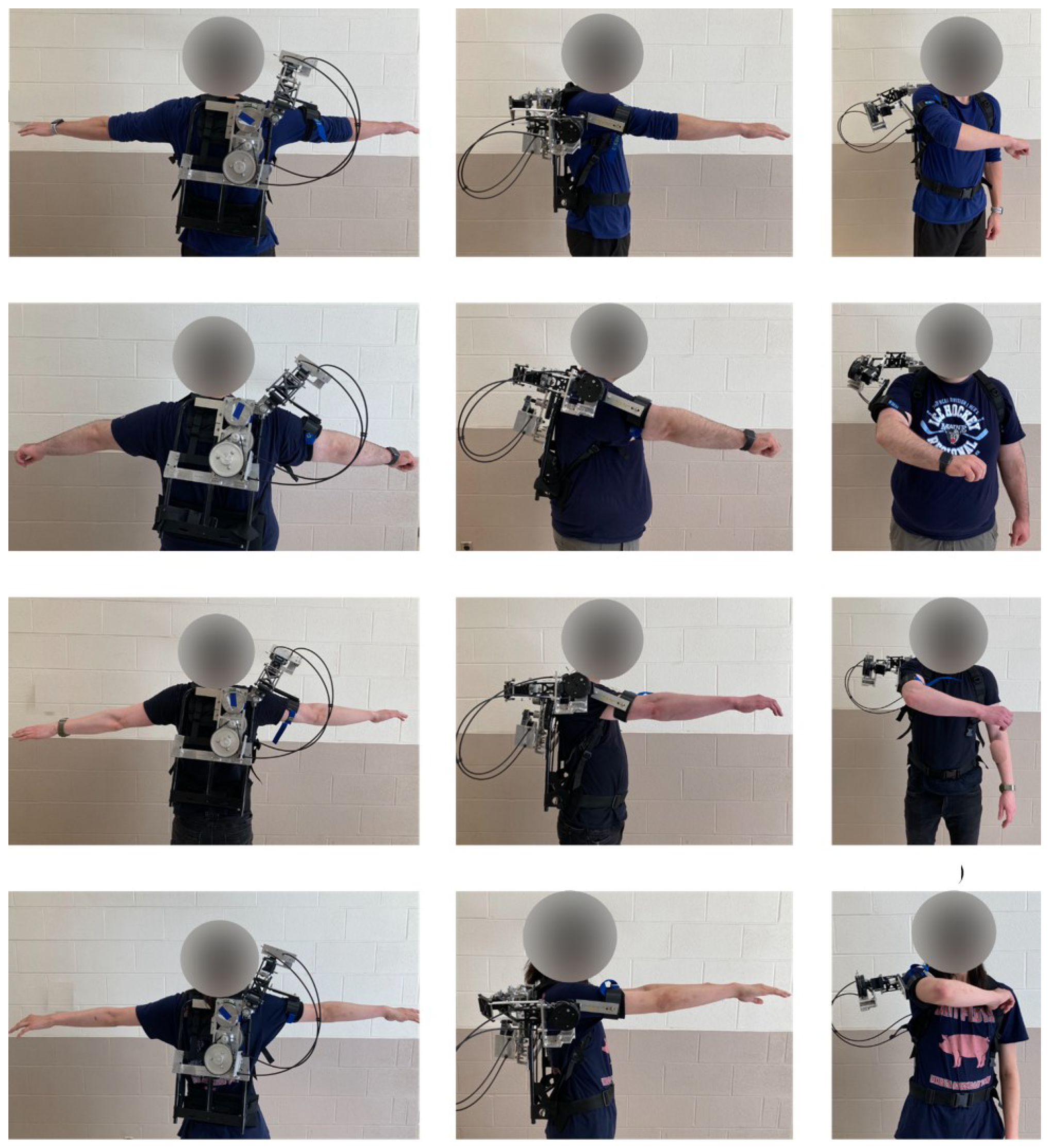
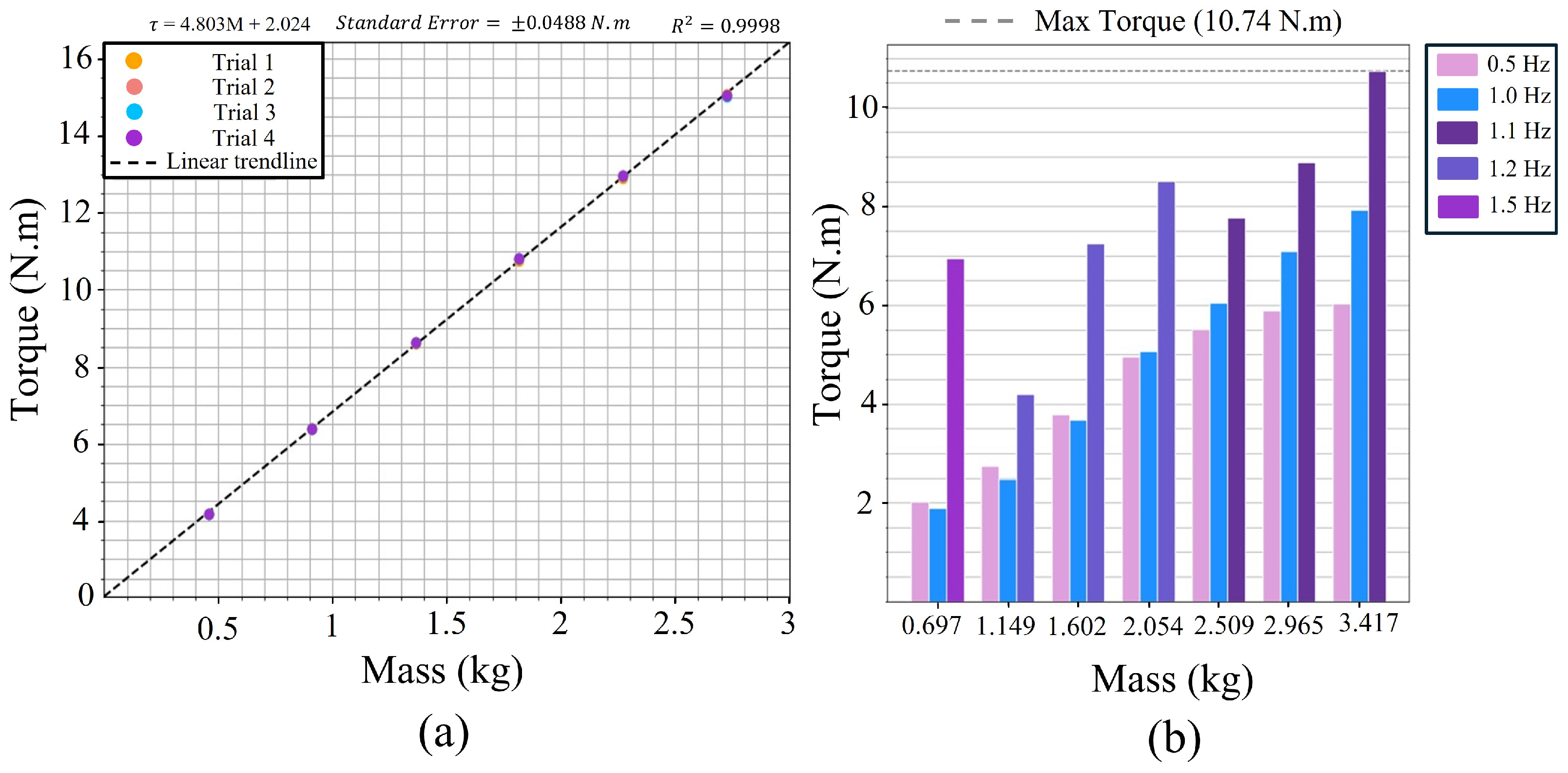
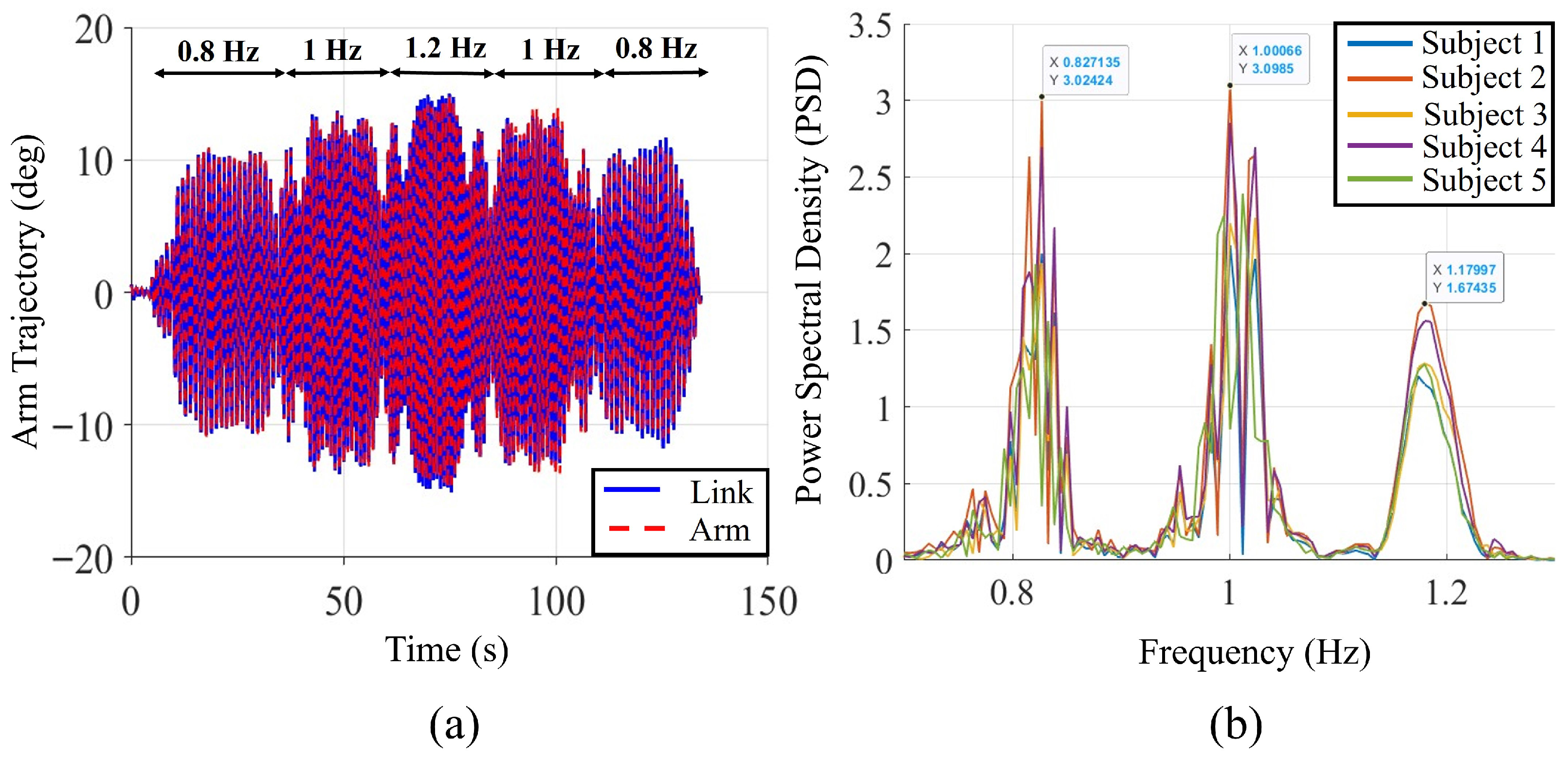
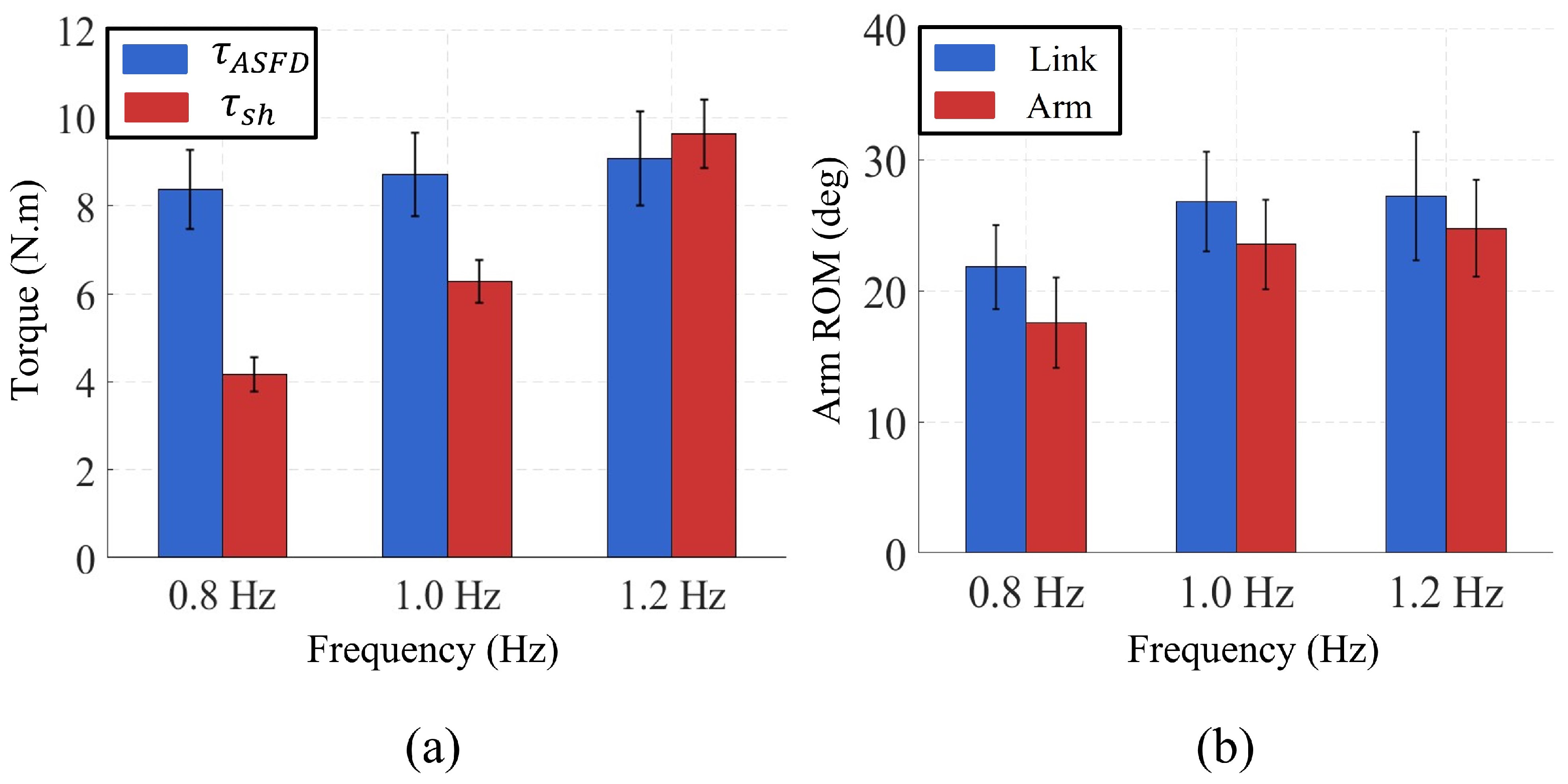
Actuators 15 00027 g012
Figure 13. Time-series evolution of EMG spectral features of the right upper trapezius muscle averaged across five participants during 20 min of continuous ASFD use: (a) median frequency (MDF) and (b) mean frequency (MNF). Solid lines represent group means, shaded regions indicate SEM, and dashed lines denote linear regression trends. Near-zero slopes of 0.0074 Hz/s and 0.0034 Hz/s for the MDF and MNF, respectively, indicate no detectable muscle fatigue.
Actuators 15 00027 g013
Table 1. Arm simulation parameters and inputs.
Parameter/InputValue
Simulation Time (s)10
Shoulder Angle Amplitude (deg) 40
Elbow Angle Amplitude (deg) 20
Frequency (Hz)1
Arm Mass (kg) 2.1463
Forearm and Hand Mass (kg) 1.6864
Arm Length (m) 0.3014
Forearm Length (m) 0.2752
Arm Moment of Inertia about the center of mass (COM) (kg·m2) 0.0220
Forearm and Hand of Inertia about the COM (kg·m2) 0.0280
Table 2. Sensitivity analysis of shoulder torque across different anthropometric conditions, where P2P stands for the peak-to-peak torque difference.
CaseHeight (m)Weight (kg)Min (N·m)Max (N·m)P2P (N·m)
US Male1.7590.36.94513.4706.525
Healthy Male1.7576.65.89211.4275.535
US Female1.6177.54.8219.1374.316
Male Mass ( 10 % )1.7581.276.25112.1235.873
Male Mass ( + 10 % )1.7599.337.64014.8177.178
Male Height ( 10 % )1.57590.36.36611.9455.580
Male Height ( + 10 % )1.92590.37.47815.0357.557
Female Mass ( 10 % )1.6169.754.3398.2233.884
Female Mass ( + 10 % )1.6185.255.30410.0514.748
Female Height ( 10 % )1.44977.54.4068.1093.703
Female Height ( + 10 % )1.77177.55.21010.1914.981
Table 3. Joint limits of the ASFD based on updated joint numbering and axis orientation.
JointLower LimitUpper Limit
θ 1 20 90
θ 2 = θ 3 = θ 4 59 64
θ 5 31.75 31.75
θ 6 45 90
Table 4. The ASFD DH parameters.
Linka [mm] α [ rad ] d [mm] θ * [ rad ]
162.02 π 2 163.71 θ 1 *
2103.5000.00 θ 2 *
3162.7000.00 θ 3 *
430.0500.00 θ 4 *
578.12 π 2 0.00 θ 5 *
6196.43079.54 θ 6 *
Table 5. Tested frequencies for each added weight during dynamic testing.
Target Frequency [Hz]
Added Weight [lb] Total Mass [kg] Trial 1 Trial 2 Trial 3
None 0.697 0.5 1.0 1.5
1 1.149 0.5 1.0 1.2
2 1.602 0.5 1.0 1.2
3 2.054 0.5 1.0 1.2
4 2.509 0.5 1.0 1.1
5 2.965 0.5 1.0 1.1
6 3.417 0.5 1.0 1.1
Table 6. The two-stage transmission efficiency and loss analysis, with gear ratios of N 1 = 3.0 , N 2 = 4.0 , N t o t a l = 12.0 .
Actual Gear RatioEfficiency (%)Power Loss (%)
Frequency N 1 N 2 N total η 1 η 2 η total Stage 1 Stage 2 Total
0.8 Hz3.324.3614.4890.391.882.99.78.217.1
1.0 Hz3.254.2713.8792.393.786.57.76.313.5
1.2 Hz3.184.1913.3294.495.490.15.64.69.9
Average3.254.2713.8992.393.786.57.76.313.5
Table 7. Anatomical limits [71] and measured limits of shoulder joint movements wearing the ASFD.
Shoulder Joint MovementAnatomical LimitASFD Measured Limit
Abduction 150 129.76
Extension45–60 36.93
Flexion 180 125.5
External Rotation 90 24.58
Internal Rotation70–90 56.21
Table 8. Tested frequencies for each added weight.
Target Frequency [Hz]
Experiment Total Mass [kg] Trial 1 Trial 2 Trial 3
1 0.697 0.5 1.0 1.5
2 1.149 0.5 1.0 1.2
3 1.602 0.5 1.0 1.2
4 2.054 0.5 1.0 1.2
5 2.509 0.5 1.0 1.1
6 2.965 0.5 1.0 1.1
7 3.417 0.5 1.0 1.1
Disclaimer/Publisher’s Note: The statements, opinions and data contained in all publications are solely those of the individual author(s) and contributor(s) and not of MDPI and/or the editor(s). MDPI and/or the editor(s) disclaim responsibility for any injury to people or property resulting from any ideas, methods, instructions or products referred to in the content.