
A Serious Game for Upper Limb Rehabilitation Implementing a Custom Vibrotactile Wireless Wearable Device and Leap Motion
 , ,
, ,  ,
,  and
and
Abstract
1. Introduction
2. State-of-the-Art
3. Development of a System for Upper Limb Rehabilitation
3.1. User Requirements
3.2. Virtual Environment Design
3.2.1. Graphical User Interface (GUI)
- Login: The physical therapist enters their username and password.
- Patient registration: A new patient is registered (name, age, sex, diagnosis), or an existing patient is selected. Clinical observations can also be added.
- Settings: Parameters such as game mode, sound, and the selection of scenarios and difficulty levels are configured.
- Game mode selection:
- (a)
- Both hands: The game starts with the right hand and switches to the left hand halfway through the level.
- (b)
- Single hand: The UL to be used for the exercises is selected.
- Scenario and level selection: The user can select one of four gameplay modes.
- (a)
- By game: A single scenario with its three difficulty levels.
- (b)
- By level: All three scenarios at a single difficulty level.
- (c)
- Game and level: A specific scenario and desired difficulty level.
- (d)
- Play all: All scenarios and all levels.
- Tutorial and virtual scenarios execution: Before the game begins, five video tutorials are presented. The first is a general tutorial that appears before any gameplay option is selected. The four remaining scenarios explain how to perform the exercises correctly. Bubbles provides two tutorials: an easy level (12 s) and one for intermediate and advanced levels (13 s); the Maze tutorial lasts 24 s; and the Fish tutorial lasts 41 s. After completing each tutorial, the corresponding scenario is launched based on the selected settings.
- End of session: A summary is displayed showing the patient’s name, ID, number of correct actions, errors, and session duration.
3.2.2. Virtual Scenarios
- Bubbles: Set in a flower field, bubbles of varying sizes and colors appear. In the easy level, bubbles float horizontally; in the intermediate and advanced levels, they fall vertically like raindrops. Each level involves different tasks:
- (a)
- Easy: Users must pop bubbles (large or small) as instructed, using a pinch gesture, thumb to index finger. Successfully popping bubbles increases the score. Movements include metacarpophalangeal flexion and slight interphalangeal flexion, which are commonly employed in UL rehabilitation exercises.
- (b)
- Intermediate and Advanced: Users collect bubbles and sort them by color into containers. The forearm must be supinated to catch a bubble and pronated to release it. Movements include forearm pronation/supination. Difficulty increases with the number of bubbles (two in intermediate, four in advanced) and the speed of appearance.
- Maze: The scene features a 3D maze on the far wall of a room. Users guide a virtual hand through a sequence of spheres representing the solution path to reach a diamond. Once the diamond is obtained, a new level is automatically generated with a different trajectory; i.e., longer and more complex maze paths, with varying shapes and sizes. Movements involve elbow and shoulder flexion, and metacarpophalangeal flexion–extension.
- Fish: Set in a marine environment, users control an orange fish using wrist and elbow movements. The goal is to collide with point-gaining objects (bubbles, starfish) while avoiding harmful ones (rocks, sharks). Sensitivity settings adjust the fish’s response speed, allowing customization to the user’s range of motion. Higher levels increase the number, type, and speed of incoming objects. Moreover, as the levels progress, both the speed at which objects approach and the number and variety of objects increase. Table 1 shows the objects present in each level of the Fish scenario. Table 2 illustrates the movement of the pawn represented by the Fish (a manipulation metaphor) based on the user’s executed motions. For ulnar and radial deviation of the wrist, the direction of the pawn’s movement changes depending on whether the left or right UL is used. For the rest of the movements, including flexion/extension of wrist and elbow, the resulting displacement is the same with either hand. Initially, the user must place their wrist in a neutral position, with the forearm in pronation, the elbow semiflexed, and the arm positioned close to the side of the body.
3.3. Wearable Device Design
4. Testing the System
4.1. Evaluation Protocol Description
- (a)
- Demographic information (administered before the session) collected demographic information, including level of computer proficiency, experience with video games and VR, and prior use of optical motion trackers. This data was used to characterize participants’ technical backgrounds across both groups.
- (b)
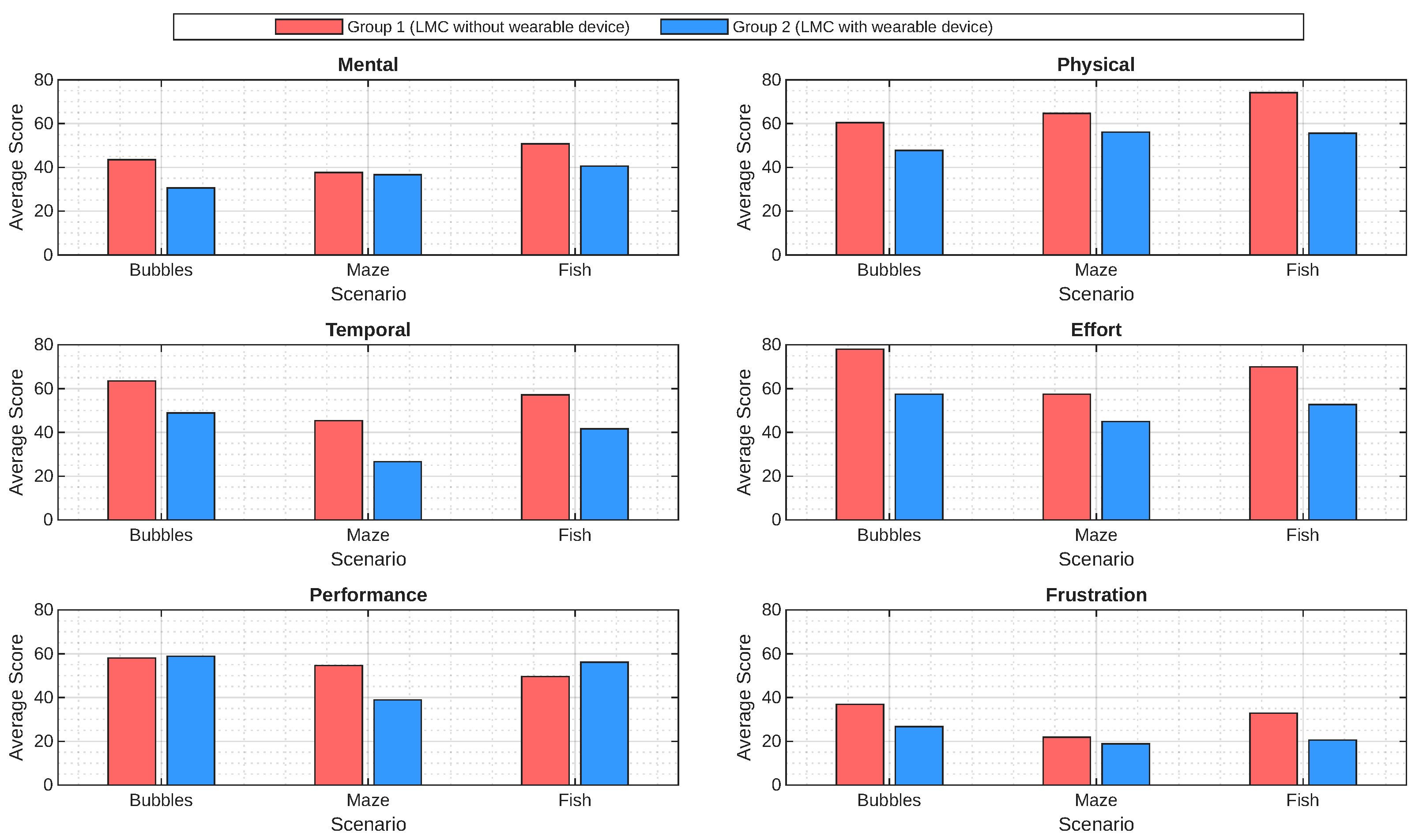
- Workload assessment (administered after each scenario) assessed the perceived mental workload of each virtual scenario using the Raw NASA Task Load Index (Raw NASA-TLX) [26,41]. The Raw NASA-TLX version was used because it evaluates workload dimensions independently—without subjective weighting between dimensions—thereby preserving the individual contribution of each subscale and avoiding information loss [26]. The six evaluated dimensions are mental demand, physical demand, temporal demand, performance, effort, and frustration level. Each dimension is rated on a scale from 1 to 100, where 1 indicates a very low level and 100 a very high level. In addition to per-dimension scores, an overall workload score was computed for each participant as the unweighted mean of the six subscales [26], providing a global index of perceived workload for between-group comparison.
- (c)
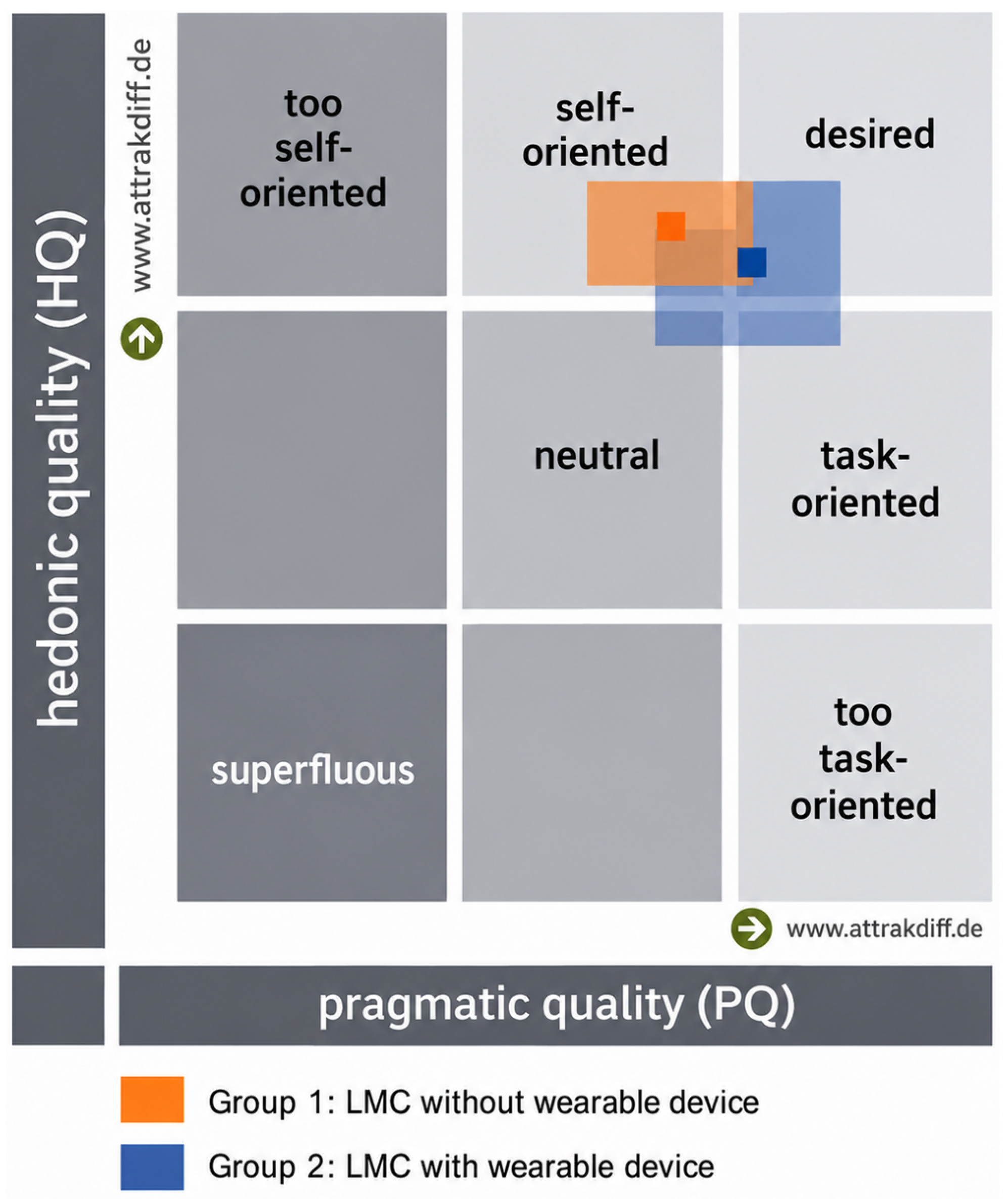
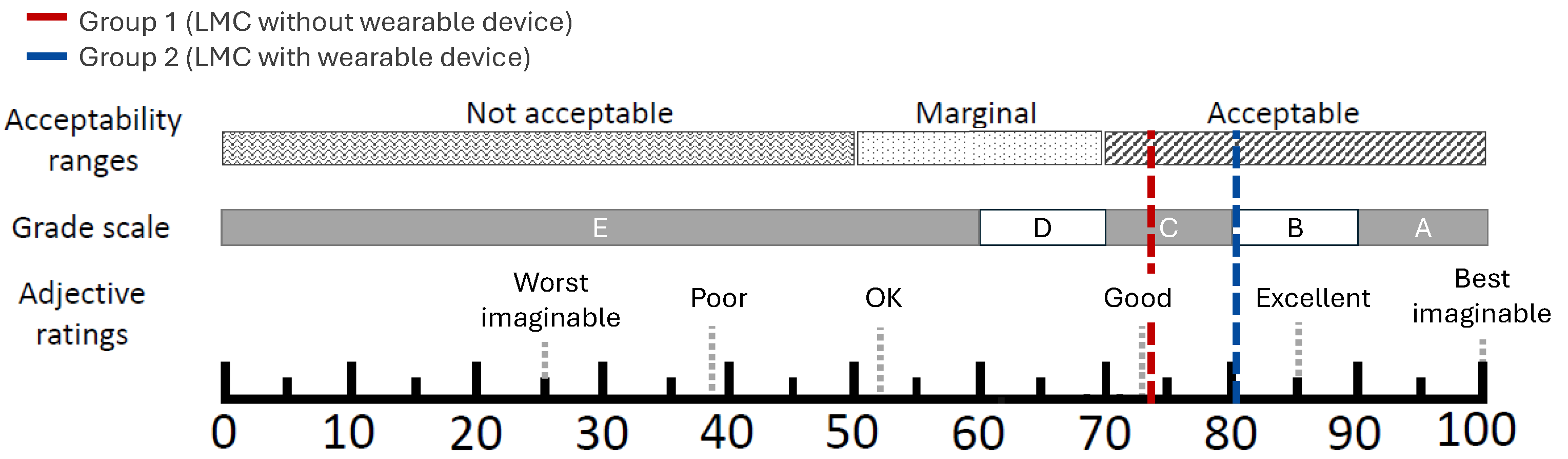
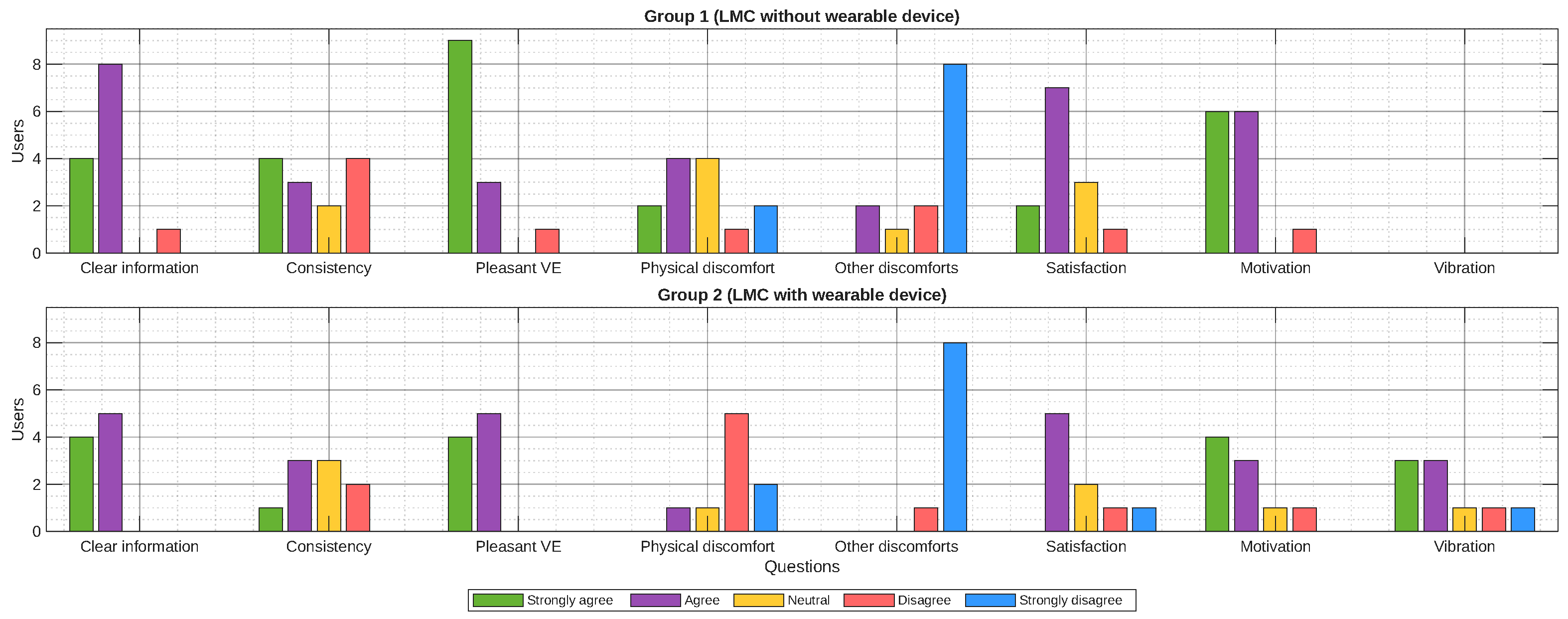
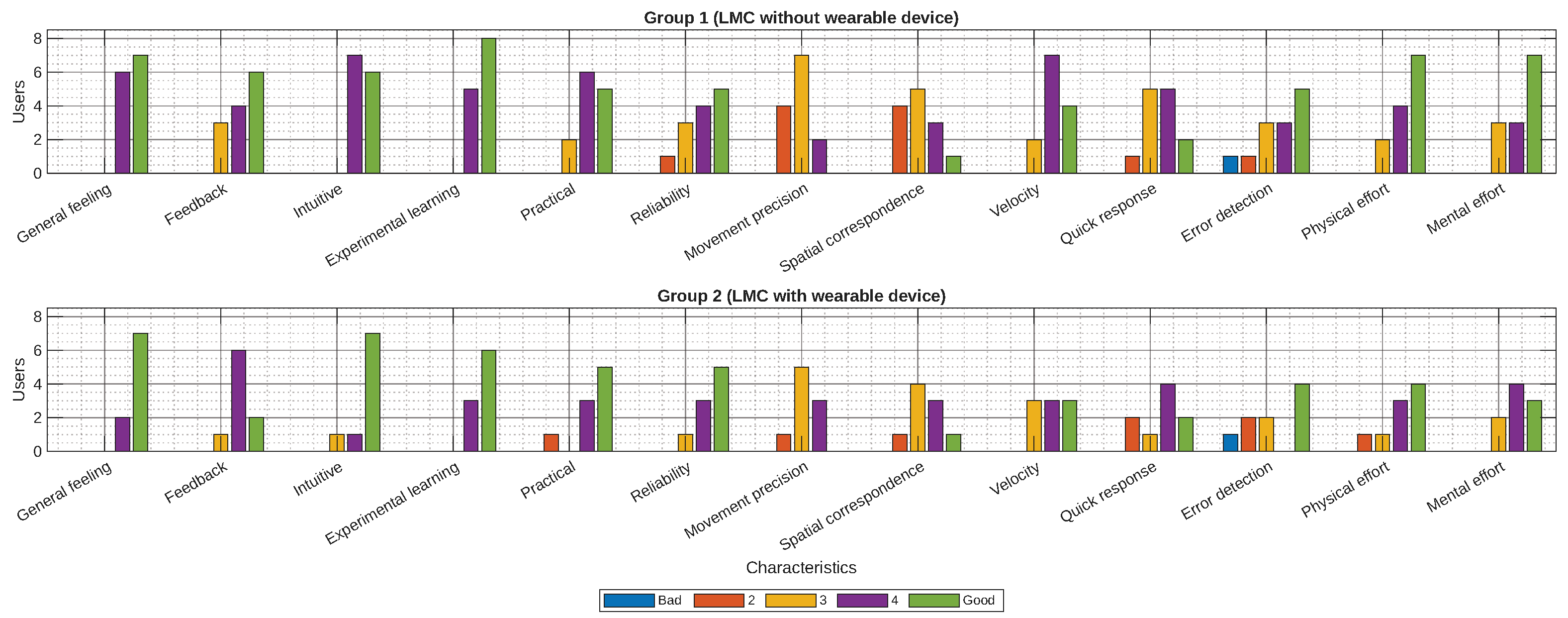
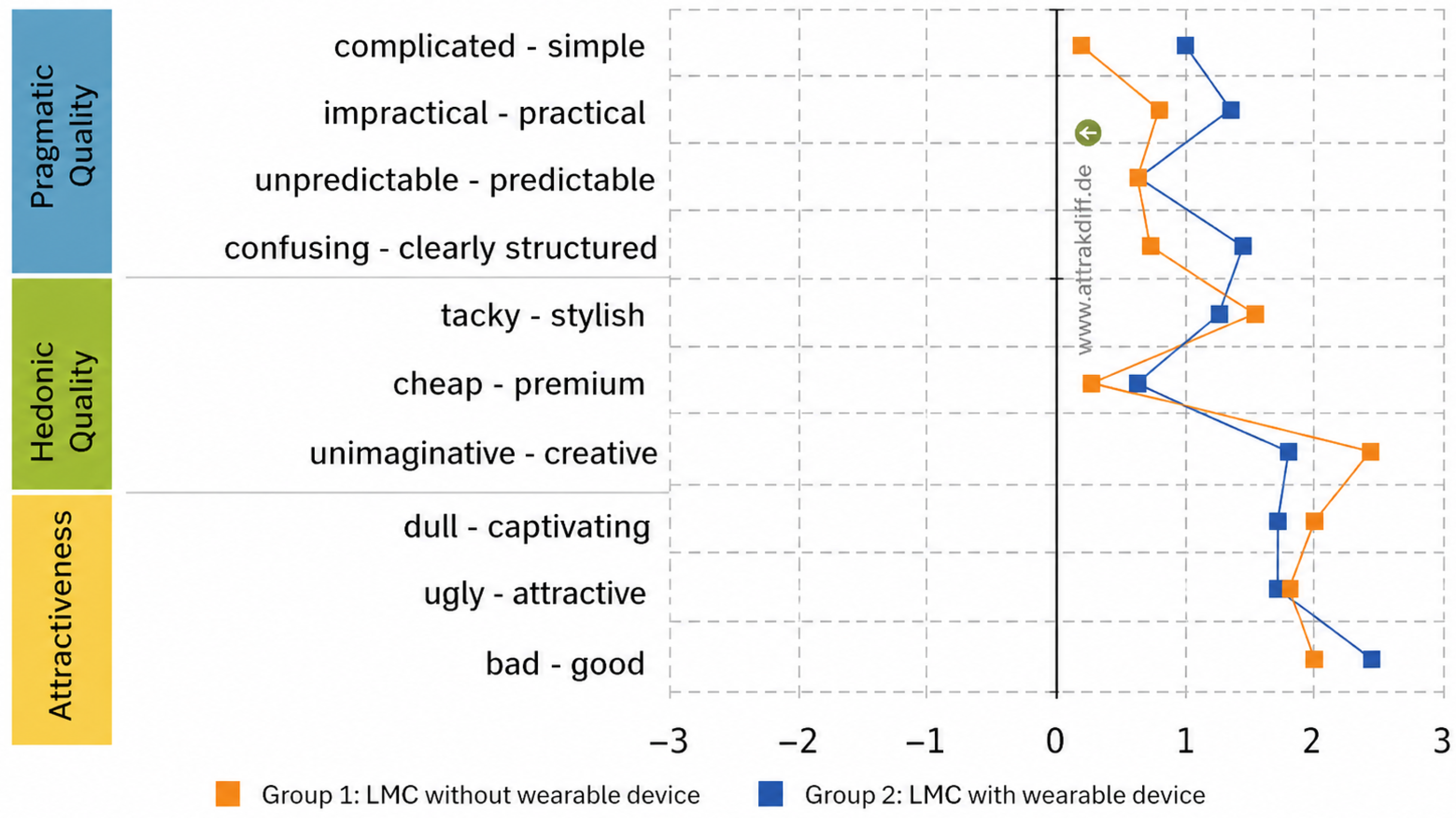
- User experience evaluation (administered at the end of the session) explored the user’s experience with the system through four subsections: (i) the short AttrakDiff questionnaire [25], consisting of 10 pairs of opposing adjectives to assess pragmatic and hedonic quality; (ii) the 10-item SUS scale [27,42] to evaluate perceived usability; (iii) a purpose-built questionnaire (Table 5) to assess physical discomfort, enjoyment of the scenarios, and the clarity of information provided by the VE; and (iv) a 1–5 rating of the overall system based on user perception (1 = bad, 5 = good) to identify specific errors and opportunities for improvement.
4.2. Experimental Testing
- Group 1 (System without Wearable Device): This group consisted of 6 men and 7 women. Regarding educational background, 8 participants were undergraduate students, 4 were master’s students, and 1 was a PhD student.Participants rated their computer proficiency as follows: two rated themselves as 9, one as 8.5, six as 8, three as 7, and one as 6. Weekly computer usage was reported as follows: four users between 1 and 10 h, two between 11 and 20 h, four between 21 and 30 h, and three for more than 40 h per week. Regarding video game usage, six participants reported playing rarely, three occasionally, and four frequently. Eight participants were familiar with VR and had previously used a VR system. One participant was familiar with the LMC; five participants reported knowledge of the Kinect sensor.
- Group 2 (Complete System): This group included 4 men and 5 women. Regarding educational background, six participants had completed high school, two held a bachelor’s degree, and one held a master’s degree. In terms of computer proficiency, participants reported the following ratings: two rated themselves as 9, two as 8, one as 7, and four as 6. Weekly computer usage was distributed as follows: two participants reported between 10 and 20 h, three between 21 and 30 h, three between 31 and 40 h, one between 41 and 50 h, and one for 60 h per week. Regarding video game use, one participant did not play, three played rarely, two played occasionally, and three played frequently. Eight participants were familiar with VR, and five had previously used a VR system. No participants were aware of the LMC or had previously used it; six had interacted with the Kinect sensor.
5. Results
5.1. User Experience: AttrakDiff Questionnaire
5.2. Perceived Workload: Raw NASA-TLX
5.3. System Usability Scale (SUS)
6. Discussion
7. Conclusions
Author Contributions
Funding
Institutional Review Board Statement
Informed Consent Statement
Data Availability Statement
Acknowledgments
Conflicts of Interest
Abbreviations
| CEREE | State Center for Rehabilitation and Special Education |
| GUI | Graphical User Interface |
| HMDs | Head-Mounted Displays |
| IVR | Immersive Virtual Reality |
| LMC | Leap Motion Controller |
| NASA TLX | NASA Task Load Index |
| NUI | Natural User Interface |
| SG | Serious Game |
| SUS | System Usability Scale |
| UE | Unreal Engine |
| UL | Upper Limb |
| VE | Virtual Environment |
| VR | Virtual Reality |
Appendix A. Research Ethics Committee Approval (Spanish Version)

Appendix B. Research Ethics Committee Approval (English Version)

Appendix C. Informed Consent (English Version)

References
- Mahfouz, D.M.; Shehata, O.M.; Morgan, E.I.; Arrichiello, F. A Comprehensive Review of Control Challenges and Methods in End-Effector Upper-Limb Rehabilitation Robots. Robotics 2024, 13, 181. [Google Scholar] [CrossRef] [Scilit]
- Belluzzi, E.; Pozzuoli, A.; Ruggieri, P. Musculoskeletal Diseases: From Molecular Basis to Therapy. Biomedicines 2024, 12, 32. [Google Scholar] [CrossRef] [Scilit] [PubMed]
- Institute for Health Metrics and Evaluation (IHME). WHO Rehabilitation Need Estimator. 2024. Available online: https://vizhub.healthdata.org/rehabilitation/ (accessed on 21 May 2026).
- Gimigliano, F.; Negrini, S. The World Health Organization “rehabilitation 2030: A call for action”. Eur. J. Phys. Rehabil. Med. 2017, 53, 155–168. [Google Scholar] [CrossRef] [Scilit]
- Riener, R.; Harders, M. Chapter 7 Virtual Reality for Rehabilitation. In Virtual Reality in Medicine; Springer: London, UK, 2012; pp. 160–180. [Google Scholar] [CrossRef] [Scilit]
- Rego, P.A.; Moreira, P.M.; Reis, L.P. Architecture for serious games in health rehabilitation. In Proceedings of the New Perspectives in Information Systems and Technologies; Springer: Cham, Switzerland, 2014; Volume 2, pp. 307–317. [Google Scholar]
- Sabatino, E.; Moschetta, M.; Lucaroni, A.; Barresi, G.; Ferraresi, C.; Podda, J.; Grange, E.; Brichetto, G.; Bucchieri, A. A Pilot Study on Mixed-Reality Approaches for Detecting Upper-Limb Dysfunction in Multiple Sclerosis: Insights on Cerebellar Tremor. Virtual Worlds 2025, 4, 4. [Google Scholar] [CrossRef] [Scilit]
- Ríos-Hernández, M.; Jacinto-Villegas, J.M.; Zemiti, N.; Vilchis-González, A.H.; Padilla-Castañeda, M.A.; Debien, B. Development of a lumbar puncture virtual simulator for medical students training: A preliminary evaluation. Int. J. Med. Robot. Comput. Assist. Surg. 2023, 19, e2572. [Google Scholar] [CrossRef] [Scilit]
- Laspro, M.; Groysman, L.; Verzella, A.N.; Kimberly, L.L.; Flores, R.L. The Use of Virtual Reality in Surgical Training: Implications for Education, Patient Safety, and Global Health Equity. Surgeries 2023, 4, 635–646. [Google Scholar] [CrossRef] [Scilit]
- Li, X.; Elnagar, D.; Song, G.; Ghannam, R. Advancing Medical Education Using Virtual and Augmented Reality in Low- and Middle-Income Countries: A Systematic and Critical Review. Virtual Worlds 2024, 3, 384–403. [Google Scholar] [CrossRef] [Scilit]
- Suh, I.; McKinney, T.; Siu, K.-C. Current Perspective of Metaverse Application in Medical Education, Research and Patient Care. Virtual Worlds 2023, 2, 115–128. [Google Scholar] [CrossRef] [Scilit]
- Fealy, S.; Irwin, P.; Tacgin, Z.; See, Z.S.; Jones, D. Enhancing Nursing Simulation Education: A Case for Extended Reality Innovation. Virtual Worlds 2023, 2, 218–230. [Google Scholar] [CrossRef] [Scilit]
- Ríos-Hernández, M.; Jacinto-Villegas, J.M.; Portillo-Rodríguez, O.; Vilchis-González, A.H. User-centered design and evaluation of an upper limb rehabilitation system with a virtual environment. Appl. Sci. 2021, 11, 9500. [Google Scholar] [CrossRef] [Scilit]
- Mubin, O.; Alnajjar, F.; Jishtu, N.; Alsinglawi, B.; Al Mahmud, A. Exoskeletons with virtual reality, augmented reality, and gamification for stroke patients’ rehabilitation: Systematic review. JMIR Rehabil. Assist. Technol. 2019, 6, e12010. [Google Scholar] [CrossRef] [Scilit] [PubMed]
- Cerda, I.H.; Therond, A.; Moreau, S.; Studer, K.; Donjow, A.R.; Crowther, J.E.; Mazzolenis, M.E.; Lang, M.; Tolba, R.; Gilligan, C.; et al. Telehealth and virtual reality technologies in chronic pain management: A narrative review. Curr. Pain Headache Rep. 2024, 28, 83–94. [Google Scholar] [CrossRef] [Scilit] [PubMed]
- Doumas, I.; Everard, G.; Dehem, S.; Lejeune, T. Serious games for upper limb rehabilitation after stroke: A meta-analysis. J. Neuroeng. Rehabil. 2021, 18, 100. [Google Scholar] [CrossRef] [Scilit]
- Somrak, A.; Pogačnik, M.; Guna, J. Suitability and Comparison of Questionnaires Assessing Virtual Reality-Induced Symptoms and Effects and User Experience in Virtual Environments. Sensors 2021, 21, 1185. [Google Scholar] [CrossRef] [Scilit]
- Maldonado, P.; Muñoz, D.; Barría, P.; Alberti, P.; Ojeda, C. Proyecto de realidad virtual inclusivo para pacientes con discapacidad motriz. In Proceedings of the Memorias Congreso Iberoamericano de Tecnologías de Apoyo a la Discapacidad; Escuela Colombiana de Ingeniería: Bogotá, Colombia, 2017; pp. 339–345. Available online: https://reasiste.umh.es/portfolio/iberdiscap-2017/ (accessed on 21 May 2026).
- Slater, M.; Sanchez-Vives, M.V. Enhancing our lives with immersive virtual reality. Front. Robot. AI 2016, 3, 74. [Google Scholar] [CrossRef] [Scilit]
- Pacchierotti, C.; Sinclair, S.; Solazzi, M.; Frisoli, A.; Hayward, V.; Prattichizzo, D. Wearable haptic systems for the fingertip and the hand: Taxonomy, review, and perspectives. IEEE Trans. Haptics 2017, 10, 580–600. [Google Scholar] [CrossRef] [Scilit]
- Aguilera-Rubio, Á.; Cuesta-Gómez, A.; Mallo-López, A.; Jardón-Huete, A.; Oña-Simbaña, E.D.; Alguacil-Diego, I.M. Feasibility and efficacy of a virtual reality game-based upper extremity motor function rehabilitation therapy in patients with chronic stroke: A pilot study. Int. J. Environ. Res. Public Health 2022, 19, 3381. [Google Scholar] [CrossRef] [Scilit]
- De Los Reyes-Guzmán, A.; Lozano-Berrio, V.; Álvarez Rodríguez, M.; López-Dolado, E.; Ceruelo-Abajo, S.; Talavera-Díaz, F.; Gil-Agudo, J. RehabHand: Oriented-tasks serious games for upper limb rehabilitation by using leap motion controller and target population in spinal cord injury. NeuroRehabilitation 2021, 48, 365–373. [Google Scholar] [CrossRef] [Scilit]
- Shah, V.; Cuen, M.; McDaniel, T.; Tadayon, R. A rhythm-based serious game for fine motor rehabilitation using leap motion. In Proceedings of the 2019 58th Annual Conference of the Society of Instrument and Control Engineers of Japan (SICE); IEEE: New York, NY, USA, 2019; pp. 737–742. [Google Scholar]
- Postolache, G.; Carry, F.; Lourenço, F.; Ferreira, D.; Oliveira, R.; Girão, P.S.; Postolache, O. Serious Games Based on Kinect and Leap Motion Controller for Upper Limbs Physical Rehabilitation. In Modern Sensing Technologies; Mukhopadhyay, S.C., Jayasundera, K.P., Postolache, O.A., Eds.; Springer International Publishing: Cham, Switzerland, 2019; Volume 29, pp. 147–177. [Google Scholar] [CrossRef] [Scilit]
- Hassenzahl, M.; Burmester, M.; Koller, F. AttrakDiff: Ein Fragebogen zur Messung wahrgenommener hedonischer und pragmatischer Qualität. In Proceedings of the Mensch & Computer 2003: Interaktion in Bewegung; Szwillus, G., Ziegler, J., Eds.; Springer: Stuttgart, Germany, 2003; pp. 187–196. [Google Scholar]
- Hart, S.G. NASA-task load index (NASA-TLX); 20 years later. In Proceedings of the Human Factors and Ergonomics Society Annual Meeting; Sage Publications: Los Angeles, CA, USA, 2006; pp. 904–908. [Google Scholar]
- Brooke, J. SUS: A “Quick and Dirty” Usability Scale. In Usability Evaluation in Industry; Jordan, P.W., Thomas, B., Weerdmeester, B.A., McClelland, A.L., Eds.; Taylor & Francis: London, UK, 1996; pp. 189–194. [Google Scholar]
- Kong, G.; He, K.; Wei, K. Sensorimotor experience in virtual reality enhances sense of agency associated with an avatar. Conscious. Cogn. 2017, 52, 115–124. [Google Scholar] [CrossRef] [Scilit]
- Liao, K.L.; Huang, M.; Wang, Y.; Wu, Z.; Yang, R.; Zhang, J.; Wang, L. A Virtual Reality Serious Game Design for Upper Limb Rehabilitation. In Proceedings of the International Conference on Serious Games and Applications for Health (SeGAH); IEEE: New York, NY, USA, 2021. [Google Scholar] [CrossRef] [Scilit]
- Paraense, H.; Marques, B.; Amorim, P.; Dias, P.; Santos, B.S. Whac-A-Mole: Exploring Virtual Reality (VR) for Upper-Limb Post-Stroke Physical Rehabilitation based on Participatory Design and Serious Games. In Proceedings of the 2022 IEEE Conference on Virtual Reality and 3D User Interfaces Abstracts and Workshops (VRW); IEEE: New York, NY, USA, 2022; pp. 716–717. [Google Scholar] [CrossRef] [Scilit]
- Villada Castillo, J.F.; Montoya Vega, M.F.; Muñoz Cardona, J.E.; Lopez, D.; Quiñones, L.; Henao Gallo, O.; López, J.F. Design of Virtual Reality Exergames for Upper Limb Stroke Rehabilitation Following Iterative Design Methods: Usability Study. JMIR Serious Games 2024, 12, e48900. [Google Scholar] [CrossRef] [Scilit]
- Bachmann, D.; Weichert, F.; Rinkenauer, G. Review of three-dimensional human-computer interaction with focus on the leap motion controller. Sensors 2018, 18, 2194. [Google Scholar] [CrossRef] [Scilit]
- Cuesta-Gómez, A.; Sánchez-Herrera-Baeza, P.; Oña-Simbaña, E.D.; Martínez-Medina, A.; Ortiz-Comino, C.; Balaguer-Bernaldo-de Quirós, C.; Jardón-Huete, A.; Cano-de-la Cuerda, R. Effects of virtual reality associated with serious games for upper limb rehabilitation in patients with multiple sclerosis: Randomized controlled trial. J. Neuroeng. Rehabil. 2020, 17, 90. [Google Scholar] [CrossRef] [Scilit]
- Hidalgo, J.C.C.; Delgado, J.D.A.; Bykbaev, V.R.; Bykbaev, Y.R.; Coyago, T.P. Serious game to improve fine motor skills using Leap Motion. In Proceedings of the 2018 Congreso Argentino de Ciencias de la Informática y Desarrollos de Investigación (CACIDI); IEEE: New York, NY, USA, 2018; pp. 1–5. [Google Scholar]
- Lécuyer, A. Simulating Haptic Feedback Using Vision: A Survey of Research and Applications of Pseudo-Haptic Feedback. Presence Teleoperators Virtual Environ. 2009, 18, 39–53. [Google Scholar] [CrossRef] [Scilit]
- Ernst, M.O.; Banks, M.S. Humans integrate visual and haptic information in a statistically optimal fashion. Nature 2002, 415, 429–433. [Google Scholar] [CrossRef] [Scilit]
- Burdea, G.C. Force and Touch Feedback for Virtual Reality; John Wiley & Sons: New York, NY, USA, 1996. [Google Scholar]
- Bark, K.; Khanna, P.; Irwin, R.; Kapur, P.; Bhirangi, V.; Cutkosky, M. Lessons in Using Vibrotactile Feedback to Guide Fast Arm Motions. In Proceedings of the 2011 IEEE World Haptics Conference; IEEE: Piscataway, NJ, USA, 2015; pp. 355–360. [Google Scholar] [CrossRef] [Scilit]
- Ultraleap. Hand Tracking Documentation. Available online: https://docs.ultraleap.com/hand-tracking/index.html (accessed on 21 May 2026).
- Weichert, F.; Bachmann, D.; Rudak, B.; Fisseler, D. Analysis of the Accuracy and Robustness of the Leap Motion Controller. Sensors 2013, 13, 6380–6393. [Google Scholar] [CrossRef] [Scilit] [PubMed]
- Nygren, T.E. Psychometric Properties of Subjective Workload Measurement Techniques: Implications for Their Use in the Assessment of Perceived Mental Workload. Hum. Factors 1991, 33, 17–33. [Google Scholar] [CrossRef] [Scilit]
- Grier, R.A.; Bangor, A.; Kortum, P.; Peres, S.C. The system usability scale: Beyond standard usability testing. In Proceedings of the Human Factors and Ergonomics Society Annual Meeting; SAGE Publications: Los Angeles, CA, USA, 2013; pp. 187–191. [Google Scholar]
- Virzi, R.A. Refining the Test Phase of Usability Evaluation: How Many Subjects Is Enough? Hum. Factors 1992, 34, 457–468. [Google Scholar] [CrossRef] [Scilit]
- Nielsen, J.; Landauer, T.K. A Mathematical Model of the Finding of Usability Problems. In Proceedings of the INTERACT ’93 and CHI ’93 Conference on Human Factors in Computing Systems; ACM: New York, NY, USA, 1993; pp. 206–213. [Google Scholar] [CrossRef] [Scilit]
- Hyzy, M.; Bond, R.; Mulvenna, M.; Bai, L.; Dix, A.; Leigh, S.; Hunt, S. System usability scale benchmarking for digital health apps: Meta-analysis. JMIR mHealth uHealth 2022, 10, e37290. [Google Scholar] [CrossRef] [Scilit] [PubMed]
- Faulkner, L. Beyond the Five-User Assumption: Benefits of Increased Sample Sizes in Usability Testing. Behav. Res. Methods Instrum. Comput. 2003, 35, 379–383. [Google Scholar] [CrossRef] [Scilit]





| Level | Desired Objects | Undesired Objects |
|---|---|---|
| 1 | - Starfish | - Rocks |
| 2 | - Starfish | - Rocks |
| - Bubbles | ||
| 3 | - Starfish | - Rocks |
| - Bubbles | - Sharks | |
| Collision outcome | Increases the number of hits. | Increases the number of errors. |
| Movements | Left UL | Right UL |
|---|---|---|
| Wrist | ||
| Ulnar deviation | Moves to the left | Moves to the right |
| Radial deviation | Moves to the right | Moves to the left |
| Flexion | Moves downward | |
| Extension | Moves upward | |
| Elbow | ||
| Flexion | Moves backward | |
| Extension | Moves forward | |
| Scenario | Movements |
|---|---|
Bubbles: Intermediate level.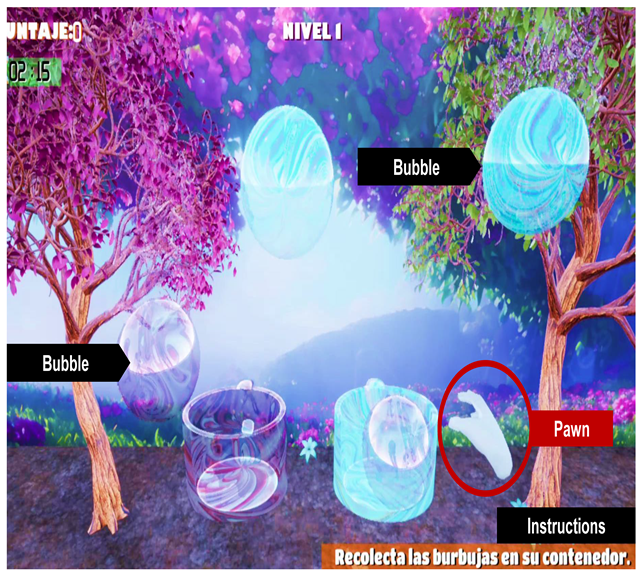 |
|
Maze: Easy level. |
|
Fish: Intermediate level. |
|
| Actions | Duty Cycle 8 Bits | Vibration Frequency | Motor Activated |
|---|---|---|---|
| Bubbles: popping bubbles, bubble collisions and depositing in containers. Maze: collision with spheres. Fish: collision with desired objects. | 55% | Motor 1 | |
| Maze: collecting diamonds and collision with the black wall. Fish: workspace boundaries. | 59% | Motor 1 | |
| Fish: collision with undesired objects. | 79% | Motor 1 Motor 2 |
| Question | Keywords |
|---|---|
| Is the information provided by the VE clear? | Clear information |
| Do the on-screen movements make sense in relation to my own? | Coherence |
| I liked the game environments. | Pleasant VE |
| Did you experience any physical discomfort or pain while using the system? | Physical discomfort |
| Did you experience any visual or auditory discomfort while using the system? | Other discomfort |
| I successfully completed the activities. | Satisfaction |
| I felt motivated to finish the games. | Motivation |
| I think that vibration modes are distinguished according to the actions performed. | Vibration |
| Scenario | Group | W Statistic | p-Value |
|---|---|---|---|
| Bubbles | Group 1 | 0.93 | 0.37 |
| Group 2 | 0.81 | 0.03 | |
| Maze | Group 1 | 0.98 | 0.95 |
| Group 2 | 0.74 | 0.00 | |
| Fish | Group 1 | 0.93 | 0.33 |
| Group 2 | 0.92 | 0.38 | |
| Global average | Group 1 | 0.96 | 0.80 |
| Group 2 | 0.73 | 0.00 |
| Analysis | Group 1 Mean ± SD | Group 2 Mean ± SD | U | p-Value | Effect Size (r) | Post Hoc Power | ||
|---|---|---|---|---|---|---|---|---|
| Bubbles | 13 | 9 | 56.74 ± 16.46 | 42.96 ± 19.76 | 87.5 | 0.057 | 0.41 | ≈45–50% |
| Maze | 13 | 9 | 46.95 ± 18.03 | 37.13 ± 22.71 | 85.5 | 0.077 | 0.38 | ≈40–45% |
| Fish | 13 | 9 | 55.74 ± 18.85 | 44.54 ± 18.08 | 84.0 | 0.094 | 0.36 | ≈35–40% |
| Global average | 13 | 9 | 53.15 ± 16.02 | 41.54 ± 19.01 | 87.0 | 0.062 | 0.41 | ≈45–50% |
| Group 1 | |||||||||
|---|---|---|---|---|---|---|---|---|---|
| User | 1 | 2 | 3 | 4 | 5 | 6 | 7 | 8 | 9 |
| SUS Score | 87.5 | 82.5 | 70 | 52.5 | 85 | 52.5 | 62.5 | 72.5 | 82.5 |
| User | 10 | 11 | 12 | 13 | |||||
| SUS Score | 77.5 | 82.5 | 70 | 90 | |||||
| Average: 74.42 ± 12.50 | |||||||||
| Group 2 | |||||||||
|---|---|---|---|---|---|---|---|---|---|
| User | 1 | 2 | 3 | 4 | 5 | 6 | 7 | 8 | 9 |
| SUS Score | 75 | 82.5 | 82.5 | 85 | 85 | 70 | 82.5 | 80 | 85 |
| Average: 80.83 ± 5.15 | |||||||||
| Measure | Group | W Statistic | p-Value |
|---|---|---|---|
| SUS overall | Group 1 | 0.90 | 0.16 |
| Group 2 | 0.80 | 0.02 |
| Analysis | Group 1 Mean ± SD | Group 2 Mean ± SD | U | p-Value | Effect Size (r) | Post Hoc Power | ||
|---|---|---|---|---|---|---|---|---|
| SUS overall | 13 | 9 | 74.42 ± 12.51 | 80.83 ± 5.15 | 43.0 | 0.310 | 0.22 | ≈15–20% |
Disclaimer/Publisher’s Note: The statements, opinions and data contained in all publications are solely those of the individual author(s) and contributor(s) and not of MDPI and/or the editor(s). MDPI and/or the editor(s) disclaim responsibility for any injury to people or property resulting from any ideas, methods, instructions or products referred to in the content. |
© 2026 by the authors. Licensee MDPI, Basel, Switzerland. This article is an open access article distributed under the terms and conditions of the Creative Commons Attribution (CC BY) license.
Share and Cite
Sánchez-Nava, E.R.; Ríos-Hernández, M.; Jacinto-Villegas, J.M.; Portillo-Rodríguez, O.; Vilchis-González, A.H. A Serious Game for Upper Limb Rehabilitation Implementing a Custom Vibrotactile Wireless Wearable Device and Leap Motion. Virtual Worlds 2026, 5, 25. https://doi.org/10.3390/virtualworlds5020025
Sánchez-Nava ER, Ríos-Hernández M, Jacinto-Villegas JM, Portillo-Rodríguez O, Vilchis-González AH. A Serious Game for Upper Limb Rehabilitation Implementing a Custom Vibrotactile Wireless Wearable Device and Leap Motion. Virtual Worlds. 2026; 5(2):25. https://doi.org/10.3390/virtualworlds5020025
Chicago/Turabian StyleSánchez-Nava, Estrella Rubi, Monserrat Ríos-Hernández, Juan Manuel Jacinto-Villegas, Otniel Portillo-Rodríguez, and Adriana Herlinda Vilchis-González. 2026. "A Serious Game for Upper Limb Rehabilitation Implementing a Custom Vibrotactile Wireless Wearable Device and Leap Motion" Virtual Worlds 5, no. 2: 25. https://doi.org/10.3390/virtualworlds5020025
APA StyleSánchez-Nava, E. R., Ríos-Hernández, M., Jacinto-Villegas, J. M., Portillo-Rodríguez, O., & Vilchis-González, A. H. (2026). A Serious Game for Upper Limb Rehabilitation Implementing a Custom Vibrotactile Wireless Wearable Device and Leap Motion. Virtual Worlds, 5(2), 25. https://doi.org/10.3390/virtualworlds5020025