You are currently viewing a new version of our website. To view the old version click .

Crops, Volume 2, Issue 3

September 2022 - 9 articles

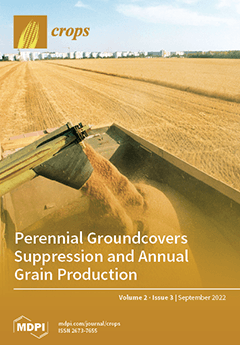
Cover Story: Perennial groundcover (PGC) merges scalable soil and water conservation with high-yielding row crops, enhancing the ecosystem services of annual grain crop production. However, ineffective groundcover suppression increases competition between the groundcover and row crop, reducing row crop grain yield. The objective of this study was to assess the effectiveness of three Kentucky bluegrass (KBG) groundcover suppression methods on maize (Zea mays L.) growth and development in evenly spaced PGC at narrow and wide widths, compared to alternating PGC swards and a no-PGC conventional tillage control. View this paper
  • Issues are regarded as officially published after their release is announced to the table of contents alert mailing list .
  • You may sign up for email alerts to receive table of contents of newly released issues.
  • PDF is the official format for papers published in both, html and pdf forms. To view the papers in pdf format, click on the "PDF Full-text" link, and use the free Adobe Reader to open them.

Articles (9)

  • Article
  • Open Access
4 Citations
4,391 Views
13 Pages

14 September 2022

Osmotic stress enhances fruit quality, including the dry matter content, in tomatoes (Solanum lycopersicum L.). This study aimed at providing further insight into the precision control of fruit yield and quality on the long-term moderate osmotic stre...

  • Article
  • Open Access
7 Citations
3,744 Views
17 Pages

Tolerance and Adaptability of Tomato Genotypes to Saline Irrigation

  • Carlos Eduardo Da Silva Oliveira,
  • Tiago Zoz,
  • Arshad Jalal,
  • Eduardo Pradi Vendruscolo,
  • Thiago Assis Rodrigues Nogueira,
  • Arun Dilipkumar Jani and
  • Marcelo Carvalho Minhoto Teixeira Filho

29 August 2022

High salt concentration in irrigation water is often a limiting factor to tomato production in Brazil. However, there is limited information available regarding the tolerance of tomato genotypes to saline irrigation. An experiment was conducted in a...

  • Article
  • Open Access
13 Citations
6,077 Views
19 Pages

Nutritional Content, Phytochemical Profiling, and Physical Properties of Buckwheat (Fagopyrum esculentum) Seeds for Promotion of Dietary and Food Ingredient Biodiversity

  • Madalina Neacsu,
  • Shirley De Lima Sampaio,
  • Helen E. Hayes,
  • Gary J. Duncan,
  • Nicholas J. Vaughan,
  • Wendy R. Russell and
  • Vassilios Raikos

29 August 2022

The adoption of food crops as a source of dietary macro- and micro-nutrients is a sustainable way to promote diet biodiversity and health while being respectful to the environment. The aim of this work was to comprehensively characterize the nutrient...

  • Article
  • Open Access
1 Citations
3,585 Views
19 Pages

Evaluating Strip and No-Till Maintenance of Perennial Groundcovers for Annual Grain Production

  • Cynthia A. Bartel,
  • Kenneth J. Moore,
  • Shui-zhang Fei,
  • Andrew W. Lenssen,
  • Roger L. Hintz and
  • Samantha M. Kling

5 August 2022

Perennial groundcover (PGC) merges scalable soil and water conservation with high-yielding row crops, enhancing ecosystem services of annual grain crop production. However, ineffective groundcover suppression increases competition between the groundc...

  • Article
  • Open Access
1 Citations
2,251 Views
10 Pages

The Sustainable Future of Carbon Farming with Virginia Fanpetals, a Carbon-Negative Species

  • Roman Molas,
  • Halina Borkowska,
  • Dominika Skiba,
  • Barbara Sawicka and
  • Ewa Skulimowska

26 July 2022

In 2016–2018, an experiment with Sida hermaphrodita L. Rusby (Virginia fanpetals) called Sida was conducted in the system of random blocks on sandy and sandy loam soil. Each year, the yields of dry aboveground mass and dried mass of roots were...

  • Article
  • Open Access
5 Citations
2,569 Views
11 Pages

Mating Competition between Wild and Artificially Reared Olive Fruit Flies

  • Anastasia Terzidou,
  • Dimitrios Koveos and
  • Nikos Kouloussis

14 July 2022

Mating success of artificially reared males of the olive fruit fly is essential for genetic control techniques for this pest. We studied the mating competition between males from a laboratory-adapted population reared with an artificial diet and wild...

  • Article
  • Open Access
9 Citations
4,000 Views
14 Pages

Brassica carinata Seed Meal as Soil Amendment and Potential Biofumigant

  • Elga Monaci,
  • Cristiano Casucci,
  • Arianna De Bernardi,
  • Enrica Marini,
  • Lucia Landi,
  • Giuseppe Toscano,
  • Gianfranco Romanazzi and
  • Costantino Vischetti

13 July 2022

Brassicaceae products have been extensively studied for their biofumigant activity; despite this, few investigate their effect on soil proprieties. This paper aims to describe the effect on soil fertility by adding the seed meal of Brassica carinata...

  • Article
  • Open Access
10 Citations
3,180 Views
15 Pages

Quantitative-Genetic Evaluation of Resistances to Five Fungal Diseases in A Large Triticale Diversity Panel (×Triticosecale)

  • Thomas Miedaner,
  • Kerstin Flath,
  • Norbert Starck,
  • Sigrid Weißmann and
  • Hans Peter Maurer

30 June 2022

The man-made cereal triticale was fully resistant to the biotrophic diseases powdery mildew, leaf rust, yellow rust, and stem rust from its introduction in Europe in the mid-1970s until about 1990. In the following years, new races that were able to...

  • Article
  • Open Access
32 Citations
6,968 Views
16 Pages

Growth-Promoting and Protective Effect of Trichoderma atrobrunneum and T. simmonsii on Tomato against Soil-Borne Fungal Pathogens

  • Dimitrios Natsiopoulos,
  • Apostolos Tziolias,
  • Ioannis Lagogiannis,
  • Spyridon Mantzoukas and
  • Panagiotis A. Eliopoulos

29 June 2022

Trichoderma fungi are promising candidates for biocontrol agents and plant growth promoters. Trichoderma atrobrunneum and T. simmonsii were evaluated for the control of soil-borne phytopathogenic fungi, in the present study. Dual culture tests with R...

Get Alerted

Add your email address to receive forthcoming issues of this journal.

XFacebookLinkedIn
Crops - ISSN 2673-7655