



Constr. Mater., Volume 5, Issue 4 (December 2025) – 22 articles
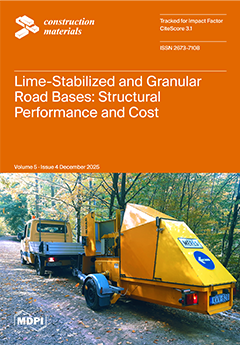
Cover Story (view full-size image):
Pavement base layers significantly influence the structural performance and economic viability of rural roads. This study compares traditional granular base layers with in situ lime-stabilized soil sections constructed on cohesive subgrade, evaluating both load-bearing capacity and life-cycle costs based on pilot road sections in Hungary. Instrumented field tests revealed that lime stabilization can achieve elastic moduli comparable to crushed stone bases while offering substantial cost savings and reduced environmental impact through local material use and lower transport needs. The results support lime stabilization as a sustainable alternative for low-volume pavement design without compromising structural performance. View this paper
- Issues are regarded as officially published after their release is announced to the table of contents alert mailing list.
- You may sign up for e-mail alerts to receive table of contents of newly released issues.
- PDF is the official format for papers published in both, html and pdf forms. To view the papers in pdf format, click on the "PDF Full-text" link, and use the free Adobe Reader to open them.
Previous Issue
Next Issue
