Article

Parametric Optimization of a Cross-Beam Glulam Floor System Using Response Surface Methodology


1
Department of Metal, Wooden and Plastic Structures, Odesa State Academy of Civil Engineering and Architecture, 65029 Odesa, Ukraine
2
Department of Highways and Airfields, Odesa State Academy of Civil Engineering and Architecture, 65029 Odesa, Ukraine
*
Author to whom correspondence should be addressed.
Constr. Mater. 2025, 5(4), 85; https://doi.org/10.3390/constrmater5040085
Submission received: 28 September 2025 / Revised: 17 November 2025 / Accepted: 20 November 2025 / Published: 26 November 2025

Abstract

Cross-beam glued-laminated timber (glulam) floor systems offer material efficiency but pose a complex design challenge due to three-dimensional (3D) load interactions, and systematic optimization guidelines are lacking. This study implements a parametric optimization framework using a three-factor Design of Experiments (DOE) approach (beam spacing ratio, height-to-span ratio, width-to-height ratio). A total of 27 full-factorial finite element models (FEMs) were simulated in Dlubal RFEM. A second-order response surface methodology (RSM) model was developed to predict the load utilization factor (Y) in accordance with Eurocode 5. The predictive model demonstrated high statistical accuracy (R2 > 0.98). A multi-criteria optimization using the Pareto frontier identified a balanced solution (x1 = 0.250, x2 = 0.042, x3 = 0.5) that achieved 97.4% load utilization (Y = 0.974). This optimal configuration reduces the required timber volume by approximately 10% compared with other efficient designs and by over 60% compared with inefficient (Y ≈ 0.5) but safe designs within the experimental space. The resulting regression model provides a validated engineering tool for designing materially efficient glulam floor systems, allowing designers to balance structural safety with material economy.

1. Introduction

Timber flooring systems are widely used in residential and commercial buildings due to their sustainability, aesthetic appeal, and favorable mechanical properties [1]. Among these systems, glued-laminated timber (glulam) structures offer enhanced strength, dimensional stability, and design flexibility, enabling engineers to tailor solutions to specific architectural and loading requirements [2,3]. The development of efficient glulam flooring structures has become particularly important in view of the environmental challenges facing modern construction, as wood serves as a low-carbon, renewable alternative to steel and concrete, thereby promoting carbon sequestration in building structures [4].
Particular attention is given to cross-beam glulam systems, which can provide high stiffness and load-bearing capacity over large spans with potentially reduced material consumption compared with solid slabs [5]. These systems are integral to the growth of multi-stored timber buildings, which have seen a significant increase in scale and ambition over the past two decades [5].
Despite their advantages, the efficient design of glulam floor systems—particularly those with cross-beam configurations—poses a significant challenge. This challenge arises because the structural behavior is governed by a complex, three-dimensional interaction between primary and secondary beams, often involving biaxial bending and compressive forces that simple one-dimensional beam theory cannot adequately capture. Geometric parameters such as beam spacing, cross-sectional dimensions, and their ratios directly affect this load distribution, structural performance (strength and deflection), and overall material consumption. Suboptimal configurations can lead to excessive deflection, vibration issues, increased costs, and reduced structural reliability [6,7].
Previous research has applied optimization techniques to various timber structures, such as single beams, trusses, or CLT panels [8,9]. For instance, studies by Loss et al. focused on topological optimization [8], while Wang et al. reviewed machine learning applications in timber design [9]. However, the specific parametric optimization of cross-beam glulam floor systems remains a less explored area. There is a need for a systematic methodology that can navigate the complex design space defined by multiple interacting geometric variables, which has not been fully addressed.
To address this problem, the present study proposes a parametric optimization framework for cross-beam glulam flooring systems. The methodology integrates Design of Experiments (DOE) and Response Surface Methodology (RSM) approaches [10,11]. These methods are particularly well-suited for this problem as they can efficiently model the complex, non-linear relationships and quadratic interactions between multiple geometric variables, which simpler one-factor-at-a-time analyses would miss.
The primary objective of this work is to develop and validate a predictive model for the load utilization factor (Y) of a cross-beam glulam floor system. This study quantitatively assesses the influence of the beam-spacing ratio (x1), height-to-span ratio (x2), and width-to-height ratio (x3) on structural performance in accordance with Eurocode 5 [12]. Using this model, the research seeks to identify optimal geometric parameters that minimize material usage (timber volume) while satisfying the normative constraint of 0.9 < Y ≤ 1.0, thereby providing a practical, scientifically grounded methodology for designers.

2. Methodology

2.1. Parametric Modeling and Strength Verification

Numerical modelling of a glulam cross-beam floor system was performed using Dlubal RFEM (version 6.03.3109) software, which implements the finite element method for the spatial analysis of load-bearing structures. The overall structure had a span of 6000 mm. The glulam material was assumed to be GL24h, in accordance with EN 14080 [13], with a characteristic bending strength of 24 MPa, a mean modulus of elasticity (E) of 11,500 MPa, and a density of 380 kg/m3. The model calculations were performed for Service Class 1 under a medium-term load duration. Additional material properties for GL24h used in the FEM analysis included a shear modulus G = 690 N/mm2 and a characteristic compressive strength fc,0,k = 21 N/mm2.
In this study, three primary dimensionless parameters were varied at three levels each (Table 1):
x1—ratio of the secondary beam spacing (b) to the total structure span;
x 1 = b L
x2—ratio of the beam height (hb) to the span;
x 2 = h b L
x3—ratio of the beam width ( b b ) to its height hb;
x 3 = b b h b
These three factors were chosen because they are the primary drivers of a cross-beam system’s geometric design. The selected ranges (e.g., 0.167 to 0.333 for x1) are dimensionless, making the methodology scalable and representative of typical spacing-to-span ratios used in practical construction.
For each combination of values for these factors (27 variations in total), a corresponding structural model was created in Dlubal RFEM, incorporating a static load and pinned corner supports. The ultimate load-bearing capacity was calculated in accordance with EN 1995 [12] and EN 1990 [14] standards.
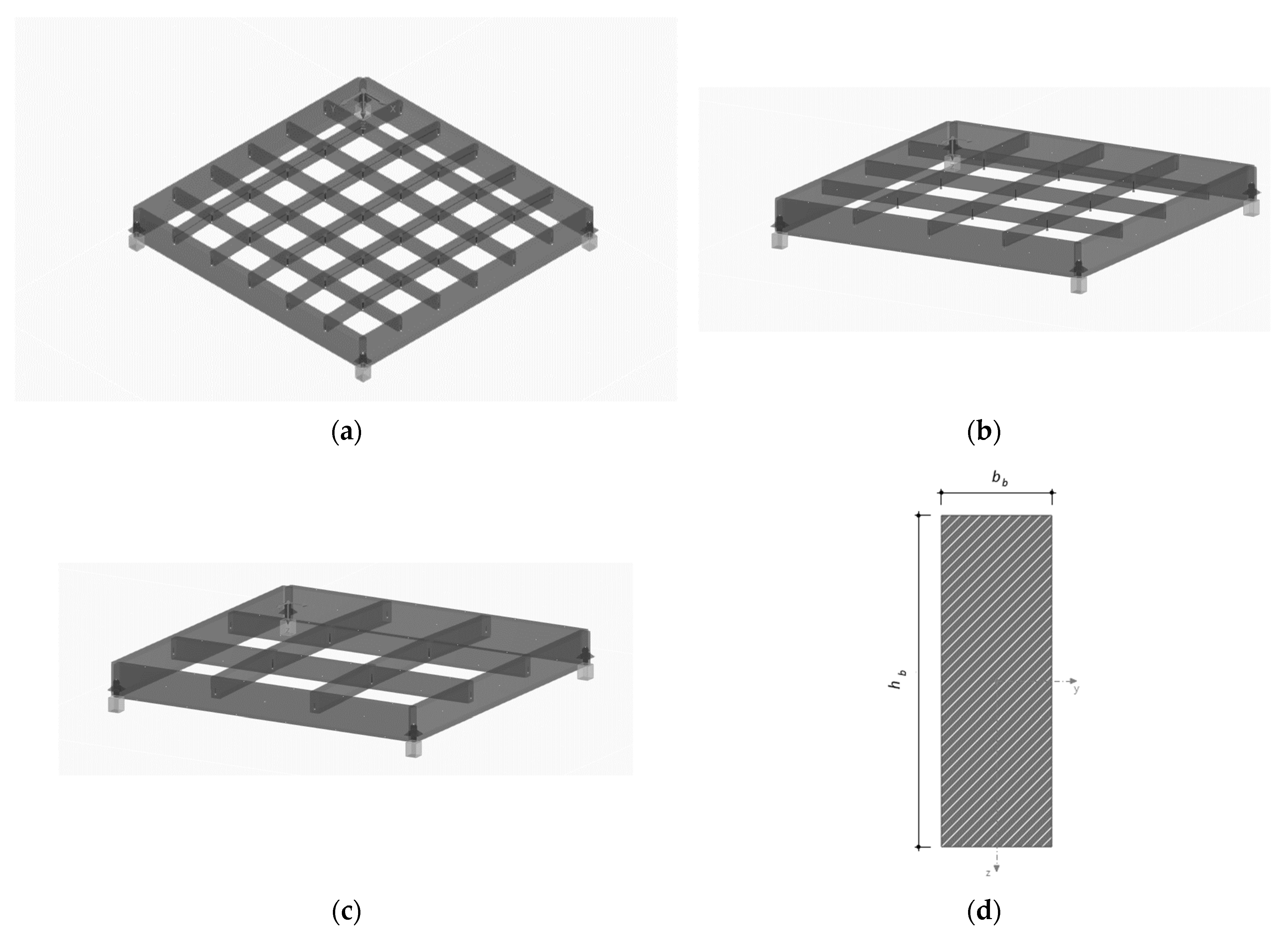
The computational models (Figure 1) illustrate the variations in system configuration under different geometric parameters. Modelling was performed using Dlubal RFEM (version 6.03.3109) software in accordance with Eurocode 5 requirements. The total span of the system was 6.0 m.
The load-bearing capacity was assessed in accordance with DSTU B EN 1995-1-1:2010 (Eurocode 5) [12]. The analysis revealed that the most critical condition involved the simultaneous application of bending moments in two planes, combined with a compressive force acting on the central elements of the cross-beam system. Verification was carried out in accordance with Clause 6.2.4 of Eurocode 5 [12] for combined biaxial bending and compression.
The stress state of an element subjected to a compressive normal force and bending in two planes was considered, and verification was performed in accordance with Clause 6.2.4 of Eurocode 5, which requires consideration of the interaction between normal and bending stresses.
The ultimate limit state of strength is determined by the utilization factor η, denoted as Y in this study:
η = max η 1 , η 2
where
η 1 = σ c , 0 , d f c , 0 , d 2 + σ m , y , d f m , y , d + k m σ m , z , f m , z ,
η 2 = σ c , 0 , d f c , 0 , d 2 + k m σ m , y , d f m , y , d + σ m , z , f m , z ,
fc,0,d—design compressive strength; kmod—modification factor; fc,0,k—characteristic compressive strength; γMpartial factor; fm,y,d, fm,z,d—design bending strength; fm,y,k—characteristic bending strength; η1—design variant 1; η2—calculated variant 2; σc,0,d—calculated compressive stress; σm,y,d, σm,z,d—calculated bending stresses.
The design element satisfies the requirements of the ultimate limit state (ULS) if the load-bearing capacity utilization factor η ≤ 1, confirming an adequate safe margin. The primary load is transferred through compression, with negligible bending stresses, consistent with the behavior of the element within a cross-beam slab system.
To illustrate the verification methodology in accordance with Eurocode 5 [12], a worked example is provided for a critical element (experimental point 21, Y = 0.702). The design strength values were derived using a modification factor kmod = 0.8.
Design Stresses (from FEM):
Compressive stress σc,0,d = −0.430 N/mm2;
Bending stress σm,y,d = −10.277 N/mm2;
Bending stress σm,z,d = −0.322 N/mm2.
Design Strengths:
Compressive strength fc,0,d = 12.923 N/mm2;
Bending strength fm,y,d = 14.769 N/mm2;
Bending strength fm,z,d = 14.769 N/mm2.
Redistribution Factor km = 0.7.
These values are substituted into Equations (4) and (5):
η 1 = 0.43 12.923 2 + 10.277 14.769 + 0.7 0.322 14.769 0.702 ,
η 2 = 0.43 12.923 2 + 0.7 10.277 14.769 + 0.322 14.769 0.510 .
The final utilization factor (Y) is determined as the maximum of these values: Y = η = max (0.712; 0.510) = 0.712.

2.2. Finite Element Model (FEM) Assumptions

To ensure transparency and reproducibility, the following assumptions were adopted in the Dlubal RFEM modeling:
Loads: The system was analyzed for a total design load combining the self-weight of the glulam members (calculated automatically by RFEM based on the GL24h density) and a uniformly distributed service load of 2.5 kN/m2 applied to the floor surface. This corresponds to a characteristic load for office or residential areas in accordance with EN 1991-1-1 [15].
Element Type: All main and secondary beams were modeled using one-dimensional (‘member’) elements.
Supports and connections: The four corner supports were modelled as pinned (hinged), restraining translation in X, Y, and Z but allowing rotation. All beam-to-beam intersections within the grid were modeled as rigid connections, ensuring full moment and shear transfer. This assumption—while a simplification of practical semi-rigid joinery—is a common and generally conservative approach used to establish a baseline in parametric studies. The specific influence of connection semi-rigidity is noted as a limitation in Section 5.
Mesh: The one-dimensional (‘member’) elements were discretized with a mesh-refinement strategy ensuring at least ten finite elements per member (beam segment) to accurately capture bending modes.
Analysis: A second-order static analysis was performed to account for potential geometric non-linearities, although the design was primarily governed by first-order strength criteria in Equations (4) and (5).
FEM validation: Although full-scale experimental validation was outside the scope of this study, the FEM modeling approach was verified. Simple configurations of the model (e.g., a single beam under uniform load) were compared against analytical solutions based on classical beam theory. The FEM results for deflection and stress showed strong agreement with these analytical predictions, providing confidence in the model’s fundamental accuracy.

3. Design of Multifactorial Experiment and Predictive Modeling

3.1. Input Parameters

The input data for the regression analysis of the structural parameters are presented in Table 2. The table is also supplemented with the timber volume of the secondary beams within the cross-beam glulam system.
Based on the adopted assumptions, the volume of the cross-beam glulam system is defined as follows:
V = 2   n   h b b b L
where beam height h b = x 2 · L ; beam width; b b = x 3 · x 2 · L ; number of beams in each principal direction n = 1 x 1 1 .
For subsequent analysis and parameter optimization, it is necessary to construct an analytical model capable of predicting the utilization factor Y (η) of the structure’s load-bearing capacity. A second-order regression surface was selected as the model, incorporating the main effects, pairwise interactions, and quadratic nonlinearities. The dependency of Y was modelled using a classic second-order polynomial equation (Equation (7)). This approach captures the main effects, pairwise interactions, and quadratic nonlinearities, representing a standard formulation in Response Surface Methodology [11,16]:
Y = b 0 + b 1 x 1 + b 2 x 2 + b 3 x 3 + b 12 x 1 x 2 + b 13 x 1 x 3 + b 23 x 2 x 3 + b 11 x 1 2 + + b 22 x 2 2 + b 33 x 3 2
To perform the regression analysis accounting for interactions and quadratic effects, the Analysis ToolPak add-in in Microsoft Excel was utilized. The experimental dataset was supplemented with artificial variables as follows:
-
Products of factor pairs: x1x2, x1x3, x2x3;
-
Squares of individual factors: x12, x22, x32.
The procedure includes the following steps:
1.
Forming a table of input variables.
2.
Creating additional columns for non-linear terms.
3.
Applying the Regression function.
4.
Estimating the model coefficients and assessing their statistical significance.

3.2. Predictive Model and Interpretation

The utilization factor Y (or η from Equations (4) and (5)) is the principal response variable, representing the ratio of applied stress to the material’s design strength. The interpretation of this value is crucial for optimization:
Y > 1.0—the element fails to satisfy the strength requirements (loss of load-bearing capacity). This design region is structurally unsafe and therefore unacceptable.
Y = 1.0—the element’s strength is fully (100%) utilized; this represents the theoretical optimum.
Y < 1.0—the element remains safe, but its full capacity is not exploited. A value significantly less than 1.0 (e.g., Y = 0.3) indicates an excessive, uneconomical safety margin, leading to inefficient material usage.
A second-order regression model, developed on the basis of the results from the three-factor numerical experiment (Table 2), enables a quantitative assessment of the influence of the structural parameters of the cross-beam timber flooring system on the utilization factor of the structure’s load-bearing capacity (Y).
In the context of technical design aimed at cost optimization and efficiency, achieving values of Y close to 1.0 signifies full utilization of the structural potential without an excessive safety margin. This, in turn, permits a reduction in the timber volume used in the structure without compromising safe operational conditions.
The resulting mathematical model was obtained in the following form:
Y = 5.257 + 14.561 x 1 142.5 x 2 8.729 x 3 58.174 x 1 x 2 + 9.68 x 1 x 3 + 111.75 x 2 x 3 11.54 x 1 2 + 792.86 x 2 2 + 4.44 x 3 2
According to the simulation results, the model’s coefficient of determination is (R2) is 0.982, indicating a high level of explanatory power. The statistical significance of the model and its coefficients was verified, as summarized in Table 3.
The high F-statistic and corresponding p-value (<0.001) confirm the overall statistical significance of the model. The p-values for the individual coefficients are predominantly below the 0.05 threshold, validating their contribution to the model. The relatively large magnitudes of some coefficients (e.g., b2, b22) are an expected mathematical outcome of model fitting to small input variables (e.g., x2 in the range 0.0417–0.0625) and their quadratic terms. Given the high R2 and consistently strong p-values, this does not indicate a multicollinearity issue; rather, it confirms the model’s sensitivity to these parameters. While the MS Excel Analysis ToolPak used for this regression is sufficient for a full-factorial design, it is acknowledged that more advanced statistical software could provide more comprehensive diagnostic capabilities, which may be explored in future work.
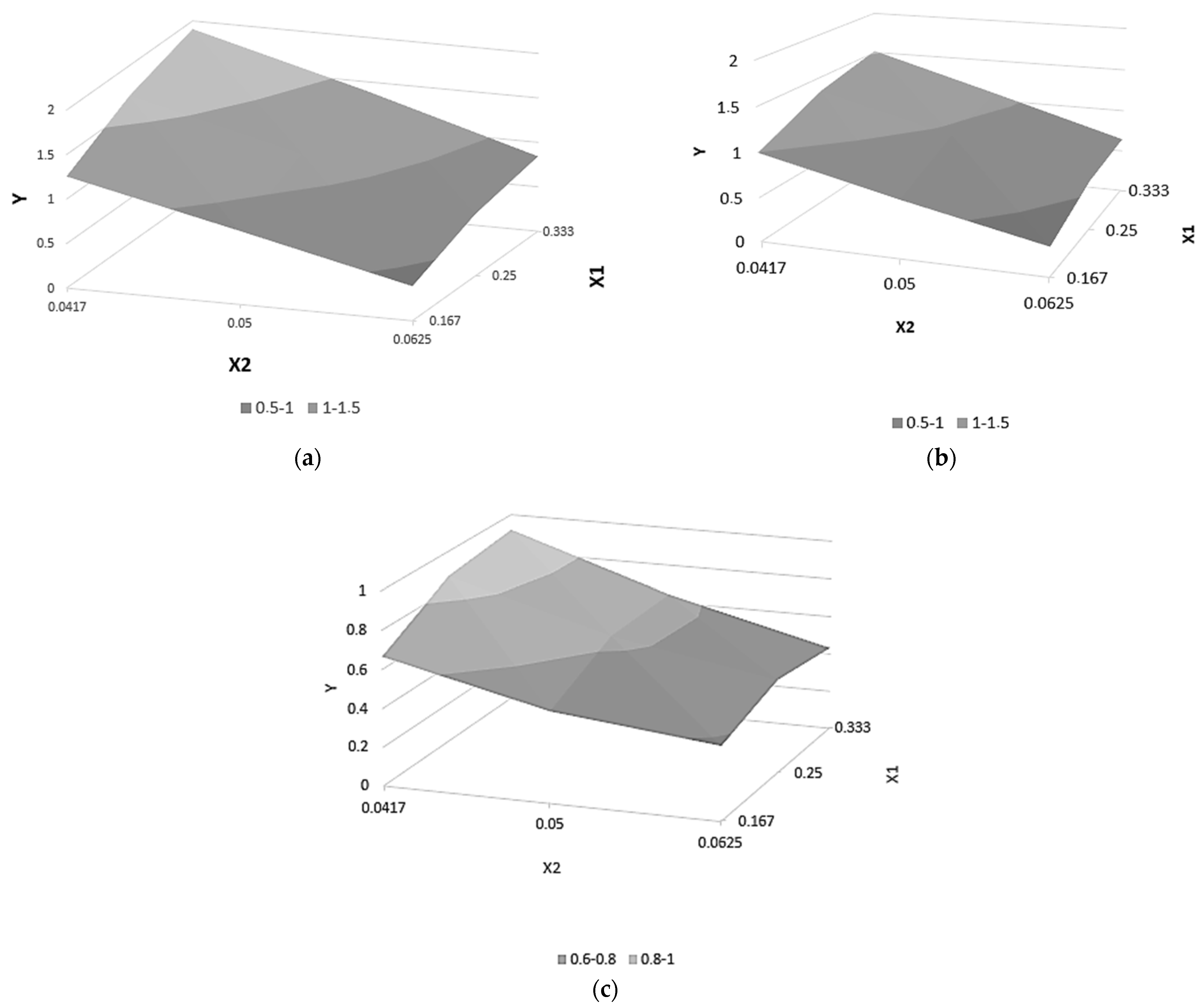
Visual interpretation of the model as response surfaces (Figure 2) enables the identification of regions within the factor space where the value of Y approaches unity. In regions where Y > 1, the structure loses load-bearing capacity, whereas when Y > 1, an excessive safety margin exists, which is economically impractical.
The response surfaces presented in Figure 2 illustrate the complex relationship described by Equation (8). Each plot shows the interaction between the beam spacing ratio (x1) and the height-to-span ratio (x2) at a fixed level of the width-to-height ratio (x3).
Figure 2a (x3 = 0.25): The surface is a notable “steep” surface, and Y-values easily exceed 1.0, indicating high structural sensitivity and a substantial unsafe region.
Figure 2b (x3 = 0.33): The surface becomes more moderate, but the area where Y > 1.0 remains significant.
Figure 2c (x3 = 0.50): The entire surface lies within the “safe” region (Y < 1.0), demonstrating that these wider beams provide a robust structure but may also lead to over-design (Y << 1.0).
The optimization objective is to determine the combination of (x1, x2, x3) that positions the design at the “peak” of this response surface, as close as possible to Y = 1.0 without entering the unsafe region (Y > 1.0). It is important to note that this predictive model (Equation (8)) is validated only within the tested parameter ranges (Table 1). Extrapolating beyond these limits (e.g., x1 > 0.333) is not recommended, as the model’s accuracy cannot be guaranteed.

3.3. Optimization and Practical Configuration Assessment

An analytical model of a cross-beam glued laminated timber system was developed in Dlubal RFEM, numerically assessed, and subsequently validated through a three-factor parametric experiment. Based on these results, the dependence of the load-bearing capacity utilization coefficient (Y) on the structural parameters (Equation (8)) was established. To achieve a rational balance between the mechanical efficiency of the structure and its material consumption, a multi-criteria optimization problem was established.
Variables:
x1(0.167/0.25/0.333);
x2(0.0417/0.05/0.0625);
x3(0.25/0.333/0.5).
Models:
Y ( x 1 ,   x 2 ,   x 3 ) regression Equation   ( 8 ) ; V ( x 1 ,   x 2 ,   x 3 )   =   2 1 x 1 1 · x 2 2 · x 3 · L 3 timber volume .
where L = 6 m.
Optimization criterion:
V ( x 1 ,   x 2 ,   x 3 )     min
Constraints:
0.9 < Y ( x 1 ,   x 2 ,   x 3 )     1
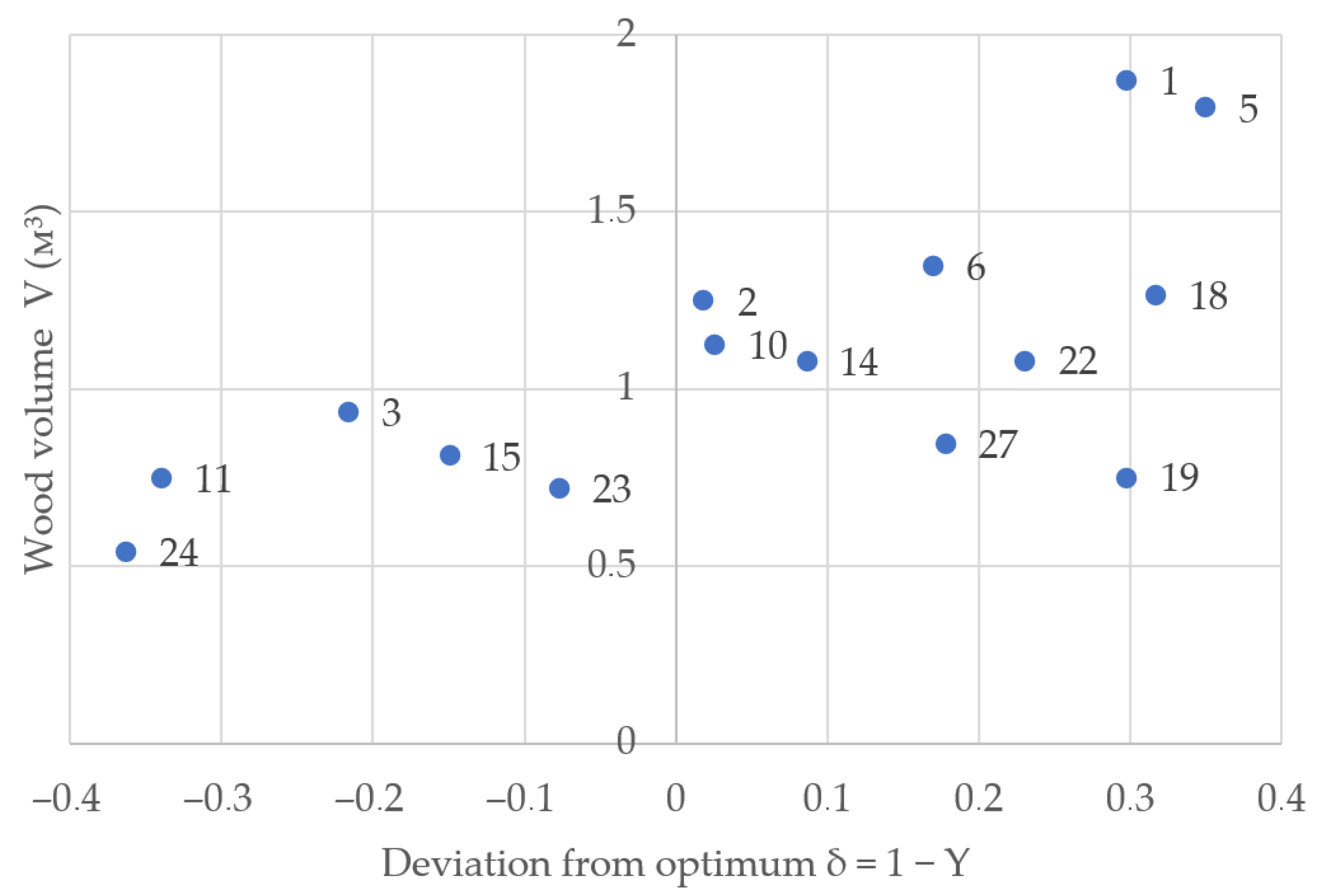
Figure 3 presents the set of experimental configurations for the glued-laminated timber (glulam) cross-beam system. The X-axis represents the absolute deviation of the load-bearing capacity utilization coefficient from its optimal value (δ = 1 − Y), which characterizes the operational efficiency of the structure. The Y-axis represents the corresponding timber volume (V) required for each configuration.
The Pareto chart enables the identification of balanced solutions that minimise timber consumption while maintaining an acceptable level of load-bearing capacity utilization. Data points within the range δ ≤ 0.1 correspond to designs approaching technical optimality, whereas solutions with δ ≥ 0.1 demonstrate a trade-off between reduced material intensity and decreased efficiency. The diagram indicates that three configurations—corresponding to experimental variants 2, 10, and 14 in Table 2—fall within the high-efficiency zone. The optimization results for these configurations are summarised in Table 4.

4. Discussion of Results

4.1. Comparison of Efficient Structural Configurations

The selected structural parameter configurations (Table 3) enable a comparative assessment of solutions that provide a standard level of load-bearing capacity utilization while varying in timber volume. The analysis indicates that even small variations in the parameters (x1, x2, x3) can significantly influence the relationship between structural reliability and cost-effectiveness.
The most balanced solution is Option № 10, with parameters x1 = 0.250, x2 = 0.042, and x3 = 0.5, demonstrating near-optimal strength utilization (Y = 0.974, δ = 0.026) and a relatively low timber volume of V = 1.127 m3. This option can therefore be considered technically and economically viable within the framework of a multi-criteria evaluation.
In option № 2, where Y = 0.981, the deviation is even smaller; however, the structure requires a larger timber volume (V = 1.248 m3), thus achieving higher strength utilization at the expense of material economy. Conversely, Option № 14 has a lower volume (V = 1.079 m3), but also a noticeably reduced realized strength (Y = 0.914, δ = 0.086), which falls outside the 5% the optimal zone.

4.2. Pareto Analysis

Based on the constructed Pareto chart (Figure 3), which was generated by manually plotting the 27 discrete experimental outcomes from Table 2 against the two objectives—timber volume (V) and deviation (δ)—the limits of an acceptable technical and economic trade-off can be defined. Structures with δ ≤ 0.1 (or a utilization factor Y ≥ 0.9) are considered to lie on the efficient Pareto frontier. This range (0.9 < Y ≤1.0) is not an explicit requirement of Eurocode 5 [12] but represents a practical engineering target commonly adopted in structural optimization. Designs where Y ≥ 0.9 are structurally safe but are economically inefficient due to excessive, unused material capacity. Consequently, the threshold Y ≥ 0.9 is chosen as a rational engineering compromise, representing designs that achieve at least 90% utilization while maintaining a small acceptable margin.
Variants with larger deviations may still be acceptable under reduced load requirements or for temporary solutions.
Hence, it is advisable to select structural configurations not only on the basis of minimizing material volume but also on ensuring adequate strength utilization. This approach guarantees reliability, durability, and compliance with regulatory requirements. The proposed methodology further enables the adaptation of the structure to specified design conditions, including span length, operational environment, and permissible load.

4.3. Model Validation

The high coefficient of determination (R2 = 0.982) demonstrates that the second-order regression model (Equation (8)) provides an excellent fit to the data generated by the FEM simulations within the investigated parameter space. This result confirms the reliability for interpolation and optimization within the specified design range. Although full-scale experimental validation was beyond the scope of this study, the model’s accuracy—based on the 27 numerical experiments—is considered robust for the purpose of this parametric optimization.

4.4. Material Efficiency

The analysis demonstrates a significant potential for material savings. The estimated reduction of 25–30% is derived by comparing the optimized solution (Point 10, V = 1.127 m3) with other structural ‘safe’ (Y < 1.0) yet non-optimal designs identified in the numerical experiment. For instance, Point 18 (x1 = 0.250, x2 = 0.0625, x3 = 0.500) has a timber volume of V = 2.252 m3 with Y = 0.510. Although structurally adequate, this configuration is highly inefficient, requiring almost twice the material of the optimal design (Point 10). The 25–30% range therefore represents a conservative estimate of potential savings relative to a typical baseline configuration that might be selected intuitively by an engineer (e.g., Y ≈ 0.7–0.8) in the absence of systematic optimization.

5. Limitations and Future Work

The authors acknowledge the following limitations of this study, which also indicate potential directions for future research:
FEM Assumptions: The FEM model assumed perfectly rigid connections at beam intersections. In practice, glulam joints exhibit semi-rigid behavior, which can influence both load distribution and deflection. Future work should incorporate non-linear springs or ‘joint’ elements to model these more realistically.
Material Properties: The study used deterministic material properties for GL24h glulam and did not account for the natural variability of timber properties (e.g., modulus of elasticity, strength). A probabilistic analysis—such as Monte Carlo simulation—could be implemented in future research to evaluate the reliability of the optimal design.
Scope of Parameters: The optimization was performed for a specific span (L = 6.0 m) and load case (2.5 kN/m2). While the methodology is applicable to other spans and loads, the particular optimal ratios (x1, x2, x3) identified in this study are valid only under these conditions.
Slab and System Scope: The study focused exclusively on the timber volume of the cross-beam grid. It did not include the volume or structural contribution of the floor slab (e.g., CLT or timber-concrete composite) that the grid would support. A holistic optimization including the slab volume and stiffness as variables would represent a valuable extension of this work.
Optimization Objectives: The present study focused on volume minimizing under ultimate limit state (ULS) conditions. However, it is important to recognize that for timber floor systems, Serviceability Limit States (SLS)—specifically deflection and vibration—often govern the design [17,18,19], particularly for longer spans or residential applications where user comfort is critical. Consequently, the ULS-optimal configurations identified here may carry a risk of insufficient stiffness. The presented results are therefore most applicable as a baseline for structural efficiency or for scenarios with high imposed loads where strength is the dominant constraint. Future research should explicitly integrate SLS criteria to refine these optima.

6. General Conclusions

This research successfully developed and applied a scientifically grounded methodology for the parametric optimization of a cross-beam glulam floor system. By integrating a three-factor Design of Experiments (DOE) framework with Finite Element Modeling (FEM) and Response Surface Methodology (RSM), the study moved beyond simplified one-dimensional analysis and addressed the complex, non-linear interactions between key geometric ratios.
A robust predictive regression model (R2 > 0.98) was formulated, enabling a quantitative evaluation of how beam spacing (x1), height-to-span (x2), and width-to-height (x3) ratios collectively influence the load utilization factor (Y) in accordance with Eurocode 5.
Multi-criteria optimization, using Pareto frontier analysis, identified a technically optimal configuration (x1 = 0.250, x2 = 0.042, x3 = 0.5) that achieves near-complete load utilization (Y = 0.974) while minimizing timber volume (V = 1.127 m3). This outcome demonstrates the methodology’s capacity to achieve a balance between structural safety and material economy.
The practical significance of this research lies in providing a validated framework that can lead to material savings of 25–30% compared with conventional, non-optimized designs, while maintaining full compliance with normative requirements. The proposed methodology therefore offers a practical tool for structural engineers to enhance sustainability, resource efficiency [20,21,22], and design in modern timber construction [23].
From a practical perspective, structural engineers can utilize the proposed regression model as a rapid pre-design tool [24]. This allows for the estimation of timber volume and load utilization for various geometric configurations without the need for immediate finite element modeling, serving as an efficient screening method during the preliminary design phase.

Author Contributions

Conceptualization, O.G. (Oleksandr Gilodo) and O.G. (Oleksandr Gimanov); methodology, A.A. and O.G. (Oleksandr Gimanov); software, A.A.; validation, S.K. and O.G. (Oleksandr Gimanov); formal analysis, O.G. (Oleksandr Gimanov); investigation, A.A.; resources, S.K. and O.G. (Oleksandr Gilodo); data curation, O.G. (Oleksandr Gimanov); writing—original draft preparation, O.G. (Oleksandr Gimanov); writing—review and editing, O.G. (Oleksandr Gilodo) and O.G. (Oleksandr Gimanov); visualization, A.A.; supervision, S.K. and O.G. (Oleksandr Gilodo); project administration, S.K.; funding acquisition, S.K. All authors have read and agreed to the published version of the manuscript.

Funding

This research received no external funding.

Institutional Review Board Statement

Not applicable.

Informed Consent Statement

Not applicable.

Data Availability Statement

The data supporting this study are available from the author on request.

Acknowledgments

The author gratefully acknowledges the provision of an academic license for the Dlubal RFEM software, which was essential for performing the numerical modeling and parametric optimization presented in this study.

Conflicts of Interest

The authors declare no conflicts of interest.

References

  1. Sandberg, D.; Fragiacomo, M.; Loss, C.; Buchanan, A.H. Timber engineering principles for sustainable construction. Constr. Build. Mater. 2021, 301, 124082. [Google Scholar] [CrossRef]
  2. Fragiacomo, M.; Lukaszewska, E. Advances in timber structures. Eng. Struct. 2019, 183, 1–3. [Google Scholar] [CrossRef]
  3. Svatoš-Ražnjević, H.; Orozco, L.; Menges, A. Advanced timber construction industry: Review of 350 projects. Buildings 2022, 12, 404. [Google Scholar] [CrossRef]
  4. Churkina, G.; Organschi, A.; Reyer, C.P.O.; Ruff, A.; Vinke, K.; Liu, Z.; Reck, B.K.; Graedel, T.E.; Schellnhuber, H.J. Buildings as a global carbon sink. Nat. Sustain. 2020, 3, 269–276. [Google Scholar] [CrossRef]
  5. Kaufmann, H.; Krotsch, S.; Winter, S. Manual of Multistorey Timber Construction; DETAIL: Munich, Germany, 2018. [Google Scholar] [CrossRef]
  6. Karacabeyli, E.; Lum, C. CLT Handbook: US Edition; FPInnovations: Pointe-Claire, QC, Canada, 2023. [Google Scholar]
  7. Gimanov, O.M. Analysis of Development Paths and Use of Timber and Glulam Floor Systems; Research Bulletin; Odesa State Academy of Civil Engineering and Architecture: Odesa, Ukraine, 2025. [Google Scholar]
  8. Belz, J.; Kromoser, B. Structural optimization of wooden building components: A systematic review of established practices. Wood Mater. Sci. Eng. 2025, 1–22. [Google Scholar] [CrossRef]
  9. Wdowiak-Postulak, A.; Bahleda, F.; Prokop, J. An Experimental and Numerical Analysis of Glued Laminated Beams Strengthened by Pre-Stressed Basalt Fibre-Reinforced Polymer Bars. Materials 2023, 16, 2776. [Google Scholar] [CrossRef] [PubMed]
  10. Montgomery, D.C. Design and Analysis of Experiments, 9th ed.; Wiley: Hoboken, NJ, USA, 2017. [Google Scholar]
  11. Box, G.E.P.; Hunter, W.G.; Hunter, J.S. Statistics for Experimenters: Design, Innovation, and Discovery, 2nd ed.; Wiley: Hoboken, NJ, USA, 2005. [Google Scholar]
  12. EN 1995-1-1; Eurocode 5: Design of Timber Structures—Part 1-1. European Committee for Standardization: Brussels, Belgium, 2014.
  13. Simón-Portela, M.; Villar-García, J.R.; Rodríguez-Robles, D.; Vidal-López, P. Optimization of Glulam Regular Double-Tapered Beams for Agroforestry Constructions. Appl. Sci. 2023, 13, 5731. [Google Scholar] [CrossRef]
  14. EN 1990; Eurocode: Basis of Structural Design. European Committee for Standardization: Brussels, Belgium, 2002.
  15. EN 1991-1-1; Eurocode 1: Actions on structures—Part 1-1: General actions—Densities, Self-Weight, Imposed Loads for Buildings. European Committee for Standardization: Brussels, Belgium, 2002.
  16. Lee, H.; Lee, S.; Ha, Y.; Kim, K. CLT floor slab impact sound and reduction performance. In Proceedings of the INTER-NOISE 2023 Conference Proceedings, Chiba, Japan, 20–23 August 2023. [Google Scholar] [CrossRef]
  17. Brandner, R.; Flatscher, G.; Ringhofer, A.; Schickhofer, G.; Thiel, A. Cross-laminated timber roofs: Structural performance. J. Struct. Eng. 2020, 146, 04020049. [Google Scholar] [CrossRef]
  18. Marini, A.; Sandu, I.C.; Modena, C. Retrofit of wooden floors in historical buildings: Criteria and case studies. Constr. Build. Mater. 2018, 158, 801–813. [Google Scholar] [CrossRef]
  19. Won, D.; Kim, Y. Literature review of floor impact noise in CLT apartments. In Proceedings of the INTER-NOISE 2023 Conference Proceedings, Chiba, Japan, 20–23 August 2023. [Google Scholar] [CrossRef]
  20. Carrigan, C.; McKenna, S.; Mohammed, S. Green cement and concrete technology. Int. J. Sust. Built Environ. 2013, 1, 9–15. [Google Scholar] [CrossRef]
  21. ARUP Rethinking Timber Buildings. ARUP Research Report. 2019. Available online: https://www.arup.com/perspectives/publications/research/section/rethinking-timber-buildings (accessed on 22 August 2025).
  22. Jalali, S.; Borges, C.; da Silva, L.F.M. Sustainable adhesive joints in timber construction. Polymers 2022, 15, 89. [Google Scholar] [CrossRef]
  23. Buchanan, A.; Palermo, A.; Pampanin, S. Post-tensioned timber buildings: Seismic performance and design. Struct. Eng. 2011, 89, 24–30. [Google Scholar]
  24. Fursov, V.; Puryazdanhah, M. Full-scale GLT beam testing. Ukr. Inst. Steel Constr. J. 2013, 12, 71–77. [Google Scholar]
Figure 1. Computational models of the cross-beam system with different beam-spacing configurations: (a) beam spacing = 1.0 m (x1 = 0.167); (b) beam spacing = 1.5 m (x1 = 0.25); (c) beam spacing = 2.0 m (x1 = 0.333); (d) parameters of secondary-beam cross-section.
Constrmater 05 00085 g001
Figure 2. Response surfaces illustrating the relationship between geometric parameters and the load utilization coefficient (Y) at different fixed levels of the width-to-height ratio (x3): (a) x3 = 0.25 (thin beams); (b) x3 = 0.33; (c) x3 = 0.50 (wide beams).
Constrmater 05 00085 g002
Figure 3. Pareto frontier plot for multi-objective optimization illustrating the trade-off between material consumption (timber volume V, m3) and structural efficiency (deviation from the optimum, δ = 1 − Y).
Constrmater 05 00085 g003
Table 1. Input parameters for parametric study of cross-beam glulam floor system.
FactorNotationLevels
Ratio of secondary beam spacing to spanx10.167/0.25/0.333
Ratio of secondary beam height to spanx20.0417/0.05/0.0625
Ratio of beam width to heightx30.25/0.333/0.5
Table 2. Design matrix and coded levels of input parameters for regression modeling.
x1x2x3YV, m3
10.1670.04170.2500.6830.709
20.1670.04170.3330.8010.946
30.1670.04170.5000.8831.419
40.1670.05000.2500.8301.020
50.1670.05000.3330.9261.358
60.1670.05000.5001.0112.042
70.1670.06250.2500.4681.593
80.1670.06250.3330.3552.121
90.1670.06250.5000.3003.183
100.2500.04170.2500.9170.564
110.2500.04170.3331.0200.751
120.2500.04170.5000.9741.127
130.2500.05000.2501.1500.800
140.2500.05000.3330.9141.080
150.2500.05000.5000.6461.620
160.2500.06250.2500.6831.125
170.2500.06250.3330.5261.501
180.2500.06250.5000.5102.252
190.3330.04170.2500.9570.423
200.3330.04170.3331.0030.564
210.3330.04170.5000.7020.846
220.3330.05000.2501.0560.600
230.3330.05000.3331.0770.800
240.3330.05000.5000.7691.200
250.3330.06250.2500.8220.844
260.3330.06250.3330.6421.125
270.3330.06250.5000.4511.688
Table 3. Statistical validation of the regression model coefficient (Equation (8)).
PredictorCoefficientsStandard Errort Statp-Value
Intercept (b0)5.2570.8126.47<0.001
x114.5612.5025.82<0.001
x2−142.50018.067−7.89<0.001
x3−8.7291.107−7.88<0.001
x1x2−58.17420.932−2.780.012
x1x39.6803.5112.760.012
x2x3111.75016.5826.74<0.001
x12−11.5405.093−2.270.035
x22792.860169.5444.68<0.001
x324.4401.3413.310.003
Model SummaryR Square0.982
F-statistic102.1p (Significance F)<0.001
Table 4. Optimized parameter configurations for the cross-beam glulam floor system.
Point №x1x2x3Yδ = 1 − YV (m3)
20.1670.0420.330.9810.0191.247753
100.2500.0420.500.9740.0261.126801
140.2500.0500.330.9140.0861.07892
Disclaimer/Publisher’s Note: The statements, opinions and data contained in all publications are solely those of the individual author(s) and contributor(s) and not of MDPI and/or the editor(s). MDPI and/or the editor(s) disclaim responsibility for any injury to people or property resulting from any ideas, methods, instructions or products referred to in the content.