


Abstract
Background: Mental illness stigma among healthcare professionals can adversely affect patient care and recovery. While attitudes are shifting globally, limited data exist on stigma among non-psychiatrist doctors (NPDs) in India. This study aimed to assess the attitudes of NPDs toward mental illness and psychiatry using the Mental Illness Clinicians’ Attitudes Scale (MICA-4), and to explore associated sociodemographic and clinical factors. Methods: A cross-sectional online survey was conducted across India over six months in 2022, following ethics approval. The survey link was distributed via professional social media platforms using convenience and snowball sampling. Non-psychiatrist doctors with at least an MBBS degree were eligible. The MICA-4 scale assessed stigma across five domains. Descriptive statistics, correlation analyses, and multiple regression analysis were conducted. Results: A total of 102 responses were analysed. The mean MICA-4 score was 48.37, indicating moderately positive attitudes. Domain-wise analysis revealed higher stigma in knowledge/misconception and self-disclosure domains, while attitudes towards ethics and patient care were more favourable. No significant differences were found by gender, specialty, or practice setting. Weekly psychiatric caseload was not associated with reduced stigma. Internal consistency of the scale was low (Cronbach’s α = 0.46), raising concerns about cultural fit. The regression model was statistically significant F (5, 96) = 661.95, p < 0.001, explaining 97.18% of the variance in overall attitudes toward mental illness. Among the five domains, Respect for Psychiatry and Knowledge and Misconceptions emerged as the strongest predictors, highlighting their critical role in shaping positive professional attitudes in the public sector. Conclusions: Stigma toward mental illness persists among NPDs, particularly around misconceptions and help-seeking attitudes. These biases are culturally embedded and may not be significantly influenced by clinical exposure alone. While stigma was generally moderate, persistent misconceptions and self-stigma point to the importance of further developing culturally adapted tools and systemic interventions to promote reflective practice and ethical parity in clinical settings.
1. Introduction
1.1. Background and Burden of Mental Illness
Mental illness is a major contributor to both global and national disease burden, affecting not just mortality but also overall quality of life. In India, the National Mental Health Survey estimates that nearly 14% of the population will experience a mental health condition in their lifetime [1]. Despite this high prevalence, a significant proportion of those affected fail to receive timely or adequate care. Stigma remains a particularly pervasive barrier, operating at public, institutional, and personal levels. It does more than discourage treatment-seeking; it also hampers recovery and contributes to chronic disadvantage [2]. The treatment gap in India is striking, with only one in ten individuals with mental illness accessing evidence-based treatment. This gap arises not only from the limited availability of services but also from the underuse of existing community mental health resources [3].
1.2. Conceptualizing Mental Health Stigma
Stigma has been described as comprising three dimensions: lack of knowledge (ignorance), negative attitudes (prejudice), and discriminatory practices (behaviour) [4]. Link and Phelan [5] further describe stigma as a sociocultural process encompassing labelling, stereotyping, separation, status loss, and discrimination, all embedded within social and structural power dynamics. Such processes foster exclusion, perceptions of incompetence, and associations with dangerousness, which strongly discourage help-seeking.
In clinical practice, stigma often emerges in subtle forms rather than overt discrimination. This may include diagnostic overshadowing, reluctance to explore psychological symptoms, or the implicit assumption that psychiatric disorders are less valid than physical illnesses [6]. Contributing factors include cultural beliefs, insufficient psychiatric training, and negative portrayals of mental illness in media. Although psychiatry has gained increasing inclusion within medical curricula, there remains limited evidence of sustained shifts in clinician attitudes. Moreover, existing studies often examine students or group doctors with allied health staff, leaving gaps in our understanding of practicing non-psychiatrist doctors (NPDs).
1.3. Provider Attitudes and the Role of Healthcare Professionals
The attitudes of healthcare providers are particularly influential as they can facilitate or obstruct access to treatment. A recent systematic review and network meta-analysis concluded that anti-stigma interventions are most effective when they integrate education with structured social contact, leading to meaningful changes in clinician and student attitude [7]. However, anticipated stigma from providers remains a major factor in patients’ reluctance to seek help [8].
1.4. Stigma in the Indian Healthcare Context
A recent SAARC review identified provider-level stigma as a persistent barrier that delays or prevents treatment-seeking across South Asia, including India [9]. This review underscored the importance of studying clinician-level stigma to address the broader treatment gap. Stigma in India is not limited to mental illness but extends to other health conditions. The Indian Council of Medical Research (ICMR) has developed stigma measurement tools for illnesses such as HIV, TB, and sickle cell anaemia [10]. Broader forms of discrimination—rooted in caste, class, sexuality, and disability—further compound healthcare inequities [11]. A recent study among nurses reported that 77% held negative attitudes toward mental illness [12]. Comparable findings were observed among doctors in a London teaching hospital, suggesting that even formal medical training does not guarantee the elimination of stigma [13]. However, the direct applicability of such international findings to India is limited by cultural, structural, and workforce differences.
Within India, few studies have examined stigma comparatively across specialties or explored how psychiatric exposure, years of experience, or workplace setting (public vs. private) shape clinicians’ attitudes. One mixed-methods study investigated stigma among doctors of different specialties, accounting for contextual and experiential variables [14]. Still, broader systemic challenges—such as fragmented referral pathways and resource scarcity—remain underexplored.
At the policy level, efforts to reduce stigma have gained traction. The National Mental Health Policy explicitly identifies stigma reduction as a priority [15]. This was reinforced by the Mental Healthcare Act of 2017, which enshrined the right to equality and non-discrimination for people with mental illness [16]. Nevertheless, the National Mental Health Survey of India (2015–16) concluded that empirical data on stigma in healthcare settings remain limited and called for more research in this area [17].
To address this gap, this study explores attitudes among Indian NPDs, focusing on stigma and its links to demographics, specialty, work setting, and psychiatric exposure.
2. Methods
2.1. Study Design and Participants
A cross-sectional online survey was conducted using Google Forms among non-psychiatrist doctors (NPDs) across India. Ethical approval was obtained from the Institutional Ethics Committee prior to data collection (IEC: DGMCH/2020/349/9). The survey was conducted over a six-month period in 2022. The link was distributed through professional WhatsApp groups and Facebook networks of clinicians.
Inclusion criteria were:
- Holding a minimum qualification of an MBBS degree.
- Actively practicing in a non-psychiatric medical, surgical, or pre-/para-clinical specialty at the time of the survey.
- Consent to participate and completion of the online questionnaire.
Exclusion criteria were:
- Psychiatrists and doctors currently enrolled in postgraduate psychiatry training.
- Medical students or interns who had not yet completed the MBBS degree.
- Incomplete survey responses.
Participation was voluntary, anonymous, and without incentives. Informed consent was obtained electronically prior to survey commencement.
2.2. Tools
The survey comprised two sections. The first section captured demographic information such as age, gender, level of qualification, clinical specialty, and primary work setting (government, private, or both). It also recorded details on clinical exposure to psychiatric comorbidity and attitudes toward referring patients to psychiatric services.
The second section consisted of the 16-item Mental Illness: Clinicians’ Attitudes Scale (MICA-4). The MICA scale was first developed as MICA-2, designed specifically for medical students; however, an amended version was later developed as MICA-4, originally intended for nursing professionals. Over time, use of MICA-4 has been further adapted to diverse professional settings, thereby broadening its scope beyond the medical student focus of MICA-2. The scale consists of 16 items, each rated on a 6-point Likert scale ranging from 1 (strongly agree) to 6 (strongly disagree). Some items are reverse scored so that higher total scores consistently represent more negative (i.e., stigmatizing) attitudes. Thus, the minimum possible score is 16, indicating fewer stigmatizing attitudes, while the maximum is 96, indicating more stigmatizing attitudes. In line with the original factor analysis by Gabbidon et al. [18], the scale was structured into five conceptual domains: respect for psychiatry, knowledge of mental illness, willingness to disclose, distinction between physical and mental illness, and patient care orientation. For clarity and comprehensiveness, both the short labels and detailed explanations of these domains are presented in Table 1.
Table 1.
MICA item domain and details.
2.3. Data Analysis
Data were analysed using R (version 4.4.3). Descriptive statistics were used to summarise participant demographics and MICA-4 total and domain-level scores. Group comparisons of MICA scores by gender, specialty, and sector were conducted using independent-sample t-tests and one-way ANOVA, with post hoc comparisons where relevant. Pearson’s correlation coefficients were calculated to examine associations between total MICA scores and continuous variables such as age and self-reported weekly psychiatric caseload.
A multiple regression analysis was performed to examine how five attitudinal domains—Respect for Psychiatry, Knowledge and Misconceptions, Disclosure and s-Stigma, Distinguishing Physical vs. Mental Health, and Patient Care and Ethics—predict the total MICA score.
The general equation of multiple regression model of this study can be expressed as:
where
Y = β0 + β1X1 + β2 X2 + β3X3 + β4X4 + β5X5 + ε.
Y = Total MICA score (dependent variable).
β0 = Intercept (constant term).
β1, β2, β3, β4, β5 = Regression coefficients of the independent variables:
X1 = Domain Respect;
X2 = Domain Knowledge;
X3 = Domain Self Stigma;
X4 = Domain Distinguish;
X5 = Domain Ethics.
ε = Error term.
3. Results
3.1. Demographic and Professional Characteristics of Participants
A total of 102 non-psychiatrist doctors (NPDs) participated in the study. The mean age was 32.1 years (SD = 8.1), ranging from 22 to 60 years. 56.9% identified as male and 43.1% as female. Educational background varied: 60.8% had postgraduate degrees (MD/MS), 33.3% were MBBS graduates, and 5.9% held super-specialty degrees (DM/MCh). Regarding clinical specialty, 57.8% were from medical disciplines, 17.6% from surgical fields, and 24.5% from non-clinical (pre-/para-clinical) areas. More than half (53.9%) were employed in government settings, 34.3% in private, and 11.8% worked across both. A majority (88.2%) reported encountering psychiatric comorbidity in their routine practice: 47.1% saw such cases regularly, while 41.2% encountered them occasionally. Only 11.8% reported no such exposure. Most participants (75.5%) reported seeing 1–10 psychiatric cases weekly, with fewer seeing 10–30 (17.6%) or more than 30 (6.9%). Regarding referral attitudes, 77.5% indicated they would refer patients to psychiatry when appropriate, 16.5% were unsure, and 5.9% would not refer—indicating broad openness to psychiatric liaison (Table 2).
Table 2.
Demographic and Professional Characteristics of Participants.
3.2. MICA-4 Total and Domain Scores
The total MICA-4 score ranged from 33 to 74, with a mean of 48.37.
Table 3 presents descriptive statistics for five attitudinal domains based on responses from 102 participants. Overall, the mean scores range from 2.96 to 3.17, indicating generally moderate attitudes toward psychiatry and mental health–related issues. The highest mean score was observed for Knowledge and Misconceptions (mean = 3.17, SD = 0.57), suggesting that respondents demonstrate relatively better understanding of psychiatric concepts, with low variability indicating consistent perceptions across participants. Disclosure and Self-Stigma recorded a mean of 3.11 with the highest standard deviation (SD = 1.07), reflecting substantial variability in attitudes and suggesting that respondents hold mixed views regarding mental health disclosure and internalized stigma. Distinguishing Physical versus Mental Health had a mean score of 3.03 (SD = 0.92), indicating a moderate level of awareness, although responses varied noticeably. Patient Care and Ethics and Respect for Psychiatry reported slightly lower mean scores of 2.97 (SD = 0.95) and 2.96 (SD = 0.62), respectively, suggesting comparatively less favorable but still moderate attitudes in these domains. Overall, the findings indicate adequate knowledge levels alongside persistent attitudinal challenges, particularly in relation to stigma, ethical perceptions, and respect for psychiatry, highlighting areas where targeted educational interventions may be beneficial.
Table 3.
Domain-wise Mean Scores of MICA-4.
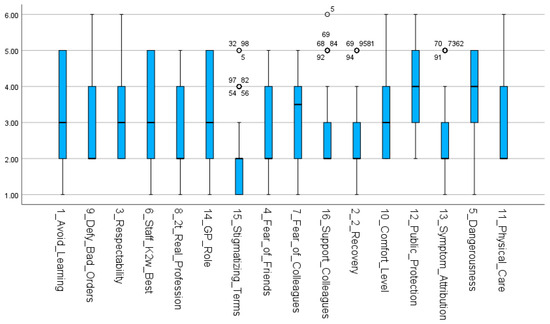
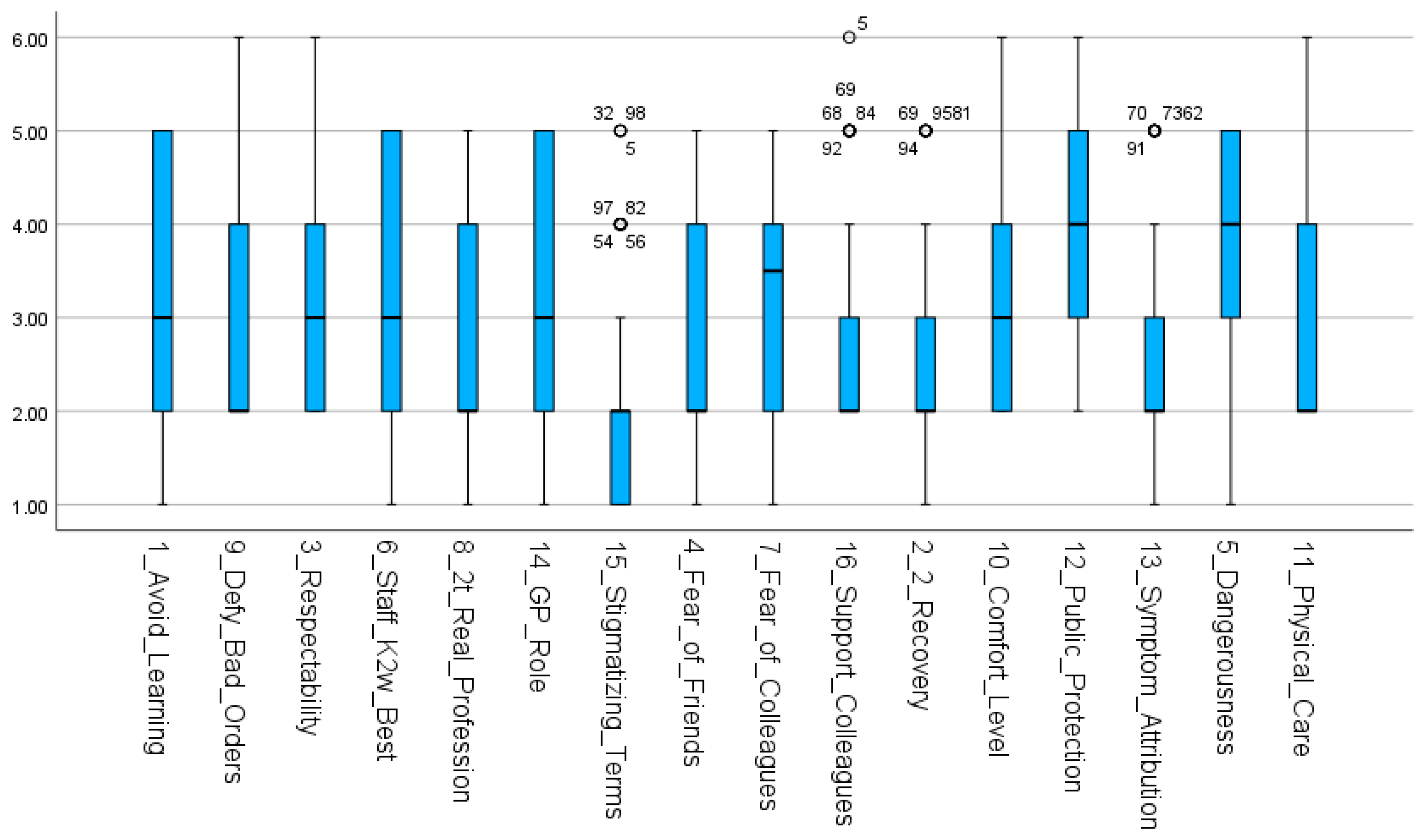
Figure 1 presents the distribution of scores across multiple domains evaluating psychiatric attitudes, revealing noticeable variability between items. Most domains are centred around mid-range values, typically between scores of 3 and 5, while certain items such as “Stigmatizing Terms” reflect relatively lower median values. The presence of distinct outliers in a few domains highlights diverse perspectives among respondents, particularly in areas related to public protection and recovery.
Figure 1.
MICA item-wise score.
3.3. Group Comparisons and Post Hoc Analysis
- By Gender: No significant difference was found between male and female clinicians in MICA scores (mean for males: 49.0, females: 47.6; t(100) = 0.89, p = 0.38).
- By Specialty: Mean MICA scores were: Medical = 47.8, Surgical = 46.9, Nonclinical = 50.0. A one-way ANOVA revealed no significant differences (F(2,99) = 1.07, p = 0.35).
- By Work Setting: Government = 49.1, Private = 47.2, Both = 48.9. Differences were not statistically significant (p > 0.5).
- By Exposure Frequency: Clinicians with regular exposure had slightly lower MICA scores (47) than those with occasional (49) or no exposure (50), but the differences were not significant (Table 4).Table 4. Group Comparisons of Total MICA Score (t-test/ANOVA).
3.4. Correlational Analysis
Age showed a weak negative correlation with stigma (r = −0.11, p = 0.27), suggesting a non-significant trend where older clinicians held slightly more positive views. Psychiatric caseload showed no association (r = −0.02, p = 0.83) (Table 5).
Table 5.
Correlation Between MICA and Age/Caseload.
3.5. Regression Analysis
Multiple regression analysis was conducted to examine how five attitudinal domains—Respect for Psychiatry, Knowledge and Misconceptions, Disclosure and Self-Stigma, Distinguishing Physical vs. Mental Health, and Patient Care and Ethics—predict professionals’ overall attitudes toward mental illness, as measured by the total MICA score (Table 6).
Table 6.
Multiple Regression Analysis Predicting Total MICA Score.
All five domains were significant positive predictors of overall attitudes toward mental illness (p < 0.001), demonstrating that each contributes uniquely to shaping professionals’ perceptions and responses toward individuals with psychiatric conditions.
- Respect for Psychiatry (β = 5.694) was the strongest predictor, indicating that valuing psychiatry as a legitimate and essential discipline is most strongly associated with positive attitudes. Enhancing professional respect for mental health services may therefore yield the greatest impact in reducing stigma within public sector organizations.
- Knowledge and Misconceptions (β = 4.197) emerged as the second most influential factor, emphasizing the importance of accurate information and mental health literacy. Addressing misconceptions through education and professional development can directly improve empathy and service quality.
- Disclosure and Self-Stigma (β = 1.978) significantly influenced overall attitudes, suggesting that individuals who are comfortable discussing mental health and who experience lower self-stigma demonstrate more positive perspectives. Organizational initiatives that normalize help-seeking and mental health discussions could enhance this effect.
- Distinguishing Physical vs. Mental Health (β = 1.890) contributed meaningfully, highlighting that professionals who view mental and physical health as equally important exhibit more balanced and non-discriminatory attitudes. Integrating holistic care perspectives into training may help bridge this conceptual divide.
- Patient Care and Ethics (β = 2.158) also played a significant role, reaffirming that adherence to ethical standards and commitment to patient-centred care underpin positive mental health attitudes and equitable treatment practices.
The constant term (β = −0.125, p = 0.888) was non-significant, indicating that the model’s explanatory power is almost entirely driven by the predictor domains rather than baseline effects.
The model equation will be:
Total MICA Score = −0.125 + 5.694 (Respect for Psychiatry) + 4.197 (Knowledge and Misconceptions) + 1.978 (Disclosure and Self-Stigma) + 1.890 (Distinguishing Physical vs. Mental Health) + 2.158 (Patient Care and Ethics).
4. Discussion
4.1. Overall Attitudes and MICA-4 Score Interpretation
This study offers a detailed understanding of how non-psychiatrist doctors (NPDs) in India perceive mental illness. The average MICA-4 score in our sample was 48.4 (SD = 7.3), below the theoretical midpoint of 56. This indicates a moderately positive attitude towards mental illness and is broadly consistent with previous Indian findings. For instance, Mahla and Gandhi [19] reported a similar mean of 46 ± 9, and Moodley [20] also noted low-to-moderate stigma levels among clinical associates. The fact that the mean is clearly below the midpoint suggests that overtly negative views are not dominant in this population; however, the persistence of stigma in particular domains (as revealed in the domain and item-level analysis) indicates that attitudes remain ambivalent and context-dependent.
When compared internationally, our scores were more favourable than those reported among Egyptian medical students using MICA-2 (mean = 50.7) [21], Chinese community mental health staff (mean = 51.7) [22] and general practitioners in Guangzhou [23]. These comparisons suggest that Indian NPDs—possibly due to clinical experience or training reforms—may hold relatively more constructive attitudes than medical trainees or general community providers in other LMIC contexts. Nevertheless, our null findings in subgroup comparisons may reflect insufficient sample power rather than genuine equivalence and Type II error remains a potential possibility.
4.2. Domain-Level Insights and Stigma Patterns
A domain-wise breakdown revealed nuanced patterns. The “Respect for Psychiatry” domain showed encouraging results, indicating improved legitimacy accorded to the specialty. This may reflect the positive influence of new competency-based medical education (CBME) curricula, which mandate psychiatry rotations for all Indian medical graduates [17].
In contrast, the “Knowledge and Misconceptions” domain (—the highest among all—highlighted persistent stigma. Seventy percent of participants endorsed the belief that patients with mental illness are often dangerous, one of the most enduring stereotypes globally [24]. This misperception is particularly concerning because it affects referral behaviour and clinical empathy [25]. One plausible explanation is selective exposure to high-acuity psychiatric presentations in emergency settings, leading to overgeneralization of risk [26].
The “Disclosure and Self-Stigma” domain reflected internalised stigma. Nearly half of the participants expressed discomfort disclosing mental illness, aligning with earlier studies that show Indian clinicians often fear professional repercussions or loss of credibility [27,28,29]. Globally, this phenomenon is mirrored among doctors in the UK, where what clinicians say they would do often diverges from their actual help-seeking behaviour [30,31].
The “Distinguishing Mental vs. Physical Illness” domain exposed the persistence of diagnostic overshadowing, a known barrier to holistic care [6]. While most clinicians rejected attributing all physical symptoms to mental illness, residual bias remained.
Notably, the “Patient Care and Ethics” domain showed the most supportive attitudes, suggesting a general professional commitment to equitable care. This is a promising foundation on which to build further stigma reduction strategies. The juxtaposition of high ethical support with lingering misconceptions illustrates a paradox: clinicians appear willing to provide fair care, but subconscious biases may still affect how they perceive risk, capacity, or disclosure in psychiatric patients [32].
4.3. Determinants of Professionals’ Attitudes Toward Mental Illness
The multiple regression analysis demonstrates that attitudinal domains collectively explain nearly all variance in professionals’ overall attitudes toward mental illness (R2 = 0.97), underscoring the model’s strong explanatory power. Among the predictors, Respect for Psychiatry emerged as the most influential determinant, indicating that fostering professional recognition of psychiatry as a legitimate medical discipline is central to reducing stigma and promoting positive mental-health perspectives. The substantial effect of Knowledge and Misconceptions further highlights that targeted education and awareness initiatives are essential for improving mental-health literacy and countering prevalent myths. Similarly, the significant role of Disclosure and Self-Stigma suggests that creating organizational cultures that normalize help-seeking and open discussions about mental health can enhance acceptance and empathy. The positive coefficients for Distinguishing Physical vs. Mental Health and Patient Care and Ethics reinforce the importance of holistic, ethically grounded care frameworks that place mental and physical health on equal footing. Collectively, these findings imply that multifaceted interventions—combining professional education, stigma-reduction strategies, and ethical reinforcement—are most effective for cultivating positive mental-health attitudes among healthcare professionals.
4.4. Sociodemographic and Exposure Correlates
Gender, specialty, and practice setting did not significantly influence MICA scores. This consistency mirrors findings from both Indian [33] and international studies [34], indicating that stigma is pervasive across medical subgroups, not confined to any particular demographic. Interestingly, even regular exposure to psychiatric comorbidity did not significantly reduce stigma, suggesting that exposure alone is insufficient unless it includes positive, structured interactions [25]. A systematic review by Bannatyne and colleagues [35] confirms that interventions targeting medical professionals are more effective when they emphasize reflection and peer narratives over didactic exposure alone.
Correlation analysis showed a non-significant negative trend with age (r = −0.11) and no correlation with psychiatric caseload (r = −0.02). Regression analysis (adjusted R2 = 0.05) did not reveal any significant predictors, reinforcing the idea that attitudes may be shaped more by cultural, institutional, or affective factors than by basic demographics or exposure levels.
4.5. Psychometric Considerations and Scale Limitations
The internal consistency of the MICA-4 in our sample was poor (Cronbach’s α = 0.46). While this aligns with some cross-cultural studies where the scale underperforms outside Western contexts [18], it also raises the possibility of cultural mismatch or interpretative variance among Indian clinicians. Item-level analyses showed several items (e.g., dangerousness, disclosure, respect for psychiatry) with weak item-total correlations (<0.20), suggesting they may have been interpreted inconsistently in the Indian cultural context.
This finding underscores the urgent need to adapt or develop locally validated stigma tools, especially tailored to doctors. The INDIGO framework [36] offers valuable guidance by emphasizing cultural adaptation across language, metaphors, and delivery methods.
4.6. Global and Indian Contextualisation
Our findings echo those of the ASPEN study [37], which surprisingly found higher clinician stigma in high-income countries. In India, where collectivist values and hierarchical relationships are common, stigma reduction must be embedded within systemic medical reform [1,11]. Similarly, the Quality Rights model—shown to reduce stigma among Colombian medical students [38]—could be piloted in Indian teaching hospitals. At the same time, unique Indian structural drivers require emphasis: overburdened tertiary centres, medico-legal anxieties around psychiatry referrals, and reliance on families for care may all reinforce stigma. Addressing these systemic barriers alongside clinician attitudes will be essential for meaningful reform.
4.7. Practical Implications and Systemic Solutions
Despite lingering stigma, 75% of respondents reported regular psychiatric exposure and referral openness—suggesting readiness for interdisciplinary care. However, stigma remains a silent disruptor of clinical pathways. Stigma among non-psychiatric doctors can delay diagnosis, reduce referrals, and diminish patient trust [39,40]. Tackling this requires a multi-tiered strategy.
- -
- At the individual level, reflective practice, peer-support groups, and confidential mental health services for doctors should be prioritised [41].
- -
- At the curricular level, reforms should ensure psychiatry training is integrated across medical education, with structured contact-based interventions featuring recovered patients, narrative accounts, and role models from within the profession.
- -
- At the systemic level, institutional anti-stigma policies, interdepartmental liaison psychiatry services, and continuous professional development modules on mental health should be implemented. These efforts must be guided by culturally tailored frameworks like INDIGO [42] and supported by psychometrically sound tools.
4.8. Limitations
This study has some important limitations. Convenience and snowball sampling may have introduced self-selection bias, possibly favouring clinicians already sensitised to mental health. The small sample size, though diverse, limits generalisability and statistical power. Reliance on self-reported data may be affected by social desirability, especially when shared among peers. Finally, the MICA-4 demonstrated low internal consistency in this population, which may limit the broader applicability of the study findings; however, it underscores the need for culturally validated assessment tools.
5. Conclusions
Attitudes toward mental illness among Indian NPDs appear to be improving, particularly in terms of respect for psychiatry and ethical patient care. However, significant stigma remains—especially regarding perceived dangerousness and emotional discomfort. The multiple regression results indicate that enhancing respect for psychiatry, improving mental-health literacy, and fostering ethical, stigma-free professional cultures are key to promoting positive attitudes toward mental illness. These findings call for culturally tailored, contact-based anti-stigma initiatives, alongside validated tools that reflect India’s clinical and cultural diversity. Building clinician empathy and confidence will be key to narrowing the country’s substantial mental health treatment gap.
Author Contributions
Conceptualization, A.A., S.S.C., S.D., B.C.M., S.M. and M.R.; Data Curation, Formal Analysis and Writing-Original Draft Preparation, A.A., S.S.C. and M.R., Writing-Review & Editing, A.A., S.S.C., S.D., B.C.M., S.M. and M.R. All authors have read and agreed to the published version of the manuscript.
Funding
This research received no external funding.
Institutional Review Board Statement
The study was conducted in accordance with the Declaration of Helsinki and approved by the Institutional Ethics Committee of Diamond Harbour Govt. Medical College & Hospital (protocol code DGMCH/2020/349/9 and date of approval 4 June 2020).
Informed Consent Statement
Informed consent was obtained from all subjects involved in the study.
Data Availability Statement
The original contributions presented in this study are included in the article. Further inquiries can be directed to the corresponding author(s).
Conflicts of Interest
The authors declare no conflicts of interest.
References
- Murthy, R. National Mental Health Survey of India 2015–2016. Indian J. Psychiatry 2017, 59, 21–26. [Google Scholar] [CrossRef] [Scilit]
- Jahn, D.R.; Leith, J.; Muralidharan, A.; Brown, C.H.; Drapalski, A.L.; Hack, S.; Lucksted, A. The influence of experiences of stigma on recovery: Mediating roles of internalized stigma, self-esteem, and self-efficacy. Psychiatr. Rehabil. J. 2020, 43, 97–105. [Google Scholar] [CrossRef] [Scilit]
- Murthy, R.S. Stigma is universal but experiences are local. World Psychiatry 2002, 1, 28. [Google Scholar] [PubMed]
- Thornicroft, G.; Rose, D.; Kassam, A.; Sartorius, N. Stigma: Ignorance, prejudice or discrimination? Br. J. Psychiatry 2007, 190, 192–193. [Google Scholar] [CrossRef] [Scilit] [PubMed]
- Link, B.G.; Phelan, J.C. Conceptualizing stigma. Annu. Rev. Sociol. 2001, 27, 363–385. [Google Scholar] [CrossRef] [Scilit]
- Molloy, R.; Brand, G.; Munro, I.; Pope, N. Seeing the complete picture: A systematic review of mental health consumer and health professional experiences of diagnostic overshadowing. J. Clin. Nurs. 2023, 32, 1662–1673. [Google Scholar] [CrossRef] [Scilit]
- Lien, Y.-Y.; Lin, H.-S.; Lien, Y.-J.; Tsai, C.-H.; Wu, T.-T.; Li, H.; Tu, Y.-K. Challenging mental illness stigma in healthcare professionals and students: A systematic review and network meta-analysis. Psychol. Health 2021, 36, 669–684. [Google Scholar] [CrossRef] [Scilit]
- Schulze, B. Stigma and mental health professionals: A review of the evidence on an intricate relationship. Int. Rev. Psychiatry 2007, 19, 137–155. [Google Scholar] [CrossRef] [Scilit] [PubMed]
- Khanal, G.; Selvamani, Y.; Ghimire, S.; Thapa, S.; Dhital, R. Examining barriers to access mental health services among patients with mental health issues in SAARC nations: A systematic review and meta-synthesis of qualitative studies. Asian J. Psychiatry 2024, 103, 104331. [Google Scholar] [CrossRef] [Scilit]
- Bhat, D.; Sharma, Y.; Sridevi, P.; Surti, S.B.; Sarmah, J.; Ranjit, M.; Bal, M.; Babu, B.V. Indian Council of Medical Research (ICMR)-Sickle Cell Disease (SCD) Stigma Scale for India (ISSSI): A Protocol for Scale Development. J. Racial Ethn. Health Disparities 2024, 13, 84–92. [Google Scholar] [CrossRef] [Scilit]
- Van Brakel, W.H. Measuring health-related stigma—A literature review. Psychol. Health Med. 2006, 11, 307–334. [Google Scholar] [CrossRef] [Scilit] [PubMed]
- Sapharina, G.J.S.; Nalini, S.; Vijayasamundeeswari, P.; Ramanathan, K.; Subramanian, S.S.; Alyoubi, R.; Althubaiti, F.; Gaowgzeh, R.A.M.; Alhalaiqa, F. Assess the attitude towards mental illness among nurses working in a selected tertiary care hospital. Int. J. Exp. Res. Rev. 2024, 37, 61–67. [Google Scholar] [CrossRef] [Scilit]
- Mukherjee, R.; Fialho, A.; Wijetunge, A.; Checinski, K.; Surgenor, T. The stigmatisation of psychiatric illness: The attitudes of medical students and doctors in a London teaching hospital. Psychiatr. Bull. 2002, 26, 178–181. [Google Scholar] [CrossRef] [Scilit]
- Munisami, T.; Namasivayam, R.K.; Annamalai, A. Mental-illness-related stigma in health care in South India: A mixed-methods study. Indian J. Psychol. Med. 2021, 43, 58–64. [Google Scholar] [CrossRef] [Scilit]
- Government of India. New Pathways, New Hope: National Mental Health Policy of India; Ministry of Family Welfare, Government of India (GoI): New Delhi, India, 2014.
- Malhotra, S. Mental Health Care Act 2017 at five years of its existence. Indian J. Psychiatry 2023, 65, 971–973. [Google Scholar] [CrossRef] [Scilit] [PubMed]
- Gururaj, G.; Varghese, M.; Benegal, V.N.R.K.P.; Rao, G.N.; Pathak, K.; Singh, L.K.; Misra, R. National Mental Health Survey of India, 2015–2016: Summary; NIMHANS Publication No 128; NIMHANS Publication: Bengaluru, India, 2016. [Google Scholar]
- Gabbidon, J.; Clement, S.; van Nieuwenhuizen, A.; Kassam, A.; Brohan, E.; Norman, I.; Thornicroft, G. Mental Illness: Clinicians’ Attitudes (MICA) Scale—Psychometric properties of a version for healthcare students and professionals. Psychiatry Res. 2013, 206, 81–87. [Google Scholar] [CrossRef] [Scilit]
- Mahla, A.; Gandhi, R. Knowledge, attitude and behaviour towards mental illness among non-psychiatric clinicians in a tertiary care teaching hospital. J. Posit. Sch. Psychol. 2022, 6, 4412–4421. [Google Scholar]
- Moodley, S.V.; Wolvaardt, J.; Grobler, C. Mental illness attitudes, service provision interest and further training preferences of clinical associates. S. Afr. Fam. Pract. 2024, 66, e1–e9. [Google Scholar] [CrossRef] [Scilit]
- El-Din, M.A.; Amen, G.R.; ElGhamry, R.H.; Mahmoud, D.A.; Kandel, H.H. Attitude of medical students towards mentally ill patients: Impact of a clinical psychiatric round. Egypt. J. Neurol. Psychiatry Neurosurg. 2016, 53, 6–11. [Google Scholar] [CrossRef] [Scilit]
- Li, J.; Thornicroft, G.; Huang, Y. Levels of stigma among community mental health staff in Guangzhou, China. BMC Psychiatry 2014, 14, 231. [Google Scholar] [CrossRef] [Scilit]
- Yang, Y.Y.; Wang, C.; Cai, J.; Mu, Y.F.; Zhou, L.; Wang, Y.Z.; Zhang, T.M.; Zhao, X.Y.; Li, M.; Luo, W.; et al. Mental illness-related stigma and its associated factors among primary health care professionals in rural China. Front. Psychiatry 2025, 16, 1519527. [Google Scholar] [CrossRef] [Scilit]
- Thornicroft, G.; Brohan, E.; Kassam, A.; Lewis-Holmes, E. Reducing stigma and discrimination: Candidate interventions. Int. J. Ment. Health Syst. 2008, 2, 3. [Google Scholar] [CrossRef] [Scilit] [PubMed]
- Corrigan, P.W.; Nieweglowski, K. How does familiarity impact the stigma of mental illness? Clin. Psychol. Rev. 2019, 70, 40–50. [Google Scholar] [CrossRef] [Scilit] [PubMed]
- Chen, P.; Dols, A.; Rej, S.; Sajatovic, M. Update on the Epidemiology, Diagnosis, and Treatment of Mania in Older-Age Bipolar Disorder. Curr. Psychiatry Rep. 2017, 19, 46. [Google Scholar] [CrossRef] [Scilit] [PubMed]
- Cohen, D.; Winstanley, S.J.; Greene, G. Understanding doctors’ attitudes towards self-disclosure of mental ill health. Occup. Med. 2016, 66, 383–389. [Google Scholar] [CrossRef] [Scilit]
- Mafi, A.; Sharma, J. An early warning system could help to protect resident doctor welfare. BMJ 2025, 388, q2854. [Google Scholar] [CrossRef] [Scilit]
- Thomas, N.; Paul, S.; George, S. Mental health stigma and barriers to seeking help among resident doctors in India. J. Fam. Med. Prim. Care 2021, 10, 1330–1335. [Google Scholar]
- Babicki, M.; Małecka, M.; Kowalski, K.; Bogudzińska, B.; Piotrowski, P. Stigma Levels Toward Psychiatric Patients Among Medical Students—A Worldwide Online Survey Across 65 Countries. Front. Psychiatry 2021, 12, 798909. [Google Scholar] [CrossRef] [Scilit]
- Gupta, S.; Kumar, A.; Kathiresan, P.; Pakhre, A.; Pal, A.; Singh, V. Mental health stigma and its relationship with mental health professionals—A narrative review and practice implications. Indian J. Psychiatry 2024, 66, 336–346. [Google Scholar] [CrossRef] [Scilit]
- Gaiha, S.M.; Salisbury, T.T.; Koschorke, M.; Raman, U.; Petticrew, M. Stigma associated with mental health problems among young people in India: A systematic review of magnitude, manifestations and recommendations. BMC Psychiatry 2020, 20, 538. [Google Scholar] [CrossRef] [Scilit]
- Varma, N.N.; Sreekumar, S.; Varghese, P.J. Attitude towards mental illness among doctors working in a tertiary care centre: A cross-sectional study. Kerala J. Psychiatry 2023, 36, 50–58. [Google Scholar] [CrossRef] [Scilit]
- Del Olmo-Romero, F.; González-Blanco, M.; Sarró, S.; Grácio, J.; Martín-Carrasco, M.; Martinez-Cabezón, A.C.; Perna, G.; Pomarol-Clotet, E.; Varandas, P.; Ballesteros-Rodríguez, J.; et al. Mental health professionals’ attitudes towards mental illness: Professional and cultural factors in the INTER NOS study. Eur. Arch. Psychiatry Clin. Neurosci. 2019, 269, 325–339. [Google Scholar] [CrossRef] [Scilit] [PubMed]
- Bannatyne, A.J.; Jones, C.; Craig, B.M.; Jones, D.; Forrest, K. A systematic review of mental health interventions to reduce self-stigma in medical students and doctors. Front. Med. 2023, 10, 1204274. [Google Scholar] [CrossRef] [Scilit]
- Daniel, M.; Kallakuri, S.; Gronholm, P.C.; Wahid, S.S.; Kohrt, B.; Thornicroft, G.; Maulik, P.K. Cultural adaptation of INDIGO mental health stigma reduction interventions using an ecological validity model in north India. Front. Psychiatry 2024, 15, 1337662. [Google Scholar] [CrossRef] [Scilit] [PubMed]
- Lasalvia, A.; Van Bortel, T.; Bonetto, C.; Jayaram, G.; van Weeghel, J.; Zoppei, S.; Knifton, L.; Quinn, N.; Wahlbeck, K.; Cristofalo, D.; et al. Cross-national variations in reported discrimination among people treated for major depression worldwide: The ASPEN/INDIGO international study. Br. J. Psychiatry 2015, 207, 507–514. [Google Scholar] [CrossRef] [Scilit]
- Agudelo-Hernández, F.; Vélez-Botero, H.; Guapacha-Montoya, M. Results of quality rights on human rights engagement, stigma and attitudes towards mental health among Colombian medical students. PLoS ONE 2025, 20, e0319431. [Google Scholar] [CrossRef] [Scilit] [PubMed]
- Nishad, P.M.A.; Dilshana, N.B.; Kakunje, A.; Karkal, R.; Chisty, M.K. Attitude of non-mental health professionals towards mental illness in a tertiary care center. Indian J. Ment. Health Neurosci. 2019, 2, 23–28. [Google Scholar]
- Tan, C.; Reelh, S.; Suri, R.; Hiskens, M.; Ajit, A.; Rana, A. A Multifaceted Assessment of the Consultation Liaison Psychiatry Service Within a Regional Australian Hospital. Healthcare 2024, 12, 2250. [Google Scholar] [CrossRef] [Scilit]
- Harvey, S.B.; Epstein, R.M.; Glozier, N.; Petrie, K.; Strudwick, J.; Gayed, A.; Dean, K.; Henderson, M. Mental illness and suicide among physicians. Lancet 2021, 398, 920–930. [Google Scholar] [CrossRef] [Scilit]
- Semrau, M.; Gronholm, P.C.; Eaton, J.; Maulik, P.K.; Ayele, B.; Bakolis, I.; Mendon, G.B.; Bhattarai, K.; Brohan, E.; Cherian, A.V.; et al. Reducing stigma and improving access to care for people with mental health conditions in the community: Protocol for a multi-site feasibility intervention study (Indigo-Local). Int. J. Ment. Health Syst. 2024, 18, 35. [Google Scholar] [CrossRef] [Scilit]

Disclaimer/Publisher’s Note: The statements, opinions and data contained in all publications are solely those of the individual author(s) and contributor(s) and not of MDPI and/or the editor(s). MDPI and/or the editor(s) disclaim responsibility for any injury to people or property resulting from any ideas, methods, instructions or products referred to in the content. |
© 2026 by the authors. Licensee MDPI, Basel, Switzerland. This article is an open access article distributed under the terms and conditions of the Creative Commons Attribution (CC BY) license.