
Cognitive-Emotional Teacher Burnout Syndrome: A Comprehensive Behavioral Data Analysis of Risk Factors and Resilience Patterns During Educational Crisis


 ,
,  and
and 
Abstract
1. Introduction
1.1. Theoretical Framework of Teacher Burnout
1.2. The COVID-19 Context and Educational Crisis
1.3. Demographic and Individual Factors in Burnout Syndrome
1.4. Psychological Factors and Burnout Syndrome
1.5. The Greek Educational Context During Crisis
1.6. Conceptual Framework and Definitions
1.7. Research Objectives and Questions
2. Materials and Methods
2.1. Study Design and Participants
2.2. Instrumentation
2.3. Data Collection Procedures
2.4. Behavioral Statistical Analysis
2.4.1. Sample Size Considerations for Advanced Analyses
2.4.2. Gender Imbalance Statistical Handling
3. Results
3.1. Sample Characteristics
3.2. Stress Perception and Management
3.3. Burnout Dimensions
3.4. Gender and Location Differences
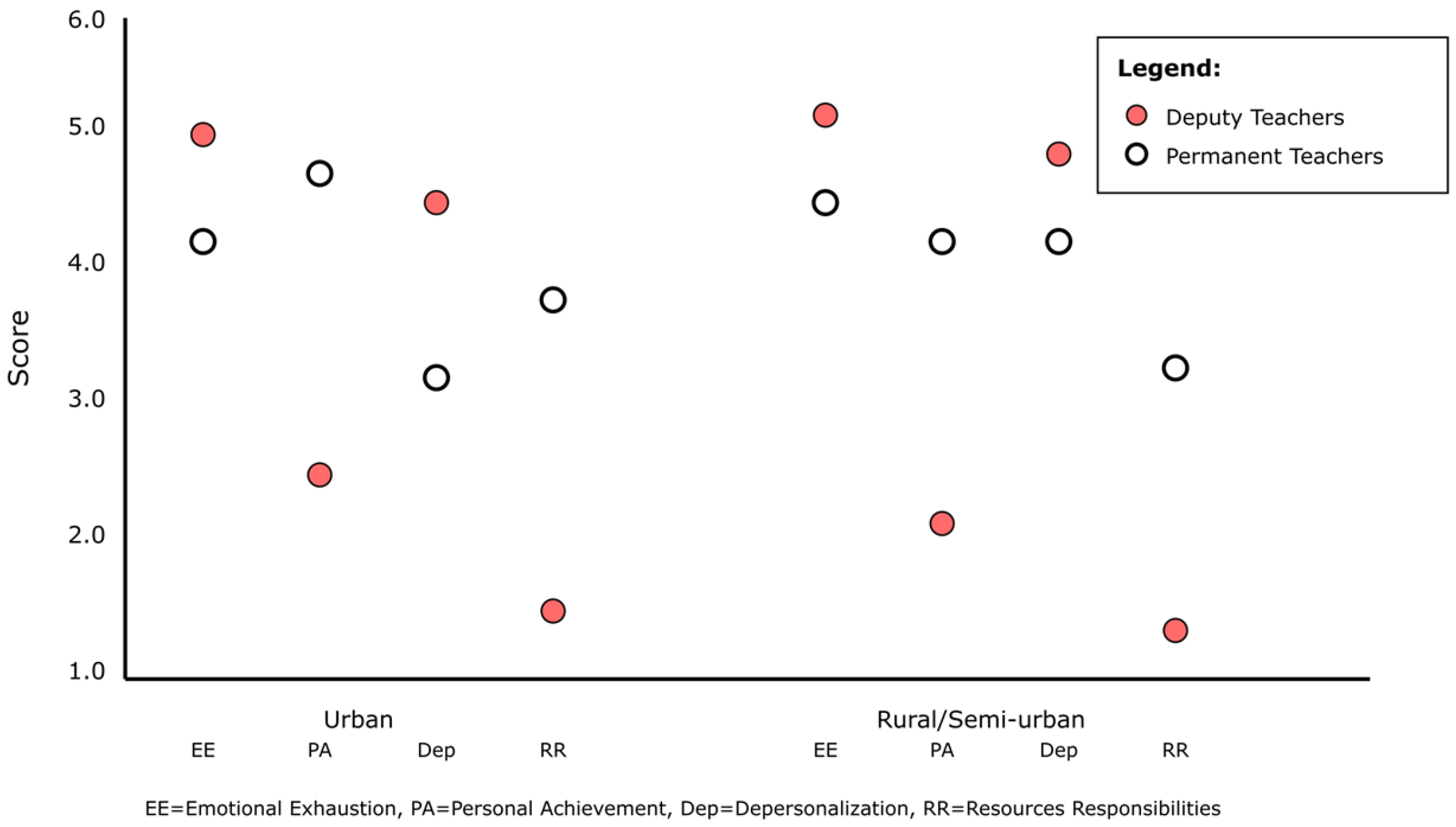
3.5. Employment Type Differences
3.6. School Location Differences
3.7. Age-Related Variations
3.8. Multiple Linear Regression Analysis
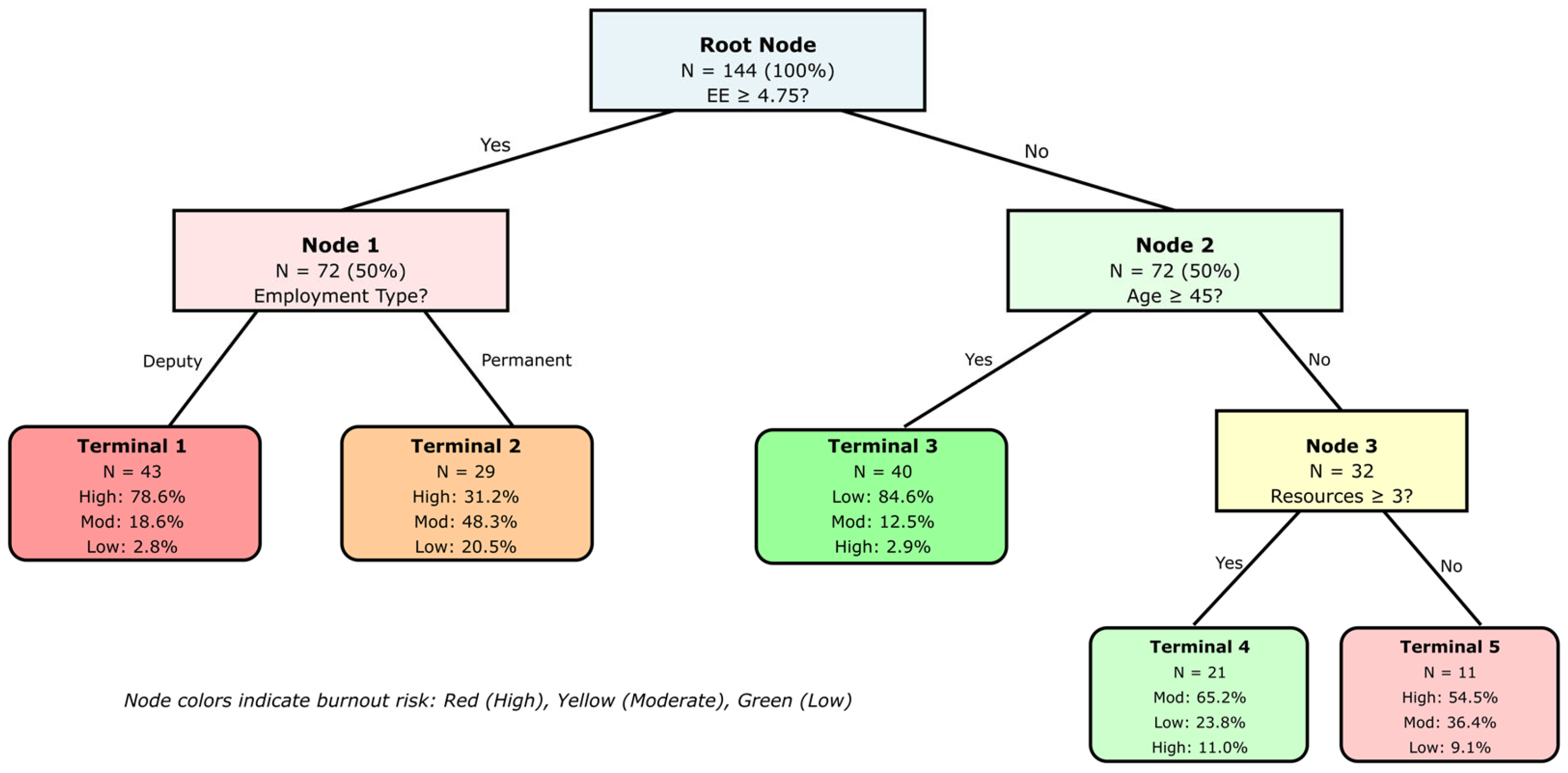
3.9. Classification Tree Analysis
3.10. Association Pattern Analysis
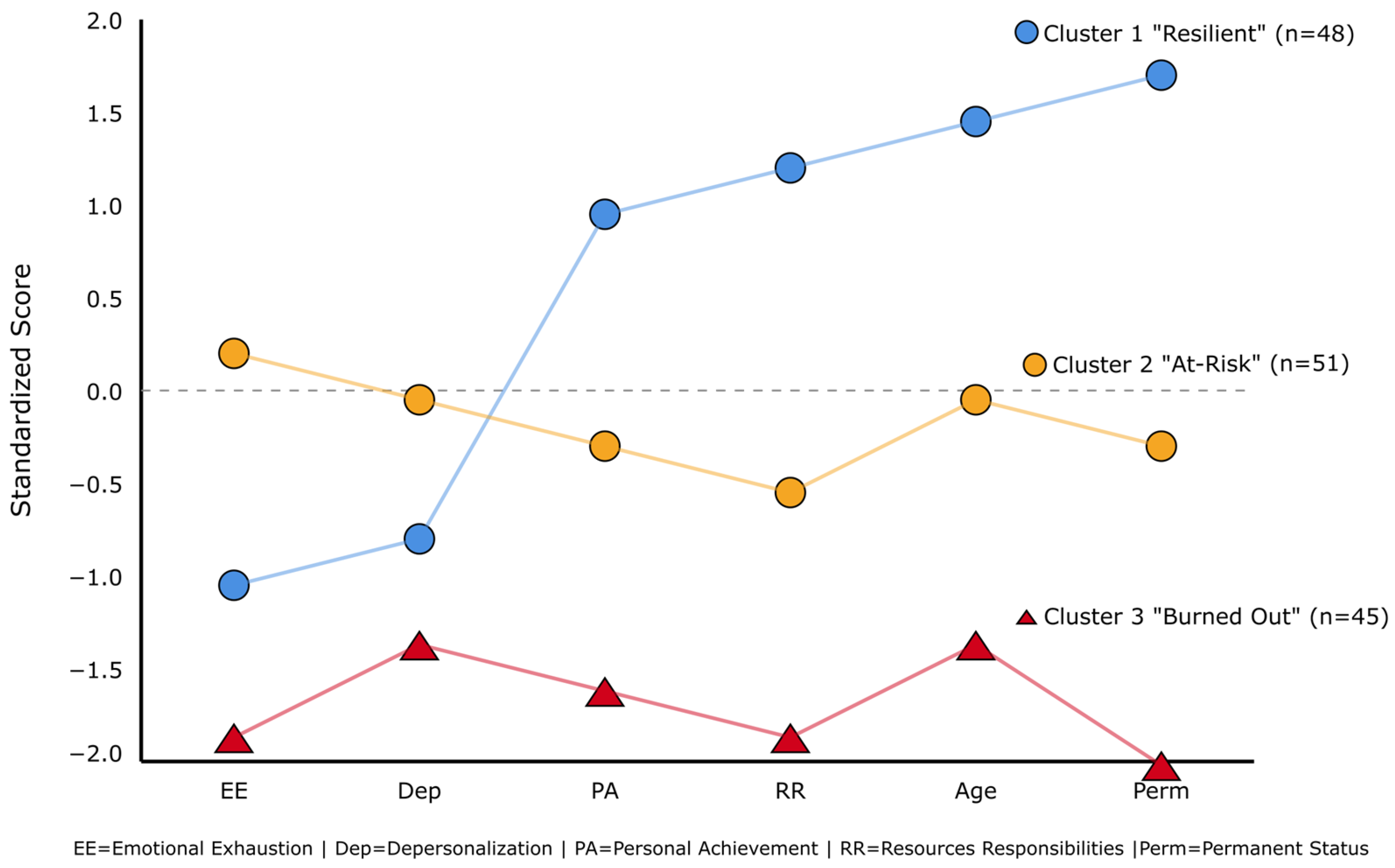
3.11. Cluster Analysis Profiles
3.12. COVID-19 Pandemic Impact
4. Discussion
4.1. Overview of Findings
4.2. Employment Status and Burnout Vulnerability
4.3. Age as a Protective Mechanism
4.4. Context and Support Systems
4.5. Pandemic as Crisis Amplifier
4.6. Practical and Public Health Implications
4.7. Ethical Implications
4.8. Limitations
4.9. Future Directions
5. Conclusions
Author Contributions
Funding
Institutional Review Board Statement
Informed Consent Statement
Data Availability Statement
Conflicts of Interest
References
- Maslach, C.; Jackson, S.E.; Schwab, R.L. Maslach Burnout Inventory—Educators Survey (MBI-ES). In MBI Manual, 3rd ed.; Maslach, C., Jackson, S.E., Leiter, M.P., Eds.; Consulting Psychologists Press: Palo Alto, CA, USA, 1996. [Google Scholar]
- Maslach, C.; Jackson, S.E. The measurement of experienced burnout. J. Organ. Behav. 1981, 2, 99–113. [Google Scholar] [CrossRef] [Scilit]
- Wang, H.; Wang, L. Understanding teacher burnout through cognitive load and emotion regulation perspectives. Teach. Teach. Educ. 2022, 116, 103758. [Google Scholar] [CrossRef] [Scilit]
- Li, S. The effect of teacher self-efficacy, teacher resilience, and emotion regulation on teacher burnout: A mediation model. Front. Psychol. 2023, 14, 1185079. [Google Scholar] [CrossRef] [Scilit] [PubMed]
- Wang, Y.; Wang, Y. The interrelationship between emotional intelligence, self-efficacy, and burnout among foreign language teachers: A meta-analytic review. Front. Psychol. 2022, 13, 913638. [Google Scholar] [CrossRef] [Scilit]
- Arens, A.K.; Morin, A.J.S. Relations between teachers’ emotional exhaustion and students’ educational outcomes. J. Educ. Psychol. 2016, 108, 800–813. [Google Scholar] [CrossRef] [Scilit]
- Skaalvik, E.M.; Skaalvik, S. Job satisfaction, stress and coping strategies in the teaching profession—What do teachers say? Int. Educ. Stud. 2015, 8, 181–192. [Google Scholar] [CrossRef] [Scilit]
- Agyapong, B.; Obuobi-Donkor, G.; Burback, L.; Wei, Y. Stress, burnout, anxiety, and depression among teachers: A scoping review. Int. J. Environ. Res. Public Health 2022, 19, 10706. [Google Scholar] [CrossRef] [Scilit]
- Gkintoni, E.; Antonopoulou, H.; Sortwell, A.; Halkiopoulos, C. Challenging Cognitive Load Theory: The Role of Educational Neuroscience and Artificial Intelligence in Redefining Learning Efficacy. Brain Sci. 2025, 15, 203. [Google Scholar] [CrossRef] [Scilit]
- Cordes, C.L.; Dougherty, T.W. A review and an integration of research on job burnout. Acad. Manag. Rev. 1993, 18, 621–656. [Google Scholar] [CrossRef] [Scilit]
- Harmsen, R.; Helms-Lorenz, M.; Maulana, R.; van Veen, K. The relationship between beginning teachers’ stress causes, stress responses, teaching behaviour and attrition. Teach. Teach. 2018, 24, 626–643. [Google Scholar] [CrossRef] [Scilit]
- Gkintoni, E.; Dimakos, I.; Nikolaou, G. Cognitive Insights from Emotional Intelligence: A Systematic Review of EI Models in Educational Achievement. Emerg. Sci. J. 2025, 8, 262–297. [Google Scholar] [CrossRef] [Scilit]
- Klusmann, U.; Richter, D.; Lüdtke, O. Teachers’ emotional exhaustion is negatively related to students’ achievement: Evidence from a large-scale assessment study. J. Educ. Psychol. 2016, 108, 1193–1203. [Google Scholar] [CrossRef] [Scilit]
- O’Brien, G.E. Workplace Stress and Coping Among Teachers; Australian Council for Educational Research: Camberwell, Australia, 2007. [Google Scholar]
- Ransford, C.R.; Greenberg, M.T.; Domitrovich, C.E.; Small, M.; Jacobson, L.; Sanetti, L.; Kratochwill, T. The role of teachers’ psychological experiences and perceptions of curriculum supports on the implementation of a social and emotional learning curriculum. Sch. Psychol. Rev. 2009, 38, 510–532. [Google Scholar] [CrossRef] [Scilit]
- Taris, T.W.; Leisink, P.L.; Schaufeli, W.B. Applying occupational health theories to educator stress: Contributions of the Job Demands-Resources model. In Educator Stress: An Occupational Health Perspective; McIntyre, T.M., McIntyre, S.E., Francis, D.J., Eds.; Springer: Berlin/Heidelberg, Germany, 2017; pp. 237–260. [Google Scholar]
- Chang, M.-L. An appraisal perspective of teacher burnout: Examining the emotional work of teachers. Educ. Psychol. Rev. 2009, 21, 193–218. [Google Scholar] [CrossRef] [Scilit]
- Carroll, A.; Forrest, K.; Sanders-O’connor, E.; Flynn, L.; Bower, J.M.; Fynes-Clinton, S.; York, A.; Ziaei, M. Teacher stress and burnout in Australia: Examining the role of intrapersonal and environmental factors. Soc. Psychol. Educ. 2022, 25, 441–469. [Google Scholar] [CrossRef] [Scilit] [PubMed]
- Gkintoni, E.; Halkiopoulos, C.; Antonopoulou, H. Neuroleadership as an Asset in Educational Settings: An Overview. Emerg. Sci. J. 2022, 6, 893–904. [Google Scholar] [CrossRef] [Scilit]
- Petropoulou, A.; Antonopoulou, H.; Vlachou, A.A.; Gkintoni, E.; Halkiopoulos, C. Social–Cognitive Factors in Antisocial Behavior and School Violence: A Cross-Sectional Analysis of Greek Vocational Students. Children 2025, 12, 1647. [Google Scholar] [CrossRef] [Scilit]
- El Helou, M.; Nabhani, M.; Bahous, R. Teachers’ views on causes leading to their burnout. Sch. Leadersh. Manag. 2016, 36, 551–567. [Google Scholar] [CrossRef] [Scilit]
- Richards, J. Teacher stress and coping strategies: A national snapshot. Educ. Forum 2012, 76, 299–316. [Google Scholar] [CrossRef] [Scilit]
- Boles, J.S.; Dean, D.H.; Ricks, J.M.; Short, J.C.; Wang, G. The dimensionality of the Maslach Burnout Inventory across small business owners and educators. J. Vocat. Behav. 2000, 56, 12–34. [Google Scholar] [CrossRef] [Scilit]
- Schaufeli, W.B.; Bakker, A.B.; Salanova, M. The measurement of work engagement with a short questionnaire: A cross-national study. Educ. Psychol. Meas. 2006, 66, 701–716. [Google Scholar] [CrossRef] [Scilit]
- Brenner, S.O. Work, Health, and Well-Being; Arbetarskyddsfonden: Stockholm, Sweden, 1982. [Google Scholar]
- Rubilar, N.V.; Oros, L.B. Stress and burnout in teachers during times of pandemic. Front. Psychol. 2021, 12, 756007. [Google Scholar] [CrossRef] [Scilit] [PubMed]
- Räsänen, K.; Pietarinen, J.; Soini, T.; Väisänen, P.; Pyhältö, K. Experienced risk of burnout among teachers with persistent turnover intentions. Teach. Dev. 2022, 26, 317–337. [Google Scholar] [CrossRef] [Scilit]
- Madigan, D.J.; Kim, L.E.; Glandorf, H.L.; Kavanagh, O. Teacher burnout and physical health: A systematic review. Int. J. Educ. Res. 2023, 119, 102173. [Google Scholar] [CrossRef] [Scilit]
- Mijakoski, D.; Cheptea, D.; Marca, S.C.; Shoman, Y.; Caglayan, C.; Bugge, M.D.; Gnesi, M.; Godderis, L.; Kiran, S.; McElvenny, D.M.; et al. Determinants of burnout among teachers: A systematic review of longitudinal studies. Int. J. Environ. Res. Public Health 2022, 19, 5776. [Google Scholar] [CrossRef] [Scilit]
- Persson, R.; Leo, U.; Arvidsson, I.; Håkansson, C.; Nilsson, K.; Österberg, K. Prevalence of exhaustion symptoms and associations with school level, length of work experience and gender: A nationwide cross-sectional study of Swedish principals. BMC Public Health 2021, 21, 331. [Google Scholar] [CrossRef] [Scilit]
- Berjot, S.; Weber, T.; Huyghebaert-Zouaghi, T. Burnout integrative measure: A preliminary validation among French college students. Front. Psychol. 2022, 13, 904367. [Google Scholar] [CrossRef] [Scilit]
- Johnson, M.W. Use of the Copenhagen Burnout Inventory among U.S. academic librarians: Examining construct validity through factor structure and model fit. J. Acad. Libr. 2024, 50, 102922. [Google Scholar] [CrossRef] [Scilit]
- Delladio, S.; Caputo, A. When the tank is empty: Reviewing burnout in entrepreneurship. J. Small Bus. Manag. 2025, 63, 2320–2356. [Google Scholar] [CrossRef] [Scilit]
- Nadon, L.; De Beer, L.T.; Morin, A.J.S. Should burnout be conceptualized as a mental disorder? Behav. Sci. 2022, 12, 82. [Google Scholar] [CrossRef] [Scilit]
- Bakker, A.B.; Demerouti, E. The Job Demands-Resources model: State of the art. J. Manag. Psychol. 2007, 22, 309–328. [Google Scholar] [CrossRef] [Scilit]
- McCarthy, C.J.; Lambert, R.G.; Lineback, S.; Fitchett, P.; Baddouh, P.G. Assessing teacher appraisals and stress in the classroom: Review of the classroom appraisal of resources and demands. Educ. Psychol. Rev. 2015, 28, 577–603. [Google Scholar] [CrossRef] [Scilit]
- Demerouti, E.; Bakker, A.B.; Nachreiner, F.; Schaufeli, W.B. The job demands-resources model of burnout. J. Appl. Psychol. 2001, 86, 499–512. [Google Scholar] [CrossRef] [PubMed]
- Bakker, A.B.; de Vries, J.D. Job Demands–Resources theory and self-regulation: New explanations and remedies for job burnout. Anxiety Stress Coping 2020, 34, 1–21. [Google Scholar] [CrossRef] [Scilit]
- Demerouti, E.; Bakker, A.B. Job Demands-Resources theory in times of crises: New propositions. Organ. Psychol. Rev. 2022, 13, 209–236. [Google Scholar] [CrossRef] [Scilit]
- Maslach, C.; Leiter, M.P. The Burnout Challenge: Managing People’s Relationships with Their Jobs; Harvard University Press: Cambridge, MA, USA, 2022. [Google Scholar] [CrossRef] [Scilit]
- Bakker, A.B.; Demerouti, E.; Sanz-Vergel, A. Job Demands-Resources theory: Ten years later. Annu. Rev. Organ. Psychol. Organ. Behav. 2023, 10, 25–53. [Google Scholar] [CrossRef] [Scilit]
- Bakker, A.B.; Schaufeli, W.B.; Leiter, M.P.; Taris, T.W. Work engagement: An emerging concept in occupational health psychology. Work Stress 2008, 22, 187–200. [Google Scholar] [CrossRef] [Scilit]
- Edú-Valsania, S.; Laguía, A.; Moriano, J.A. Burnout: A review of theory and measurement. Int. J. Environ. Res. Public Health 2022, 19, 1780. [Google Scholar] [CrossRef] [Scilit]
- Reed, B.N. Turning the tide: Addressing threats to pharmacist well-being through work redesign. J. Am. Coll. Clin. Pharm. 2023, 6, 742–750. [Google Scholar] [CrossRef] [Scilit]
- Alarcon, G.M. A meta-analysis of burnout with job demands, resources, and attitudes. J. Vocat. Behav. 2011, 79, 549–562. [Google Scholar] [CrossRef] [Scilit]
- Leclercq, C.; Hansez, I. Temporal stages of burnout: How to design prevention? Int. J. Environ. Res. Public Health 2024, 21, 1617. [Google Scholar] [CrossRef] [Scilit]
- Fernández-Suárez, I.; García-González, M.A.; Torrano, F.; García-González, G. Study of the prevalence of burnout in university professors in the period 2005–2020. Educ. Res. Int. 2021, 2021, 7810659. [Google Scholar] [CrossRef] [Scilit]
- Holmes, E.A.; O’Connor, R.C.; Perry, V.H.; Tracey, I.; Wessely, S.; Arseneault, L.; Ballard, C.; Christensen, H.; Silver, R.C.; Everall, I.; et al. Multidisciplinary research priorities for the COVID-19 pandemic: A call for action for mental health science. Lancet Psychiatry 2020, 7, 547–560. [Google Scholar] [CrossRef] [Scilit] [PubMed]
- Sokal, L.; Trudel, L.E.; Babb, J. Canadian teachers’ attitudes toward change, efficacy, and burnout during the COVID-19 pandemic. Int. J. Educ. Res. Open 2020, 1, 100016. [Google Scholar] [CrossRef] [Scilit]
- Broadbent, J.; Ajjawi, R.; Bearman, M.; Boud, D.; Dawson, P. Beyond emergency remote teaching: Did the pandemic lead to lasting change in university courses? Int. J. Educ. Technol. High. Educ. 2023, 20, 58. [Google Scholar] [CrossRef] [Scilit]
- Srivastava, P.; Sehgal, T.; Jain, R.; Kaur, P.; Luukela-Tandon, A. Knowledge management during emergency remote teaching: An interpretative phenomenological analysis of the transition experiences of faculty members. J. Knowl. Manag. 2024, 28, 78–105. [Google Scholar] [CrossRef] [Scilit]
- González-García, H.; Martinent, G.; Morales, A.T. Perceived Coach Leadership Profiles and Relationship with Burnout, Coping, and Emotions. Front. Psychol. 2019, 10, 1785. [Google Scholar] [CrossRef] [Scilit]
- Antonopoulou, H.; Halkiopoulos, C.; Barlou, O.; Beligiannis, G.N. Associations between Traditional and Digital Leadership in Academic Environment: During the COVID-19 Pandemic. Emerg. Sci. J. 2021, 5, 405–428. [Google Scholar] [CrossRef] [Scilit]
- Bruria, A.; Maya, S.-T.; Gadi, S.; Orna, T. Impact of emergency situations on resilience at work and burnout of hospital’s healthcare personnel. Int. J. Disaster Risk Reduct. 2022, 76, 102994. [Google Scholar] [CrossRef] [Scilit]
- Wittmers, A.; Maier, G.W. Leaders’ mental health in times of crisis: Work intensification, emotional demands and the moderating role of organizational support and self-efficacy. Front. Psychol. 2023, 14, 1122881. [Google Scholar] [CrossRef] [Scilit]
- Farber, B.A. Stress and burnout in suburban teachers. J. Educ. Res. 1984, 77, 325–331. [Google Scholar] [CrossRef] [Scilit]
- Van Dick, R.; Wagner, U. Stress and strain in teaching: A structural equation approach. Br. J. Educ. Psychol. 2001, 71, 243–259. [Google Scholar] [CrossRef] [Scilit] [PubMed]
- Antoniou, A.; Polychroni, F.; Vlachakis, A. Gender and age differences in occupational stress and professional burnout between primary and high-school teachers in Greece. J. Manag. Psychol. 2006, 21, 682–690. [Google Scholar] [CrossRef] [Scilit]
- Bilge, F. Examining the burnout of academics in relation to job satisfaction and other factors. Soc. Behav. Pers. Int. J. 2006, 34, 1151–1160. [Google Scholar] [CrossRef] [Scilit]
- Burke, R.J.; Greenglass, E. Work stress, role conflict, social support, and psychological burnout among teachers. Psychol. Rep. 1993, 73, 371–380. [Google Scholar] [CrossRef] [Scilit]
- Ghorpade, J.; Lackritz, J.; Singh, G. Burnout and personality: Evidence from academia. J. Career Assess. 2007, 15, 240–256. [Google Scholar] [CrossRef] [Scilit]
- Sánchez-Pujalte, L.; Mateu, D.N.; Etchezahar, E.; Yepes, T.G. Teachers’ burnout during COVID-19 pandemic in Spain: Trait emotional intelligence and socioemotional competencies. Sustainability 2021, 13, 7259. [Google Scholar] [CrossRef] [Scilit]
- Nagle, E.; Griskevica, I.; Rajevska, O.; Ivanovs, A.; Mihailova, S.; Skruzkalne, I. Factors affecting healthcare workers burnout and their conceptual models: Scoping review. BMC Psychol. 2024, 12, 637. [Google Scholar] [CrossRef] [Scilit]
- Le, T.V.; Barboza-Wilkes, C. How self-determination moderates burnout in public organizations across gender, race, and generation. Public Pers. Manag. 2024, 53, 113–147. [Google Scholar] [CrossRef] [Scilit]
- Chmiel, J.; Wiażewicz-Wójtowicz, P.; Stępień-Słodkowska, M. Neural correlates of burnout syndrome based on electroencephalography (EEG)—A mechanistic review and discussion of burnout syndrome cognitive aspects. J. Clin. Med. 2025, 14, 1895. [Google Scholar] [CrossRef] [Scilit]
- Ansley, B.M.; Houchins, D.E.; Varjas, K.; Roach, A.; Patterson, D.; Hendrick, R. The impact of an online stress intervention on burnout and teacher efficacy. Teach. Teach. Educ. 2021, 98, 103251. [Google Scholar] [CrossRef] [Scilit]
- Byrne, B.M. Burnout: Investigating the impact of background variables for elementary, intermediate, secondary, and university educators. Teach. Teach. Educ. 1991, 7, 197–209. [Google Scholar] [CrossRef] [Scilit]
- Kantas, A.; Vassilaki, E. Burnout in Greek teachers: Main findings and validity of the Maslach Burnout Inventory. Work. Stress 1997, 11, 94–100. [Google Scholar] [CrossRef] [Scilit]
- Koehler, M.J.; Mishra, P. Introducing TPCK. In Handbook of Technological Pedagogical Content Knowledge (TPCK) for Educators; AACTE Committee on Innovation and Technology, Ed.; Routledge: London, UK, 2008; pp. 3–29. [Google Scholar]
- Maslach, C.; Schaufeli, W.B.; Leiter, M.P. Job burnout. Annu. Rev. Psychol. 2001, 52, 397–422. [Google Scholar] [CrossRef] [Scilit] [PubMed]
- Vassilopoulos, S.P. Job burnout and work engagement in primary school teachers: The role of the school context. Hell. J. Psychol. 2012, 9, 18–39. [Google Scholar]
- Söderholm, F.; Viljaranta, J.; Hirvonen, R.; Tuominen, H.; Lappalainen, K.; Holopainen, L. The development of exhaustion, cynicism, and inadequacy in general upper secondary education: Perceived and received support, student engagement, and gender as predictors. Scand. J. Educ. Res. 2025, 69, 1271–1287. [Google Scholar] [CrossRef] [Scilit]
- Tikkanen, L.; Haverinen, K.; Pyhältö, K.; Pietarinen, J.; Soini, T. Differences in teacher burnout between schools: Exploring the effect of proactive strategies on burnout trajectories. Front. Educ. 2022, 7, 858896. [Google Scholar] [CrossRef] [Scilit]
- Boone, A.; Elst, T.V.; Vandenbroeck, S.; Godderis, L. Burnout profiles among young researchers: A latent profile analysis. Front. Psychol. 2022, 13, 839728. [Google Scholar] [CrossRef] [Scilit]
- Ghasemi, F. The effects of dysfunctional workplace behavior on teacher emotional exhaustion: A moderated mediation model of perceived social support and anxiety. Psychol. Rep. 2024, 127, 2526–2551. [Google Scholar] [CrossRef] [Scilit]
- Kokkinos, C.M.; Davazoglou, A.M. Special education teachers under stress: Evidence from a Greek national study. Educ. Psychol. 2009, 29, 407–424. [Google Scholar] [CrossRef] [Scilit]
- Kokkinos, C.M. Job stressors, personality and burnout in primary school teachers. Br. J. Educ. Psychol. 2007, 77, 229–243. [Google Scholar] [CrossRef] [Scilit] [PubMed]
- Turner, M.; Holdsworth, S. Developing resilience: Examining the protective factors of early career construction professionals. Constr. Manag. Econ. 2023, 41, 805–819. [Google Scholar] [CrossRef] [Scilit]
- Guo, L. Unsettled horizon: Adolescents’ career expectations in the volatile, uncertain, complex, and ambiguous contexts. Humanit. Soc. Sci. Commun. 2025, 12, 5298. [Google Scholar] [CrossRef] [Scilit]
- Frolova, Y. Navigating career uncertainty: The role of proactive decision-making, sense of emptiness and constructivist beliefs in professional fulfillment. Int. J. Organ. Theory Behav. 2025. [Google Scholar] [CrossRef] [Scilit]
- Tajeddin, Z.; Keshvari, Z. Emotional tensions in identity transition from teachers to teacher educators: Voices from early-career teacher educators. Asian-Pac. J. Second. Foreign Lang. Educ. 2025, 10, 14. [Google Scholar] [CrossRef] [Scilit]
- Rohwedder, A.-B.; Le Fevre, D.M. Effective early career VET teaching: The importance of developing adaptive expertise in workplace learning. Int. J. Train. Res. 2025, 23, 1–14. [Google Scholar] [CrossRef] [Scilit]
- Bai, Q.; Nam, B.H.; English, A.S.; Marshall, R.C.; Tian, X. Mental health and early career adaptation challenges of Chinese returnees and Korean ambitionists among the STEAM doctoral cohorts in the post-pandemic academic job market. Comp. A J. Comp. Int. Educ. 2025, 55, 1030–1050. [Google Scholar] [CrossRef] [Scilit]
- Evers, W.J.G.; Brouwers, A.; Tomic, W. Burnout and self-efficacy: A study on teachers’ beliefs when implementing an innovative educational system in the Netherlands. Br. J. Educ. Psychol. 2002, 72, 227–243. [Google Scholar] [CrossRef] [Scilit]
- Pereira, H.; Gonçalves, V.O.; de Assis, R.M. Burnout, organizational self-efficacy and self-esteem among Brazilian teachers during the COVID-19 pandemic. Eur. J. Investig. Health Psychol. Educ. 2021, 11, 795–803. [Google Scholar] [CrossRef] [Scilit]
- Skaalvik, E.M.; Skaalvik, S. Dimensions of teacher self-efficacy and relations with strain factors, perceived collective teacher efficacy, and teacher burnout. J. Educ. Psychol. 2007, 99, 611–625. [Google Scholar] [CrossRef] [Scilit]
- Vladut, C.I.; Kállay, É. Psycho-emotional and organizational aspects of burnout in a sample of Romanian teachers. Cogn. Brain Behav. 2011, 14, 331–358. [Google Scholar]
- Cao, Y.; Gao, L.; Fan, L.; Jiao, M.; Li, Y.; Ma, Y. The influence of emotional intelligence on job burnout of healthcare workers and mediating role of workplace violence: A cross-sectional study. Front. Public Health 2022, 10, 892421. [Google Scholar] [CrossRef] [Scilit] [PubMed]
- Almeneessier, A.S.; Azer, S.A. Exploring the relationship between burnout and emotional intelligence among academics and clinicians at King Saud University. BMC Med. Educ. 2023, 23, 689. [Google Scholar] [CrossRef] [Scilit] [PubMed]
- Bagatini, A.; Bumaguin, D.B.; Bagatini, L.Z.; Ardais, A.P. The relationship between burnout syndrome and emotional intelligence in anesthesiologists during the COVID-19 pandemic: A cross-sectional study. J. Patient Saf. Risk Manag. 2025, 30, 149–156. [Google Scholar] [CrossRef] [Scilit]
- Merino-Soto, C.; Angulo-Ramos, M.; Llaja-Rojas, V.; Chans, G.M. Academic performance, emotional intelligence, and academic burnout: A cross-sectional study of a mediational effect in nursing students. Nurse Educ. Today 2024, 139, 106221. [Google Scholar] [CrossRef] [Scilit]
- Pietarinen, J.; Pyhältö, K.; Haverinen, K.; Leskinen, E.; Soini, T. Is individual- and school-level teacher burnout reduced by proactive strategies? Int. J. Sch. Educ. Psychol. 2021, 9, 340–355. [Google Scholar] [CrossRef] [Scilit]
- Ahmed, A.K.; Atta, M.H.R.; El-Monshed, A.H.; Mohamed, A.I. The effect of toxic leadership on workplace deviance: The mediating effect of emotional exhaustion, and the moderating effect of organizational cynicism. BMC Nurs. 2024, 23, 308. [Google Scholar] [CrossRef] [Scilit]
- Braun, S.S.; Schonert-Reichl, K.A.; Roeser, R.W. Effects of teachers’ emotion regulation, burnout, and life satisfaction on student well-being. J. Appl. Dev. Psychol. 2020, 69, 101151. [Google Scholar] [CrossRef] [Scilit]
- Agina, M.F.; Khairy, H.A.; Fatah, M.A.A.; Manaa, Y.H.; Abdallah, R.M.; Aliane, N.; Afaneh, J.; Al-Romeedy, B.S. Distributive injustice and work disengagement in the tourism and hospitality industry: Mediating roles of workplace negative gossip and organizational cynicism. Sustainability 2023, 15, 15011. [Google Scholar] [CrossRef] [Scilit]
- Bibou-Nakou, I.; Stogiannidou, A.; Kiosseoglou, G. The relation between teacher burnout and teachers’ attributions and practices regarding school behaviour problems. Sch. Psychol. Int. 1999, 20, 209–217. [Google Scholar] [CrossRef] [Scilit]
- Vandenberghe, R.; Huberman, A.M. (Eds.) Understanding and Preventing Teacher Burnout: A Sourcebook of International Research and Practice; Cambridge University Press: Cambridge, UK, 1999. [Google Scholar]
- Papadakis, N.; Drakaki, M.; Saridaki, S.; Amanaki, E.; Dimari, G. Educational capital/level and its association with precarious work and social vulnerability among youth, in EU and Greece. Int. J. Educ. Res. 2022, 112, 101921. [Google Scholar] [CrossRef] [Scilit]
- Koutra, K.; Mavroeides, G.; Triliva, S. Of caring: Prevalence and associated factors of burnout, compassion fatigue, and compassion satisfaction among mental health professionals in Greece. Psychol. Int. 2025, 7, 58. [Google Scholar] [CrossRef] [Scilit]
- Pakou, V.; Andrianopoulos, I.; Gouva, M.; Dragioti, E.; Tatsis, F.; Papathanakos, G.; Ntantana, A.; Antoniadou, E.; Fligou, F.; Papageorgiou, E.; et al. Burnout and mental health symptoms among ICU professionals in Greece: A national comparative study between the COVID-19 pandemic and pre-pandemic eras. Cureus 2025, 17, e84555. [Google Scholar] [CrossRef] [Scilit] [PubMed]
- Katsarou, E.; Chatzipanagiotou, P.; Sougari, A.-M. A systematic review on teachers’ well-being in the COVID-19 era. Educ. Sci. 2023, 13, 927. [Google Scholar] [CrossRef] [Scilit]
- Kim, L.E.; Asbury, K. ‘Like a rug had been pulled from under you’: The impact of COVID-19 on teachers in England during the first six weeks of the UK lockdown. Br. J. Educ. Psychol. 2020, 90, 1062–1083. [Google Scholar] [CrossRef] [Scilit]
- Pressley, T. Factors contributing to teacher burnout during COVID-19. Educ. Res. 2021, 50, 325–327. [Google Scholar] [CrossRef] [Scilit]
- Oliveira, S.; Roberto, M.S.; Pereira, N.S.; Marques-Pinto, A.; Veiga-Simão, A.M. Impacts of Social and Emotional Learning Interventions for Teachers on Teachers’ Outcomes: A Systematic Review with Meta-Analysis. Front. Psychol. 2021, 12, 677217. [Google Scholar] [CrossRef] [Scilit]
- Malinauskas, R.; Malinauskiene, V. Characteristics of stress and burnout among Lithuanian university coaches: A pre-pandemic coronavirus and post-pandemic period comparison. Healthcare 2023, 11, 2096. [Google Scholar] [CrossRef] [Scilit]
- Sikaras, C.; Pachi, A.; Alikanioti, S.; Ilias, I.; Sideri, E.P.; Tselebis, A.; Panagiotou, A. Occupational burnout and insomnia in relation to psychological resilience among Greek nurses in the post-pandemic era. Behav. Sci. 2025, 15, 126. [Google Scholar] [CrossRef] [Scilit]
- Katsogiannis, I.; Manara, E.; Peletidi, A.; Bistaraki, A.; Constantinides, T.; Kontogiorgis, C. Occupational burnout and job satisfaction among community pharmacists. Explor. Res. Clin. Soc. Pharm. 2024, 14, 100445. [Google Scholar] [CrossRef] [Scilit]
- Patra, D.; Bharti, N.; Dutta, M. Are better equipped schools delivering better student outcomes? Evidence from India. Indian J. Hum. Dev. 2025, 19, 09737030251346751. [Google Scholar] [CrossRef] [Scilit]
- Giannopoulos, A.; Caouris, Y.G.; Souliotis, M.; Santamouris, M. Characteristics of the urban heat island effect, in the coastal city of Patras, Greece. Int. J. Sustain. Energy 2022, 41, 556–571. [Google Scholar] [CrossRef] [Scilit]
- Petridou, V. The Organization for Economic Co-operation and Development (OECD) experts’ contribution in the establishment of the University of Patras. Plan. Perspect. 2022, 37, 1029–1049. [Google Scholar] [CrossRef] [Scilit]
- Antonopoulou, H.; Halkiopoulos, C.; Gkintoni, E.; Katsimpelis, A. Application of Gamification Tools for Identification of Neurocognitive and Social Function in Distance Learning Education. Int. J. Learn. Teach. Educ. Res. 2022, 21, 367–400. [Google Scholar] [CrossRef] [Scilit]
- Grządzielewska, M. Using machine learning in burnout prediction: A survey. Child Adolesc. Soc. Work. J. 2021, 38, 175–180. [Google Scholar] [CrossRef] [Scilit]
- Johnson, T.; Shamroukh, S. Predictive modeling of burnout based on organizational culture perceptions among health systems employees: A comparative study using correlation, decision tree, and regression models. Sci. Rep. 2024, 14, 56771. [Google Scholar] [CrossRef] [Scilit]
- Merhbene, G.; Nath, S.; Puttick, A.R.; Kurpicz-Briki, M. BurnoutEnsemble: Augmented intelligence to detect indications for burnout in clinical psychology. Front. Big Data 2022, 5, 863100. [Google Scholar] [CrossRef] [Scilit]
- Alexaki, P.-S.; Antonopoulou, H.; Gkintoni, E.; Adamopoulos, N.; Halkiopoulos, C. Psychological dimensions of professional burnout in special education: A cross-sectional behavioral data analysis of emotional exhaustion, personal achievement, and depersonalization. Int. J. Environ. Res. Public Health 2025, 22, 1420. [Google Scholar] [CrossRef] [Scilit]
- Regli, A.; Antonopoulou, H.; Beligiannis, G.N.; Asimakopoulos, G.; Halkiopoulos, C. Beyond Digital Natives: A System-Level Analysis of Institutional Barriers and Teacher Experience in Secondary School ICT Integration. Sustainability 2026, 18, 1108. [Google Scholar] [CrossRef] [Scilit]
- Zabel, R.H.; Zabel, M.K. Revisiting burnout among special education teachers: Do age, experience, and preparation still matter? Teach. Educ. Spec. Educ. 2001, 24, 128–139. [Google Scholar] [CrossRef] [Scilit]
- Han, H. Fuzzy clustering algorithm for university students’ psychological fitness and performance detection. Heliyon 2023, 9, e18550. [Google Scholar] [CrossRef] [Scilit]



| Variable | Category | n | % | Cumulative % |
|---|---|---|---|---|
| Gender | Female | 90 | 62.5 | 62.5 |
| Male | 54 | 37.5 | 100.0 | |
| Age | 22–25 years | 7 | 4.9 | 4.9 |
| 26–35 years | 13 | 9.0 | 13.9 | |
| 36–45 years | 57 | 39.6 | 53.5 | |
| 46–55 years | 32 | 22.2 | 75.7 | |
| 56 years and over | 35 | 24.3 | 100.0 | |
| Educational Level | Retraining/Teaching for Primary Education | 13 | 9.0 | 9.0 |
| B.A. in Secondary Education | 24 | 16.7 | 25.7 | |
| B.A. in Primary Education | 31 | 21.5 | 47.2 | |
| Additional University/TEI Degree | 48 | 33.3 | 80.6 | |
| Postgraduate Diploma | 26 | 18.1 | 98.6 | |
| Doctoral Degree | 2 | 1.4 | 100.0 | |
| Family Status | Unmarried | 42 | 29.2 | 29.2 |
| Married without Children | 17 | 11.8 | 41.0 | |
| Married with Children | 65 | 45.1 | 86.1 | |
| Divorced | 15 | 10.4 | 96.5 | |
| Widowed | 5 | 3.5 | 100.0 | |
| Teacher Specialty | Biology/Physics/Chemistry | 16 | 11.1 | 11.1 |
| Literature | 51 | 35.4 | 46.5 | |
| Mathematics | 35 | 24.3 | 70.8 | |
| Gymnastics/Music Education | 17 | 11.8 | 82.6 | |
| Information Technology | 25 | 17.4 | 100.0 | |
| School Area | Urban (School “Central”) | 103 | 71.5 | 71.5 |
| Rural-Semi-urban Area (School “Regional”) | 41 | 28.5 | 100.0 | |
| Administrative Grade | Primary Education Teacher | 30 | 20.8 | 20.8 |
| Secondary Education Teacher | 97 | 67.4 | 88.2 | |
| Director of Primary Education | 6 | 4.2 | 92.4 | |
| Director of Secondary Education | 11 | 7.6 | 100.0 | |
| Form of Employment | Permanent | 87 | 60.4 | 60.4 |
| Deputy | 57 | 39.6 | 100.0 |
| Variable | Response Level | n | % | Cumulative % |
|---|---|---|---|---|
| To what extent do you find your job stressful? | Small | 22 | 15.3 | 15.3 |
| Enough | 37 | 25.7 | 41.0 | |
| Large | 51 | 35.4 | 76.4 | |
| Very large | 23 | 16.0 | 92.4 | |
| Too big | 11 | 7.6 | 100.0 | |
| To what extent do you manage stress and psychological pressure? | Very small | 2 | 1.4 | 1.4 |
| Small | 22 | 15.3 | 16.7 | |
| Enough | 55 | 38.2 | 54.9 | |
| Large | 44 | 30.6 | 85.4 | |
| Very large | 16 | 11.1 | 96.5 | |
| Too big | 5 | 3.5 | 100.0 |
| Dimension/Item | n | Min | Max | M | SD | Skewness | Kurtosis |
|---|---|---|---|---|---|---|---|
| Emotional Exhaustion | |||||||
| I feel mentally exhausted | 144 | 2 | 7 | 4.65 | 1.25 | 0.187 | −0.456 |
| I feel exhausted when I wake up in the morning | 144 | 3 | 7 | 4.93 | 1.10 | 0.089 | −0.612 |
| It’s very tiring working with people | 144 | 3 | 7 | 4.81 | 1.16 | 0.156 | −0.487 |
| I feel exhausted from my work | 144 | 3 | 7 | 4.63 | 1.23 | 0.203 | −0.398 |
| I feel frustrated with my work | 144 | 3 | 7 | 4.53 | 1.19 | 0.234 | −0.367 |
| I feel like I’m working too hard at school | 144 | 3 | 7 | 4.83 | 1.22 | 0.112 | −0.534 |
| I feel very tense/stressed to work closely with teachers | 144 | 3 | 7 | 4.64 | 1.14 | 0.178 | −0.445 |
| I feel like I’m at the limits of my endurance | 144 | 3 | 7 | 4.69 | 1.44 | 0.267 | −0.689 |
| I feel empty at the end of the day | 144 | 3 | 7 | 5.01 | 1.43 | −0.023 | −0.756 |
| Overall Emotional Exhaustion | 144 | 3 | 7 | 4.75 | 1.14 | 0.142 | −0.523 |
| Personal Achievement | |||||||
| I can easily understand how teachers feel | 144 | 2 | 7 | 3.94 | 1.32 | −0.123 | −0.456 |
| I deal effectively with teachers’ problems | 144 | 1 | 7 | 3.84 | 1.59 | −0.156 | −0.689 |
| Through my work I positively affect the lives of others | 144 | 2 | 7 | 3.89 | 1.47 | −0.098 | −0.523 |
| I feel full of energy | 144 | 1 | 7 | 3.41 | 1.62 | 0.234 | −0.798 |
| I can create a comfortable atmosphere with teachers | 144 | 2 | 7 | 3.81 | 1.26 | −0.067 | −0.345 |
| I have achieved many remarkable things in this job | 144 | 1 | 7 | 4.01 | 1.76 | −0.289 | −0.912 |
| I deal calmly with the problems that arise from my work | 144 | 2 | 7 | 3.94 | 1.39 | −0.145 | −0.567 |
| I feel refreshed when I work with teachers | 144 | 1 | 7 | 3.85 | 1.70 | −0.212 | −0.845 |
| Overall Personal Achievement | 144 | 1 | 7 | 3.84 | 1.44 | −0.089 | −0.612 |
| Depersonalization | |||||||
| I feel that I treat some teachers impersonally as objects | 144 | 1 | 7 | 3.24 | 1.37 | 0.456 | −0.234 |
| I’ve become harder on people because of work | 144 | 1 | 7 | 4.32 | 1.37 | −0.089 | −0.567 |
| I’m worried that this job might make me more tough | 144 | 1 | 7 | 4.00 | 1.56 | 0.123 | −0.789 |
| I feel that the progressives blame me for some of their problems | 144 | 1 | 7 | 4.07 | 1.85 | 0.087 | −1.123 |
| I don’t care what happens to some teachers | 144 | 1 | 7 | 4.03 | 1.87 | 0.098 | −1.156 |
| Overall Depersonalization | 144 | 1 | 7 | 3.93 | 1.40 | 0.234 | −0.445 |
| Mixing | |||||||
| I feel that I sympathize with the rehearsals of colleagues | 144 | 1 | 7 | 3.42 | 1.49 | 0.312 | −0.612 |
| I feel uncomfortable about past handling of student problems | 144 | 1 | 7 | 3.25 | 1.42 | 0.378 | −0.523 |
| Resources and Responsibilities | |||||||
| I receive adequate support from the manager | 144 | 1 | 6 | 2.85 | 1.43 | 0.398 | −0.667 |
| I receive adequate support from the students’ parents | 144 | 1 | 6 | 2.71 | 1.80 | 0.523 | −0.945 |
| I receive adequate support from my colleagues | 144 | 1 | 6 | 2.81 | 1.64 | 0.445 | −0.823 |
| I receive adequate support from my family | 144 | 1 | 6 | 2.60 | 1.84 | 0.567 | −0.998 |
| I receive adequate support from my friends | 144 | 1 | 6 | 2.96 | 1.61 | 0.378 | −0.756 |
| I receive adequate instructions on teaching methods | 144 | 1 | 6 | 2.66 | 1.81 | 0.534 | −0.967 |
| Overall Resources and Responsibilities | 144 | 1 | 6 | 2.77 | 1.65 | 0.456 | −0.789 |
| Variable | Female (n = 90) | Male (n = 54) | |||||
|---|---|---|---|---|---|---|---|
| M | SD | M | SD | t(142) | p | Cohen’s d | |
| To what extent do you find your work stressful? | 4.83 | 1.18 | 4.61 | 1.04 | 1.142 | 0.255 | 0.20 |
| To what extent do you manage stress? | 4.37 | 1.12 | 4.59 | 0.88 | −1.269 | 0.207 | −0.22 |
| Emotional Exhaustion | 4.67 | 1.16 | 4.87 | 1.11 | −1.020 | 0.309 | −0.18 |
| Personal Achievement | 3.73 | 1.63 | 4.00 | 1.04 | −1.078 | 0.283 | −0.20 |
| Resources & Responsibilities | 2.85 | 1.79 | 2.63 | 1.38 | 0.780 | 0.437 | 0.14 |
| Low Depersonalization * | 4.11 | 1.53 | 3.63 | 1.09 | 1.999 | 0.048 | 0.36 |
| Variable | Permanent (n = 87) | Deputy (n = 57) | |||||
|---|---|---|---|---|---|---|---|
| M | SD | M | SD | t(142) | p | Cohen’s d | |
| To what extent do you find your work stressful? *** | 4.33 | 1.02 | 5.39 | 1.00 | −6.116 | <0.001 | −1.05 |
| To what extent do you manage stress? * | 4.26 | 0.92 | 3.67 | 1.09 | −2.384 | 0.018 | −0.58 |
| Emotional Exhaustion *** | 4.28 | 1.09 | 5.46 | 0.81 | −6.974 | <0.001 | −1.23 |
| Personal Achievement *** | 4.78 | 0.92 | 2.39 | 0.72 | 16.523 | <0.001 | 2.90 |
| Resources & Responsibilities *** | 3.72 | 1.47 | 1.31 | 0.25 | 12.304 | <0.001 | 2.29 |
| Low Depersonalization *** | 3.26 | 1.22 | 4.95 | 0.98 | −8.741 | <0.001 | −1.53 |
| Variable | Urban (n = 103) | Rural/Semi-Urban (n = 41) | |||||
|---|---|---|---|---|---|---|---|
| M | SD | M | SD | t(142) | p | Cohen’s d | |
| To what extent do you find your work stressful? | 4.65 | 1.11 | 5.00 | 1.16 | −1.684 | 0.094 | −0.31 |
| To what extent do you manage stress? | 4.51 | 1.04 | 4.29 | 1.03 | 1.161 | 0.248 | 0.21 |
| Emotional Exhaustion | 4.70 | 1.18 | 4.87 | 1.04 | −0.795 | 0.428 | −0.15 |
| Personal Achievement *** | 4.11 | 1.24 | 3.14 | 1.68 | 3.798 | <0.001 | 0.65 |
| Resources & Responsibilities * | 2.95 | 1.59 | 2.31 | 1.72 | 2.120 | 0.036 | 0.39 |
| Low Depersonalization *** | 3.69 | 1.35 | 4.54 | 1.34 | −3.405 | 0.001 | −0.63 |
| Variable | 22–25 Years | 26–35 Years | 36–45 Years | 46–55 Years | 56+ Years | ||||
|---|---|---|---|---|---|---|---|---|---|
| M (SD) | M (SD) | M (SD) | M (SD) | M (SD) | F(4, 139) | p | η2 | Post Hoc | |
| To what extent do you find your work stressful? | 5.00 (1.00) | 5.54 (0.97) | 4.91 (1.14) | 4.44 (0.98) | 4.43 (1.17) | 3.504 | 0.009 | 0.092 | 26–35 > 46–55, 56+ |
| To what extent do you manage stress? | 4.00 (1.63) | 3.85 (1.14) | 3.70 (0.96) | 3.97 (0.93) | 4.69 (0.76) | 5.809 | <0.001 | 0.143 | 56+ > 26–35, 36–45 |
| Emotional Exhaustion | 5.02 (0.95) | 5.69 (0.75) | 5.05 (1.04) | 4.01 (0.98) | 4.52 (1.18) | 8.536 | <0.001 | 0.197 | 26–35 > all others |
| Personal Achievement | 1.50 (0.00) | 3.00 (0.00) | 3.24 (1.47) | 4.73 (1.04) | 4.76 (0.78) | 24.482 | <0.001 | 0.413 | 46–55, 56+ > all others |
| Resources & Responsibilities | 1.00 (0.00) | 1.50 (0.00) | 2.08 (1.29) | 4.04 (1.61) | 3.55 (1.46) | 20.189 | <0.001 | 0.367 | 46–55, 56+ > all others |
| Depersonalization | 5.60 (0.00) | 4.29 (1.18) | 4.33 (1.27) | 3.24 (1.33) | 3.45 (1.37) | 8.259 | <0.001 | 0.192 | 22–25 > all others |
| Predictor | B | SE B | β | t | p | 95% CI | VIF |
|---|---|---|---|---|---|---|---|
| (Constant) | 1.256 | 0.312 | 4.026 | <0.001 | [0.639, 1.873] | ||
| Emotional Exhaustion *** | 0.755 | 0.068 | 0.612 | 11.103 | <0.001 | [0.621, 0.889] | 1.234 |
| Personal Achievement | −0.075 | 0.073 | −0.056 | −1.027 | 0.308 | [−0.219, 0.069] | 1.156 |
| Resources & Responsibilities ** | 0.199 | 0.074 | 0.152 | 2.689 | 0.008 | [0.053, 0.345] | 1.189 |
| Low Depersonalization * | 0.189 | 0.075 | 0.141 | 2.520 | 0.012 | [0.041, 0.337] | 1.167 |
| Performance Metric | Value | 95% CI |
|---|---|---|
| Overall Accuracy | 81.4% | [77.2%, 85.6%] |
| Sensitivity (High Burnout) | 84.6% | [79.8%, 89.4%] |
| Specificity (Low Burnout) | 87.5% | [82.9%, 92.1%] |
| Precision | 82.1% | [77.5%, 86.7%] |
| F1-Score | 0.833 | [0.801, 0.865] |
| Regression Metrics | ||
| R2 | 0.713 | - |
| RMSE | 0.487 | - |
| MAE | 0.392 | - |
| Variable | Normalized Importance | |
| Emotional Exhaustion | 100.0% | |
| Employment Type | 83.9% | |
| Age | 57.9% | |
| Resources & Responsibilities | 45.6% | |
| School Location | 26.0% | |
| Gender | 12.6% | |
| Antecedent | Consequent | Support | Confidence | Lift | χ2 |
|---|---|---|---|---|---|
| {High Workload, Deputy} | {High Emotional Exhaustion} | 0.42 | 0.89 | 1.87 | 45.23 *** |
| {Low Admin Support, High Workload} | {High Burnout} | 0.38 | 0.85 | 2.13 | 52.67 *** |
| {Age > 45, Permanent} | {Low Burnout} | 0.35 | 0.78 | 1.95 | 38.92 *** |
| {Urban School, High Resources} | {High Personal Achievement} | 0.33 | 0.75 | 1.68 | 29.45 *** |
| {Female, Low Depersonalization} | {Moderate Stress Management} | 0.31 | 0.72 | 1.45 | 21.78 ** |
| {Remote Teaching > 50%} | {Increased Stress} | 0.56 | 0.81 | 1.38 | 35.62 *** |
| Variable | Cluster 1 “Resilient” (n = 48) | Cluster 2 “At-Risk” (n = 51) | Cluster 3 “Burned Out” (n = 45) | F | p |
|---|---|---|---|---|---|
| Standardized Scores | |||||
| Emotional Exhaustion | −0.89 (0.62) | 0.14 (0.57) | 0.98 (0.46) | 142.3 | <0.001 |
| Depersonalization | −0.69 (0.58) | −0.08 (0.66) | 0.91 (0.63) | 98.7 | <0.001 |
| Personal Achievement | 0.86 (0.48) | −0.21 (0.61) | −0.82 (0.53) | 115.4 | <0.001 |
| Resources & Responsibilities | 0.81 (0.89) | −0.32 (0.57) | −0.67 (0.15) | 89.2 | <0.001 |
| Demographics | |||||
| Age (years) | 48.2 (8.7) | 41.5 (9.2) | 35.8 (7.9) | 34.6 | <0.001 |
| Permanent (%) | 85.4% | 52.9% | 20.0% | χ2 = 42.1 | <0.001 |
| Urban (%) | 77.1% | 72.5% | 62.2% | χ2 = 2.8 | 0.247 |
| Variable | n | Pre-Pandemic M (SD) | During Pandemic M (SD) | Change | t | p | d |
|---|---|---|---|---|---|---|---|
| Remote Teaching Load | |||||||
| <25% remote | 38 | 3.82 (0.91) | 4.23 (1.02) | +0.41 | 2.34 | 0.021 | 0.42 |
| 25–50% remote | 44 | 3.95 (0.88) | 4.76 (1.14) | +0.81 | 4.67 | <0.001 | 0.80 |
| >50% remote | 62 | 4.12 (0.95) | 5.23 (0.98) | +1.11 | 7.89 | <0.001 | 1.15 |
| Burnout Trajectory Patterns | |||||||
| Acute Onset | 45 (31.2%) | - | 5.42 (0.76) | - | - | - | - |
| Gradual Escalation | 65 (45.1%) | - | 4.89 (0.92) | - | - | - | - |
| Stable Resilience | 34 (23.6%) | - | 3.67 (0.84) | - | - | - | - |
Disclaimer/Publisher’s Note: The statements, opinions and data contained in all publications are solely those of the individual author(s) and contributor(s) and not of MDPI and/or the editor(s). MDPI and/or the editor(s) disclaim responsibility for any injury to people or property resulting from any ideas, methods, instructions or products referred to in the content. |
© 2026 by the authors. Licensee MDPI, Basel, Switzerland. This article is an open access article distributed under the terms and conditions of the Creative Commons Attribution (CC BY) license.
Share and Cite
Troubouni, E.; Antonopoulou, H.; Kourtidou, S.; Gkintoni, E.; Halkiopoulos, C. Cognitive-Emotional Teacher Burnout Syndrome: A Comprehensive Behavioral Data Analysis of Risk Factors and Resilience Patterns During Educational Crisis. Psychiatry Int. 2026, 7, 26. https://doi.org/10.3390/psychiatryint7010026
Troubouni E, Antonopoulou H, Kourtidou S, Gkintoni E, Halkiopoulos C. Cognitive-Emotional Teacher Burnout Syndrome: A Comprehensive Behavioral Data Analysis of Risk Factors and Resilience Patterns During Educational Crisis. Psychiatry International. 2026; 7(1):26. https://doi.org/10.3390/psychiatryint7010026
Chicago/Turabian StyleTroubouni, Eleni, Hera Antonopoulou, Sofia Kourtidou, Evgenia Gkintoni, and Constantinos Halkiopoulos. 2026. "Cognitive-Emotional Teacher Burnout Syndrome: A Comprehensive Behavioral Data Analysis of Risk Factors and Resilience Patterns During Educational Crisis" Psychiatry International 7, no. 1: 26. https://doi.org/10.3390/psychiatryint7010026
APA StyleTroubouni, E., Antonopoulou, H., Kourtidou, S., Gkintoni, E., & Halkiopoulos, C. (2026). Cognitive-Emotional Teacher Burnout Syndrome: A Comprehensive Behavioral Data Analysis of Risk Factors and Resilience Patterns During Educational Crisis. Psychiatry International, 7(1), 26. https://doi.org/10.3390/psychiatryint7010026